
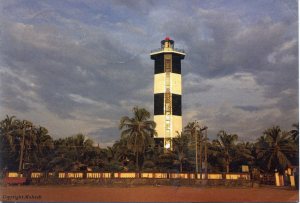
ver a decade ago, I shot this glistening sun-bathed view of a lighthouse. It happened during one of those long motorcycle rides, and in an obscure part of the globe. A few years ago, someone contacted me to request permission to create a postcard from that exact photo, and I agreed. Recently, just out of curiosity, I Googled for postcards based on that lighthouse and ran into an interesting WordPress link – Remembering Letters and Postcards. The card had visible paper wrinkles, a postal stamp watermark, and © Mahesh printed at the bottom!
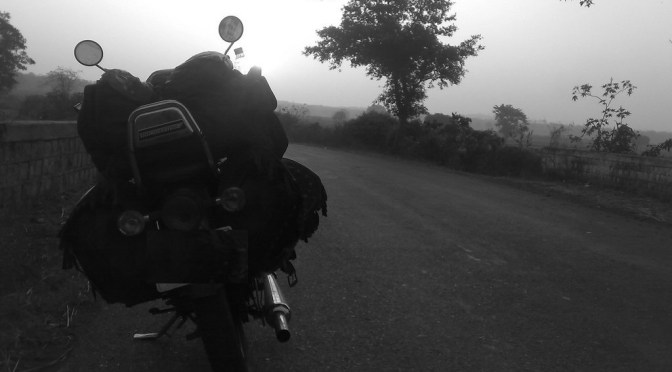
Just another one of those motorcycle rides, and another one of those photos. But it caught the attention of a Lighthouse Thematic Philatelist who turned it into a postcard. Someone actually bought that card and mailed it to a distant part of the world. Whoever received the card scanned and uploaded it, and now I Googled to find my own photo! But now my memories of taking it are also perceived in a totally different context. Basically, that simple act now feels quite gilded and romantic. One of my favorite bands wrote this lyric — “with every single step we are progressively shaping our own trajectory, and at the same time influencing lives of others.” In this case, my act of framing a lighthouse, in its tropical sunset splendor, ended up traveling the world!
The lady who got the postcard, or the person who sent it to her, will never know the backstory of that motorcyclist who captured it. They simply derived some value from the unknown motivations of a photographer. Just like how I derived value from those who engineered the Royal Enfield motorcycle and the Nokia camera. And how I derive value from the actions of the unknown actors sending postcards to each other. Several independent actions accidentally formed a virtuous loop surrounding an innocuous photo — something common yet rarely appreciated. To generalize all this, our ability to add distributed value without explicit top-down coordination creates unique value chains. It’s probably the most romantic side of a market-based civilization.
The photograph incident just illustrates a general fact – as much as we add value to unknowns, we also get most of our help from them. This includes our groceries, the coffee we brew, the roads we travel, the clothes we wear – almost everything in our lives we owe to unknown actors. Leonard Reed’s famous essay I-Pencil explained how impossible it is to create a simple pencil without the help of the unknowns. In short, we are always acting as part of collectives that are rarely visible, often transient, and constantly forming as a response to the unknown needs of the many. Quite like a complex organism — adapting to emerging selection pressures.
Republished at ridersmodel.com


But if we are to live together, and not die together, we must learn a kind of charity and a kind of tolerance, which is absolutely vital to the continuation of human life on this planet.”
― Bertrand Russell
“My brother asked the birds to forgive him: that sounds senseless, but it is right; for all is like an ocean, all is flowing and blending; a touch in one place sets up movement at the other end of the earth. It may be senseless to beg forgiveness of the birds, but birds would be happier at your side –a little happier, anyway– and children and all animals, if you yourself were nobler than you are now. It’s all like an ocean, I tell you. Then you would pray to the birds too, consumed by an all-embracing love in a sort of transport, and pray that they too will forgive you your sin.”
― Fyodor Dostoyevsky, The Brothers Karamazov
LikeLiked by 1 person