Lifesigns Live In The Netherlands: Instantly Classic Prog

The British group, Lifesigns, released a 2-disc live album recorded in the Netherlands back in 2023. Brad and Tad have a conversation about why this is a fantastic live album and why Lifesigns is a fantastic group.

Tad: Brad, I’m so glad you suggested we review this album. It’s been out a couple of years, but it didn’t get the attention it deserves. I became a fan of Lifesigns when they released Altitude in 2021, which was one of my favorite albums of that year. Live In The Netherlands features live renditions of almost that entire album, which is definitely a plus!

On listening to it, I am impressed with how well they replicate the studio versions of the songs, while adding a lot of energy. 

Brad: Thanks so much, Tad.  From what I can tell, Lifesigns is pretty huge in Europe but just does get enough attention here in the U.S.  Our loss!  Back when we were at Progarchy, John Young got ahold of me and let me know about Lifesigns.  I knew about Young, of course–he’s a huge name in the prog and rock worlds–and I was honored, to be sure, to communicate with him.  He’s not only a gentleman, but I believe he is truly a good, good soul.  And, obviously, what a talent.  So, I’ve been proudly following Lifesigns from the beginning, being introduced to them with their first amazing album, the self titled Lifesigns.  

My first and lasting impression of that album is that it’s one of prog joy, much more closely related to, say, a Transatlantic album, than, say, Storm Corrosion.  There’s a real beauty as well as real innocence to the music that I deeply admire.  

When I say it’s related to Transatlantic, I don’t mean in sound, but in atmosphere.  While I wouldn’t call Lifesigns a Christian band, I would say they’re most certainly not adverse to Christianity and all it entails.  And, the fact that the openly Christian Dave Bainbridge is now a part of the band certainly doesn’t hurt this reputation.  It’s definitely not an in-your-face Christianity like some of Neal Morse’s work tends to be, but rather music and lyrics inspired by Christianity.  Again, the best way I can explain it is that Lifesigns radiates joy.

There’s also something humorous about what I just said.  When I became Facebook friends with John Young, back in 2013, I also became friends with the first bassist of the band, Nick Beggs.  Beggs, of course, is well known in the prog world, especially given his work with Steven Wilson.  Almost immediately after I became friends with Beggs, he posted a number of pictures of himself in the buff.  I will admit, I was utterly shocked and, in no uncertain terms, made my horror quite plain on social media!  Ha.  There’s a puritan streak in me, to be sure.  Young, however, gently reprimanded Beggs and suggested this might not be the best way to introduce the band to the public.  It all turned out well.

Tad: Brad, that is hilarious! Beggs is definitely a prankster, but he is an amazingly talented bassist.

Let’s talk about Lifesign’s Live In The Netherlands. It features an excellent playlist, with the first half of the show devoted to old favorites like “N” and “At the End of the World”. It’s the second half that really gets me excited, where they perform the entire Altitude album. They are an incredibly tight unit, and Dave Bainbridge really shines on guitar.

Like you, Altitude was a favorite of mine the year it came out, and I immediately picked up all of their other albums. I still think Altitude is their best, but they haven’t released a weak album to date. I love the title track, which runs a generous 15:49, but never lags. John Young does a fantastic job on keyboards and vocals. “Last One Home” is one of my all-time favorite songs, regardless of genre. I think it is just beautiful in its perfect melding of song and lyrics. The version on Live In The Netherlands is outstanding, with Bainbridge turning in a wonderful guitar solo reminiscent of Gilmour at his best. 

It’s interesting you find Lifesigns reminding you of Transatlantic, and I can certainly hear that in terms of atmosphere, as you say. When I listen to Lifesigns, I am reminded of the classic prog band, UK – especially their eponymous debut album that featured Alan Holdsworth on guitar. I think it’s because Young’s vocals remind me of the late, great John Wetton’s. Also, Young’s melodies have a way of turning a phrase that brings to mind late ‘70s prog. 

Anyway, I think for someone who enjoys melodic and uplifting prog, Lifesigns is hard to beat, and Live In The Netherlands is the perfect introduction to their music. It covers the best songs from their first two albums as well as including an excellent performance of their complete third album. Lifesigns doesn’t have much music on the streaming services, so I encourage people to support them by buying hard copies of their albums. 

Brad: Tad, what a great analysis.  I’d not thought of Lifesigns resembling late 1970s proggers like UK.  Now that you’ve said that, I can’t unsee it.  I think you’re absolutely right.  Maybe John Young has a particular 1970s sound that I’ve never quite realized. 

Again, for me, it’s best summed up as “joy” rather than overly precious or overly intricate or overly self-involved.  For whatever reason, John Young and his music inspires me to be a better person, to approach my own art with a love of life and a gratitude for all that made my own life possible.  Hence, I think of it as being Christian adjacent rather than out and out Christian.  Again, we know Bainbridge’s Christianity, but if someone told me that Young was also serious about his faith, I wouldn’t be surprised.

And agreed, Lifesign’s three (only three!) studio albums are all excellent, and I very much love the two live releases.  I suppose, if pushed, I would say that Lifesigns (the debut album from 2013) is my favorite, only because it was my introduction to them.  In terms of quality of music and lyrics and vocals, I would rank all three equally.  Again, this music just makes me want to be a better person. 

We haven’t explicitly mentioned Cardington, and I would like to praise that album as well for being every bit the equal of Lifesigns and Altitude.

If I had one complaint, it would be that I want more Lifesigns music!  Call me greedy, but I would love more than three albums over a decade.  Still, I’m sure that John has a ton of things going on, so I’m deeply appreciative of what we do have.

Though I’d not thought of this as having a late 1970s sound until you mentioned it, I would love for more prog to have this feel and atmosphere to it.  There are a hundred Radiohead and Porcupine Tree inspired bands, where are the John Young inspired bands?  I would love more of this kind of music: classy and classic, beautifully constructed, and majestically orchestrated.  The lyrics are perfect and compelling as is the music itself.

For me, Tad, Live in the Netherlands perfectly captures all of this.  Indeed, in terms of sound quality, I’m especially impressed, as the live album sounds just like the studio release, despite being in an uncontrolled environment.  I love the first set of older material and the second set of newer material.  My only complaint is that all of the banter has been removed from the live release.  I’m sure that John spoke to the audience, and I would love to know what he had to say.  Specifically, given what a gentleman he is, I’m sure that he’s an excellent frontman.

John, Jon, Steve, Frank, and Dave: if you’re reading this, please know that you are loved, and my desire to have more music from you is meant in the best possible way.  Thank you, hugely, for everything you’ve given us already.  Now, we just need to get all Americans to listen to you. . . .

Tad: From your keyboard to John Young’s ears, Brad! Yes, I wish they released more music, because the contemporary music scene needs more like it. And, dear readers, you can find all of Lifesigns’ music and merchandise at https://lifesignsmusic.co.uk/. Check them out!

The Hank Show: The End of Privacy

I was born in 1961, so a little more than half of my life was pre-internet (for me, the internet really began in 1995, when a new piece of software called Netscape was introduced). I remember how amazing email was before spammers got going, how fun the early “world-wide web” was, and how interesting and informative various bloggers were before Facebook, Twitter, and Google showed up and took over. There weren’t adblockers in the late 90s, because there weren’t many ads. I remember how furious we websurfers got when it was revealed that websites had these things called “cookies” that were sent to your browser, so they could track your history. What an invasion of privacy!

Those concerns seem quaint now. My daughter was born in 1994, and she has really not known any time when she couldn’t go online. She also knows that she has no privacy, and she goes on the internet with the expectation that everything she emails, posts on social media, and buys is seen and logged by someone or something. McKenzie Funk’s book, The Hank Show, is a biography of the man he holds responsible for first exploiting the financial potential of Big Data.

To continue reading, click here.

In Concert: Alison Krauss Warms Our Cold, Cold Hearts

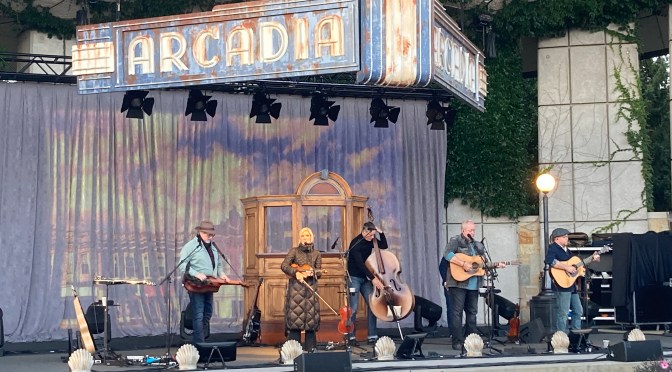
Alison Krauss & Union Station featuring Jerry Douglas, Meijer Gardens Amphitheatre, Grand Rapids, Michigan, September 5, 2025.

Over three decades, Alison Krauss has parleyed her singing and fiddling skills into an international career that (with the help of a Coen Brothers movie or two) brought bluegrass back to the masses and boosted her into an orbit of musical celebrity shared by few. But in the wake of her second collaboration with rock god Robert Plant, Krauss went back to her beginnings, reconvening her long-time band Union Station after a ten-year hiatus, with a new album and a six-month tour on the agenda. And that’s how, on the first genuinely chilly evening of Meijer Gardens’ concert season, Krauss and company wound up onstage in winter gear, getting down to business with relish, drawing a sold-out audience huddled beneath layers of Gore-Tex and fuzzy blankets toward their blossoming circle of musical warmth and light.

Not that Krauss & Union Station’s music is all sunshine, lollipops and rainbows. The tunes featured from their new album Arcadia were about (in this order): loneliness; a factory fire disaster; loneliness again; a mysterious stranger terrorizing a small town; and getting shut down on the make. In fact, some of the most compelling vocal moments were the darkest – Krauss’ spooky solo turn on “Ghost In This House”, Russell Moore’s bone-chilling folk narrative “The Hangman”. And there was melancholy galore in the mainstays of the band’s back-catalog: “Every Time You Say Goodbye”, “Let Me Touch You For A While” (“our one sexy song”, according to Krauss), revamped 1970s soul classic “Now That I’ve Found You”, and a spare, devastating cover of Willie Nelson’s “Angel Flying Too Close To The Ground.”

But while sad songs say so much, they weren’t the only emotion on offer; for every heartbreaker, there was an anthem to survival and resilience like the new “One Ray of Shine” and the classic “Forget About It.” In these tunes especially, Krauss showed her consummate range and interpretive skill, pattering out the verses to draw us into the story, then launching into the high lonesome choruses (often cradled by Union Station’s understated vocal harmony) to finish the job. While that sweet, supple voice is Krauss’ foremost calling card, she’s also consistently savvy with her vocal gift, knowing how to blend in tart, savory, even spicy flavors as the music requires.

So there were humor and high spirits aplenty to set off all the sadness too. Whether commiserating with us about the weather (“You all look like Paw and Laura under the blankets in the back of the wagon”), or slyly teasing her bandmates (guitarist/banjo player/songwriter Ron Block was introduced as “our sexy librarian — and a recovering vegetarian”), Krauss combined downhome deadpan with a mischievous gleam in her eye whenever she addressed the audience. And when Union Station launched into hoedowns “Choctaw Hayride”, “Sawing On the Strings” and Bill Monroe’s “Cluck Old Hen”, she leaned right in, hunkering down on rhythm fiddle as Block, violin/mandolin wizard Stuart Duncan and dobro legend Jerry Douglas tore it up over Barry Bales’ resonating bass.

Douglas proved equally riveting in his extended solo spot, a weird and wonderful medley of Paul Simon’s brooding “American Tune” and Chick Corea’s festive “Spain”. Extra kudos go to Russell Moore as well: slotting into the male lead vocal spot formerly held by long-time stalwart Dan Tyminski, he brought home the bacon on both the back catalog and the upbeat “(Crazy ‘Bout A) North Side Gal” (which, in Krauss’ words, “covered three important topics – geographical location; mental wellness; and gender.”)

Ultimately, a concert by Alison Krauss & Union Station comes down to first-rate musicians playing and singing deceptively simple yet deeply affecting music, at the highest level of technical brilliance and visceral commitment, to stunning effect. But if anything, the extended encore, where the sextet gathered around a single microphone to harmonize with minimal instrumentation, sounded even richer depths. As the gentle love song “When You Say Nothing At All”, the weeper “Whiskey Lullaby”, the traditional spiritual “Down to the River to Pray” and Block’s moving confession of faith “There Is A Reason” wafted into the chill of the night, it settled over the rapt crowd like a bluegrass benediction to provide a thoroughly satisying finish. Put simply: hear and see them live if you can.

— Rick Krueger

Setlist:

  • Looks Like the End of the Road
  • Granite Mills
  • Choctaw Hayride
  • Sawing on the Strings
  • Rain Please Go Away
  • Every Time You Say Goodbye
  • Cluck Old Hen
  • The Lucky One
  • Ghost in This House
  • I Don’t Believe You’ve Met My Baby
  • Baby, Now That I’ve Found You
  • Wish I Still Had You
  • Angel Flying Too Close to the Ground
  • Let Me Touch You for Awhile
  • American Tune (Jerry Douglas solo)
  • Spain (Jerry Douglas solo)
  • Dust Bowl Children
  • The Boy Who Wouldn’t Hoe Corn
  • Lie Awake
  • The Hangman
  • Orange Blossom Special
  • One Ray of Shine
  • Restless
  • North Side Gal
  • Forget About It
  • Paper Airplane
  • Gravity
  • When You Say Nothing at All
  • Whiskey Lullaby
  • Down to the River to Pray
  • A Living Prayer
  • When He Reached Down His Hand for Me
  • There is a Reason

Raymond Chandler’s The Little Sister

I’ve become a big fan of Raymond Chandler’s hard-boiled novels featuring his private eye, Philip Marlowe. I previously reviewed his fourth book, The Lady In The Lake, and The Little Sister, published in 1949, continues Chandler’s bleak and disillusioned perspective on the seamy side of Los Angeles and its surrounding towns. 

It opens with Marlowe alone in his office, when a woman calls him on the phone, asking him to find her missing brother. He insists on seeing her in person, which she resists, but eventually gives in. She is Orfamay Quest, and, as Marlowe describes her, 

She was a small, neat, rather prissy-looking girl with primly smooth brown hair and rimless glasses.
RAYMOND CHANDLER. The Little Sister (Kindle Locations 229-230). Delphi Classics. Kindle Edition.

She has come all the way out to California from Manhattan, Kansas, because her brother, Orrin – who, she assures Marlowe, would never get into any kind of trouble – stopped sending weekly letters to her and their mother. Marlowe is naturally suspicious of Orfamay’s story, but he agrees to take on her case for twenty dollars. 

What follows is a very complicated situation involving mobsters from Cleveland, corrupt cops, Hollywood B-listers, a doctor who supplies them with drugs, and a murderer who likes to kill by stabbing his (or her) victims in the neck with an ice pick. Suffice it to say that no one is particularly innocent and Marlowe’s natural cynicism is fully justified. 

And yet, even in the most dangerous and tempting circumstances, Marlowe clings to his code of honor: refusing to take bribes, stating the truth to the police even when it puts himself in danger, and resisting the blandishments of a beautiful Hollywood actress. He knows he won’t get rewarded for his virtue, but like a medieval knight pledged to behave chivalrously, he never gives in.

As in The Lady In The Lake, one of my favorite ingredients of Chandler’s style is his deadpan humor. Here are a few examples:

I got my wallet out and handed him one of my business cards. He read it thoughtfully and tapped the edge against his porcelain crown.
“He coulda went somewhere without telling me,” he mused.
“Your grammar,” I said, “is almost as loose as your toupee.”
“You lay off my toupee, if you know what’s good for you,” he shouted.
“I wasn’t going to eat it,” I said. “I’m not that hungry.”
He took a step towards me, and dropped his right shoulder. A scowl of fury dropped his lip almost as far.
“Don’t hit me. I’m insured,” I told him.
“Oh hell. Just another screwball.” He shrugged and put his lip back up on his face.
RAYMOND CHANDLER. The Little Sister (Kindle Locations 571-577). Delphi Classics. Kindle Edition.

A fat man in sky-blue pants was closing the door with that beautiful leisure only fat men ever achieve. He wasn’t alone, but I looked at him first. He was a large man and wide. Not young nor handsome, but he looked durable. Above the sky-blue gabardine slacks he wore a two-tone leisure jacket which would have been revolting on a zebra. The neck of his canary-yellow shirt was open wide, which it had to be if his neck was going to get out. He was hatless and his large head was decorated with a reasonable amount of pale salmon-colored hair. His nose had been broken but well set and it hadn’t been a collector’s item in the first place.
RAYMOND CHANDLER. The Little Sister (Kindle Locations 1364-1368). Delphi Classics. Kindle Edition.

The boss mortician fluttered around making elegant little gestures and body movements as graceful as a Chopin ending. His composed gray face was long enough to wrap twice around his neck.
RAYMOND CHANDLER. The Little Sister (Kindle Locations 2162-2163). Delphi Classics. Kindle Edition.

And, of course, there are plenty of wonderfully descriptive similes to set the mood:

Her voice was as cool as boarding-house soup.
RAYMOND CHANDLER. The Little Sister (Kindle Location 683). Delphi Classics. Kindle Edition.

She had a low lingering voice with a sort of moist caress in it like a damp bath towel.
RAYMOND CHANDLER. The Little Sister (Kindle Locations 795-796). Delphi Classics. Kindle Edition.

I smelled Los Angeles before I got to it. It smelled stale and old like a living room that had been closed too long.
RAYMOND CHANDLER. The Little Sister (Kindle Locations 1338-1339). Delphi Classics. Kindle Edition.

I took the wrinkles out of my lips and said aloud:
“Hello again. Anybody here needing a detective?”
Nothing answered me, not even a stand-in for an echo. The sound of my voice fell on silence like a tired head on a swansdown pillow.
RAYMOND CHANDLER. The Little Sister (Kindle Locations 2985-2987). Delphi Classics. Kindle Edition.

Either you love this stuff, or you don’t. I think it’s great – despite Marlowe’s world-weariness, he loves LA and the losers who populate its seediest neighborhoods. He knows one man can’t make much difference in the world, but he never gives up trying.

Chandler wrote The Little Sister after he had had some very frustrating experiences as a screenwriter in Hollywood, and his contempt for Tinseltown is as clear as a bell. (Or maybe like “two dead fish in the silt at the bottom of a drained pool”, to borrow a simile!) The plot is difficult to unravel at times, and just when I thought I had things figured out, he throws a curveball to surprise. That said, the ending is very good, and I would rank The Little Sister as one of Chandler’s best.