
Think about it. Almost all unpleasant things happen on Sundays. We wait all week for that special day, to relax, to live those twenty-four hours blissfully and without commitments. But when it comes, it’s never what we hoped for, we feel so lost doing nothing that we go looking for worries and troubles.
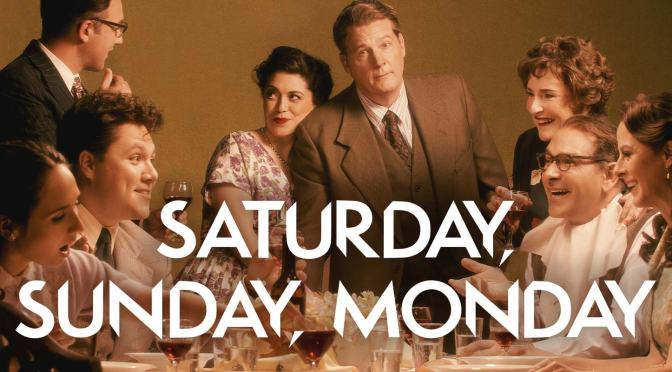
The beginning of Eduardo de Philippo’s Saturday, Sunday, Monday seems to set up an extended Italian family as little more than bickering figures of fun. Matriarch Rosa Priore (Rose Napoli) is already cooking Sunday dinner on the day before, sparing no one in her attention to her famous ragu; her husband, clothing shop owner Peppino (Graham Abbey) looks on frustrated and bemused as his retired father-in-law Antonio (Rod Beattie) eggs on son Rocco (Emilio Vieira) to open his own hat shop and his independent sister Meme (Seana McKenna) encourages daughter Giulianella (Katarina Fiallos) to carve out a life for herself, against the wishes of her fiance Federico (Maher Sinno). Then there are Peppino’s melodramatic brother Raffaele (Geraint Wyn Davies), intent on his weekend foray into commedia dell’arte; Meme’s sickly son and Raffaele’s biggest fan Attilio (Josue Laboucane); and neighbors the Ianniellos – Luigi (Gordon S. Miller) praising Rosa to the skies and showering her with gifts, his wife Elena (Michelle Giroux) patiently bearing with Luigi’s copious enthusiasm. With all these personalities passing through Rosa’s kitchen, colliding as they make contact, sparks fly non-stop throughout Act One – to the point that, when my wife and I compared notes at the first intermission, we thought that, entertaining though the tangled web of tussling might be, more passive-aggressive behavior might be in order!
But like Shakespeare in his “problem plays” – comedies like Measure for Measure and All’s Well that Ends Well that have happy endings, but whose characters and plots may be as disturbing as they are funny – de Filippo is after something deeper than cheap laughs. It’s not just that Peppino feels his authority over his grown children ebbing; distance and estrangement from Rosa combined with jealous imaginings about her and Luigi have taken hold. When his farcical futility early in Act Two gives way to an accusatory outburst at the dinner table, it’s a genuine shock that stops the assembled family in their tracks and utterly derails audience expectations. The crisis that follows casts a shadow over every character – but also reveals the depths of loyalty and sympathy that have bound them all together, whatever their conflicts. Still, on Act Three’s Monday morning, no matter how much warm-hearted support others might give, it’s up to a thoroughly devastated Rosa and a heartbreakingly repentant Peppino to dig deep for the roots of their mutual misunderstanding. Beyond making amends, they face the ordeal of recovering what brought and kept them together, no matter the pain such an uphill climb entails.
Under Antoni Cimolino’s committed, passionate direction, the cast is more than up to the task of bringing diFilippo’s bustling yet intimate morality play to life. Coming off the similar male lead Leontes in last year’s Stratford production of The Winter’s Tale, Abbey thoroughly inhabits and embodies Peppino’s inner turbulence; while Napoli may be a Stratford rookie, her solid background in Canadian theater and television has given her the technical chops and emotional muscle to easily go toe to toe with him and the rest of the cast. The cross-generational character pairings of Beattie & Vieira, McKenna & Fiallos and Davies & Laboucane, as well as the couples Fiallo & Sinno, Miller & Giroux and Jakob Ehman & Celia Aloma (as oldest son Roberto and his wife Maria Carolina) all do stellar supporting work; beyond the lively dialogue (from a translation developed with the cast in the process of rehearsal), you can see richly grounded relationships playing out in facial expressions, body language, pauses to listen. Even the comic characters that pass through the Priore house on various errands – Jenna-Lee Hyde’s longsuffering maid Virginia, Liam Tobin as her tortured brother Michele, David Collins’ exasperated tailor Catiello, Michael Wamara’s doctor Cefercola – bring an open-heartedness to their roles; they know and value this family, and whatever their personal preoccupations or the surprises they encounter in the course of the weekend, they desire the best for them.
A decade beyond his authorship of Saturday, Sunday, Monday, Eduardo di Filippo offered this interpretive key:
At the end of the comedy there is no one who does not understand that only love can hold two beings together.
Kudos are unquestionably due to Antoni Cimilino for driving home diFilippo’s unique blend of effervescent humor, penetrating psychological insight and hope for the human condition in this, his final production as Artistic Director of the Stratford Festival, as well as to a superb cast of Festival veterans and newcomers for their collaboration in bringing diFilippo’s vision to life onstage.
— Rick Krueger
Saturday, Sunday, Monday premieres at the Stratford Festival on August 22 and runs through October 24. For information, schedule and ticket links, click here.

