At the Stratford Festival: A Midsummer Night’s Dream

A Midsummer Night’s Dream is a surefire box office winner. It’s long been considered one of Shakespeare’s most approachable plays, due to its appealing characters, humorous plot complications, and language that rings the changes from rustic simplicity through witty aristocratic banter to lyrical flights of supernatural fancy. As such, it’s typically considered actor-proof; say your lines, hit your marks and you’ve done your job.

Director-proof, however, can be another story; from Max Reinhardt’s 1930s outdoor spectacular at the Hollywood Bowl through Peter Hall’s 1960s “white box” chamber version with the Royal Shakespeare Company, to recent decades’ fad for gender-bending within the core romances, Shakespeare is frequently swallowed up in directors’ need to Get Our Attention And Make A Statement. The first time my wife and I saw the play at Stratford in 2004, Leon Rubin’s production conceits (“The enchanted wood’s like a — a rain forest! So we’ll set the whole thing in South America! Oh, and the fairies are acrobats too!”) proved an active turn-off; the characters and humor were all but smothered by the bells and whistles of distracting costumes, scenery and spectacle.

In his program note, director Graham Abbey threatens full-on Regietheater, making opaque noises about reveling in disorder and the necessity of rebellion. But fortunately, Abbey’s basic trust in Shakespeare. along with his solid dramatic instincts, carry the day. This is by and large A Midsummer Night’s Dream as veteran admirers know it and those encountering it for the first time should.

Abbey’s biggest tweak is setting the action in late Victorian England, and that works – because arguably, Shakespeare’s original human characters are pretty doggone universal across cultures, no matter their Athenian names. So Evan Buliung’s Theseus is appropriately pompous yet engaging, whether wooing Ijeoma Emesowum’s reluctant but not adamant Hippolyta or throwing up his hands at the young lovers’ relationship hassles. Vivien Endicott-Douglas is a wonderfully straight-up Hermia, gushingly in love; Jessica B. Hill grabs the majority of the laughs as a dryly funny yet vulnerable Helena; Jordin Hall and Thomas Duplessie start out bland and interchangeable as Lysander and Demetrius, but put clever props (a ukelele and a deerstalker hat, respectively) to good use opening up their characters. The rustic mechanicals – morphed to traveling circus players in this version – are, as usual, winningly earnest and hopelessly out of their depth from top (Sarah Dodd’s flustered dramaturge Rita Quince) to Bottom (Nick Spencer-Davis in an appropriately bravura comic turn).

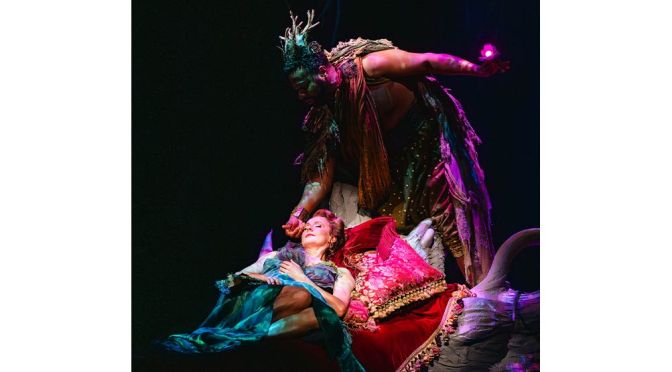
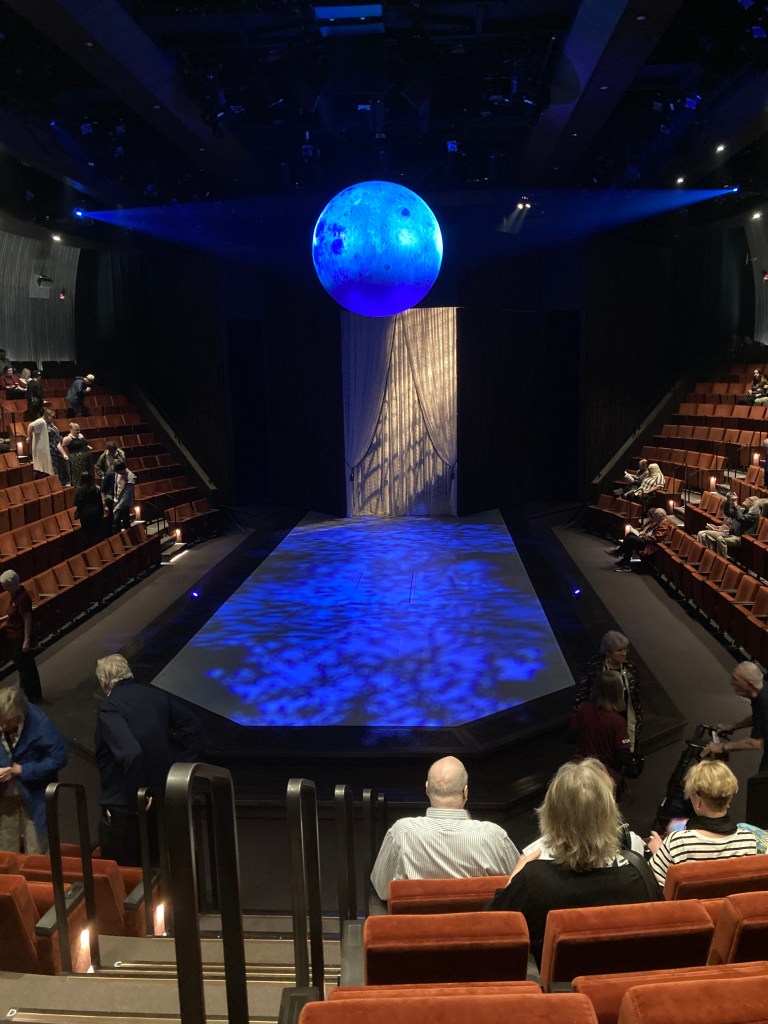
And of course, when all and sundry wander into the enchanted wood of Shakespeare’s fairies Oberon (Andre Sills, seasoning his usual power and magnetism with sly humor), Titania (a spellbinding Sara Topham, whose every line and gesture compel attention) and Puck (Mike Nadajewski, energetically committed to maximum disruption) — mayhem breaks loose, with the audience quite literally in the midst of it. As fairies troop down the theatre aisles to the thrust stage of the Tom Patterson Theatre (pulsating with subtly immersive digital projections and surround-sound effects) and Nadajewski persistently breaks the fourth wall, playing to the crowd with sneaky pranks and Phil Collins-style party tricks, we wind up every bit as loopy as the lovers, as bemused as Bottom and company. And Abbey’s second-biggest tweak – unwinding Oberon’s curse on Titania through mutual forgiveness instead of further deception – puts us in the same boat as everyone else exiting the wood; not quite certain of our footing, but ready for a breather via The Most Lamentable Comedy and Most Cruel Death of Pyramus and Thisbe (enacted by the mechanicals with eager flair, organic pratfalls and a hilarious pastiche soundtrack of classical/Romantic chestnuts, courtesy of Michael Man’s Robin Starveling).

To sum up: most (though not all) directors’ theater versions of A Midsummer Night’s Dream stutter and stumble trying to make their point. Though Abbey’s take on the play is portentous on the surface, the loose, fantastical staging and slapstick comedy of this production issue directly from Shakespeare’s characters and situations, given fire and vibrancy by a first-rate cast where the young players step up to the level of their veteran Festival colleagues. The few tiny hiccups here are vastly outweighed by a real devotion to the absurdity and the grace baked in by the poet himself. From Row G of the theatre, this was an utterly enjoyable vision of the Dream, one that brings to life Theseus’ Act 5 summation of the night:

The lunatic, the lover, and the poet
Are of imagination all compact.
One sees more devils than vast hell can hold:
That is the madman. The lover, all as frantic,
Sees Helen’s beauty in a brow of Egypt.
The poet’s eye, in a fine frenzy rolling,
Doth glance from heaven to Earth, from Earth to
heaven,
And as imagination bodies forth
The forms of things unknown, the poet’s pen
Turns them to shapes and gives to airy nothing
A local habitation and a name.

— Rick Krueger

A Midsummer Night’s Dream plays at the Stratford Festival’s Tom Patterson Theatre through September 26th. For information, schedule and ticket sales click here.

At the Stratford Festival: Saturday, Sunday, Monday

Think about it. Almost all unpleasant things happen on Sundays. We wait all week for that special day, to relax, to live those twenty-four hours blissfully and without commitments. But when it comes, it’s never what we hoped for, we feel so lost doing nothing that we go looking for worries and troubles.

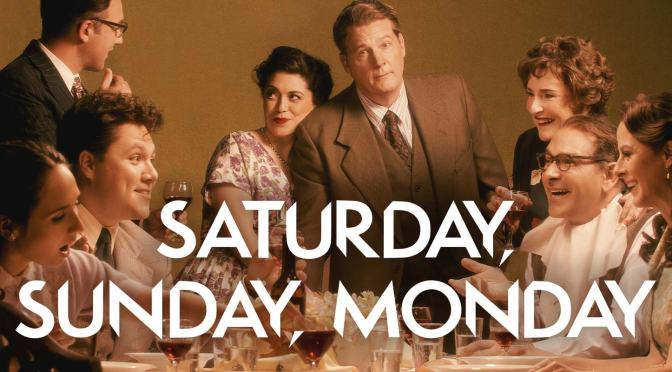
The beginning of Eduardo de Philippo’s Saturday, Sunday, Monday seems to set up an extended Italian family as little more than bickering figures of fun. Matriarch Rosa Priore (Rose Napoli) is already cooking Sunday dinner on the day before, sparing no one in her attention to her famous ragu; her husband, clothing shop owner Peppino (Graham Abbey) looks on frustrated and bemused as his retired father-in-law Antonio (Rod Beattie) eggs on son Rocco (Emilio Vieira) to open his own hat shop and his independent sister Meme (Seana McKenna) encourages daughter Giulianella (Katarina Fiallos) to carve out a life for herself, against the wishes of her fiance Federico (Maher Sinno). Then there are Peppino’s melodramatic brother Raffaele (Geraint Wyn Davies), intent on his weekend foray into commedia dell’arte; Meme’s sickly son and Raffaele’s biggest fan Attilio (Josue Laboucane); and neighbors the Ianniellos – Luigi (Gordon S. Miller) praising Rosa to the skies and showering her with gifts, his wife Elena (Michelle Giroux) patiently bearing with Luigi’s copious enthusiasm. With all these personalities passing through Rosa’s kitchen, colliding as they make contact, sparks fly non-stop throughout Act One – to the point that, when my wife and I compared notes at the first intermission, we thought that, entertaining though the tangled web of tussling might be, more passive-aggressive behavior might be in order!

But like Shakespeare in his “problem plays” – comedies like Measure for Measure and All’s Well that Ends Well that have happy endings, but whose characters and plots may be as disturbing as they are funny – de Filippo is after something deeper than cheap laughs. It’s not just that Peppino feels his authority over his grown children ebbing; distance and estrangement from Rosa combined with jealous imaginings about her and Luigi have taken hold. When his farcical futility early in Act Two gives way to an accusatory outburst at the dinner table, it’s a genuine shock that stops the assembled family in their tracks and utterly derails audience expectations. The crisis that follows casts a shadow over every character – but also reveals the depths of loyalty and sympathy that have bound them all together, whatever their conflicts. Still, on Act Three’s Monday morning, no matter how much warm-hearted support others might give, it’s up to a thoroughly devastated Rosa and a heartbreakingly repentant Peppino to dig deep for the roots of their mutual misunderstanding. Beyond making amends, they face the ordeal of recovering what brought and kept them together, no matter the pain such an uphill climb entails.

Under Antoni Cimolino’s committed, passionate direction, the cast is more than up to the task of bringing diFilippo’s bustling yet intimate morality play to life. Coming off the similar male lead Leontes in last year’s Stratford production of The Winter’s Tale, Abbey thoroughly inhabits and embodies Peppino’s inner turbulence; while Napoli may be a Stratford rookie, her solid background in Canadian theater and television has given her the technical chops and emotional muscle to easily go toe to toe with him and the rest of the cast. The cross-generational character pairings of Beattie & Vieira, McKenna & Fiallos and Davies & Laboucane, as well as the couples Fiallo & Sinno, Miller & Giroux and Jakob Ehman & Celia Aloma (as oldest son Roberto and his wife Maria Carolina) all do stellar supporting work; beyond the lively dialogue (from a translation developed with the cast in the process of rehearsal), you can see richly grounded relationships playing out in facial expressions, body language, pauses to listen. Even the comic characters that pass through the Priore house on various errands – Jenna-Lee Hyde’s longsuffering maid Virginia, Liam Tobin as her tortured brother Michele, David Collins’ exasperated tailor Catiello, Michael Wamara’s doctor Cefercola – bring an open-heartedness to their roles; they know and value this family, and whatever their personal preoccupations or the surprises they encounter in the course of the weekend, they desire the best for them.

A decade beyond his authorship of Saturday, Sunday, Monday, Eduardo di Filippo offered this interpretive key:

At the end of the comedy there is no one who does not understand that only love can hold two beings together.

Kudos are unquestionably due to Antoni Cimilino for driving home diFilippo’s unique blend of effervescent humor, penetrating psychological insight and hope for the human condition in this, his final production as Artistic Director of the Stratford Festival, as well as to a superb cast of Festival veterans and newcomers for their collaboration in bringing diFilippo’s vision to life onstage.

— Rick Krueger

Saturday, Sunday, Monday premieres at the Stratford Festival on August 22 and runs through October 24. For information, schedule and ticket links, click here.

At the Stratford Festival: Guys and Dolls

[For maximum effect, read the next paragraph aloud with a New York accent:]

So this gentleman Damon Runyon, a progeny of Kansas grown to manhood in Colorado, comes to the big city of Manhattan to pursue his vocation as a journalist in the early 1900s. His greatest success, though, turns out to be his fictional “fables of Broadway”, where a motley cast of “guys” pursue their vocations: penny ante gambling; recounting their tall tales in verbose orotund sentences couched in the historical present and spiced with a smattering of Yiddish; staying one step ahead of the law, the “big boys” of their chosen profession, and the “dolls” that seem to lurk around every corner to knock them off their desired courses. These fables prove to be so popular that, in 1950, they become a Broadway musical . . .

And what a musical it is! Though Rodgers and Hammerstein’s Oklahoma pioneered the full integration of tunes with story on Broadway, Guys and Dolls elevated the genre to the sparkling heights of Strauss’ Die Fledermaus or Mozart’s The Magic Flute, while hitting the bullseye of pop culture at the Great American Songbook’s height. Production roadblocks meant that Frank Loesser’s jazzy songs came first, laying out the characters and plot twists of Runyon’s “The Idyll of Miss Sarah Brown” all by themselves; his lyrics teem with wit and warmth, his music stuffs soaring melodic earworms into compellingly clever forms. All book writer Abe Burrows had to do was sharpen the setting and exposition (and set up as many opportunities for ensemble dance numbers as possible) and voila! – an affectionate, rough-edged romp that sets petty crooks, burlesque dancers and revivalist missionaries at odds, then lets romance complicate the whole meshuggah situation.

Over the decades, this kind of big musical has become catnip for the Stratford Festival, sitting comfortably alongside Shakespeare, Oscar Wilde, Beckett, Arthur Miller and world premieres in the current season’s repertory. And mounted on the Festival Theatre’s unique thrust stage for the fourth time, Guys and Dolls plays every bit as spectacularly as when my wife and I saw it on our first trip here back in 2004. Veteran Donna Feore’s direction is ceaselessly vivid and lively, flowing into organic, breathtaking choreography from the “Runyonland” overture and the opening vocal canon “Fugue for Tinhorns” onward, backed by a live 20-piece orchestra. Onstage Manhattan street life feels as bustling and busy as when you’re there in person; the characters populating Nathan Detroit’s “oldest established floating crap game in New York”, Sister Sarah Brown’s Save-A-Soul Mission and Miss Adelaide’s Hot Box all bubble over with anticipation and zest for whatever may come their way. Even wandering roustabout Sky Masterson brings his own atmosphere with him: smitten by Sarah, crashing her mission and (based on a bet with Nathan) sweeping her away to Havana, where neither can find the words to express their feelings without breaking into song . . .

Whatever the overall impression, it’s the principal actors who make or break a show like this, and every one of them delivers here. Best known for screwball comedy, Dan Chameroy delivers a bluff, charismatic male lead in Sky, whether letting down his guard on “My Time of Day” or stepping up for the gamble of his life on “Luck Be A Lady”. Olivia Sinclair-Brisbane proves a top-notch ingenue, a bit strident in her high vocal range, but wonderfully steely on “I’ll Know” and comedically tipsy on “If I Were A Bell” (one of Miles Davis’ standby tunes). When sparks fly between the two on “I’ve Never Been in Love Before”, the effect is genuine and magical. Then there’s Mark Uhre’s Nathan and Jessica Rider Shaw’s Adelaide as a delightfully neurotic second couple, longtime lovers each afraid in their own way of commitment (“Adelaide’s Lament” and the duet “Sue Me” are both smartly, squirmingly hilarious). Meanwhile, sideline observers like Steve Patterson as mission colleague Arvide Abernathy (who nails the fatherly “More I Cannot Wish You”) and Steve Ross as Nathan’s comic colleague Nicely-Nicely Johnson (who steals the show on the title song and the uproarious “Sit Down, You’re Rocking the Boat”) look on in bemusement, knowing from experience how these crazy kids’ tangles will work themselves out.

It’s a tribute to this cast’s talent and commitment that most of them – including Uhre, Chameroy and Sinclair-Brisbane in principal roles – are also in Feore’s remount of the nutty Shakespeare send-up Something Rotten (sometimes playing both productions on the same day). But the Stratford Festival is consistently good at theatrical miracles like this. And in its warmly humanist view of life out of the mainstream, Guys and Dolls itself is kind of miraculous: underneath its postwar, American-as-apple- pie optimism, this is a schmaltzy, mischievously naughty yet emotionally true take on how the love of your life can ambush you on any corner as you wait for something to happen – whether you’re singing your song, dancing your dance, pounding your big bass drum or just hanging out.

Guys and Dolls plays at the Stratford Festival Theatre until November 1st. For information, more sneak previews, schedules and ticket sales, click here.

— Rick Krueger

In Concert: Listening In on Bruce Hornsby

Most artists wouldn’t start their live set with an obscure song from an now-obscure 20-year-old album (arguably a major label’s desperate attempt to justify their investment by breaking said artist back into the mainstream, via celebrity duets with Sting and Eric Clapton). Most artists definitely wouldn’t follow that up with another obscure song from his follow-up collaboration with a generational bluegrass talent.

But then, this is Bruce Hornsby we’re talking about. Seated at the grand piano stage left, facing his Noisemakers – J.T. Thomas on keyboards, Gibb Droll on guitar, J.V. Collier on bass, John Mailander on mandolin and fiddle, and Chad Wright on drums – grouped in a half circle, Hornsby launched into an extended, exploratory take on Halcyon Days’ “Circus on the Moon“, followed by “Gulf of Mexico Fishing Blues” from his duet album with Ricky Skaggs.

While a familiar track from Hornsby’s Top 40 years, “Look Out Any Window“, was up next, only the chords and the lyrics recalled the original recording. Instead of facing the audience, intent on making maximum impact, Hornsby and the Noisemakers seemed to invite us into a space where, though grateful for our company, their focus would be on the music. And the near-capacity crowd went there, leaning in to listen as Hornsby worried at the melody and the band took the tune’s structure new places, scaling heights of delicate interplay and spanning depths of ensemble groove.

The next stretch of songs, from the new album Indigo Park, confirmed that impression; “Ecstatic”, “Memory Palace”, and the title track continually blazed unexpected trails, individual Noisemakers stepping forward and pulling back, Hornsby choreographing with eye contact and hand gestures. And the hits were forthcoming – but only on Hornsby‘s terms. A wildly atonal piano prelude spanning the length and breadth of the keyboard gave away to a decorous, romantic waltz, eventually teasing Hornsby’s breakthrough song “The Way It Is”. At which point he turned to the audience and said, “You want the pretty version or the jammin’ version?“ The whoop of recognition and the crowd’s spontaneous rise to its feet decided the question in favor of a jam; and with Hornsby again scatting around the melody and extending the jazz piano breaks, the result bore only faint resemblance to that long-ago hit single.

By that point, Hornsby was in his comfort zone and ready to take multiple chances. The minor hit “Across the River”, his first recorded collaboration with the Grateful Dead’s Jerry Garcia, drew a warm ovation from the crowd. They also ooh’d and ah’d when the band unplugged and came forward, Hornsby picked up a dulcimer, and Wright donned a washboard vest for two more deep tracks, followed by an appealing, muted take on “Mandolin Rain”.

Appropriately, the high point of the night was the climax of the set: “Rainbow’s Cadillac“, jazzed up and stretched out; “The Show Goes On”, where a passionate piano/vocal solo morphed into a full on, full-band power ballad; and a tribute to Hornsby‘s Grand Rapids debut 40 years ago, Bruce strapping on his accordion to rock out the first track from his debut album, “On the Western Skyline “.

Throughout the night, Hornsby and his Noisemakers welcomed you into their world – but very much on their terms. If the instrumental jamming went on a bit too long, you could focus on how each person on stage was listening hard, adding their bit or laying out as required. Or you could focus on how Hornsby – whose voice now lacks the power of his youthful salad days, but brings to bear all kinds of canny tricks as he sings – constantly played with the tunes, twisting and turning them, familiar words perceived from fresh melodic angles. And whether any given moment moved toward stasis, languor or excitement, you could tell that, flashing and flickering, Music was there on this serene summer evening, leaning over, taking Hornsby, the Noisemakers, and all of us into its confidence.

— Rick Krueger

  • Circus on the Moon
  • Gulf of Mexico Fishing Blues
  • Look Out Any Window
  • Ecstatic
  • Memory Palace
  • Indigo Park
  • Piano Solo/The Way It Is
  • Across the River
  • M.I.A. in M.I.A.M.I
  • North Dakota Slate Roof
  • Mandolin Rain
  • Rainbow’s Cadillac
  • The Show Goes On
  • On the Western Skyline

A Good Biography of Charles Dickens

As readers of this blog probably know, Charles Dickens is my favorite author. His writing is certainly flawed in many ways, but his novels are consistently entertaining, and they reward repeat readings. Back in 2002, Penguin publishers commissioned the American novelist Jane Smiley to write a biography of Dickens for its Penguin Lives series. I recently picked up a copy, and it is very good.

Smiley does not go into great detail in regards to Dickens personal life, instead describing significant milestones in it while referring to contemporaneous novels of his. I like this approach very much, as it gives me a greater appreciation of how his personal situations were reflected in his writing. As Smiley explains,

Biographies of Dickens, long and short, abound. A lifelong friend of his, John Forster, published the first authoritative one shortly after Dickens died. The most recent, by Peter Ackroyd, published in 1990, is more than a thousand pages long. It is, therefore, not the intention of this volume to lay out chronologically everything that we have come to know of Charles Dickens’s life as a result of some 130 years of industrious digging on the part of aficionados and scholars from all parts of the world (though admittedly mostly from England). The Charles Dickens we know is decidedly different from the man his contemporaries knew.

… In addition, I will offer interpretations of almost all of Dickens’s major works. One of the most interesting things about Charles Dickens is the way in which his style and his interest in social themes remained remarkably consistent throughout his career, while his vision shifted and evolved.

Thus, this relatively brief (207 pages) and readable biography is an excellent companion to someone who loves Dickens and would like to know the context in which he wrote his works. 

To continue reading my review, click here.

Feast of Cecilia Rose

Dear Spirit of Cecilia readers,

I presume every once in a while you wonder where we got our name.

Well, two sources. First, St. Cecilia is the traditional patron saint of music and art. She’s often depicted playing a keyboard with angels dropping roses on her.

Second, though, and much more personally, I (Brad) had a daughter, Cecilia Rose, who passed away today, 19 year ago.

If you’re interested in learning more about my daughter, please go here.

Blessings to you all, Brad

Werewolf Cop: Law Enforcement Meets The Supernatural

Andrew Klavan has become one of my favorite living authors, and his current Cameron Winter series is excellent. His standalone novel, Werewolf Cop, came out in 2015. When first heard that Klavan considers it one of his finest works, I thought, “Maybe so, but what a silly title”. Well, despite the cheesy title, it is a terrific mix of horror, suspense, and straightforward murder mystery.

It begins with a crime scene involving several bodies that have been gruesomely cut to pieces in the NYC apartment of a small-time fencer of stolen goods. Zach “Cowboy” Adams and his partner, Martin “Broadway Joe” Goulart, are part of a special investigative unit: The Task Force for Extraordinary Crimes. All signs from this carnage point to a shadowy German gangster, Dominic Abend, who has been on international law enforcement’s radar for years, but he has kept a low profile. Such a low profile that there are barely any photographs of him. However, he seems to be involved in every kind of criminal enterprise imaginable, and it appears he is moving in to take over NYC.

While going over the apartment, Zach discovers a secret storage space in which a terrified little boy is hiding. He is taken to the station and during questioning he says he overheard somebody demanding to know where the “stoomp bassard” was. The social worker talking to him assumes he heard “stupid bastard”, but Zach decides to do a little research on his own.

After digging into the internet, he finds a reference to “Stumpf’s Baselard” in a paper written by a German university Professor Gretchen Dankl. It explores the mystery of a missing 15th century dagger called the Baselard. The paper has disappeared from the internet, but Zach is able to contact Dankl via email. She sends him a copy of her paper, but she will not communicate anything useful electronically, so Zach convinces his supervisor to sign off on him flying to Germany to meet with Dankl face to face.

His trip to Germany is an almost surreal experience, where Zach is so jet lagged he thinks he’s hallucinating things. There are all kinds of riots happening across Europe, and the political order there seems to be collapsing. Professor Dankl is a wizened old woman who appears to be crazy. She tells Zach that Stumpf’s Baselard is a dagger that is imbued with the power to prolong life and cure any wound. It was used to execute a notorious murderer who was suspected of being a werewolf in the 15th century, and after reappearing a few times in European history, seems to have disappeared. Dankl then shows Zach a photograph of a group of Nazi officers from WWII, and one of them bears a remarkable resemblance to Dominic Abend.

To continue reading, click here.