
Today the Revolution continues to be a police state that brutally represses any form of dissidence, and its reforms have yielded nothing but failure. As the well-respected economist Carmelo Mesa-Lago has shown, the private sector represents no more than 7% of GDP. The country is severely undercapitalized (gross capital formation is one half of Latin America’s average); and agricultural and industrial production has shrunk in the last decade. The island’s largest source of foreign exchange continues to be the export of professional services, that grotesque euphemism
— Read on www.investors.com/politics/commentary/cuba-castro-communism-misery/
All posts by bradbirzer
What Anti-Semites and Pro-Abortionists Have in Common ~ The Imaginative Conservative
The Nazis also systematically exterminated children with Down syndrome, regardless of their race. In similar fashion and with the same crassly inhuman spirit, children with Down syndrome are being systematically exterminated in the womb in almost every so-called “developed” nation. In the United States, Planned Parenthood is at the forefront of this genocide.
The government of Iceland even boasted that it had eradicated Down syndrome completely through the simple expedient of exterminating every child who had it. This “final solution” to the problem of Down’s was lauded by the Icelandic government as proof of its progressive credentials
— Read on theimaginativeconservative.org/2019/01/what-anti-semites-pro-abortionists-have-common-joseph-pearce.html
Tim Morse III (Album Review)

Tim Morse, Tim Morse III (Cymbalick Music, 2018). Tracks: Wake Up; Labyrinth; The Marquis; The Path; The Mary Celeste; My Ally; and Circle/Talisman.
For any one who has followed progressive rock over the past twenty-plus years, the name Tim Morse means something. Something very good. Something very special. Not only is Morse the author of one of the very best books ever published about Yes—Yes Stories: Yes In Their Own Words—but he’s a serious and truly gifted musician in his own right.
His latest cd, Tim Morse III, is nothing but a delight and a pleasure. Morse is, to put it at its most basic, classy. He has taste. A lot of it.
True to prog, he can jump from style to style as well, all with elegance and ease. Tim Morse III has hints of Yes, Big Big Train, Lifesigns, Genesis, Glass Hammer, Steely Dan, Dave Brubeck, and others. When he needs a keyboard jam, there’s a keyboard jam. When he needs a guitar to soar, the guitar soars. While his vocal range isn’t huge, it’s quite solid, and he knows how to use his voice to its best. Heck, he even gives us cow bell on track six, the wonderfully nostalgic “My Ally.”
Most importantly, though, it’s clear that Morse loves what he does. There’s an infectious optimism to his music that is absent in so much recent prog music. Without naming names, too many musicians have gone down the path of cynicism, outrage, and naval gazing. In short, they have become obsessed with their own worries and fears, calling their bloviatings about politics, art. It’s not, and it’s a sad moment in prog history.
Even when Morse is dark—such as on the second track, “Labyrinth,” or on the fifth track, “The Mary Celeste”—he doesn’t leave the listener there. We see the darkness, maybe even experience it, and, then, we move on. The themes of this album are not some unrelenting and unremitting tenebrous existence but but a life of joy, forgiveness, love, and redemption.
Frankly, having spent way too much time over the last six months watching the news cycle and the social media circus that devolves from it, I’m finding Tim Morse III a breath of alpine air, clear, cool, and wholesome.
Actually, to be even more blunt, Morse’s music makes me want to be a better father, a better professor, and a better writer.
Being Christopher Dawson’s Friend ~ The Imaginative Conservative
Though he might very well have been the most important Christian Humanist intellectual of the twentieth century, Christopher Dawson (1889-1970) certainly did not possess the easiest of lives. His mother rejected him when he converted to Roman Catholicism in 1914, and he suffered from severe anxiety, depression, mania, insomnia, and extreme self-doubt his entire adult life. At times, when he lectured, he grew so nervous that his wife would have to take over the talk, speaking for him. She was “tall and beautiful with unaffected charm,” Tom Burns reminisced. “She ministered to husband, family and their guest with an easy devotion.” Indeed, without his vivacious and loving wife, Valerie, it’s not clear just how Dawson would’ve survived adulthood. Had he been born several generations later, he would’ve been probably been diagnosed with some kind of disorder, and he’d most likely be heavily medicated—on Paxil, Xanax, and Ambien.
— Read on theimaginativeconservative.org/2019/01/being-christopher-dawson-friend-bradley-birzer.html
Early Christopher Dawson: The Land (1921)
I post this more out of interest rather than agreement. Here’s a young Christopher Dawson contemplating the intersection of property ownership, history, and culture. It was his fourth publication, but one can already see the penetrating thought and style that would characterize his more mature work.
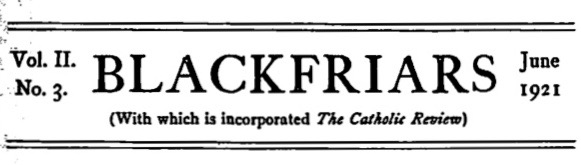
98 years ago. . .
Source: Christopher Dawson, “The Land,” Blackfriars (June 1921): 137-145.
SEEKING CHRISTENDOM Now Available

I’m very proud to announce our third publication for SPIRIT OF CECILIA books, SEEKING CHRISTENDOM: AN AUGUSTINIAN DEFENSE OF WESTERN CIVILIZATION.
This was a book–roughly 82,000 words–I wrote over Christmas break, 2002-2003, and then revised four times between 2003 and 2008. I wrote it in between writing the biographies of J.R.R. Tolkien and Christopher Dawson as a way to understand Christian Humanism. I wanted to know its scope as well as its limits, hoping to find something to move well beyond the simple and deceptive left-right spectrum.
Here’s the opening to the original version:
The nineteenth century witnessed the flourishing of progressivist thought in social relations, politics, religion, and biology. Everything was evolving, or so it seemed, toward the better. Smiles were more frequent, and lives just kept getting happier, as the citizens of the world were becoming one, homogenized, contented mass. The blessings of modernity entangled everything, East to West, claiming that no more perfect offerings needed to be made. Once properly educated and the childhood superstitions of the race outgrown, the prophets of modernity assured us, the masses collectively would speak as a god. In a word, according to intellectuals such as Bernard Shaw and H.G. Wells, it would soon be “utopian.”
It was a lie.
Modernity was a trap, and we were its greatest victims. We failed to resist, and it greedily fed on us. In democratic regimes, the brightly colored and candy-coated machines of bureaucracy and large corporations mechanized us, making us far less than human. In non-democratic regimes, the damage proved much worse, nearly irreparable. Beginning with the assassination of a relatively minor figure by an equally obscure terrorist group in 1914, the twentieth century drowned in its vast killing fields, gulags, holocaust camps, trench warfare, and weapons of mass destruction. Whether in the camps of the European or Asian ideologues, some humans, convinced of the righteousness of their cause, viewed all other human persons as nothing more than a collection of parts, ready to be dismembered and reassembled in a Picasso-esque fashion, or perhaps simply quartered and then quartered again. Armed with the ideological doctrines of fascism, National Socialism, and Communism, the twentieth-century became a century of the inverted vision of Ezekiel: wheels within wheels, endlessly spinning, the abyss ever expanding, ever within reach. All that was sacred became irrelevant. All who remained relevant were shot. And, the State and its faithful companion, War, demanded the sacrifice of much blood to the restored gods. Demos, Mars, and Leviathan became ascendant, taking possession of the field, and claiming victory, their appetites insatiable.
And, the Logos wept.
If you’re interested, here’s the link to the amazon Kindle version ($4.99). If you’re interested in a copy to review for a print or online publication, please let us know through the contact button.
Thanks! And, enjoy.
Birzer Guide to Art Rock and Pop

Spirit of Cecilia Books has begun a series of ebooks–Cecilia’s Notations–on the history of modern music (mostly rock, pop, and jazz).
Other volumes in the series, forthcoming: on Talk Talk, Big Big Train, Rush, Glass Hammer, Tears for Fears, and Kate Bush.
To purchase the first volume of Cecilia’s Notations, Birzer Guide to Art Rock and Pop, please click here. It’s only $2.99.
Real Leaders Tear Down Walls
How Did Kevin J. Anderson Build Your World? | The American Conservative
Have you ever wanted to live in a Rush lyric? Explode a sun? Attack nothingness itself? Download your consciousness into another body? Creep into the mind of Fox Mulder? Solve a mystery with a slowly decaying zombie? Meet Benjamin Franklin? Study the alchemical properties of a steampunk fortune teller? Save Superman from greedy commie thugs? Build a light sabre? Or, ride a sandworm across the desert?
— Read on www.theamericanconservative.com/birzer/how-did-kevin-j-anderson-build-your-world-science-fiction/
Ronald Reagan’s Creative Society

The Creative Society, in other words, is simply a return to the people of the privilege of self-government, as well as a pledge for more efficient representative government–citizens of proven ability in their fields, serving where their experience qualifies them, proposing common sense answers for California’s problems, reviewing governmental structure itself and bringing it into line with the most advanced, modern business practices. Those who talk of complex problems, requiring more government planning and more control, in reality are taking us back in time to the acceptance of rule of the many by the few. Time to look to the future. We’ve had enough talk–disruptive talk–in America of left and right, dividing us down the center. There is really no such choice facing us. The only choice we have is up or down–up, to the ultimate in individual freedom consistent with law and order, or down, to the deadly dullness of totalitarianism.
–Ronald Reagan, The Creative Society (1968)


You must be logged in to post a comment.