Category Archives: Philosophy

Troika’s First Video, JULIA


Nick D’Virgilio, Neal Morse & Ross Jennings share first single and video for “Julia” from debut albumNick D’Virgilio (Big Big Train, ex-Spock’s Beard), Neal Morse (Transatlantic, NMB, ex-Spock’s Beard), and Ross Jennings (Haken, Novena) are pleased to announce their debut album titled ‘Troika’ will be released on Feb 25th, 2022.  The album is now available for pre-order here:
https://dvirgiliomorsejennings.lnk.to/Troika
 
Today, the band is also sharing the album’s first single “Julia”.  You can watch the video by Christian Rios here:
https://youtu.be/Y31eVTnMIxIRoss had this to say about the track:
“With my original demo clocking in at around the 8-minute mark and possibly leaning too close to ‘prog epic’ than the singer/songwriter vibe we were attempting to present on this record, Neal arranged my lengthy ballad into something more concise, in-keeping with the album’s essence and writing in a powerful new chorus in the process! 
 
“This one was all about the 3-part vocal harmony interplay and ‘pull-at-the-heartstring’ lyrics which deals with themes of regret and forgiveness in the context of a broken father-daughter relationship.”
– Ross JenningsTracklisting:
1.Everything I Am (5:43)
2. Julia (6:07)
3. You Set My Soul On Fire (3:22)
4. One Time Less (4:53)
5. Another Trip Around The Sun (4:39)
6. A Change Is Gonna Come (4:24)
7. If I Could (4:02)
8. King For A Day (5:47)
9. Second Hand Sons (4:43)
10. My Guardian (3:43)
11. What You Leave Behind (4:16)
 
‘Troika’ will be available as Ltd. CD Edition / Gatefold 2LP+CD / Digital Album. Each format includes a bonus alternative version of the track ‘Julia’ and is available for pre-order here: https://dvirgiliomorsejennings.lnk.to/TroikaRecorded during lockdown, the process began with Neal Morse writing some acoustic songs that he thought would be enhanced by strong vocal harmonies. He already knew how well his voice blended with former Spock’s Beard band-mate and Big Big Train drummer/ vocalist, Nick D’Virgilio who came on board and, considering a third man, the Americans sought out Haken’s Ross Jennings from the UK to complete the trio. All three found they had songs that would benefit from the three part harmonic blend, and so they pooled their resources, inputting creatively into each others compositions.
 
Neal comments: “What a great pleasure it’s been to work on this album with these amazing artists! It was kind of funny… We had been working on the songs remotely for several months before I finally heard all of us singing together at the same time. The first time I brought the faders up, I knew we had the magic!“
 
Nick adds: “I’ve known and worked with Neal for over 30 years and I’ve been a big fan of Ross and the music he makes for a long time. I felt confident right away that this would be a fun project to be a part of. I was so right.”
 
Ross comments: “Receiving ‘The Call’ from Neal to participate in this project was somewhat of a prayer answered… As a long time fan of their work, I’ve been singing along to Neal’s & Nick’s records for years, so it felt really natural for my voice to slot right in.”
 
The tracks took shape with the musicians recording all of the music and vocals separately, yet the eclectic performances burst with the energy and excitement of the collaboration. Acoustic anthems, charged rockers and sensitive ballads are all part of the mix, and the unique blend of Ross, Neal and Nick’s voices and styles have created an album in which you will encounter these musicians in a way you’ve never heard before.D’Virgilio, Morse & Jennings ONLINE:
https://www.facebook.com/ndvofficial/ 
https://www.nickdvirgilio.com/ 
https://www.instagram.com/ndvirgilio/ 
https://twitter.com/NDVmusic
 
https://www.facebook.com/nealmorse/ 
https://twitter.com/nealmorse 
https://www.instagram.com/neal_morse_official/
 
www.rossjennings.co.uk
https://www.instagram.com/rossjenningsofficial/ 
https://www.facebook.com/rossjenningsofficial
https://twitter.com/RossWJennings
INSIDEOUT MUSIC online:
www.insideoutmusic.com
www.youtube.com/InsideOutMusicTV
www.facebook.com/InsideOutMusic
www.twitter.com/InsideOutUSA
www.insideoutmusic.store
Spotify Prog Rock Playlist

Reconciling Gene

If it isn’t already quite evident, most of my contributions on this website have been eulogies, attempted hymns of motorcycling and all the things uniquely American. My dad and great grandfather also used to motorcycle, so for that obsession I’d conveniently blame the inherited genes. But curiosity about Americana and in general Western civilization is probably acquired. Would like to believe for the most part these ideas were shaped by an honest sense of inquiry, sort of an amateur study into the causes of relative peace and prosperity.

If it isn’t already obvious, most parts of the world are in a constant state of strife or state of tension. It varies in terms of degree, but people are in general deadlocked in some form of bickering, often these inter-group squabbles are over disputes hundreds of years old, and probably even inflicted by unknown individuals. Generations continually born into this baggage and their minds shaped by these artifacts of the past. Without reconciling these disputes there is no peace or path to prosperity. Even if someone manages a truce, it is often fleeting, the mischief inevitably reemerges.

Thanks to some fortunate accidents of history, somehow the reconciling cultural strand of Englishmen survived, and often thrived. From common law jurisprudence and related institutions, to its more evolved form of American Federalism, for hundreds of years there is a constant recurring theme of attempting to reconcile divergent views. This framework itself is designed to resolve disputes without taking sides or enforcing collective goals. An unconditional 1st Amendment is a perfect illustration of this tendency. Even when most countries emulated Constitutionalism and all the surrounding institutions, they adopted a caricatured variant devoid of that impartial reconciling strand.

Not just in dispute resolution, peace through reconciliation is evident in all the functioning layers of the political system. Whether it’s reconciling majority views with minority or legislature with judiciary or democracy with rule of law or states rights with Federal — seems like English tradition constantly steered towards that simple goal of peaceful coexistence. But that mere goal of peaceful coexistence has lead to lofty outcomes of stability and prosperity, because that peace also allowed channeling individual energies to higher goals. In short, while simple goals lead to elevated outcomes, numerous political systems striving for explicitly high ideals consistently fell off the cliff. Well, yet another Thanksgiving, and felt like we have a lot to be thankful for, including that rarely acknowledged reconciling institutional gene.

Rest in Peace, David Longdon

It’s finally hitting me that we live in a world without David Longdon. What a tragedy, what a loss. I first received the news of his death during lunch. Uncharacteristically for me, I was eating lunch while checking things on my iPad. Two things happened at once–I saw the notice from Louder.com and my phone rang. It was my awesome friend, Tom Woods, making sure that I knew the news. Seriously, the phone rang within seconds of me reading the Louder.com post.

A few years ago, Tom and I had the great fortune of interviewing David for Tom’s rather famous podcast. Tom and I have bonded over many things, but few as precious as the hour we spent with David. David was, to be sure, a master craftsman, an original, and a true-to-life gentleman. While Tom and I were barely concealing our fanboy excitement, David offered us nothing but gratitude and clarity.

When I was at Progarchy.Com, I had the pleasure of “talking” with David over email, and I’ll never forget when I first heard the magisterial song, “A Boy in Darkness”–about child abuse. I emailed David, asking him (and hoping against hope that my suspicions were wrong) if the song was autobiographical. No, he assured me, it was not! Thank, God.

To be sure, Longdon and Spawton were the greatest rock musical writing duo since McCartney and Lennon. Their loss will be felt for a generation or more.

I first heard David Longdon’s excellence in 2009, receiving a mix from the mighty Carl Olson with a Big Big Train song on it. I was, from the first moment, hooked. I still consider The Underfall Yard one of the best rock albums of all time. It ranks up there with Selling England by the Pound, Close to the Edge, and Spirit of Eden. I would also–and, yes, I’m throwing the gauntlet down–argue that Longdon had the single best voice in all of rock.

So, David, thank you for everything. A life beautifully lived. There’s so much more to be said, but my brain and soul are still processing a world without you.

In Memory of David Longdon

Devastating news at Big Big Train’s website:

David Longdon
17th June 1965 – 20th November 2021

Big Big Train are extremely saddened to announce the death of David Longdon this afternoon in hospital in Nottingham, UK at the age of 56 following an accident in the early hours of Friday morning. He is survived by his two daughters Amelia and Eloise, his mother Vera and his partner Sarah Ewing.

Sarah Ewing comments: “David and I were best friends, partners and soul mates and I am utterly devastated by his loss. He was a beautiful person and I feel so lucky to have known and loved him.”

Greg Spawton comments: “We are absolutely stunned to lose David. It is unspeakably cruel that a quirk of fate in the early hours of yesterday morning has deprived him and his loved ones of a happy future together and all of the opportunities, both personal and musical, that awaited him next year and beyond.”

David joined Big Big Train in 2009, immediately making a significant impact with that year’s The Underfall Yard album. He proceeded to record a further eight studio albums with the band, including the forthcoming Welcome To The Planet, as well as fronting the band for a series of highly acclaimed concerts from 2015 onwards. In addition last year he released an album with the late Judy Dyble under the name Dyble Longdon. On the day before his accident he had been in the studio working on a new solo album.

“David made a huge impact on my life both musically and personally,” Spawton continues. “I loved him like a brother and already feel his loss very deeply. He was a true creative visionary with extraordinary depth of talent. But above all he was a first rate and very kind man. His family, friends, BBT bandmates and crew will miss him terribly.”

The band’s Welcome To The Planet album remains scheduled for release on 28th January 2022. A further statement regarding the band’s 2022 concerts and other activities will follow in due course.

The band and their management request privacy for David’s family and friends at this extremely difficult time.

— Rick Krueger

Listen, and then Ride

Pictures often bring back memories, same applies to music, or for that matter any comparable visual/audio/sensory inputs. So, spend enough years listening to heavy metal, and overlap those very same years with motorcycle rides, odds of them converging increases. Basically certain riffs are now for time travel, to some motorcycling experience! Listening to opening riffs of Bleak rewinds time back to that 2:00 AM lonely highway ride, actually journeying to this small college town for seeing Opeth live. Jazz-fusion like bass lines in Surface’s Echoes brings back late autumn rides, and glimpses of peninsula sunsets. Honeycomb is a lot about early summers, exploring forts around Port Townsend. Frankly, it’s not an exhaustive list; somehow these experiences got overlaid in memory. One begets the other. But, this is not intentional and they don’t happen all the time.

Often such recurring patterns motivate study of the underlying causes. In the past we were satisfied with merely discovering that correlation. Just like how animals keep returning to a spot where they got food, but without knowing what’s the underlying reason. Quite similarly, primitive men were satisfied with different degrees of correlation. Eating this herb cured this disease, or freezing food or using spices helped in longer shelf life etc. Seems like modern scientific mentality was not satisfied with mere correlation. It sought to discover underlying causes, theorize and apply those mechanisms in multiple diverse contexts. For instance, the underlying mechanism for overlapping memories could be used for curing depression or as motivational tool, basically the application might extend beyond motorcycling metal heads. Same idea applies to something as simple as Pythagoras theorem. The inference that a triangle of particular dimension satisfies specific properties is used in multiple contexts. To paraphrase Louis Rougier, it’s a mentality to move from specific to the abstract. This idea is relevant in every sphere of modern science, including politics.

For instance, moving from specific rules to abstract rule of law is an illustration of same concept. Instead of directing everyone to specific duties, we enabled a framework to exercise free will. But exercise of freedom based on general qualities like respect for property, life and human rights. So, instead of celebrating good rulers, we started inferring good laws. We basically abstracted qualities of a good ruler into this new found mechanism called law. Movement from Magna Carta to American federalism is sort of that steady evolution from specific to the abstract. In fact, seems like Federalism adds one more layer to that dispersed rule-of-law framework. Sort of a higher level instrument to institutionalize development of good laws itself. An attempt to automate generation of good laws. As James Madison famously explained, all this checks and balances should automatically lead to good legislation. Results of this experiment can be debated, but the scientific argument for Federalism seems obvious. In that spirit, if we see legislation with specific directives assigning us tasks, it’s safe to say they are primitive artifacts in an otherwise sophisticated system.

Book Review: Christopher Gehrz’s Religious Biography of Charles Lindbergh

Christopher Gehrz, Charles Lindbergh: A Religious Biography of America’s Most Infamous Pilot, Grand Rapids, MI: William B. Eerdmans Publishing Company, 2021, 265 pages.

Christopher Gehrz - Charles LindberghCharles Lindbergh is simultaneously the most fascinating and the most frustrating individual I have ever encountered. Since December 2019, I have been cataloging the Missouri Historical Society’s collection of over 2000 objects that Lindbergh donated following his May 1927 New York to Paris flight. The collection ranges from artifacts carried on that flight to the hundreds of medals and awards he received, personal effects, artwork, two aircraft, jewelry, and the random gifts people and governments sent him or gave him and his wife, Anne, on their travels. In studying the material culture owned by and given to Lindbergh, I have learned a lot about him. Perhaps I have learned too much.

I imagine Christopher Gehrz, professor of history at Bethel University in Lindbergh’s home state of Minnesota, might also say he has learned too much about Lindbergh in the course of writing the latest biography on the aviator. There have been many biographies written about Lindbergh since the pilot, outspoken isolationist, and conservationist died in 1974, with A. Scott Berg’s 1998 biography widely considered to be the standard text on Lindbergh’s life.

A lot has come out of the woodwork on Lindbergh since 1998, most prominently the discovery of his multiple extramarital affairs and the children he had with three German women. Over the past twenty years, historians have also unpacked Lindbergh’s legacy in light of his views on eugenics and race, as well as his anti-Semitic remarks made during his isolationist America First speeches in the run-up to World War II.

Despite the numerous books that have been written about Lindbergh over the years, one aspect of his life has been woefully overlooked, until now. Gehrz’s biography is the first to analyze Lindbergh’s life, writings, and actions through a religious lens. Perhaps you might not think religious or spiritual when you think of Charles Lindbergh (if you even think of him at all – increasing numbers of people I run across have never even heard of him). That would be fair, since Lindbergh was not an orthodox Christian. He did not believe in Jesus Christ as Savior and Lord, yet he was fascinated by Jesus and thought deeply about his own spirituality. Lindbergh’s Pulitzer Prize-winning 1953 book The Spirit of St. Louis drips with religious imagery, as do some of his other later writings.

Gehrz’s biography investigates Lindbergh’s beliefs and writings on Jesus, religion, spirituality, the afterlife, and how Lindbergh’s beliefs influenced his actions. Through intense archival research and analysis of published works, Gehrz unpacks Lindbergh’s spiritual complexity. Since Lindbergh’s spirituality flourished in his later years (he was only 25 when he made his famous flight), the foundational part of Gehrz’s argument rests upon the period of Lindbergh’s life spanning the 1930s until his death. The book begins by looking at the religious elements in the lives of Lindbergh’s parents and grandparents, shining a light on the rather unorthodox beliefs in which he grew up.

This book is perhaps best suited for those who already know the fundamental stories of Lindbergh’s life: his 1927 flight, his marriage to Anne Morrow, the 1932 kidnapping and murder of their son, dubbed the “crime of the century,” and Lindbergh’s involvement in the isolationist America First committee from 1940-41. Gehrz touches on Lindbergh’s early life and the 1927 flight, but he does not dwell on those periods as that is not the point of the book. Instead he briefly tells those stories through a religious lens. It is quite the literary feat to pull this narrative style off. I am fascinated and impressed by Gehrz’s skills as a writer. He tells a familiar story in a brand new way.

Gehrz looks at his subject openly and honestly.  When I sat down to read this book, I honestly expected it to be a hate-fest, but it isn’t. He simply tells the story of Lindbergh’s spiritual side in a “matter-of-fact” way, which I believe is how history should be written. Gehrz also tells this story in a very readable way. The book flows very well, and it is exceptionally well written. The biography is very focused, which makes it digestible in a way a broader biography might not be. I actually found the book to be quite the page-turner.

One of my few complaints with this tale of Lindbergh’s spirituality is one omission: there is no discussion of Lindbergh’s involvement in freemasonry. Lindbergh was a 32nd degree freemason in the Scottish Rite. He attained that level in a masonic temple in St. Louis, Missouri, when he was working as an airmail pilot prior to his transatlantic flight. I have cataloged a few artifacts given to him by that masonic group as well as others across the nation. My frustration in researching those objects was how little I could find about Lindbergh’s masonic past. About all I could find were references to it in newspapers at the time. I assume Gehrz does not mention it because either he was not aware or because there is no additional information about that part of Lindbergh’s life. There appears to be little to no related primary sources, apart from the gold masonic gifts held in the Missouri Historical Society collection. (Shameless self promotion: a coworker and I wrote a blog post about objects in the collection connected to secret societies, including a few masonic pieces: https://mohistory.org/blog/secret-societies/.)

If Gehrz had come across information related to Lindbergh’s masonic involvement, he probably would have included it. It is possible that Lindbergh never had anything to do with freemasonry after he left St. Louis. Maybe we will never know.  

One of Gehrz’s best contributions to the Lindbergh story is his analysis of Lindbergh’s journal entries from the run-up to World War II. Lindbergh published these journals in an edited form in 1970, but Gehrz dug into the original journals housed at Yale. What Lindbergh omitted from their published form says a lot.

Perhaps the most offensive thing Gehrz uncovers in his book is a journal entry from November 5, 1940 where Lindbergh, in recounting a conversation he had with friends, questions the validity of universal franchise, specifically arguing that African Americans should not be allowed to vote. In the same entry, Lindbergh discussed “the Jewish problem,” hoping to solve that “problem” without resorting to the violent racism seen in Nazi Germany (page 135).

One cannot help but be disappointed and angry with Lindbergh at such statements. Many have accused Lindbergh of being a Nazi sympathizer, which I think goes a stretch too far and misses a lot of the nuance of Lindbergh’s actions in the late 1930s and early 1940s. Nevertheless, Lindbergh, at least at this point in his life, held racist views of other human beings who are created in the image of God. He never publicly repented of such beliefs.

Gehrz’s honesty with the reader is refreshing. Rather than a distant biographer, Gehrz reminds us of his presence without inserting himself needlessly. The following is my favorite paragraph of the whole book because it perfectly encapsulates how I have felt about Lindbergh over the past twenty months of studying him (page 138):

It can’t be you! If not as intensely as his youngest child, that’s still how most of us feel when we come to this chapter in the story of Charles Lindbergh. If we have any appreciation for his historic achievements, any admiration for his courage and modesty, any compassion for the tragedies he endured, or if we simply nod along with the honest questions he asked about God, science, and mortality, we don’t want to accept that he believed what he said about Jews.

Even so, it is hard not to be a little sympathetic towards Lindbergh. The man was treated as if he were the Messiah. Gehrz has a chapter entitled “The New Christ,” where he discusses the religious language used to embrace Lindbergh following his 1927 flight. An entire monograph could be written about the reasons why Americans and Europeans embraced Lindbergh with the enthusiasm they did. Gehrz argues that the media and public created a version of Lindbergh that fit what they wanted: “Lindy.” Gehrz writes,

For all the public scrutiny that would soon make Charles Lindbergh more protective of his privacy, no one was interested in uncovering the more complicated story of their hero’s upbringing, influences, and beliefs. Whether politicians or pastors, reporters or their readers, Americans wanted a type, not a person: Lindy, not Lindbergh. (page 64)  

The media pressure on Lindbergh was intense. How is any mortal man supposed to live up to the Messiah image the public created? Add to that the kidnapping and murder of his firstborn son a few years later, which he perhaps rightly blamed on press publicity. None of this excuses his racism and lack of compassion for those he deemed lesser than himself, but it is clear that America set Lindbergh up to fail. For that I cannot help but pity him, even if I find some of his beliefs to be offensive and sinful.

The saddest part of Lindbergh’s story, however, is how it ends. Based upon Gehrz’s research and narrative of Lindbergh’s final days, I see no evidence that Lindbergh ever let go of his arrogance and pride and acknowledged Jesus as Lord and Savior. Maybe he had some sort of deathbed conversion as he died of cancer at his home on Maui, but based upon the witness of those who spent those last days with him, it does not sound like it.

In that regard, let Charles Lindbergh be a warning to us all. Lindbergh knew that scientific achievement falls far short in its attempts to explain the meaning of life, but his example also shows us that unsanctified human reason also falls short. Christopher Gehrz’s biography does an excellent job of exploring that aspect of Lindbergh’s life.

Bryan Morey

https://www.eerdmans.com/Products/7621/charles-lindbergh.aspx

Yesterday’s Seven Thousand Years

by RICHARD K. MUNRO

Thomas Munro,Sr, circa 1939 and his beloved pal FUZZY whom he picked up as a pup in Texas in 1923. He had him for over 20 years

The FINALE: The last gathering of the Regimental Band of the Argyll and Sutherland Highlanders in 1993. My son and I traveled hundreds of miles to see their last performance in Los Angeles. There we me Corporal Munro and other sonsie Scottish faces. The last notes of an Auld Sang -sad but sweet

My grandfather THOMAS MUNRO, SR ASH 1914-1919
Near the end of the Long, long road CONSTANTINOPLE January 1919 my grandfather is 5th from the right. He told me stories of the Turks (whom he hated with a passion) and visited Hagia Sophia and the ruins of the city. He also had contact with Greek and Armenian refugees and he said the tales they told were heart-breaking and horrific.
Thomas Munro, Sr. in Salonika Greece APRIL 1917. He had written to my grandmother that now that the USA was in the war the Allies would surely win. He said it was just a matter of time six months? a year? two years. He didn’t know for sure but all of the men felt hope they might now survive the war. He used to say he survived 2nd Ypres but would not have survived 5th or 6th Ypres.
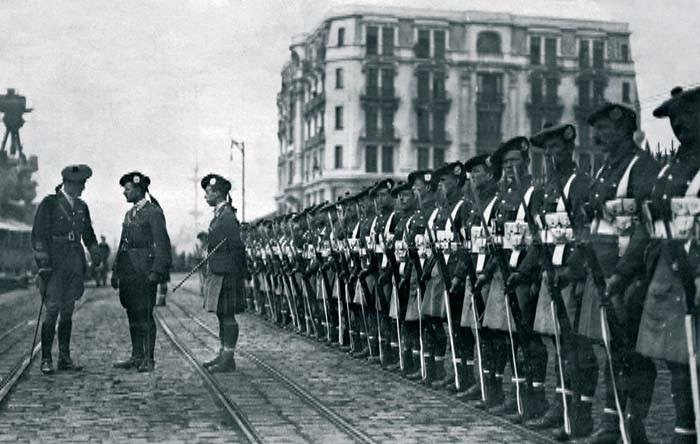
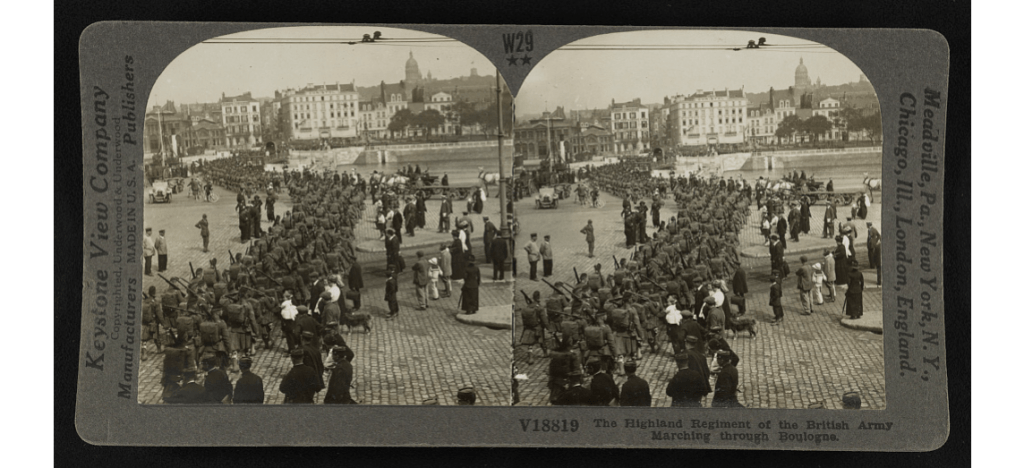
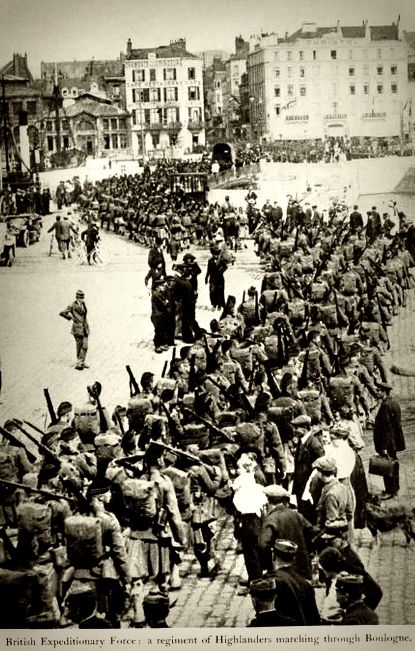
The 1st Battalion Argyll and Sutherland Highlanders arrive to come to the rescue of France and Belgium.
This photo has the same sources

When people say “New York” they mean “New York City” when they want to talk about the state they say “New York State.” As an exile from New York, I don’t consider myself a New Yorker and never considered myself a New Yorker. I was never accepted as a New Yorker. My family just passed through New York via Montreal, Canada, and Ellis Island. They never really were New Yorkers or even “Yankees”.

And you know what they say: being born in a garage doesn’t make you a car. I wouldn’t mind visiting it again (I haven’t been there since 2005) but I have no burning desire to return and no family and few friends to greet me.

Cianalas is the Highland word for it -that place you are connected to by heritage where joy and sadness mingle.

But it is quite true. You can’t go home again. The greatest distance between two points is time. New York, Glasgow, Argyll, Inverness, Glenties, and Ferindonald represent lost worlds to me. So is Seattle, Washington where we lived for seven years.

There is some warmth of memories in all of those places -places where my family lived for over one thousand years but I know them well enough to know they all belong to the past and are not likely to have any place in my future and the future of my children.

They are now part of Yesterday’s Seven Thousand Years.

We may sing of them and memory remembers the ghost of a tune and the ghost of a kiss and the Silent Ones.

But the Silent Ones greet forever as they greet no more.

Gars ye tae greet,aye. “But the broken heart it kens no second spring again thought the waeful heart cease not from its greeting.” (grieving; lamenting -that’s Scots dialect)

But then I am speaking only to myself.

“The world is hard and cruel. We are here none knows why, and we go none knows whither. We must be very humble. We must see the beauty of quietness. We must go through life so inconspicuously that Fate does not notice us. And let us seek the love of simple, ignorant people. Their ignorance is better than all our knowledge. Let us be silent, content in our little corner, meek and gentle like them. That is the wisdom of life.” (The Moon and Sixpence, W. Somerset Maugham)

Of course, the 1890 Highlands is a vanished world and so is pre-1914 Glasgow and so is Brooklyn, USA 1927-1957.

I grew up hearing about Ebbets Field ( I was there in 1955 in utero) and my cousins and sisters went there. I used to be very happy to return to New York but that is because my grandmother and mother and father lived there (plus a few college friends). I studied at New York University. I had many international friends but oddly very few American friends. But since my parents have passed on -it has been over 20 years so there is no homestead, no property, no address, and no welcoming face at any door.

It is sad when you know your mother’s email and phone number and you know no matter how long you wait there will never be a return message or call.

Phone numbers disconnected and ideas for conversations that would never take place. I used to call my mother long distance at least once a week and she would see “this is costing money” but I told her it was cheaper than a cocaine habit and in any case I know each day is a gift. I told her I would call her now for a modest amount. The time is coming, I said to her, that no matter how much I would spend the door would still be locked and the phone disconnected.

Life and love are just brief moments in time. My mother used to say that.

I half believed it. Now I have learned it.

I thought winter would never come but winter came and the snow is general.

Even on Labor Day. Especially on a holiday.

Thank God for my beloved wife!

Thank God for our children and the new generation of four grandchildren so far!