When I was a kid (about 12) I wrote a short essay: “THE GREATEST DAY IN MY LIFE” It was about my friendship with Hank Aaron from afar. He knew me, in a way, I always had the same banner out there “NAIL ‘EM DOWN Hammerin’ Hank.” He always waved at us when he went out to right field.
And when the cop said, “This kid has your book on its first day out! What do you think? Could you sign it for the kid? ” Hank said, “What’s the kid’s name?”Rickey” , said the big good natured cop. The game was about tobegin. He signed it and they passed to book down the dugout from player to player and back to the cop and then to my dad and me. He signed it with my Dad’s scorecard pencil.
Personally, I have no trouble with renaming military bases whose time has come. Most of those bases in the South and elsewhere were named circa 1917-1920 to appease White Democratic segregationists. For the same reasons many federal institutions remained segregated until President Kennedy.. I have no problem with town councils or state governments deciding to remove pubic statuary if it is done in a democratic way with due process. Statues could be placed in museum and given additional context. But destroying the original inscription and defacing the statue or plaque seems sinister to me. Something out of 1984. For example many old Civil War monuments refer to “Negros” or “Colored troops”. In some cases these monuments were put up by ex-slaves themselves. At the time, “Negro” and “Colored” were the accepted and popular terms. Sometimes (in Winslow Homer paintings ) the word Ethiopian is used for African-American but that was not common. It makes no sense to go back and destroy every book, every document, every monument which uses non PC languages.
I am totally opposed however for iconoclastic mobs to deface and destroy in the dead of the night historical monuments and displays which are also public art.
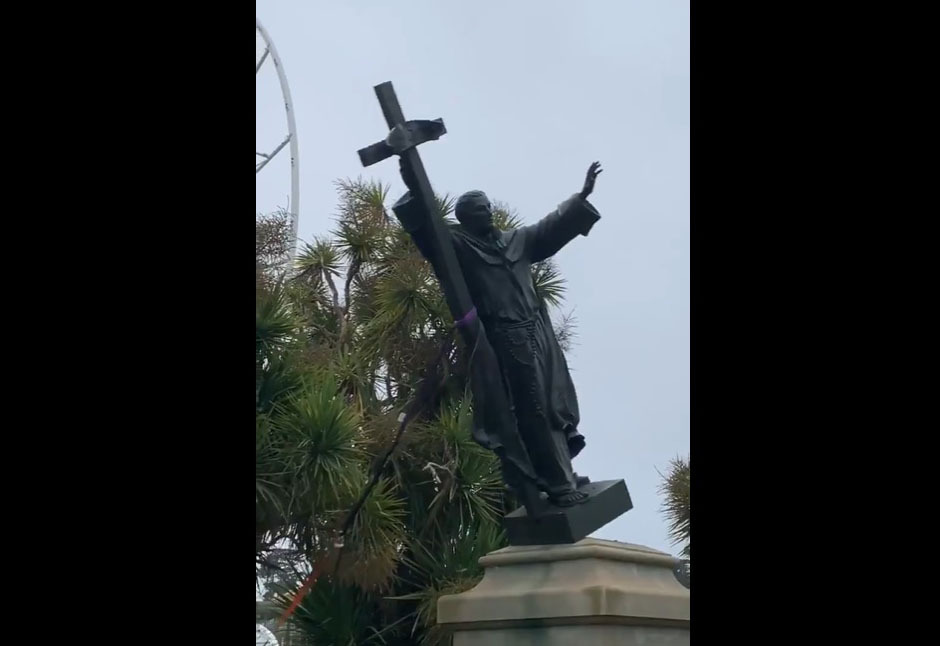
This is not totally new. There have been attacks of Columbus Statues and the statues of Spanish missionaries before usually with red paint accusing them as colonizers killers and slavers. Columbus was certainly a master mariner and a colonizer but he never held a single black slave in his entire life not did he introduce Black slavery to the Americas. Similarly, Father Serra never held a Black slave either, in fact he prohibited slavery at the California Missions.
There was a controversy about the Mohave Cross a number of years ago not far from where I live. It was a World War One memorial to fallen local soldiers. It was shamefully in a box during the back and forth trials because people said they could see it from a public highway and that was offensive to them . The Mohave Cross finally triumphed like some other public war memorials or crosses but it was vandalized and destroyed by opponent AFTER the court case. It has been restored (and is on private land) but it is sad the original monument from 80 years ago was destroyed. The Supreme Court has upheld the legality of public crosses as memorials to the fallen. There are many many crosses in Arlington also but also symbols of other religions and some graves have no symbol at all. The reason is every soldier, sailor, airman or Marine designates his or her preferred religious affiliation. If the fallen warrior is Jewish it would have a Jewish symbol if Muslim a crescent moon etc. et. The reason there are so many white crosses at Arlington, Normandy, Anzio, Bastogne, Salerno is because the majority of the Americans who fell there were from Christian communities. Allowing them to be honored by crosses is free exercise of religion and in any case the cross has for many a non-religious meaning just the acknowledgement of the fallen warrior.
I am totally against destroying or defacing WWII, WW, Civil War monuments in cemeteries or National Park battlefields. I am totally against the Spanish missions being destroyed or defaced. I am totally against all public art as to Spanish missionaries being destroyed or defaced. In San Francisco not only was Francis Scott Key statue toppled but a statue of Miguel de Cervantes was also vandalized (I am not sure of the extent of its damage). I also see in newspapers noble souls like Father Kino, Father Crespi and Father Serra being trashed as cruel slave holders who brutalized and exterminated the native Americans.
The fact is Father Serra -and we know a lot about his service and actions BECAUSE of his letters and the notes of Father Crespi did not allow any slavery at all in the Spanish Missions. Escaped black slaves in the Spanish Missions in Florida or New Mexico or California were considered free men Father Serra personally baptized Black persons in the Catholic church and married them to White Californios or Native Americans.
The most famous example is PIo Pico was the last Mexican governor of California. Pio Pico was legally “Spanish/Mexican” when California joined the Union but was of African descent. So Serra helped free slaves and did no allow for slavery in the Spanish Missions while he was the president of the missions.
We know from his own accounts and the accounts of Father Crespi that he disciplined Native Americans who broke Mission rules -stealing, getting drunk in one instance entering the sleeping quarters of the female neophytes (some as young as nine years old) and sexually assaulting and raping them. On this occasion -it was very rare for Father Serra himself to administer punishment -he did not like but on this occasion (well documented ) Serra publicly flogged the “renegade’. They had a strict discipline at the Missions those who stayed had to work and contribute and had to follow the rules. But it isn’t true that the Indians were press-ganged into the Missions. Many came because water (due to wells and irrigation) and food was more readily available.
Father Serra (St. Junipero) dedicated his life to defend the Indians and to teach them. He and the Franciscan Fathers taught them pottery, leatherwork, metallurgy, ranching, candle making, preserving foods in oil. He introduced many new plants and crops to California like citrus -lemons and oranges. He vastly increased food production through ranching of sheep and cattle. He vastly improved agricultural production by introducing irrigation. He taught the natives music and sophisticated musical instruments were constructed at the missions. He established the first libraries in the history of California. He instructed the Indians in religion and helped assimilate them to Spanish society by learning Spanish. Father Serra, St. Junipero, was a good man in his time. This does not mean he was a perfect person who advocated for woman’s suffrage, self-government, universal abolition of slavery, preservation of the environment and all native languages and customs. We have no knowledge if he advocated the independence of California or Mexico. As far as we know he was a loyal Spanish Subject who expected his missions to continue indefinitely under Spanish rule and under the Spanish monarchy. At the time he lived there was no Mexican nationality. The world Latin American did not even exist. We do know that Serra seemed to sympathize with the American Revolution but he was mostly concerned with his own region.
Very importantly Serra and the Spanish fathers saw to it that local women (Native Americans and Californios) married foreign immigrants and marred Spanish soldiers. So immigrants and mixed race people became Spanish citizens (subjects). The Spanish Empire was not a democracy nor a perfect society but it was a humane society where local peoples had rule of law, relative peace and prosperity. It was never a society that practiced strict segregation of the races. What evidence is there that the Spanish missions were not Nazi-style concentration camps of extermination?
I can think of two powerful pieces of evidence. One was this: when the Mexican government dissolved the Spanish Missions the Indians who lived there did not want to leave and wanted to stay with the Spanish fathers. Why would they stay if they thought they were being ruled tyrannically? And another is this. Why are there so man Mexicans, Peruvians (and Filipinos also?) Because the Indian/or native mestizo populations thrived and increased hugely in the years of Spanish rule.
It is true that the Spanish did not, usually (the Jesuits are an exception) teach or preserve the native customs or dialects. The Franciscans, in general, were not great scholars but practical workers and farmers. But what we know of ancient native languages and civilizations is almost entirely because of what Spanish missionaries documented and preserved. The native tribes of California would not have survived independently as hunter gatherers as California’s economy and agriculture developed. Their only hope for survival as individuals and families was in an around the Spanish missions and ranches. The native Americans and Filipinos had hundreds, probably thousands of languages and dialects. Some have survived Quecha, Aymara , Guarani and Tagalog have survived precisely because Spanish missionaries created grammars and dictionaries in those tongues (this was chiefly the work of Jesuits) and evangelized using those languages as well as Spanish. It is wrong to characterize Spanish rule as equivalent to Nazi rule and to compare Spanish Missions to Nazi concentration camps. It is wrong, it is unjust, it is a calumny to do so. It is a historical falsehood. In short much of the criticisms of Spanish rule and Spanish missionaries are just propaganda. They give a completely false, incomplete and distorted. view of Spanish culture and history.
We are sowing the seed of love, and we are not living in the harvest time so that we can expect a crop. We must love to the point of folly, and we are indeed fools, as our Lord Himself was who died for such a one as this
— Read on www.commonwealmagazine.org/scandal-works-mercy
Yet, was Columbus the first to discover America? Well, let’s leave aside the fact that at least three separate migrations of people in pre-history migrated to the Americas to become the Native American Indians. Obviously, we leave this aside merely for the sake of argument. Once, when my family visited Plymouth Rock, my oldest son looked down at the moment—a massive rock stamped 1620—and asked, “Dad, how did the Indians know that the Pilgrims would arrive in 1620”? A great question to be sure, and we too often—as Americans and as scholars—imagine the American Indians standing around, doing next to nothing, impatiently waiting for the Europeans to arrive so that their history might begin.
Well, it turns out that the French Prog Rockers think we’re (we, meaning The Bardic Depths, though, let’s hope they love Spirit of Cecilia as well) ok!
When Andrew Jackson delivered his famous (or infamous, depending on one’s point of view) veto message regarding the re-chartering of the Second Bank of the United States, his most adamant supporters labeled it “a second Declaration of Independence.” While Jackson’s message was excellent, it certainly was not at the level of the Declaration of Independence. In a less hyperbolic fashion, one pro-Jackson paper stated: in “the final decision of the President between Aristocracy and the People—he stands by the People.”
This newspaper statement is almost certainly true, but not everyone agreed that the president should ever stand “by the People.” The president’s job, they believed, was to execute the laws that the representatives of the People—through the House—had drafted into law. To proclaim himself the representative of the people was to violate all that was sacred in the Constitutional understanding of the American Founders as expressed in Article II of that glorious document. Even the most adamant supporter of a strong executive, Alexander Hamilton, had feared that Article II might be the “fetus of monarchy.” To the opponents of Jackson, he had crossed a line that should never have been approached. One opposition paper proclaimed, not without justice: “the King upon the Throne: The People in the Dust!” Other papers mocked Jackson as a monarch, a king, and a dictator. All critics came together and began to refer to the president as “King Andrew,” and one of the most important political cartoons of that age depicted an old and wary man, sitting on his throne, with his feet resting on a shattered constitution.
— Read on theimaginativeconservative.org/2020/06/odd-history-whig-party-bradley-birzer.html
Greta Gerwig’s big-screen adaptation of Little Women offers an emphasis on women’s economic independence that has precipitated some protest from purists, who correctly point out that such moments as Amy’s “marriage is an economic arrangement” speech are not in Louisa May Alcott’s novel. What such criticism misses, however, is the reminder Ms. Gerwig’s script provides of just how central the story of Little Women is to the American literary landscape. Since the novel’s publication in 1868, the four March sisters and their neighbor Laurie have lived in the imaginations of generations of Americans and readers across the globe, inspiring plays, musicals, movies, television series, and even Japanese anime. Each adaptation maintains the broad strokes of the story but alters the details to emphasize, and sometimes completely reimagine, the moral of the story. Ms. Gerwig’s retelling of Little Women maintains the major aspects of Alcott’s beloved novel, but rearranges them to serve as a commentary on the very real lack of economic opportunities available to middle- and upper-class women (really, the genteel poor) in nineteenth-century America.
— Read on theimaginativeconservative.org/2020/06/economics-marriage-greta-gerwig-little-women-dedra-mcdonald-birzer.html
About the Declaration there is a finality that is exceedingly restful. It is often asserted that the world has made a great deal of progress since 1776, that we have had new thoughts and new experiences which have given us a great advance over the people of that day, and that we may therefore very well discard their conclusions for something more modern. But that reasoning can not be applied to this great charter. If all men are created equal, that is final. If they are endowed with inalienable rights, that is final. If governments derive their just powers from the consent of the governed, that is final. No advance, no progress can be made beyond these propositions. If anyone wishes to deny their truth or their soundness, the only direction in which he can proceed historically is not forward, but backward toward the time when there was no equality, no rights of the individual, no rule of the people. Those who wish to proceed in that direction can not lay claim to progress. They are reactionary. Their ideas are not more modern, but more ancient, than those of the Revolutionary fathers.
As an African-American man, I have had the experience of being pulled over by a police officer, with no apparent or expressed reason for the stop. I have been berated and verbally abused, without receiving a ticket or a warning. The most scarring of these events occurred in front of my two little boys, who are now grown, African-American men themselves. The police officer was intent on nothing more than humiliating and emasculating me in front of my small children, hoping to provoke me to respond. At that moment, I remember thinking that the most important thing I could do for my sons was to survive the encounter. Still, I have often thought about what lasting scars may have cut into their psyche by watching what that officer did to me that night. I often wonder what my sons think of me, as a man, and as their protector, knowing that I could not fight back.
Yes, I am alive, and George Floyd is dead. I can breathe; he cannot. But just because a police officer did not murder me or my children does not mean that he did not harm us.
Like many African-American men, my experiences are far too common. While they have never left me, these memories are all too frequently brought back to the surface by watching the videos that have become routine on American televisions and mobile telephones. The callous murders of unarmed men like Ahmaud Arbery and George Floyd are real for me. That could have been my father. That could have been me. That could be either one of my sons. And in a very real sense, like many other African-American men, I am George Floyd. Except, I can breathe. And I can do something. I must do something.
— Read on ethicscenter.nd.edu/news/ndls-dean-g-marcus-cole-i-am-george-floyd-except-i-can-breathe-and-i-can-do-something/
Before our own time, the customs of our ancestors produced excellent men, and eminent men preserved our ancient customs and the institutions of their forefathers. But though the republic, when it came to us, was like a beautiful painting, whose colours, however, were already fading with age, our own time not only has neglected to freshen it by renewing the original colours, but has not even taken the trouble to preserve its configuration and, so to speak, its general outlines. For what is now left of the ‘ancient customs’ one which he said ‘the commonwealth of Rome’ was ‘founded firm’? They have been, as we see, so completely buried in oblivion that they are not only no longer practiced, but are already unknown. And what shall I say of the men? For the loss of our customs is due to our lack of men, and for this great evil we must not only give an account, but must even defend ourselves in every way possible, as if we were accused of capital crime. For it is through our own faults, not by any accident, that we retain only the form of the commonwealth, but have long since lost its substance.





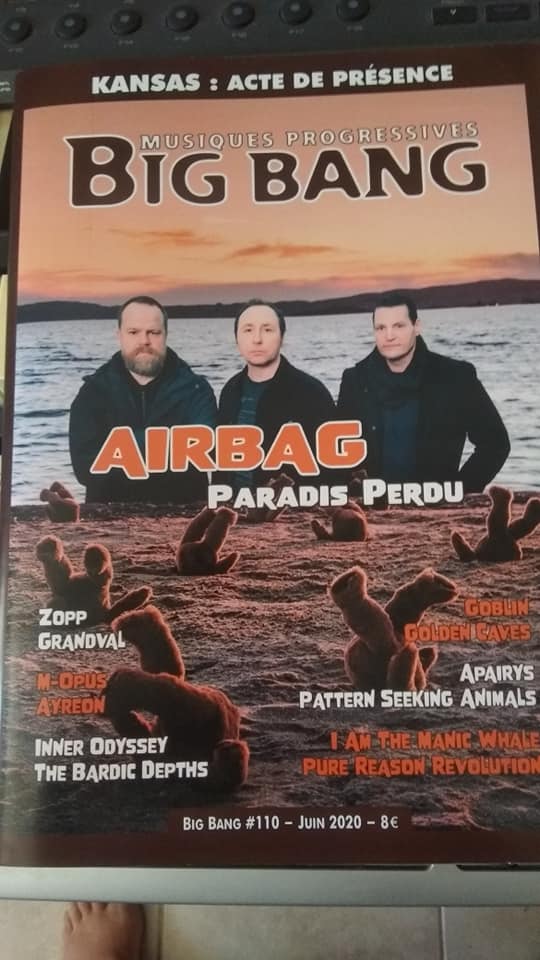
 Spirit of Cecilia
You must be logged in to post a comment.