Category Archives: Republic of Letters

At the Stratford Festival: Get That Hope (To the True North, Part 8)

Daddy wants to win the lottery, Mommy is still bitter about getting knocked up at twenty, Simeon has war-related PTSD, and Rachel just wants to get out of her parents’ place and have a home of her own, but first there are a few things she’s got to get off her chest. It’s Jamaica’s Independence Day, Toronto is sweltering, and everyone is on edge–then the air-conditioner breaks.

— publishers’ blurb for Get That Hope

If the above sounds like a downer — well, on stage it didn’t turn out that way! While playwright/screenwriter Andrea Scott explicitly claims Eugene O’Neill’s famously depressing Long Day’s Journey into Night as inspiration for Get That Hope, her new play (currently in previews for its world premiere next month) has too much of the milk of human kindness to leave its audience shattered. There’s misapprehension and conflict shot throughout her bittersweet portrait of the Jamaican-Canadian Whyte family, but as individuals’ secrets are revealed and each character gathers the courage to be honest, the play becomes an affirmation of how the ties that seem to confine can also bind together — in love (however clumsily and reluctantly expressed), in sympathy, in mutual support.

With only five characters, each actor has to make their portrayal count — and each steps up to the challenge. Conrad Coates’ Richard Whyte works hard to be carefree as the head of the family– maybe a little too hard, as he dismissively tries to keep the lid on everyone’s tensions and just have a party. Kim Roberts (a pioneer in Canadian stage, film and TV) vividly portrays the challenges Richard’s wife Margaret faces, both to recover her health and to relate to the household’s adult children. Celia Aloma as Richard’s daughter Rachel bears the brunt of the Whytes’ situation; providing most of the family income, she longs for respect and independence. And son Simeon, sketched with quiet intensity by Savion Roach, wrestles with demons acquired while serving overseas, locked into inaction by his suppressed pain, fear and frustration. Jennifer Villaverde’s Millicent Flores — the family’s Filipino neighbor, Margaret’s care worker, everybody’s confidant — seems to be the glue holding the Whytes together; but a secret that’s only revealed as Act II begins threatens to blow all these tense relationships completely apart.

Misunderstanding between generations and cultures breaks out in the open; Rachel slams into her parents for not living up to her expectations, Richard and Margaret react with disbelief and defensiveness, Millicent has to stand up for herself while Simeon confronts his own emotional paralysis. What’s true to life here — what Scott, director Andre Sills and the company bring home powerfully — is that none of these problems are solved with a pat therapeutic answer, or even a melodramatic apology. Everyone in this circle stands their ground — but everyone also realizes that all they have is each other. And as painful as their vulnerabilities are, leaning on each other, letting go of built-up resentment, is how they’ll get through whatever might come their way, with the play’s final moments hinting at both further suffering and (just perhaps) reasons to hang on.

I found Get That Hope to be a solid slice-of-life drama, resonant in its forthright assertion of how we need each other in the face of adversity — whether it’s eaten at you for years or comes at you from out of nowhere. Come to this new play with an open mind and heart; you won’t be disappointed.

— Rick Krueger

Get That Hope is currently in previews at the Stratford Festival’s Studio Theatre; it officially opens on August 10, playing through September 28. For production information and ticket availability, click here.
At the Stratford Festival: Romeo & Juliet (To the True North, Part 7)

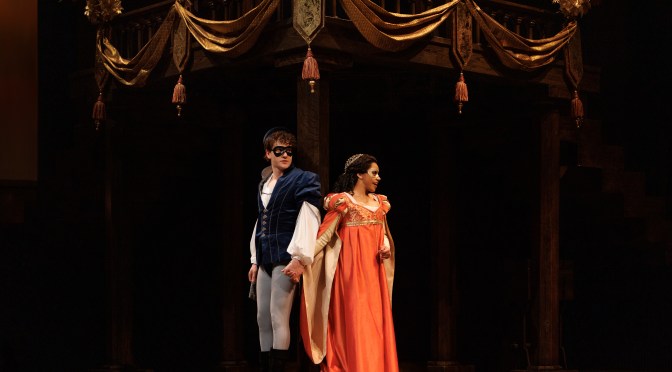
This is why my wife and I return to Stratford. The bells and whistles of featured musicals like Something Rotten are typically engaging, farcical fun; our mileage will vary on time-travel takes on classics (like the current “Summer of Love” production of Twelfth Night) and unsubtly Urgent Cultural Message plays (looking at you, La Cage aux Folles). But what draws us here again and again is what Sam White’s production of Romeo and Juliet provides in plenty: Shakespeare’s archetypal tragedy, presented with unwavering commitment, designed with minimalist period flair, expertly staged and acted. This is a refreshingly down and dirty exploration of a play that resonates down the centuries, not only in its high-spirited vision of young love, but in its taut portrayal of the fears and passions that ultimately thwart its star-crossed lovers.

Members of the company in Romeo and Juliet. Stratford Festival 2024. Photo: David Hou.

A sung prologue sets the table for a whirlwind first half, with White’s deft command of the intimate, surprisingly bare Festival Theatre stage was powerfully evident. Whether in the opening scene’s street brawl or at the masquerade where Romeo meets Juliet, crowd movements are vibrant, organic, purposeful, frequently cued by Graham Hargrove & Jasmine Jones-Ball’s thrusting onstage percussion. Individuals’ speeches fluently unpack each character’s motivation and reactions: a blustering Tybalt (Emilio Vieria), a cautious Benvolio (Steven Hao), the exasperation of Prince Escalus (Nick Dolan), the defensive crouch of the senior Capulets and Montagues — all establish the underlying powder keg of anger and resentment, ready to go off at an antagonist’s tiniest slight to personal honor.

Jonathan Mason as Romeo and Vanessa Sears as Juliet in Romeo and Juliet. Stratford Festival 2024. Photo: David Hou.

Which is the reason Jonathan Martin’s lovesick Romeo and Vanessa Sears’ passionate Juliet stand out; in clans obsessed with judgment and rejection of the other, their soliloquies mark how they crave hope, yearn for a lasting acceptance. And when they find each other, the attraction is immediate, magnetic, unstoppable. The inspired duet of their balcony scene exhilarates; their capricious browbeating of Friar Laurence (consummate Festival veteran Scott Wentworth) into a clandestine wedding feels inevitable in the sweep of their mounting passion. But then, the explosion: with the hair-trigger murders of Andrew Iles’ Mercutio by Tybalt and Tybalt by Romeo — tumbling over each other in a brutal, riveting flash of violence — fear wins out, tragedy gathers momentum. Blackout!

From left: Emilio Vieira as Tybalt, Andrew Iles as Mercutio and Derek Kwan as Tybalt Follower in Romeo and Juliet. Stratford Festival 2024. Photo: David Hou.

This was the moment when my stomach knotted — and even though I’ve known this play since high school, as the second half slammed one door after another and the lovers’ scheming grew more desperate, it refused to untwist. When Graham Abbey’s Capulet compels Juliet’s consent to marry Austin Eckert’s Paris by callous words and physical force; when Juliet threatens suicide, then grasps at the straw of Friar Laurence’s stupefying potion; when Glynnis Ranney’s Nurse keens an anachronistic snatch of Henry Purcell (testimony to White’s love for opera) over Juliet’s grave; when Romeo’s turbulent emotions solidify around his own suicide mission, the tension ratchets up and up, to unbearable heights.

Scott Wentworth as Friar Laurence in Romeo and Juliet. Stratford Festival 2024. Photo: David Hou.

Which is why the final bloodbath in the Capulet vault — as Paris, then Romeo, then Juliet die at the hands of misdirected honor and folly under pressure, to the belated horror of Capulets, Montagues and Prince alike — ultimately feels inescapable, and remarkably universal. In White’s sure, determined hands, this tragedy could be playing out anywhere at anytime, be it Renaissance Mantua or 21st-century Detroit (where her mother kickstarted her passion for Shakespeare at the age of 8, as a disciplinary consequence for catching her listening to Salt’n’Pepa). As she tosses out to close her program notes: “Remember what happens when we don’t love our neighbor as ourselves. Just saying.”

I’m deeply grateful for this production of Romeo & Juliet — its primal commitment to Shakespeare as an artist speaking across and into multiple cultures, its understated opulence and fleet pace, its vivid characterizations and exuberant performances, its cataclysmic clash of the deepest forces at work in our fallen, idealistic, conflicted psyches and societies. For those with ears to hear and eyes to see, it’s a thrill, a warning, and maybe even a necessary passage from heights of joy through depths of despair to chastened, repentant grief. Above all, it’s well worth your time and travel to experience.

— Rick Krueger

Romeo & Juliet plays at Stratford’s Festival Theatre through October 26. Click here for production information. Click here for ticket availability.

At the Stratford Festival: Something Rotten! (To the True North, Part 6)

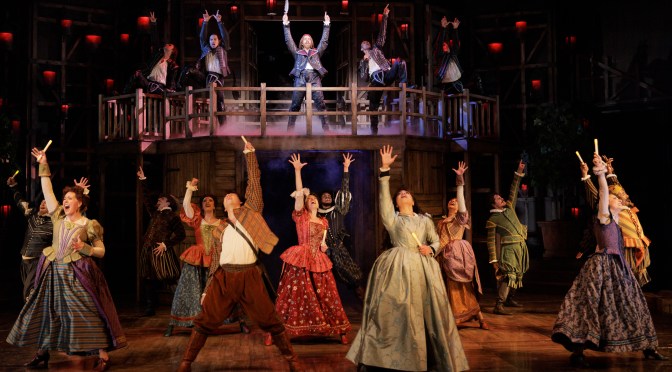
I thought there were three genuinely great things about the Tony Award-winning musical Something Rotten, as currently playing at the Stratford Festival:

1. Mark Uhre’s frenetic take on struggling Elizabethean playwright Nick Bottom. Between his oversized desire for fame, his strained interactions with enterprising wife Bea (a confident Starr Dominque) and poetic little brother Nigel (Henry Firmston in the boy-next-door role), and his obsessive drive to take down William Shakespeare and win the Renaissance fame game, Nick is desperation personified, thoroughly uncomfortable in his own skin and all the funnier for it. Uhre plays him as a live-action version of Daffy Duck, spluttering with unbounded rage at his situation, and thus completely susceptible to any bizarre idea that crosses his path – like inventing the musical – and thus totally willing, no matter how insane the consequences that follow, to “commit to the bit”.

2. The thing is, in this universe, Nick’s right! Framing Shakespeare as a vain, manipulative rock star (continuing the parallel, think Bugs Bunny without redeeming qualities) is Something Rotten’s masterstroke. Trailed by his own theme song and a crew of dancing Bard Boys, basking in the adulation of a solo stadium gig (with hilariously low-tech special effects), scheming against Nick to the point of donning a fatsuit disguise and a Northern accent, stealing Nigel’s best lines and passing them off as his own, Jeff Lillico is a utter hoot, England’s greatest dramatist as an egotistical, over-the-top pantomime villain. Even when he lets his guard down in his big solo “Hard to Be the Bard”(“I know writing made me famous, but being famous is just so much more fun”) , this is a Shakespeare you can love to hate.

3. Speaking of over-the-top, director Donna Feore and her creative team absolutely chose the right path by leaning into the Broadway musical’s inherent absurdities, as foreseen by cut-rate soothsayer Nostradamus (Festival veteran Dan Chameroy in a giddy, disheveled supporting turn):

You could go see a musical
A musical
A puppy piece, releasing all your blues-ical
Where crude is cool
A catchy tune
And limber-legged ladies thrill you ’til you swoon
Oohs, ahhs, big applause, and a standing ovation
The future is bright
If you could just write a musical

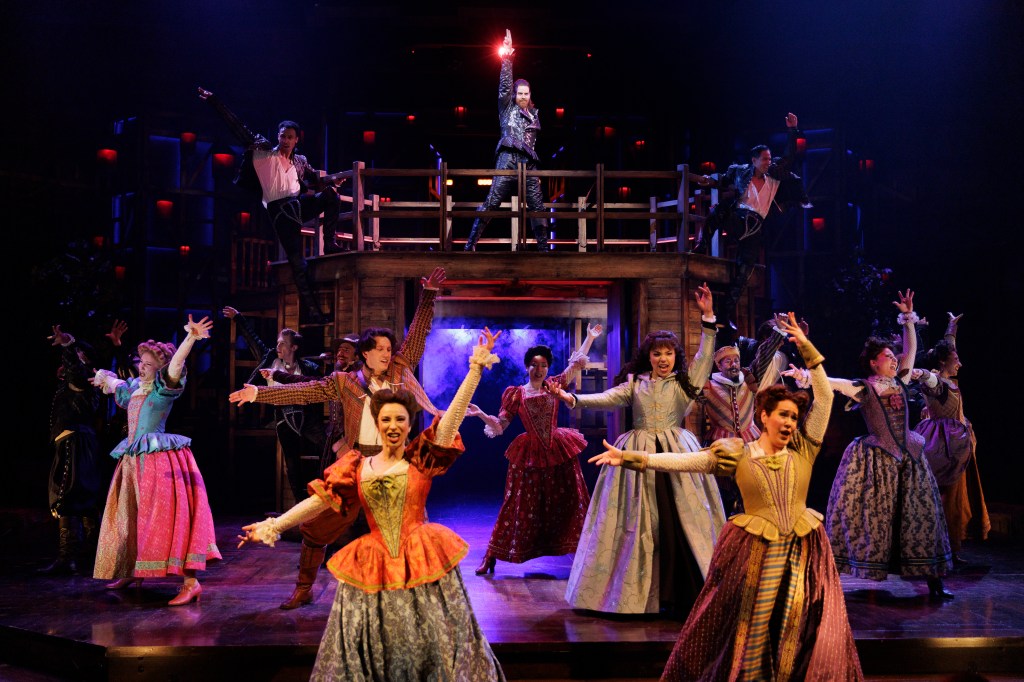
Dan Chameroy as Nostradamus with members of the company in Something Rotten!. Stratford Festival 2024. Photo: David Hou.

Every possible cliché you can think of is there onstage for those six minutes: Sung recitatives (with self-mocking asides)! Bawdy double-entendres and suggestive choreography! Costume changes (including nonsensical hats and wigs)! Jazz hands! Synchronized high-kicking (with callbacks goofing on Feore’s 2016 Festival production of A Chorus Line)! It all worked to perfection at this matinee, the capacity audience (including your scribe) yelling and applauding for more (which the company obligingly provided) as if Pavlov had just rung his biggest, shiniest bell. And the places Nick and Nostradamus find themselves going in the second act’s big number scale even zanier heights. Complete the sentence yourself: “When life gives you eggs . . .” Then imagine the costumes!

Where Something Rotten falls short? Compared to the sublime ridiculousness of the main story, the supporting characters’ arcs bog down in vapid sentimentality and already-stale contemporary memes. Bea’s occasional empowerment shoutouts pale in comparison to what she actually does out of love for her husband and his brother, subtly undercutting her role as the true hero of the piece. Nigel’s emergence from Nick’s shadow is a bit of a damp squib; his main solo turn “To Thine Own Self Be True” proves an shallow, unearned manifesto of self-actualization instead of a rite of passage. And the meet-cute romance between Nigel and Portia (Olivia Sinclair-Brisbane, winningly portraying a budding poetry fangirl under the thumb of Juan Chioran, a Puritan father given to pre-Freudian slips) sputters, toggling between aren’t-we-transgressive smuttiness and, in “We See the Light”, a Big Message about tolerance, tediously staged as a clumsy cross between Sister Act and Rent — Feore’s only directorial misfire.

But that said, Something Rotten’s full-on commitment to farce and totally bonkers energy (with Feore, Uhre, Lillico and Chameroy setting the pace for a young, frisky cast) carries the day. Productions about Shakespeare at the Stratford Festival are typically on or about at the same level as their productions of Shakespeare, and this delightfully nutty escape into a toe-tapping alternate version of the Renaissance is no exception.

Members of the company in Something Rotten!. Stratford Festival 2024. Photo: David Hou.

— Rick Krueger

Something Rotten continues at Stratford Festival’s Theatre, with its run now extended through November 17th. Click here for ticket availability.

A Grand Night for Singing: The Elora Festival Closing Night Gala (To the True North, Part 4)

The Elora Singers had me at “hello” when, saluting a sell-out crowd in the town’s Gambrel Barn, they kicked off their 45th festival’s closing night gala with this:

Quick and bright yet wonderfully poignant, Gerald Finzi’s partsong has been the Singers’ unofficial theme tune since they returned to the post-pandemic concert stage. It deftly conveys their genuine delight in making music, made manifest even in the boilerplate welcome speeches of artistic director Mark Vuorinen and festival manager/alto Christine Stelmachovich. As the duo powered through the now-ubiquitous Land Acknowledgment, sponsorship recognitions, dad jokes, etc., their gratitude and glee at seeing an audience literally unable to fit inside the Barn’s walls was impossible to fake.

Then the stage was turned over to piano duo James Anagnoson & Leslie Kinton for a sweeping version of Johannes’ Brahms’ Variations on a Theme by Haydn. Kicking off with an exalted statement of the St. Anthony Chorale, Anagnoson & Kinton teased out Brahms’ imaginative shifts of tempo, texture and tonality throughout the variations, his accomplished use of counterpoint brought firmly to the fore. And when the duo built up the work’s finale (variations on a ground bass leading into a grandly restated chorale) to its tumultuous climax, they received an ovation not only well-deserved, but essential as a response to their first-rate performance.

Next came Toronto’s Elmer Iseler Singers, celebrating their 45th year as Canada’s premier professional vocal ensemble. Conducted by artistic director Lydia Adams (wonderfully gracious when we chatted briefly at intermission), the EIS exhibited their rich tone in a brief set on the lyrical theme of “rising” — bookended by seminal choral classics (James MacMillan’s O Radiant Dawn, Healey Willan’s Rise Up, My Love), investigating the compositional possibilities inherent in Hindu, Islamic and First Nations texts — and unleashing a devastatingly gorgeous, wordless take on Ukranian composer Myroslav Skoryk’s Melodia.

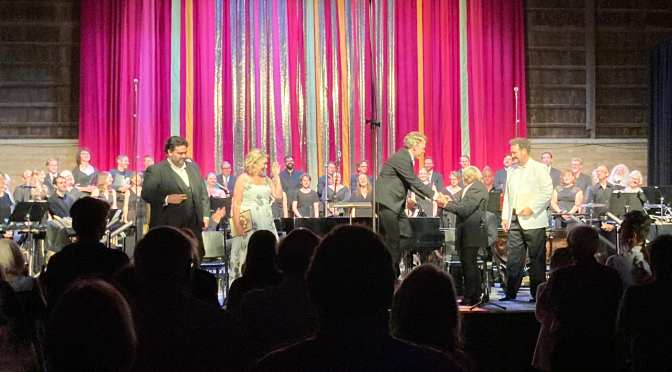
Finally, an hour of everything but the kitchen sink; how else to describe Carl Orff’s gargantuan cantata Carmina Burana, with all the previous forces plus five percussionists and three vocal soloists jammed onstage? Based on a medieval manuscript of secular poems (by disaffected monks?), Orff’s 1936 masterwork is a rhythm-dominated hour of songs about — well, sex and drink and the Middle Ages equivalent of rock’n’roll! Soprano Leslie Fagan as “the girl in the red dress”, tenor Andrew Haij in an infamously difficult cameo (as a swan roasting on a spit) and baritone Russell Braun as a variety of ne’er-do-wells played their parts to the hilt, flirting shamelessly with the front rows; the massed choir lamented the woes of Fortune (“Empress of the World”), raised way too many toasts in the tavern and egged on young lovers with a will. And even in this cut-down orchestration, the pianos and percussion slammed out one driving, kaleidoscopic groove after another. Having performed it multiple times with the Grand Rapids Symphony & Chorus, I can tell you that few classical works build up the momentum or bring the sonic spectacle this work does; with Vuorinen focusing Orff’s inventions to full intensity, the Eloras, Iselers and companions brought down the house, wild applause erupting almost before the final crescendo died away.

In short, this past Saturday proved a grand night for singing. What the Elora Festival accomplished this past weekend (and throughout the past month) is not just another set of rousing performances, but a lasting testimony to music’s ability to move, shake and thrill its creators, performers and listeners. Long may this choral festival bring the best of what’s sung and said to this beautiful village!

— Rick Krueger

To the True North!

Perhaps you might remember that, for twenty years now, my wife and I have been regular attendees at the Stratford Festival in Ontario, Canada. This week, we’re off to the north (and east) for another adventure in world-class theatre! But this time around, there’ll be additions to an already ambitious arts-going itinerary:

Now in its 45th season, the Elora Festival has established a reputation as Canada’s international choral festival, presenting world-class choirs and vocal ensembles over two weeks in July in the artists village of Elora, “Ontario’s most beautiful village”.

We’re looking forward to experiencing the Elora Festival for the first time, taking in these mouth-watering programs:

Then we’ll double back to Stratford – but before we settle into our theatre seats we’ll catch world-renowned Canadian pianist Angela Hewitt as she performs Bach, Beethoven, Scarlatti and Brahms (no pressure!) under the auspices of Stratford Summer Music.

And the plays on tap?

Watch this space for reviews and impressions, beginning later this week!

— Rick Krueger

Stratford Festival Review: Richard III by William Shakespeare

The thought will not down that an unfortunate choice was made when King Richard III was selected as the spearhead stage offering. It is definitely the most unwholesome of all Shakespeare’s tragedies, and its only character of any real dramatic interest is that of Richard himself — a physically repulsive hypocrite, liar & murderer without one redeeming feature.

— The Stratford Beacon-Herald, June 30, 1953

Defying the Beacon-Herald’s strictures, the Stratford Festival nonetheless opened its inaugural season with Richard III — with no less a personage than Alec Guinness (“the old Obi-Wan”, as I overheard a Festival-going mom telling her son a few years back) in the title role, and the results were raved about throughout the Anglophone world. Since then, the Festival has mounted the tragedy at least seven more times, with both widely-known actors such as Alan Bates (1967) and Brian Bedford (1977) and talented company members like Stephen Ouimette (1997) and Tom McCamus (2002’s 50th season) flocking to fill the part.

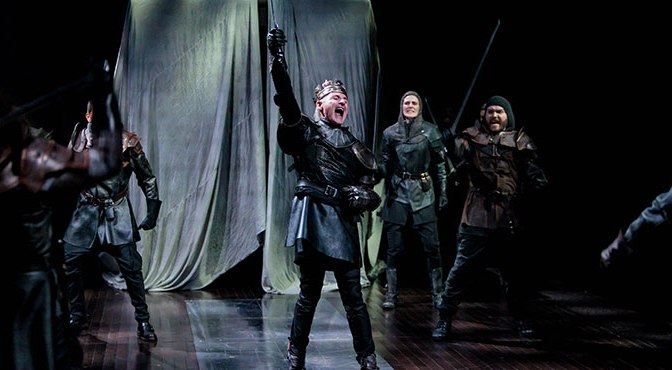
Having paid his dues at Stratford before launching into a well-rounded career that spans Canadian biopics of Pierre Trudeau & Glenn Gould and comic book movies (Thor: The Dark World and The Amazing Spider Man 2), it’s intriguing to see Colm Feore become a repeat Richard, 35 years after he first essayed the role at the 1988 Festival. His deeply physical take on the Duke of Gloucester, complete with a gait that evokes the scoliosis evident in the monarch’s recently-discovered skeleton, is visually riveting. His way with the text is equally arresting; doing without the scene-chewing excess of an Olivier, he’s nonetheless “determined to prove a villain” from the opening soliloquy, unabashedly eager to walk the Tom Patterson Theatre audience through his machinations as he claws his way toward the throne. And like Feore’s other role this season as Molière’s The Miser, his Richard becomes the focal point around which Shakespeare’s cast revolves, constantly manipulated and mesmerized by him whether they realize it or not.

Sooner or later, however, most of the other characters do discover what Richard really wants. Freed from their self-deception and ambition, it’s their reactions that give the tragedy both its recurring sparks of conflict and its building momentum. Michael Blake’s Duke of Clarence, with his dreamed intimations of his brother’s betrayal; Jessica B. Hill’s Lady Anne, whose loathing of Richard is palpable even as he perversely woos her (and wins her!); Ben Carlson’s clueless Hastings and Andre Sills’ scheming Buckingham, whose death row regrets soar to commanding heights — all these keep any empathy the audience may be developing for the would-be usurper at arm’s length.

Towering over all these are Seana McKenna (who played Richard in 2011!) as the mad, prophetic dowager Queen Margaret, calling down curses on all and sundry; Lucy Peacock, whose Queen Elizabeth soars to dizzy heights of spite and bereavement following Richard’s slaughter of her children; and Diana LeBlanc, whose Duchess of York is shocked into cursing her upstart son just as he gains the throne. This is titanic stuff — the loosely historical narrative may drive the action of the play, but the clash of deep — and deeply flawed — characters is what keeps us from joining Team Richard, despite the combined allure of Shakespeare’s words and Feore’s strange appeal. In fact, no sooner does Richard become king than we (and possibly he) realize that his downfall is inevitable — and that we need to see it, to make some sense of these tumultyous events.

Even in the intimate TPT (with one-third the capacity of the Festival Theatre), there’s spectacle aplenty to be mined by director Antoni Cimolino and the populous, well-drilled cast as Richard approaches his necessary end. Royal processions, civil unrest, a coronation, ghostly visitations and the final battle between the forces of the usurper and Jamie Mac’s enigmatic, recessive Henry Tudor stir the blood, even as they bring Richard’s lurid dreams to both their culmination and their dissolution. And while this generally traditional production is a feast for the eyes and ears that I can’t recommend highly enough, Cimolino leaves us with more food for thought as well. His prologue and epilogue are set in the present day, with the discovery of Richard’s skeleton and his reburial in Leicester Cathedral bookending the tragedy — as if to remind us that, no matter how high Shakespeare’s characters may fly, as the Bard wrote later in his career,

Golden lads and girls all must,
Like chimney sweepers come to dust.

(Cymbeline)

Richard III runs through October 30th at the Stratford Festival’s Tom Patterson Theatre. Tickets available at stratfordfestival.ca.

— Rick Krueger

Stratford Festival Preview: The Miser by Molière

Harpagon, the title character of Molière’s The Miser, is a flat-out fool. Money — getting it, keeping it, hoarding it — is his obsession; in the presence of his stash, he kneels in abject devotion. But he also projects that obsession onto everyone else in his life. He berates his adult son and daughter for their “spendthrift” ways; he lends cash only at exorbitant rates (with outrageous stipulations in the small print); his fear of both having his treasure with him and letting it out of his sight easily slides into wholesale paranoia that everyone is out to part him from it.

The thing is, Harpagon isn’t completely wrong; his single-mindedness warps how everyone in his life approaches him. Both his children hesitate to reveal their new loves to him, for fear he’ll deny access to their trust funds. His household servants (including his son’s shady buddy and his daughter’s lover) suck up to him and diss their colleagues to his face, bitching behind his back and battling for dominance all the while. The local matchmaker (who Harpagon has tasked with finding him a new, young wife) and moneylender butter him up outrageously, hoping against hope to profit from their flattery. Even the ingenue both Harpagon and his son are after wants the miser’s money — to provide for her ill mother’s medical care, but still! The farcical complications of the play flow naturally and wittily from this set-up; in the company of a master fool who has what they desire, everyone’s foolishness will out.

Where the Stratford Festival’s new production of The Miser is faithful to that core revelation of Molière’s wry fable, it sparkles with a sneaky glee — even through two layers of adaptation (Ranjit Bolt’s Anglicized translation of 2001, further updated to contemporary Canada by director Antoni Cimolino). Guarding not only his briefcase full of Canadian $100s, but every absurd knick-knack in his Victorian horror of a house, Colm Feore’s Harper is the blazing star of this show; his alternating mania about Mammon and cluelessness about everything else send everyone around him into their own eccentric orbits. The household servants — ne’er do well Fletcher (a phlegmatic, sly Emilio Vieira), butler/secret lover Victor (Jamie Mac, confident and bewildered in turn), and chef/chauffeur Jack (Ron Kennell in full clowning mode) — alternately brazen their way through Harper’s whims and unleash their frustrations on each other; matchmaker Fay (Festival stalwart Lucy Peacock, in what amounts to a well-deserved star cameo) puts on a show of managerial competence for everyone else while gingerly fumbling with Harper like he’s about to explode; love interest Marianne (an empathetic, determined Beck Lloyd) stands up for herself and her mother appealingly, even as Harper and his son Charlie scrap over her like kids on a playground.

The characterizations of Charlie and Harper’s daughter Eleanor were what struck me as the weakest part of this production. While Qasim Khan and Alexandra Lainfiesta hit the right notes of frustration and futility (aided by the campy thrift-store chic of their costuming), their amped-up desperation comes across as shrill and brittle. The struggle between a serenely ignorant father and his deprived yet somehow spoiled children — the heart of the play’s satire — is where Cimilono least trusts Molière to connect. Instead, he crams gratituous Boomer vs. Millenial references into both the program notes and the script, saddling Charlie with a petty consumerist materialism and Eleanor with a string of cliche “woke yet broke” slogans. It has to be said that Khan and Lainfiesta sell this material with all their considerable ability; but for me, the insistence on painfully present-tense content is what keeps a funny production from crossing over into the hysteria that Molière generates when played with trust. There are plenty of simmering chuckles and outright hoots here, but not as many unstoppable guffaws as I had hoped for.

That said, this production of The Miser (complete with an over-the-top fairy-tale ending that does retain its hilarious impact through the layers of updating, as David Collins’ wonderfully deadpan Sir Arthur Edgerton sticks the landing) had the Festival Theatre audience in stitches, attested by the generous, heartfelt ovation for Feore and his supporting cast. If you can peer through the alternately opaque and overripe references to “the next Bezos” and “the land of Tim’s” (oh, and Harper’s distrust of safes — they attract the FBI as well as burglars!), you may well find yourself reflected in Molière’s unflattering yet strangely revealing mirror.

The Miser is currently in previews at the Stratford Festival Theatre. It officially opens on August 26th, playing through October 29th. Tickets are available at stratfordfestival.ca.

— Rick Krueger

Live from the Stratford Festival

This is an exciting time for the Stratford Festival. In 2022, we reopen our theatres, honour the excellence of the past and embark on a new leg of our journey together. A fresh start: an opportunity to reassess ourselves in the world today, reaffirm what we value and take the best path to an extraordinary future.

This will also be a year to celebrate milestones: our 70th season, the 20th anniversary of the Studio Theatre, the 10th season of The Meighen Forum, and the grand opening of our glorious new Tom Patterson Theatre.

It’s fitting, then, that our season theme for 2022 is New Beginnings. Our playbill explores the difficult moral and ethical decisions a new journey entails: What is the best way to start again? How can we avoid the traps of the past? In an imperfect world, what is good?

From Shakespeare’s most iconic play, Hamlet, to the American family classic Little Women; from the great Nigerian Nobel Prize winner Wole Soyinka’s Death and the King’s Horseman to such captivating new plays as 1939 and Hamlet-911, we offer you stories about navigating a new start in life.

Antoni Cimolino, Artistic Director, Stratford Festival

Since 2004, my wife and I have been regular visitors to the Stratford Festival in southwestern Ontario. We’ve fallen in love with the Festival’s unbroken ethos across 70 seasons — dynamic, top-level performances by a dedicated repertory company of classics by William Shakespeare, Molière, Anton Chekhov, Berthold Brecht and others, as well as substantive, appealing musicals and fresh, often experimental works by today’s playwrights. We’ve also fallen in love with the city of Stratford; set in the heart of Ontario farm country, it combines picturesque architecture, unique shops and eateries, and a stunningly beautiful park system along the Avon River and Lake Victoria. And the thought of everyone who’s trod a stage at the Festival’s multiple theatres, played a rock show at the hockey rink or busked for change on the streets (ranging from Alec Guinness and William Shatner to Richard Manuel of The Band and native son Justin Bieber) makes the place a performing arts lover’s dream.

Which is why it hit hard when, in the wake of the worldwide pandemic, the Festival’s 2020 season was cancelled and the 2021 season only went on under severe limitations and restrictions. It’s true that the summer of 2020 brought welcome YouTube screenings of the Festival’s ongoing project to film every play by Shakespeare (along with other archival videos), culminating in the online Stratfest At Home subscription service. But, a few days back at a local B&B, with a full season of 10 productions energizing the town around us, has served to remind me that there’s nothing like the real thing. And that experience is what I plan to share here with you.

Over the next few days, we’ll be attending Molière’s The Miser (currently in previews at the Festival Theatre), Shakespeare’s Richard III (at the new Tom Patterson Theatre), and Freedom Cabaret 2.0: How Black Music Shaped the Dream of America (at the TPT’s Lazaridis Hall). Look for reviews posted here ASAP after each performance. Whether you’re able to visit the Stratford Festival this season or in the future (or take in what it offers online), my hope is to capture at least a bit of the serious fun, the sheer emotional and intellectual sweep, the thrills, spills, heartbreak and heart’s ease — in short, the immersive, cathartic experience live theatre at its best can provide, and that the two of us have come to love and crave.

— Rick Krueger

Pure Americana

Recently I was on another ferry ride to San Juan Islands, that last frontier before Alaska! In fact at various points on those islands we can gaze at the Canadian shores across the water. Most of my previous rides were during colder months of autumn and spring, so almost always I was the lone motorcyclist on the ferry. This time it was a summer group ride and also there were several other unknown motorcyclists waiting at the terminal for the ferry back to Anacortes.

Among those unknown riders was this older gentleman riding a 500cc Royal Enfield. The signature classic look and that inimitable thump, even though muffled by the newer pipes, were instantly discernible. I walked over to him and mentioned how much I have enjoyed touring on these motorcycles, but of course it was over a decade ago and it was also the older 350cc variant. Interestingly he knew exactly what I was talking about. Even though a Westerner, evidently he has been living in Nepal for a while, and has done extensive touring of Indian subcontinent. More I conversed with him, more I realized how well aware he was about the machine’s quirks, subcontinent geography, and the motorcycle culture there.

Just to put all this in perspective – my conversation is with an American several generations older to me, riding a motorcycle originally invented in Britain, but now Indian engineered and exported to the US. While I am on a British designed Triumph, and most likely manufactured in Thailand. We are having this impromptu talk on a ferry terminal, in a corner of the world so distant from the Great Britain, Thailand or India. Even in our near past, possibility of this happening would be remote. But not anymore, seems like both humans and the products we engineer travel the world.

Even though the conversation itself wasn’t about the US, this situation might just be another silent illustration of American exceptionalism. Might sound like a leap, but we are in a more cohesive, connected world because of early American Federalists. That causal chain from the formation of an experimental republic, to current world is definitely long, tortuous, and involves several complex factors. But, beneath all the layers, that mechanism underlying globalization is American driven.

American Federalism created a large open market where a set of States played well with each other. While most of the world kept creating protectionist barriers to growth, Americans were able to leverage a relatively large open domestic market to expand. Similar expansion to foreign markets indirectly created same incentives for everyone to play well with each other. Obviously there are other factors in this complex equation, but a contractual union of countries retaining their political identity, but coexisting without cultural and economic barriers sounds like pure Alexander Hamilton/James Madison Americana!

Podcast: The Return of the King

Our three-part series on The Lord of the Rings comes, sadly, to an end. A huge thanks to John J. Miller for bringing me onto his excellent show and allowing me to talk and talk and talk about some of the things I love most in this crazy whirligig of a world. A true and meaningful honor.

Here is part III:

https://www.nationalreview.com/podcasts/the-great-books/episode-163-the-return-of-the-king-by-j-r-r-tolkien/