Shop – Nick D’Virgilio
— Read on www.nickdvirgilio.com/shop/
Pre-order NDV’s forthcoming album!

Shop – Nick D’Virgilio
— Read on www.nickdvirgilio.com/shop/
Pre-order NDV’s forthcoming album!

In this brilliant account of the literary war within the Cold War, novelists and poets become embroiled in a dangerous game of betrayal, espionage, and conspiracy at the heart of the vicious conflict fought between the Soviet Union and the West
During the Cold War, literature was both sword and noose. Novels, essays, and poems could win the hearts and minds of those caught between the competing creeds of capitalism and communism. They could also lead to blacklisting, exile, imprisonment, or execution for their authors if they offended those in power. The clandestine intelligence services of the United States, Britain, and the Soviet Union recruited secret agents and established vast propaganda networks devoted to literary warfare. But the battles were personal, too: friends turned on one another, lovers were split by political fissures, artists were undermined by inadvertent complicities. And while literary battles were fought in print, sometimes the pen was exchanged for a gun, the bookstore for the battlefield.
In Cold Warriors, Duncan White vividly chronicles how this ferocious intellectual struggle was waged on both sides of the Iron Curtain. Among those involved were George Orwell, Stephen Spender, Mary McCarthy, Graham Greene, Aleksandr Solzhenitsyn, John le Carré, Anna Akhmatova, Richard Wright, Ernest Hemingway, Boris Pasternak, Gioconda Belli, and Václav Havel. Here, too, are the spies, government officials, military officers, publishers, politicians, and critics who helped turn words into weapons at a time when the stakes could not have been higher.
Drawing upon years of archival research and the latest declassified intelligence, Cold Warriors is both a gripping saga of prose and politics, and a welcome reminder that–at a moment when ignorance is all too frequently celebrated and reading is seen as increasingly irrelevant–writers and books can change the world.
To put this more positively: The future of the Church, once again as always, will be reshaped by saints, by men, that is, whose minds probe deeper than the slogans of the day, who see more than others see, because their lives embrace a wider reality. Unselfishness, which makes men free, is attained only through the patience of small daily acts of self-denial. By this daily passion, which alone reveals to a man in how many ways he is enslaved by his own ego, by this daily passion and by it alone, a man’s eyes are slowly opened. He sees only to the extent that he has lived and suffered.
If today we are scarcely able any longer to become aware of God, that is because we find it so easy to evade ourselves, to flee from the depths of our being by means of the narcotic of some pleasure or other. Thus our own interior depths remain closed to us. If it is true that a man can see only with his heart, then how blind we are!
— Read on ucatholic.com/blog/the-lost-prophecy-of-father-joseph-ratzinger-on-the-future-of-the-church/
Since 1953, the little Ontario town of Stratford has hosted what is arguably North America’s premier repertory theater. Down the decades, every summer the Stratford Festival has presented world-class productions of plays by William Shakespeare, along with other classics of the world stage and new, cutting-edge efforts. (Not to mention musicals ranging from vintage Broadway to The Who’s Tommy.)
As with so many other performing arts institutions, Stratford’s 2020 season is currently on hold. To fill the gap, the Festival’s YouTube channel kicked off free screenings of its Stratford on Film series last night — Shakespeare’s birthday — with an intense, gripping 2014 production of King Lear:
Each film of the series (an effort to film all of Shakespeare’s plays in ten years) will be available to view for 3 weeks, scheduled as below:
My wife and I have been regular attenders at the Stratford Festival for over 15 years. We return again and again because of the Festival’s consistently high quality — an acting company of impressive craft, dedication and emotional heft, working together on the unique thrust stage of the Festival Theatre and other more intimate venues, creating utterly immersive artistic experiences. (And all in a welcoming, delightful small town environment.) We hope to return later this summer to see Richard III, Wolf Hall and Spamalot (!) but in the meantime we agree: the Stratford on Film series is the next best thing to being there, and a first-class way to drink in Shakespeare’s luminous genius.
— Rick Krueger
We have nothing for always. We all know you can’t take it with you.
In Gaelic there is no word for permanent possession. Tha airgead agam nam phòcaid means I have money (temporarily) at me in my pocket. Tha bean agam aig an taigh; I have a wife (temporarily)at me at the house. Tha agus foghlam agam; I have learning at me (an education). Tha glòir agus buaidh agam. There is glory and victory at me (temporarily) Tha ìmpireachd agam. There is an empire at me (temporarily)
Similarly, the Greek philosophers taught us that nothing in life is ours to keep PERMANENTLY—not our children, not our family, not our beloved mothers, not our wives and husbands not our loyal dogs and cats. not piano, not our books, our material possessions, not our youth and vitality, not our beauty, not our pains, sorrow and losses or minor triumphs, not our brain nor our memory. You are lucky if you keep your wits late in life as your hair goes gray and limbs grow old.
My father often quoted from memory Sophocles:
OEDIPUS AT COLONUS:
Dear son of Aegeus, to the gods alone
Is given immunity from eld and death;
But nothing else escapes all-ruinous time.
Earth’s might decays, the might of men decays,
Honor grows cold, dishonor flourishes,
There is no constancy ‘twixt friend and friend,
Or city and city; be it soon or late,
Sweet turns to bitter, hate once more to love.
If now ’tis sunshine betwixt Thebes and thee
And not a cloud, Time in his endless course
Gives birth to endless days and nights, wherein
The merest nothing shall suffice to cut
With serried spears your bonds of amity.
My mother used to say, life and love are just brief moments in time so we should love each other today and be kind to each other today so as to have no regrets.
The door is locked forever and beyond it I cannot go or even knock. I still know my mother’s phone number 201 992 4871 but it has been disconnected for over 20 years now.
But I have only a few regrets. I called her at least once a week. She used to say, “this is costing money!” and I answered, “it’s cheaper than cocaine, whiskey and beer. I will cut back on them.” She laughed. She never once hung up on me.
I was was not the worst son in the world though not the best. I could have done more and been less selfish. I showed gratitude however. And we sang songs together and had a few laughs. We went to ballgames and picnics and hikes and museums. And my parents lived to know their grandchildren and they them. That was a great blessing. And soon I will see my grandchildren again. They are far away now -hundreds of miles. But I am happy they are safe.
God willing, they may get to know and remember me.
RICHARD K. MUNRO
For the last several years, Dr. Birzer has been involved in a fascinating musical collaboration with British progressive rock multi-instrumentalist Dave Bandana.[1] The collaboration is fascinating not only because of the intellectual and spiritual weight that Dr. Birzer’s concepts and lyrics bring to Mr. Bandana’s composition and performance, but also because the two men have never met in person, and have reportedly not even spoken to each other until quite recently. Dr. Birzer’s home is in Michigan, where he teaches at Hillsdale College, while Mr. Bandana resides “across the pond,” working from his studio in the Canary Islands. The collaboration began when Mr. Bandana, having “met” and become acquainted with Dr. Birzer via email, invited the latter to contribute concepts and lyrics for a CD, resulting in Becoming One, released under the name “Birzer Bandana” in 2017. Of Course It Must Be followed in 2018. The creative sparks that fly between idea man and music man are already apparent in these two exploratory releases. Now the sparks have burst into full flame, as they emerge with a new band name, a new label, and a new eponymous CD, The Bardic Depths, which was released on March 20th. They are the first band signed to Gravity Dream Music, a label run by critically acclaimed prog-rock musician and producer Robin Armstrong (Cosmograf).
— Read on theimaginativeconservative.org/2020/04/bardic-depths-peter-blum.html
By RIchard K. Munro
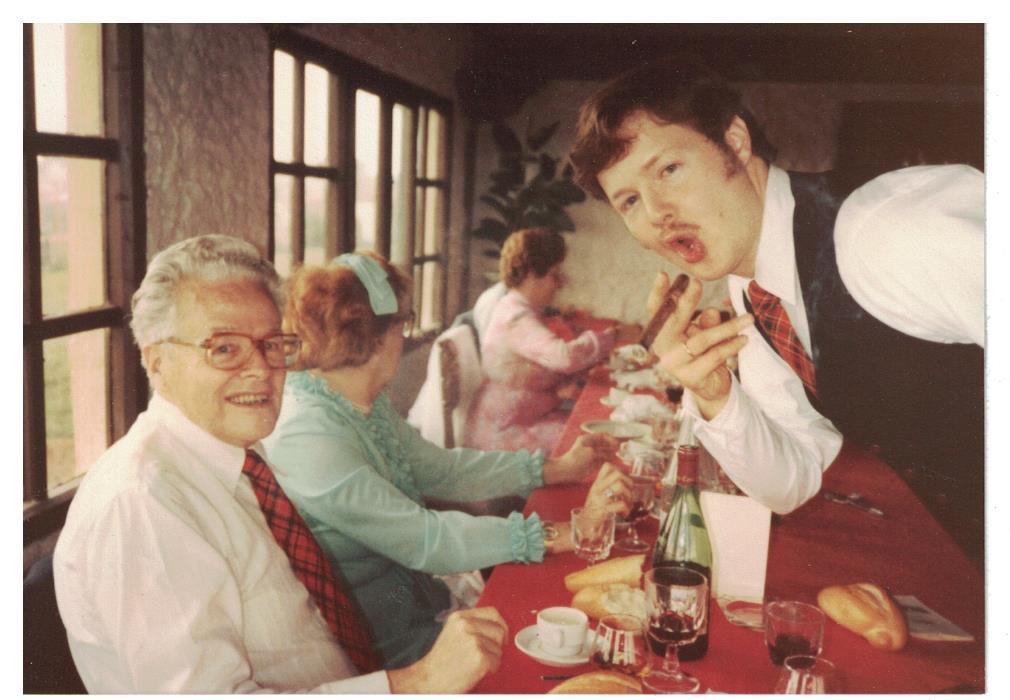
I know what it is to love a father and to lose a father.
“Death leaves a heartache no one can heal, love leaves a memory no one can steal.” is an old Irish saying.
NE OBLIVISCARIS..DO NOT FORGET.
People you love never die entirely. They live in your mind in, the way they always have lived within you. If you remember them well enough, they will speak to you and sing to you in your dreams. When you open an old book, a letter or note will drop out and you will hear their voice again.
The Silent Ones can still guide you, like the milky gleam of long-extinguished stars guided Odysseus or St. Brendan in dark nights and distant seas. When I look up from my desk I see books, art reproductions and curios that had been gifted to me or had belonged to my parents.

When I look from my dining room table I see the old Hamilton upright where we all sang, joyously, old songs while my mother played. It gave us pleasure, then, to sing songs that had been favorites of Aunt Annie (whom I never met she died in Scotland in 1936), Auld Pop, Auntie Nelsie, Granny Andy. It gives pleasure now to sing songs that my mother and father loved and when I sing it is the only time I forget that they have died. For they live in song and in memory.

‘

My father loved Shakespeare and this was quoted by Robert Kennedy when speaking of his beloved fallen brother from Romeo and Juliet:
‘
When he shall die,
Take him and cut him out in little stars,
And he will make the face of heaven so fine
That all the world will be in love with night
And pay no worship to the garish sun.
My father died Sept 27, 2003 in Germany of all places (he was visiting my sister Pat when he fell and broke his hip in 2001 he never fully recovered). Curiously, I could never forget this day because I have known this date for most of my life. Some years ago my father and saw an exhibit to Medal of Honor winners in Washington DC with my uncle Norman (Major Norman Eliasson) and Norman pointed out the DOUGLAS MUNRO -not a close relative but a Munro-who was awarded the Medal of Honor for his actions at Guadalcanal on September 27, 1942. My father said, “That’s a date you should always remember.” Then later I went to my sister-in-law’s birthday while she was studying to be a nurse in Tarragona, Spain -the only time I happened ever to coincide with her birthday while I lived in Spain. It was on September 27. And the afternoon of the day my father died my sister turned over her “poetic quote of the day calendar”. On September 27, it had a quote of Robert Burns. It was the only Scottish author in the entire collection. Truth is stranger than fiction. But it goes without saying Sept 27 is a day I will remember as long as I live. We all know the date of our death, of course, we just don’t know the year. But the date is waiting for us up there somewhere. Ten days away, a hundred, a thousand, ten thousand. Only God knows. But the date is there waiting for us.
I was lucky enough to spend but three weeks with my father in Germany in that last summer of 2003 before he died and we had a lot of laughs our last night together. It was a happy time though we all sensed it was last note of an “auld sang.” We sang a lot of songs, told a lot of stories and had a few drinks. He said goodbye to me at the airport the next morning. I remember it all as if it were yesterday. I remember the last day I saw my mother as well and Auld Pop.
And my father had a good death. He did not suffer. He lingered a day or so in the hospital listening to his favorite songs and arias. My sister said she could see tears forming at his eyes so she knew he was listening.
My father had a stroke when he was 63 in 1978 and almost died but recovered by about 90%. So those last 26 years were a special gift. My mother was an RN and she nursed him back to health. He was 89 when he died and until he was 87 he was very vigorous and healthy often traveling to Europe and California. His last ten years he just stopped driving. He felt his reflexes and vision were not good enough.
My father’s illness had a big impact on my life because I had to drop everything and think about supporting myself. I had been accepted to some graduate programs but without any significant financial aid so I passed and spent the next ten years in exile myself often on the fringe of the English-speaking world. From then on I did all I could so my father would not worry about me or worry about bills. He always would call me and say, “How’s yer wee JO-B? (Joe-b)”. He felt if you had a job and money coming in your could advance in life or at least not be homeless.
It was not as easy as I thought it would be. I had almost no money no car and no phone. I only had a PO box. I worked at many jobs which included unloading rail cars and digging ditches. In a way it was a prison sentence and exile. I just carried on hoping for the best. I felt I was sinking into poverty and there was only one way out. Hard work. Eventually, my economic life stabilized to the point I could return to school but it was a near thing. For years I simply did not have the time , money or energy to return to school. That’s a lesson I share with my student’s: “the early learning ’tis the bonnie learning and you will never be younger to learn.” For many of us life gives us only so many cards so you have to play them when you can.
How long will we live? Some of it is sheer luck. One of the healthiest and athletic men I ever met was General Pershing’s grandson. He was killed in his 20’s in Vietnam and it was a shock to me. I had a science teacher in high school and he was killed in a motorcycle accident when he was just in his 30’s. At OCS a Sea Knight helicopter crashed and 23 Marines were killed. So you never know. Of course, Auld Pop killed many men and probably saw hundreds if not thousands of men die. He saw his commanding officer killed as dawn broke May 10, 1915 (Captain Dick MacDonald Porteous: “Auld Port”. He said after that the NCO’s and subalterns fell so quickly they didn’t even learn their names. By 1917 his company had no officers, no NCO’s just one Acting Corporal (him). He always said, “Save yourrrr luck for when it counts because soonerrr or laterrrr you will rrrroll snake eyes,” Auld Pop was a great believer in luck and he believed everyone had only so much luck. So you shouldn’t ever tempt the devil. He believed in the Devil and in the power of evil:
There’s a wicked spirit
Watching ‘round us still,
And he tries to tempt us
Into harm and ill.
“Sain yersel’ frae the Deil and the Kaiser’s grenadiers” (Shield yourself or make the sign of the cross to save you from the Devil and the Germans) Tapa leat AUld POP would say, ‘ LUCK TO YOU!” To him that was the best thing you could wish anyone.
Genes are an advantage of course. “The Blood is strong” as the old Highland saying goes. But lifestyle is also important. Auld Pop died at 76 but he smoked three packs a day and had been gassed in the Great War so his lungs were shot by the early 1960’s. Today with transplants and medicine they might have been able to extend his life. HIs father lived until he was 86 so most of my forebears (if they were not killed in war or lost at sea) lived until their 80’s or 90’s. So I figure I have an even chance to make it to 80 or 90. If not, as Auld Pop used to say, “What’s the differ?” because you will never know the difference.
And we can count it as a blessing we knew our father and loved our father over many years. I had the blessing of the friendship and love of my father for almost 50 years. By contrast, my wife’s father died when she was four and she has no memory of her father. My mother was three when her father was killed and she had no memory of him also. She only knew him from family stories, old photographs and from his record collections.
So I am stoically satisfied. I am much closer to the end of my career than the beginning of it. This distance learning is somewhat bizarre to me. It is partially effective but in education, it is the Matthew effect. The rich get richer (reading Defoe, Dickens) and the poor get poorer (doing little or nothing). One cannot expect a reluctant student to become an ardent autodidact and this is partially what a home schooling student has become. All one can do is light a candle and pray for them. I have been a teacher a long time I know you cannot command anyone to learn. All you can do is encourage them and invite them to learn.
I hope to live long enough to get to know my grandchildren so perhaps they will love me more and have some memories of me. It is not likely I will live long enough to see them graduate from college or have a career or get married. It is highly unlikely I will personally know my great-grant children but I bless them all the same and say TAPA LEIBH (good luck to them!)
One of the things I plan to do in these days is to write a philosophical and biographical letter to each of our grandchildren to be opened when they graduate from high school, college or get married. I will write it in the languages I know so they will know that part of my life. I might even record part of it.I also will prepare music and readings for my funeral Mass. I hope when that date comes it will be a celebration of life and a bonnie gathering of the clans.
After all I survived the 20th century.
I know I won’t survive the 21st century.
But as Auld Pop used to say: ” Ye canna live foriver”
He loved Kipling and would quote fragments by heart
“When first under fire an’ you’re wishful to duck,
Don’t look nor take ‘eed at the man that is struck,
Be thankful you’re livin’, and trust to your luck
And march to you front like a soldier!”
So we, here, now, have to soldier on as well.
and:
“When the cholera comes – as it will past a doubt –
Keep out of the wet and don’t go on the shout,
For the sickness gets in as the liquor dies out,

An’ it crumples the young British soldier.

Crum-, crum-, crumples the soldier . .”
This time of plague will end.
And most of us will be here at the end.
So be thankful we are living and trust to our luck.
This lament is for Donald Bàn MacCrimmon who was killed at the Rout of Moy in 1746. It was his death and the death of his cause but symbolically the death or near extinction of Gaeldom as well.
| Tuireadh Mhic Criomain | MacCrimmon’s Lament |
| Dh’ aidh cèo nan stùc mu aodann chuilinn | The mist of the stacks is about the face of the Cuillinn |
| ‘Us sheinn a’ bheinn-shith a torman mulaid | And the fairy woman has sung her sad song |
| Gorm shuilean ciuin san Dun a’ sileadh | Gentle blues eyes in the fort are crying |
| O’n thriall thu bhuainn ‘s nach till thu tuille | Since you left, and will never return |
| Sèist: | Chorus (after each verse): |
| Cha till, cha till, cha till Maccrimmain | He will never return MacCrioman |
| An cogadh no sìth cha till Maccrimmain | In war-time or peace he will never return |
| Le airgiod no ni cha till Maccrimmain | With neither money nor possessions he will return |
| Cha till e gu bràth gu la na cruinne | He will never return ’til judgement day |
| Tha osag nam beann gu fann ag imeachd | The sigh of the hills is weakly departing |
| Gach sruthan ‘s gach allt gu mall le bruthach | Each stream and brook go slowly down the hillside |
| Tha ealtainn nan speur feadh geugan dubhach | The birds of the sky are sad in the branches |
| A caoidh gu’n d’fhalbh ‘s nach till thu tuille | Lamenting that you left and will never more return |
| Cha chluinnear do cheòl san Dun mu fheasgar | Your music will not be heard in Dunvegan in the evening |
| ‘Smac-talla nam mùr le muirn ga fhreagairt | And the echo of the ramparts mourning in answer |
| Gach fleasgach us òigh, gun cheol gun bheadrach | Each handsome man and maiden without music or merriment |
| O’n thriall thu bhuainn, ‘snach till thu tuille | Since you left us and never will return |
By Richard K. Munro
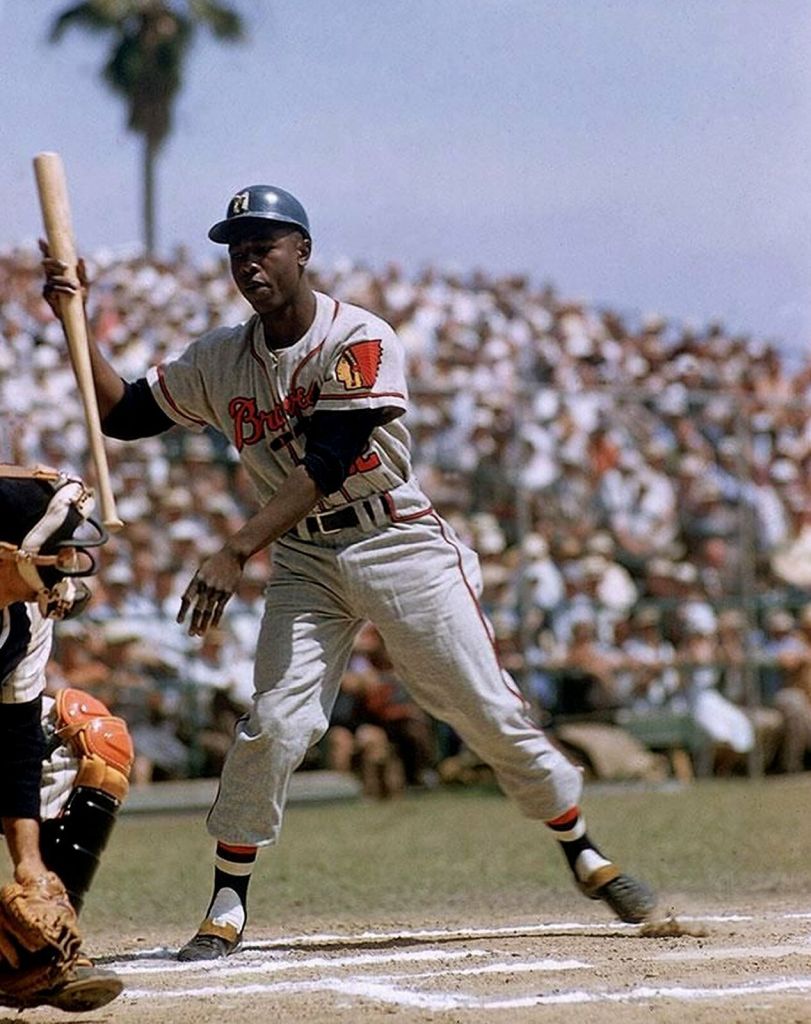
When I was a kid (about 12) I wrote a short essay: “THE GREATEST DAY IN MY LIFE” It was about my friendship with Hank Aaron from afar. He knew me, in a way, I always had the same banner out there “NAIL ‘EM DOWN Hammerin’ Hank.” He always waved at us when he went out to right field.
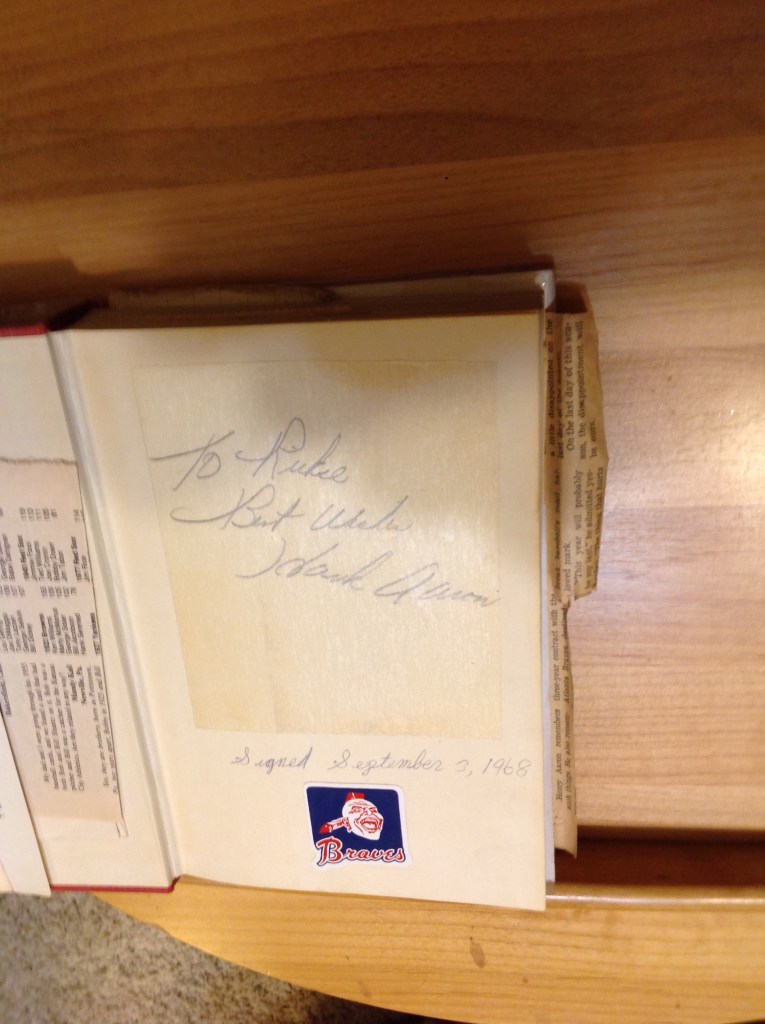
And when the cop said, “This kid has your book on its first day out! What do you think? Could you sign it for the kid? ” Hank said, “What’s the kid’s name?”Rickey” , said the big good natured cop. The game was about to begin. He signed it and they passed to book down the dugout from player to player and back to the cop and then to my dad and me. He signed it with my Dad’s scorecard pencil.
My dad actually apologized he didn’t have a pen and I said, “Dad, nothing could be better than Hank Aaron to sign his book with my Dad’s scorecard pencil.” To top it all off the game was just about to begin.
The first man walked and the second man struck out. Then the announced him: “NOW BATTING, number 44 Hank Aaron”: Hank was all business at bat. No distractions.
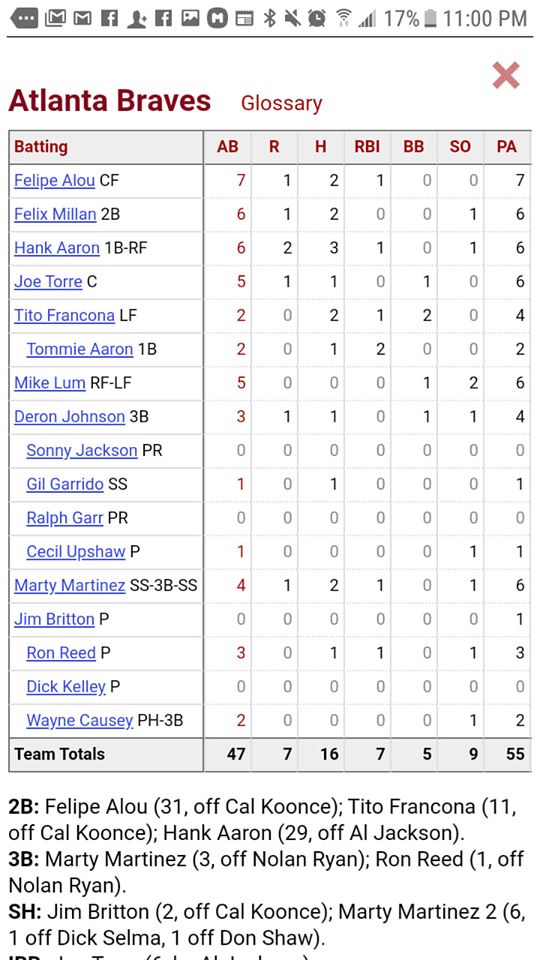
The first pitch was a ringing double down the left field line for an RBI. I couldn’t have been more thrilled. Here was my baseball hero and here he came through right then and there when he knew I was watching!
At 2nd base, Hank doffed his hat. I knew he doffed it for me.
So I wrote about it for school and said, THIS WAS THE GREATEST DAY IN MY LIFE
. As a young boy I loved baseball and my favorite baseball player of all time was Hank Aaron of the Milwaukee Braves and later Atlanta. We were Dodger fans, of course, but the Dodgers moved away and I sought authentic Yankee Killers and my father entranced me with stories of the 1957 World Series. If you watch the 1957 official films you can see my father and some Dodger fans rooting for the Braves. Always was an NL fan primarily. My father loved Duke Snider and my grandfather loved Zac Wheat! But they saw all the great players of the 1920’s 30’s 40’s 50’s and early 60’s and told me all about them. The greatest part of baseball was sharing those days and nights with Auld Pop, my grandfather, my mother, my sisters, boyhood friends too but especially my father. We spent a lot of time together and I went to more baseball games with him than anyone else. Looking back I realize he really went out of his way on work nights and when he was on business trips in Philadelphia, Baltimore and Atlanta to get me in on some baseball games.
Once he and his business associate set me up with a beautiful southern girl. I was very polite to her. After the game, he asked her, “How did the evening go?” She sighed. “He’s already deep in love!” The man said, “Yeah? With who?’ “With Hank Aaron and baseball!” And though she was a very pleasant young woman I didn’t ask for her autograph or her address. After all, she had never heard of Babe Ruth or seen the Braves play. I was young enough (12) not to be distracted by feminine charms. What was a girl compared to BASEBALL? Of course, a few years later I skipped a few ballgames. After all, a woman is a woman.
And Hank Aaron had retired.
My mother said, “You aren’t going to miss the big game?”
I told her, “I have a rendevouz with a beautiful dame.”

“Does she like baseball?”
“Frankly, mom, I haven’t got around to that. All I know is have a date with a beautiful, dusky, dark-haired girl with a fetching smile who speaks English reasonably well with a slight Spanish accent.”
“So for a Latin lover you will miss the big game!”
“Mom, I will read the box score in the morning! You can tell me about any big plays.”
And I added, ” I will let you how my game will go. I expect to get , at the very least to second base. After all she is eager and twenty.”
At twenty I would not have written the same story as the GREATEST AND MOST MEMORABLE NIGHT of my life. She liked me so much we went to a Bosox Yankee Double Header at the old Yankee Stadium. We had a brief romance in our innocent way.
Perhaps the night or the game was memorable to her but I have forgotten her name. But I remember this.
She held my hand and kissed me goodnight.
And I never lied to her or caused her to cry. And there is no doubt, I remember the box scores and ball players more than the women of those years. But it was the time I suppose. Few of the women I met liked baseball or really wanted a serious relationship. And those were two things I knew would be part of my life: baseball and one girl to be my lifetime companion. God shone on me of course.


By Richard K. Munro
My uncle (Norman Eliasson) served with the 10th Armored Division and used his German to pass through the German lines in December 16, 1944 thus avoiding capture and possible execution. His plan was simple he said, “Achtung!Deutsche Soldaten der 1. SS-Panzer-Division Leibstandarte-SS Adolf Hitler Hierkommt der Feldmarschall! (“Men of the… here comes the Field Marshall!”) The Germans all stood to attention –obeying orders as my uncle had hoped- so my uncle and his fellow American soldiers drove right through the front lines in their jeep without a single shot being fired until they were long gone !
My uncle did get in trouble getting through the American lines because the American soldiers of the101st Airborne quizzed him about baseball and my uncle who had not grown up in America knew very little about the game. He had been to Ebbets field however and managed to name some Dodger players. But what really convinced them was his knowledge of Jewish delicatessens in New York, the subways and the streets. My uncle had been a delivery boy during high school! And of course, he could speak a little Yiddish as well (very similar to German).

https://www.thestate.com/news/local/military/article14388251.html


You must be logged in to post a comment.