
Now, three decades after the fall of the Soviet Union, we have Red Storm Rising’s more than worthy successor, Red Metal, by Mark Greaney and Lt. Col. Hunter “Rip” Rawlings IV. While Lt. Rawlings is new to me, I have been reading Mr. Greaney’s novels for over a decade. He roared onto the literary scene during the revival of Tom Clancy co-authored books around 2010 and with his own extraordinary novel and hero (or anti-hero), The Grey Man, a year earlier. I have had the chance to praise Mr. Greaney several times, but never enough. Mr. Greaney is, in every way, our current and better Tom Clancy, taking thrillers into the twenty-first century. By this, I mean that Mr. Greaney fully understands that we live in a post-Communist world, a world of fundamentalisms as well as of nation-states and tenuous alliances. His own analysis of world affairs—though couched in fiction—is every bit as interesting as that coming out from any current periodical or think tank.
— Read on theimaginativeconservative.org/2020/02/making-sense-chaotic-world-red-metal-bradley-birzer.html
The Awesome 1980s
It’s hard not to laugh when my students think they’re imitating or comprehending the zeitgeist of—whether to honor or mock—the 1980s.
Though, in almost every way, it’s impossible to fault them for this.
The individual members of the incoming freshman class will have entered this world sometime in 1996 or 1997, a full seven to eight years after the collapse of the Berlin Wall. To their active and eager minds, the 1980s meant lots of repetitive electronic pop music, an MTV that actually played music videos, leg warmers, bright colors, big checks and plaids, baggy pants and oversize shirts, top siders, goofy hair styles, televangelists, “duck and cover” safety from nuclear weapons, general happiness and prosperity, and John Hughes movies. It was a time before time, an era without wardrobe malfunctions, wacky chief executives, or reality TV.
Not all of these memories are wrong, of course, just selective.
From what I can tell, most current students idealize the decade in much the same way my generation—coming of age in the 1980s—viewed the 1950s. That nearly perfect decade represented peace, prosperity, primitive rock music, American assertion of power without lots of consequent deaths, innocence and naiveté, white t-shirts with packs of cigarettes rolled up in one’s sleeve, poodle skirts, leather jackets, James Dean shades, motorcycles, Marlan Brando cool, and tail fins on huge cars.
Everything, of course, was in black and white as well in the 1950s.
Well, so we thought.
But, two things must be remembered by those of us who lived in the 1980s and who want to teach our students the truth.
[Please continue to read on page 2]
Why I Went to CU: An Interview
An interview with Clint Talbott, Summer 2014.
Why did you choose a life in academe?
Two of the finest persons I knew as a child were my maternal grandfather and mother, both teachers. One Saturday, my grandfather decided to take me to the Sternberg Museum of Natural History in his hometown of Hays, Kansas. He was always incredibly dignified. As we drove onto the campus of Fort Hays State, he saw a parking spot reserved for “Professor” somebody. He looked at me with his typical mischievous eye, and said, “Bradley, today, I think I’ll be a professor.” Whatever reason, I knew that a professor was somebody of importance (who, after all, could be wiser than my grandfather?), and the idea stuck with me throughout all of my schooling. I also had the great fortune of having a number of amazing teachers and professors, from grade-school Dominican nuns to some of the best lecturers and thinkers imaginable at the University of Notre Dame and Indiana University.
How would you characterize the state of political discourse in the United States today?
Terrible. Absolutely terrible. But I must admit, I write this as a 46-year old jaded romantic who once would have given much of his life to one of the two major political parties.
Political discourse as of 2014 comes down to two things 1) loudness and 2) meaningless nothings. Oration is a dead art, and the news from CNN, Fox, and other outlets is just superficial talking points with some anger and show. Radio is just as bad, if not worse. As one noted journalist, Virginia Postrel, has argued, we probably shouldn’t take anything that someone such as Ann Coulter says with any real concern, as she “a performance artist/comedian, not a serious commentator.”
Two examples, I think, help illustrate this. Look at any speech delivered by almost any prominent American from 1774 to 1870 or so. The speeches are rhetorically complicated, the vocabulary immense, and the expectations of a well-informed audience high. To compare the speech of a 1830s member of Congress with one—perhaps even the best—in 2014 is simply gut-wrenchingly embarrassing.
Another example. The authors of the Constitution expected us to discuss the most serious matters with the utmost gravity. Nothing should possess more gravitas in a republic than the issue of war. Yet, as Americans, we have not engaged in a properly constitutional debate on the meaning of war since the close of World War II. We’ve seen massive protests, some fine songs, and a lot of bumper stickers, but no meaningful dialogue.
As a humanist, I crave answers for this, and I desire a return to true—not ideological—debate and conversation. Academia has much to offer the larger political world in this.
If you were asked to summarize what you hope to accomplish during your year as visiting scholar, what would you say?
I have dedicated my own academic career to the study of two things: 1) the human person as a unique manifestation of universal truths in a culturally- and temporally-specific setting; and 2) the humanities as best understood through the classics of western (and, at times, world) civilization.
CU is already rich in all of this, but I hope to add to that richness and to benefit from the same. No community can survive without a conversation with those of the present, those of the past, and those who are to come.
The Visiting Scholar in Conservative Thought and Policy at CU-Boulder was created because of a perceived imbalance of perspectives among faculty; do you see this as an issue that should be addressed, and, if so, how should it best be addressed?
Though I grew up (in Kansas) vacationing in Boulder and the Boulder area, I have only been a part of the campus community on the day I came for the interviews. Of course, I had a brilliant time. Regardless, I don’t really know what the state of discourse is on CU’s campus. I plan on being involved in as many discussions as possible, and I also plan on sharing those discussions with non-Coloradans through the website, The Imaginative Conservative (imaginativeconservative.org).
And, of course, it’s an absolute privilege to be invited to be an additional voice in such a vibrant intellectual community of scholars as that in Boulder. My voice, I hope, though will be that of Brad Birzer who happens to have strong conservative and libertarian leanings rather than as a libertarian or conservative who happens to be named Brad Birzer.
And, as much as I appreciate a relatively recent historical figure such as Barry Goldwater, I still much prefer Cicero and Virgil.
How do you view the value of higher education today, particularly given its rising cost and rising student-loan burden?
This is a terribly difficult problem, and, from what little I know of economics, so much has changed over the past fifty years due to strange incentives in funding, etc. But, we also continue to specialize and specialize in our professions and disciplines to the point we can no longer talk across the self-imposed barriers. A person might gain from this, but a society and the persons that make up that society do not.
I’m rather a devoted patriot of and for liberal education. From Socrates forward, the goal of a liberal education has been to “liberate” the human person from the everyday details of this world and the tyranny of the moment. Our citizenship, as liberally-educated persons, belongs to the eternal Cosmopolis, not to D.C. or London or. . . .
College-level education must return to the fundamentals of the liberal tradition. Interestingly, this is the least expensive way to teach and to be educated. The best education involves a professor, a group of students, a primary text, and three hours a week in discussion.
Given how readily available the texts of the greats have become through the liberation and decentralization of publishing through the internet, the complete writings of Plato are within reach of anyone with access to the web.
Real education does not have to be expensive.
This is in no way meant to discount professional education. Training for engineering, law, the sciences, etc. is vital for a functioning and healthy world and happy citizenry.
But, in our own titillation with what we can create, we often forget what came before and what will need to be passed on in terms of ethics and wisdom. The best lawyer, the best engineer, the best chemist, will be a better person for knowing the great ideas of the past: the ethics of Socrates; the sacrifice of Perpetua; and the genius of Augustine.
Lecture: Cato, A tragedy
How Joseph Addison’s 1713 play, CATO: A TRAGEDY, fundamentally shaped American republicanism, the American founding, and, especially, George Washington.
A huge thanks to Christine Dunn Henderson, Mark Yellin, and everyone at Liberty Fund for such an outstanding edition of the play.
Please listen, like, share, and subscribe!
V for Vendetta
Throw together an English Roman Catholic terrorist from 1605, a 1930’s noir atmosphere, a damsel who is only somewhat in distress, a government that makes Ingsoc look humane, some psychedelics, some fortuitous but random evangelical proof texting of The Collected Works of William Shakespeare, some references to the mass killings of the twentieth century, a bit of Ray Bradbury, Max Ernst, and Patrick McGoohan, a rather tame lesbian romance, a fictional 1980s that went exactly against what actually happened, and two young cocksure perfectionist English artists who wanted to avoid mimicking their American counterparts. You probably still would not end up with the disturbing masterpiece that is V FOR VENDETTA. J
A penny for the English guys.
Written in the first third of the 1980s but not published as a graphic novel until 1988, V FOR VENDETTA broke into the cultural mindset of the intellectual rising generation like nothing else.
For someone growing up in that decade—with New Wave, Blade Runner, Reagan, Rush, New Wave, Macintosh, Red Rain, and Nuclear Winter—V FOR VENDETTA took the extreme desires and fears of a whole generation and made them into a coherent (mostly) tale.
If John Hughes captured our most adolescent suburban libertinism, V FOR VENDETTA made them into our most terrifying libertarian nightmare.
The story, written jointly by Alan Moore and David Lloyd, takes place in the late 1990s. In 1983, a Labour government replaced the Tories, kicking out the American nuclear missiles, thus leaving the U.K. free from destruction. Soon, the Americans and the Soviets went after each other, leaving America, especially, in ruins.
The resulting economic turmoil in Europe led to the rise of a National Socialist/Fascist government in Britain. Though the leaders personally gave into every lewd pleasure in and out of the bedrooms, they outlawed homosexuality, non-whites, and non-Protestant Christians. Those who weren’t deported or executed found themselves in prison camps, the playthings of progressive eugenicists, willing to see the body contorted in every possible manner to “perfect the race.”
Under the slogan “England Prevails,” the fascists maintain control through mass surveillance as well as through armed thugs known as “Finger Men” who have the power to kill, rape, and pillage at will, all in the name of England. Signs litter the streets with the hypocritical propaganda: “Strength through Purity; Purity through Faith.”
Of the internment camps, one of the most brutal was the Larkhill Settlement, out of which emerged the anarchist anti-hero, V. The authors intentionally keep his identity hidden, as he represents an idea more than an individual person. Still, the reader does come to know that V had been interned and had survived the experiments. In some way, never explained, the experiments made him more human than human, endowing him with extraordinary powers of resistance to bodily harm, astounding concentration and memory, and near perfect agility. It would, however, be better to describe the final product of the experiment as the creation of a Batman rather than a Superman. The only one of the test subjects to live, V gained the favor of his captors, set the camp aflame, and departed.
The main story takes place years after the destruction of Larkhill. Now, one by one, every person who ever worked at Larkhill is being systematically murdered. Though, the more appropriate term would be “assassinated.” V, of course, is proudly the killer. He not only kills his victims, but he does so with immense poetic justice. Each person assassinated—reminiscent of Dante’s Inferno—dies according to his or her vice.
A Story of Friendship: Star Trek
As young children, my older brother and I watched the original Star Trek series on Saturday mornings. We weren’t big TV watchers as a family, but Star Trek was special. To make it even better, it was the local PBS that aired Star Trek, presenting it free of all commercials.
Every Saturday, Todd and I awoke very early and watched the rerun for that week. This would have been around 1975, almost a decade after the show first aired. After each episode, Todd and I would talk, always mesmerized by the possibilities of space, life, and a billion other things. How much of the galaxy had this crew explored? Were they the modern Lewis & Clark? What happened when someone transported from one place to another? How smart were the computers? Were the Klingons the Soviets and the Romulans the Chinese? Or, maybe the other way around? Why did we only see the military aspects of Starfleet? What about the colonists, the pioneers? How did time travel work? If the Enterprise found itself sent back to Earth, why did it happen to arrive the same year the show was being filmed.
Pretty serious stuff for an eight year old sitting with his much admired thirteen year old brother.
I had no idea at the time, but the show’s founder and creator, Gene Roddenberry had actually described Star Trek as a “wagon train to the stars” when he first shopped it to studios. It would be set, though, on the space equivalent of an aircraft carrier, a mobile community as diverse as Gunsmoke’s Dodge City, he continued in his show treatment. The crew, roughly 203 of them, would be as diverse as possible, asserting that racial prejudice and ethnic strife would be things of the past in the non-specified time of Star Trek. Only later did the show writers decide it took place in the 2260s. From its beginning, however, Roddenberry’s Star Trek represented a brash Kennedy-esque liberalism, a confidence that America could teach the world the principles of civilization, tolerance, and dignity. [Sources: Whitfield and Roddenberry, THE MAKING OF STAR TREK (1968); and Paul Cantor, Gilligan Unbound (2003) and The Invisible Hand of Popular Culture (2012)]
[Please continue reading on page 2]
What's in a name? Latinos i have known and loved
Many years ago I was reading Don Quixote in the original Spanish for the first time. I remember I encountered the word “Latino” for the first time. So there are “Latinos” in Don Quijote. But wait! The way Cervantes meant the term it didn’t mean “Latino” but “Latinist” that is someone who could read and write Latin. Ruben Navarrette writes:
“Of course, I speak about what the Latino literati has been referring to cryptically — and often angrily — as “the book.”
The book is “American Dirt,” and it’s a novel, which is to say that the admittedly riveting story it tells — about a Mexican woman and her son who leave their comfortable life in Acapulco and head for the U.S.-Mexico border as they flee drug cartels — never happened.
How fitting, then, that this make-believe story would be written by a make-believe Mexican.
New York City-based Jeanine Cummins was born in Spain, but only because her Navy father was stationed there. She has lived her entire life in the United States, where she has identified as “white” and studied English in college.
Cummins does have a Puerto Rican grandmother. But she doesn’t appear to have spent much time over the years identifying as Puerto Rican.”
Of course, you know being born in Spain and having a Puerto Rican grandmother DOES make one (if one wants to claim it) officially Hispanic. Of course, as we know there are elites among Hispanics themselves so i don’t need to list them.
Suffice it to say if one’s father is a medical doctor and one’s mother was a teacher in a private Catholic academy and one graduates from a private Jesuit academy one is very privileged and more likely to succeed in an American high school or junior college.
Only a small minority of my students are high school graduates (from overseas) but those who are or who graduated from the 8th grade in Mexico or Central America usually have an advantage and usually graduate from high school and go on to college. It is an advantage, even if one knows little English, to have studied Latin, to know the parts of speech, to have a high level of cultural literacy in one’s native language as compared to someone with a very spotty elementary education or perhaps not even a native Spanish speaker (being a native speaker of an indigenous language).
I grew up speaking two languages (other than English), including Spanish (my father and uncle could speak Spanish reasonably well -my father read, Garcia Lorca, Machado and Cervantes in the original -he was an avid amateur linguist). But I never once claimed to be of Hispanic origin (because I am not) or even a national from another country (though I have strong cultural and linguistic ties to the Gaeltacht). None of my grandparents or great-grandparents were native English-speakers.
Of course, by heritage, I am a Gael but I know and have always known that I am the last of my race; my children and grandchildren will all be part of la raza cosmica. At this point every person in my family under the age of 40 is a native Spanish speaker and most are Mexicans or Mexican-Americans. How they identify themselves in the future is up to them. I just take for granted they will not speak my language or know much if anything about their paternal grandfather’s culture. The languages of Empire and the highest utility triumph. That’s why Gaulish and Celtiberian are extinct and most Native American dialects. Spanish and English are world languages as my language is not and I cannot lament the disappearance of our language (only a few people over age 60 speaking it in our family now and no one under the age of 64). As my grandfather told me more than 50 years ago -and he did not speak to me in English- “We lost the war. English is the language of the banks and the long-range guns.”
The languages of the big battalions and Empires always have an advantage over scattered broken tribes and clans. My English-speaking friends cannot understand the persistence of Spanish. I tell them it was CREATED and FORMED as a universal language of Empire. The Empire might be gone but the roots of that culture and thickness of the trunk are both deep and wide. In North American Spanish is the only possible rival to English. In my opinion, Spanish will survive into the 22nd century.alongside of English.
My language probably will not. The writing was on the wall for the Gaels long ago -Flodden, Kinsale and Culloden. The last leaves of that linguistic tree will fall sometime this century.
Christopher Dawson: Preparing to Fight Modernity
Too sickly to fight in the Great War, Christopher Dawson volunteered for civilian duty and spent roughly fourteen years reading and drawing up ideas to prepare for a career in writing. He had received a profound mystical vision on Easter, 1909, while visiting Rome. In that vision, the nineteen-year old Anglo-Welshman believed God had commanded him to record the entire history of the world, showing him all times and all peoples at once. Determined to live up to what God had asked him, he began building upon an already solid liberal education.
During these years, he kept extensive notes and journals influential writings included in his notes came from the significant historians, anthropologists, and thinkers from every school of thought from his day. Generally, he took notes in the same language as the original texts, and he delved deeply into Plato’s Laws and the various writings by Aristotle, Xenophon, and Heraclitus. In his journals, now residing at the University of St. Thomas in St. Paul, one can see vividly that Dawson readily moved through a variety of languages including English, French, Greek, and Latin.[1]
In the same notebook, presumably after reading the above authors, Dawson concluded tellingly: “All the events of the last years have convinced me what a fragile thing civilization is and how near we are to losing the whole inheritance which our age might have acquired [sic] enjoyed.”
In addition to his voluminous academic and scholarly reading, he also devoured wht works of Jane Austen, Henry David Thoreau, P.J. Wodehouse, Hilaire Belloc, G.K. Chesterton, H.G. Wells, R.H. Benson, Arthur Conan Doyle, and a huge selection of science fiction, historical fiction, American westerns, and English detective stories.[2] G.K. Chesterton, especially, influenced Dawson, as the latter regarded him as “one of the greatest champions of Christian culture in our time.”[3] Chesterton’s most influential work on Dawson was his epic poem, The Ballad of the White Horse [read from this?]. This poem, perhaps the most significant call to arms for twentieth-century Christian Humanists, equally inspired C.S. Lewis, J.R.R. Tolkien, and Russell Kirk.
[Please continue reading on page 2]
Stephen Humphries: Playlist January
Stephen Humphries: Playlist January
— Read on stephenhumphries.blogspot.com/2020/01/playlist-january.html
The Overshadowed Child of Big Big Train

I freely admit that I am an Anglophile. When I was 13, my father took a one-semester sabbatical from Vanderbilt University – where he was a materials science professor – to do research at Cambridge University. He loved to tell me how he worked in the same lab where J. J. Thomson discovered electrons. Our family lived in a house in Cambridge, and I went to school at Comberton Village College. The few months we were there were some of the happiest of my life.
I don’t know how we first learned about brass rubbing, but we quickly adopted it as our family hobby while we lived in England. Brasses are engraved plates of brass that were placed over tombs in English churches. They were popular from the 1200’s until Victorian times, and they were often quite ornate representations of the person they commemorated. Many are over six feet long and portray knight crusaders. Others are more modest in size, and they might represent prosperous merchants or accomplished academics.
Brass rubbing is the same as putting a penny under a piece of paper and rubbing it with a crayon. As you rub, all the details of the penny emerge onto the paper. With a medieval brass, it’s same principle, just on a much larger scale.
My family had a book that catalogued all of the brasses in Europe and Great Britain. Every week, we would locate a promising brass somewhere within driving distance and spend a Saturday afternoon making rubbings of it. Some small country churches had many beautiful examples, hidden under old rugs in the aisles, or atop sarcophagi in side chapels.
I wasn’t aware of it at the time, but our family hobby ended up being a marvelous way of visiting out-of-the-way villages all over East Anglia. We even got fairly proficient at spotting churches that were likely to contain hidden brass treasures. While we worked, the local vicar would often stop by to chat with us and share the history of the church and the person under the brass. To my 13-year-old eyes and ears, these impossibly old churches and the persons buried in them came to life, and I grew to love British culture and history.
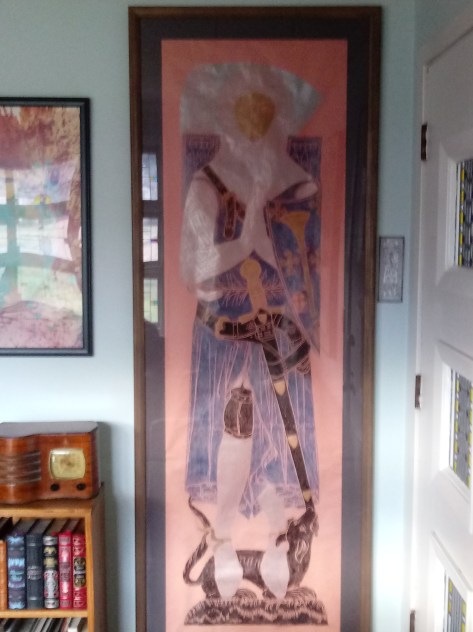
Which is a convoluted way of explaining why I also love Big Big Train, possibly the most “British” group working today. In song after song, they sing of forgotten heroes and heroines, everyday Britons who labored without complaint to make their communities safe and prosperous. As an American, I don’t understand all of the references in their lyrics, but, God bless ‘em, their albums contain enough notes for me to get the gist of what they are trying to convey.
One of Big Big Train’s albums that is most grounded in English life is English Electric Part One. (Even the title is a reference that is easily missed by a non-Britisher. English Electric manufactured diesel engines for trains.) It is also one of the strongest set of songs they ever recorded.
Released in September of 2012, it came two years after BBT’s Far Skies, Deep Time EP, and three years after The Underfall Yard. So BBT fans were eager to hear new music from them, and English Electric did not disappoint. From the energetic opener The First Rebreather to the immensely satisfying closer Hedgerow, there is not a weak track on this perfectly sequenced album. Even the cover art, featuring Matt Sefton’s close up photos of rusted and worn metal surfaces, contributes to the sense of past glories and forgotten men and women.
The Underfall Yard was the first album that featured vocalist/flutist David Longdon, and with English Electric Part One, he is a fully integrated member of the group. Drummer Nick D’Virgilio is also officially on board, so the original core trio of Greg Spawton, Dave Gregory, and Andy Poole is now a quintet.
The First Rebreather is a tale of diver Alexander Lambert, who, in 1880, used an experimental “rebreather” (like today’s scuba equipment) to rescue some workmen who were trapped in an underground tunnel. While they were digging the tunnel, they struck a spring which quickly flooded their exit. Lambert used the rebreather to swim 1000 feet in total darkness to reach the trapped workers. Greg Spawton brilliantly imagines Lambert as a “mummer” (a British folk actor who brings dead characters to life). The guitar-driven melody features a beautiful string interlude composed by Dave Gregory. The musical tension builds inexorably until it is blessedly released with the spring water bursting out to the words “Here she comes/the sleeper wakes/ten thousand years/she lay in wait for this.”
After the intense drama of The First Rebreather, we need a little relief, and Longdon’s Uncle Jack is the perfect song for that. It starts with a down-home banjo riff that is soon augmented with fiddle, keyboards, double bass, and melodica. It features one of the most infectious melodies BBT has ever recorded, particularly when Lily and Violet Adams chime in on background vocals to sing, “Rose Hips/Haw Berries/Hedgerow/Dry Stone/Dog Rose/Honeysuckle/Blackbirds/Red Wing” – all inconspicuous and mundane sights of an outdoor stroll, but to Longdon’s coal miner Uncle Jack they are magical elements that cannot be taken for granted. Spending hours toiling underground makes any time in the sun outdoors infinitely precious.
Spawton’s Winchester From St. Giles’ Hill is a beautiful ode to the historic town of Winchester. Its heritage goes back to ancient times of chalkhills and Alfred. Danny Manners’ piano and Longdon’s flute combine for an exquisite duet on this celebration of a quintessentially British town.
Judas Unrepentent is a tribute to Tom Keating, a frustrated artist who turned to painting forgeries of masters’ works to undermine the art establishment. He left clues in all his works, and he was eventually found out. He has since passed away, but he has the last laugh, as his art now fetches high prices. “So now we can all buy/Real genuine fakes/That’s posthumous fame/It’s always the same”. Another Longdon composition, this track features an insistent rhythmic base supporting an irresistible melodic hook and cascading vocal harmonies. It is one of the most enjoyable songs in BBT’s entire catalog.
Summoned By Bells is a gentle celebration of Spawton’s mother’s hometown of Leicester. Spawton’s lyrics describe the nostalgia and disorientation one feels when returning to a place of one’s childhood after it has changed and evolved: “A stone’s throw from the line/some of the old places survive/ a golden thread in time.” Once again, Danny Manners’ piano playing is masterful, and a musical theme emerges that will be heard again in the finale, Hedgerow.
Upton Heath is a Spawton/Longdon collaboration, and it draws on the strengths of both songwriters. The melody conveys a yearning that cannot be put into words, yet the lyrics complement it perfectly. Ethereal voices sing, “And all that we are/And all that we shall be/Walk with me/Up on Upton Heath” and transform the simple activity of strolling through the countryside into a sacramental act. The instrumentation is all acoustic – this is timeless folk music, and like the best folk music, it manages to evoke contradictory emotions. Listening to it makes me melancholy and joyful at the same time. It is a masterpiece, plain and simple.
From the heavenly heights of Upton Heath, we are brought down to earth with a crash by the harrowing A Boy In Darkness. This song begins with a clear-eyed depiction of the horrors of child labor in 19th century British coal mines and fast forwards to the suffering of abused children in our supposedly more enlightened times. It is a fearless and unflinching song, performed with sensitivity. It doesn’t preach; it just makes its case. You have to have a heart of stone to not say a prayer for the young innocents who suffer after hearing this song.
English Electric Part One finishes with another masterpiece, the Longdon/Poole/Spawton composed Hedgerow. An ebullient guitar riff kicks it off, and before you know it, we’re off on another jaunt outdoors with Uncle Jack. Musical and lyrical motifs from Uncle Jack, Summoned By Bells, and Upton Heath pop up, tying together the entire album into a satisfying whole. It is the perfect conclusion to a song cycle that celebrates all that is good (and weeps for some that is bad) in England.
I titled this reflection on English Electric Part One The Overshadowed Child Of Big Big Train, because one year later they released English Electric Part Two, and a few months after that they combined both (with a few extra tracks) into English Electric: Full Power. Full Power is a gorgeous two-disc package with a huge full-color booklet featuring explanatory notes on every song, brief bios of all the contributors, and beautiful photos. It makes sense to plunk down the money for the two-disc set, right?
Well, yes, but I also want to make the case for English Electric Part One as a major work that deserves its own place in the BBT pantheon. As I stated at the beginning of this essay, it is a perfectly sequenced album, moving effortlessly from peak to musical peak. Spawton and Longdon both subsume their individual songwriting styles to serve the needs of the group, and as a result come up with some of their finest efforts ever. There is quite a large supporting cast of musicians (including future official members Danny Manners and Rachel Hall), but every song sounds intimate, like someone tapping you on the shoulder and asking, “Can I share with you a story about this place you might find interesting?”
In these times of streaming music, you can create endless playlists of your favorite songs of your favorite artists, but back in 2012, Big Big Train released an album that they obviously lavished great care on. Do them a favor and listen to it as they originally intended. Uncle Jack would appreciate it.
 Spirit of Cecilia
You must be logged in to post a comment.