Tag Archives: LITERATURE

CH 2 SHORT HISTORY OF THE ENGLISH LANGUAGE

By Richard K. Munro

Chapter two “With God Came Letters and Numbers”

Anglo-Saxon and barbarian invasions of Britain (England)

Christianity came relatively late to the pagan Anglo-Saxons of whom it was said, “Neither numbers, nor letters, nor God.” Missionaries from Roman Britain spread Christianity to the Scotti (Gaels) of Ireland and the Picts of Scotland (St. Patrick c 432, St. Columba  c. 563 and St. Mungo c 560. for example) thus preserving the ancient faith and knowledge of schooling, books and the Roman alphabet. [1]

In turn, these Celtic missionaries reintroduced Christianity to southern Britain –now known as England- and the Latin alphabet to the Anglo-Saxons.   The Irish Gaels were instrumental in this time period in fomenting education and Christianity not only in England but on the continent as well planting an early missionary base on Lindisfarne Island as well as schools in Charlemagne’s empire (present day France, Germany and Switzerland). [2]

Figure 9 THE ROMAN ALPHABET The Latin alphabet originally had 20 letters; the Romans themselves added K plus Y and Z for loan words transcribed from Greek.
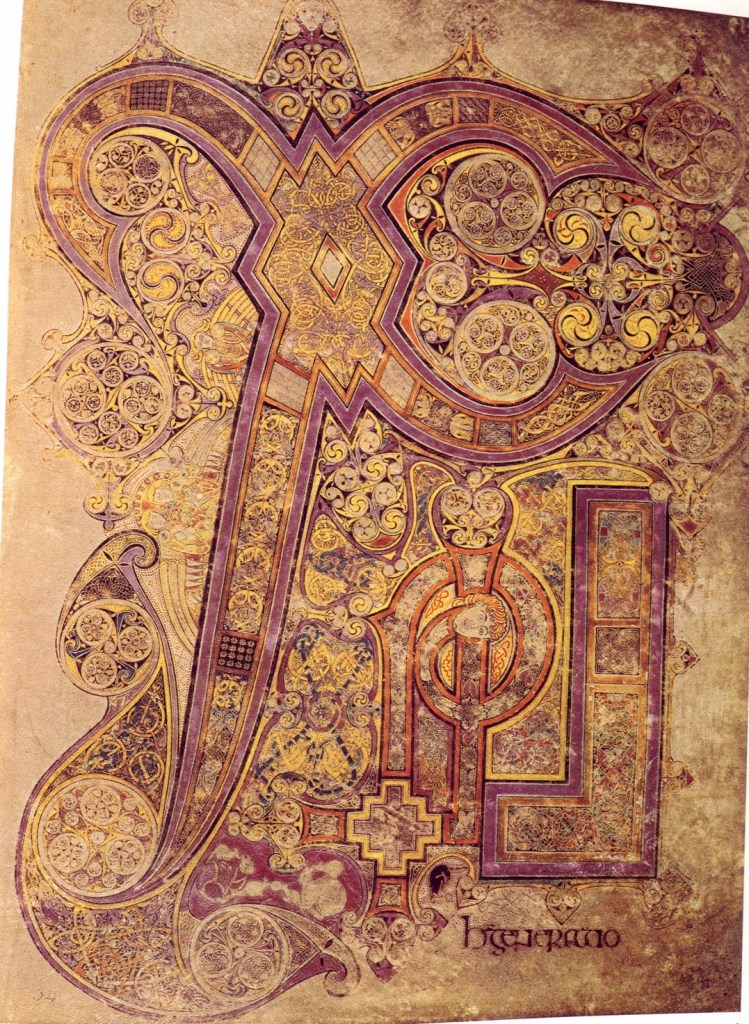
Figure 10 Book of Kells

Another force in Christianizing the Saxons came from Rome beginning with the mission of St.Augustine to Aethelbert, King of Kent, in AD 597. Aethelbert was chosen because he was married to a Frankish Christian princess[3] who encouraged the new religion. The story goes that Aethelbert, afraid of the powers of the Christian “sorcerers”, chose to meet with them in the open air to ensure that they wouldn’t cast a wicked spell over him!  In any case, St. Augustine, “the Apostle of the English” laid a solid cultural foundation for English Christianity and the English language.

St. Augustine

Augustine’s original intent was to establish an archbishopric in London, but at that time the London English were hard-core pagans, slavers and polygamists and so were very hostile to Christians.  Therefore, Canterbury, the capital of the Kentish kingdom of Aethelbert, became the seat of the pre-eminent archbishop in England. The Church was a very important force in medieval English society.  It was the only truly national entity –international really- tying together the various warring Anglo-Saxon kingdoms.  It is significant to report that no written records of the Anglo-Saxon language survive from before the seventh century AD.  The earliest substantial literature of the Anglo-Saxons is Beowulf[4]:

O flower of warriors, beware of that trap.
Choose, dear Béowulf, the better part,
eternal rewards. Do not give way to pride.
For a brief while your strength is in bloom
but it fades quickly; and soon there will follow
illness or the sword to lay you low,
or a sudden fire or a surge of water
or jabbing blade or javelin from the air
or repellent age. Your piercing eye
will dim and darken; and death will arrive,
dear warrior, to sweep you away.” 
(translation Seamus Heaney)

If the Anglo-Saxons had remained pagan it is possible that their language may never have been widely written and so may not have survived its many travails.  
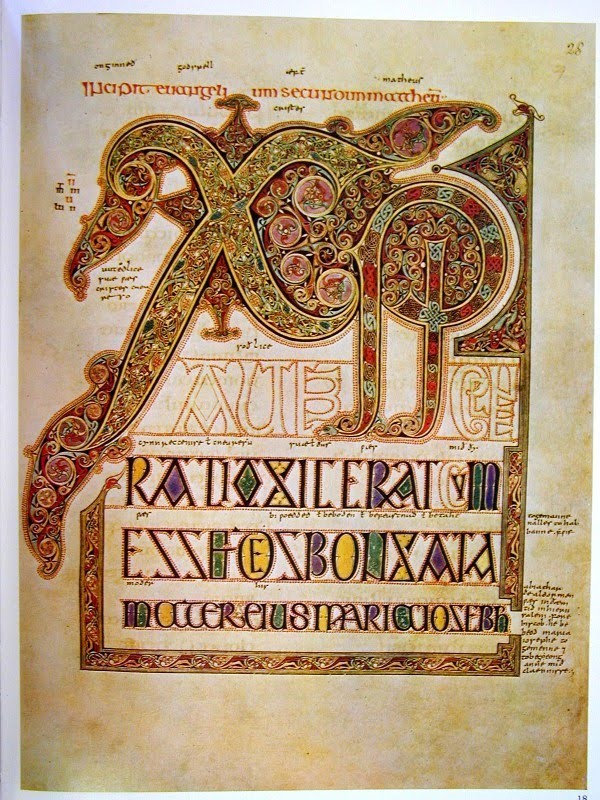
Figure 11 Lindisarne Gospels

Anglo-Saxon England’s most famous historian and Doctor of the Church , the monk Bede, known as the Venerable Bede, lived most of his life at the monastery of Jarrow, in Northumbria (died 735). Nearby, the monastery of Lindisfarne  is famous for its’ celebrated hand-colored  illuminated  Bible, an 8th century masterpiece of Celtic- inspired art, which is now in the British Library.[5] Lindisfarne Gospels, is a Latin Vulgate text with interlined Old English paraphrase.  So it is very important in the history of the English language.

This is evidence that the Masses were given in Latin but the sermons were given (usually) in English.  King Alfred’s circle of (Old) English-speaking teachers (Plegmund, Waerferth, Aethelstan, and Werwulf) led to a late 9th century revival of learning in Latin as well as the growth of Anglo-Saxon literature. The Anglo Saxon Chronicle, for example, was written in Old English not Latin). Alfred the Great’s unique importance in the history of English letters came from his conviction that a life without knowledge or reflection was unworthy.  Alfred’s enthusiasm to spread learning to the people in English may have been a turning point for the survival of English. Under the auspices of Alfred the Great church schools were encouraged for common people, and many Latin works were translated into English.  English was becoming a literary language and a language of local commerce.  French was still important for the nobility and Latin for higher education but English soldiers, sailors and merchants continued to speak, to sing and to pray in English among themselves.  And, increasingly, keep records and write in English.     English became strong enough even to survive the catastrophic subjugation of the English which came after 1066.

Figure 12 Manuscript of Beowulf (Anglo-Saxon)

During this time the influence of Church Latin and St. Jerome’s Latin version of the Bible (known also as the “Vulgate” was colossal.  Churches were almost the only forum for higher education[6] during the middle Ages. The higher church officials also played important secular roles; advising the king, witnessing charters, and administering estates of the church, which were extensive. The Magna Charta (1215) was written in Latin and so was the Scottish Arbroath Declaration of 1320. Previously Anglo-Saxon had a few Latin words most of them products or indicating spheres in which the Romans excelled such as road-building, commerce, travel and communication. These early Anglo-Saxon borrowings from Latin or Greco-Latin include, anchor, butter, candle, chalk, cheap[7], cheese, kettle, kitchen, to cook, dish mile, mint, crisp, pepper, port,  pound, sack, school (originally Greek) ,shrine, street (paved road), tile and wall.   Now with the introduction of a literate Latin Christian culture we have many new words (many originally Greek like the word Bible meaning in Greek “books”)[8] Hundreds of words come into English at this time from Latin and here are just a few: altar, apostle, circle, crystal, monastery, martyr, monk, nun, priest, clerk[9], commandment, devil, demon,  relic, cat, fork, creed, mass, camel, psalm, paper, chapter, verse, lily, temple, and trout.

Viking-landing[1]The early monasteries of Northumberland were vital centers of learning and the arts until they were wiped out by savage Viking raids of the 9th century.[10] Much of England, Ireland and Scotland were conquered by the Vikings (c.800-1263) but the Vikings dominated the off shore islands, the sea and the coasts not the hinterland.

raid[1]

Figure 13 Viking attack on Christian monastery

The northern dialects of English were very influenced by Old Norse (an ancestor of Norwegian and Swedish but Germanic like Anglo-Saxon).  Some examples of Old Norse (Viking) words  are fellow, hit, sly, take, skirt, scrub, gill, kindle, kick, get, give, window, skipper, sister, thrall (slave),earl(warrior/noble),  want and dream (it meant ‘joy’ in Anglo-Saxon.). [11] Yet despite these sporadic attacks both English and Christianity set deep roots.  I cannot but help think that the Vikings were vanquished not only by the sword but by the faith and virtue of young Christian maidens with whom the Norseman cohabited and later married.  In time language and religion assimilated and transformed the invader.


[1]  After its adoption by the English, this 23-letter Roman alphabet developed W as a doubling of U and later J and V as consonantal variants of I and U. The resultant alphabet of 26 letters has both uppercase, or capital, and lowercase, or small, letters. 

English spelling is essentially based on 15th century orthography, but pronunciation has changed considerably since then, especially that of long vowels and diphthongs.

[2] See Thomas Cahill’s charming small book How the Irish Saved Civilization

[3] Named Bertha

[4] Beowulf, Seamus Heaney, trans. ( New York. Farrar, Straus and Giroux 2000)

[5] Older than this are the Book of Kells, its inspiration which was probably created in Iona generations before.

[6] Almost entirely in Latin.

[7] Cheap comes from the Latin caupo meaning “wine-seller”; a Chapman was original a merchant.

[8] Of course, the Anglo-Saxons called the Bible the Gospels, or the Good Book or the Old Book; these are expressions still used in modern English today.

[9] In Britain “clerk” is pronounced like “Clark” as in Clark Kent (Superman); it almost sounds like “clock”.

[10] There was an ancient prayer known round the Isles that went like this: A furore normannorum libera nos domine (“From the fury of the Norsemen deliver us, O Lord!”).

[11] Thomas Pyles and John Algeo The Origins and Development of the English Language Harcourt Brace, 1982 p299-300.

the gilbert highet society

THE GILBERT HIGHET SOCIETY 
The Gilbert Highet SocietyPublic group · 224 membersJoin GroupWe try to stay true to the spirit of the late Gilbert Highet. Gilbert Highet was a patriot, an educator, critic and writer. Before WWII he served in M…
 

We try to stay true to the spirit of the late Gilbert Highet. Gilbert Highet was a patriot, an educator, critic and writer. Before WWII he served in MI6 while visiting Nazi Germany with his wife who had an MA in German. Highet himself was fluent in German and several other languages. During WWII he was a Colonel in British Intelligence (his true role has never been completely revealed but I surmise he contributed to interpretation of ULTRA intelligence). He may have been an agent for MI6 (military intelligence during the war and even before the war). Therefore his true contribution to the Allies has never been publicly acknowledged. He and his wife, author Helen MacInness were naturalized Americans -Americans by choice-having emigrated from Scotland. Their son Keith Highet was a veteran of the US Marines who served in Korea and a noted legal scholar. Highet is best known for his book “The Classical Tradition,” a generous, lucid survey of the Western Canon.He also was the translator of PAIDEIA by Werner Jaeger, one of the best books ever written on Greek culture and literature. In the 1950’s he had a radio program on WQXR and later turned his radio scripts into books of essays (still outstanding reads). His book MAN’S UNCONQUERABLE MIND still makes compelling reading; many have called him the Scottish-American Cicero. But beyond all of this, his writing was jargon-free and confident. It is a style and manner that is sorely missed. Gilbert Highet. wrote Robert Ball, “taught the classics for 40 years, also believed in the importance of great books, which he brought to life in class and in print through a humane form of scholarship. He concen­trated on those aspects of the classics that he thought made them worth studying—their truth, beauty, and wisdom, and the imagery and language that inspired him—without burying the texts under a technical, theoretical superstructure.”

In addition to all this Professor Highet recorded many radio programs on general culture and some of these recordings are commercially available. This group celebrates the best in non-fiction writing, fiction, history, literature poetry and culture.”I believe that much of the maladjustment in our societies is caused, not by malevolence and corruption, but simply by ignorance.” GILBERT HIGHET We also post things that would interest Mr. Highet such as literature, history, poetry and Scottish things as well as aticles and pictures of HELEN MACINNES, his wife, the well-known 20th century suspense author whose books were made into well-known films such as THE SALZBURG CONNECTION.

http://en.wikipedia.org/wiki/Gilbert_Highet

INTRODUCTION TO A Short history of the english language

By Richard K. Munro

Figure 1 Roman soldier and barbarian In English there has long been a battle between the LATIN  (Classical soul) and the ANGLO-SAXON soul.

That book you read,” she asked wistfully, “what’s it about?”

“It was written by a man named Plato,” Ranse told her stiffly.

“It was written in Greek.”

She brought him a cup of coffee and hesitated for a minute, and then asked, “You can read and write American, too, can’t you?”

“English, Miss Hallie, “he corrected. “English is our mother tongue. I am quite familiar with English.”

She put her red hands on the café counter. ‘Mr. Foster,” she whispered, “will you teach me to read?’    FROM “The Man Who Shot Liberty Valance” by Dorothy M. Johnson.

B

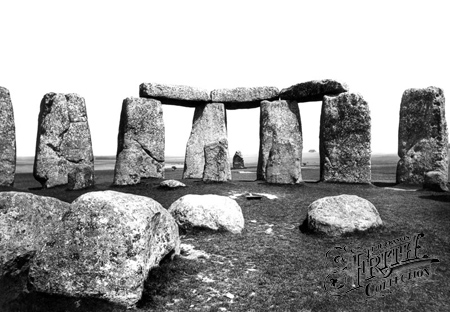
Figure 2 STONEHENGE

Brief timeline of English history

  • Neolithic (Stone Age) period, c. 5000-2000 BC, agriculture, mound tombs
    • Non-Indo-European speaking people of Britain (indigenous population; related to Picts and Basques?)
    • Stonehenge I & II (2800-2000 B.C.)
  • Bronze Age, 2000-500 B.C.
    • Indo-European language, burial with drinking vessels, flint, metal
    • Stonehenge III & IV (2000 B.C. -1100 B.C.)
    • Celtic inhabitants (British) arrived around 750 B.C., hill forts
  • Iron Age, , in Britain around 500 or 600 B.C.; Began in Europe around 8th century B.C
    • CELTIC  people in British Isles from Gaul and Spain: Britons (hence Britannia) Κελτοί Keltoi  was a Greek word and Celtae was the Latin equivalent.  Britain (Britannia) seems to be land of painted people (Picts).Albion is also an ancient name meaning land of the “White Cliffs” (Dover).  [1]
    • Celtic languages: Gaelic, Brythonic (British; ancestor of Welsh) Celtic place names in Britain:

London, Avon, Carlisle,  Dover, Devon, Cornwall, Tobermory, Glasgow,  Tremaine,Aberdour,Aberdeen,,Cardiff, Tredgar, Breedon, Braemar, Usk, Esk, Thames,

Camulodunum “Camelot” = chief Celtic town named after Camulos a God of War in Celtic Britain; later “Colchester”, York (Eboracum:”Place of the Yew Trees”) Bows were made of Yew wood so occupying this place would have of strategic importance.

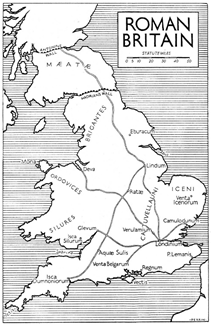
Figure 3 Britannia circa 150 AD

  • Roman Britain
    • Julius Caesar invades Britain, 55/54 BC  Roman influence grows
    • 43 AD Roman Conquest begins under Claudius, Romanization of Britain 43-410 AD: introduction of Latin & Latin alphabet.  ; Roman place names (sometimes mixed with native Celtic) Castra meant military camp (fort):Chester (camp of XX Legion), Colchester,Gloucester, Manchester, Lancaster, Portchester;  Lincoln (Colonia)
  • Hadrian’s Wall (73 miles long), 121-127 A.D. Fortification against Picts and Scots.  First evidence of Jews and early Christians in 2nd century.  

Figure 4 Hadrian’s Wall

  • 4th and 5th centuries: Germanic tribes invade  Roman Empire ; Visigoths sacked Rome in 410 A.D.)
  • Roman departure from Britain 410 AD
  • Birth of St. Patrick in Roman Britain circa 432AD; his mother was the niece of St. Martin of Tours and his father was a deacon and a low-ranking Imperial official.
  • Fall of Roman Empire in the West 476 AD
  • Anglo-Saxon barbarian Invasions  of Britain
    • Roman Britain besieged by Picts, Scots, and Saxons (barbarian tribes) circa 375-410
    • Circa 410: British leader Vortigern invites Saxons (Angles, Saxons, Jutes) into as mercenaries against  other barbarians (Picts and Scots);
    • Large-scale Germanic invasions (Angles, Saxons, Jutes), 449
    • Saxon settlements in Britain  (Sussex and Wessex, 477- 495)
    • British Celts (Romano-Britons) driven into Wales, Cornwall and Brittany (on northwest coast of France)
    • British resistance, King Arthur, British victory at Mt. Badon, A.D. 500 (quasi-historical King of Camelot).[2]
    • Gildas, De Excidio Britanniae (The Fall of Britain) (c. A.D. 540) , a Latin work describing and lamenting the fall of Britain to the Anglo-Saxons.
    • Anglo-Saxons in control of “England” (Angle-Land)  by sixth century
    • St. Columba (Irish saint) establishes center of learning and Christianization at Iona which will spread the Latin alphabet and Christianity to Scotland and northern England. 563 AD.
  • Anglo-Saxon England    
    • Angles’ settlements in East Anglia, the Midlands, and Northumbria;  England (“land of the Angles”)[3]
    • Pope Gregory the Great sends St. Augustine (the “Apostle of the English)”a Roman Benedictine monk,[4] to Kent A.D. 597
    • Aethelbert I of Kent (Jutes), converted to Christianity by Augustine, first Christian king of Anglo-Saxon England (Rex Anglorum), also compiled law code (c. 600)
    • Gradual Christianization of pagan Anglo-Saxons by Roman and Irish (Gaels) missionaries (St. Aidan and others, 635-655); Theodore of Tarsus, Greek and Latin speaking archbishop of Canterbury organized the Anglo-Saxon church.
    • Lindisfarne Gospels 698, Latin Vulgate text with interlined Old English paraphrase
    • Circa 725 AD Beowulf    Old English epic poem consisting of 3182 alliterative lines. It is the oldest surviving long poem in Old English (Anglo-Saxon)
    •  Venerable Bede (673-735), Historia Ecclesiastica Gentis Anglorum (Ecclesiastical History of the English People) (731), Latin work;
    • Offa, king of Mercia (r. 757-796); Alcuin of York (732-804), high level of Latin scholarship
    • First Viking attacks 787, sack of Lindisfarne Priory 793; Book of Kells: created in Iona:  Irish illuminated manuscript of four gospels (8th c.) in Latin.
    •  King Alfred the Great of England
    • King Alfred the Great (849-899), king of Wessex (r. 871-899), many victories over Vikings ; 886 Alfred captures London and is recognized as king of all England (except for Danish parts)
    • King Alfred’s employment of Mercian scholars (Plegmund, Waerferth, Aethelstan, and Werwulf) in educational and literary endeavors (885), revival of learning, beginnings of Anglo Saxon Chronicle (written in Old English not Latin) Alfred the Great’s unique importance in the history of English letters came from his conviction that a life without knowledge or reflection was unworthy.
    • West Saxon dialect became literary standard of Old English literature; oral tradition.  Many translations from Latin into English fostered by Alfred the Great.
    • late 10th and early 11th century, renewed Scandinavian (Viking) invasions of British Isles (England, Ireland, Scotland and Wales)
    • Aethelred II Unraed (r. 978-1016); married to Emma (daughter of Richard II, duke of Normandy); peak of monastic and literary revival: Aelfric (955-1020), Catholic Homilies, Lives of the Saints; Wulfstan d. 1023, Sermo Lupi ad Anglos (1014, “Sermon of the Wolf to the English People”) (in Old English with Latin introductory words).
    • Battle of Maldon 991; Old English poem Battle of Maldon recorded in manuscript Cotton Otho (destroyed by fire in 1731)
    • Cotton Vitellius (c. 1000), manuscript containing Old English poem Beowulf  Judith, partially destroyed by fire in 1731
    • Danish Canute (Cnut), king of England (r. 1016-1035), married Aethelred’s widow Emma and fathered Hardecanute, king of England (1040-1042)
    • Edward the Confessor (r. 1042-1066), son of Aethelred II Unraed and Emma; lived in exile in Normandy, during Danish rule of England, until 1041; conflicts and power sharing with Godwin, earl of Wessex, and his son Harold Godwinson (last Anglo-Saxon king, killed in 14 October 1066 at the Battle of Hastings)
    • 1066 Norman invasion; William the Conqueror, Battle of Hastings 1066, end of Anglo-Saxon Period   French and Latin become the languages of law and higher education.
    • Circa 1120  Eadwine’s Psalterium triplex, which contained the Latin version accompanied by Anglo-Norman and Anglo-Saxon renderings, appeared.
    • Circa 1350 Chaucer wrote The Canterbury Talesin Middle English using thousands of French borrowings.
    • By 1362 English had replaced French as the common language of the English parliament but the elite study Latin and speak French.
    • Inspired by John Wycliffe, Nicholas of Hereford leads English translation of the Bible. Circa 1380.
    • In 1408 a synod of clergy summoned to Oxford by Archbishop Arundel forbade the translation and use of Scripture in the vernacular (English). The Wycliffe Bible 1420-1450 in English gains popularity; thousands of handwritten copies (200 manuscripts extant).
    • Gutenberg’s Bible (1455); printing double-faced on linen paper spread rapidly throughout Europe opening unexpected possibilities in education, commerce, religion and communication.
    • Protestant Reformation 1519-1560; establishment of national churches with national languages undermines the supremacy of Latin.
    • 1523-1525 William Tyndale translates English New Testament directly from Greek, over 18,000 copies are printed.
    • Act of Supremacy(1534); confirmation of the  English-speaking Anglican  church by Parliament,
    • 1538“Great Bible” of Henry VIII placed in every parish church in England; 2500 copies are printed to start and six more editions are printed in 1540’s.
    • Colonies of dissident exiled Protestants   make the “Breeches” Bible new translation of the Bible published in Geneva (New Testament, 1557; Old Testament, 1560) by a colony of Protestant scholars in exile English will become the standard language of the Calvinist Church of Scotland leading to a decline of Gaelic and of Scots (Scottish dialect of English).Geneva Bible is an important influence on the translators of the James King Version of 1611.
    • Jerome’s Latin Vulgate served as the basis for translations of both the Old and New Testament into Syriac, Arabic, Spanish, and many other languages, including English. The Vulgate provided the basis for the Douai-Reims Version (New Testament, 1582; Old Testament, 1609–10) ,revised in 1740-1752 by Bishop Challoner which remained the only authorized Bible in English for Roman Catholics until the 20th century.
    • Execution of Mary Queen of Scots (1587); leads to war with Spain until 1604;  continues decline of French and Latin in England and Scotland
    • Destruction of Spanish Armada (1588) opens America to English and French colonization.
    • Famous speech by Queen Elizabeth (1588) “On eve of facing the Spanish Armada.”
    • First English dictionary A Table Alphabeticall (1604) by schoolmaster Robert Cawdrey
    • Colonization of North America by England : the South (Jamestown:1609) and the North (Plymouth 1620) Seed of USA and Canada
    • James King Version of Bible 1611.  Most influential English book of all history.
    • William Shakespeare (1564-1616) contemporary with King James Bible and the greatest poet and playwright of the English language.  Sonnets circa 1592;
    • Defeat of the French in the Seven Years War 1755-1763 (“French and Indian War”) leads to the eclipse of French on the Indian subcontinent, and the dominance of English in British North America.   French survives as a regional  (“official”) language in Canada but English will be the predominate culture language in South Africa, India, Australia, New Zealand , Singapore, Hong Kong and many islands in the Caribbean.
    • Johnson’s Dictionary (1755)
    • Declaration of Independence (1776); US Constitution “and Bill of Rights (1787-1791): English will become divided into what we may call a“British Standard” (Standard English based on the “received pronunciation”) and American English where the emphasis in on grammar “good usage and spelling” not pronunciation.
    • 1898 USA acquired Hawaii and the Philippines (Spanish was an official language until 1966) and English will become the lingua franca; Puerto Rico, officially bilingual remains Spanish-speaking.
    • 1914-1945  War with   Germany in two World Wars undermines use of German by German-American Communities (at one time about 20% of the American people -30 millions- spoke German and it was studied more than any foreign language except French and Latin.
    • WINSTON CHURCHILL NOBEL PRIZE FOR LITERATURE (1953)
    • 1900-1945 USA becomes major English-speaking world power;
    • about 50% of all native English speakers are American (C. 2016)

INTRODUCTION

English is not the oldest native language of the British Isles and Ireland but today it is the preeminent language of many English-speaking nations such as England (the U. K.), the USA, Canada, Ireland, South Africa, Australia and New Zealand.  English has become the native language of more than 380 million people and is the most important second language in the world spoken by perhaps 1 billion people.  English is worth studying because it is very useful in business, law, medicine, technology, computers, and education.  English has a vast and famous literature, an influential musical culture and arguably the greatest film and entertainment industry in the modern world.  English is also the language of the Declaration of Independence, the U.S. Constitution, Washington, Jefferson, Lincoln, Kennedy and the Roosevelts and so has been an instrument in spreading democracy and human rights throughout the world. The first step in gaining command of English is to know the story of English. Along the way you will be introduced to selection of great authors, orators and writers of the English language.


[1] Thomas, Charles (1997). Celtic Britain. London: Thames and Hudson. p. 82. “If we seek a meaning, the favored view is that it arises from an older word implying ‘people of the forms, shapes or depictions’  

  • [2] Morris, John (1977). The Age of Arthur: A History of the British Isles from 350 to 650. Chichester, West Sussex, United Kingdom: Phillimore & Co Ltd.   

[3] The legal name of the country we sometimes call England is “The United Kingdom of Great Britain and Northern Ireland.”  Their passport is British, their Army is British, and the Parliament is British.  There is an English national football team (soccer) and a Scottish national football time.

[4] NOT the more famous St. Augustine, author of The Confessions who lived 354-430 A.D.)