Tag Archives: Peter Jones

We Really Like The Bardic Depths’ “What We Really Like In Stories”!

Bardic Depths Stories

In this post, Kevin McCormick and Tad Wert discuss The Bardic Depths’ new album, What We Really Like In Stories. It is the third album from them, and it features songwriting by Dave Bandana and Gareth Cole, with lyrics by Bradley Birzer.

Tad: Kevin, it’s great to be reviewing this album with you! I know you and Brad go way back in your friendship – did you ever imagine he would someday be the lyricist for a British progressive rock group?

Kevin: Thanks Tad–great to be writing it with you as well.  It was definitely a surprise when Brad first mentioned he was writing lyrics for a rock recording—we had a good laugh! But in retrospect it seems a natural step. We shared a love of the early prog music from the start of our friendship and he writes constantly, albeit in a more academic setting than rock lyrics. So it’s not as much of a stretch as you might think. One of his favorite aspects of Tolkien’s and Chesterton’s writings are their poems. And he’s a huge fan of T.S. Eliot. But I think his collaboration with Dave on the Bardic Depths albums is a great fit and I’ve enjoyed watching the development of the concepts and sounds over the years. You know, the first album started out as just a friendly experiment. Dave had some music he had written and asked Brad for a lyric to put with it.

Tad: Kevin, I always enjoy learning the “behind the scenes” details of albums, so thanks for sharing those. 


Okay! Let’s talk about What We Really Like In Stories. As I mentioned, this is the third album from The Bardic Depths, and I think they just improve with every release. I really, really like this one. First, I think these are the best lyrics Brad has written yet. Every song is a tribute to an author, and taken as a collection they illustrate Brad’s love for various genres, primarily fantasy and science fiction. The title track refers to C. S. Lewis and J. R. R. Tolkien, who are responsible for two of the most popular fantasy series of the twentieth century: The Chronicles of Narnia and The Lord of the Rings, respectively. Birzer imagines them discussing their literary aims over a drink and a smoke in the local pub:

Could we write fiction
That might combine these things:
A love of history; a desire to debate the defenders of the modern world
Promote one’s philosophical and religious thoughts
Could a modern writer create art but not be over blatant?  

“You’ve Written Poetry My Boy” is about Ray Bradbury (The Martian Chronicles, Something Wicked This Way Comes, The Illustrated Man, among many others), and refers to some praise that Aldous Huxley gave him. “Vendetta” is dedicated to Alan Moore, who put together the graphic novel, V for Vendetta. “Old Delights” is a delightful little song in honor of midwestern American author Willa Cather, while “The Feast Is Over” recognizes the genius of pulp writer Robert E. Howard (Conan the Barbarian stories). “Stillpoint” pays tribute to Walter M. Miller (A Canticle for Leibowitz), and the last track is about British fantasist Robert Rankin. 

In other words, this is a very literate collection of songs, and they celebrate some of the greatest bards of modern times. I was an avid reader of Bradbury, Lewis, Tolkien, Howard, and Miller when I was in high school, so it is a joy to see them properly honored by The Bardic Depths. I’m not familiar with Rankin’s work, but I am certainly going to check him out now.

Kevin: Without a doubt this new album is a real step forward for the band.  Everything from the songwriting, to the instrumental performances, to the production is excellent. You can see the maturation process as the band really seems to blend and complement one another so well. The vocal harmonies are tight and solid. The lead lines are powerful and expressive and carry the songs into new spaces.

I think my favorite track at the moment is “You’ve Written Poetry My Boy.” It opens with a beautiful arpeggiating twelve-string guitar evoking memories of early Genesis. But it is soon joined by an equally-beautiful soprano sax (if this is a keyboard patch it’s an extremely natural sound). The unlikely pairing dance around each other’s lines and set up the entrance to the tune proper.  Again there are hints of Genesis here, but the band seems to have found a sound of their own.  And I love the variety in the instrumentation–string pads, piano, organ, and I think I hear some harpsichord in there. And then mid-song there is a shift to a minor section which briefly darkens the mood and serves as a platform for a sax solo, only to pass through back to the main theme. Shifts like this can be clunky sometimes in prog bands, but TBD avoid this pitfall by carefully crafting the transition compositionally.

Overall I must say that I hear hints and suggestions of so many great prog bands throughout this album. Those hints position the album in a space that sits well with other classic recordings yet still retains its own voice. Moments of the Floyd and Supertramp peak out here and there, and there’s a bluesy hard rock sensibility in the final track, “Whispers In Space,” and some even some techno in Stillpoint. Some of the vocal work has shades of Big Big Train. But again, there is a TBD color in the sound that holds everything together as a part of the larger work.

Tad: Kevin, I knew you had excellent taste – “You’ve Written Poetry My Boy” is my favorite track as well! And that is Peter Jones on clarinet and alto sax. I too hear glimmers of classic Genesis (the Steve Hackett years) in this song, and I find that very appealing. There’s no wonder they chose this track to be the first single.

I also want to give a shoutout to Gareth Cole’s guitar work throughout the album – it is truly stellar. His solos in Vendetta are spectacular – driving, melodic, and pure. His slide guitar in “The Feast Is Over” is terrific!

To wrap things up, I think we can agree that What We Really Like In Stories is a big leap forward for a group that improves upon excellence. They seem to have really gelled as a unit – Dave Bandana, Gareth Cole, and Brad Birzer are at the top of their form as far as songwriting goes, and Peter Jones’ vocal and instrumental contributions are wonderful. I also like Dave’s vocals on “The Feast Is Over” – he’s got an “everyman” sound that is quite inviting. 

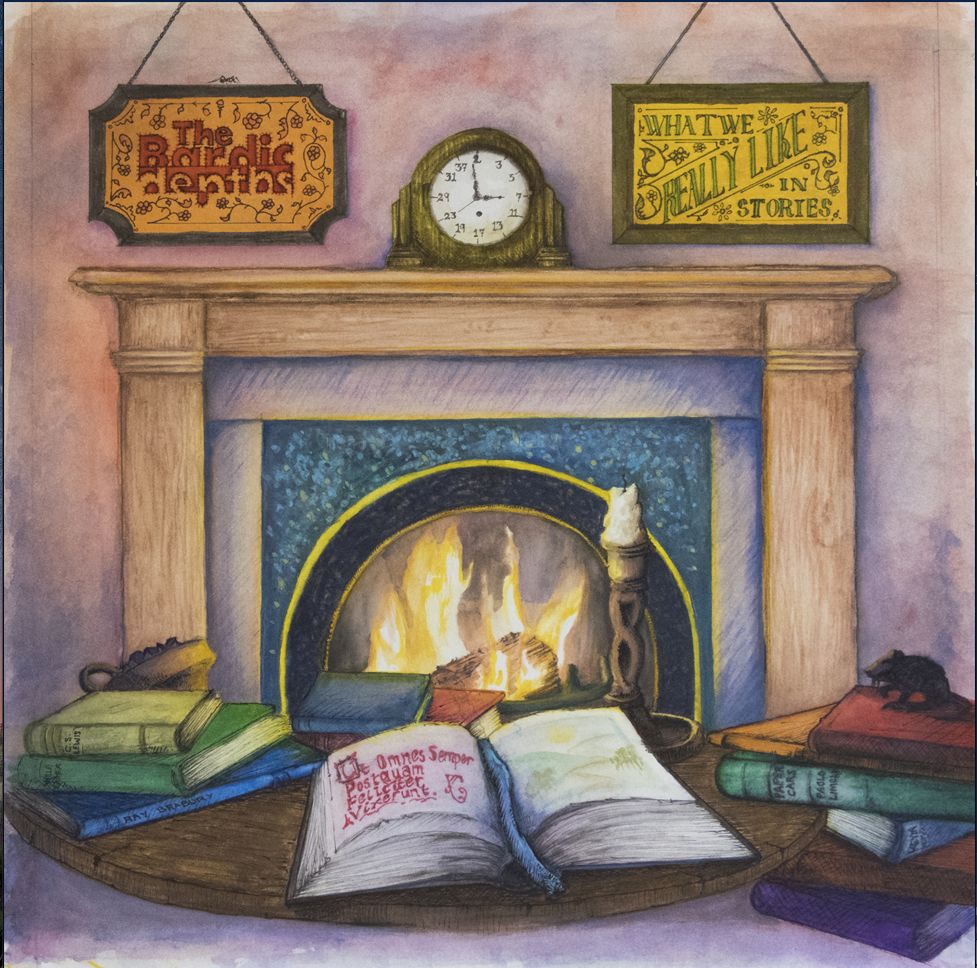
Before we close, I’d like to mention how interesting Kevin Thompson’s artwork is. The style is somewhat primitive and whimsical, which complements the songs perfectly. Stylistically, it reminds me of the cover art for the Beach Boys’ Smile album. Thompson’s painting is of a cozy room with a fire blazing away, and piles of books on a table. The authors are the ones featured in the songs, and there are needlepoint hanging that spell out the “The Bardic Depths” and “What We Really Like In Stories”. I’m intrigued by the clock on the mantel: the numbers aren’t the standard 1 through 12! Instead, they run 2, 3, 5, 7, 11, 13, 17, 19, 23, 29, 31, 37.

What We Really Like In Stories is a contender for album of the year in my book. The subject matter of the songs is thought-provoking while remaining playful, while the musicianship is first-rate. This is one album I’ll be enjoying for years to come.

Here’s the video for “You’ve Written Poetry My Boy”:
Cyan and Galahad: Double Fun and Greatness

Cyan_Galahad

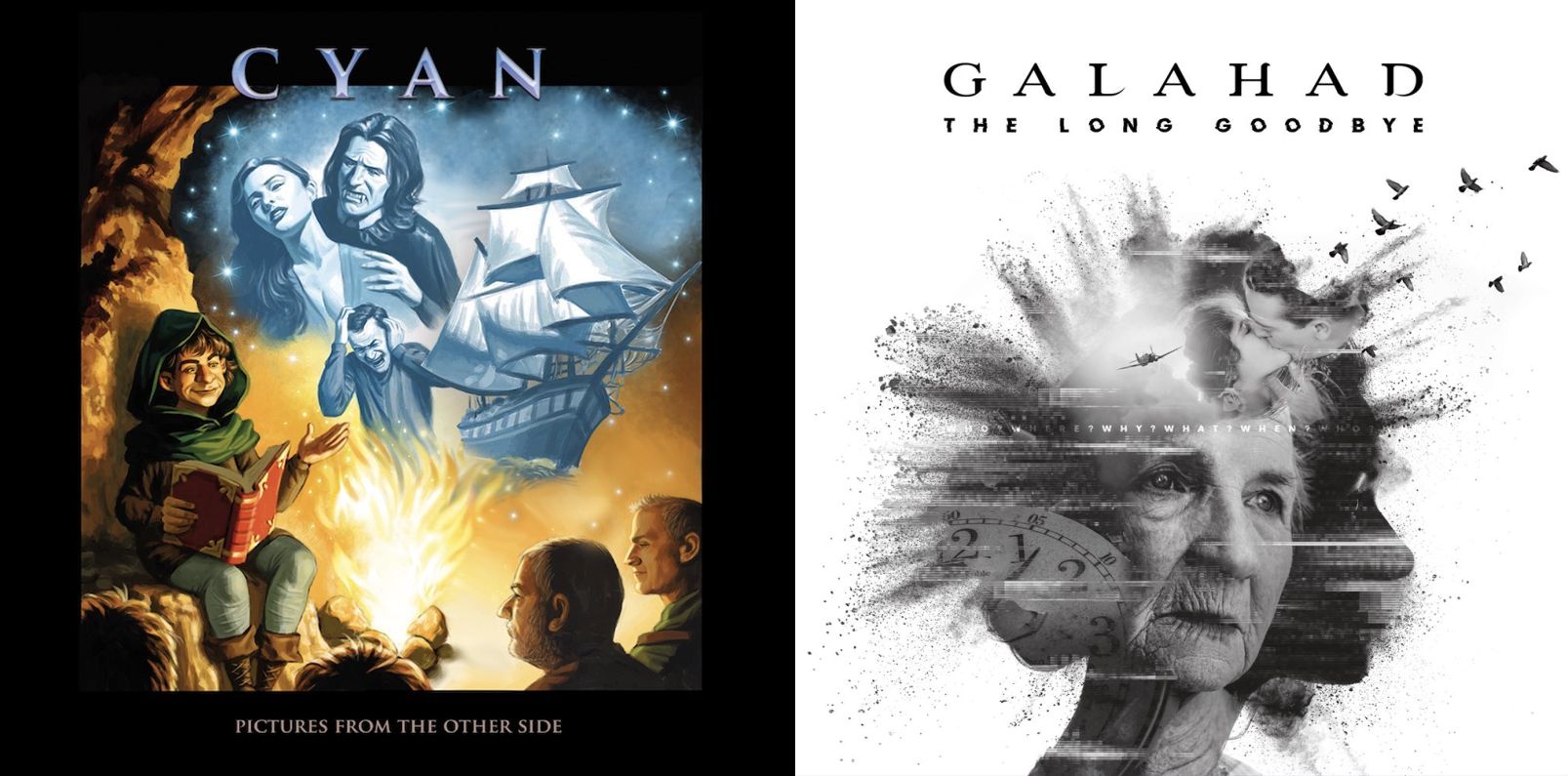
There are two new releases that have created a buzz here at Spirit of Cecilia: Cyan’s Pictures From the Other Side, and Galahad’s The Long Goodbye. The usual Proglings take some time to share their impressions.

Tad: Gentlemen, I suggested we pair these two albums together, because in some unexplainable way they seem to complement each other. To my ears, both are extremely enjoyable listening experiences, and I’m eager to see what you think of them.

I’ll start things off with Cyan’s Pictures From the Other Side. This is a resurrection of an old Rob Reed (Magenta) project, but it is a totally new sound. What immediately leapt out to me was Peter Jones’ (Camel) terrific vocals. He has a bit of that Peter Gabriel/David Longdon vibe, and he is incredibly powerful. Angharad Brinn joins him on several songs, and her soprano melds beautifully with Jones’ baritone. 

The first song, “Broken Man” is an awesome starter to the set – it begins so softly I can barely hear it, then what sounds like Celtic bagpipes show up, and then the entire band explodes! The melody is first-rate, as well as the lyrics:

A broken man always knows what he’s lost

A broken man always counting the cost

A broken man on his knees always prays out loud,

“Give me one more, give me one more chance.”

Brad: What a great suggestion, Tad.  When it comes to Cyan, it’s hard to do better than either Rob Reed or Peter Jones.  Both are men with incredible vision and incredible integrity, exuding class.  I, too, am really taken with “Broken Man” as the opening track.  I’m so glad that the band didn’t turn it into a three-minute pop song, but instead gave it some real life.  I say this as a compliment–the song lingers when it should linger.  It comes to a head when it should come to a head.

As to influences, I hear a lot of Big Country, a lot of U2, and a lot of The Call.  Not sure if Reed or Jones would see it that way, but all three bands sound like forerunners to me.

It’s probably unfair of me–of all people to say this–but the second track, the title track, “Pictures from the Other Side,” sounds very much like a Bardic Depths song.

“Solitary Angel,” track three, just feels like solid rock, a Journey-esque ballad, but with a bit of Marillion (vocals, especially) thrown in.

Track four, “Follow the Flow,” continues in a ballad-esque way, soft but captivating.  Again, I’m hearing a lot of Marillion in this track.  Delicate without being prissy.

Again, track five, “Tomorrow’s Here Today,” continues the intense but soft sound.  And, again, I can only state this is precious in the best sense.  I feel like I’m holding the most fragile flower imaginable while listening to it.  Then, about ½ through the song, it really, really picks up, becoming a rather blistering prog and rock song.  Excellent guitar work here, but also keyboards, bass, and drums.  The last third of the song feels a bit like a Yes/Jon Anderson track.

Not surprisingly, given its name, the sixth and final track, “Nosferatu,” rocks, possessing a Glass Hammer or post-Neal Morse Spock’s Beard sound.  At nearly 18 minutes long, this track gives everything a prog fan would want.  An amazing journey through music.  The keyboards and guitar are especially well-finessed!  Towards the end of the song, there’s even a glorious Star Wars moment!  Or, maybe it’s inspired by Queen.  Regardless, it’s epic.

Tad: Brad, that is very perceptive of you to make the connection to 80s groups like U2, The Call, and Big Country. I did a little research, and these songs were actually first done on Cyan’s second album in the early 90s, and then rerecorded for this album. 

I agree with you that the overall sound of Pictures From The Other Side is good, solid rock. It is definitely prog, but prog grounded in the tuneful hard rock of the 70s and 80s. I think we both give it a strong recommendation for our readers.

Okay – on to Galahad’s latest! Brad, I am so impressed with the music Galahad is producing these days. I thought their previous album, The Last Great Adventurer, was terrific, and the song, “Blood, Skin, and Bone”  off of it was just fantastic.

Their latest offering, The Long Goodbye, is just as strong. The title track, in particular, really moved me. I think it is about saying goodbye to a loved one who is dealing with senile dementia, and it is an outstanding track.

I also think the first three songs are a 1-2-3 tour de force. The opening track, “Behind the Veil of a Smile” is a synth-laden beauty that sets the energy level at high. It has an addictive hook for a melody, and I hit “Repeat” a couple of times before I even listened to the rest of the album! The second song, “Everything’s Changed” is just as good – a perfect mix of retro synths and crunchy guitars. The third track, “Shadow In The Corner” is my favorite. Once again, it starts with some retro-sounding synths and sequencers before a killer guitar riff jumps in. This is the kind of music U2 should be making now! As a matter of fact, I think that’s what links the Cyan album to this one – they both take what’s best from 80’s rock and combine it with 21st century production sensibilities. In both cases, there is no question of sounding nostalgic or cheesy – both groups have an appreciation for the music that was made nearly 40 years ago (Oh my gosh, can you believe that?!) and have brought it into the contemporary prog scene.

Brad: Dear Tad, I very much appreciate your enthusiasm regarding the new Galahad.  I must admit, it’s taken me a bit longer than usual to appreciate.  I’m on several listens now, and I like it very much, but I’m still–even after numerous listens–surprised by just how electronic the album is.  Galahad has had this side to them as far back as I can remember, but it was always on the sides and in parts of the albums rather than at the core.

“Behind the Veil of a Smile” reminds me very much of Steven Wilson and Porcupine Tree but without Wilson’s trademark scratchingly-hard guitars.  And, I very much appreciate the lyrics, which Galahad always excels at writing.

Track two is really pop excellence, reminding me a bit of New Order, especially from the mid-1980s.  The refrain, “everything is changed and nothing will ever be the same again. . . the same again” is pop perfection.

I like very much how track three, “Shadow in the Corner,” steps back from the hyperactivity of the first two songs and gives us something intense and low.  Again, I’m very much reminded of New Order and, even possibly, all the way back to Joy Division, especially at the beginning of the track.  After about a minute, it resumes hyperactivity, becoming a more “mainstream” Galahad song.

Track Four, an acapella-esque folk song, “The Righteous and the Damned,” lovingly takes us back to Galahad’s masterpiece, “Empires Never Last.”  The middle of the track sounds very central European, right before becoming a brilliant flaring guitar track that sounds very much like Fish-era Marillion.

The longest song on the album, track five, the title track, “The Long Goodbye” incorporates a number of different musical styles.  As you note, Tad, the song deals with the very difficult topic of dementia and Alzheimers.  It is a beautiful wrought exploration of the subject, and Galahad should be praised for handling it with such class and delicacy.

Track six, “Darker Days“ takes us back to pretty straight-forward Galahad electronica, sounding here like a harder version of 1980’s Asia.

The album ends with “Open Water,” a gorgeous and gentle tune and ballad–absent all electronica and ending the album on a positive note.

Tad, I’m in full agreement with you, Galahad has very successfully bridged the past and the present with The Long Goodbye.  What seemed jarring to me on the first listen now seems incredibly complex and clever on the 10th listen.  This album took a bit to grow on me, but now that it has, I’m deeply thankful for it.

Tad: Brad, I don’t have as much experience hearing Galahad’s music as you do, so your perspective is very interesting. The Last Great Adventurer was my first exposure to them, so, as far as I’m concerned, the electronics are all good! I hear the New Order vibe you mention, and I think that is a feature. Hopefully, we’ve put enough distance between us and the 80s to appreciate the innovation and variety in music that blossomed during that decade. Yes, some music from then can sound “dated”, but that doesn’t mean it wasn’t great music.

Okay! So it looks like we have two thumbs up for both Cyan’s and Galahad’s new offerings. Dear Spirit of Cecilia readers, take some time to check these two albums out. And, like Brad, give yourself time to really absorb them. They will repay the effort – we promise!

The Bardic Depths’ “Promises of Hope” Is a Triumph

cover

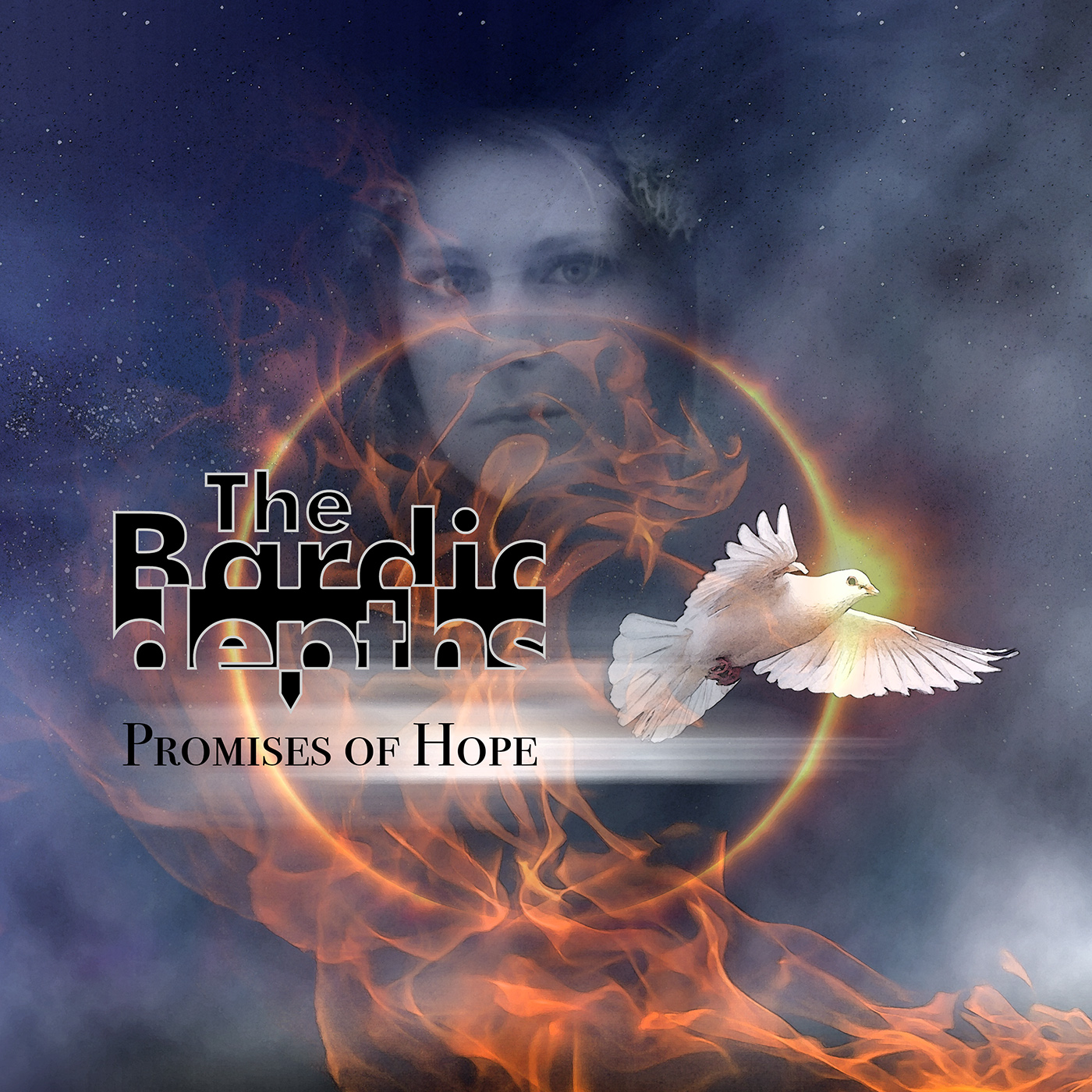
The Bardic Depths, a musical project begun by musician Dave Bandana and lyricist Brad Birzer (who also founded this blog!) have just released their second album, Promises of Hope.

Rock artists fear succumbing to the dreaded “sophomore slump”, but Bandana et al. need have no worries on that front. Promises of Hope shows tremendous growth from their eponymous debut album, which was an all-around delight itself. (Reviewed on Spirit of Cecilia here.) There is now a stable core of musicians involved: Bandana on vocals, guitars, keyboards; Gareth Cole on guitars, Peter Jones on vocals, sax, penny whistle, and Tim Gehrt on drums.

Like their debut, Promises of Hope is a concept album, this time relating a tale of divine intervention in an attempted suicide in a fantasy realm. Sounds heavy, I know, but this is some of the most life-affirming music I’ve ever heard. The opening song, And She Appeared, is roaring rocker that is reminiscent of classic ’70s Rush. Cole’s lead guitar trades wonderful solos with Richard Krueger’s galloping organ. It’s an exhilarating way to begin an album. Lyrically, it introduces the main character, a woman who is

“Halo’d wrapped in white
Radiant wrapped in white
Innocence made real
Beauty made manifest”

However, there is something tragic in the offing, because she brings “promises of hope, but never of victory.”

Regal Pride, the next song, features lead vocals by Peter Jones, as well as his excellent saxophone flourishes. Our heroine has been betrayed by a man of mystery, and the melody is suitably somber.

Track three, Consumed, is the best of the album. It features a stunning classical guitar intro by Kevin McCormick, and soon shifts into a beautiful British-folk melody that sounds timeless. Jones’ penny whistle and Donny O”Connell’s spritely violin add Celtic atmosphere while Cole pulls off two more excellent electric guitar solos. The heroine has lost hope, and she is consumed by a fire.

Next up is The Burning Flame, which has a very spacey intro that calls to mind Wish You Were Here-era Pink Floyd. McCormick contributes another excellent guitar solo, this time on electric, while Paolo Limoli provides wonderful piano and Fender Rhodes accompaniment. Jones takes lead vocals here, and they have a definite bluesy edge. This entire track is a gorgeous, slow burn (pun intended!) of song that I wish lasted far longer than six minutes. Fortunately, it segues into the extended instrumental, Colours and Shapes, where Jones’ sax continues the spacey blues mood.

In Why Are You Here? our heroine is confronted in the afterlife:

Why are you here?
Did you not respect?
Did you not cherish it?
Could you not love life?

This is another somewhat slow song, but one that is enlivened by Limoli’s tasteful piano fills and Cole’s terrific guitar solos. 

Things pick up with Returned, where the protagonist’s suicide is rejected by her Creator:

“You must return
You will make good
Rewrite this wrong
You must Love”

These lyrics are accompanied by a triumphant melody that is bursting with energy. The album’s co-producer, Robin Armstrong really shines here, lending his talents on keyboards, vocals, bass, and lead guitar.

With our heroine given a new lease on life, The Essence explodes out of the speakers with an insistent beat and infectious melody that is truly exhilarating. 

“Reconciling hope, reconciling all.
Reconciling everything.
It is the universe made real.”

Bandana’s vocals and synths are outstanding here; they convey the pure joy of the lyrics.

The final track, Imagine, is a coda addressed to all of us and the choices we must make:

“Imagine a world in which we are judged by
Our most insufferable, our sorriest…

A horror beyond time…

Imagine a world in which we are judged by
Our best and our glory, our gift and our love…

There is a word and it needs to be heard.
It is hope. It is what you promised to me.
Rise up and see, it is our victory.”

Krueger’s church organ is appropriately employed here, because this last song is a hymn to hope. As the song unfolds, the tempo increases inexorably, and I’m reminded of the final scene in C. S. Lewis’ Narnia book, The Last Battle, where the protagonists reach paradise. As they realize where they are, they cry out, “Further up and farther in!”

Some final thoughts on this special album:

Dave Bandana has said that Robin Armstrong really pushed him to do his best, and it shows. His vocals and keyboards are terrific throughout. Peter Jones is the secret weapon of The Bardic Depths – his singing and sax work are some of the best elements in the mix. Gareth Cole’s lead guitar is AMAZING!

Promises of Hope is an outstanding album with an inspiring concept. The melodies complement the lyrics perfectly. As good as their debut was, this is even better. The core group of Bandana, Cole, Jones, and Gehrt have gelled into a formidable ensemble, and I hope they plan to tour.

Promises of Hope is on Gravity Dream Music. Here is the official lyric video for The Essence