Tag Archives: progressive rock

The (accidental) Christian Humanism of Steven Wilson

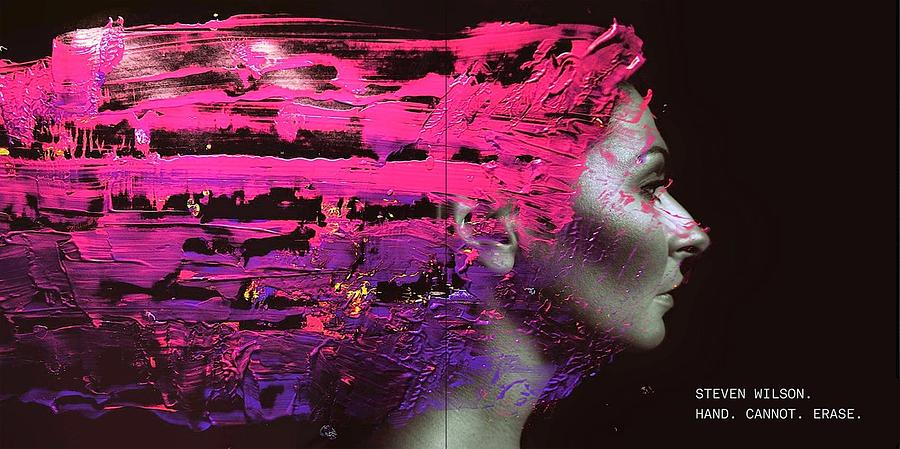
The Meaning of a Life: Steven Wilson’s Hand.Cannot.Erase.

An Incarnational Whole

One of the greatest things in this whirligig of a world—however fraught with a string of perilous and gut-wrenching disasters—is the mystery of the human person.  And, until God so decides to end this existence, every person is a new reflection of the Infinite.  From the Catholic Humanist perspective, every human is an unrepeatable center of dignity and freedom.  Each person, born in a particular place and time, comes only once, a life to burn as brightly or not, for one’s self or for another, in the time allotted to each of us.  “Dark and inscrutable are the ways in which we come into the world,” the grand Anglo-Irish statesman and philosopher, Edmund Burke, understood.  Fewer truths have ever been spoken in such perfect formation of the English language. 

Yet, speaking on the mystery of the person and personhood, Pope John Paul II put it even more beautifully in the penultimate month of 1996.

The mystery of the Incarnation has given a tremendous impetus to man’s thought and artistic genius. Precisely by reflecting on the union of the two natures, human and divine, in the person of the Incarnate Word, Christian thinkers have come to explain the concept of person as the unique and unrepeatable centre of freedom and responsibility, whose inalienable dignity must be recognized. This concept of the person has proved to be the cornerstone of any genuinely human civilization.

As someone who has had the privilege of teaching history and writing biography the entirety of his professional career, I hope and pray that John Paul II’s words and ideas each across everything I teach, think, and write.  As such, I am always looking at and for new ways to understand the dignity of each individual person, however tragically flawed.

Nearly six years ago, such a statement and manifestation of dignity arrived in the most unusual of ways: in the form of a rock concept album by the rather devoutly atheistic, seemingly always grumpy, and unbelievably talented English musician, Steven Wilson.  His album, a sixty-seven minute story about a lost soul, came out on February 27, 2015.  In terms of lyrics and music, Wilson’s work is extraordinary by the standards of any genre.  What should intrigue us most, however, is the subject matter and how Wilson fills it out.  The subject matter is the uniqueness of each human person, and he focuses on the life of one lost soul.

[Please scroll down a bit to go to page 2]

Best Prog of 2020, Part II

A few days ago, I attempted to create a “best of 2020” purely from memory.  My oldest daughter was driving the Honda, and I was enjoying the thrill of the quickly-moving Illinois landscape out the passenger’s window.  Honestly, at age 53, I should know better than to rely only on my memory, though, as a historian, I actually still have a pretty good one.  But, no longer great.  Just pretty good.  Even as I was typing the list in the car, I knew I’d forget all kinds of great albums, but I tried it anyway.  Pride and ego are funny things. 

Anyway. 

That list still stands (a few posts back), but I want to add some brilliant albums that I inadvertently failed to remember at the moment of writing.

Two albums this year get the spiritual successor to Talk Talk’s Laughing Stock award.  First up is Tim Bowness’s extraordinary nuanced (so glorious), Late Night Laments, an album full of meaningful lyrics and sonic soundscapes that boggle the imagination. Bowness, unfortunately, gets overshadowed by his sometime writing partner, Steven Wilson, but, frankly, the two artists are equally extraordinary. 

Following Bowness’s lead was the more recently-released Loma album, Don’t Shy Away.  Again, incredible textures mixed with intriguing lyrics.  Clearly, the band has spent a lot of good quality time listening to Talk Talk. Regardless, I owe Stephen Humphries (of the Christian Science Monitor) a huge thanks for introducing the band to me.

Nick D’Virgilio’s Invisible in an album full of surprises and full of soul.  There’s conviction behind every word and every note. I wasn’t sure what to expect before the album arrived, but I fell in love with it on the first listen. D’Virgilio is also rock’s greatest living drummer, so I was especially pleased to be reminded that the guy is just incredibly talented in all kinds of ways.

[Scroll down a bit to click on page 2 of this article. . .]

My Conflicted Relationship with Progressive Music (Prog)

By Mark Sullivan

My earliest memory is standing on my tiptoes putting Let it Be by The Beatles on my parent’s stereo. I must have been only four or five years old, and I don’t know why my parents let their pre-schooler touch their records. I wouldn’t have.

“I dig a pygmy, by Charles Hawtry on the deaf-aids. Phase one, in which Doris gets her oats.” Then the acoustic guitar, the bass drum, John and Paul singing in unison, and I’m in my happy place – laying on the floor listening to music. Looking up at the ceiling and lost in my imagination. Not much has changed in 45 years. 

Besides The Beatles, my parent’s record collection consisted of 1970s staples such as Linda Rondstadt, Neil Diamond (laugh if you’d like), Emmy Lou Harris, Glen Campbell, Loretta Lynn, Bob Dylan, Charlie Parker, the Modern Jazz Quartet, Wes Montgomery, Herbie Mann, and The Moody Blues. I listened to all of those albums except Every Good Boy Deserves Favor by The Moody Blues. The cover freaked me out and planted the seeds of suspicion about Progressive Music (Prog).

Probably as a teenager I tried to listen to it. I imagine that I picked up the needle at “Desolation, creation.” It still sounds stupid, but if I would have stayed with it and listened to “The Story in Your Eyes,” things may have been different. 

However, I wasn’t aware of Prog as a thing or deliberately avoiding it until I encountered the anti-Prog bible, The Worst Rock n’ Roll Records of All Time: A Fan’s Guide to the Stuff You Love to Hate by Jimmy Guterman and Owen O’Donnell in a used bookstore sometime in my early 20s. That book was everything a young music snob like me could want, take downs of stupid lyrics and bloated Prog bands on every page. I learned that you could always be cool by ripping on Prog.

[Scroll down a bit to click on page 2 of this article. . .]

Profoundly Tangible: Nick D’Virgilio’s Invisible

Being a fundamentally HUGE (yes, it’s that large!) fan of Big Big Train, I wasn’t sure what to expect from Nick D’Virgilio’s solo album, Invisible.  I proudly own his first album, Karma, his first EP, Pieces, every Spock’s Beard album, and Rewiring Genesis.  To be sure, I presumed I would like Invisible, as I consider NDV our greatest living drummer, armed not only with rhythm (Holy Moses–that drum kit!) but with vocal prowess as well. And, from what I can tell from social media, he seems like a truly good and genuine person.  

All of this adds up to high expectations for Invisible.

Well, it is even better than I expected. And, I expected a lot.

If you asked me to sum it up in a few words or even analyze it track by track, I couldn’t do it.  This is a whole work of art—something to be digested in one sitting. Relentlessly captivating, it mixes progressive rock with classical with (ok, I was surprised by this one) with 1960’s style R&B with some mid-1970’s Styx with some punk-tinted Rush with broadway musicals with electronica with funk with straightforward rock and pop.  Frankly, Invisible has it all. In this sense, it fits Andy Tillison’s definition of progressive—basically, “whatever I damn well want to throw in, I throw in” (my words, not Andy’s).

What most captures my imagination with the album, though, is NDV’s lyrics—so utterly earnest and so uplifting.  In every song, NDV calls us to be our best. That NDV loves life is a certainty as certain that the sun will rise tomorrow, and his joy comes through every song.

If you’re looking for a new BBT or Spock’s Beard album, this isn’t it. And, that’s perfectly fine.  Frankly, it doesn’t even really seem like a simple evolution from NDV’s previous solo efforts.

Invisible is . . . beyond all of this in ways that are very difficult to put into words.  

But, if you’re looking for something gorgeous, something meaningful, something real, something inspiring. . . look no further.  If anything, NDV has proven that real life is quite the opposite of being invisible. Rather, NDV calls us to be our best, to be tangible, and, frankly, to be the incarnate souls we’re meant to be.

To find out everything about NDV, click here: https://www.nickdvirgilio.com

Passion Incarnate: IZZ’s Half-Life (2020)

Well, let me admit, immediately and without hesitation, I’ve been a huge fan of IZZ since I first heard them a little over a decade ago. In everything they do, they combine passion, taste, and elegance.  One might even describe their music as an earnest intensity.  Lyrically, the band never dumbs itself down, but offers words of majestic inspiration and serious contemplation. 

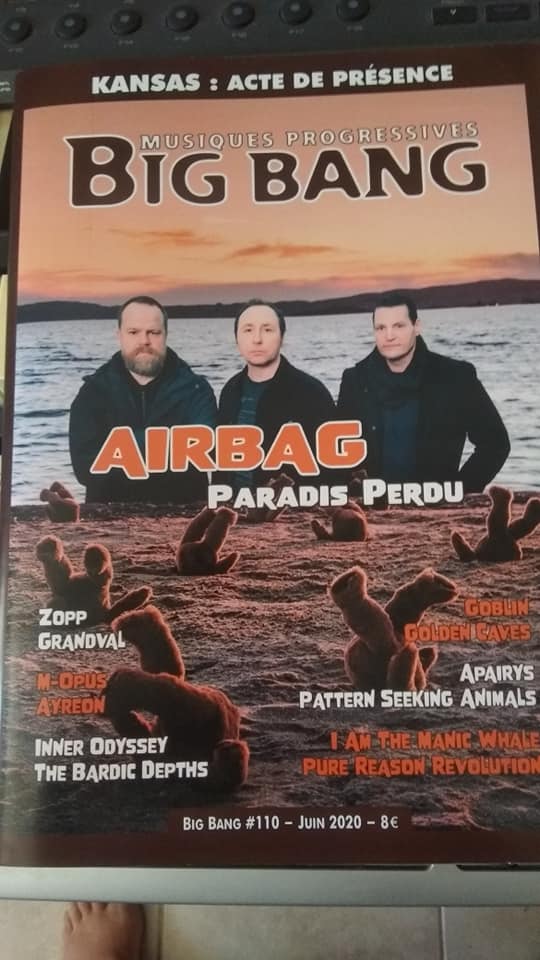
Their latest release is an EP, appropriately and rather cleverly entitled Half-Life, itself comprised of three new tracks and one live track.  The three new tracks—entitled, in order, “The Soul of Music,” “Into the Sun,” and “Half Life”—offer grand progressive visions, reflecting, respectively, IZZ’s deep appreciation and love of Kate Bush and Chris Squire and Yes;  Rick Wakeman and Big Big Train and ELP; and, perhaps most interestingly of all, Stranger Things(the Netflix series) and Kansas and Glass Hammer.  

None of IZZ’s appreciation of other progressive rock acts gets in the way of that uniquely beautiful IZZ voice.  Indeed, such appreciation on the part of IZZ of other bands only makes IZZ all the more interesting, honed, and glorious. And, just in case it might seem like the music overwhelms the listener, the lyrics simply soar, especially on “Half Life,” bringing the listener to the verge of tears in the last several second of the track.

The final track is a rather stunning live rendition “The Weight of It All” from the band’s Ampersand, Vol. 1, album.

In this current whirligig of viruses, protests, injustices, and anxious unrest, do yourself a grand, grand favor—treat yourself to the humane, cultivated, and class act that is IZZ.  Your soul will thank you.

[To support IZZ (and for a mere $5), click here: https://izzmusic.bandcamp.com/album/half-life-ep]

Heartfelt and Intelligent: Auto Reconnaissance by The Tangent

In the not so distant past, I had the opportunity (and, perhaps, the gall) to label Andy Tillison the “G.K. Chesterton of progressive rock.” As I listen to the latest release by Tillison’s band, The Tangent, I can only nod in approval at my earlier assessment.  He has always been a master of story, but, on Auto Reconnaissance, he reveals himself as a master of story telling. Light your pipe, sip from your pint, and pull yourself up next to the fire. Tillison has several tales to tell, and he does so in the best way, as a friend rather than a teacher.

Auto Reconnaissance begins with the discovery of radio—not just its function, but it’s essence—on “Life on Hold.”  It’s a short piece, by The Tangent standards, but it offers the perfect introduction to an album that demonstrates the wonder of life.

The second track, the second longest on the album, “Jinxed in Jersey,” tells the story—quite convoluted at times—of Tillison’s journey to the Statue of Liberty. Naturally, the story can be understood at many different levels, the literal but also the symbolic. If, on track one, the boy Tillison discovered the workings of radio, on track two, the adult Tillison discovers the realities and complexities of America.  The renaissance—or was that reconnaissance?—continues.

The third song, “Under Your Spell,” has a Tears for Fears feel, akin to “Working Hour” on Songs from the Big Chair.  Melancholic in theme, the song is tasteful to the extreme.

“The Tower of Babel,” track four, is the shortest on the album, but it’s intense and unrelenting with its disco-esque beat. A clever look at the techno-babble of the modern world, as the song’s title indicates, Tillison wonders just how we manage to speak to one another with so many types of technologies (where is that simple radio of track one!?!?) and so much noise in our modern whirligig of a very human (and very flawed) world.  “The system is human, too!”

At nearly one-half of an hour long, “Lie Back and Think of England,”—a jazzy, pastoral meditation—provides the brilliant backbone to the album.  Where are those hills and those dales?  On this track, especially, Tillison proves his title as the Chesterton of the prog world.  The song’s structure harkens back to the first two albums of The Tangent, and it is a gorgeous harkening, filled with passionate solos and musical lingerings and wild segues.

The final track of the album, “The Midas Touch,” provides the proper conclusion to such a complex album, offering a jazz-fusion odyssey.

The previous two The Tangent albums were deeply (and, at times, distractingly) political, but this album is appreciatively cultural. Indeed, it is Tillison and the band at its absolute best.  Heartfelt, clever, tasteful (yes, I know I’ve used this word already in this review) and, most of all, intelligent, Auto Reconnaissance is a true work of art, taken as a whole and even analyzed in parts.  Tillison proves that he remains England’s red-headed mischievous genius.

Beauty’s Lease: Big Big Train

Nothing Big Big Train does is unimportant in the world of music or in the larger world of art. As such, its most recent release, Summer’s Lease, is an important cultural marker, a signal act of beauty in a terribly—at least at the moment—ugly world. It’s as though Spawton, Longdon, and Co. are stating: hold on just a bit longer. . . we’ll all make it.

The album begins with the enchanting and pastoral instrumental, “Expecting Snow,” followed by a majestic—and reworked—version of “Kingmaker,” one of the oldest songs in the BBT canon, but a song that never tires and never grows old or out of style. The song is approaching, quickly, its thirtieth anniversary.  Again, though, it only gets more interesting with age.

From here, BBT jumps forward two years, to 1995, and offers us a glorious reworking of the very first track to appear on CD, “Wind Distorted Pioneers.” Danny’s delicate-turned-jazz piano work and Rachel’s lush strings (as opposed to heavy guitar) make this a track to behold and celebrate. Truly, this track is a thing of wonder.

The band then gives us an in-studio live version of Swan Hunter’s rather sensuous and pondering “Summer’s Lease” and a subtly reworked version of track two of The Underfall Yard, “Master James of St. George.”

To conclude disk one, BBT offers a slightly shorter version of “London Song.”  What was once barely over 34 minutes is now, with a bit of pruning and reworking, just barely under 34 minutes. Each version though—whether the original download or this CD version—is simply outstanding, a manifest demonstration of BBT’s compositional skills and dedication to excellence.

Disk two is, for the most part, much more straight forward with few surprises: “Victorian Brickwork”; “Judas Unrepentant”; “East Coast Racer”; “Curator of Butterflies”; “Swan Hunter”; “Transit of Venus Across the Sun”; Nick’s latest song; and “Brave Captain”.

On disk two, the only real surprise is the just-mentioned Nick D’Virgilio’s latest song, the undeniably mesmerizing “Don’t Forget the Telescope,” a track of seemingly endless possibilities, a tangle of love intertwined in a spirit of exploration. The song feels live, and it feels as though we’re listening to it an Irish baptism or wake (you know, the kind wake that celebrates life) being held on the south side of Chicago in the 1920s.  Glorious.

Finally, I must write something about the packaging.  BBT understands well that its fan base likes tangible things, and this package does not disappoint.  Each of the two CDs come in nice cloth sleeves, the booklet is long (though, in Japanese!), and Sarah Ewing’s artwork is. . . well, just perfect and fantastic. Indeed, this is now my favorite BBT album cover. I would love to own a print of it.

No matter how bleak the world looks at the moment, Big Big Train wields the light, encouraging us to keep going, no matter the cost and no matter the doubt.

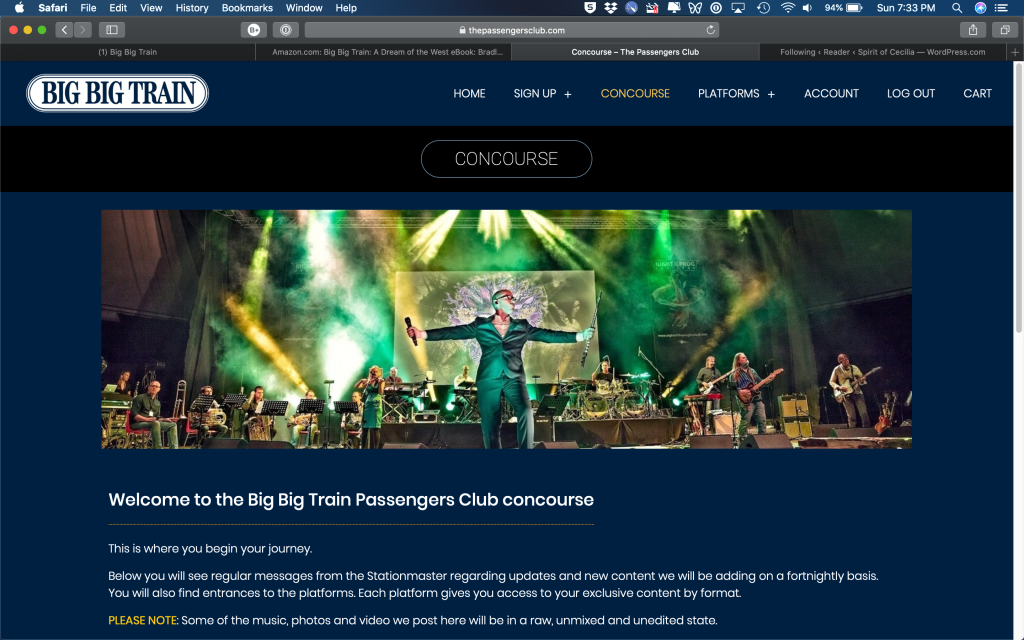
Big Big Train's Passenger Club: update #3

Well, it’s that time.  That glorious time.  Two weeks later, and Friday.  This means that Big Big Train has updated, once again, its Passenger’s Club membership-only fan service. And, for this third update, I am reminded yet again how good BBT is.  This week’s update comes in four (well, really five) parts.

First, there’s a new song, one written by Greg roughly ten to twelve years ago.  It’s a love ballad for his wife, Kathy. Tender and fluid, “Sundial” might have ended up on Bard. Thus, it can probably be regarded as a “b-side,” if BBT created such things.  I like the song quite a bit, and it fits nicely onto the Master Passengersonglist/album I’m slowly compiling as BBT releases each new song.

Second, there are a number of really nice photos taken during the Grand Tour rehearsals.  Honestly, when the Passenger Club first emerged on February 14, I thought this was the weakest part of the service.  But, I’m proven wrong here.  There are no weak parts to the service, and these photos are really interesting. I’m not sure if I’m allowed to repost them, so I’ll refrain from doing so.  But, I like them—really nice captures of the band.

Third, Nick Shilton give us yet another fascinating look into the marketing and branding side of the Big Big Train business. Shilton has a winsome writing style, and he clearly understands that the band must continue to innovate as entrepreneurs as well an innovate as artists. He sums up everything best about BBT in his final sentences of his update: “The BBT ethos is to strive for top quality in everything that the band does. If on occasion we fall short of that with the Club, we’re sure that you will let us know and we will always seek to rectify any issue as soon as possible.”

Fourth, BBT has released not one but TWO new videos!  One is of the orchestration conducted at Abbey Road Studios, and the other is a “Behind the Scenes” look at the creation of the “Make Some Noise” video. When this first came out, I loved Dave Gregory’s “Slash” hat. If anything, I love it even more seven years later. There’s something quite humorously rebellious and defiant about the hat.

Well, there you have it. Granted, the world kind of reeks at the moment, and we’re either suffering or waiting to suffer—but that doesn’t negate the importance and permanence of the good, the true, and the beautiful. No matter how miserable things might get, BBT reminds us yet again that excellence really does matter.

Big Big Train's Passenger Club: Update #2

It’s that time again–the time (every two weeks) when Big Big Train updates its brand new, shining, glimmering, and more than meaningful web service, The Passenger’s Club.

Update #2 again reminds us of how important and how well done this web service is. In my previous update, I mentioned two other fan services that were, rather, lacking, and I’ll keep this one more positive. Let me just reiterate: BBT does it EXACTLY right.

The highlight of the new material is the achingly beautiful demo track, “Hope Prologue.” It contains everything that makes BBT. . . well, BBT. Soaring guitar, Mission-like flute, bizarre rhythms, tasteful keyboards and brass, and David Longdon’s simply perfect vocals. Even the lyrics–though all too brief–evoke mystery.

Two other additions are here as well. We get a fascinating look at the business side of the band, in Nick Shilton’s masterful “Building a Bigger Bigger Train” (which should’ve been titled, “Building a Better Better Train).

Finally, we also get a confessional video–thoughts from the band members on their first appearance and arrival in Peter Gabriel’s Real World Studios.

If you’ve subscribed to this service, amen. If not, do so immediately. I’m also really glad to see that BBT is not erasing what it released two weeks ago. The new material is an addition, not a replacement. Thus, all of the older material remains accessible.

As I’ve typed many, many times before: Ave, Spawtonius and friends!

Whether you’re a fan of BBT, specifically, or prog, generally, this service is excellent. Enjoy.