Tag Archives: review

Steven Hyden’s Radiohead’s Kid A

I had just turned 33 when Radiohead’s Kid A came out on October 2, 2000, and I was in my second full-year of teaching at Hillsdale College.  My wife and I had been married for two years, and we were expecting our second child.

Though I purchased it on CD, I pretty much wore it out playing it continuously for a year or so after its release (at least until Amnesiac came out the following late spring).  For whatever reason, I especially loved having Kid A on low volume during office hours.  It, more often than not, became a conversation piece with my students.  And, my students seemed to love the album as much as I did.

Admittedly, I was relatively new to Radiohead.  Like everyone else in the early 90s, I had heard “Creep”—Radiohead’s original and the Tears for Fears cover—innumerable times, but it never just grabbed me.  It always seemed like a nice alternative pop song, but nothing more.  At the time, I was even surprised that someone as innovative as Roland Orzabal played it, considering his original music. . . well, far more original.

In the fall of 1997, I purchased O.K. Computer in a small record shop in Helena, Montana.  To say that I was blown away by it would be a total understatement.  The album absolutely floored me, and, being a prog rock guy, I thought prog had found its answer to the disappearance of classic Yes and Peter-Gabriel era Genesis.  Admittedly, I became more than a little obsessed with Radiohead, purchasing then Pablo HoneyThe BendsMy Iron Lung,  and Airbag.  I had family and friends in Japan at the time, and I was able to get some Japanese releases of Radiohead, too.  In other words, I became a full-blown Radiohead obsessive.  To this day, I own every release (including several obscure ones) as well as several books by or about Radiohead.  I also religiously watched the video, Meeting People is Easy.

Yet, for whatever reason, I’ve hardly written about the band.  I’ve listed Radiohead albums—especially Kid A—as among my favorites, but I’ve never given them the writing space I’ve given to Talk Talk, Rush, Steven Wilson, Big Big Train, Kate Bush, or Tears for Fears.

To be sure, I have no idea how I missed Steven Hyden’s excellent 2020 book, This Isn’t Happening: Radiohead’s Kid A and the Beginning of the 21st Century.  In fact, crazily, I’d never heard of it until my wife gave it to me for Christmas.  Then, I devoured it.  A truly great read.

A music journalist, Hyden—ten years younger than yours truly—offers a memoir of growing up with Radiohead and being 23 when Kid A first appeared.  As he sees it, though Kid A preceded 9/11 by nearly a year, it perfectly captured the mood of the beginnings of the twenty-first century, a century, thus far, of political polarization, paranoia, and warfare.  This, then, is the essence of the book.  Throughout This Isn’t Happening, Hyden offers a beautiful essay on the meaning of music, the meaning of life, and the meaning of the world.  It’s all terribly subjective, of course, but it’s excellent as such.

As he brilliantly sums up in his conclusion:

“That’s what I hear now when I listen to Kid A—a desperation to not feel disconnected from one another, our environment, our very own souls or whatever the essence of who we are is.  Radiohead diagnosed this malaise at the heart of so many of us at the dawn of the twenty-first century.  And then they (perhaps unwittingly) offered themselves up as a remedy, crating music that has provided a common thread in our personal narratives, a rare constant presence amid so much change and disruption.  Even as everything else in your life has been turned over since the first time you heard ‘Creep,’ you still have your relationship with this band’s music.  Even when Radiohead themselves have felt lost, they’re provided ballast to so many of us for decades.  You can hear the common anxieties that bonded so many of us back then in Kid A—about technology, about globalism, about the precarious state of truth and decency in our political lives.  Radiohead conveyed these chaotic feelings with free-jazz horn sections and Aphex Twin-inspired glitches and other musical flourishes that might seem outdated now.  But, the vibe of this record—the uncertainty, the darkness, the abject fear that things will only grow worse—has felt like a constant in our world ever since.”

While I could relate to many of Hyden’s personal experiences, there were also several I couldn’t.  On the relatable side, I never once voted for a Bush—the original or Scrub—and I’ve been deeply opposed to the military conflicts after 9/11.  

On the unrelatable side, Hyden comes from a much more culturally left-wing position than I do, and I’m also coming out of a prog background rather than a pop one.  Hyden also references several music groups and movies I’ve never even heard of.  I suppose this is just a generational defect on my part.

Hyden also makes a convincing case that Kid A is a bold and revolutionary move in Radiohead’s discography.  To me, it was always a natural and fascinating evolution from OK Computer, in the way that Talk Talk’s Spirit of Eden evolved from The Colour of Spring.  After reading This Isn’t Happening, I’m now more on Hyden’s side.  Maybe Kid A truly was revolutionary for the band.

I only have one complaint, and it’s a fairly minor one.  At times, Hyden is prone to exaggeration.  Believe me, it’s part of the charm of the book, too.  But, when he makes statements such as 9/11 being “the worst tragedy in American history,” I have to scratch my head.  Worst in what way?  Numerically?  Far more—in fact, 52,000—died at the Battle of Gettysburg.  Morally?  I would call the internment of Japanese-Americans under Franklin Roosevelt, the enslavement of African-Americans, or the unwarranted decimation of the American Indian far more tragic.  Anyway, a minor complaint.

I don’t want to end on a negative note.  Again, I highly recommend this book—for anyone interested in music or, frankly, the world itself.  One of my favorite parts of This Isn’t Happening was the author hypothetically creating his own version of Kid A/Amnesiac.  It was thoughtful and thought-provoking, and I felt like a good friend had just made a mixed tape for me.  Thank you, Steven.

Yet Another Best Of List (2023)

2023 is coming to a close, so I’d like to take stock of some great music I’ve enjoyed over the past 12 months. These are my personal favorites, not the official list of Spirit of Cecilia (but we have reviewed quite a few of them!)

#10 – Haken: Fauna

Halen Fauna

Have these guys ever made a bad record? I don’t think so. No band better combines heaviness with soaring vocals and great melodies. There are moments of true beauty – the intro to “Nightingale” – alongside blistering guitar-driven rock – “Beneath the White Rainbow”. And the artwork is a total hoot!

#9 – Galahad: The Long Goodbye

Galahad Goodbye

Brad Birzer and I reviewed this excellent album recently here at Spirit of Cecilia. You can read our thoughts on it here.

#8 – Downes Braide Association: Celestial Songs

DBA Celestial

I know that Yes released a new album in 2023, but I ended up listening to this one much, much more. I think Geoff Downes is saving his best songs for DBA, and Chris Braide is the perfect collaborator for him. This is a uniformly excellent set of pop-prog songs. Majestic, intimate, and altogether pleasing to the ear. Also, it features one of Roger Dean’s finest album covers.

#7 – Cyan: Pictures From The Other Side

Cyan Pictures

Again, Brad Birzer and I reviewed this one recently. It is a rerecording of earlier songs, but what a fine set of songs to work with! You can read our thoughts on it here

#6 – Kite Parade: Retro

Retro

I reviewed this delightful album back in April. What a fun blast of “retro” sounding songs that please the power pop lover in me.

#5 – Bruce Soord: Luminescence

Luminescence

This offering from the Pineapple Thief’s frontman impressed Carl Olson, Brad Birzer, and me so much that we posted a discussion of it back in early November. Check it out here.

#4 – Riverside: ID.Entity

Riverside ID

Our own Erik Heter wrote a masterful review of this phenomenal album in January. I couldn’t possibly improve on it, so check it out here.

#3 – Glass Hammer: Arise

Arise

Glass Hammer is a perennial favorite of Spirit of Cecilia, and Arise continues their streak of excellence. Steve Babb and company blast off for a very spacey adventure in this album. You can read my detailed review of it here.

#2 – North Atlantic Oscillation: United Wire

NAO Wire

It is Brad Birzer’s and my firm belief that Sam Healy is a musical genius.  United Wire confirms that belief. You can read our discussion of this wonderful suite of songs here

#1 – Southern Empire: Another World

Southern Empire Another World

I only recently was able to listen to this, Southern Empire’s third album, and it has not left my CD player and car stereo. What an achievement! Sean Timms has really come into his own as a composer, and wow, what a terrific sound he and his group create here. Sean Holton is the vocalist now, and he is amazing. The 20-minute epic “White Shadows” is the finest song I have heard in a long, long time. The overall feel of the album reminds me of Spock’s Beard when they had Neal Morse writing all of their material.  Another World is one of those rare albums that I can listen to multiple times in a row and not tire of it. In a year of incredibly good music, Southern Empire has jumped out to lead the pack.

Well, that’s it for another year. If I sat down to do this again tomorrow, I’d probably come up with a different one (that included, perhaps, Steven Wilson’s Harmony Codex, Steve Thorne’s Malice in Plunderland, Katatonia’s Sky Void Of Stars, or Damanek’s Making Shore)! 

Happy New Year, and thank you for following us at Spirit of Cecilia!

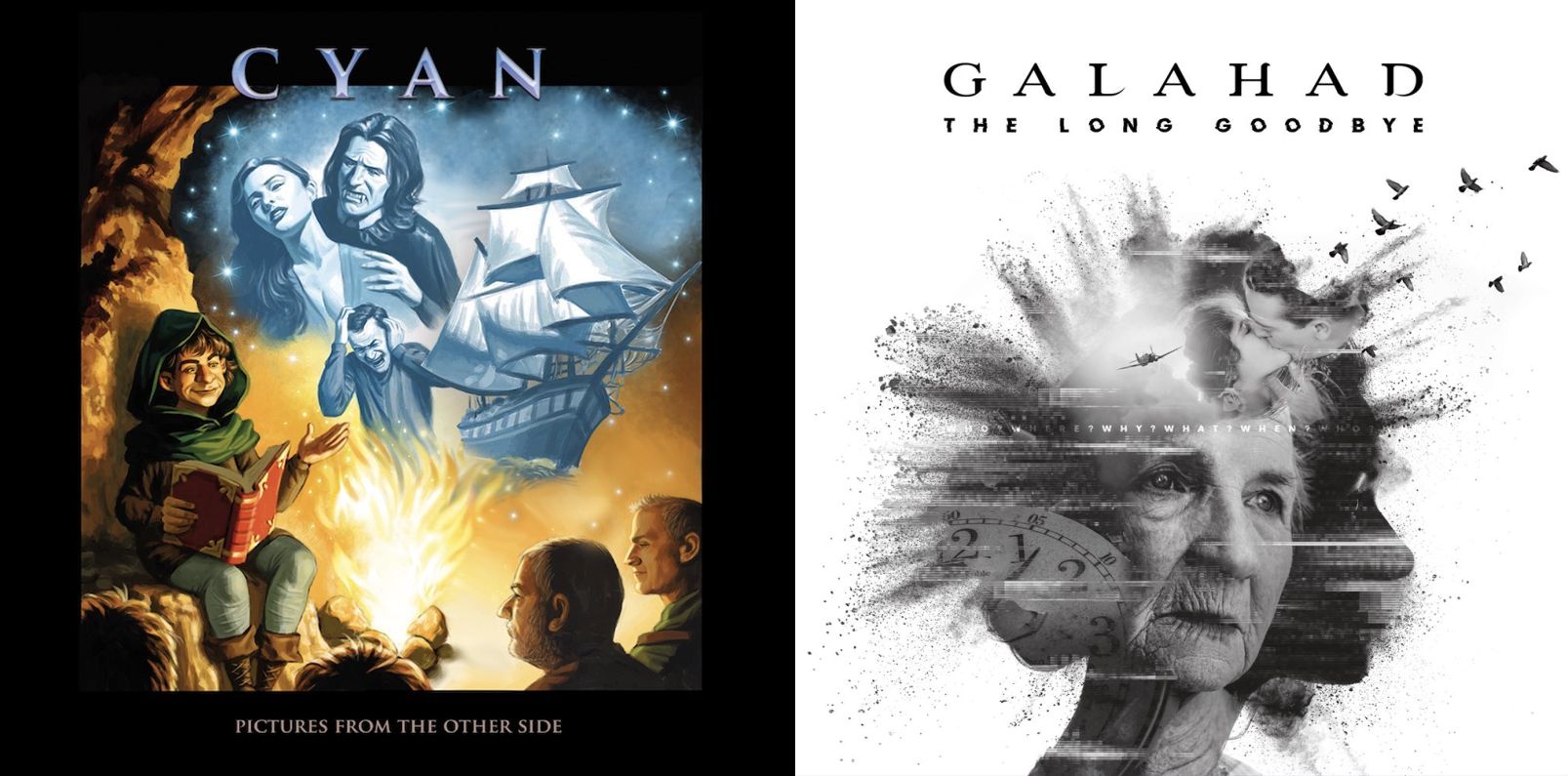
Cyan and Galahad: Double Fun and Greatness

Cyan_Galahad

There are two new releases that have created a buzz here at Spirit of Cecilia: Cyan’s Pictures From the Other Side, and Galahad’s The Long Goodbye. The usual Proglings take some time to share their impressions.

Tad: Gentlemen, I suggested we pair these two albums together, because in some unexplainable way they seem to complement each other. To my ears, both are extremely enjoyable listening experiences, and I’m eager to see what you think of them.

I’ll start things off with Cyan’s Pictures From the Other Side. This is a resurrection of an old Rob Reed (Magenta) project, but it is a totally new sound. What immediately leapt out to me was Peter Jones’ (Camel) terrific vocals. He has a bit of that Peter Gabriel/David Longdon vibe, and he is incredibly powerful. Angharad Brinn joins him on several songs, and her soprano melds beautifully with Jones’ baritone. 

The first song, “Broken Man” is an awesome starter to the set – it begins so softly I can barely hear it, then what sounds like Celtic bagpipes show up, and then the entire band explodes! The melody is first-rate, as well as the lyrics:

A broken man always knows what he’s lost

A broken man always counting the cost

A broken man on his knees always prays out loud,

“Give me one more, give me one more chance.”

Brad: What a great suggestion, Tad.  When it comes to Cyan, it’s hard to do better than either Rob Reed or Peter Jones.  Both are men with incredible vision and incredible integrity, exuding class.  I, too, am really taken with “Broken Man” as the opening track.  I’m so glad that the band didn’t turn it into a three-minute pop song, but instead gave it some real life.  I say this as a compliment–the song lingers when it should linger.  It comes to a head when it should come to a head.

As to influences, I hear a lot of Big Country, a lot of U2, and a lot of The Call.  Not sure if Reed or Jones would see it that way, but all three bands sound like forerunners to me.

It’s probably unfair of me–of all people to say this–but the second track, the title track, “Pictures from the Other Side,” sounds very much like a Bardic Depths song.

“Solitary Angel,” track three, just feels like solid rock, a Journey-esque ballad, but with a bit of Marillion (vocals, especially) thrown in.

Track four, “Follow the Flow,” continues in a ballad-esque way, soft but captivating.  Again, I’m hearing a lot of Marillion in this track.  Delicate without being prissy.

Again, track five, “Tomorrow’s Here Today,” continues the intense but soft sound.  And, again, I can only state this is precious in the best sense.  I feel like I’m holding the most fragile flower imaginable while listening to it.  Then, about ½ through the song, it really, really picks up, becoming a rather blistering prog and rock song.  Excellent guitar work here, but also keyboards, bass, and drums.  The last third of the song feels a bit like a Yes/Jon Anderson track.

Not surprisingly, given its name, the sixth and final track, “Nosferatu,” rocks, possessing a Glass Hammer or post-Neal Morse Spock’s Beard sound.  At nearly 18 minutes long, this track gives everything a prog fan would want.  An amazing journey through music.  The keyboards and guitar are especially well-finessed!  Towards the end of the song, there’s even a glorious Star Wars moment!  Or, maybe it’s inspired by Queen.  Regardless, it’s epic.

Tad: Brad, that is very perceptive of you to make the connection to 80s groups like U2, The Call, and Big Country. I did a little research, and these songs were actually first done on Cyan’s second album in the early 90s, and then rerecorded for this album. 

I agree with you that the overall sound of Pictures From The Other Side is good, solid rock. It is definitely prog, but prog grounded in the tuneful hard rock of the 70s and 80s. I think we both give it a strong recommendation for our readers.

Okay – on to Galahad’s latest! Brad, I am so impressed with the music Galahad is producing these days. I thought their previous album, The Last Great Adventurer, was terrific, and the song, “Blood, Skin, and Bone”  off of it was just fantastic.

Their latest offering, The Long Goodbye, is just as strong. The title track, in particular, really moved me. I think it is about saying goodbye to a loved one who is dealing with senile dementia, and it is an outstanding track.

I also think the first three songs are a 1-2-3 tour de force. The opening track, “Behind the Veil of a Smile” is a synth-laden beauty that sets the energy level at high. It has an addictive hook for a melody, and I hit “Repeat” a couple of times before I even listened to the rest of the album! The second song, “Everything’s Changed” is just as good – a perfect mix of retro synths and crunchy guitars. The third track, “Shadow In The Corner” is my favorite. Once again, it starts with some retro-sounding synths and sequencers before a killer guitar riff jumps in. This is the kind of music U2 should be making now! As a matter of fact, I think that’s what links the Cyan album to this one – they both take what’s best from 80’s rock and combine it with 21st century production sensibilities. In both cases, there is no question of sounding nostalgic or cheesy – both groups have an appreciation for the music that was made nearly 40 years ago (Oh my gosh, can you believe that?!) and have brought it into the contemporary prog scene.

Brad: Dear Tad, I very much appreciate your enthusiasm regarding the new Galahad.  I must admit, it’s taken me a bit longer than usual to appreciate.  I’m on several listens now, and I like it very much, but I’m still–even after numerous listens–surprised by just how electronic the album is.  Galahad has had this side to them as far back as I can remember, but it was always on the sides and in parts of the albums rather than at the core.

“Behind the Veil of a Smile” reminds me very much of Steven Wilson and Porcupine Tree but without Wilson’s trademark scratchingly-hard guitars.  And, I very much appreciate the lyrics, which Galahad always excels at writing.

Track two is really pop excellence, reminding me a bit of New Order, especially from the mid-1980s.  The refrain, “everything is changed and nothing will ever be the same again. . . the same again” is pop perfection.

I like very much how track three, “Shadow in the Corner,” steps back from the hyperactivity of the first two songs and gives us something intense and low.  Again, I’m very much reminded of New Order and, even possibly, all the way back to Joy Division, especially at the beginning of the track.  After about a minute, it resumes hyperactivity, becoming a more “mainstream” Galahad song.

Track Four, an acapella-esque folk song, “The Righteous and the Damned,” lovingly takes us back to Galahad’s masterpiece, “Empires Never Last.”  The middle of the track sounds very central European, right before becoming a brilliant flaring guitar track that sounds very much like Fish-era Marillion.

The longest song on the album, track five, the title track, “The Long Goodbye” incorporates a number of different musical styles.  As you note, Tad, the song deals with the very difficult topic of dementia and Alzheimers.  It is a beautiful wrought exploration of the subject, and Galahad should be praised for handling it with such class and delicacy.

Track six, “Darker Days“ takes us back to pretty straight-forward Galahad electronica, sounding here like a harder version of 1980’s Asia.

The album ends with “Open Water,” a gorgeous and gentle tune and ballad–absent all electronica and ending the album on a positive note.

Tad, I’m in full agreement with you, Galahad has very successfully bridged the past and the present with The Long Goodbye.  What seemed jarring to me on the first listen now seems incredibly complex and clever on the 10th listen.  This album took a bit to grow on me, but now that it has, I’m deeply thankful for it.

Tad: Brad, I don’t have as much experience hearing Galahad’s music as you do, so your perspective is very interesting. The Last Great Adventurer was my first exposure to them, so, as far as I’m concerned, the electronics are all good! I hear the New Order vibe you mention, and I think that is a feature. Hopefully, we’ve put enough distance between us and the 80s to appreciate the innovation and variety in music that blossomed during that decade. Yes, some music from then can sound “dated”, but that doesn’t mean it wasn’t great music.

Okay! So it looks like we have two thumbs up for both Cyan’s and Galahad’s new offerings. Dear Spirit of Cecilia readers, take some time to check these two albums out. And, like Brad, give yourself time to really absorb them. They will repay the effort – we promise!