Tag Archives: Stratford Festival

Vacationing with the Sublime

Sublime, noun or adj. 9. Of a feature of nature or art: that fills the mind with a sense of overwhelming grandeur or irresistible power; that inspires awe, great reverence, or other high emotion, by reason of its beauty, vastness, or grandeur.

– Oxford English Dictionary

Since 2019, my wife and I have made biennial efforts to route our long vacation toward one of the USA’s national parks. (She saw the Ken Burns film; I read Neil Peart’s travel books.) For this year’s trip, we ended up circling the Great Lakes, with a side quest to visit college friends in upstate New York. And while our trek had plenty of normal vacation fun — and even a few proggy moments — it struck me looking back how much time we spent in the presence of the sublime. (It cropped up on our 2024 vacation, too!)

The core destination on our eastward journey was Ohio’s Cuyahoga Valley National Park. A unlooked-for haven of forests, rivers, byways and trails situated between Cleveland and Akron, entering the park cast us back to the era when mule-drawn shipping plied the Ohio & Erie Canal, passing settlements and small towns on the way to the Mississippi River. But our initial destination within Cuyahoga Valley, Blossom Music Center, casts a distinctly modern silhouette on this pastoral scene.

The Cleveland Orchestra has long been considered one of America’s top five symphony organizations, alongside New York, Boston, Philadelphia and Chicago. Since the late 1960s, they’ve played summer concerts on Blossom’s 800-acre grounds. On the Saturday night we attended, 4,000 folks filled the pavilion and dotted the expansive lawn as a remarkably youthful orchestra took to the faux-rustic stage for a challenging program.
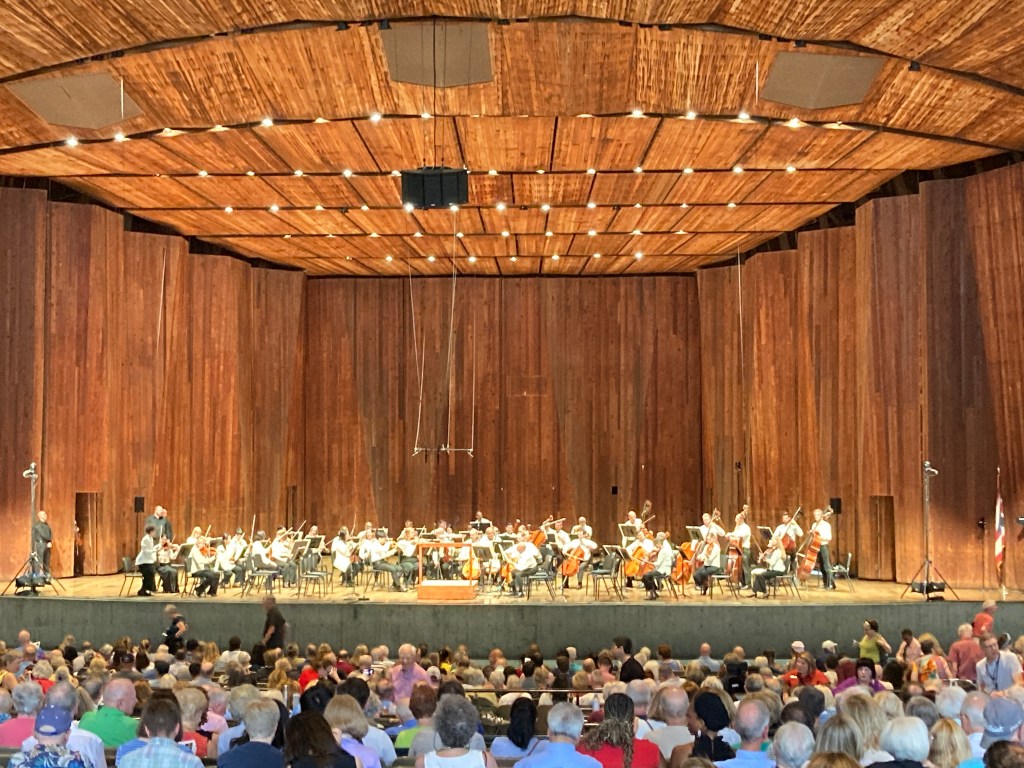
With young Czech conductor Petr Popelka on the podium, German violin phenom Veronika Eberle tackled one of the monuments of her instrument’s repertoire, Beethoven’s Violin Concerto. Twice as long as any similar work of the period, the Concerto stands out for its focus on cooperation between soloist and orchestra instead of contention. Eberle proved more than equal to the broad, lyrical span of the work, graciously in tune with her colleagues through the Allegro’s subtle, sonorous build, the Larghetto’s placid thematic variations and the vivacious, folksy Rondo. A well-deserved standing ovation led to Eberle dashing off a Bartok duet with concertmaster Joel Link. Then Popelka proved himself a maestro to watch and hear with a sprightly, energetic reading of Schumann’s “Spring” Symphony. Music, audience and surroundings came together for a thoroughly delightful evening. The rain that had threatened throughout even held off until after the concert!
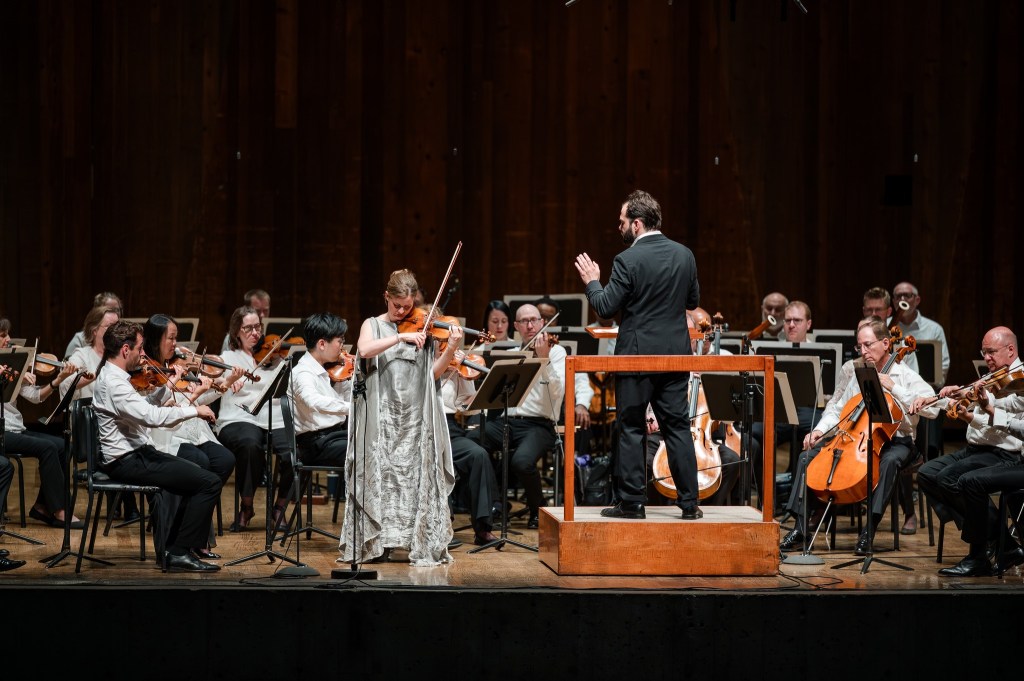
(Click here to hear Eberle’s recording of the Beethoven with the London Symphony Orchestra. Click here to hear Popelka conduct symphonic works by Czech composer Biedrich Smetana. Young musicians like these fill me with hope for the future of orchestras and their historic repertoire! A month remains in TCO’s Blossom season; full info is here.)

After an evening’s rest, the park called and we answered, hiking to and around the breathtaking Brandywine Falls (a hop, skip and jump from our B&B):

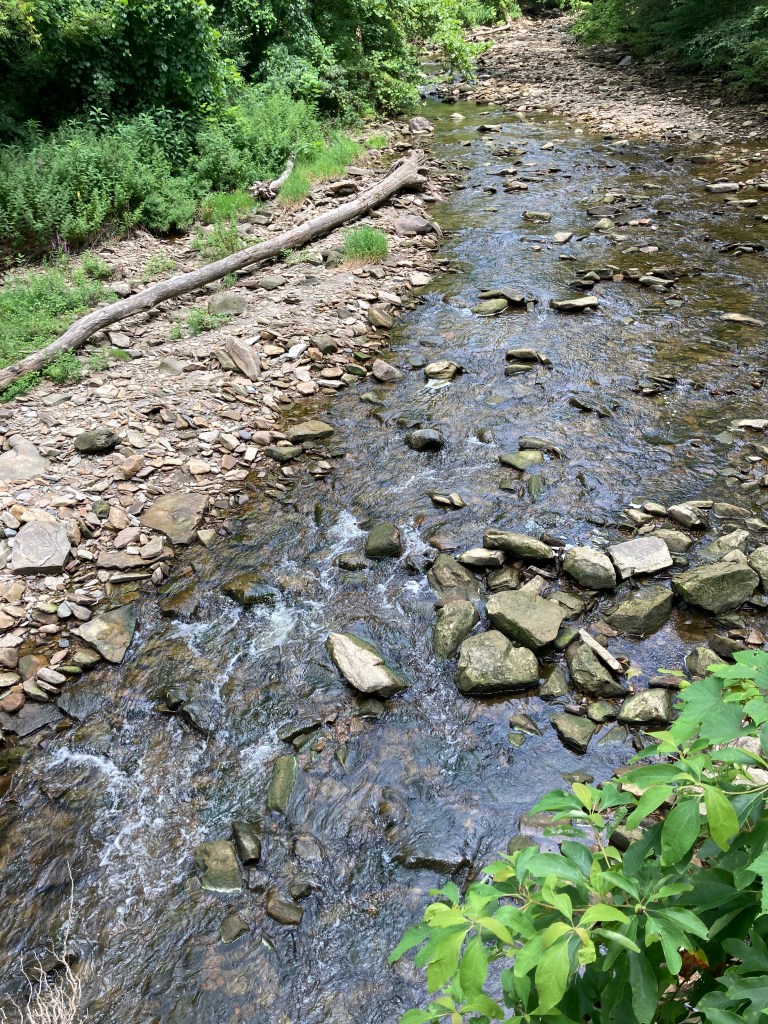
On our outbound journey the next day, we hiked The Ledges, a massive rock outcropping with its own ecosystem, actual bat caves, and a spectacular overlook of the Valley’s forests.


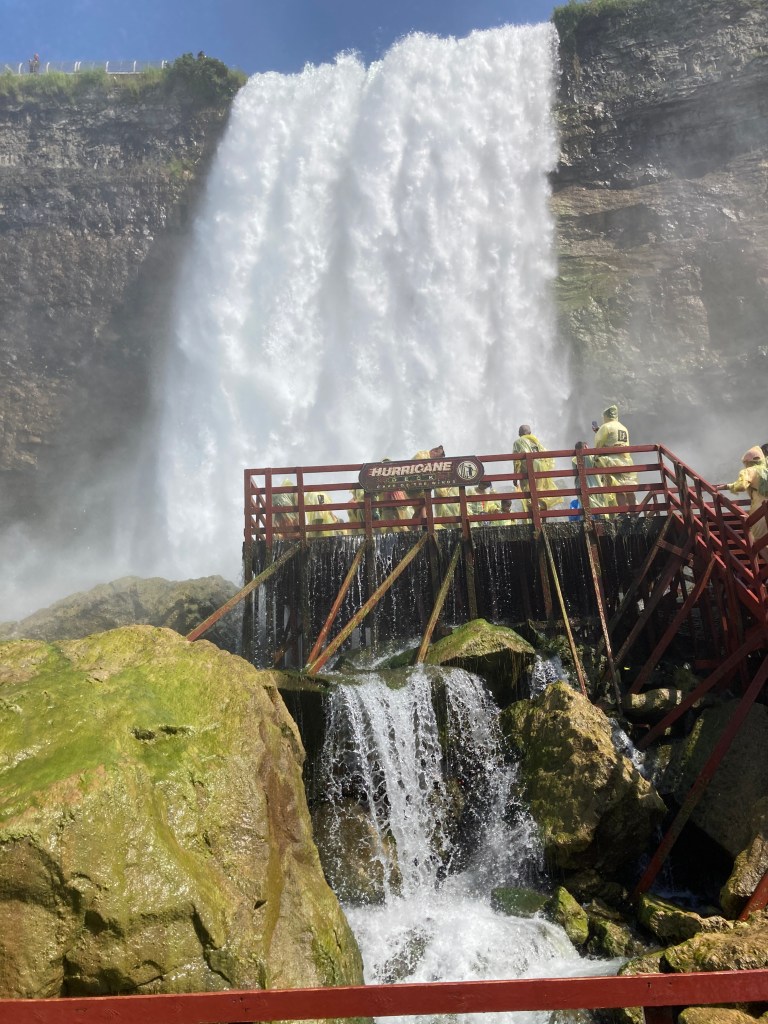
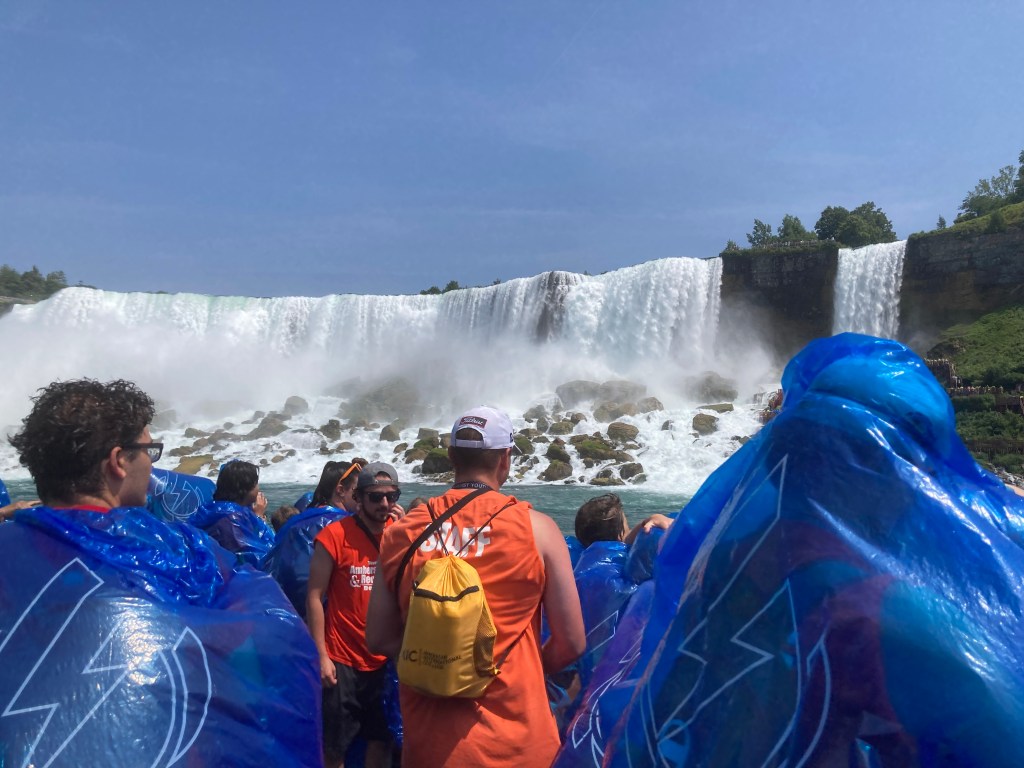
Following time with our friends, we tackled the sublimest of the Sublime for our wedding anniversary: the American side of Niagara Falls, experienced from multiple angles via New York’s expansive state park (the oldest in the country), a boat trip on the Maid of the Mist, and a river-level viewing platform where the now-obliterated Cave of the Winds once beckoned.

And it’ll surprise no one that, cutting back through Canada to head home, we stopped at the annual Stratford Festival for a taut, spellbinding production of Shakespeare’s The Winter’s Tale. One of the Bard’s late tragicomic romances, this one’s got it all: just in the first half, there’s jealousy and skullduggery, messages from the gods, false accusations with fatal results, plus the most notorious stage direction in theatrical history, “Exit, pursued by a bear.” How Shakespeare fashions a happy ending from of these tangled threads (hint: a flash-forward of 16 years is involved) is a marvel in and of itself, but a company that can pull off such a drastic vibe shift is even greater cause for wonder. As usual, Stratford was up to the task, with veterans (Graham Abbey’s hapless Leontes, Sara Topham’s noble Hermione, Yonna McIntosh’s searing Paulina, Tom McCamus’ country clod facing off with Geraint Wyn Davies’ citified rogue Autolycus) and new recruits (an enthusiastic Marissa Orjalo and a passionate Austin Eckert as young lovers Perdita and Florizel, Christo Graham’s show-stealing Clown) giving it their all under Antoni Cimolino’s sure-footed direction. If there’s finer theater on this continent, I’d be hard-pressed to find it. (The Winter’s Tale runs through September 27 at Stratford; see it for yourself!)

— Rick Krueger

At the Stratford Festival: Get That Hope (To the True North, Part 8)

Daddy wants to win the lottery, Mommy is still bitter about getting knocked up at twenty, Simeon has war-related PTSD, and Rachel just wants to get out of her parents’ place and have a home of her own, but first there are a few things she’s got to get off her chest. It’s Jamaica’s Independence Day, Toronto is sweltering, and everyone is on edge–then the air-conditioner breaks.

— publishers’ blurb for Get That Hope

If the above sounds like a downer — well, on stage it didn’t turn out that way! While playwright/screenwriter Andrea Scott explicitly claims Eugene O’Neill’s famously depressing Long Day’s Journey into Night as inspiration for Get That Hope, her new play (currently in previews for its world premiere next month) has too much of the milk of human kindness to leave its audience shattered. There’s misapprehension and conflict shot throughout her bittersweet portrait of the Jamaican-Canadian Whyte family, but as individuals’ secrets are revealed and each character gathers the courage to be honest, the play becomes an affirmation of how the ties that seem to confine can also bind together — in love (however clumsily and reluctantly expressed), in sympathy, in mutual support.

With only five characters, each actor has to make their portrayal count — and each steps up to the challenge. Conrad Coates’ Richard Whyte works hard to be carefree as the head of the family– maybe a little too hard, as he dismissively tries to keep the lid on everyone’s tensions and just have a party. Kim Roberts (a pioneer in Canadian stage, film and TV) vividly portrays the challenges Richard’s wife Margaret faces, both to recover her health and to relate to the household’s adult children. Celia Aloma as Richard’s daughter Rachel bears the brunt of the Whytes’ situation; providing most of the family income, she longs for respect and independence. And son Simeon, sketched with quiet intensity by Savion Roach, wrestles with demons acquired while serving overseas, locked into inaction by his suppressed pain, fear and frustration. Jennifer Villaverde’s Millicent Flores — the family’s Filipino neighbor, Margaret’s care worker, everybody’s confidant — seems to be the glue holding the Whytes together; but a secret that’s only revealed as Act II begins threatens to blow all these tense relationships completely apart.

Misunderstanding between generations and cultures breaks out in the open; Rachel slams into her parents for not living up to her expectations, Richard and Margaret react with disbelief and defensiveness, Millicent has to stand up for herself while Simeon confronts his own emotional paralysis. What’s true to life here — what Scott, director Andre Sills and the company bring home powerfully — is that none of these problems are solved with a pat therapeutic answer, or even a melodramatic apology. Everyone in this circle stands their ground — but everyone also realizes that all they have is each other. And as painful as their vulnerabilities are, leaning on each other, letting go of built-up resentment, is how they’ll get through whatever might come their way, with the play’s final moments hinting at both further suffering and (just perhaps) reasons to hang on.

I found Get That Hope to be a solid slice-of-life drama, resonant in its forthright assertion of how we need each other in the face of adversity — whether it’s eaten at you for years or comes at you from out of nowhere. Come to this new play with an open mind and heart; you won’t be disappointed.

— Rick Krueger

Get That Hope is currently in previews at the Stratford Festival’s Studio Theatre; it officially opens on August 10, playing through September 28. For production information and ticket availability, click here.

At the Stratford Festival: Something Rotten! (To the True North, Part 6)

I thought there were three genuinely great things about the Tony Award-winning musical Something Rotten, as currently playing at the Stratford Festival:

1. Mark Uhre’s frenetic take on struggling Elizabethean playwright Nick Bottom. Between his oversized desire for fame, his strained interactions with enterprising wife Bea (a confident Starr Dominque) and poetic little brother Nigel (Henry Firmston in the boy-next-door role), and his obsessive drive to take down William Shakespeare and win the Renaissance fame game, Nick is desperation personified, thoroughly uncomfortable in his own skin and all the funnier for it. Uhre plays him as a live-action version of Daffy Duck, spluttering with unbounded rage at his situation, and thus completely susceptible to any bizarre idea that crosses his path – like inventing the musical – and thus totally willing, no matter how insane the consequences that follow, to “commit to the bit”.

2. The thing is, in this universe, Nick’s right! Framing Shakespeare as a vain, manipulative rock star (continuing the parallel, think Bugs Bunny without redeeming qualities) is Something Rotten’s masterstroke. Trailed by his own theme song and a crew of dancing Bard Boys, basking in the adulation of a solo stadium gig (with hilariously low-tech special effects), scheming against Nick to the point of donning a fatsuit disguise and a Northern accent, stealing Nigel’s best lines and passing them off as his own, Jeff Lillico is a utter hoot, England’s greatest dramatist as an egotistical, over-the-top pantomime villain. Even when he lets his guard down in his big solo “Hard to Be the Bard”(“I know writing made me famous, but being famous is just so much more fun”) , this is a Shakespeare you can love to hate.

3. Speaking of over-the-top, director Donna Feore and her creative team absolutely chose the right path by leaning into the Broadway musical’s inherent absurdities, as foreseen by cut-rate soothsayer Nostradamus (Festival veteran Dan Chameroy in a giddy, disheveled supporting turn):

You could go see a musical
A musical
A puppy piece, releasing all your blues-ical
Where crude is cool
A catchy tune
And limber-legged ladies thrill you ’til you swoon
Oohs, ahhs, big applause, and a standing ovation
The future is bright
If you could just write a musical

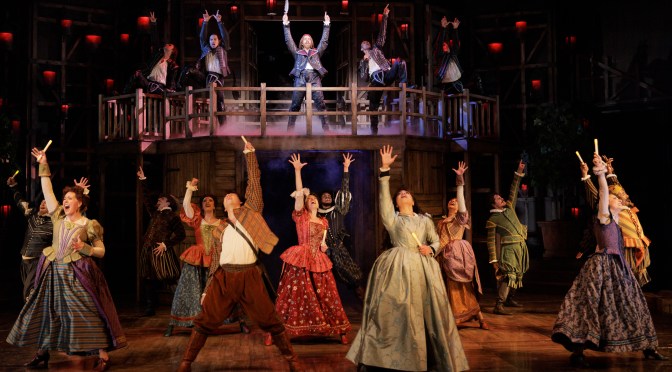
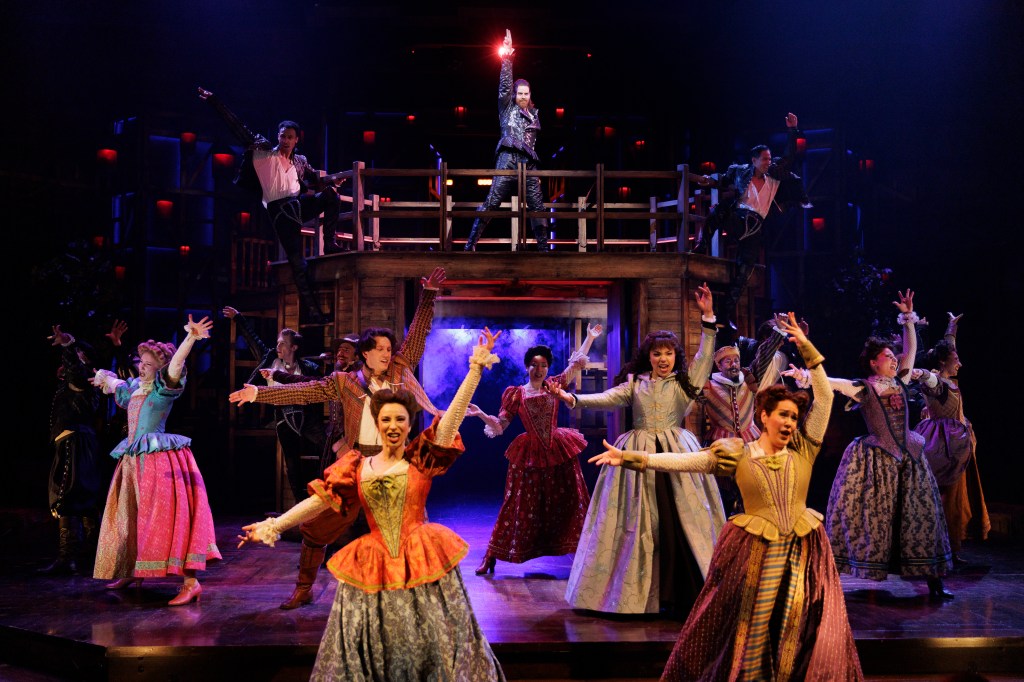
Dan Chameroy as Nostradamus with members of the company in Something Rotten!. Stratford Festival 2024. Photo: David Hou.

Every possible cliché you can think of is there onstage for those six minutes: Sung recitatives (with self-mocking asides)! Bawdy double-entendres and suggestive choreography! Costume changes (including nonsensical hats and wigs)! Jazz hands! Synchronized high-kicking (with callbacks goofing on Feore’s 2016 Festival production of A Chorus Line)! It all worked to perfection at this matinee, the capacity audience (including your scribe) yelling and applauding for more (which the company obligingly provided) as if Pavlov had just rung his biggest, shiniest bell. And the places Nick and Nostradamus find themselves going in the second act’s big number scale even zanier heights. Complete the sentence yourself: “When life gives you eggs . . .” Then imagine the costumes!

Where Something Rotten falls short? Compared to the sublime ridiculousness of the main story, the supporting characters’ arcs bog down in vapid sentimentality and already-stale contemporary memes. Bea’s occasional empowerment shoutouts pale in comparison to what she actually does out of love for her husband and his brother, subtly undercutting her role as the true hero of the piece. Nigel’s emergence from Nick’s shadow is a bit of a damp squib; his main solo turn “To Thine Own Self Be True” proves an shallow, unearned manifesto of self-actualization instead of a rite of passage. And the meet-cute romance between Nigel and Portia (Olivia Sinclair-Brisbane, winningly portraying a budding poetry fangirl under the thumb of Juan Chioran, a Puritan father given to pre-Freudian slips) sputters, toggling between aren’t-we-transgressive smuttiness and, in “We See the Light”, a Big Message about tolerance, tediously staged as a clumsy cross between Sister Act and Rent — Feore’s only directorial misfire.

But that said, Something Rotten’s full-on commitment to farce and totally bonkers energy (with Feore, Uhre, Lillico and Chameroy setting the pace for a young, frisky cast) carries the day. Productions about Shakespeare at the Stratford Festival are typically on or about at the same level as their productions of Shakespeare, and this delightfully nutty escape into a toe-tapping alternate version of the Renaissance is no exception.

Members of the company in Something Rotten!. Stratford Festival 2024. Photo: David Hou.

— Rick Krueger

Something Rotten continues at Stratford Festival’s Theatre, with its run now extended through November 17th. Click here for ticket availability.

To the True North!

Perhaps you might remember that, for twenty years now, my wife and I have been regular attendees at the Stratford Festival in Ontario, Canada. This week, we’re off to the north (and east) for another adventure in world-class theatre! But this time around, there’ll be additions to an already ambitious arts-going itinerary:

Now in its 45th season, the Elora Festival has established a reputation as Canada’s international choral festival, presenting world-class choirs and vocal ensembles over two weeks in July in the artists village of Elora, “Ontario’s most beautiful village”.

We’re looking forward to experiencing the Elora Festival for the first time, taking in these mouth-watering programs:

Then we’ll double back to Stratford – but before we settle into our theatre seats we’ll catch world-renowned Canadian pianist Angela Hewitt as she performs Bach, Beethoven, Scarlatti and Brahms (no pressure!) under the auspices of Stratford Summer Music.

And the plays on tap?

Watch this space for reviews and impressions, beginning later this week!

— Rick Krueger

Stratford Festival Review: Richard III by William Shakespeare

The thought will not down that an unfortunate choice was made when King Richard III was selected as the spearhead stage offering. It is definitely the most unwholesome of all Shakespeare’s tragedies, and its only character of any real dramatic interest is that of Richard himself — a physically repulsive hypocrite, liar & murderer without one redeeming feature.

— The Stratford Beacon-Herald, June 30, 1953

Defying the Beacon-Herald’s strictures, the Stratford Festival nonetheless opened its inaugural season with Richard III — with no less a personage than Alec Guinness (“the old Obi-Wan”, as I overheard a Festival-going mom telling her son a few years back) in the title role, and the results were raved about throughout the Anglophone world. Since then, the Festival has mounted the tragedy at least seven more times, with both widely-known actors such as Alan Bates (1967) and Brian Bedford (1977) and talented company members like Stephen Ouimette (1997) and Tom McCamus (2002’s 50th season) flocking to fill the part.

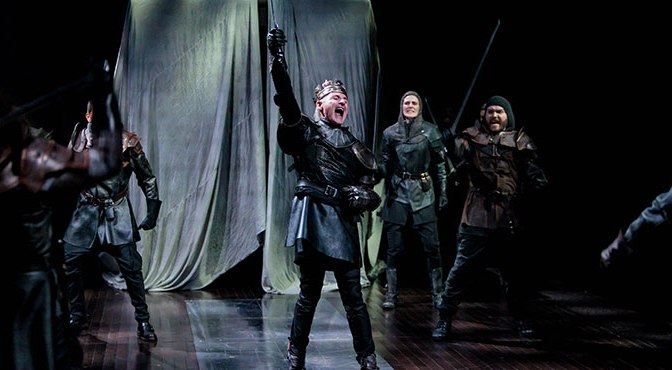
Having paid his dues at Stratford before launching into a well-rounded career that spans Canadian biopics of Pierre Trudeau & Glenn Gould and comic book movies (Thor: The Dark World and The Amazing Spider Man 2), it’s intriguing to see Colm Feore become a repeat Richard, 35 years after he first essayed the role at the 1988 Festival. His deeply physical take on the Duke of Gloucester, complete with a gait that evokes the scoliosis evident in the monarch’s recently-discovered skeleton, is visually riveting. His way with the text is equally arresting; doing without the scene-chewing excess of an Olivier, he’s nonetheless “determined to prove a villain” from the opening soliloquy, unabashedly eager to walk the Tom Patterson Theatre audience through his machinations as he claws his way toward the throne. And like Feore’s other role this season as Molière’s The Miser, his Richard becomes the focal point around which Shakespeare’s cast revolves, constantly manipulated and mesmerized by him whether they realize it or not.

Sooner or later, however, most of the other characters do discover what Richard really wants. Freed from their self-deception and ambition, it’s their reactions that give the tragedy both its recurring sparks of conflict and its building momentum. Michael Blake’s Duke of Clarence, with his dreamed intimations of his brother’s betrayal; Jessica B. Hill’s Lady Anne, whose loathing of Richard is palpable even as he perversely woos her (and wins her!); Ben Carlson’s clueless Hastings and Andre Sills’ scheming Buckingham, whose death row regrets soar to commanding heights — all these keep any empathy the audience may be developing for the would-be usurper at arm’s length.

Towering over all these are Seana McKenna (who played Richard in 2011!) as the mad, prophetic dowager Queen Margaret, calling down curses on all and sundry; Lucy Peacock, whose Queen Elizabeth soars to dizzy heights of spite and bereavement following Richard’s slaughter of her children; and Diana LeBlanc, whose Duchess of York is shocked into cursing her upstart son just as he gains the throne. This is titanic stuff — the loosely historical narrative may drive the action of the play, but the clash of deep — and deeply flawed — characters is what keeps us from joining Team Richard, despite the combined allure of Shakespeare’s words and Feore’s strange appeal. In fact, no sooner does Richard become king than we (and possibly he) realize that his downfall is inevitable — and that we need to see it, to make some sense of these tumultyous events.

Even in the intimate TPT (with one-third the capacity of the Festival Theatre), there’s spectacle aplenty to be mined by director Antoni Cimolino and the populous, well-drilled cast as Richard approaches his necessary end. Royal processions, civil unrest, a coronation, ghostly visitations and the final battle between the forces of the usurper and Jamie Mac’s enigmatic, recessive Henry Tudor stir the blood, even as they bring Richard’s lurid dreams to both their culmination and their dissolution. And while this generally traditional production is a feast for the eyes and ears that I can’t recommend highly enough, Cimolino leaves us with more food for thought as well. His prologue and epilogue are set in the present day, with the discovery of Richard’s skeleton and his reburial in Leicester Cathedral bookending the tragedy — as if to remind us that, no matter how high Shakespeare’s characters may fly, as the Bard wrote later in his career,

Golden lads and girls all must,
Like chimney sweepers come to dust.

(Cymbeline)

Richard III runs through October 30th at the Stratford Festival’s Tom Patterson Theatre. Tickets available at stratfordfestival.ca.

— Rick Krueger

Stratford Festival Review: Freedom Cabaret 2.0

In last year’s cut-down Stratford Festival lineup, actor/musician/playwright Beau Dixon’s Freedom Cabaret (part of the Festival’s Forum of other performing arts and speakers) garnered some of the strongest reviews. Walking out of yesterday’s performance of Freedom Cabaret 2.0, I completely understood why.

Subtitled “How Black Music Shaped the Dream of America”, this year’s cabaret is loosely structured around the life of work and Martin Luther King, Jr. Dixon’s command of the black musical tradition is formidable and thrillingly eclectic; grasping the connections between decades and genres with a firm hand, his new set comfortably mingles jazz, soul, folk, gospel and even a touch of hip-hop in an arc that illuminates both King’s journey and the idealism he set loose during the era of the Civil Rights Movement.

And the ensemble that Dixon has reconstituted for this year — serving as the lynchpin on piano and vocals for a trio of singers with rhythm section — grasps those connections at the same level, vividly painting a compelling portrait of King’s context, life, death and legacy. Shakura Dickson’s floating soprano and Alana Bridgewater’s earthy alto scale the gospel heights of “Oh, Happy Day” and “Move On Up A Little Higher”, then pull back for an eerie, hovering “Strange Fruit” and Nina Simone’s wrenching “Four Women”; Aadin Church runs the emotional and vocal gamut from soaring tenor to down-home baritone on showcases like Louis Armstrong’s “(What Did I Do to Be So) Black and Blue”. Rohan Staton on guitar, Roger Williams on bass and Joe Bowden on drums lay down one irresistible groove after another, slipping serenely from a Jeff Beck quote in “People Get Ready” to the abstracted jazz of “Freedom Day”. And Dixon ties it all together with his supple piano, his power-packed voice and his understated yet emotional narration.

Most fascinating to me were the artists Dixon chose to anchor King’s story. Stevie Wonder’s “Love’s in Need of Love Today” and “Living for the City” bookended the narrative, melding harmonic sophistication with unaffected idealism; the Staples Singers “Why? (Am I Treated So Bad)”, “Freedom Highway” and “Respect Yourself” embodied both the lament of the oppressed and the spiritual grit to stand up against that oppression. But the searing quartet of pieces by chanteuse Nina Simone provided the real key to unlock the heart of King’s message. From unflinching confrontation with racism’s deepest horrors in “Mississippi Goddamn” (operatic in structure, visceral in its impact) through the heartbroken elegy for the fallen leader “Why? (The King of Love Is Dead)” pivoting to the visionary hope of “To Be Young, Gifted and Black”, Simone’s music is brutally honest and unsparing — but it also incarnates how King’s dream of hatred conquered by love was set loose in the 1960s and how its ramifications have been rippling out ever since.

The dream and its spread — even after the horrors of black history in the United States, even in the face of what obstacles remain following the progress of the Civil Rights era — are why Dixon and his ensemble can finish Freedom Cabaret with a hearty invitation for the Festival audience to join the “Love Train” that King set in motion. If you can, I highly recommend you catch it.

Setlist:

  • Oh, Freedom
  • Love’s in Need of Love Today (Stevie Wonder)
  • Why? (Am I Treated So Bad) (The Staples Singers)
  • Oh, Happy Day (The Edwin Hawkins Singers)
  • Move On Up A Little Higher (Mahalia Jackson)
  • Strange Fruit (Billie Holliday)
  • Mississippi Goddam (Nina Simone)
  • Freedom Highway (The Staples Singers)
  • People Get Ready (The Impressions)
  • We Shall Not Be Moved
  • John Henry (Harry Belafonte)
  • Black Man in a White World (Michael Kiwanuka)
  • (What Did I Do to Be So) Black and Blue? (Louis Armstrong)
  • Respect Yourself (The Staples Singers)/Respect (Aretha Franklin)
  • Freedom Day (Max Roach & Abbey Lincoln)
  • Phenomenal Woman (Maya Angelou)/Four Women (Nina Simone)
  • So Much Trouble in the World (Bob Marley and the Wailers)
  • Why? (The King of Love Is Dead) (Nina Simone)
  • Harlem (Langston Hughes)/To Be Young, Gifted and Black (Nina Simone)
  • Living for the City (conclusion) (Stevie Wonder)
  • Ain’t No Stoppin’ Us Now (McFadden & Whitehead)
  • Move On Up (Curtis Mayfield)
  • Love Train (The O’Jays)

Personnel:

  • Joe Bowden, drums
  • Alana Bridgewater, singer
  • Aadin Church, singer
  • Shakura Dickson, singer
  • Beau Dixon, piano, singer, musical director
  • Rohan Staton, guitars
  • Roger Williams, basses

Freedom Cabaret 2.0: How Black Music Shaped the Dream of America runs through August 28th at the Tom Patterson Theatre’s Lazaridis Hall in Stratford, Ontario. Tickets are available at stratfordfestival.ca.

— Rick Krueger

Live from the Stratford Festival

This is an exciting time for the Stratford Festival. In 2022, we reopen our theatres, honour the excellence of the past and embark on a new leg of our journey together. A fresh start: an opportunity to reassess ourselves in the world today, reaffirm what we value and take the best path to an extraordinary future.

This will also be a year to celebrate milestones: our 70th season, the 20th anniversary of the Studio Theatre, the 10th season of The Meighen Forum, and the grand opening of our glorious new Tom Patterson Theatre.

It’s fitting, then, that our season theme for 2022 is New Beginnings. Our playbill explores the difficult moral and ethical decisions a new journey entails: What is the best way to start again? How can we avoid the traps of the past? In an imperfect world, what is good?

From Shakespeare’s most iconic play, Hamlet, to the American family classic Little Women; from the great Nigerian Nobel Prize winner Wole Soyinka’s Death and the King’s Horseman to such captivating new plays as 1939 and Hamlet-911, we offer you stories about navigating a new start in life.

Antoni Cimolino, Artistic Director, Stratford Festival

Since 2004, my wife and I have been regular visitors to the Stratford Festival in southwestern Ontario. We’ve fallen in love with the Festival’s unbroken ethos across 70 seasons — dynamic, top-level performances by a dedicated repertory company of classics by William Shakespeare, Molière, Anton Chekhov, Berthold Brecht and others, as well as substantive, appealing musicals and fresh, often experimental works by today’s playwrights. We’ve also fallen in love with the city of Stratford; set in the heart of Ontario farm country, it combines picturesque architecture, unique shops and eateries, and a stunningly beautiful park system along the Avon River and Lake Victoria. And the thought of everyone who’s trod a stage at the Festival’s multiple theatres, played a rock show at the hockey rink or busked for change on the streets (ranging from Alec Guinness and William Shatner to Richard Manuel of The Band and native son Justin Bieber) makes the place a performing arts lover’s dream.

Which is why it hit hard when, in the wake of the worldwide pandemic, the Festival’s 2020 season was cancelled and the 2021 season only went on under severe limitations and restrictions. It’s true that the summer of 2020 brought welcome YouTube screenings of the Festival’s ongoing project to film every play by Shakespeare (along with other archival videos), culminating in the online Stratfest At Home subscription service. But, a few days back at a local B&B, with a full season of 10 productions energizing the town around us, has served to remind me that there’s nothing like the real thing. And that experience is what I plan to share here with you.

Over the next few days, we’ll be attending Molière’s The Miser (currently in previews at the Festival Theatre), Shakespeare’s Richard III (at the new Tom Patterson Theatre), and Freedom Cabaret 2.0: How Black Music Shaped the Dream of America (at the TPT’s Lazaridis Hall). Look for reviews posted here ASAP after each performance. Whether you’re able to visit the Stratford Festival this season or in the future (or take in what it offers online), my hope is to capture at least a bit of the serious fun, the sheer emotional and intellectual sweep, the thrills, spills, heartbreak and heart’s ease — in short, the immersive, cathartic experience live theatre at its best can provide, and that the two of us have come to love and crave.

— Rick Krueger

THE STRATFORD FESTIVAL GOES DIGITAL

From Broadway World:

The Stratford Festival is following up on the success of its recent Shakespeare Film Festival with a $10-a-month digital content subscription, Stratfest@Home, offering more Shakespeare and more films, along with new commissions, music, conversation, cooking and comedy. A free film festival, with a theme of Hope Without Hope, will once again be offered on Thursday evenings.

“At this particular moment of pandemic, with social isolation once more upon us, nights growing longer and winter approaching, we need the consolation of community like never before. With these viewing parties and the many related artistic programs in Stratfest@Home, we invite you to enter the warmth of the Festival bubble,” says Artistic Director Antoni Cimolino.

The subscription cost will include:

  • access to the 12 Shakespeare films streamed on YouTube this past spring;
  • a growing library of Festival-related legacy films, interviews & discussions;
  • new content like the filmed-in-Stratford mini-soap opera Leer Estates, holiday specials for Halloween and U.S. Thanksgiving, and video introductions to the young actors currently studying at the Festival’s Birmingham Conservatory;
  • coming in 2021, the game show Undiscovered Sonnets and the concert series Up Close and Musical.

The free film festival begins this Thursday on YouTube. Already on the schedule are:

  • October 22: The 2011 production of Shakespeare’s Twelfth Night featuring the late Brian Dennehy (a great version that my wife & I saw in person – it includes cool songs by then-artistic director Des McAnuff, who worked with Pete Townshend on the Broadway version of Tommy);
  • October 29: The Stratford Festival Ghost Tours Halloween binge.
  • November 5: The 1994 production of Eugene O’Neill’s Long Day’s Journey Into Night. This one’s a legendary part of Festival history.
  • November 12: The 1992 production of Shakespeare’s Romeo & Juliet, with a young Antoni Cimolino as Romeo and Anne of Green Gables’ star Megan Follows as Juliet.
  • November 19: The 2000 production of Timothy Findley’s Elizabeth Rex, a Festival commission. Playwright Findley was in the acting company with Sir Alec Guinness for the Festival’s inaugural season in 1953.
  • November 26: The Early Modern Cooking Show U.S. Thanksgiving binge.
  • December 3: The 2010 production of Shakespeare’s The Tempest, starring Christopher Plummer. (Another great version that we saw live — and also got Plummer’s autograph on his memoirs!)
  • December 10: The 2008 production of George Bernard Shaw’s Caesar and Cleopatra, starring Christopher Plummer.
  • December 17: All the Sonnets of Shakespeare, a lecture with readings.

You can learn more about Stratfest@Home and subscribe at https://www.stratfordfestival.ca/AtHome

— Rick Krueger

Shakespeare @ Stratford on YouTube

Since 1953, the little Ontario town of Stratford has hosted what is arguably North America’s premier repertory theater.  Down the decades, every summer the Stratford Festival has presented world-class productions of plays by William Shakespeare, along with other classics of the world stage and new, cutting-edge efforts.  (Not to mention musicals ranging from vintage Broadway to The Who’s Tommy.)

As with so many other performing arts institutions, Stratford’s 2020 season is currently on hold.  To fill the gap, the Festival’s YouTube channel kicked off free screenings of its Stratford on Film series last night — Shakespeare’s birthday — with an intense, gripping 2014 production of King Lear:


https://www.youtube.com/watch?v=qKm-1t_O9Vk

Each film of the series (an effort to film all of Shakespeare’s plays in ten years) will be available to view for 3 weeks, scheduled as below:

  • King Lear (2014): April 23 to May 14
  • Coriolanus (2018): April 30 to May 21
  • Macbeth (2016): May 7 to 28
  • The Tempest (2018): May 14 to June 4
  • Timon of Athens (2017): May 21 to June 11
  • Love’s Labour’s Lost (2015): May 28 to June 18
  • Hamlet (2015): June 4 to 25
  • King John (2014): June 11 to July 2
  • Pericles (2015): June 18 to July 9
  • Antony and Cleopatra (2014): June 25 to July 16
  • Romeo and Juliet (2017): July 2 to 23
  • The Taming of the Shrew (2015): July 9 to 30

My wife and I have been regular attenders at the Stratford Festival for over 15 years.  We return again and again because of the Festival’s consistently high quality  — an acting company of impressive craft, dedication and emotional heft, working together on the unique thrust stage of the Festival Theatre and other more intimate venues, creating utterly immersive artistic experiences.  (And all in a welcoming, delightful small town environment.)   We hope to return later this summer to see Richard III, Wolf Hall and Spamalot (!)  but in the meantime we agree: the Stratford on Film series is the next best thing to being there, and a first-class way to drink in Shakespeare’s luminous genius.

— Rick Krueger