All posts by bradbirzer

By day, I'm a father of seven and husband of one. By night, I'm an author, a biographer, and a prog rocker. Interests: Rush, progressive rock, cultural criticisms, the Rocky Mountains, individual liberty, history, hiking, and science fiction.

The Underfall Yard

I make no apologies–“The Underfall Yard” is arguably one of the four or five greatest rock tunes ever written. Only “Supper’s Ready” by Genesis really challenges it for the number one spot.

Enjoy the 2020 remixed version of Big Big Train’s best.

Defining The Republic: From the Declaration to the Northwest Ordinance

In this lecture, I define a republic in two ways. First as a mixed government: monarchy, aristocracy, and democracy, comparing it to the human person (mind, soul, stomach). Thus, the republic is always flawed and always in a life cycle of birth, middle age, and death. Second by its elements: virtue, property (as the right to moral ownership), a well-armed citizenry, and decentralized decision making. I also focus on Articles 1-3, 6 of the Northwest Ordinance, and I talk about Hillsdale’s connection (with historian Ransom Dunn’s creation of the Republican Party in 1854—inspired by Article Six of the Northwest Ordinance) to all of this.

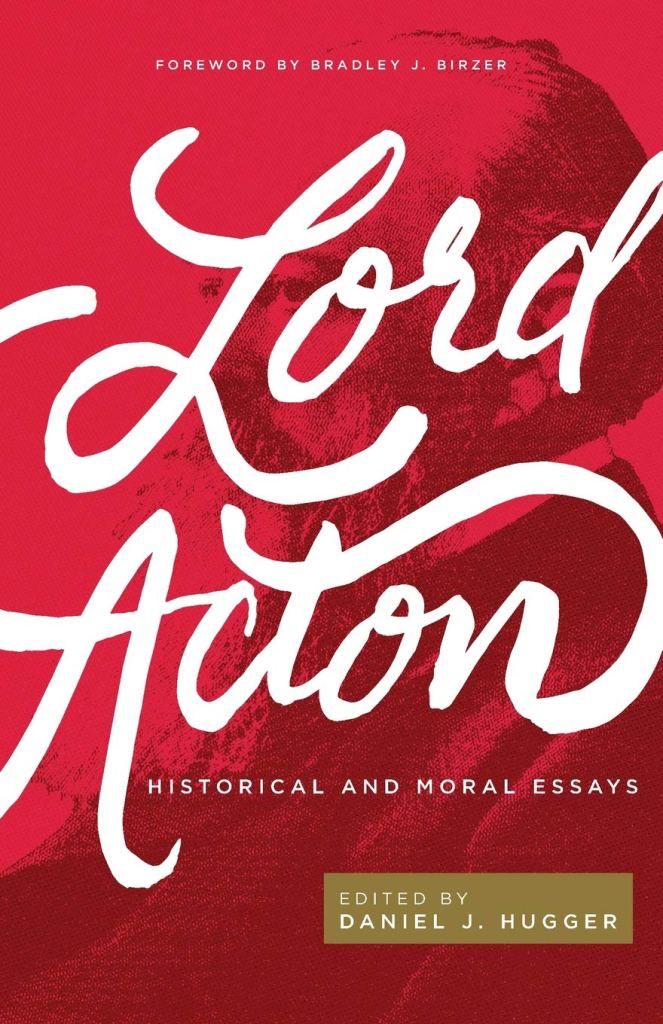
Reflections on Lord Acton

Introduction for Dan Hugger’s LORD ACTON: HISTORICAL AND MORAL ESSAYS (2017).

When scholars discuss the nineteenth century of western civilization, they automatically and reflexively conjure images of the three most profound and original minds of the period: Karl Marx, Charles Darwin, and Sigmund Freud.  Sometimes, depending on the scholar, one might list Friedrich Nietzsche as well.  This is obvious in the massive and tedious surveys of western civilization as well as in the remaining and lingering canons of Great Books.  None of this is false, of course, and the three (or four) men remembered certainly were among the greatest of minds to come into this world of sorrows.

One might, with equal accuracy and a bit more humanity and justice, create a different trinity.  What about John Henry Newman, Alexis de Tocqueville, and Lord Acton?  After all, as the great Russell Kirk once argued, “In every age, society has been relieved only by the endeavors of a few people moved by the grace of God.”  With the possible exception of Darwin, neither the taken-for granted trinity nor their followers were wont to taint the men or their ideas with the airy notion of the “grace of God.” 

With the newly-proposed trinity of nineteenth-century thinkers, though, the men and their followers would lovingly accept the grace of [g]od. 

Even among these proposed three, however, Lord Acton—the author of the essays you now hold in hands–remains the least known, the least studied, and the least understood.  True, every American with any education at all remembers his assertion that “power corrupts.”  Other than this, though, he’s largely forgotten or dismissed.  It’s as though his entire existence from 1843 through 1902 mattered only for that one sentence.  Truly, this is to both our discredit and our loss.  Thanks to the Acton Institute and Daniel Hugger, we can begin to rectify this massive error near the beginning of the twenty-first century.

A profound thinker and essayist, Acton argued in his seminal piece of 1862, “Nationality”: “Christianity rejoices at the mixture of races as Paganism, however, identifies itself with their differences, because truth is universal, errors various and particular.” The modern and rising nation-states, though, demand unity of thought, culture, and politics.  In essence, Acton believed, the world was re-paganizing, returning to its worship of the state as god.  After all, he wrote, “in the ancient world idolatry and nationality went together, and the same term is applied in Scripture to both.”

While this is just one of many profound arguments that Acton advanced during his writing career, it is critical to see him not only as important in his own day and age, but also as the critical link in the arguments about natural rights, liberty, and human dignity between Edmund Burke and Thomas Jefferson, a century earlier, and Friedrich Hayek and Christopher Dawson, a century later.

In his own day and age, though, Acton tapped into something rather deep in the currents and movements of the western tradition.  Imagine for a moment the influence the original trinity mentioned above had on the West and on the World.  When looking at the depth and intelligence and brilliance of their arguments, one can readily narrow down each to one fundamental element.  For Darwin, all things were biological and adaptive.  For Marx, they were economic.  For Freud, they were psychological.  As Acton would well understand, none of these things were untrue.  The problem with each was not falsity, but lack of context.  Man is biological, economic, and psychological, but not singularly.  Rather man is all of these plus a million other things.  As with Burke before and Dawson after, Acton knew that man’s greatness and his sin simultaneously resided in the immense complexity of each individual human person, made uniquely in the infinite image of God.  With Socrates as well as Hayek, Acton knew that we knew very little and that, through humility, we recognized our limitations of knowledge.

Thus, one can readily picture Acton writing “Christianity rejoices at the mixture of and mysteries of human complexities as Darwinism, however, “identifies itself with their biological adaptation.”  Or, as Marxism, however, “identifies itself with their economic base.” Or, as Freudianism, however, “identifies itself with their psychological urges.”  To which, each can be answer, “yes, but there’s more.”  Again, no matter how significant Darwin, Marx, and Freud were, Acton is more nuanced, broader, and, thus, in the long run, more accurate and insightful.  Unlike the three more famous men, Acton never demanded any gnostic sureties in this world or the next.  Faith is, after all, not fact.

Of course, this book you now are reading is much deeper than what I’ve just given.  Hugger has ably and, indeed, lovingly crafted a book of some of the best arguments Acton made in his life.  From a philosophy of history to the history of liberty, from specific personalities to the grand movement of ideas, Acton looked at all with a Catholic and classical wisdom so often lacking in his day.  We would do well to remember Acton.  In so doing, we remember not just the man, but the insight of one man into a much larger and unfathomably complicated world.  True, in choosing Acton over Darwin, Marx, and Freud, we choose an ignorance and humility that the world hates.  But, then, the world has generally hated what’s good for it.  Have your ideologies if you must, but I’ll take truth, beauty, and goodness anytime. 

Oh, and, by the way, power does corrupt.

Henri de Lubac’s Criticism of Indirect Power – The Regensburg Forum

In my previous post, I discussed theologians who offered interpretations of the doctrine of the two swords before the Second Vatican Council. While some hierocrats believed that the pope’s two swords made him lord of the world, Vitoria, Bellarmine, and Suarez argued that popes had indirect power in temporal matters. Papal power was only indirect because temporal rulers were “supreme in their own order.” These theologians also believed that temporal rulers derived their authority from the political community, not from the pope. Nonetheless, for spiritual ends, the pope could use temporal authority, even to the point of deposing rulers in certain circumstances. (I mentioned the deposing power in the section on Suarez. Perhaps I could have mentioned it a few more times as a way of clarifying the extent of this “indirect power” in the thought of Vitoria, Bellarmine, and Suarez, even though I was focused on what they said about the “two swords.”)

While some seventeenth-century contemporaries of Bellarmine and Suarez and modern scholars see the controversy between the hierocratic position and this idea of “indirect power” as a distinction without a difference, Bellarmine faced opposition from some in the Roman Curia for his idea. So, the debate certainly mattered at that time.

We should not ignore this seventeenth-century debate. While my previous post indicated that the “two swords” doctrine was interpreted in different ways long before Vatican II, we should not forget that twentieth-century challenges to the temporal power of the papacy (whether direct or indirect) saw Bellarmine (and not the hierocrats) as the major challenge. My goal here is not to oppose (or defend) Bellarmine, nor is it to endorse (or challenge) the twentieth-century arguments that follow. I hope that these passages might be of interest and useful for future discussion.
— Read on regensburgforum.com/2018/02/02/henri-de-lubacs-criticism-of-indirect-power/

Reflecting on Solzhenitsyn

“Shut your eyes, reader.  Do you hear the thundering of wheels?  Those are the Stolypin cars rolling on and on.  Those are the red cows rolling.  Every minute of the day.  And every day of the year.  And you can hear the water gurgling—those are prisoners’ barges moving on and on.  And the motors of the Black Marias roar.  They are arresting someone all the time, cramming him in somewhere, moving him about.  And what is that hum you hear?  The overcrowded cells of the transit prisons.  And that cry?  The complains of those who have been plundered, raped, beaten to with an inch of their lives.  We have reviewed and considered all the methods of delivering prisoners, and we have found that they are all. . . worse.  We have examined the transit prisons, but we have not found any that were good.  And even the last human hope that there is something better ahead, that it will be better in camp, is a false hope.  In camp it will be . . . worse.”—End of Volume 1 of the Gulag.

Solzhenitsyn knew of that which he wrote in his appropriately subtitled “An Experiment in Literary Investigation.”

“And where among all the preceding qualities was there any place left for kindheartedness?  How could one possibility preserve one’s kindness while pushing away the hands of those who were drowning?  Once you have been steeped in blood, you can only become more cruel,” Solzhenitsyn knew.  “And when you add that kindness was ridiculed, that pity was ridiculed, that mercy was ridiculed—you’d never be able to chain all those who were drunk on blood.”  

More than any other work, the Gulag forced western journalists and academics to confront the monstrous realities of the Soviet Union, not just under Stalin’s Cult of Personality dictatorship, but under the wretched evil that pervaded the entire system.  Indeed, the Soviet Union ran on the blood of those who deviated from its vision of harmony and perfection.  From the very beginning of the Soviet takeover of Russia, Solzhenitsyn noted, the revolutionaries established the ideologically-driven police, militia, army, courts, and jails.  Even the labor camps—the Gulag—began in embryo form only a month into the revolution. The parasitic Soviets craved blood from 1917 to 1991; such bloodletting was an inherent part of the system.  Solzhenitsyn claims that the Gulag state murdered 66 million just between 1917 and 1956.

The ideological system created distrust. “This universal mutual mistrust had the effect of deepening the mass-grave pit of slavery.  The moment someone began to speak up frankly, everyone stepped back and shunned him: ‘A provocation!’  And therefore anyone who burst out with a sincere protest was predestined to loneliness and alienation.”

It also, Solzhenitsyn understood, established a permanent lie.  “The permanent lie becomes the only safe form of existence, in the same way as betrayal.  Every wag of the tongue can be overheard by someone, every facial expression observed by someone.  Therefore every word, if it does not have to be a direct lie, is nonetheless obliged not to contradict the general, common lie.  There exists a collection of ready-made phrases, of labels, a selection of ready-made lies.”

Ultimately, those who died immediately had the best of it, the Russian prophet knew.  To survive meant not merely to lose the body at some point, but almost certainly the soul as well.

No mere anti-communist, Solzhenitsyn attacked not just the ideological regimes of Russia and its former communist allies in Eastern Europe, but he challenged all of modernity—in the East and the West.  Western consumerism, he warned, will destroy the West by mechanizing its citizens in a more efficient and attractive manner than communism could.  “Dragged along the whole of the Western bourgeois-industrial and Marxist path,” Solzhenitsyn stated,

A dozen maggots can’t go on and on gnawing the same apple forever; that if the earth is a finite object, then its expanses and resources are finite also, and the endless, infinite progress dinned into our heads by the dreamers of the Enlightenment cannot be accomplished on it . . . All that ‘endless progress’ turned out to be an insane, ill-considered, furious dash into a blind alley.  A civilization greedy for ‘perpetual progress’ has now choked and is on its last legs.

Only by embracing a transcendent order and the true Creator, Solzhenitsyn argued, can mankind save itself from the follies and murders of the ideologues.  In his 1983 Templeton address, he took his arguments against modernity even further.

Our life consists not in the pursuit of material success but in the quest of worthy spiritual growth.  Our entire earthly existence is but a transition stage in the movement toward something higher, and we must not stumble or fall, nor must be linger fruitless on one rung of the ladder . . . The laws of physics and physiology will never reveal the indisputable manner in which the Creator constantly, day in and day out, participates in the life of each of us, unfailingly granting us the energy of existence; when the assistance leaves us, we die.  In the life of our entire planet, the Divine Spirit moves with no less force: this we must grasp in our dark and terrible hour.

In his commentary on Solzhenitsyn’s address, Russell Kirk argued that the above passage “expressed with high feeling [ ] the conservative impulse.” Certainly, Kirk and Solzhenitsyn were kindred spirits. 

Importantly, one should never underestimate the importance of Solzhenitsyn’s moral imagination.  As one of the leading Solzhenitsyn scholars, Edward E. Ericson, Jr., has argued: “I would say that One Day in the Life of Ivan Denisovich put the first crack into the Berlin Wall and The Gulag Archipelago was an irresistible blow to the very foundations of the Soviet edifice.”

The prophet is dead.  The priest (John Paul II) and the king (Ronald Reagan) went before him. 

Roosevelt’s Folly: Robert Nisbet’s Second World War ~ The Imaginative Conservative

World War II—especially the European theatre—intrigued Robert A. Nisbet (1913-1996) throughout his life. A staff sergeant in the Pacific Theatre during the Second World War, 1943-1945, he desired to understand the Cold War and how it had come about. After writing an article for a conservative academic journal, Modern Age, in 1986, on the friendship of Franklin D. Roosevelt and Josef Stalin, he decided to write a book exploring the topic. The result, Roosevelt and Stalin: The Failed Courtship, offered a penetrating examination of a dark period in world history. For Nisbet, America went from isolationist to accommodationist almost entirely because of Roosevelt’s wrong-headedness and misunderstanding. Though he never accuses Roosevelt of homosexual feelings for Stalin, he does accuse him of treating the Soviet dictator as a lover and himself, at times, as the spurned lover. Certainly, from the beginning of their friendship, Roosevelt could not see Stalin as anything other than an ally, an anti-imperialist and proto-democrat.
— Read on theimaginativeconservative.org/2021/01/roosevelt-folly-robert-nisbet-second-world-war-bradley-birzer.html

Nietzsche: A Primer

I suppose we all have guilty pleasures. 

One of mine (one of several, actually) is reading the works of Friedrich Nietzsche.   I can pretty much sit down, day or night, with any one of his works and be rather—at least intellectually, if not spiritually—a happy man.

Yes, I very much know he was somewhat crazy, descending into a greater and greater madness until his death, so symbolically in the last year of the nineteenth century, 1900.  I also know how much he loathed republicanism, liberalism, Stoicism, and Christianity (well, really just Catholicism) and things that matter most to me.  Still. . . .

In many ways, though, he was the greatest of all nineteenth-century men.  Think about his competition for even a moment or two.  Of the five most influential thinkers of the western world in the nineteenth century—Charles Darwin, Karl Marx, Herbert Spencer, Sigmund Freud, and Nietzsche—he was the most interesting, the most-well rounded, and the one with the most depth. 

Certainly, some of the greatest thinkers of the twentieth century—such as Paul Elmer More, Eric Voegelin, and Henri de Lubac—respected and feared the ideas of Nietzsche, recognizing their significance for the modern and post-modern world.

He also, for better or worse, will continue to influence cultures, individuals, and peoples for centuries to come, in ways the other important thinkers of the nineteenth century probably will not.  In many ways, the entire modern and post-modern obsession with power comes from Nietzsche, whether those tools who espouse theories of power (race, class, gender) realize this or not.

For the purposes of this post, here are three of Nietzsche’s most important ideas.

First, the mad philosopher claimed that all modern drama in western civilization stemmed from the conflict found in the mythology of Apollo (order) and Dionysius (chaos).

We shall have gained much for the science of aesthetics were we have succeeded in perceiving directly, and not only through logical reasoning, that art derives its continuous development from the duality of the Apolline and Dionysiac; just as the reproduction of species depends on the duality of the sexes, with its constant conflicts and only periodically intervening reconciliations. These terms are borrowed from the Greeks, who revealed the profound mysteries of their artistic doctrines to the discerning mind, not in concepts but in the vividly clear forms of their deities. To the two gods of art, Apollo and Dionysus, we owe our recognition that in the Greek world there is a tremendous opposition, as regards both origins and aims, between the Apollo arts of the sculptor and the non-visual Dionysius art of music. These two very different tendencies walk side-by-side, usually in violent opposition to one another, inciting one another to ever more powerful birds, perpetuating the struggle of the opposition only apparently bridged by the word “art”; until, finally, by a metaphysical miracle of the Hellenic “will” will, the two seem to be coupled. [Source: Nietzsche, The Birth of Tragedy]

While this is too extreme and Manichean, Nietzsche makes a fine point, and it’s difficult to dismiss our own modern Hollywood culture without, at least to some degree, realizing that he understood a fundamental aspect of who and what we were to become in the twentieth and twenty-first centuries.

Second, Nietzsche considered Catholicism to be the greatest enemy yet invented and imposed upon the nobility of man.  It’s most important representative, he feared, was Pascal.

Faith, as early Christianity desired, and not infrequently achieved in the midst of a skeptical and southerly free–spirit world, which had centuries of struggle between philosophical schools behind it and in it, counting besides the education intolerance for which the imperium Romanum—this faith is not that sincere, austere slave–faith by which perhaps a Luther or a Cromwell, or some other northern barbarian of the spirit remained attached to his God and Christianity; it is much rather the faith of Pascal, which resembles in a terrible manner a continuous suicide of reason—eight to half, long–lived, wormlike reason, which is not to be slain at once and with a single blow. The Christian faith from the beginning, is sacrifice: the sacrifice of all freedom, all pride, all self–confidence of spirit; it is at the same time’s objection, self–derision, and self–mutilation. [Source: Nietzsche, Beyond Good and Evil]

His father had been a Lutheran pastor, but Friedrich had rejected not only the faith of his father, but he also rejected all Protestantism because it was insufficiently pagan.  Catholicism, he believed, represented the only true Christianity.  Lutheranism and Protestantism were merely halfway houses between Catholicism and full-blown paganism. 

At one very powerful point in Beyond Good and Evil, Nietzsche imagines what an Epicurean god might do if he gazed long enough upon 1,900 years of Catholicism.

If one could observe the strangely painful, equally course and refined comedy of European Christianity with the derisive and impartial eye of an Epicurean god, I should think one would never cease marveling and laughing; does it not actually seem that some single will has ruled over Europe for eighteen centuries in order to make a sublime abortion of man?  He, however, who, with opposite requirements (no longer Epicurean) and with some divine hammer in his hand, could approach this almost voluntary degeneration and stunting of mankind, as exemplified in the European Christian (Pascal, for instance), would he not have to cry aloud with rage, pity, and horror: ‘Oh, you bunglers, presumptuous pitiful bunglers, what have you done!  Was that a work for your hands?  How you have hacked and botched my finest stone!  What have you presumed to do!’ –I should say that Christianity has hitherto been the most portentous of presumptions.  Men, not great enough, not hard enough, to be entitled as artists to take part in fashioning man; men, not sufficiently strong and far-sighted to allow, with sublime self-constraint, the obvious law of the thousandfold failures and perishings to prevail; men, not sufficiently noble to see the radically different grades of rank and intervals of rank that separate man from man:–such men, with their ‘equality before God,’ have hitherto swayed the destiny of Europe; until at least a dwarfed, almost ludicrous species has been produced, a gregarious animal, something obliging, sickly, mediocre, the European of the present day.

Finally, Nietzsche himself believed that his ideas had taken him, mystically, into another universe or plane of existence, confirmed later, at least as he believed it, by a vision of Zarathustra, a pre-Christian Persian priest and prophet, within and next to him.  Henri de Lubac has done the best job of exploring this side of Nietzsche in his Drama of Atheist Humanism.  And though he despised Catholicism, Nietzsche even believed his collected writings to be a fifth Gospel, obviating those of Sts. Matthew, Mark, Luke, and John.  He, Nietzsche, then, believed he would serve as a “rival and successor to Jesus,” espousing the myth of the Overman, and transcending the limitations of good and evil.

Well, nobody’s perfect. . . .