Category Archives: Faith

The Betrothed: A 200 Year Old Tale of Suffering and Redemption

Alessandro Manzoni published his magnum opus, The Betrothed, in 1824. At the time, Italy was composed of many different states with different dialects. Through the popularity of his novel, Manzoni forged a uniform version of the modern Italian language. As such, The Betrothed is one of the most important literary works in Italian culture. It’s also a delightful and wonderful novel.

It is set in northern Italy in the early seventeenth century – 1628 to 1630, to be exact. Technically, the Spanish empire is in charge of the region, but the towns are ruled by local lords – some benevolent and fair, some cruel and despotic. In a small town in Lombardy near Lake Como, young and honest Lorenzo “Renzo” Tramaglino, and the pretty and pious peasant girl, Lucia Mondella, are planning to get married. Unfortunately, the local ruler, Don Rodrigo, has noticed the beauty of Lucia, and he has a bet with his decadent cousin, Count Attilio, that he will seduce Lucia. He sends two of his “bravi” (basically thugs) to threaten Don Abbondio, the priest who is supposed to perform the wedding. Don Abbondio is a self-centered coward who takes the bravi’s warnings to heart and tells Renzo that the wedding must be postponed.

On this basic event, a massive, sprawling chronicle unfolds that takes in a famine, a plague, and political upheaval. Renzo and Lucia, with the help of her mother, Agnese, first try to trick Don Abbondio into marrying them by a subterfuge, but he sees through them, and his frantic cries for help awaken the entire village. At the same time, Don Rodrigo’s head henchman, Griso, is leading a group of bravi to kidnap Lucia. Lucia, Agnese, and Renzo barely escape, after being warned by a good friar, Fra Cristoforo. He arranges for Lucia and Agnese to take shelter at a convent, while Renzo heads to Milan seeking work.

While in Milan, the innocent and naive Renzo gets caught up in some bread riots, because prices have risen due to flour shortages resulting from the famine. Manzoni has some fun here at the expense of clueless political leaders who try to curry popularity by defying the laws of economics:

Ferrer [the Grand Chancellor of Milan] saw – and who would not? – that a fair price for bread is a very desirable thing. He thought – and this was his mistake – that all it would require was an order from him. He set the bread meta (as they called the tariff of foodstuffs) at a price that would have been fair if the average price for grain had been thirty-three liras a bushel, when in reality it sold for as much as eighty. He acted like an aging woman who thinks she can be young again by simply altering her birth certificate.

As a result of Ferrer’s folly, the bread shortages worsen, and the chapters describing the horrors of a city in the throes of a deep famine are incredibly moving. Thousands of people die from starvation, and the scenes Manzoni describes are heartrending.

As soon as there is some relief from the famine, the Thirty Years War intrudes in the form of German mercenaries who ravage and pillage the countryside. They also bring another wave of the bubonic plague, and when it strikes the densely populated city of Milan it practically wipes out everyone. Renzo manages to get out and head to the town of Bergamo, where a friend is able to employ him as a silk weaver. 

Meanwhile, Don Rodrigo has not given up his obsession with Lucia. He calls on the most powerful gangster in the area to kidnap her from the convent and bring her to him. This gangster is so feared, he is only referred to as “The Nameless One”. He pulls the strings of every prominent person in northern Italy, and he is incredibly powerful. He succeeds in kidnapping Lucia, and when he first confronts her, her helpless purity and piety somehow warm his cold heart and begins a long process of repentance.

I’ll stop there, because I don’t want to spoil the tale any more. Manzoni does a masterful job of portraying the horror and suffering of those struck by the plague. Nevertheless, this is, at heart, a comic novel, so there are some truly humorous characters and scenes. The aforementioned Don Abbondio is hilarious in his efforts to avoid responsibility and save his skin. He’s a scoundrel, but a lovable one. The Archbishop of Milan, Federigo Borromeo, is a heroic an inspiring man who does everything in his power to alleviate the suffering of those around him. The underlying message throughout the book is that the meek and powerless, through the mercy of God, can eventually triumph.

Many of Manzoni’s characters are based on actual historical figures, and he has a lot of fun making comments on their actions and behavior. The premise of the novel is that he has discovered a lost manuscript, and he is retelling the story related in it to a nineteenth century audience. There are many clever asides to the reader that make the book very enjoyable.

Finally, I must praise the translator of the latest version of The Betrothed, Michael F. Moore. He has made a 200-year-old novel sound as new and up to date as any contemporary writer without losing any of Manzoni’s power and morality. Even though it is 650 pages, I zipped through it in a few days. My all-time favorite author is Charles Dickens, and The Betrothed is on a par with Dickens’ best. It’s a wonderful and moving novel that should be as widely known as any well-loved and revered English language classic.

Andrew Klavan’s The Kingdom of Cain: Beauty from Darkness

Andrew Klavan is one of the most intelligent and thought-provoking cultural critics working today. It doesn’t hurt that he’s also an excellent mystery writer. His Cameron Winter series of novels has given me hours of great enjoyment, and he’s just getting started with it.

Besides mysteries, Klavan also writes nonfiction, including the bestselling The Truth and Beauty, where he discusses how nineteenth century romantic poetry reflects eternal Truths. His latest book, The Kingdom of Cain, is subtitled Finding God in the Literature of Darkness, and he isn’t kidding when he says Literature of Darkness! He focuses on three horrific and infamous crimes, and then he describes how each one led to extraordinarily beautiful and inspirational works of art. So how can the terrible crime of murder lead to great art? As he puts it in the Introduction,

The opposite of murder is creation – creation, which is the telos of love. And because art, true art, is an act of creation, it always transforms its subject into itself, even if the subject is murder. An act of darkness is not the same thing as a work of art about an act of darkness. The murders in Shakespeare’s Macbeth are horrific, but they are a beautiful part of the play. (p. 17)

To continue reading, click here.

Ross Douthat’s Believe: Apologetics for a Skeptical Age

Ross Douthat is a New York Times columnist who opines regularly on issues of morality, faith, and culture. His latest book, Believe, is an interesting entry in the crowded catalog of Christian apologetics. 

Douthat chooses to devote most of his book to making the case for a higher reality than the one we can measure scientifically. As he puts it in the introduction,

Whatever mysteries and riddles inhere in our existence, ordinary reason plus a little curiosity should make us well aware of the likelihood that this life isn’t all there is, that mind and spirit are just an illusion woven by our cells and atoms, that some kind of supernatural power shaped and still influences out lives and universe. (p. 7)

Believe is not a long book – eight chapters, 206 pages – but it is packed with weighty argument and evidence for a “supernatural” reality. The chapter titles outline his thesis:

  1. The Fashioned Universe
  2. The Mind and the Cosmos
  3. The Myth of Disenchantment
  4. The Case for Commitment
  5. Big Faiths and Big Divisions
  6. Three Stumbling Blocks
  7. The End of Exploring
  8. A Case Study: Why I Am a Christian

What is welcoming about Douthat’s approach is his invitation to simply accept the evidence around you and acknowledge that some sort of creative intelligence is the likeliest explanation for our universe. He doesn’t even get into why he believes Christianity fits the bill until the final chapter. As a matter of fact, he posits that belief in any of the major religions – Judaism, Christianity, Buddhism, Islam – can lead a person to ultimate truth better than nonbelief:

Your choice might be the wrong one ultimately but the right one for you in that moment, or the wrong one but with enough that’s right in it to make an important difference in your life. And if, in the end, your initial conversion doesn’t convert you the the true faith, the religion you enter will have hopefully acquired enough truth and wisdom in its long development to make a ladder upward, from the mire of meaninglessness and the snares of indecision toward whatever the full plan of your life is meant to be. (p. 149)

In The Mind and the Cosmos chapter, Douthat points out that 

It isn’t merely that the universe appears improbably fine-tuned to enable our existence. It’s that our own consciousness seems improbably capable when it comes to discovering that fine-tuning, like a key fitted to a lock. (p. 61)

In other words, it’s a miracle that the universe is habitable for us and we are able to discern that habitability. 

From that basic argument, Douthat builds his case, eventually addressing three “stumbling blocks” that prevent people from believing in God: 

  1. Why Does God Allow So Many Wicked Things to Happen?
  2. Why Do Religious Institutions Do So Many Wicked Things?
  3. Why Are Traditional Religions So Hung Up on Sex?

His answers to these questions are thoughtful, comprehensive, and convincing. 

It isn’t until the last chapter that Douthat makes the case for Christianity as the best explanation for reality and how we should live. As he acknowledges, he’s a Christian because that was the dominant religion of the culture in which he was raised. At no point in the book does Douthat promote Christianity at the expense of the other major religions (although he is careful to warn the reader against getting involved in cults or Satanism!). This fair-minded approach is very effective, in my opinion, making his points hard to refute. 

Believe is the latest in a long line of Christian apologetics (the first of which is probably Augustine’s Confessions, but I’m not sure), but it is somewhat unusual in its acceptance of other ways of reaching the truth. Douthat is primarily concerned with winning people over to a belief in a Creator God who cares about his creation. Once one has made the commitment to that belief, Douthat is confident that a sincere seeker will eventually be rewarded with a greater understanding of how we should order our lives, and, as a result, live much more fulfilling lives.

Megan Basham’s Shepherds For Sale – Stirring Up A Hornets Nest

Shepherds

Megan Basham’s new book, Shepherds For Sale, has made a big splash in evangelical Christian circles with its accusations of prominent leaders “selling out” their orthodox Christian principles. I’m a lifelong United Methodist, and in my denomination that battle was lost decades ago. (As an aside, the only reason I still attend my UMC is because I have many dear friends there.) However, I have read and appreciated evangelical authors such as Timothy Keller (The Reason for God), Russell Moore (Onward), and Eric Metaxas (Miracles). Basham has compiled a convincing case that on a variety of hot button issues, quite a few well-respected pastors – “Big Eva” – have attempted to use their influence to convince evangelical congregations and organizations to lobby for progressive legislation that they normally would oppose.

To continue reading, click here.

Brad Birzer: Your Faithful Guide Through Mythic Realms

Mythic Realms
The prolific Dr. Birzer’s latest tome

Angelico Press has just published a new book by Bradley Birzer (where does he find the time to write all these wonderful works?) entitled Mythic Realms: The Moral Imagination in Literature and Film, and it is an unabashed love letter to everything that is good in contemporary American popular culture. I’m sure some of you are spluttering, “Everything that is good in American culture? There’s nothing good there!” Dr. Birzer would beg to differ, and for that we can all give thanks.

A quick look at the Table of Contents gives the reader a sense of the scope of Birzer’s loves. Here are just a few examples:

On Loving Libraries
An American Greatness: Willa Cather’s Oh Pioneers!
The Dark Virtues of Robert E. Howard
Romance After Tolkien?
The Audacity of Frank Miller
Alfred Hitchcock’s Vertigo
Batman on Film, Part I: Bruce Timm’s Animated Series
Steven Wilson’s Hand.Cannot.Erase: An Incarnational Whole

Clearly, his interests range far and wide! How many scholars can write intelligently on such disparate topics as The Inklings, Steven King, Russell Kirk, Alfred Hitchcock, a Batman animated series, and the prog rock wunderkind Steven Wilson?

But what makes Mythic Realms so much fun is Birzer’s infectious enthusiasm. When he gets going on a film or writer that he loves, he’s like a kid in a candy shop, and the reader can’t help but smile and join in. Take this example from his chapter on the Christopher Nolan Dark Knight Trilogy:

“In Nolan’s expert hands, Batman becomes what he always meant to be: an American Odysseus, an American Aeneas, and American Arthur, an American Beowulf, and an American Thomas More….Batman resonates with us because he is the best of us and the best of what came before us. Bruce Wayne is the embodiment of western virtue and heroism.”

Wow, that’s quite a claim, but Birzer makes an excellent case for it. After reading his in-depth analysis of Nolan’s trilogy, I came away having learned many fascinating behind-the-scenes facts, as well as gaining a greater appreciation for Nolan’s vision of Batman as another enduring chapter in western civilization’s mythos – oops, I mean Mythic Realms.

I also was introduced to a great American novelist of whom I knew next to nothing: Willa Cather. Birzer devotes two chapters to this underappreciated writer, and I hope other readers will take the plunge and immerse themselves in her delightful world of the American frontier. As he notes, “The Great Plains unveil treasure after treasure to those who explore. The same is true of Cather’s novels.” Birzer fittingly compares her painstaking craft of novel writing to Steve Jobs’ attention to detail when designing Apple products.

One of my favorite chapters is Birzer’s tribute to John Hughes. I have long thought his run of coming-of-age movies set and filmed the 1980s was one of the most brilliant series of movies ever made. Hopefully, Birzer’s thoughtful tribute to Hughes will spark a reassessment of this overlooked writer/director/producer.

Not many cultural critics can write credibly and engagingly on writers such as Ray Bradbury, J. R. R. Tolkien, Willa Cather, comic book writer/artists Frank Miller and Alan Moore, film directors like Hitchcock, Nolan, and Hughes, let alone TV series such as Star Trek and Stranger Things, and THEN pull them together to make a deeply meaningful point: that even in lowly pop culture, truth, beauty, and transcendent Christian morality can be found. Birzer does it, again and again. That’s the joy of this book – discovering eternal truths in the most unlikely places.

The last chapter, Oh, White Lady: Faith as a Struggle begins with Birzer’s personal confession of his struggle during his youth to see anything except hypocrisy in organized religion in general and Roman Catholicism in particular. But through the example of devout friends and a growing appreciation for the role Mary, the Theotokos, has played in history throughout the world, he returned to his faith. It’s a fitting finale to a wild ride through Mythic Realms. After all, how does the old saying go? “All roads lead to….”

Book Review: Christopher Gehrz’s Religious Biography of Charles Lindbergh

Christopher Gehrz, Charles Lindbergh: A Religious Biography of America’s Most Infamous Pilot, Grand Rapids, MI: William B. Eerdmans Publishing Company, 2021, 265 pages.

Christopher Gehrz - Charles LindberghCharles Lindbergh is simultaneously the most fascinating and the most frustrating individual I have ever encountered. Since December 2019, I have been cataloging the Missouri Historical Society’s collection of over 2000 objects that Lindbergh donated following his May 1927 New York to Paris flight. The collection ranges from artifacts carried on that flight to the hundreds of medals and awards he received, personal effects, artwork, two aircraft, jewelry, and the random gifts people and governments sent him or gave him and his wife, Anne, on their travels. In studying the material culture owned by and given to Lindbergh, I have learned a lot about him. Perhaps I have learned too much.
I imagine Christopher Gehrz, professor of history at Bethel University in Lindbergh’s home state of Minnesota, might also say he has learned too much about Lindbergh in the course of writing the latest biography on the aviator. There have been many biographies written about Lindbergh since the pilot, outspoken isolationist, and conservationist died in 1974, with A. Scott Berg’s 1998 biography widely considered to be the standard text on Lindbergh’s life.

A lot has come out of the woodwork on Lindbergh since 1998, most prominently the discovery of his multiple extramarital affairs and the children he had with three German women. Over the past twenty years, historians have also unpacked Lindbergh’s legacy in light of his views on eugenics and race, as well as his anti-Semitic remarks made during his isolationist America First speeches in the run-up to World War II.

Despite the numerous books that have been written about Lindbergh over the years, one aspect of his life has been woefully overlooked, until now. Gehrz’s biography is the first to analyze Lindbergh’s life, writings, and actions through a religious lens. Perhaps you might not think religious or spiritual when you think of Charles Lindbergh (if you even think of him at all – increasing numbers of people I run across have never even heard of him). That would be fair, since Lindbergh was not an orthodox Christian. He did not believe in Jesus Christ as Savior and Lord, yet he was fascinated by Jesus and thought deeply about his own spirituality. Lindbergh’s Pulitzer Prize-winning 1953 book The Spirit of St. Louis drips with religious imagery, as do some of his other later writings.

Gehrz’s biography investigates Lindbergh’s beliefs and writings on Jesus, religion, spirituality, the afterlife, and how Lindbergh’s beliefs influenced his actions. Through intense archival research and analysis of published works, Gehrz unpacks Lindbergh’s spiritual complexity. Since Lindbergh’s spirituality flourished in his later years (he was only 25 when he made his famous flight), the foundational part of Gehrz’s argument rests upon the period of Lindbergh’s life spanning the 1930s until his death. The book begins by looking at the religious elements in the lives of Lindbergh’s parents and grandparents, shining a light on the rather unorthodox beliefs in which he grew up.

This book is perhaps best suited for those who already know the fundamental stories of Lindbergh’s life: his 1927 flight, his marriage to Anne Morrow, the 1932 kidnapping and murder of their son, dubbed the “crime of the century,” and Lindbergh’s involvement in the isolationist America First committee from 1940-41. Gehrz touches on Lindbergh’s early life and the 1927 flight, but he does not dwell on those periods as that is not the point of the book. Instead he briefly tells those stories through a religious lens. It is quite the literary feat to pull this narrative style off. I am fascinated and impressed by Gehrz’s skills as a writer. He tells a familiar story in a brand new way.

Gehrz looks at his subject openly and honestly.  When I sat down to read this book, I honestly expected it to be a hate-fest, but it isn’t. He simply tells the story of Lindbergh’s spiritual side in a “matter-of-fact” way, which I believe is how history should be written. Gehrz also tells this story in a very readable way. The book flows very well, and it is exceptionally well written. The biography is very focused, which makes it digestible in a way a broader biography might not be. I actually found the book to be quite the page-turner.

One of my few complaints with this tale of Lindbergh’s spirituality is one omission: there is no discussion of Lindbergh’s involvement in freemasonry. Lindbergh was a 32nd degree freemason in the Scottish Rite. He attained that level in a masonic temple in St. Louis, Missouri, when he was working as an airmail pilot prior to his transatlantic flight. I have cataloged a few artifacts given to him by that masonic group as well as others across the nation. My frustration in researching those objects was how little I could find about Lindbergh’s masonic past. About all I could find were references to it in newspapers at the time. I assume Gehrz does not mention it because either he was not aware or because there is no additional information about that part of Lindbergh’s life. There appears to be little to no related primary sources, apart from the gold masonic gifts held in the Missouri Historical Society collection. (Shameless self promotion: a coworker and I wrote a blog post about objects in the collection connected to secret societies, including a few masonic pieces: https://mohistory.org/blog/secret-societies/.)

If Gehrz had come across information related to Lindbergh’s masonic involvement, he probably would have included it. It is possible that Lindbergh never had anything to do with freemasonry after he left St. Louis. Maybe we will never know.  

One of Gehrz’s best contributions to the Lindbergh story is his analysis of Lindbergh’s journal entries from the run-up to World War II. Lindbergh published these journals in an edited form in 1970, but Gehrz dug into the original journals housed at Yale. What Lindbergh omitted from their published form says a lot.

Perhaps the most offensive thing Gehrz uncovers in his book is a journal entry from November 5, 1940 where Lindbergh, in recounting a conversation he had with friends, questions the validity of universal franchise, specifically arguing that African Americans should not be allowed to vote. In the same entry, Lindbergh discussed “the Jewish problem,” hoping to solve that “problem” without resorting to the violent racism seen in Nazi Germany (page 135).

One cannot help but be disappointed and angry with Lindbergh at such statements. Many have accused Lindbergh of being a Nazi sympathizer, which I think goes a stretch too far and misses a lot of the nuance of Lindbergh’s actions in the late 1930s and early 1940s. Nevertheless, Lindbergh, at least at this point in his life, held racist views of other human beings who are created in the image of God. He never publicly repented of such beliefs.

Gehrz’s honesty with the reader is refreshing. Rather than a distant biographer, Gehrz reminds us of his presence without inserting himself needlessly. The following is my favorite paragraph of the whole book because it perfectly encapsulates how I have felt about Lindbergh over the past twenty months of studying him (page 138):

It can’t be you! If not as intensely as his youngest child, that’s still how most of us feel when we come to this chapter in the story of Charles Lindbergh. If we have any appreciation for his historic achievements, any admiration for his courage and modesty, any compassion for the tragedies he endured, or if we simply nod along with the honest questions he asked about God, science, and mortality, we don’t want to accept that he believed what he said about Jews.

Even so, it is hard not to be a little sympathetic towards Lindbergh. The man was treated as if he were the Messiah. Gehrz has a chapter entitled “The New Christ,” where he discusses the religious language used to embrace Lindbergh following his 1927 flight. An entire monograph could be written about the reasons why Americans and Europeans embraced Lindbergh with the enthusiasm they did. Gehrz argues that the media and public created a version of Lindbergh that fit what they wanted: “Lindy.” Gehrz writes,

For all the public scrutiny that would soon make Charles Lindbergh more protective of his privacy, no one was interested in uncovering the more complicated story of their hero’s upbringing, influences, and beliefs. Whether politicians or pastors, reporters or their readers, Americans wanted a type, not a person: Lindy, not Lindbergh. (page 64)  

The media pressure on Lindbergh was intense. How is any mortal man supposed to live up to the Messiah image the public created? Add to that the kidnapping and murder of his firstborn son a few years later, which he perhaps rightly blamed on press publicity. None of this excuses his racism and lack of compassion for those he deemed lesser than himself, but it is clear that America set Lindbergh up to fail. For that I cannot help but pity him, even if I find some of his beliefs to be offensive and sinful.

The saddest part of Lindbergh’s story, however, is how it ends. Based upon Gehrz’s research and narrative of Lindbergh’s final days, I see no evidence that Lindbergh ever let go of his arrogance and pride and acknowledged Jesus as Lord and Savior. Maybe he had some sort of deathbed conversion as he died of cancer at his home on Maui, but based upon the witness of those who spent those last days with him, it does not sound like it.

In that regard, let Charles Lindbergh be a warning to us all. Lindbergh knew that scientific achievement falls far short in its attempts to explain the meaning of life, but his example also shows us that unsanctified human reason also falls short. Christopher Gehrz’s biography does an excellent job of exploring that aspect of Lindbergh’s life.

Bryan Morey

https://www.eerdmans.com/Products/7621/charles-lindbergh.aspx

Reflections on Lord Acton

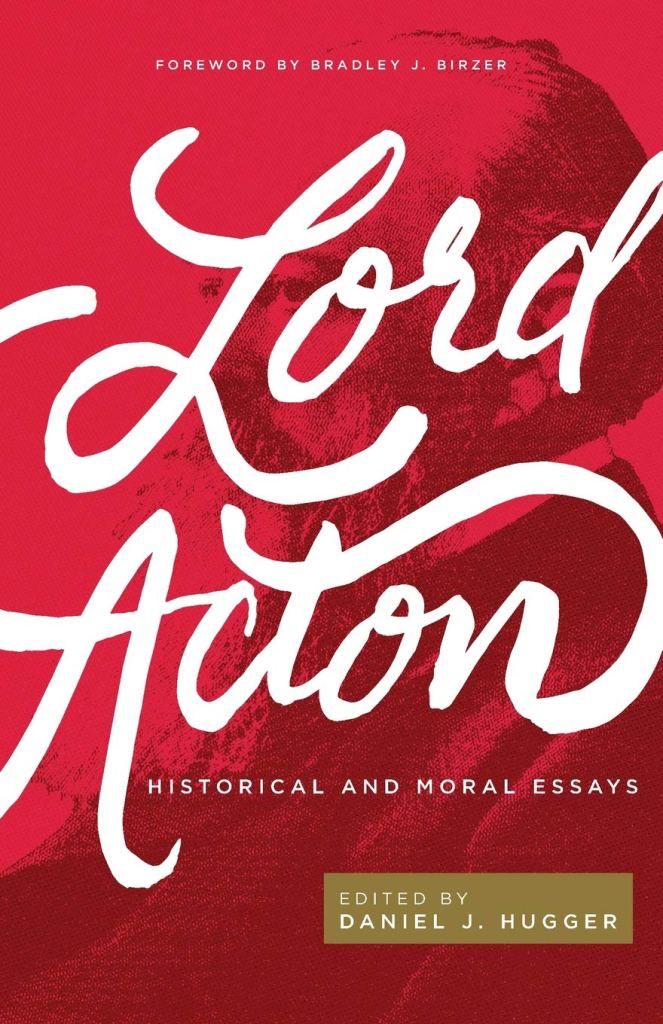
Introduction for Dan Hugger’s LORD ACTON: HISTORICAL AND MORAL ESSAYS (2017).

When scholars discuss the nineteenth century of western civilization, they automatically and reflexively conjure images of the three most profound and original minds of the period: Karl Marx, Charles Darwin, and Sigmund Freud.  Sometimes, depending on the scholar, one might list Friedrich Nietzsche as well.  This is obvious in the massive and tedious surveys of western civilization as well as in the remaining and lingering canons of Great Books.  None of this is false, of course, and the three (or four) men remembered certainly were among the greatest of minds to come into this world of sorrows.

One might, with equal accuracy and a bit more humanity and justice, create a different trinity.  What about John Henry Newman, Alexis de Tocqueville, and Lord Acton?  After all, as the great Russell Kirk once argued, “In every age, society has been relieved only by the endeavors of a few people moved by the grace of God.”  With the possible exception of Darwin, neither the taken-for granted trinity nor their followers were wont to taint the men or their ideas with the airy notion of the “grace of God.” 

With the newly-proposed trinity of nineteenth-century thinkers, though, the men and their followers would lovingly accept the grace of [g]od. 

Even among these proposed three, however, Lord Acton—the author of the essays you now hold in hands–remains the least known, the least studied, and the least understood.  True, every American with any education at all remembers his assertion that “power corrupts.”  Other than this, though, he’s largely forgotten or dismissed.  It’s as though his entire existence from 1843 through 1902 mattered only for that one sentence.  Truly, this is to both our discredit and our loss.  Thanks to the Acton Institute and Daniel Hugger, we can begin to rectify this massive error near the beginning of the twenty-first century.

A profound thinker and essayist, Acton argued in his seminal piece of 1862, “Nationality”: “Christianity rejoices at the mixture of races as Paganism, however, identifies itself with their differences, because truth is universal, errors various and particular.” The modern and rising nation-states, though, demand unity of thought, culture, and politics.  In essence, Acton believed, the world was re-paganizing, returning to its worship of the state as god.  After all, he wrote, “in the ancient world idolatry and nationality went together, and the same term is applied in Scripture to both.”

While this is just one of many profound arguments that Acton advanced during his writing career, it is critical to see him not only as important in his own day and age, but also as the critical link in the arguments about natural rights, liberty, and human dignity between Edmund Burke and Thomas Jefferson, a century earlier, and Friedrich Hayek and Christopher Dawson, a century later.

In his own day and age, though, Acton tapped into something rather deep in the currents and movements of the western tradition.  Imagine for a moment the influence the original trinity mentioned above had on the West and on the World.  When looking at the depth and intelligence and brilliance of their arguments, one can readily narrow down each to one fundamental element.  For Darwin, all things were biological and adaptive.  For Marx, they were economic.  For Freud, they were psychological.  As Acton would well understand, none of these things were untrue.  The problem with each was not falsity, but lack of context.  Man is biological, economic, and psychological, but not singularly.  Rather man is all of these plus a million other things.  As with Burke before and Dawson after, Acton knew that man’s greatness and his sin simultaneously resided in the immense complexity of each individual human person, made uniquely in the infinite image of God.  With Socrates as well as Hayek, Acton knew that we knew very little and that, through humility, we recognized our limitations of knowledge.

Thus, one can readily picture Acton writing “Christianity rejoices at the mixture of and mysteries of human complexities as Darwinism, however, “identifies itself with their biological adaptation.”  Or, as Marxism, however, “identifies itself with their economic base.” Or, as Freudianism, however, “identifies itself with their psychological urges.”  To which, each can be answer, “yes, but there’s more.”  Again, no matter how significant Darwin, Marx, and Freud were, Acton is more nuanced, broader, and, thus, in the long run, more accurate and insightful.  Unlike the three more famous men, Acton never demanded any gnostic sureties in this world or the next.  Faith is, after all, not fact.

Of course, this book you now are reading is much deeper than what I’ve just given.  Hugger has ably and, indeed, lovingly crafted a book of some of the best arguments Acton made in his life.  From a philosophy of history to the history of liberty, from specific personalities to the grand movement of ideas, Acton looked at all with a Catholic and classical wisdom so often lacking in his day.  We would do well to remember Acton.  In so doing, we remember not just the man, but the insight of one man into a much larger and unfathomably complicated world.  True, in choosing Acton over Darwin, Marx, and Freud, we choose an ignorance and humility that the world hates.  But, then, the world has generally hated what’s good for it.  Have your ideologies if you must, but I’ll take truth, beauty, and goodness anytime. 

Oh, and, by the way, power does corrupt.

Reflecting on Solzhenitsyn

“Shut your eyes, reader.  Do you hear the thundering of wheels?  Those are the Stolypin cars rolling on and on.  Those are the red cows rolling.  Every minute of the day.  And every day of the year.  And you can hear the water gurgling—those are prisoners’ barges moving on and on.  And the motors of the Black Marias roar.  They are arresting someone all the time, cramming him in somewhere, moving him about.  And what is that hum you hear?  The overcrowded cells of the transit prisons.  And that cry?  The complains of those who have been plundered, raped, beaten to with an inch of their lives.  We have reviewed and considered all the methods of delivering prisoners, and we have found that they are all. . . worse.  We have examined the transit prisons, but we have not found any that were good.  And even the last human hope that there is something better ahead, that it will be better in camp, is a false hope.  In camp it will be . . . worse.”—End of Volume 1 of the Gulag.

Solzhenitsyn knew of that which he wrote in his appropriately subtitled “An Experiment in Literary Investigation.”

“And where among all the preceding qualities was there any place left for kindheartedness?  How could one possibility preserve one’s kindness while pushing away the hands of those who were drowning?  Once you have been steeped in blood, you can only become more cruel,” Solzhenitsyn knew.  “And when you add that kindness was ridiculed, that pity was ridiculed, that mercy was ridiculed—you’d never be able to chain all those who were drunk on blood.”  

More than any other work, the Gulag forced western journalists and academics to confront the monstrous realities of the Soviet Union, not just under Stalin’s Cult of Personality dictatorship, but under the wretched evil that pervaded the entire system.  Indeed, the Soviet Union ran on the blood of those who deviated from its vision of harmony and perfection.  From the very beginning of the Soviet takeover of Russia, Solzhenitsyn noted, the revolutionaries established the ideologically-driven police, militia, army, courts, and jails.  Even the labor camps—the Gulag—began in embryo form only a month into the revolution. The parasitic Soviets craved blood from 1917 to 1991; such bloodletting was an inherent part of the system.  Solzhenitsyn claims that the Gulag state murdered 66 million just between 1917 and 1956.

The ideological system created distrust. “This universal mutual mistrust had the effect of deepening the mass-grave pit of slavery.  The moment someone began to speak up frankly, everyone stepped back and shunned him: ‘A provocation!’  And therefore anyone who burst out with a sincere protest was predestined to loneliness and alienation.”

It also, Solzhenitsyn understood, established a permanent lie.  “The permanent lie becomes the only safe form of existence, in the same way as betrayal.  Every wag of the tongue can be overheard by someone, every facial expression observed by someone.  Therefore every word, if it does not have to be a direct lie, is nonetheless obliged not to contradict the general, common lie.  There exists a collection of ready-made phrases, of labels, a selection of ready-made lies.”

Ultimately, those who died immediately had the best of it, the Russian prophet knew.  To survive meant not merely to lose the body at some point, but almost certainly the soul as well.

No mere anti-communist, Solzhenitsyn attacked not just the ideological regimes of Russia and its former communist allies in Eastern Europe, but he challenged all of modernity—in the East and the West.  Western consumerism, he warned, will destroy the West by mechanizing its citizens in a more efficient and attractive manner than communism could.  “Dragged along the whole of the Western bourgeois-industrial and Marxist path,” Solzhenitsyn stated,

A dozen maggots can’t go on and on gnawing the same apple forever; that if the earth is a finite object, then its expanses and resources are finite also, and the endless, infinite progress dinned into our heads by the dreamers of the Enlightenment cannot be accomplished on it . . . All that ‘endless progress’ turned out to be an insane, ill-considered, furious dash into a blind alley.  A civilization greedy for ‘perpetual progress’ has now choked and is on its last legs.

Only by embracing a transcendent order and the true Creator, Solzhenitsyn argued, can mankind save itself from the follies and murders of the ideologues.  In his 1983 Templeton address, he took his arguments against modernity even further.

Our life consists not in the pursuit of material success but in the quest of worthy spiritual growth.  Our entire earthly existence is but a transition stage in the movement toward something higher, and we must not stumble or fall, nor must be linger fruitless on one rung of the ladder . . . The laws of physics and physiology will never reveal the indisputable manner in which the Creator constantly, day in and day out, participates in the life of each of us, unfailingly granting us the energy of existence; when the assistance leaves us, we die.  In the life of our entire planet, the Divine Spirit moves with no less force: this we must grasp in our dark and terrible hour.

In his commentary on Solzhenitsyn’s address, Russell Kirk argued that the above passage “expressed with high feeling [ ] the conservative impulse.” Certainly, Kirk and Solzhenitsyn were kindred spirits. 

Importantly, one should never underestimate the importance of Solzhenitsyn’s moral imagination.  As one of the leading Solzhenitsyn scholars, Edward E. Ericson, Jr., has argued: “I would say that One Day in the Life of Ivan Denisovich put the first crack into the Berlin Wall and The Gulag Archipelago was an irresistible blow to the very foundations of the Soviet edifice.”

The prophet is dead.  The priest (John Paul II) and the king (Ronald Reagan) went before him. 

From Venus to Virgin

“Lustrous among the cloudbanks,” the goddess Venus descended into the grove of oak trees, telling her son, Aeneas, that her gifts were of divine origin, forged by the fires of her husband, Vulcan. Venus embraced Aeneas as she offered him the weaponry and armor. He, amazed, looks each piece over, one by one, unsure whether to be more shocked that his mother was a goddess or that she had defied her own father to aid him.

He cannot get enough of them, filled with wonder,

turning them over, now with his hands, now his arms,

the terrible crested helmet plumed and shooting fire

the sword-blade honed to kill, the breastplate, solid bronze,

blood-red and immense, like a dark blue cloud enflamed

by the sun’s rays and gleaming through the heavens.

Then the burnished greaves of electrum, smelted gold,

The spear and the shield, the workmanship of the shield,

No words can tell its power.

For there, upon the shield, was the entire story of Rome, its past, its present, and its future, for Vulcan possessed the power of the seer, and directed by his wife, he had written it all.

Armed by his mother’s confidence and gifts, the half-god Aeneas of the destroyed city of Troy conquered his Latin foes, creating a new people that would rule the Mediterranean for over a millennium.

As Socrates awaited his execution by the hands and vote of the Athenian people in 399BC, a “woman in white” appeared to him in a dream, assuring him that in three days, he would spend eternity with his people and the gods in the land of Phthia. Socrates found more comfort in this dream, than in all of his own logic or the reassurances of his best friend, Crito.

When two Lakota warriors—the first representatives of their people—traveled onto the Great Plains of North America, they encountered a vision of the Great Buffalo Woman, a being shrouded in white light. One of the Lakota could not see passed her beauty and immediately felt lust in his heart. The other, though, saw her for what she really was, the lawgiver. The Great Buffalo Woman destroyed the lustful one, but she rewarded the other with the laws to govern his people, the laws by which all good Lakota would live.

At the moment a young Celtic man needed a tangible sign to unify his warring peoples, the Lady of the Lake emerged to offer him the sword, Excalibur, to unite and lead his people into virtuous victory. So armed, Arthur created a brotherhood the ushered in a Kingdom of Summer. . . for a while.

At Princeton, an eager and enthusiastic young student asked T.S. Eliot just why were there three leopards in his poem of conversion, Ash Wednesday, and who was the lady?

Lady, three white leopards sat under a juniper-tree
In the cool of the day, having fed to satiety
On my legs my heart my liver and that which had been contained
In the hollow round of my skull. And God said
Shall these bones live? shall these
Bones live? And that which had been contained
In the bones (which were already dry) said chirping:
Because of the goodness of this Lady
And because of her loveliness, and because
She honours the Virgin in meditation,
We shine with brightness. 

To which, Eliot replied, is it not enough that the lady honors the Virgin? Pagan or not, does she not point to the Blessed Mother of God, and, thus, to God? It is more than enough, Eliot assured his audience.

When another frustrated king, an Anglo-Saxon who would one day be known as Alfred the Great, begged of God aid in his battle against the heathen Danes, not God, but the Blessed Virgin appeared to him.  As Chesterton recorded it:

“Out of the mouth of the Mother of God,

More than the doors of doom,

I call the muster of Wessex men

From grassy hamlet or ditch or den,

To break and be broken, God knows when,

But I have seen for whom.

“Out of the mouth of the Mother of God

Like a little word come I;

For I go gathering Christian men

From sunken paving and ford and fen,

To die in a battle, God knows when,

By God, but I know why.

And, yet, like most of us, Alfred craved sureity.  If he put his faith in Mary and in God, would he be rewarded.

And this is the word of Mary,

The word of the world’s desire

No more of comfort shall yet get,

Save that the sky grows darker yet

And the sea rises higher.

Then silence sank.

Venus might promise victory, but Mary, rightly, only offers hope.  Yet, it is a hope that breaks the bounds of the world, and shows us eternity.