Category Archives: LITERATURE

Charles Williams’ All Hallows Eve – Stranger Things Meets Rosemary’s Baby

The First Edition

All Hallows Eve is Charles Williams’ seventh novel, and one of his best. In 2024, I began working my way through all of the novels of this member of The Inklings, the famous literary group of friends that included J. R. R. Tolkien and C.S. Lewis. Williams’ fiction is definitely darker and more philosophical than the writings of either of the his more well known colleagues.

All Hallows Eve begins with a startling scene: a young woman, Lester Furnival, is standing on a street in nighttime London, and there are none of the usual sounds and traffic around her. She soon realizes that she is dead. She and a friend, Evelyn Mercer, were supposed to meet each other for a get-together, but they were killed by a plane crashing into the area. It appears that Lester and Evelyn are in some sort of purgatory – they can interact with each other, but they do not perceive any other beings. The only way they know it’s night is when the lights come on in the houses around them. There is no sun or moon, just a diffuse, gray light.

Back in the land of the living, Lester’s grieving husband, Richard, visits his artist friend, Jonathan Drayton. Drayton is a talented painter who shows Richard his latest work: a painting of a charismatic religious leader who goes by the moniker Simon the Clerk, or Simon Leclerc. It has been commissioned by Lady Wallingford, a devoted disciple of Simon. Jonathan Drayton is in love with her daughter Betty, but she will not allow them to get engaged.

Lady Wallingford drops by to view the painting, and she is extremely disappointed. In her eyes, Simon looks malevolent, and the people in the congregation look like insects. Later, Simon himself visits Drayton to view the painting, and he proclaims it a masterpiece that captures him perfectly.

What follows is a very dark tale of necromancy and all-consuming greed for power. Simon was conceived and born during the French revolution, and he has plans for world domination that involve breaking through to the spiritual plane where Lester and Evelyn are. Lady Wallingford’s daughter, Betty, is the hinge through which this will happen. Things get very creepy as the story unfolds – I was put in mind of Rosemary’s Baby as the pieces fell into place.

As a favor to Jonathan, Richard Furnival agrees to attend a meeting of Simon’s followers, and see if he is legitimate. Simon uses some sort of spell to put everyone under his will. At the end of the meeting, Simon speaks to Richard, and Richard recounts their disturbing conversation to Jonathan:

“He [Simon] said: ‘I won’t keep you, Mr. Furnival. Come back presently. When you want me, I shall be ready. If you want your wife, I can bring her to you; if you don’t want her, I can keep her away from you. Tell your friend I shall send for him soon. Good-bye.” So then I walked out.

He lifted his eyes and looked at Jonathan, who couldn’t think of anything to say. Presently Richard went on, still more quietly: “And suppose he can?”

“Can what?” asked Jonathan gloomily.

“Can,” said Richard carefully and explicitly, “do something to Lester. Leave off thinking of Betty for a moment; Betty’s alive. Lester’s dead, and suppose this man can do something to dead people?

CHARLES WILLIAMS. All Hallows’ Eve (Kindle Locations 1850-1855). Delphi Classics. Kindle Edition.

As the story unfolds, there is a contrast between the characters who grow and mature, and the ones who degenerate. Betty, who is initially a slave to Simon’s will, gradually comes into her own and is able to resist him. Lester also matures spiritually as she learns to navigate the purgatory she is in. Both she and Richard remember their brief marriage, regret the mistakes they made, and come to a much deeper love than they had when she was alive. Even Jonathan’s art takes on a life of its own, becoming more transcendent.

On the other side, Lady Wallingford becomes less and less of an individual with actual agency, Evelyn undergoes a horrific degeneration into petty hatred, and Simon Leclerc reaps the rewards of his dark magic.

All Hallows Eve is one of Williams’ most accessible reads, as well. In a few of his earlier novels, particularly Descent Into Hell, his prose was very dense and unwieldy, and his dialog hard to follow. Every conversation in All Hallows Eve is terse and to the point. I thoroughly enjoyed this novel, even though it creeped me out at times. I wonder if the creators of Netflix’s Stranger Things are familiar with it, since there are definite similarities in the basic premise of both tales. Anyway, for fans of fantasy with a very dark edge (but a happy ending), I highly recommend All Hallow Eve.

George Eliot’s Middlemarch – The GOAT of British Literature?

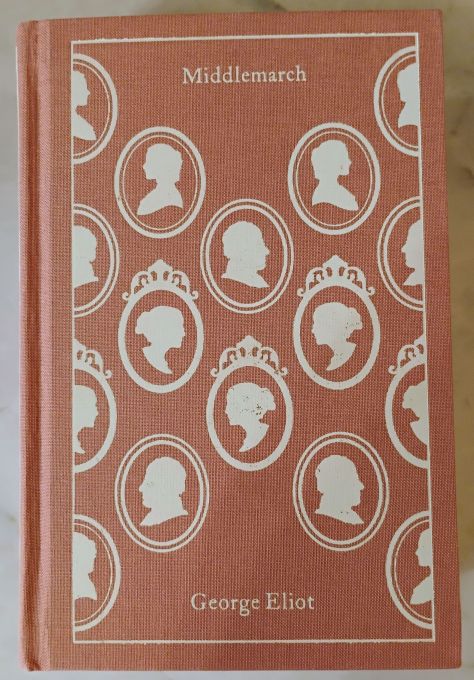
George Eliot’s masterpiece,  Middlemarch, is a massive and complex portrait of rural England at the time of the 1830s Reform Bills. The BBC lists it as the greatest British novel of all time. You can read my thoughts on it here.

Jay Wellon’s All That Moves Us: The Trials and Triumphs of a Pediatric Neurosurgeon

Moves Us

A new year, and an opportunity to begin a new batch of books! I was given several titles for Christmas, and the first one I dove into was All That Moves Us.

Dr. Jay Wellons is a pediatric neurosurgeon at Vanderbilt’s Monroe Carrell Jr. Children’s Hospital here in Nashville, TN. His memoir, All That Moves Us, is one of the most moving books I’ve ever read. It consists of 23 short chapters, each one chronicling an important episode in Wellons’ life. He doesn’t pull any punches, either. In the prologue, he explains his efforts to separate two conjoined twins that resulted in both of their deaths.

Other chapters deal with triumphs such as two-year-old Allie:

Her brain MRI showed a large bleed in her brainstem, the pons specifically. The normal brain was compressed from the inside out, the pontine brain tissue now only a thin rim displaced by the blood clot, most likely from a hemorrhagic cavernous malformation. It was gigantic considering the small space. At that point in my career, I had never seen a hemorrhage quite that large in that part of the brain with the patient still alive. (page 103)

Miraculously, Wellons is able to save Allie, and seven years later, she continues to recover. He admires her indomitable will to survive and thrive.

Throughout the book, Wellons provides interesting autobiographical details: why he went into medicine, the enormous influence his father had on him, his own battle with a tumor in his leg, the joy he receives from his own children. It doesn’t hurt that he is an extraordinarily fine writer. As a matter of fact he was an English major as an undergraduate in college. I found that I couldn’t read more than two or three chapters at a time, they are that emotionally powerful.

I also got a glimpse into the life of a surgeon, and the various trials they face. While the gratitude from parents whose children he has saved is nice, Wellons tells of the time when he couldn’t save a middle-aged woman, and her family came at him in the hallway ready to physically attack him. A surgeon has to be sensitive to the feelings of the families of his patients, while always being truthful and informative.

Doctors are always on call, even when they aren’t anywhere near a hospital. In the chapter, Last Place, Wellons is on the interstate driving to a triathlon when he comes upon a terrible car accident. He immediately stops and does triage on the family in the car that was hit. If he hadn’t been there, the mother and father would have died. This experience gives him new respect for the incredibly difficult job first responders have.

Another chapter, Shock Wave, is particularly hard-hitting. It is about a teenaged girl who shot herself in the head, driven to such despair by social media bullying that death seemed preferable to the pain she was suffering. She survived the gunshot, but the bullet destroyed her optic nerves, permanently blinding her. However, she has chosen to use her condition to try to prevent others from making the same choice she did.

Alyssa will forever live with the profound effects of that day. Both she and her parents wanted her story told so that people might understand that social bullying is real. Her mom aske me to make sure that Alyssa has worked hard since that day to be a good young woman living out her faith. For all that she has endured, Alyssa loves the idea of being able to help others, and that is how she understands her purpose now. She does not remember much of her life before her injury. But she makes a point to say that sometimes we can inflict pain on one another without much thought. It can be awful. And then she says she knows we can do better. (page 189)

All That Moves Us is an incredibly powerful read. In every chapter, Wellons’ sincere care and compassion for his patients and their families is apparent. He also weaves his love and admiration for his Mississippi Air National Guard father throughout the book. His father passed away from ALS, and Wellons was able to spend time with him and properly express his gratitude for all he did for him. As for me, I am thankful that our medical system is able to produce amazing caregivers like Jay Wellons.

The Lewis Carroll You May Not Know

While Lewis Carroll is justifiably famous for his books Alice In Wonderland and Through The Looking Glass, he was also an accomplished mathematician. In his biography, Lewis Carroll in Numberland, Robin Wilson focuses on that aspect of his life.

Lewis Carroll’s Other Life

Raphael and the Noble Task: A Modern Christmas Classic

Raphael

In 2000, when our daughters were 10 and 6, I saw a list of new Christmas-themed books that included Catherine Salton’s Raphael and the Noble Task. I found it at the local bookstore and was immediately taken with David Weitzman’s beautiful illustrations. I read it aloud to the family, and we all enjoyed it very much. Even though it’s technically a children’s book, it will appeal to readers of all ages, much like C. S. Lewis’ Narnia series.

Raphael and Alchemist
Raphael speaks with The Alchemist, another of his cathedral’s statues

I decided advent 2024 was as good a time as any to revisit this charming tale of a Gothic cathedral’s chimère (French for a statue of a chimera) named Raphael and his quest to find a Noble Task to justify his existence. Raphael is a griffin, placed above the cathedral’s main entrance. He has a lion’s body and legs, eagle’s wings, and the head and neck of a dragon. He is bored and lonely, and he visits the statue of an alchemist who refers to an older cathedral guardian named Parsifal who is no longer around. It is the alchemist who plants the idea of a noble task in Raphael’s head.

Once Raphael decides he needs to perform a noble task, he decides to ask other members of the cathedral statuary what he should do. He first goes to a couple of tomb effigies of a knight and his wife, but they’re so busy bickering they can’t help him. Next, he approaches a gargoyle who is near his niche, but, like all gargoyles, this one – named Madra-Dubh (Black Dog) – is very rude and condescending:

Raphael steeled his resolve. “You see, I’m trying to find something, and I think you might know where it is,” he said as quickly as possible.

“Oooh, and it’s trying to find something,” crowed Madra-Dubh as the others cackled gleefully. “Not good enough for the fawning idle-headed dewberry to sit in its donkey-spotted behind and do its right job, mark me! Nooo, it’s got to go thumping about pestering the working folk with foolish don’t-you-knows. Go drop some feathers, ye molting chicken-witted dragglebeak, and leave us in peace, then.” (pages 21 – 22)

Raphael eventually finds the scriptorium (library), and even though he can’t read, he sees an illustration in an illuminated manuscript. It depicts a knight in silver armor slaying a dragon. Because Raphael resembles the dragon, he begins to doubt his own integrity and wonder if he is actually evil. At this point in the story, there is beautiful scene set in a side chapel where Raphael, tortured by gnawing self-doubt, encounters a statue of Mary with her child Jesus, and he is immediately set at peace.

A young woman with a gentle expression gazed out at him from the darkness. Her plain blue gown fell in folds to her bare feet, and her hair was unbound, spreading over her shoulders in rippling veil. In her arms she cradled a baby, who reached up with one small hand to touch her face in a gesture of cam devotion. As Raphael stood wondering, his head cocked to one side, he felt as if his hurt and disappointment were being softly lifted away. For the young woman seemed to speak to him in a manner he did not fully understand; she did not move, nor did she actually say a word, but all the same, she told Raphael a long and beautiful story. In the icy darkness of that chapel, she spoke gently to Raphael alone. She spoke of joy in good times, and patience in hard, and of hope even in the bleakest hours of all. (page 41)

Once he has returned to his niche over the main portal, though, his self-doubt returns. And then one day, he sees a young woman in desperate straits hurry up the steps to leave her baby in the “foundling” box – a place for babies whose parents can’t feed them or care for them. In a flash Raphael has found his noble task!

What follows is great fun, as various communities in the cathedral all work together to help Raphael take care of his new charge. The gargoyles, the churchmice, and the pigeons all manage to put aside their differences and learn to cooperate.

Of course, the situation cannot last forever, and Raphael is faced with a terrible choice: his true noble task. Salton does a terrific job of weaving together the lives of the monks and other inhabitants of the village with the clandestine doings of the cathedral statuary, armies of mice, and flocks of pigeons. The whole tale is a marvelous allegory of how, despite the best of human (and chimère) intentions, without a little Divine intervention things would rapidly turn into tragedy. However, as Salton quotes Julian of Norwich at the very beginning of the book, “All shall be well, and all manner of things shall be well.”

Raphael and the Noble Task is a wonderful book for families to read aloud at Christmastime. It’s relatively short: 157 pages, and as I mentioned before, David Weitzman’s illustrations are fantastic. It deserves a place alongside other Christmas classics like Dickens’ A Christmas Carol  and O’Henry’s The Gift of the Magi.

Tolstoy’s Anna Karenina


Karenina

I could say 2024 is the year I rekindled my love of Russian literature: I reread Tolstoy’s War and Peace, and discovered the beauty of Turgenev’s Fathers and Sons. Like War and Peace, I read Tolstoy’s Anna Karenina when I was much younger – 21 years old. At the time, I thought it was a pretty good story, but a little melodramatic. Now, with the benefit of having been happily married for 38 years with two wonderful daughters, I can appreciate Tolstoy’s mastery of the novel form as he chronicles the tragic arc of marital infidelity. I now understand so much better the psychological and emotional torture his protagonists put themselves and those around them through.

Anna Karenina is a perfect example of why I enjoy reading classics so much: they are time machines. While reading it, I was able to get a glimmer of what life was like in 19th century Russia – the lifestyles of the peasants; the mores and conventions of the upper class; how hard life was for women, regardless of class; how perilous childhood was – if one survived infancy, he or she could easily die from illness or accident; how slow and difficult getting from one place to another was; the elaborate rules of courtship, and on and on. Tolstoy vividly conveys his world through small details that resonate over decades. I really feel like I have experienced a visit to pre-revolutionary Russia.

The story begins with one of the greatest opening sentences in all of literature: “Happy families are all alike; every unhappy family is unhappy in its own way.” We begin with Prince Stepan (Stiva) Oblonsky getting up one morning, bursting with good health and benevolent feelings for those around him. He is a government functionary who doesn’t really do anything, and he’s quite happy about it. He knows all the “right” people, he is considered quite a wit, and he has a bright future ahead of him. The only blot on his horizon is the fact that he has been having an affair with his children’s governess, and his wife has found out about it.

His best friend is Konstantin (Kostya) Levin, who is a man of simpler pleasures. He is a relatively successful landowner who is uncomfortable when he’s in the big city. He has come to Moscow to ask Kitty Shtcherbatskaya to marry him. Kitty is the sister of Stepan’s wife, Dolly. She is also in love with the dashing young military officer, Count Alexey Vronsky. He is an up-to-date man who considers wooing young noblewomen great sport:

In his Petersburg world all people were divided into utterly opposed classes. One, the lower class, vulgar, stupid, and, above all, ridiculous people, who believe that one husband ought to live with the one wife whom he has lawfully married; that a girl should be innocent, a woman modest, and a man manly, self-controlled, and strong; that one ought to bring up one’s children, earn one’s bread, and pay one’s debts; and various similar absurdities. This was the class of old-fashioned and ridiculous people.

But there was another class of people, the real people. To this class they all belonged, and in it the great thing was to be elegant, generous, plucky, gay, to abandon oneself without a blush to every passion, and to laugh at everything else.

LEO TOLSTOY. Anna Karenina (Kindle Locations 2797-2802). Delphi Classics. Kindle Edition.

Stepan’s sister, Anna Karenina, is coming to visit him – with the ulterior motive of reconciling Stepan and Dolly. She is married to an very important statesman, Alexei Karenin, and they have an eight-year-old son, Sergei (Seryozha). Vronsky happens to see her as she arrives at the Oblonsky’s and immediately is smitten with her.

Levin proposes to Kitty, but she turns him down, thinking Vronsky is about to propose to her. However, at a ball later on Kitty sees how Vronsky can’t keep his eyes off of Anna, and she realizes to her shame that she has been discarded.

Anna enjoys the attention Vronsky gives her at the ball, but realizes she must remove herself from Moscow and return to her husband and son in Petersburg. On the train home, she runs into Vronsky (who had deliberately followed her), and, to her horror, is gratified and excited to see him. Once in Petersburg, Vronsky slowly and methodically insinuates himself into a circle of oh-so-advanced nobles and thinkers that includes Anna. Here’s a typical conversation:

But why was it you didn’t come to dinner?” she said, admiring him.

“I must tell you about that. I was busily employed, and doing what, do you suppose? I’ll give you a hundred guesses, a thousand… you’d never guess. I’ve been reconciling a husband with a man who’d insulted his wife. Yes, really!”

“Well, did you succeed?”

“Almost.”

“You really must tell me about it,” she said, getting up. “Come to me in the next entr’acte.”

“I can’t; I’m going to the French theater.”

 “From Nilsson?” Betsy queried in horror, though she could not herself have distinguished Nilsson’s voice from any chorus girl’s.

“Can’t help it. I’ve an appointment there, all to do with my mission of peace.”

“Blessed are the peacemakers; theirs is the kingdom of heaven,’” said Betsy, vaguely recollecting she had heard some similar saying from someone. “Very well, then, sit down, and tell me what it’s all about.”

And she sat down again.

LEO TOLSTOY. Anna Karenina (Kindle Locations 3121-3133). Delphi Classics. Kindle Edition.

And so the die is cast for this classic tale of all-consuming passion and selfishness. Like a Shakespearean tragedy, the reader knows things cannot possible end well, yet he or she can’t stop reading. Anna and Vronsky are doomed, yet you can’t look away.

Even after their affair has been consummated, and Vronsky has told Anna she means the world to him, he really can’t think of anyone except himself. After he loses a horse race due to a riding mistake he commits that causes his horse to fall, he handles his setback poorly:

“A — a — a!” groaned Vronsky, clutching at his head. “Ah! what have I done!” he cried. “The race lost! And my fault! shameful, unpardonable! And the poor darling, ruined mare! Ah! what have I done!”

A crowd of men, a doctor and his assistant, the officers of his regiment, ran up to him. To his misery he felt that he was whole and unhurt. The mare had broken her back, and it was decided to shoot her. Vronsky could not answer questions, could not speak to anyone. He turned, and without picking up his cap that had fallen off, walked away from the race course, not knowing where he was going. He felt utterly wretched. For the first time in his life he knew the bitterest sort of misfortune, misfortune beyond remedy, and caused by his own fault.

LEO TOLSTOY. Anna Karenina (Kindle Locations 4795-4800). Delphi Classics. Kindle Edition.

Meanwhile, Konstantin Levin is doing what he enjoys most: managing his estate and not worrying about city matters. He even joins his peasants as they mow a meadow:

Another row, and yet another row, followed — long rows and short rows, with good grass and with poor grass. Levin lost all sense of time, and could not have told whether it was late or early now. A change began to come over his work, which gave him immense satisfaction. In the midst of his toil there were moments during which he forgot what he was doing, and it came all easy to him, and at those same moments his row was almost as smooth and well cut as Tit’s. But so soon as he recollected what he was doing, and began trying to do better, he was at once conscious of all the difficulty of his task, and the row was badly mown.

LEO TOLSTOY. Anna Karenina (Kindle Locations 5974-5978). Delphi Classics. Kindle Edition.

All of this happens in the first quarter of the novel, meaning Tolstoy spends the majority of it exploring the effects of Anna’s and Vronsky’s adultery on those around them. One of Tolstoy’s most striking talents is his ability to describe and analyze the psychological motivations of his characters. As I read of Anna’s anguish as she slowly realized the impossible situation she had put herself in, I was able to sympathize with her more and more. Conversely, as Vronsky’s true character came to light, he became more and more repugnant. Anna’s husband, Alexei Alexandrovich, develops from a stiff and priggish man into a compassionate and sensitive one. Konstantin Levin undergoes many changes as he struggles to understand a reason for living and working. Kitty Shtcherbatskaya matures into a thoughtful and intelligent young woman, whose faith never wavers.

Anna Karenina is also a study in contrasts: the decadent moral relativism of upper class society in Petersburg vs. the more traditional morality of Moscow; the spendthrift lifestyle the cities encourage vs. the economies of country life; the useless and parasitical occupations of the governing class vs. the difficult but productive work of the peasants; and, overarching the entire novel, the deeply satisfying holy marriage of Levin and Kitty vs. the decaying and troubled relationship Anna and Vronsky try to convince themselves is a marriage.

Where Levin and Kitty devote themselves to their newborn child and delight in his every move, Anna barely acknowledges her and Vronsky’s daughter. When Dolly visits Anna and asks to see little Annie, Anna doesn’t even know that she has some new teeth. While Levin and Kitty spend their honeymoon learning how to fuse their separate lives into one, and they sometimes quarrel, there is never any doubt about their abiding love for each other. Because Anna and Vronsky’s relationship is not grounded in a true marriage, she succumbs to paranoid jealousy, to the point that she cannot comprehend reality. The end result is truly tragic.

Tolstoy’s Anna Karenina deserves its reputation as one of the greatest novels ever written. In it, he plumbs psychological depths to a degree most authors couldn’t dream of doing. Whether he is describing the feelings of a nobleman, a peasant, a woman, a dilletante, or an intellectual, every character is fully fleshed out and someone the reader can have empathy with. Even Vronksy is revealed to truly and faithfully love Anna. No one is all bad, and no one is all good. Much like real life!

Standard Ebooks has an excellent (and free) edition of Anna Karenina that you can download here.


Andrew Klavan’s A Woman Underground – Cameron Winter battles his demons

Woman Underground

Andrew Klavan is one of my favorite writers and thinkers. He has written many mysteries, thrillers, and some very good nonfiction, as well as producing a weekly podcast on politics and culture. A Woman Underground is the fourth book in his Cameron Winter series, which just gets better and better with each installment.

Winter is a wonderfully deep and complex character – a professor of Romantic literature at a small midwestern college, he was an especially deadly counterintelligence assassin for some very dark and secret missions earlier in his life. Every novel in the series has flashbacks to Winter’s career as a deadly assassin, as he relates them to his therapist – a kindly, older woman who is very much attracted to him. Winter is incapable of maintaining any kind of relationship, because his parents, wealthy New Yorkers, had neither the time nor the inclination to care for him.

His nanny was a refugee from East Germany, and he never got over his childhood crush of her niece, Charlotte Shaefer. His unrequited love has served as an excuse to avoid any intimacy in his adult life. He is a deeply troubled man with a code of honor he tries to live by, even though he is not at all religious. Think of a Raymond Chandler character dropped into the 21st century.

A Woman Underground begins with Part 1: The Scent of Something Gone, Winter realizes that Charlotte may be trying to get in touch with him. One evening he comes home to his apartment and smells the lingering scent of her perfume in the hall. The next morning, he studies the building’s security video, and he sees a bundled up woman carrying a book. The book turns out to be a novel that is popular with right-wing extremists, and it features a heroine who is too similar to Charlotte to be a coincidence. Winter quickly tracks down the author. To avoid any spoilers, I won’t reveal any more details!

Klavan does a masterful job of balancing four(!) separate stories while keeping the reader glued to the page. First, there is the main plotline of Winter tracking down Charlotte. Then, there is a plotline involving an old mission Winter was assigned to bring back an agent who had disappeared in Turkey. When Winter is in therapy, he keeps returning to this story, even though his therapist knows he’s doing it to avoid facing what’s really causing his psychological distress. Third, there’s the plotline of the novel Charlotte was carrying when she tried to see Winter. In it, a small group of right-wingers try to decide what to do during the riots that caused so unrest and destruction in the summer of 2020. Cameron is reading this novel to try to pick up clues as to where Charlotte might be. The fourth subplot is some sexual shenanigans Winter’s colleague at the college gets himself into. Believe it or not, all four of these stories slowly come together into one.

A Woman Underground is a pivotal chapter in Cameron Winter’s development. Several things that had stunted his emotional and psychological maturity are dealt with and resolved. The path to that resolution, however, is a harrowing one. As Klavan describes him, he spends most of the book on the verge of a nervous breakdown. It is only through his therapist’s insightful and compassionate work that he is able to come out whole. By the end, it’s clear that Winter has emerged battered, but stronger and more resilient. I can’t wait to see what Andrew Klavan has in store for him. Bubbling under the surface of the various subplots is a potential global conspiracy that involves extremely powerful Americans who have been compromised. It’s enough to turn the most level-headed person into a paranoid lunatic, and the people Winter can completely trust are down to very few. Things are getting very interesting in Cameron Winter’s life!

Turgenev’s Fathers and Children: The Eternal Generation Gap

Turgenev

Continuing my exploration of classic Russian literature (you can read my review of Tolstoy’s War and Peace here), I decided to check out Ivan Turgenenv’s Fathers and Children (also known as Fathers and Sons). A couple of years ago, I read Joseph Frank’s biography of my favorite Russian author, Fyodor Dostoyevsky, and, according to Frank, Dostoyevsky was friends with Turgenev and had spoken well of Fathers and Sons.

The novel opens with middle-aged widower Nikoloai Petrovitch Kirsanov anxiously awaiting the arrival of his son, Arkady, who has graduated from the university in Petersburg. When Arkady finally arrives at the depot, he introduces a new friend of his, Yevgeny Vassilyitch Bazarov, whom he has invited to stay at their estate.

As their carriages arrive at the Kirsanov estate, it’s clear things are not doing well. Turgenev paints a picture of poverty and decay – emaciated cows, serfs driving pell-mell to gin bars, decrepit and dilapidated buildings. At the house, they are greeted by Nikolai’s brother, Pavel Petrovitch, who is a bit of an aristocratic dandy. He is glad to see Arkady, but Bazarov immediately rubs him the wrong way. The next morning, Pavel Petrovitch is not pleased to learn that Bazarov is a “nihilist”.

To continue reading, click here.

Ngaio Marsh’s A Man Lay Dead – Great Mystery Writing

Man Lay Dead

I’m a big fan of classic British mysteries. I have read quite a few Agatha Christie novels and all of Dorothy Sayers’, but until now I had not read anything by Ngaio Marsh. I remember my Mom reading her books way back when, so I decided to start at the beginning and read her first mystery, A Man Lay Dead. I am so glad I did!

First, this book did not strike me as a tentative first effort by an inexperienced author, the way the John Bude’s The Cornish Coast Murder did. All of the characters are real and have multifaceted personalities. The murder itself is very difficult to figure out how it could have been carried out, let alone by whom. And, there is a fun side-trip into a weird conspiracy of Russian assassins!

Continue reading here.

Wodehouse’s Full Moon – Excellent Humor at Blandings Castle

Full Moon

Book number 43 of 2024

Whenever I need a restorative read, I turn to the master of comedy: P. G. Wodehouse. My favorite books of his are set at Blandings Castle, the ancestral home of the dotty Lord Clarence Emsworth, his gaggle of formidable sisters, and of course, The Empress of Blandings – Lord Emsworth’s prize-winning pig. His younger son, Freddie Threepwood usually shows up, and there are always interesting guests as well as lovestruck young couples facing insuperable hurdles to their happiness. I have already read and reviewed another Blandings Castle novel, Uncle Fred In The Springtime

In Full Moon, Clarence’s brother, Galahad (who goes by Gally) is the guardian angel of the young lovers. One couple is Bill Lister, affectionately called “Blister” by Freddie, and Prudence Garland, daughter of Dora Garland, a sister of Clarence’s. Bill is an aspiring London artist with an unfortunate face like a gorilla, but Prudence loves him dearly and plans to elope with him. Her mother gets wind of things when she answers the telephone, and Bill, thinking Prudence has answered, calls her his “dream rabbit”. Prudence is quickly shipped off to Blandings for her safety. Did I mention Blister is Gally’s godson, and he will do anything in his power to bring him and Prudence together?

Meanwhile, Freddie, who has married American Niagara (“Aggie”) Donaldson, of Donaldson Dog-Joy dog biscuit fame, is back in England to drum up business for his father-in-law’s company across the pond. He would also like to have the American millionaire Tipton Plimsoll agree to carry Donaldson in his chain of supermarkets. To wine and dine Tipton, Freddie invites him to Blandings Castle to spend a few days enjoying the country air. Tipton agrees, because he has been partying a little too hard in the city, to the point where every time he tries to have a drink, he sees a man with a gorilla-like face out of the corner of his eye (you can see where this is heading). Once ensconced at Blandings, Tipton meets Veronica Wedge, the stunningly beautiful yet undeniably dim daughter of Colonel Egbert and Hermione Wedge. Hermione is another one of Clarence and Gally’s sisters, and, according to Wodehouse, looks just like a cook, which will lead to some humorous encounters. The Wedges are thrilled that their daughter seems to have captured the heart of one of the wealthiest young men in America. Unfortunately, he has a tendency to jealousy.

To continue reading, click here.