Category Archives: LITERATURE

Kevin Wilson’s Nothing to See Here

The English Department at the school where I teach has a Writer In Residence every year: an author spends 3 – 4 days guest teaching English classes and then speaking to the upper school students at an assembly. This year’s writer was Kevin Wilson, a literature professor at the University of the South in Sewanee, TN and author of several bestsellers, including The Family Fang  and Baby, You’re Gonna Be Mine

In his talk at the assembly, Wilson spoke of his terror of public speaking and how difficult his adolescence was due to his having Tourette’s Syndrome and social awkwardness. However, he managed to turn these personal obstacles into one of the most entertaining and inspiring speeches I’ve ever heard. He had everyone in the auditorium laughing hysterically one moment and wiping away tears the next. When I got home, I told my wife about how great Wilson was, and she said she thought she had recently bought a book of his. Sure enough, she Nothing to See Here  in her stack of books to read; she had picked it up on the recommendation of her brother, who raved about Wilson.

Which is a long way of explaining how I ended up reading (and loving) a book I probably never would have been aware of. Readers of this blog have probably figured out that my tastes lean to nonfiction (history, science and technology), mysteries, and classics (especially Victorian literature). I am grateful that a confluence of events led me to Kevin Wilson’s work.

Nothing to See Here is told through the eyes of Lillian Breaker, a young woman who is a cashier at a small-town grocery store in Tennessee. She is very bright, but due to several circumstances beyond her control, she is at loose ends – living in her mother’s attic, smoking pot, and generally wasting her life. Her mother doesn’t really care about Lillian, having a succession of boyfriends, and living from paycheck to paycheck.

To read the rest of my review, click here.

R. F. Kuang’s Katabasis: A Descent Into Hell

What if “Magick” was an accredited science with the most prestigious universities offering courses of study in it? What if Dante, Orpheus, Virgil, et al. really did descend to Hell, and their writings were nonfiction accounts of their experiences? What if T. S. Eliot’s The Wasteland was a travelogue of a real place? Those are the assumptions behind Rebecca Kuang’s enormously entertaining novel, Katabasis

Cambridge University’s most renowned professor of magick, Jacob Grimes, has died accidentally in a spell gone horribly awry. His two most promising and dedicated graduate students, Alice Law and Peter Murdoch, decide to go to Hell to bring him back. Unbeknownst to each other, they each consider themselves responsible for Professor Grimes’ death. On earth, they have been bitter rivals for Grimes’ attention and favor. Down below, they have to figure out how to work together as they traverse the eight courts of Hell. Based on my description, I admit Katabasis sounds like a young adult fantasy novel. However, it is definitely written for an adult audience, and Kuang’s story gets very dark, very fast.

To read my full review, click here.

The Idea Machine – How Books Changed The World

I have been a subscriber to Joel Miller’s excellent Substack, Miller’s Book Review for a couple of years. He never fails to pique my interest in whatever he’s reading, and it doesn’t hurt that he’s a hell of a good writer. So, I was very pleased when he announced that Prometheus Books had agreed to publish his book, The Idea Machine. It’s premise is very simple: How have books changed the world, and what is the history of them? As Miller writes on page 1:

The book, as I argue in the pages ahead, is one of the most important but overlooked factors in the making of the modern world. Why this lack of appreciation – or even awareness? Arguably, the book is a victim of its own success. Familiarity usually breeds more neglect than contempt. We fail to recognize the book for what it is: a remarkably potent information technology, an idea machine.

So begins Miller’s history and appreciation for the written word. He starts at the beginning with ancient Sumerian cuneiform tablets, through ancient Greek and Roman ways of storing and retrieving information on scrolls, the development of codices in Christian medieval Europe, to the explosion of books made possible by the printing press. Along the way, I learned all kinds of fascinating facts.

To continue, click here.

Nadya Williams’ Christians Reading Classics

I love old books, but sometimes the gulf between the culture in which a book was written and my own is so great that I fail to get the original intent of the author. Nadya Williams’ new book, Christians Reading Classics, is an invaluable guide to some of the most time-tested classic works from the ancient world, and it can help bridge that cultural divide. It is divided into five parts, in rough chronological order.

Part I is Longing for Eternity, and it covers Homer’s The Iliad, Hesiod’s Theogony and Works and Days, Pindar’s Odes, and the Histories of Herodotus and Thucydides. Each chapter is relatively short but packed with profound insights. For example, in her analysis of The Iliad, Williams writes,

The externally governed nature of this heroic code – that one is only a great hero if this person is recognized by others and has accumulated great prizes of honor, including prizes that are real people! – is a warning to us as we consider how aspects of such a code appeal to our own desires even today. Each of us wants to be declared good – as God once spoke when he created Adam. In fact, we would like to be declared “the Best”, and we would like this coronation to come unconditionally from absolutely everyone around. But our worth and any declaration of goodness, excellence, and ultimately righteousness is to be found in God alone, not in other people’s view of us. The suffering of the heroes in The Iliad and in other ancient epics, where heroes do all they can to be declared “the Best”, is an important warning of what happens if we place our value in others’ opinion of us. It reminds us of the empty promises of this kind of glory – it cannot satisfy. (p. 9)

To continue reading, click here.

Ivanhoe – A Tale from the Age of Chivalry

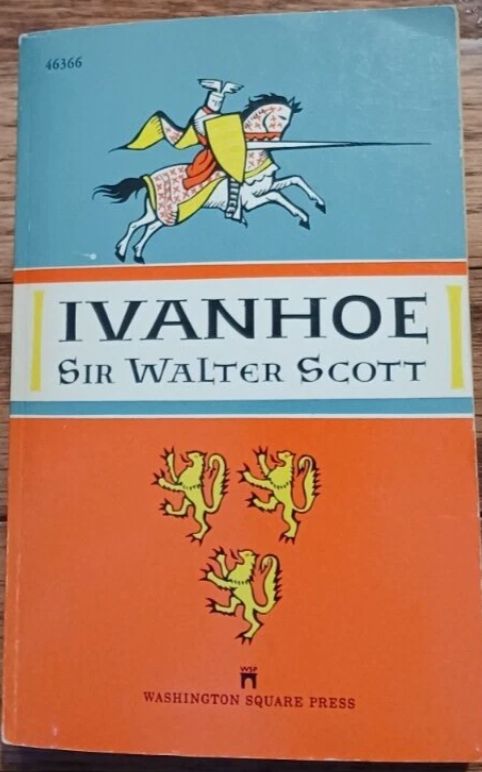
I read Sir Walter Scott’s Ivanhoe when I was in high school back in the 1970s. Was it required reading? Nope, I just picked it up in my local bookstore because the cover looked interesting and it was $0.95. With a 5% sales tax, it cost me a dollar even, which was a bargain. I soon got caught up in Scott’s fast-paced tale of a valiant and honorable knight who was treated wrongly. I’ve been rereading literary classics that I first read when I was much younger to see how much more meaning I get from them now, and I decided to dive into Ivanhoe.

The Paperback version I bought 50 years ago.

The Paperback version I bought fifty years ago.

Scott published it in 1820, and it was a big hit. It is set in the late 1100s, in Britain, after the Normans had established their conquest of it. There remain a few Saxon nobles, but almost all power resides in the Norman landowners. Richard the Lionhearted is king, but he hasn’t been seen for years, since he left for a Crusade, and it’s rumored he is being held prisoner in Europe. His brother, John, sits on the throne, and he is doing everything he can to consolidate his power.

You can read the rest of this review by clicking here.

Silver and the Sunday Cypher: A Fun Thriller

After slogging my way through the enjoyable but lengthy Bleak House, I decided to pick up a new book that Amazon’s algorithm recommended to me: Jack Gatland’s Silver and the Sunday Cypher. It turned out to be the perfect follow-up to a relatively dark Victorian masterpiece.

Silver and the Sunday Cypher is a fun and fast-paced thriller that features 64-year-old widow, Laura Carlyle, who is thrust into a cloak and dagger world of secret societies, murder, espionage, and international diplomacy. It begins with the assassination by poisoning of Harry Farrell in broad daylight in front of a London church. Farrell has been compiling a dossier on a shadowy group that is called The Calendar. Its members go by days of the week (shades of G. K. Chesterton’s The Man Who Was Thursday), with a mysterious “Mr. Sunday” at the top of The Calendar’s hierarchy.

To continue reading, click here.

Dickens’ Bleak House: One of His Best

Almost thirty years ago, I picked up Charles Dickens’ first novel, The Pickwick Papers, more out of curiosity than anything, and immediately fell in love with it. I went ahead and spent the better part of a year reading all of his novels in the order of publication. Since then, I’ve reread Pickwick and his final complete novel, Our Mutual Friend, but not any others. I know that Bleak House often tops people’s lists of The Best Dickens Novels, and when I first read it, I thought it was very good, but not one of his best. I decided to give it another chance, and, once again, I find that I have a much greater appreciation for a book now that I am older.

You can read the rest of my review here.

The Hank Show: The End of Privacy

I was born in 1961, so a little more than half of my life was pre-internet (for me, the internet really began in 1995, when a new piece of software called Netscape was introduced). I remember how amazing email was before spammers got going, how fun the early “world-wide web” was, and how interesting and informative various bloggers were before Facebook, Twitter, and Google showed up and took over. There weren’t adblockers in the late 90s, because there weren’t many ads. I remember how furious we websurfers got when it was revealed that websites had these things called “cookies” that were sent to your browser, so they could track your history. What an invasion of privacy!

Those concerns seem quaint now. My daughter was born in 1994, and she has really not known any time when she couldn’t go online. She also knows that she has no privacy, and she goes on the internet with the expectation that everything she emails, posts on social media, and buys is seen and logged by someone or something. McKenzie Funk’s book, The Hank Show, is a biography of the man he holds responsible for first exploiting the financial potential of Big Data.

To continue reading, click here.

Raymond Chandler’s The Little Sister

I’ve become a big fan of Raymond Chandler’s hard-boiled novels featuring his private eye, Philip Marlowe. I previously reviewed his fourth book, The Lady In The Lake, and The Little Sister, published in 1949, continues Chandler’s bleak and disillusioned perspective on the seamy side of Los Angeles and its surrounding towns. 

It opens with Marlowe alone in his office, when a woman calls him on the phone, asking him to find her missing brother. He insists on seeing her in person, which she resists, but eventually gives in. She is Orfamay Quest, and, as Marlowe describes her, 

She was a small, neat, rather prissy-looking girl with primly smooth brown hair and rimless glasses.
RAYMOND CHANDLER. The Little Sister (Kindle Locations 229-230). Delphi Classics. Kindle Edition.

She has come all the way out to California from Manhattan, Kansas, because her brother, Orrin – who, she assures Marlowe, would never get into any kind of trouble – stopped sending weekly letters to her and their mother. Marlowe is naturally suspicious of Orfamay’s story, but he agrees to take on her case for twenty dollars. 

What follows is a very complicated situation involving mobsters from Cleveland, corrupt cops, Hollywood B-listers, a doctor who supplies them with drugs, and a murderer who likes to kill by stabbing his (or her) victims in the neck with an ice pick. Suffice it to say that no one is particularly innocent and Marlowe’s natural cynicism is fully justified. 

And yet, even in the most dangerous and tempting circumstances, Marlowe clings to his code of honor: refusing to take bribes, stating the truth to the police even when it puts himself in danger, and resisting the blandishments of a beautiful Hollywood actress. He knows he won’t get rewarded for his virtue, but like a medieval knight pledged to behave chivalrously, he never gives in.

As in The Lady In The Lake, one of my favorite ingredients of Chandler’s style is his deadpan humor. Here are a few examples:

I got my wallet out and handed him one of my business cards. He read it thoughtfully and tapped the edge against his porcelain crown.
“He coulda went somewhere without telling me,” he mused.
“Your grammar,” I said, “is almost as loose as your toupee.”
“You lay off my toupee, if you know what’s good for you,” he shouted.
“I wasn’t going to eat it,” I said. “I’m not that hungry.”
He took a step towards me, and dropped his right shoulder. A scowl of fury dropped his lip almost as far.
“Don’t hit me. I’m insured,” I told him.
“Oh hell. Just another screwball.” He shrugged and put his lip back up on his face.
RAYMOND CHANDLER. The Little Sister (Kindle Locations 571-577). Delphi Classics. Kindle Edition.

A fat man in sky-blue pants was closing the door with that beautiful leisure only fat men ever achieve. He wasn’t alone, but I looked at him first. He was a large man and wide. Not young nor handsome, but he looked durable. Above the sky-blue gabardine slacks he wore a two-tone leisure jacket which would have been revolting on a zebra. The neck of his canary-yellow shirt was open wide, which it had to be if his neck was going to get out. He was hatless and his large head was decorated with a reasonable amount of pale salmon-colored hair. His nose had been broken but well set and it hadn’t been a collector’s item in the first place.
RAYMOND CHANDLER. The Little Sister (Kindle Locations 1364-1368). Delphi Classics. Kindle Edition.

The boss mortician fluttered around making elegant little gestures and body movements as graceful as a Chopin ending. His composed gray face was long enough to wrap twice around his neck.
RAYMOND CHANDLER. The Little Sister (Kindle Locations 2162-2163). Delphi Classics. Kindle Edition.

And, of course, there are plenty of wonderfully descriptive similes to set the mood:

Her voice was as cool as boarding-house soup.
RAYMOND CHANDLER. The Little Sister (Kindle Location 683). Delphi Classics. Kindle Edition.

She had a low lingering voice with a sort of moist caress in it like a damp bath towel.
RAYMOND CHANDLER. The Little Sister (Kindle Locations 795-796). Delphi Classics. Kindle Edition.

I smelled Los Angeles before I got to it. It smelled stale and old like a living room that had been closed too long.
RAYMOND CHANDLER. The Little Sister (Kindle Locations 1338-1339). Delphi Classics. Kindle Edition.

I took the wrinkles out of my lips and said aloud:
“Hello again. Anybody here needing a detective?”
Nothing answered me, not even a stand-in for an echo. The sound of my voice fell on silence like a tired head on a swansdown pillow.
RAYMOND CHANDLER. The Little Sister (Kindle Locations 2985-2987). Delphi Classics. Kindle Edition.

Either you love this stuff, or you don’t. I think it’s great – despite Marlowe’s world-weariness, he loves LA and the losers who populate its seediest neighborhoods. He knows one man can’t make much difference in the world, but he never gives up trying.

Chandler wrote The Little Sister after he had had some very frustrating experiences as a screenwriter in Hollywood, and his contempt for Tinseltown is as clear as a bell. (Or maybe like “two dead fish in the silt at the bottom of a drained pool”, to borrow a simile!) The plot is difficult to unravel at times, and just when I thought I had things figured out, he throws a curveball to surprise. That said, the ending is very good, and I would rank The Little Sister as one of Chandler’s best. 

Cather’s Death Comes For The Archbishop: A Good and Faithful Servant

I enjoyed Willa Cather’s My Antonia so much, I immediately started reading her Death Comes For The Archbishop. They are completely unrelated to each other, except they are both concerned with how people lived on the frontier of nineteenth century America. Death Comes For The Archbishop is set in the mid-1800s in the new territory of New Mexico. A young Roman Catholic priest, Jean Marie Latour, has been named bishop to this enormous, wild, and mostly lawless area of the southwest. He sets up his base in the small settlement of Santa Fe. 

From the title, one might think this is a mystery novel, but it is not that at all! Rather, it is the story of how two Roman Catholic missionaries from France serve various peoples with grace, sensitivity, and love. Latour’s best friend, Father Joseph Vaillant, accompanies him in his new placement. They first met in seminary in Clermont, France, and became fast friends, even though they are almost polar opposites. Physically, Fr. Vaillant is short, unattractive, and full of restless energy. Fr. Latour is tall, handsome, graceful and intellectual. Where there is a spiritual need, Vaillant wants to rush in to address it, while Latour tends to observe, take stock of the situation, and consider the long game.

Cather makes the point that these two approaches complement each other, and both are necessary for effective ministry (I owe this insight to Joel Miller’s excellent review of Death Comes For The Archbishop on his Substack, Miller’s Book Reviews.) The ministry Latour and Vaillant are assigned is daunting to say the least: a huge territory that encompasses most of what is now Arizona, New Mexico, and Colorado. There are villages of Catholics that have not seen a priest in years. Men and women have paired up, without being married. Their children have not been baptized. 

Another pressing issue is Father Martinez of Taos, a very powerful and corrupt priest who refuses to recognize the authority of Bishop Latour. When Latour visits him, he flaunts his women and children and asserts that celibacy can no longer be enforced. He is also responsible for inciting a raid on the new American authorities where several men and women were brutally slaughtered by natives. As the famous Kit Carson relates to Latour, 

Our Padre Martinez at Taos is an old scapegrace, if ever there was one; he’s got children  and grandchildren in almost every settlement around here.
(Location 855, Standard ebooks edition)

Martinez tries to set up a schismatic church, but rather than force the issue, as Vaillant urges, Latour chooses to let Martinez slowly lose influence and followers as the true Church reasserts itself in the region.

While reading Death Comes For The Archbishop, I was impressed with the efforts these French Catholics take to serve their parishioners. They traveled literally thousands of miles on horseback through some of the most inhospitable land on earth. Often, there were no roads, let alone any maps, and every trip was life-threatening. And yet, Latour’s and Vaillant’s love for their flock enabled them to effectively administer to a diocese that was thousands of square miles in size.

One of Latour’s most impressive qualities is his ability to connect with wildly different groups of people. He relates to the lowliest Mexicans in his diocese, the wealthy landowners, and the various indigenous peoples like the Hopis and the Navajo. He forges deep friendships with members of all these constituencies. As far as the Native Americans go, he respects their traditions and doesn’t try to make them “European”. There is one fascinating chapter where he and his Indian guide, Jacinto, get caught in a deadly snowstorm. Jacinto manages to reach shelter in a cave. There is something about the cave that immediately causes Latour much discomfort. Jacinto tells Latour he must never reveal that he has been in this cave. He sees Jacinto carefully fill in a hole in the wall from which a stench is issuing. Latour is aware of tales that Jacinto’s tribe has offered human sacrifices to a “giant serpent” who lives in the mountain. However, once again, Latour doesn’t press the issue, and we never learn just what it is that causes Latour his distress.

Vaillant feels called to go to believers in Arizona, and there is constant tension between Latour’s desire to have his best friend nearby and allowing him to satisfy his calling. As the novel progresses, both men see the hand of God in the decisions they make. Early on, there’s an interesting conversation between them about the Virgin of Guadalupe:

“Where there is great love there are always miracles,” he [Latour] said at length. “One might almost say that an apparition is human vision corrected by divine love. I do not see you as you really are, Joseph, I see you through my affection for you. The Miracles of the Church seem to me to rest not so much upon faces or voices or healing power coming suddenly near to us from afar off, but upon our perceptions being made finer, so that for a moment our eyes can see and our ears can hear what is there about us always.”
(Location 572, Standard Ebooks edition)

Just like in My Antonia, Cather does a masterful job of describing the beauty of the southwest desert. She truly is a visual artist whose medium is words:

The sky was as full of motion and change as the desert beneath it was monotonous and still – and there was so much sky, more than at sea, more than anywhere else in the world. The plain was there, under one’s feet, but what one saw when one looked about was that brilliant blue world of stinging air and moving cloud. Even the mountains were mere anthills under it. Elsewhere the sky is the roof of the world; but here the earth was the floor of the sky. The landscape one longed for when one was far away, the thing all about one, the world one actually lived in, was the sky, the sky!
(Location 224, Standard Ebooks edition)

As the title says, death does eventually come for Archbishop Latour, but not before we have an opportunity to reflect on a life well-lived. He served God and the Church to the best of his ability, and he left an extraordinary legacy in the wild expanse of southwest America. I’m not a Roman Catholic, but this book made me profoundly grateful for the unsung heroes of that Church who risked everything to bring the Faith to the most inaccessible areas of the world. Cather’s novel is a beautiful tribute to them.