Category Archives: Music

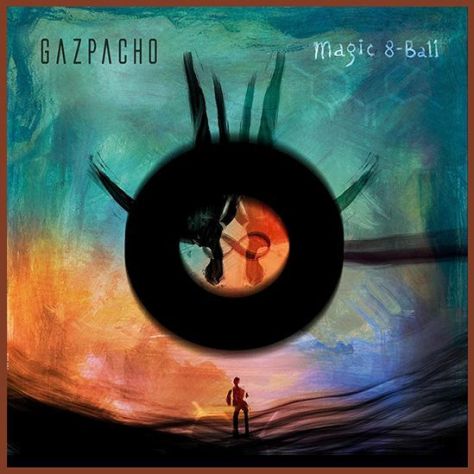
Gazpacho’s Magic 8 Ball: A Magical Musical Showcase

Greetings, Spirit of Cecilia readers! In this post, we share our thoughts on the latest album from a group we have long admired – Norway’s Gazpacho.

Tad: Brad, the first Gazpacho album I picked up was Missa Atropos (2010), and I have to admit, I couldn’t get into it. Jan-Henrik Ohme’s vocals seemed kind of weird, and none of the songs had memorable melodies, to my ears. However, on your recommendation, I bought their fourth album, Night (2007), and I fell in love with it. Their use of repetitive riffs throughout the entire album had a hypnotic effect on me, and it remains a favorite of mine.

They’ve just released their twelfth album (not counting a few live sets), Magic 8 Ball, and I think it is one of their best. It sounds like they have decided to embrace their talent for writing excellent “pop”-style songs, and this album includes eight thoroughly enjoyable tracks. After the deep and  philosophical musings of 2020’s Fireworker, Magic 8 Ball strikes me as a more lighthearted and accessible offering. I love it!

Brad: Tad!  Always a pleasure, my awesome friend.  And, to imagine that we get time to talk and write about things we absolutely love.  Life doesn’t get much better than this.

Yeah, I’m just a few years short of two decades of loving Gazpacho.  Sometime in the early 2000s, I really fell in love with Kscope and started purchasing everything the label was putting out.  To this day, I have a pretty strong Kscope collection.  

At the time, if you remember, the label was also putting out samplers.  On one of those samplers, in 2007, I was exposed to Gazpacho’s Night, and I purchased it immediately.  To say that I was taken with it would be an understatement.  Though I have loved everything Gazpacho has released, Night and Tick Tock remain my absolute favorites–standards by which I not only judge Gazpacho but all bands and all prog.  Once I encountered Night, I went back and purchased Bravo, When Earth Lets Go, and Firebird.  Those first three are much more art pop and art rock than their later stuff.  Beginning with Night, the only real way to describe their music is prog or post-prog.  

To be sure, I’ve never missed an album.  Each new release is a treat, to be sure.  Crazily enough, I even bought Introducing Gazpacho–a best of collection–simply because I wanted to support the band.  I even have a specific shelf in my home office in which I display my most prized music.  Gazpacho sits beautifully next to my Talk Talk, Big Big Train, Marillion, The Flower Kings, and Glass Hammer collections.

Somewhat infamously (at least in my household and with my wife), I was so taken with Fireworker at St. Croix, the previous Gazpacho album, that after purchasing the stand-alone CD, I purchased the blu-ray of the album.  Then, I was so taken with the blu-ray, I purchased the deluxe book/boxset of the album.  So, I have all three different versions of that glorious album!  So, yes, I’m a bit of a Gazpacho nut.

Now we have Magic-Eight Ball and it fits into its own category.  Indeed, this new album strikes me as a cross between their prog and post-prog albums post Night and their art pop albums, pre Night. The first five tracks really fit well within the prog and post-prog realm, but the last three tracks–especially “Magic Eight Ball” and “Immerwahr”–really feel like the first few albums.  That is, they’re more art pop or art rock than prog or post-prog.

That said, I really love this new album, though on my first few listens, I was a bit taken aback by “Magic Eight Ball” and “Immerwahr.”  I’m just no longer used to Gazpacho being pop!

Tad: Brad, I think you’ve hit on something – Magic 8 Ball really is a summation of what Gazpacho has done, going back to the beginning. Let’s talk about the songs themselves. The album opens with the stately “Starling”, which pulls me in with Ohme’s warm and intimate vocals. The instrumentation is primarily piano with some gorgeous violin work from Mikael Krømer. There is a sense of longing to the melody as it slowly builds in intensity. By the end of its 9-minute length, the guitars are roaring, but it’s never overwhelming. I love the gentle closing lyrics: Oh, let us be reborn. It’s one of my favorite opening tracks in the entire Gazpacho discography.

The second track, “We Are Strangers”,  is one of my favorites of the album, and it’s a great choice for a single. Don’t laugh, but when I first heard it, I kept thinking it reminded me of something, and then it hit me: the chord changes and Ohme’s vocals are very much in the vein of classic Duran Duran! I mean that as a compliment; I think Duran Duran made some of the best pop music of the ‘80s.

The third track, “Sky King” is another relatively hushed and intimate track. Once again, Gazpacho has come up with an incredibly beautiful melody that is sung with delicacy by Ohme. Even when Jon-Arne Vilbo’s guitars come crashing in, it sounds like Ohme is whispering in my ear. The mix of this album is masterful – every instrument is clearly delineated, even during moments of glorious guitar-heavy noise. 

So, three tracks in, and I’m already hopelessly in love with this album! 

Brad: Thanks, Tad.  An excellent analysis.  I love how track four, “Ceres,” begins with a haunted-sounding piano, and it continues throughout the song.  The rhythm of the song is extraordinary, especially the percussive elements mixed with the vocals.  The whole thing sounds simply driving, but in a properly gentle way.

Track five, the bizarrely titled “Gingerbread Men,” in contrast to the previous track, begins hesitatingly, playfully hinting at a loss of direction, before the guitar comes confidently in and persuasively centers the song.  There’s some really unusual sounds–maybe someone playing piano strings as percussion?  I like the lyrics, though I’m not sure what they’re supposed to mean:

Through the haze
Swallows flying high
While we sleep
In a world of steel
There’s no peace

It is my belief
That my life has been discreet
Door slammed shut
The big bad wolf of night
Fragments of hope in this endless climb
Lit up by traffic lights
Broken dreams
Parading gingermen
Aftermath
Turn away
From them

And:

And now the cars go by
Silver ghosts
Of all the gingermen
Washing out
Washed away
With the rain

You bettеr pack a suitcase
Escape beyond thе city limits
Or watch your old self disappear
Before the end is writ in dough
It can only be delayed

Track six, “Eight Ball” is shocking and discordant, only because it’s so poppy, contrasting with not only most of Gazpacho’s post-Night music but with the first half of this album in particular.  Indeed, “Eight Ball”’s actually downright whimsical, something that would not be out of place in an 1890’s carnival or early twentieth-century musical.  I’m getting Ray Bradbury vibes, mixed with some animated classic Disney!  Despite being poppy, “Eight Ball”’s really good, and it makes me realize that I should never box Gazpacho into any particular category.

The poppy feel continues with the seventh track, “Immerwahr,” though not the whimsy.  This sounds a lot like a Marillion song–especially with the guitar on it.  I especially like the lyrics:

Leaving Chekhov in the drawer
Throw the bankers at the window
Where the panic and the fear
Palest moonlight ever
Silver everywhere
Was the greater meaning
Hiding in the past
Did we send it all to bed
While the spirits of the poor
Jitterbug on judgement day

Track eight, “Unrisen,” finishes the album.  While more poppy than the first five tracks of the album, it’s the least poppy of the final three songs.  The strings are especially gorgeous, and I had no idea if they’re real or synthesized.  There’s a definite playful quality to the keyboards, too.  And, once again, I really like the lyrics, though I’m not sure what they mean.

Now you’re an astronaut lost in endless universe
Within thosе lines are older days of othеrs, I withhold the nameless why
In glass and velvet green

Mystic cryptic secret whispers
Let them be the dreamless sleep for you

See how they drift in clouds and
See how they smile
Higher, higher into the deep blue
Sail the sea of tranquility

They remind me of the lyrics from the earliest Gazpacho albums.

Tad, I’m not sure how to conclude this.  I really like the new Gazpacho, and I think it’s a fine addition to their output as a whole.  What really draws me to Gazpacho, though, are their concept albums.  As such, while I’ll certainly and happily return to Magic-Eight Ball, I’ll probably return more often to Night, Tick Tock, Missa Antropos, etc.

Tad: Brad, thank you for sharing those lyric excerpts. I have a hard time understanding the meaning of most Gazpacho songs; I think they aim more for a mood or atmosphere than for a specific message.

I’m glad you noted the whimsical nature of the title track – when I first heard it, I also thought of a carnival ride! It’s somewhat unique in their catalog, and I like it a lot. Now that you mention it, I think the entire album is suffused with whimsy, including the title. Did you ever have one of those magic 8 ball toys? You asked a question, shook it, and an answer would float up to a little window: “Maybe”, “Definitely so”, etc.

I’d like to also give some praise for the opening bars of the closing track, “Unrisen”. With the keyboards and violin accompanying Ohme’s vocals, it sounds downright baroque to my ears – like something Vivaldi or Thomas Tallis might have composed. I swear, I can even hear a harpsichord in the background! Anyway, that’s just an example of the many musical delights I’m enjoying on this album.

While I share your love for their concept albums, I think Magic 8 Ball is one of their strongest collection of tunes. They sound really energized and confident on every track, and I am impressed with how they keep pushing the envelope after twelve albums. Here’s to hoping they record many more!


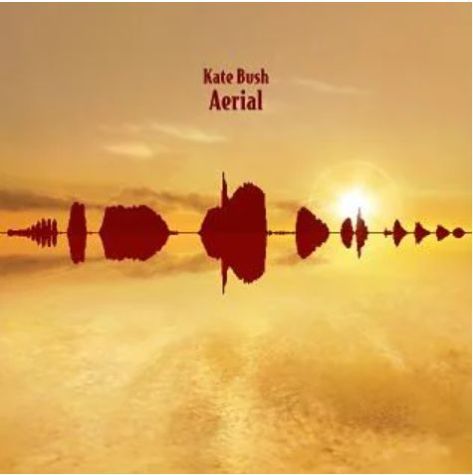
Kate Bush’s Aerial Turns Twenty

Tad: Hello, Brad! Brad recently pointed out that Kate Bush’s album, Aerial, has turned 20 which is a good excuse to have a conversation about it. I have enjoyed seeing all the new fans Ms. Bush has acquired thanks to the inclusion of “Running Up That Hill” in the soundtrack of Stranger Things. That song is off my favorite album of hers, The Hounds of Love, but Aerial is a close second, in my estimation.

The two discs have different titles: Aerial: A Sea of Honey, and Aerial: A Sky of Honey. Listening to them recently rekindled my love for this sprawling set of songs. As a math teacher, I have to express my love for the track, “Pi”, in which Kate recites the digits of that ineffable irrational number and makes it sound seductive.

Brad: Hello, Tad!  So great to be talking with you.  A pleasure and an honor.  I’m writing this on the Feast of All Souls, the weather is gorgeous, and I got to sleep in an extra hour this morning.  It all seems so appropriate as I praise Kate Bush.

I have fond memories of first hearing about Bush in 1985.  I had missed her earlier albums, but I very well remember the release of Hounds of Love in the early fall of 1985.  It was my senior year of high school, and I was utterly blown away not only by side one–especially “Running Up That Hill,” “Hounds of Love,” “Big Sky,” and “Cloud Bursting.”  It was side two, “The Ninth Wave,” however, that completely gobsmacked me.  Here was pure unadulterated prog, all from an incredibly talented pop mistress.  I was in love (it didn’t hurt that Bush is incredibly attractive and possesses an angelic voice).

A year later, during my first semester at the University of Notre Dame, the compilation, The Whole Story, came out.  It, too, was excellent, and it made me start looking through Bush’s previous albums.  

Then, my very close friend, Greg Scheckler, now a renowned professional artist in New England, made for me a mixed tape of everything prior to Hounds of Love, complete with Greg’s own doodles.  It was glorious, and I wore that tape out!  Too bad–given Greg’s subsequent fame, his doodles might very well be worth something.  

Two years later, in the spring of 1988, one of my favorite movie directors, John Hughes, came out with one of his best films, She’s Having a Baby, and during the most emotional moment of the movie, Hughes used (and commissioned, I assume) Bush’s “This Woman’s Work.”  As much as I had loved Bush prior to this, this song and scene solidified my permanent loyalty to Bush.  Yes, at that point, I became obsessed with her as an artist.  And, I remain so to this day.

Though I very much liked The Sensual World and The Red Shoes, it was 2005’s Aerial that, once again, gobsmacked me.  Disk one was truly clever prog-pop, artistic to the nth degree, but it was disk two that blew me away.  42 minutes of pure prog, akin to what Bush had done with “The Ninth Wave,” but perhaps even better.  I loved side two, “A Sky of Honey,” that I played it on my iPod night after night as I fell asleep.  At the time, I was working on my biography of Christopher Dawson, and I was having a heck of a time shutting down my brain and sleeping.  Aerial: A Sky of Honey worked wonders on me–calming me down and serving as a potent but non-addictive Ambien!

Tad: Well, Brad, I didn’t immerse myself in Kate Bush’s music as much as you did – I think I was negatively influenced by that infamous Rolling Stone Record Guide that panned her work and compared her voice to a vacuum cleaner! Needless to say, I’ve revised my opinion of practically every artist those small-minded critics at RS dismissed.

Anyway, my thoughts on disc one of Aerial are all positive (with the exception of “Mrs. Bartolozzi”, which is a little too maudlin for me). “King of the Mountain” starts off sounding like a Windham Hill album with its synthesized/indigenous rhythms, and I absolutely love the way it transforms into a straight-ahead rocker. It’s a fantastic opener! I’ve already mentioned how much I like “Pi”, and the other highlight of the first disc is “How To Be Invisible”, another great rock song with a snaky, bluesy guitar hook that is wonderful. Her vocals dance over, under, and around the other instruments and demand I pay attention to her. It’s a wonderful song that I can listen to over and over again. “Joanni” and “A Coral Room” lower the temperature a bit and are a nice way to close out the disc.

I wonder if Ms. Bush would say she’s been influenced by Joni Mitchell? “A Coral Room” in particular sounds like late-70s Mitchell to my ears. 

Brad, give us your thoughts on disc one of Aerial, and start the discussion of disc two!

Brad: It’s worth remembering that when Aerial came out in November 2005, Bush hadn’t released anything since 1993’s The Red Shoes.  That’s a huge gap.  Beautifully, Bush spent those years raising her family rather than pursuing her career.  

Still, that was a long, long time for her fans to wait.  To be sure, though, it was worth waiting for.  

I really don’t know which album is better, Hounds of Love or Aerial.  When I list my all-time favorite albums (and I always list them without letting any artist/band have more than one entry), I always list Hounds of Love.  Most recently, I listed it as my 12th favorite album of all time.  I could just’ve as easily named Aerial.  I guess, in the long run, they’re pretty interchangeable in the grand scheme of excellence.

Like you, Tad, I thoroughly love disk one.  The Elvis-like confident sway of “King of the Mountain,” the quirky intensity of “Pi”, the Renaissance sound of “Bertie,” the insistence of the washing machine of “Mrs. Bartolozzi,” the truly clever pop of “How to be Invisible” with its incredible basslines, the profound and fetching tribute to St. Joan of Arc in “Joanni,” and the deep despair mixed with hope in the melancholic “A Coral Room” all contribute to this masterpiece of a release.

I think that what impresses me most about Bush is that she is always her own person, her own artist.  She sounds only, gloriously, like Kate Bush, even when she’s playfully imitating Elvis on the first track of the album.

But, for me, it’s disk two that makes this album truly extraordinary.  At 42 minutes, “A Sky of Honey” is simply perfection itself.  When folks talk about albums that demand headphones for a full appreciation, this is that album!  

From the child whispers and bird sounds of the opening moments to the anticipatory keyboards and string to Bush’s lush vocals with meaningful lyrics to the spoken expositions, this is a complete and total celebration of life in all its varied mysteries and profound wonders.  

Tad, as you and I have talked about, it’s often the bass that makes a great album a great album.  The bass work on “A Sky of Honey” is spectacular.  Combined with Bush’s vocal lilt, everything builds and builds until the music itself is ready to explode–the tension as thick as can be–in the last 15 or so minutes of the album.  Stunning.  Just simply stunning.

If Bush had released “A Sky of Honey” as a stand-alone album, I have no doubt that it would rank up there with Close to the Edge or The Colour of Spring.

Tad: Brad, you hit on something crucial when it comes to understanding Kate Bush; you said “she is always her own person, her own artist”. I remember reading an article about the recording of Hounds Of Love, and her record label was worried about marketing it, because it was so different from her earlier work. I believe she recorded it in her home studio, and she completely disregarded her label’s suggestions (to our benefit, I would add!). She is an artist who is fearless and blazes her own trail, not giving any thought to current musical fashions. Will people be listening to Taylor Swift’s music 50 years from now? I doubt it. Will people be listening to Kate Bush’s? Absolutely!

As far as my thoughts on “A Sky Of Honey”, I am in complete agreement with you. I think of it as a musical suite that chronicles a day – the chirping birds in the intro are greeting the dawn, and it closes with “Nocturn”. However, I’m not sure how the title track, “Aerial”, fits in with my theory! It’s a fairly raucous track that, as you so aptly describe it, is ready to explode.

Also, thank you for pointing out that “Joanni” is referring to St. Joan of Arc. Once I understood that, it clicked into place. 

And so, dear readers, if you aren’t familiar with Aerial, we recommend you check it out. It is timeless and beautiful music!

An Interview with Jonas Lindberg

Jonas Lindberg & The Other Side’s 2022 album, Miles From Nowhere, burst onto the prog scene and made a lot of “Best of” lists. They are about to release the follow-up, Time Frames, and it does not disappoint. Lindberg was kind enough to take a few minutes and chat with me via Zoom.

Hi Jonas, thanks for taking the time to talk with me about your new album. Miles from Nowhere was my favorite album of 2022, and I am liking Time Frames just as much. Was the recording process for Time Frames the same as for Miles From Nowhere?

Pretty much – the recording process is the same, which means I do a full production demo, and then remove the drums. So Jonathan [Lundberg] records the drums, and he sends them to me, and I record almost everything, and then I go around and record vocals and lead guitars with the others.

So, the difference this time is that I actually have a studio to work in! I actually have recorded this one entirely in the studio. With Miles From Nowhere, most of my overdubs were recorded in my living room. So that’s the difference!

Well, Miles From Nowhere still sounds good, for being recorded in your living room!

Yes, it’s about where to put the mikes, and to understand that the room sounds weird.

I came of age in the ’70s, and I loved artists like Todd Rundgren, Boston, and Styx, and I’m hearing a lot of that style of rock in your music. Am I off-base with that?

Probably not. I haven’t listened to a lot of that, really. My influences are more – in the progressive genre – more Spock’s Beard. But they have probably listened to those bands, you know. I got that question earlier – it’s like it’s a new generation of influences. Of course, Pink Floyd has always been a big influence for me.

Yes, I can definitely hear early Spock’s Beard in your music. 

So, what are some of the lyrical topics in Time Frames?

Well, I tend to write about things that have happened to me. If I don’t have a clear idea what I want to write about, I take something that is evident or around me at the time. Some of the lyrics ended up being about parenting, you know, or my daughter, because I was on parental leave when I wrote the lyrics. A lot of the lyrics come from thoughts or things that happened during that time. So that might be a kind of overarching topic. But then you also have something like “Galactic Velvet”, for example, that’s completely different – it’s about space! [Chuckle]

I’m glad you brought that up; that’s one of my favorite songs. I love Jenny Storm’s singing on that. 

Yeah, she’s awesome. She’s really easy to work with, and she’s also incredibly fast at getting the right takes. For example, she sings a part in “The Wind” – the epic – her performance there was done in three takes.

What other musicians besides Jenny are on the new album?

Well, mostly friends of mine from university days. Jonas [Sundqvist], who is the other lead vocalist, we’ve known each other going back twenty years ago. We’re always writing music together, and we hang out together. We found each other through a Sting project that he had, doing Sting covers. And we went to school with Nicklas Thelin, who plays guitars; we went to the same classes at university. There’s Jonathan on drums, who I got to know better when I moved down to Stockholm and we ended up playing in a few different projects. Around the same period I met Calle [Schönning], the other guitar player who plays most of the lead guitar on the album. He’s just an incredible guitar player. Everything he plays, you know, everything is great! And then, also of course, my brother, [Joel Lindberg] plays guitar on a couple of songs. And my girlfriend Maria Olsson plays percussion.

Do you guys have any plans to tour?

I hope so, but it’s hard to tour, because I don’t really have a booking agent to make that happen. So I’m kind of doing everything myself! Right now, I’m more focusing on releasing the album, and then I’m planning on doing at least one or a couple of release concerts, somewhere in Sweden some time next year – I’m aiming for springtime. Then we’ll have to take it from there and see what happens. – how the album is received, you know.

Maybe you could do a pay-per-view streaming concert, or something like that.

Yeah, some kind of live film I’ve had in my head. Just an idea, but I haven’t anything set in stone – I’m just sketching at this point.

What are you listening to right now, besides your own music?

Right now, I’m in a little Steven Wilson period. I’ve been listening back through his catalog. When I was mixing this album, The Overview came out. And, being a fan of Pink Floyd, I was like, “Oh! Yes! That’s perfect for me.” Then I started going back, and I found all these albums that I had never listened to. That’s what I’ve been doing, mostly.

I’ve been a Steven Wilson fan since his Porcupine Tree days. I think my favorite solo album of his is his first, Insurgentes.

I haven’t gotten that far back yet!

Anything else you’d like to share, Jonas?

Go check out the album at my website, and I hope you like it!

Many thanks to Jonas for taking the time to talk with me, and we wish him lots of success with this new album – it’s really good! If you love progressive rock with a classic rock feel, you will not be disappointed with Time Frames. It is already one of my favorite albums of the year.

Jonas Lindberg and the Other Side’s official website is:  www.lindbergmusic.com/shop

Here’s the video for the single “Faces Of Stone”:

Lifesigns Live In The Netherlands: Instantly Classic Prog

The British group, Lifesigns, released a 2-disc live album recorded in the Netherlands back in 2023. Brad and Tad have a conversation about why this is a fantastic live album and why Lifesigns is a fantastic group.

Tad: Brad, I’m so glad you suggested we review this album. It’s been out a couple of years, but it didn’t get the attention it deserves. I became a fan of Lifesigns when they released Altitude in 2021, which was one of my favorite albums of that year. Live In The Netherlands features live renditions of almost that entire album, which is definitely a plus!

On listening to it, I am impressed with how well they replicate the studio versions of the songs, while adding a lot of energy. 

Brad: Thanks so much, Tad.  From what I can tell, Lifesigns is pretty huge in Europe but just does get enough attention here in the U.S.  Our loss!  Back when we were at Progarchy, John Young got ahold of me and let me know about Lifesigns.  I knew about Young, of course–he’s a huge name in the prog and rock worlds–and I was honored, to be sure, to communicate with him.  He’s not only a gentleman, but I believe he is truly a good, good soul.  And, obviously, what a talent.  So, I’ve been proudly following Lifesigns from the beginning, being introduced to them with their first amazing album, the self titled Lifesigns.  

My first and lasting impression of that album is that it’s one of prog joy, much more closely related to, say, a Transatlantic album, than, say, Storm Corrosion.  There’s a real beauty as well as real innocence to the music that I deeply admire.  

When I say it’s related to Transatlantic, I don’t mean in sound, but in atmosphere.  While I wouldn’t call Lifesigns a Christian band, I would say they’re most certainly not adverse to Christianity and all it entails.  And, the fact that the openly Christian Dave Bainbridge is now a part of the band certainly doesn’t hurt this reputation.  It’s definitely not an in-your-face Christianity like some of Neal Morse’s work tends to be, but rather music and lyrics inspired by Christianity.  Again, the best way I can explain it is that Lifesigns radiates joy.

There’s also something humorous about what I just said.  When I became Facebook friends with John Young, back in 2013, I also became friends with the first bassist of the band, Nick Beggs.  Beggs, of course, is well known in the prog world, especially given his work with Steven Wilson.  Almost immediately after I became friends with Beggs, he posted a number of pictures of himself in the buff.  I will admit, I was utterly shocked and, in no uncertain terms, made my horror quite plain on social media!  Ha.  There’s a puritan streak in me, to be sure.  Young, however, gently reprimanded Beggs and suggested this might not be the best way to introduce the band to the public.  It all turned out well.

Tad: Brad, that is hilarious! Beggs is definitely a prankster, but he is an amazingly talented bassist.

Let’s talk about Lifesign’s Live In The Netherlands. It features an excellent playlist, with the first half of the show devoted to old favorites like “N” and “At the End of the World”. It’s the second half that really gets me excited, where they perform the entire Altitude album. They are an incredibly tight unit, and Dave Bainbridge really shines on guitar.

Like you, Altitude was a favorite of mine the year it came out, and I immediately picked up all of their other albums. I still think Altitude is their best, but they haven’t released a weak album to date. I love the title track, which runs a generous 15:49, but never lags. John Young does a fantastic job on keyboards and vocals. “Last One Home” is one of my all-time favorite songs, regardless of genre. I think it is just beautiful in its perfect melding of song and lyrics. The version on Live In The Netherlands is outstanding, with Bainbridge turning in a wonderful guitar solo reminiscent of Gilmour at his best. 

It’s interesting you find Lifesigns reminding you of Transatlantic, and I can certainly hear that in terms of atmosphere, as you say. When I listen to Lifesigns, I am reminded of the classic prog band, UK – especially their eponymous debut album that featured Alan Holdsworth on guitar. I think it’s because Young’s vocals remind me of the late, great John Wetton’s. Also, Young’s melodies have a way of turning a phrase that brings to mind late ‘70s prog. 

Anyway, I think for someone who enjoys melodic and uplifting prog, Lifesigns is hard to beat, and Live In The Netherlands is the perfect introduction to their music. It covers the best songs from their first two albums as well as including an excellent performance of their complete third album. Lifesigns doesn’t have much music on the streaming services, so I encourage people to support them by buying hard copies of their albums. 

Brad: Tad, what a great analysis.  I’d not thought of Lifesigns resembling late 1970s proggers like UK.  Now that you’ve said that, I can’t unsee it.  I think you’re absolutely right.  Maybe John Young has a particular 1970s sound that I’ve never quite realized. 

Again, for me, it’s best summed up as “joy” rather than overly precious or overly intricate or overly self-involved.  For whatever reason, John Young and his music inspires me to be a better person, to approach my own art with a love of life and a gratitude for all that made my own life possible.  Hence, I think of it as being Christian adjacent rather than out and out Christian.  Again, we know Bainbridge’s Christianity, but if someone told me that Young was also serious about his faith, I wouldn’t be surprised.

And agreed, Lifesign’s three (only three!) studio albums are all excellent, and I very much love the two live releases.  I suppose, if pushed, I would say that Lifesigns (the debut album from 2013) is my favorite, only because it was my introduction to them.  In terms of quality of music and lyrics and vocals, I would rank all three equally.  Again, this music just makes me want to be a better person. 

We haven’t explicitly mentioned Cardington, and I would like to praise that album as well for being every bit the equal of Lifesigns and Altitude.

If I had one complaint, it would be that I want more Lifesigns music!  Call me greedy, but I would love more than three albums over a decade.  Still, I’m sure that John has a ton of things going on, so I’m deeply appreciative of what we do have.

Though I’d not thought of this as having a late 1970s sound until you mentioned it, I would love for more prog to have this feel and atmosphere to it.  There are a hundred Radiohead and Porcupine Tree inspired bands, where are the John Young inspired bands?  I would love more of this kind of music: classy and classic, beautifully constructed, and majestically orchestrated.  The lyrics are perfect and compelling as is the music itself.

For me, Tad, Live in the Netherlands perfectly captures all of this.  Indeed, in terms of sound quality, I’m especially impressed, as the live album sounds just like the studio release, despite being in an uncontrolled environment.  I love the first set of older material and the second set of newer material.  My only complaint is that all of the banter has been removed from the live release.  I’m sure that John spoke to the audience, and I would love to know what he had to say.  Specifically, given what a gentleman he is, I’m sure that he’s an excellent frontman.

John, Jon, Steve, Frank, and Dave: if you’re reading this, please know that you are loved, and my desire to have more music from you is meant in the best possible way.  Thank you, hugely, for everything you’ve given us already.  Now, we just need to get all Americans to listen to you. . . .

Tad: From your keyboard to John Young’s ears, Brad! Yes, I wish they released more music, because the contemporary music scene needs more like it. And, dear readers, you can find all of Lifesigns’ music and merchandise at https://lifesignsmusic.co.uk/. Check them out!

In Concert: Alison Krauss Warms Our Cold, Cold Hearts

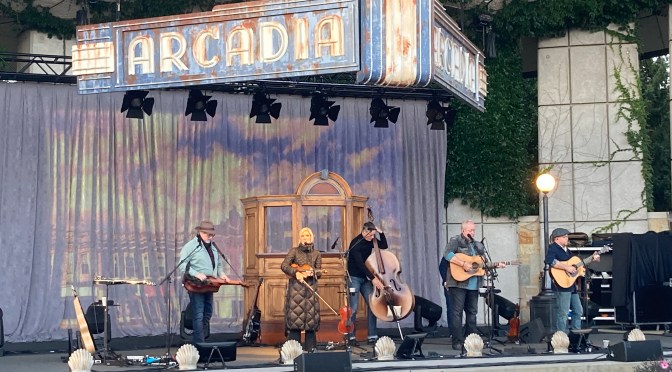
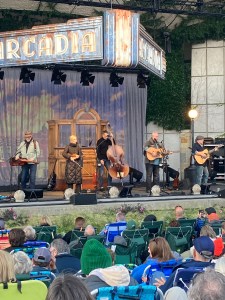
Alison Krauss & Union Station featuring Jerry Douglas, Meijer Gardens Amphitheatre, Grand Rapids, Michigan, September 5, 2025.

Over three decades, Alison Krauss has parleyed her singing and fiddling skills into an international career that (with the help of a Coen Brothers movie or two) brought bluegrass back to the masses and boosted her into an orbit of musical celebrity shared by few. But in the wake of her second collaboration with rock god Robert Plant, Krauss went back to her beginnings, reconvening her long-time band Union Station after a ten-year hiatus, with a new album and a six-month tour on the agenda. And that’s how, on the first genuinely chilly evening of Meijer Gardens’ concert season, Krauss and company wound up onstage in winter gear, getting down to business with relish, drawing a sold-out audience huddled beneath layers of Gore-Tex and fuzzy blankets toward their blossoming circle of musical warmth and light.

Not that Krauss & Union Station’s music is all sunshine, lollipops and rainbows. The tunes featured from their new album Arcadia were about (in this order): loneliness; a factory fire disaster; loneliness again; a mysterious stranger terrorizing a small town; and getting shut down on the make. In fact, some of the most compelling vocal moments were the darkest – Krauss’ spooky solo turn on “Ghost In This House”, Russell Moore’s bone-chilling folk narrative “The Hangman”. And there was melancholy galore in the mainstays of the band’s back-catalog: “Every Time You Say Goodbye”, “Let Me Touch You For A While” (“our one sexy song”, according to Krauss), revamped 1970s soul classic “Now That I’ve Found You”, and a spare, devastating cover of Willie Nelson’s “Angel Flying Too Close To The Ground.”

But while sad songs say so much, they weren’t the only emotion on offer; for every heartbreaker, there was an anthem to survival and resilience like the new “One Ray of Shine” and the classic “Forget About It.” In these tunes especially, Krauss showed her consummate range and interpretive skill, pattering out the verses to draw us into the story, then launching into the high lonesome choruses (often cradled by Union Station’s understated vocal harmony) to finish the job. While that sweet, supple voice is Krauss’ foremost calling card, she’s also consistently savvy with her vocal gift, knowing how to blend in tart, savory, even spicy flavors as the music requires.

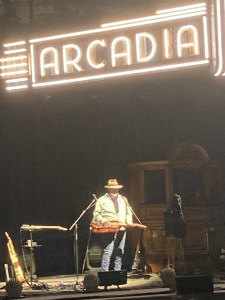
So there were humor and high spirits aplenty to set off all the sadness too. Whether commiserating with us about the weather (“You all look like Paw and Laura under the blankets in the back of the wagon”), or slyly teasing her bandmates (guitarist/banjo player/songwriter Ron Block was introduced as “our sexy librarian — and a recovering vegetarian”), Krauss combined downhome deadpan with a mischievous gleam in her eye whenever she addressed the audience. And when Union Station launched into hoedowns “Choctaw Hayride”, “Sawing On the Strings” and Bill Monroe’s “Cluck Old Hen”, she leaned right in, hunkering down on rhythm fiddle as Block, violin/mandolin wizard Stuart Duncan and dobro legend Jerry Douglas tore it up over Barry Bales’ resonating bass.

Douglas proved equally riveting in his extended solo spot, a weird and wonderful medley of Paul Simon’s brooding “American Tune” and Chick Corea’s festive “Spain”. Extra kudos go to Russell Moore as well: slotting into the male lead vocal spot formerly held by long-time stalwart Dan Tyminski, he brought home the bacon on both the back catalog and the upbeat “(Crazy ‘Bout A) North Side Gal” (which, in Krauss’ words, “covered three important topics – geographical location; mental wellness; and gender.”)

Ultimately, a concert by Alison Krauss & Union Station comes down to first-rate musicians playing and singing deceptively simple yet deeply affecting music, at the highest level of technical brilliance and visceral commitment, to stunning effect. But if anything, the extended encore, where the sextet gathered around a single microphone to harmonize with minimal instrumentation, sounded even richer depths. As the gentle love song “When You Say Nothing At All”, the weeper “Whiskey Lullaby”, the traditional spiritual “Down to the River to Pray” and Block’s moving confession of faith “There Is A Reason” wafted into the chill of the night, it settled over the rapt crowd like a bluegrass benediction to provide a thoroughly satisying finish. Put simply: hear and see them live if you can.

— Rick Krueger

Setlist:

  • Looks Like the End of the Road
  • Granite Mills
  • Choctaw Hayride
  • Sawing on the Strings
  • Rain Please Go Away
  • Every Time You Say Goodbye
  • Cluck Old Hen
  • The Lucky One
  • Ghost in This House
  • I Don’t Believe You’ve Met My Baby
  • Baby, Now That I’ve Found You
  • Wish I Still Had You
  • Angel Flying Too Close to the Ground
  • Let Me Touch You for Awhile
  • American Tune (Jerry Douglas solo)
  • Spain (Jerry Douglas solo)
  • Dust Bowl Children
  • The Boy Who Wouldn’t Hoe Corn
  • Lie Awake
  • The Hangman
  • Orange Blossom Special
  • One Ray of Shine
  • Restless
  • North Side Gal
  • Forget About It
  • Paper Airplane
  • Gravity
  • When You Say Nothing at All
  • Whiskey Lullaby
  • Down to the River to Pray
  • A Living Prayer
  • When He Reached Down His Hand for Me
  • There is a Reason

Kevin Keller’s Arcadia – 37 Minutes of Musical Joy

Close shot of sun at sunset, Brussels, Belgium

I’ve been writing the praises of contemporary composer Kevin Keller for years now. It has been fascinating to see his evolution from an extremely talented “ambient” composer/musician into one of the most vital and engaging classical music composers in America.

Keller’s Evensong, which was released in 2023, was a beautiful set of chamber choir pieces. He has just released its sequel, Arcadia, which primarily features the vocals of Sofia Campoamor, backed by a small choir and piano with string trio. As is usual with Keller, he augments this traditional musical setting with discreet and tasteful electronic touches. There simply is no other contemporary composer who can combine ancient musical styles and instrumentation with 21st century electronics as skillfully and satisfyingly as Kevin Keller.

All of the songs in Arcadia are sung in Latin, which creates a reverent and calming atmosphere throughout. The opening track, Arcadia 1, is “Et Vidi Caelum” (“And I Saw the Sky”). Hushed acapella vocals begin the song and are soon joined by various acoustic and electronic instruments. As the melody develops slowly and deliberately, the listener is transported into a state of bliss. I know I’m sounding hyperbolic, but this is some of the most beautiful music I’ve ever heard. The only thing I can compare it to is Thomas Tallis’ “Spem In Alium” or some of J. S. Bach’s fugues.

The second track, “Et Nox Ultra” (“And Night Is Over”) is a sprightly and wordless chant with a rhythmic bed of synths. It is full of anticipation for a new day. Arcadia 3, “Me Solum Me Invenio” (“I find myself alone”) is, appropriately, sung by Ms. Campoamor solo while accompanied by Keller on organ.

Kevin Keller and Sofia Campoamor

In Arcadia 4, “In Tenebris” (“In darkness”), the choir returns to sing a gentle lullaby accompanied by piano and string trio. As this song progresses, it becomes more insistent in its rhythm, but it maintains its control. It is one of the longer tracks at 6:22, and there is a beautiful, long coda that brings it to rest.

Arcadia 5 is “Mare, Littus, Flammam” (“Sea, Shore, Flame”), and you can hear waves gently washing ashore as Ms. Campoamor sings a melody that, to my ears, is full of longing. Her vocal is supported by a cello and soft electronics.

My favorite track is Arcadia 6: “In Equo Fugit” (“She flees on horseback”). It is introduced by a gentle pulse that is soon joined by the choir who sing an extraordinarily beautiful melody. I’m having a hard time conveying how delightful Keller’s music is here – it really is ineffable!

The final two tracks are “Et Lux Perpetua” (“And Eternal Light”) and “Veni Intus” (“Come Inside”) They bring our journey to a close with a very satisfying sense of returning to the comfort of a beloved sanctuary.

There is something very timely about the art Keller is creating these days. We live in such contentious times, which are exacerbated by social and news media.  Arcadia is a balm for the souls of people who need a respite from the 24/7 anxiety that our contemporary culture has a tendency to induce.

Spending 37 minutes listening to Kevin Keller’s Arcadia  is a great way to reset oneself – it is restorative and reminds us that true beauty still exists. I admire how Keller utilizes centuries-old forms of music to compose and perform new and refreshing music. He recognizes the precious worth of classic art, while building on it and adding his unique and immediately recognizable style. Here’s hoping Arcadia sparks a renaissance in contemporary classical music. Keller is planting a seed that promises to bear fruit to a world that is starved for music with lasting substance and beauty.

Arcadia is produced and performed by Kevin Keller. Sofia Campoamor sings lead vocals, while Katherine Wessinger, Danya Katok, and Wendy Baker form the choir. Sarah Zun plays violin, Angela Pickett viola, and Laura Metcalf cello.

You can purchase Arcadia at https://www.kevinkeller.com/arcadia.

A Debate On Depeche Mode

Greetings, Spirit of Cecilia readers! In this post, Brad Birzer and Tad Wert discuss a musical artist that may surprise you: Depeche Mode. These boys from Basildon, England burst on the scene in 1981 with the bouncy synthpop hit, “Just Can’t Get Enough”, and their first album, Speak and Spell, was a big hit. At the time, they seemed to be just one among many British synthpop groups that were popular due to MTV exposure in the US. Vince Clarke was their songwriter and synthplayer, while Martin Gore and Andrew Fletcher also handled synths and Dave Gahan provided vocals. They were famous for performing live without any guitars or drums. They also appeared to be doomed to “one-hit wonder” status when leader Vince Clarke left immediately following Speak and Spell. However, they had a secret weapon in Martin Gore, who stepped up and began writing songs. After the tentative album A Broken Frame was released, they added multitalented Alan Wilder to the lineup and released their first really great album, Construction Time Again, which contained the massive hit, “Everything Counts”. 

Depeche Mode has ended up outlasting all of their ‘80s synthpop peers, releasing music of surprising depth and beauty despite suffering trials that would end most artists’ careers: Alan Wilder left in frustration after Songs of Faith and Devotion, Dave Gahan survived a near-death experience from a heroin overdose, and Andrew Fletcher passed away in 2022. And yet, Gore and Gahan continue to release new music, and they remain an outstanding live act. 

Brad, I think you wanted to focus on later-era Depeche Mode, beginning with Black Celebration. Kick off the discussion!

Brad: Hello, Tad!  My friend, my colleague, my writing partner, my fellow progling.  Always great to dialogue with you.  

Ok, I admit, I’m pretty uninformed when it comes to Depeche Mode.  Of course, I’m familiar with them–as any child of the 1980s would be–but I don’t know them, really know them!  That is, whereas I knew everything there was to know about Rush or Talk Talk or, later, Big Big Train, I know next to nothing about the band.  I didn’t study their history or analyze their lyrics to any great degree. That is, I never obsessed over the band or considered them “my band.”  They evoked in me some fascination rather than loyalty.  And, when I did look them up prepping for this discussion, I find that they consider themselves Marxists.  Not a winning point for me, to be sure.

That said, in high school, I was rather taken with Black Celebration (the lyrics still resonate with me, and I very much like the production and the flow of the songs–all of which struck me, at the time, as rather proggy), though I’ve not listened to it in years–though I am now as I’m typing this.  I also bought Music for the Masses, which I appreciated but didn’t love.  And, like almost everyone our age, I had a copy of 101.  From my memory, everyone owned Black Celebration and, even more so, 101.  They were just a standard part of one’s music collection at the time.

Before I get to Songs of Faith and Devotion, let me just note that I’m very much enjoying my re-listen to Black Celebration as I type all of this.  It’s been years and years since I last heard it. I had forgotten that the songs really bleed one into another which is something I always appreciate.  And, even though this album dates back to 1986, the production and engineering is impeccable.  And, again, my memory did not deceive me–this is a very proggy album.  Even the second track, Fly on the Windscreen, seems to reference Peter-Gabriel Era Genesis.  Even the fourth track, the Gospel-tinged “Sometimes,” seems like a fragment, much like Yes’s “White Car” does on Drama.  A pop album would’ve never taken a risk like that.  Track number five, “It Doesn’t Matter Two,” sounds very much like Trevor Horn produced it.

Then, side two begins with the sixth track, “A Question of Time,” a brilliant track musically, but with very disturbing lyrics.  Track seven, “Stripped,” while again quite disturbing in its lyrics, is quite proggy in its dirge-like drive.  It merges quite nicely into a poppy eighth track, “Here is the House.”  The ninth track, “World Full of Nothing,” one against quite innovative musically, is deeply disturbing lyrically–a song about the loss of sexual innocence.  “Dressed in Black,” track 10, is about lust, and track 11, the final track, “New Dress,” is about social conformity and celebrity adoration and rather humorous in its scathing cultural critique.

Tad, what can I say?  I’m glad to have returned to Black Celebration, an album of fascinating music and deeply disturbing lyrics.  Because of the lyrics, I probably won’t return to this album again anytime soon.

Tad: Yes, Brad, I agree – there is always tension between the wonderful melodies Martin Gore conjures up and his very dark lyrics. I was not aware that they consider themselves Marxists – hopefully that was a youthful phase that they outgrew! 

As I’ve mentioned before, for me personally, lyrics take second place behind music. However, there are times when the darkness of Gore’s lyrics are unavoidable (“Blasphemous Rumours” being the most obvious example). I have all of Depeche Mode’s albums, and Black Celebration has never been high on my list. Your pointing out its proggy aspects has piqued my interest, however, and I am listening to it now as I write. 

“Stripped” has always been my favorite song from this album – the music itself is very stripped-down, and the tune is quite simple and arresting. I think Gahan’s and Gore’s vocals work together beautifully, and I love the way the production gradually adds layers of sound, while that clanking rhythm track never lets up. It also contains a great line that has turned out to be extremely prescient:

“Let me hear you make decisions without your television

Let me hear you speaking just for me”

Replace “television” with “social media” and you have our current culture nailed.

Black Celebration was followed by one of my favorite albums of theirs – Music For The Masses. The opening track, “Never Let Me Down” is probably my all-time favorite song. The opening hook is simply incredible, and I never tire of hearing it. Also, this is the album Martin decided to branch out and play some guitar! It’s interesting how incorporating that instrument immediately adds warmth to their music.

“Sacred” is a very nice song where Gore uses ecclesiastical images and metaphors to illustrate his love for someone. I think this is the album where Alan Wilder came into his own as far as contributing to the overall sound. Every song is chock-full of interesting samples (and sometimes perverse ones, like the wheezing accordion that opens “I Want You Now”!) and the array of synth sounds is employed in a more orchestral manner. “To Have and To Hold” is one of the most menacing and claustrophobic tracks they ever recorded, and it makes the more open and melodic “Nothing” a positive relief, despite the utter nihilism of the lyrics. And, again, there’s some really nice guitar work in “Nothing”. Overall, I think Music For The Masses is their strongest album to this point, even with the inclusion of the now-cringy “Little 15”.

Another reason I like MFTM is it was the album behind the tour documented in the 101 film. I love this movie! It captures mid-80s America very well. What I like most about it is that it doesn’t take itself seriously. There is a lot of humor throughout, and the footage from the final concert at the Rose Bowl is absolutely stunning. It makes it clear why Depeche Mode was such a popular band, even though they got relatively little airplay on the radio in the US. They put on an incredible show and earned their fans through touring.

On a side note, there is a scene in 101 where they go shopping on Lower Broad in my hometown of Nashville, and the sight of a leather-clad bleached-blonde Martin Gore buying country music cassettes in Ernest Tubb’s record store cracks me up every time! The sweet little lady cashier doesn’t bat an eye at him as she informs him that they can ship music all over the world.

Following Music For The Masses was the album that turned Depeche Mode into massively huge international stars – Violator. Do you have only thoughts on that one, my friend?

Brad: Tad, I’m so sorry, I really, really dislike Violator, so I’m probably not the one to review it.  I heard it when it first came out, and I thought it was ok.  Listening now, however, to it is, for me, painful.  I very much dislike “Personal Jesus,” “Enjoy the Silence,” and “Policy of Truth.”  I especially dislike the kind of spoken rather than sung lyrics, and I really dislike the lyrics, overall.  The only song I like–and I do like it quite a bit, musically–is “Waiting for the Night” though its lyrics seem creepily sexual.  I also somewhat like the final track, “Clean,” though I wish, lyrically, this song had come first and had erased the previous lyrics of the album.

Again, I apologize, Tad.  I’m not trying to be a spoilsport here.  But, the album just annoys me exceedingly.

On a more positive note, I need to listen to Music for the Masses.  I’m guessing–and it is a guess–that I’ve not heard it since 1987 or so?  I actually remember buying it at my local record store in Hutchinson, Kansas, and the record store owner actually gave me a hard time for it.  That cracked me up rather than bothered me, but I didn’t take to the album.  

Reading your review, though, makes me want to go back and listen to it.  I very much appreciate your enthusiasm.  I do remember liking “Never Let Me Down Again” and “Strangelove” and “Pimpf.”  I’m sure I misunderstood the album, though, as I thought–at least back in the late 1980s–that it was a Gay anthem, something like “We are the Champions” by Queen.

Regardless, I did really like Songs of Faith and Devotion, though I think the production is off a bit.  Whereas the production on Black Celebration is really crisp, Songs of Faith and Devotion sounds like the band was recording under heavy blankets.  It could definitely use a Steven Wilson remix!

That said, I like the album both lyrically and musically.  I actually really like the use of guitar on this one.  I especially like “Higher Love,” the final track.  A beautiful way to conclude the album.

Tad: Okay, Brad, tell us how you really feel about Violator 😄! I happen to enjoy it a lot. I agree with you about “Personal Jesus”; it was the album’s big hit, and I have never understood its popularity. It has always struck as being stupidly simplistic: twangy faux-country guitar with the shouted tagline, “Reach out and touch me!” Like you, I think “Waiting for the Night” is a good song. I imagine it as the theme song of a low budget vampire movie.

However, I have to disagree with you about “Enjoy the Silence”. I think this is a great song, with a fantastic guitar line. Instead of cheesy twang, it has just the right amount of reverb. The song’s hook is very good, but I’ll admit the lyrics are troubling: “Vows are spoken to be broken” sounds like a pathetic pickup line. I can overlook them, because the melody line is so strong. As the song progresses, it just takes off and soars. 

I also like “Policy of Truth” because of its slinky bassline and swooping synths. Once again, I ignore the lyrics and just appreciate the wicked groove of this track. I cannot listen to it and sit still! 

Okay, with Songs of Faith and Devotion, three years had elapsed since Violator. Dave Gahan had moved to Los Angeles and got caught up in the rock scene there. When they reconvened to record Songs, he was lobbying for a rawk and roll record. They decided to rent a villa in Spain and live and record there together. Hot young producer Flood was hired to oversee things. It was a disaster. Gahan was using heroin, Gore was barely speaking with Alan Wilder, who was doing yeoman’s work with Flood trying to pull things together. Fletcher was caught in the middle. All things considered, it’s amazing they got enough good music to release an album.

When I first heard Songs, I didn’t like it at all. Over the years, though, I’ve grown to appreciate it for what it is: an attempt to inject some raw emotion and energy into their music. I think Gahan’s vocals on “Condemnation” are some of the finest of his career. And I believe “Higher Love” is one of their all-time greatest songs. It is just so beautiful how it begins barely audible and inexorably builds to an amazing climax. It truly is a song of faith and devotion. 

The SOFAD tour is legendary for the excessive indulgences Depeche Mode engaged in. After it concluded, Alan Wilder announced he was leaving the group. Dave Gahan overdosed in America, and he went into rehab. It was three years before they began work on what is another all-time favorite album of mine: Ultra. Once again, it’s a miracle they were able to cobble an album together. With Wilder gone, they were once again a trio, and the onus was on Martin Gore to come up with some decent songs. I think he delivered, but apparently Dave was barely able to sing anything. According to Tim Simenon, the producer, they had to cut and paste some of his vocals into the digital tracks line by line. That said, there are some fantastic songs here: “The Love Thieves”, “It’s No Good”, “Useless”, “Sister of Night”, and another all-time favorite, “Home”, which is sung by Martin. When I hear it in the context of the album’s genesis, I have to believe “Home” is Martin’s song of concern and caring for his friend Dave, who was struggling to overcome his drug addiction.

I love the way Ultra flows – there are a couple of short instrumental tracks that link and set up larger ones, and they help create a unified work. Ultra was a transitional album that proved Martin, Dave, and Andrew could still make great music as a trio, and it allowed them to regain their balance. 

Brad: Wow, Tad, I had no idea about any of this regarding the band.  I had no idea about the drugs, the fights, etc.  All totally new to me.  And, admittedly, it doesn’t make me like the band any more than I already didn’t.  

As to Ultra, though, I think this is by far the best thing I’ve heard from the band, and I’d go even beyond this–it’s a truly great album.  From its opening moments to its conclusion, this album really grips me.  I had no idea that Gahan was so out of it–for the vocals perfectly match the production and flow of the album, though I like the instrumental tracks the best.  I especially like “Home” with its orchestration and aching vocals, the quirky but proggy “Uselink” and “Jazz Thieves” and “Jr. Painkiller,” and the triumphant “Freestate.”

Again, though, Tad, I apologize.  I generally don’t like reviewing music I don’t like, and I just find myself in very little sympathy with this band.  C.S Lewis once said that no one unsympathetic to a genre should review within that genre.  He was talking about literature, but I think it applies to music as well.  

For what it’s worth, though, I very much appreciate your enthusiasm, and I very much appreciate that I had a chance to revisit the band, despite my own negativity.

Tad: And I appreciate your candor, Brad. It’s funny how you and I are completely in sync with so much music and so many artists, but we have wildly divergent takes on this one group. Thank you for taking the time to listen and give them a chance. 

After Ultra, they took an extended hiatus, and finally released Exciter in 2001. It’s not bad, but with the exception of “Dream On”, nothing really grabs me. There is a new maturity and confidence in their music, I think. They are all healthy and seem to be comfortable making an album on their own schedule. 

I will close with a brief word of praise for Exciter’s followup, Playing the Angel. This is the last “great” Depeche Mode album in my opinion (at least up to this point – they’re still releasing music!). From the opening screech of “A Pain That I’m Used To” through the bluesy “John The Revelator” and moody “Nothing’s Impossible”, this is a very good album with no filler. The best track is the single, “Precious”, which seems to be a father’s lament for an ailing child. It has a beautiful melody, and the lyrics are quite tender.

I saw Depeche Mode live on their Spirit tour, and they were full of energy as they connected with the audience. Now that Andrew has passed away, it’s just Martin and Dave carrying the torch. Dave has contributed several nice songs to the last few albums, which has relieved Martin, I imagine. 

So there you have it, SoC followers – two very different perspectives on one of the longest-lived and popular groups from the ‘80s. Next, Brad and Tad will discuss another big ‘80s act, Boy George and Culture Club! Okay, I’m kidding – we will NOT be covering that one; there are some limits to even Tad’s tolerance for ‘80s pop music.

Vacationing with the Sublime

Sublime, noun or adj. 9. Of a feature of nature or art: that fills the mind with a sense of overwhelming grandeur or irresistible power; that inspires awe, great reverence, or other high emotion, by reason of its beauty, vastness, or grandeur.

– Oxford English Dictionary

Since 2019, my wife and I have made biennial efforts to route our long vacation toward one of the USA’s national parks. (She saw the Ken Burns film; I read Neil Peart’s travel books.) For this year’s trip, we ended up circling the Great Lakes, with a side quest to visit college friends in upstate New York. And while our trek had plenty of normal vacation fun — and even a few proggy moments — it struck me looking back how much time we spent in the presence of the sublime. (It cropped up on our 2024 vacation, too!)

The core destination on our eastward journey was Ohio’s Cuyahoga Valley National Park. A unlooked-for haven of forests, rivers, byways and trails situated between Cleveland and Akron, entering the park cast us back to the era when mule-drawn shipping plied the Ohio & Erie Canal, passing settlements and small towns on the way to the Mississippi River. But our initial destination within Cuyahoga Valley, Blossom Music Center, casts a distinctly modern silhouette on this pastoral scene.

The Cleveland Orchestra has long been considered one of America’s top five symphony organizations, alongside New York, Boston, Philadelphia and Chicago. Since the late 1960s, they’ve played summer concerts on Blossom’s 800-acre grounds. On the Saturday night we attended, 4,000 folks filled the pavilion and dotted the expansive lawn as a remarkably youthful orchestra took to the faux-rustic stage for a challenging program.

With young Czech conductor Petr Popelka on the podium, German violin phenom Veronika Eberle tackled one of the monuments of her instrument’s repertoire, Beethoven’s Violin Concerto. Twice as long as any similar work of the period, the Concerto stands out for its focus on cooperation between soloist and orchestra instead of contention. Eberle proved more than equal to the broad, lyrical span of the work, graciously in tune with her colleagues through the Allegro’s subtle, sonorous build, the Larghetto’s placid thematic variations and the vivacious, folksy Rondo. A well-deserved standing ovation led to Eberle dashing off a Bartok duet with concertmaster Joel Link. Then Popelka proved himself a maestro to watch and hear with a sprightly, energetic reading of Schumann’s “Spring” Symphony. Music, audience and surroundings came together for a thoroughly delightful evening. The rain that had threatened throughout even held off until after the concert!

(Click here to hear Eberle’s recording of the Beethoven with the London Symphony Orchestra. Click here to hear Popelka conduct symphonic works by Czech composer Biedrich Smetana. Young musicians like these fill me with hope for the future of orchestras and their historic repertoire! A month remains in TCO’s Blossom season; full info is here.)

After an evening’s rest, the park called and we answered, hiking to and around the breathtaking Brandywine Falls (a hop, skip and jump from our B&B):

On our outbound journey the next day, we hiked The Ledges, a massive rock outcropping with its own ecosystem, actual bat caves, and a spectacular overlook of the Valley’s forests.

Following time with our friends, we tackled the sublimest of the Sublime for our wedding anniversary: the American side of Niagara Falls, experienced from multiple angles via New York’s expansive state park (the oldest in the country), a boat trip on the Maid of the Mist, and a river-level viewing platform where the now-obliterated Cave of the Winds once beckoned.

And it’ll surprise no one that, cutting back through Canada to head home, we stopped at the annual Stratford Festival for a taut, spellbinding production of Shakespeare’s The Winter’s Tale. One of the Bard’s late tragicomic romances, this one’s got it all: just in the first half, there’s jealousy and skullduggery, messages from the gods, false accusations with fatal results, plus the most notorious stage direction in theatrical history, “Exit, pursued by a bear.” How Shakespeare fashions a happy ending from of these tangled threads (hint: a flash-forward of 16 years is involved) is a marvel in and of itself, but a company that can pull off such a drastic vibe shift is even greater cause for wonder. As usual, Stratford was up to the task, with veterans (Graham Abbey’s hapless Leontes, Sara Topham’s noble Hermione, Yonna McIntosh’s searing Paulina, Tom McCamus’ country clod facing off with Geraint Wyn Davies’ citified rogue Autolycus) and new recruits (an enthusiastic Marissa Orjalo and a passionate Austin Eckert as young lovers Perdita and Florizel, Christo Graham’s show-stealing Clown) giving it their all under Antoni Cimolino’s sure-footed direction. If there’s finer theater on this continent, I’d be hard-pressed to find it. (The Winter’s Tale runs through September 27 at Stratford; see it for yourself!)

— Rick Krueger

More Classical Favorites: The 20th Century

This is the third and final post I’ll write sharing my favorite albums of classical music. I’ll be devoting my picks to twentieth century composers, and I’d like to start with France’s Claude Debussy, and an album with a generous helping of his music

La Mer  is one of Debussy’s most well known works. It is a big departure from composers like Beethoven, in that he creates an atmosphere through music that doesn’t appear to have a beginning, middle, or end. It’s beautiful and completely tonal, and it does a great job of conjuring images of the ocean. This album also includes the delightful Prélude À L’Aprés-Midi D’Un Faune. Charles Dutoit conducts the Orchestre Symphonique De Montreal in these performances from 1990.

Also from France is Maurice Ravel, and my favorite album of his music is again performed by Charles Dutoit with the Orchestre Symphonique De Montreal. 

Ravel is perhaps best known for Bolero, but I find myself returning to these relatively short works. They are very melodic and soothing – like Debussy, they are evocative of various scenes. These pieces date from the early 1900s, and they are like impressionistic paintings, but in musical terms.

Another French composer (last one, I promise!) that is a favorite is Erik Satie. He was an eccentric guy, and I don’t think his contemporaries appreciated his genius. Since his death, his Gymnopedies have been recorded countless times, especially in orchestral form. He was “New Age” decades before that genre appeared. 

This album is all solo piano pieces performed by Pascal Roge, and it is delightful. On first listen, the melodies seem childishly simple, but they have surprising depth. This album from 1984 is one of my all-time favorites.

While we’re on the subject of piano music, another favorite collection of pieces is Water Music of the Impressionists, performed by Carol Rosenberger. It includes water-themed works by Liszt, Griffes, Ravel, and Debussy.

Another Delos Records production, it sounds fantastic, and the program is a lot of fun and relaxing.

Over in England, a favorite composer of mine was Ralph Vaughan Williams. This album collects several serenades and suites that are all very relaxing and pleasant. 

The standout track on this album is the violin showpiece, The Lark Ascending. It is nearly fifteen minutes of musical bliss, in which time seems to stand still. It is an astonishingly beautiful piece of music.

Sir Adrian Boult was one of Vaughan Williams’s most sympathetic interpreters, and if you like this album, I encourage you to get all of his symphonies performed by Boult.

It’s time to up the energy level, so let’s take a look at a classic album from the RCA Records vault: Sergei Rachmaninoff’s Concerto No. 2 and Rhapsody on a Theme of Paganini,  performed by the pianist Artur Rubinstein with the Chicago Symphony Orchestra conducted by Fritz Reiner.

This is unabashedly romantic music that sounds amazing, given it was recorded in 1956. The Rhapsody got a new lease on life when it was featured in the movie Somewhere In Time, starring Christopher Reeve and Jane Seymour. It’s a beautiful and moving piece that has wonderful melodies.

Over in the United States, some strange things were happening – an insurance salesman named Charles Ives was pursuing his unique vision of a classical music that celebrated America and its optimism as it entered the twentieth century. 

Ives was decades ahead of his time, and his music is weird and fun at the same time. Central Park in the Dark is meant to portray the experience of sitting on a bench in Central Park as various bands and singing groups play around you while “a fire engine, a cab horse runs away, lands ‘over the fence and out'”. You can hear snatches of popular songs like “Camptown Races” and “Turkey in the Straw” in the Holidays Symphony

One of America’s greatest composers in the twentieth century was George Gershwin. My favorite album of his music is this one performed by Michael Tilson Thomas and the Los Angeles Philharmonic

Most people are familiar with the heavily orchestrated version of Rhapsody In Blue. Tilson went back to the original 1924 version and performs it with a small ensemble. The result is amazing, as it swings like crazy. The Preludes for Piano are fantastic, bouncy works. The closing track, Promenade, is from a Fred Astaire and Ginger Rogers movie, Shall We Dance. This is a perfect album to play during a cocktail party.

In Italy, Ottorino Respighi was resurrecting sixteenth and seventeenth century songs and incorporating them into his music. The results were his three suites of Ancient Airs and Dances

I may be cheating here, because these melodies date from the Baroque era, but Respighi composed his suites in the twentieth. Regardless, this a wonderful album, and Seiji Ozawa with the Boston Symphony Orchestra turns in a lively performance. This is classical music music that makes you want to dance!

My favorite composer of the twentieth century is Igor Stravinsky. He is to modern classical music what Miles Davis was to jazz – a trailblazer who is not afraid to change. Stravinsky challenged the musical status quo, but he never lost his appreciation for classic forms. His later music was even very conservative, compared to what other composers were doing. I have to highlight three of his most famous works: The Firebird, Petrouchka, and Le Sacre du Printemps (The Rite of Spring)

All three are performed by Charles Dutoit and the Orchestre Symphonique De Montreal. These three works were groundbreaking when they were first performed, and they continue to be quoted from in popular culture. 

Finally, a couple of albums that feature more than one composer, but they are both ones that I return to repeatedly.

First, this classic album from RCA Victor: Alan Hohvaness’s Mysterious Mountain, Prokofiev’s Lieutenant Kije Suite, and Stravinsky’s The Fairy’s Kiss: Divertimento.

Fritz Reiner and the Chicago Symphony Orchestra do an outstanding job with these three works, and the sonics are incredible for a 65-year-old recording. I could do an entire post on how much I love Hovhaness’s music. He was a very prolific composer, with at least 67 known symphonies and countless other pieces. He was a lover of tonality and melody, and his music deserves to be better known.

Prokofiev’s Lieutenant Kije Suite is an extremely enjoyable piece that sparkles and delights, while the Stravinsky piece is excellent as well. This is an album with a near-perfect program of modern music.

The last album I’ll recommend is another one from Delos, and it features Stravinsky’s The Soldier’s Tale, Prokofiev’s Classical Symphony, and Dimitri Shostakovich’s Piano Concerto No. 1.

The Soldier’s Tale is a folk tale of a Russian soldier who makes a Faustian bargain with the devil. In return for his violin, the devil gives him a book that enables him to amass a fortune. The soldier soon finds out that money does not equal happiness. Stravinsky’s soundtrack is scored for a very small ensemble. He composed it during WWI in Switzerland, and he wanted it to easy to produce. The music is very rhythmic and energetic, with lots of nice melodies.

Prokofiev’s Classical Symphony is only 13 minutes long, and it’s like a rollercoaster ride. It’s very accessible and fun. The Shostakovich Piano Concerto features Carol Rosenberger, and she turns in a fine performance.

Bonus! A Brief Look at Minimalism

At the tail end of the twentieth century, a new style of music, Minimalism became quite popular. Most people trace its origin to Terry Riley’s In C. This style is characterized by repetitive phrases under which themes gradually develop. It is the antithesis of atonality, but it also doesn’t owe much to traditional ideas of melody. I personally enjoy it, but there have been a lot derivative and unoriginal music made under the Minimalist label. Here are four albums that I think are worth checking out:

This is the one album that is the best representative of what Minimalism is about. Reich’s Variations for Winds, Strings, and Keyboards is engaging and very enjoyable, while Adams’s Shaker Loops is a classic of the genre. I highly recommend this one.

Philip Glass is probably the most famous Minimalist composer. I went to a concert of his and got a headache – the music was very amplified and relentless. This album has no electronic instruments, and it is very enjoyable. I listen to it often.

Daniel Lentz is an interesting artist. He likes to take spoken and sung phrases, chop them up, throw them back together in random ways, and see what happens. Sometimes it works, sometimes it doesn’t. On On the Leopard Altar, it mostly works. I’m including it, because it contains one of the most ethereal and incredibly calming pieces of music I’ve ever heard: Lascaux. This piece is performed entirely on rubbed and struck wineglasses. It’s indescribably beautiful.

I’ll close this long(!) post with what I consider to be a true contemporary classic: Arvo Part’s Tabula Rasa.

Part would resent my including him in the Minimalsit camp. He describes his music as tintinnabulation. Nevertheless, it has a lot of repetition, but in a way that serves a greater purpose. Part is a devout Orthodox Christian, and he is familiar with Hesychastic prayers – simple prayers that are repeated over and over. His music is an attempt to express his faith. He uses silence and simplicity, and the results are extremely moving. His music truly is timeless.

I hope this post has piqued your curiosity and you make some enjoyable new musical discoveries!

An Appreciation of Classical Music, Part 2

In my previous post, I explained that while I am no expert in classical music, I do know what I like, and I’m happy to share my favorites. I know there are large gaps in my recommendations – no Haydn, Wagner, Mendelsohn, opera, etc. – but if you’re new to this genre, these albums are a good way to stick your toe in the water.

This post will focus primarily on two composers: Mozart and Beethoven. To start things off for Mozart, I’m recommending Murray Perahia’s performance of his Piano Concerti Nos. 19 & 23 with the English Chamber Orchestra.

I have all of Mozart’s piano concerti by Perahia, and this album is the one I play the most often. It is sprightly, charming, and the recording itself is excellent. Every time I put it on the stereo, it’s like sitting down with an old friend.

Next is an album of three of Mozart’s symphonies, Nos. 28, 29, and 35, “Haffner”, conducted by Claudio Abbado with the Berlin Philharmonic. These were recorded in the early ’90s, and they sound terrific. No. 35, “Haffner”, especially gives my stereo system a real workout. These symphonies are all beautiful pieces of music. I appreciate how polished and precise they are: No. 29 is the longest at just 30 minutes. 

Mozart also wrote wonderful string quartets, and two of my favorites are on this album: The Hunt and Dissonance. The first time I heard the latter, my jaw dropped; its intro sounds like something composed in the early twentieth century!

Next is an album of just fun works by Mozart, including one of the most recognizable pieces in all of music – his Eine Kleine Nachtmusik. These are relatively old recordings from the early 1960s, but Bruno Walter is my favorite conductor, so that’s why I listen to this album. 

To conclude my Mozart favorites, I’m featuring his Requiem, once again conducted by Walter. This work gives me chills every time I listen to it. This recording is mono, but I still love it. As a bonus, the album also include Bruckner’s beautiful Te Deum.

I’ve just scratched the surface of the incredible catalog of Wolfgang Amadeus Mozart. His Horn Concertos are delightful, as well as his Clarinet, Bassoon, and Oboe Concertos. Basically, you can’t go wrong with anything he wrote – it’s all good.

Beethoven took the symphony form and made it into his own. My favorite piece of classical music, bar none, is his Symphony No. 6 “Pastorale”. I use it as my morning alarm on my phone every day. I’ve listened to it probably more than any other classical work, and I have yet to tire of it. It never fails to lift my spirit. 

Naturally, I picked Bruno Walter’s performance! Don’t ask me why, but I find his conducting to be enjoyable and illuminating. 

Beethoven’s Ninth Symphony, “Chorale”, with its “Ode To Joy” in the Finale is another very familiar work. I couldn’t decide which performance to recommend, so I wimped out and offer you two: Leonard Bernstein with the NY Philharmonic from 1969, and Wilhelm Furtwangler with the Beyreuth Festival Orchestra from 1955. If you ever wondered whether a conductor can make a difference in an orchestra’s performance, compare these two! Bernstein’s is relatively straightforward, while Furtwangler’s seems all over the place, yet strangely compelling. I’ve read that he made all kinds of weird gestures while conducting, yet he managed to elicit very exciting performances from his musicians.

Another classic recording by Furtwangler is his Beethoven’s Fifth Symphony, paired with Schubert’s Symphony No. 8, “Unfinished”. Both are from the 1950s and are mono, but they are great fun. Schubert was one of the most gifted composers in terms of coming up with beautiful melodies.

Leaving Beethoven, I turn to an album that features two very moving and beautiful requiems, one by Gabriel Faure and the other by Maurice Durufle. These are performed by Robert Shaw with the Atlanta Symphony Orchestra and Chorus, they are perfect to listen to on a quiet Sunday afternoon. 

I’ll wrap this post up with Mahler’s Symphony No. 1 “Titan”. Mahler took the symphony to its limit, with his Symphony No. 2 “Resurrection” running over 80 minutes long. His first symphony, though, is an easy listen with lots of folk melodies to hum along to.

Which brings us to the twentieth century. In my next post, I’ll focus on some French, Russian, and American composers. I wish you pleasant listening experiences!