Category Archives: Music

An Appreciation of Classical Music (From Someone Who Knows Nothing About It)

I would like to share some of my favorite albums of classical music. I make no claims to be an expert – I can’t play an instrument and I can’t read music. There are huge gaps in my knowledge, but I know what I like, and these recordings have given me hours of pleasure over the years. As I feature them, it will become clear that I have some definite favorites in terms of composers, conductors, and performers. I’m sure there are better performances available; all I know is what I enjoy. I have a definite bias towards 20th century composers, because that’s the century I’ve lived most of my life. That said, I’m not a fan of atonal music – if it doesn’t have a nice melody, I’m not going to spend much time with it.

Let’s begin with the earliest composer in my collection: Thomas Tallis (1505 – 1585).

 This recording of Spem In Alium (“Hope in Any Other”) is incredible. It is nine minutes of sheer heaven. Performed by 8(!) 5-part choirs, the music slowly develops and blends into a complex yet comprehensible polyphonic thing of beauty. If a gothic cathedral could be transformed into music, it would sound like this. 

Next is probably one of the most well-known pieces of classical music ever: Vivaldi’s The Four Seasons.

There is usually a good reason a work is enduringly popular, and The Four Seasons proves it. This is an immensely enjoyable suite of music that never fails to satisfy. Melodic and delightful, it will be eternally popular. My favorite performance of this very familiar work is by Gerard Schwarz and the LA Chamber Orchestra with Elmar Oliveira on violin. It is on the Delos label, and I have always appreciated their attention to recording details. When I hit “play”, the music explodes out of my speakers (I still listen to music primarily via Lps and CDs on a conventional stereo system). This is a very lively and energetic performance that I never get tired of.

In the ’80s, Christopher Hogwood started a bit of a craze of performing classical works in an “authentic” manner using period instruments and appropriate numbers of players in his ensemble. Handel’s Musick For The Royal Fireworks was one of the first classical works that I “got”. When I was in eighth grade (1974), my family spent a semester in Cambridge, and the poor music teacher at the school I attended had to try to instill a love of classical music in me and my classmates. We were completely into David Bowie, Bad Company, Queen, and other rock artists. However, when she explained the context in which Handel composed this music and asked us to listen to it, I found myself really enjoying it. I still do to this day. This album also includes Handel’s Water Music Suite which was performed on barges as King George I and his court floated down the Thames to a dinner party. He enjoyed it so much he had them play it twice (now we just hit <-)! I would do the same in the circumstances.

I’ll conclude this post with the composer whom I consider to be one of the three greatest in human history: Johann Sebastian Bach.

In 1955, a young Glenn Gould exploded on the classical music scene with his recording of The Goldberg Variations. They were written for a solo harpsichord – the piano hadn’t been invented yet – but Gould made them his own. According to legend, these variations were written to soothe a nobleman who suffered from insomnia. Whatever the true genesis, they are endlessly inventive and enjoyable. Gould’s performance is wonderful, and this album is one of the all-time classics of the genre. I also have the Variations as performed by Murray Perahia, and they are excellent as well, but this is album is the one I return to most often.

Bach was extremely prolific, so there is no way just a couple of albums could ever do him justice, but if you’re just starting out, having his Brandenburg Concertos is a perfect introduction. I could listen to these six concertos and never plumb their depths completely. It is such an immediately pleasurable experience to hear them, even if you don’t have any experience with classical music. The Academy of St. Martin in the Fields, conducted by Sir Neville Marriner is outstanding on these performances. They were recorded in analog in the late 1970s, but they sound crisp, clean, and clear. This album also includes Bach’s four Orchestral Suites and three Violin Concertos. What an embarrassment of riches!

As I laid out in the beginning, I am no expert when it comes to classical music; I just wanted to share some performances that I have enjoyed very much. In my next post, I’ll tackle Mozart, Beethoven, and a couple other classical composers.

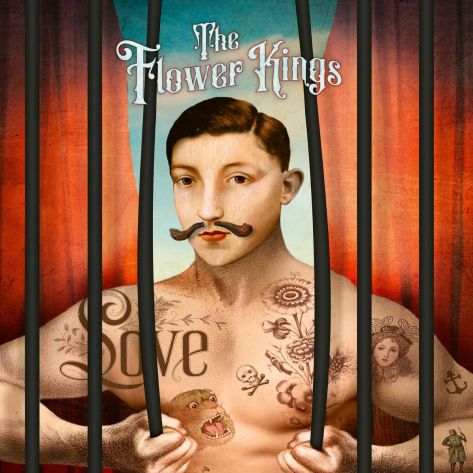
The Flower Kings’ Latest: A Hymn to Love

Hello Spirit of Cecilia Readers, it’s with great pleasure that Tad and Brad review the latest release from their beloved Flower Kings, Love (Insideout Music).  Here are their thoughts.

Brad: As always, a great pleasure to do this with you, my friend.  As you and I have talked before, I’ve been a Flower Kings fanatic (and yes, I mean a fanatic, a hyper fan!) for twenty-five years now.  A wonderful student–now one of my colleagues in the philosophy department at Hillsdale–let me borrow his copy of the band’s 1999 Flower Power.  I immediately fell in love with it, bought it, and bought my favorite album by the band, Space Revolver, to me one of the absolutely quintessential prog albums of all time.  Once I had Flower Power and Space Revolver, I bought everything before that: Stolt’s The Flower King, Back In the World of Adventures, Retropolis, Stardust We Are.  From Space Revolver to the present, I’ve bought every studio album, every DVD, every live album, every compilation, and both box sets on the day each has been released. I have two of their fan release albums, too, and two of their official bootlegs, but they’re really hard to come by.  Every once in a while they pop up on Ebay, andI pounce on them.  My point being, though, I’m a definite completist when it comes to Roine Stolt, just like I am with Steven Wilson.  Proudly so.  Both, absolutely amazing talents.

Through Facebook, I’ve had a few moments of correspondence with Stolt, and he’s a total gentleman.  Frankly, he’d be a blast over a beer.

But, Tad, let’s start with you.  You’re relatively new to the Flower Kings.  What made you change your mind about them, or what made you finally embrace them?

Tad: Brad, it is great to discuss this group’s music with you, and I have you to thank for introducing me to them. I knew about them for years, but I really didn’t get into their work until I picked up Space Revolver in a used record store. All of a sudden, things clicked, and I was able to appreciate what Stolt and his fellow Flower Kings were doing. I have since acquired all of their albums (but not the bootlegs and limited editions you have).

I have to say, they are some of the most prolific artists working today. They release an album practically every year, which are often two-disc sets. Even their single-disc albums are filled to the brim, including their latest, Love, which contains 71 minutes of music. What are your initial impressions of this one?

Brad: Tad, so glad you found and fell in love with Space Revolver.  Definitely a top-20 all time album for me, maybe even a top 15.  I certainly think it’s a classic of third-wave prog.  Everything just works on that album–the music, the shifts, the tone, the lyrics, the playfulness.  Yeah, I just love that album no matter how many times I’ve listened to it.

And, yes, I’m really happy with the new album.  It’s mellower, overall, than most previous Flower King’s releases, and it’s relatively tame, again compared to the band’s previous releases.

I had received the promo copy of the album from Inside Out, and I pretty much fell in love on the first listen, but, then, to make it even greater, my physical copy arrived.  I was so surprised to open up the CD and have the beautiful portrait of Mary and the Child staring up at me!  I’ve thoroughly enjoyed Stolt’s lyrics going all the way back to The Flower King (1994), and he’s always been respectful of Christianity.  His Christianity–at least as it comes across in his lyrics–is more mythic and symbolic than tangible and concrete.  Stolt especially loves making references to the “Holy Mother.”  I assume that’s Mary, but I’m not sure, of course.  Being Swedish, Stolt almost certainly comes for a Lutheran background.  As much as Luther loved Mary (he did, adamantly), Lutherans generally don’t put much emphasis on her.  So, one of the mysteries of Stolt and the Flower Kings.  

Here are two examples of Stolt’s rather hippyish and cosmic take on Christianity.  First, in his thank yous on Love, he writes “Remember: War is just fear and failure, FEAR manifested in small people with shady political or religious agendas–LOVE is always the winner.”

And, again, take the lyrics for track two of the album, “The Elder”:

You found your way – So come what may

You found your way – So come what may

So I have made it here

A distant light getting near

if you just knew where to begin

This holy mess you’re in – Waiting on a dream

I’ve made my peace with those who’d done me wrong

Those broken dreams that followed me along

So no more worries – If we could bury hate –

There’s nothing greater than the love we save

Betting on the love you save

Betting on the love you crave

So open up those doors – letting out the waters

And now you’re waiting on a tide

I once had a vision – behold them lights

The lights of salvation

So you look in his eyes – resurrection –

He’s risen – Came down upon me –

is it real what I’m feelin’

We can get much higher – We can start a fire

Turn away from lies – Looking eye to eye

We can catch a light – Brighten up this night

We will never die – We will never die

What you get is what you are

So give away a shiny star

Keep it closer to your heart

Do never sway – Don’t break no parts

What you give is what you are!

What was given – looking closer – Taint your soul

It’s unforgiven – cause the world has plans for you

Is it real – is it fiction? – Crucifixion

The world may soon just set you free

Here we are in silent trenches

Come this far – lived life let reckless

Waiting for the lights to change

I’m waiting for the outbound train

You found your way – So come what may

You’ve found your way

Notice, of course, the use of salvation, risen, resurrection, Crucifixion.  None of it is blatant theologically, but it is blatantly symbolically and mythically.

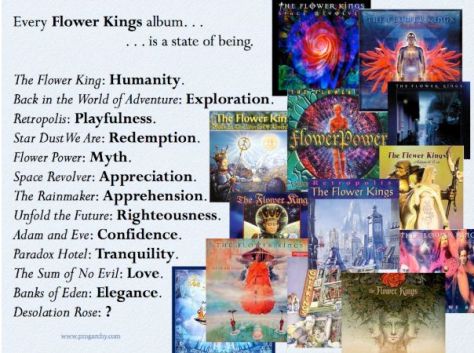
I once tried to outline all of the albums up through 2013.  It would be nice to update this, as the Flower Kings have released a lot since 2013.  But, here, at least is what I thought up to that point:

And, I have to note as well, Tad, that I once had huge aspirations of writing a book about the Flower Kings, using each album as a chapter and inspiration, a theme pregnant with whole worlds.

Tad: Brad, I love your Aristotelian classification of their discography! You have some updating to do, though, don’t you? I hope you follow through on that book – I think prog fans would love it.

I also noticed and appreciated those lyrics in “The Elder” the first time I heard that track. It is one of my favorites on the album. My overall impression of Love is one of all-encompassing joy and optimism – which is not surprising, given the album’s title! The first song, “We Claim The Moon”, bursts out with a happy sound of guitars and keyboards that conjures up classic Traffic. The line, “I’ll never get over the way you brought down the moon” brings to mind Jimmy Stewart and Donna Reed in It’s a Wonderful Life

I agree with you that this album is mellower, but, paradoxically, I think there is a lot of energy in the performances. The vocals on Love strike me as some of their best ever, with Hans Froberg and Roine Stolt trading leads and harmonizing beautifully, especially in “The Phoenix”. I love the way that track starts out acoustically with a celtic feel, and then features an outstanding guitar solo from Roine. 

Another highlight is the final song, “Considerations”, which is written by Michael Stolt and Jannica Lund. It is a truly majestic track that I admire more and more as I listen to it. The “Shine on, shine on love” section is one of my favorite musical moments.

I also appreciate the way the Kings have created a unified whole from these twelve tracks. Musical motifs reappear throughout the album, as well as lyrical themes – did you notice that “Love Is” (track 10) has the line, “How can you leave us now?”, which is the title of the album’s third track! It’s little details like that that tell me Love is meant to be listened to in its entirety to fully appreciate its message. And what a message – despite all the negative forces in our world, love can conquer all. I really appreciate how bravely Flower Kings go against the cultural grain of our time: instead of complaining about hatred and division, they choose to celebrate the power of human (and spiritual) love.

Brad: You put that all so beautifully, Tad.  I really like the idea that the album is really love calling on love, inspiring  us to be our best.  Frankly, I think that’s a perfect summation of Roine Stolt’s artistry and what he’s accomplished over the past 31 years.  All rather stunning and motivating.  And, so once again, I’m brought back to the beginning–I’m extremely proud to be a fanatic when it comes to the Flower Kings.

As always, we encourage you to buy your Flower Kings merchandise from the best online retailer, Burning Shed.

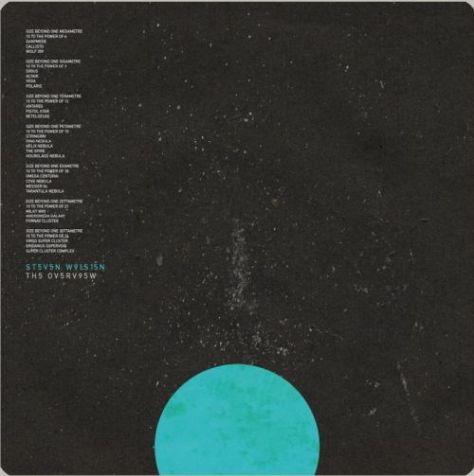
A Review of The Overview of Steven Wilson

Steven Wilson has released a new album, The Overview. Always surprising, rarely disappointing, Wilson is one of our favorite artists. Producer, songwriter, guitarist, singer, and remixer of countless classic albums, he truly is a man who can do it all. Brad Birzer and Tad Wert share thoughts on his latest opus.

Tad: Brad, you and I both have had a love/hate relationship with Steven Wilson. His almost obsessive focus on dark themes bothered me years back, but I couldn’t help but be seduced by his songwriting. The man writes and performs some of the most beautiful melodies ever recorded. His past few albums have been very good, in my opinion, albeit each very different. I’m interested in your thoughts on his latest, The Overview.

Brad: Thanks so much, Tad.  Glad to be reviewing with you!

I know I’ve had the chance to tell this story before, but I first encountered Steven Wilson through Porcupine Tree.  My wife and (then) two kids were shopping in Fort Wayne, Indiana, and a local alternative station was playing “Trains” from In Absentia.  This would’ve been the fall of 2002.  I immediately went to a local CD store and bought not only In Absentia but also Up the Down Stair.  One of my excellent students, Chase, found out about my new-found Porcupine Tree obsession and gifted me with the PT compilation boxset, Stars Die: The Delirium Years.  It was one of the coolest gifts I’ve ever received, and I was smitten.

From there, I dove into everything I could find related to Wilson and Porcupine Tree.  So, I’ve been a fan for twenty–three years now, and I’m amazed how much of my CD collection revolves around Wilson.  Whether it’s Porcupine Tree, No-Man, Blackfield, Storm Corrosion, Bass Communion, IEM, solo material, or one of the billion albums Wilson has remastered, my home is a repository and archive!  I also have several books on Porcupine Tree, Wilson’s deluxe autobiography, and a huge number of deluxe editions of the album releases.

You’re right, though, I do have a love/hate relationship with Wilson.  Let me note: I admire the man deeply.  But, a few things he’s said and done drive me a bit crazy.  It’s really hard to be his fan as he constantly wants to distance himself from us.  Even when we follow him album to album, genre to genre, he has to make skeptical comments about us, implying that we demand too much of him and hold him back musically.  And, from any objective standard–whether it’s Grace for Drowning or The Future Bites–the man just exudes progressive rock.  He’s always exploring, always changing, but he has tried to distance himself from the label.  I don’t get it, and I find his attitude incredibly frustrating.  Maybe he simply has a really restrictive view of progressive rock.  To me, progressive means exploration.

I also thought that as much as I loved The Raven Who Refused to Sing, the album seemed very much a remake of a Tangent album without acknowledging or giving Andy Tillison all due credit.

As far as I know, Tad, these are my only complaints.  And, given how much joy Wilson’s music has brought to me, they’re incredibly minor complaints.  Of all my loves re: the present scene of music, Steven Wilson is certainly at the top–along with Big Big Train, IZZ, The Tangent, Glass Hammer, and a few others.  I would especially rank Hand.Cannot.Erase as an all-time top five album for me.


And, I’ve not even gotten to The Overview yet. . .  Tad, what are your thoughts on what you like and dislike about Wilson?

Tad: Well, Brad, my experience was much the same as yours. I saw that Alex LIfeson played on Fear of a Blank Planet, so I got it cheap from BMG Music Club (remember those?), and I was hooked. I grabbed everything I could find that Wilson was involved with. I loved Porcupine Tree and Blackfield; NoMan not so much (at least until they put out Schoolyard Ghosts).

As I said earlier, I wish he would lighten up a little in the lyrics department. Life isn’t all bad! I guess that he finds depressing subjects more inspiring. On the plus side, I think he is an excellent guitarist and singer. His production work is unparalleled; I don’t think anything he’s produced will ever sound dated – it’s all timeless and of incredibly high quality.

Okay, let’s talk about the subject at hand: his new album, The Overview. It’s two long tracks, one more than 23 minutes long and one more than 18 minutes. You can’t get more proggy than that, can you? I think he wants the listener to hear this as an album, and not a playlist of tracks. Given this is the age of Spotify, that is pretty countercultural! 

On first impression, I think the section entitled “Objects: Meanwhile” is one favorite. It has a nice piano motif that builds throughout. The lyrics, well, they’re pretty depressing:

The tiniest lives fill their hives up with worry
To make it to church, well, she needs to hurry
When late she will bow down contrite
While a meteor trunks out the light

And there in an ordinary street
A car isn’t where it would normally be
The driver in tears, ‘bout his payment in arrears
Stll, nobody hears when a sun disappears
In a galaxy afar

That seems to be the overarching theme of this album – how insignificant humans and their concerns are, compared to the vastness of the universe. Wilson makes this explicit in the section “Perspective”, where a woman narrates ever-increasing numbers on a literal astronomical scale.

“A Beautiful Infinity/Borrowed Atoms/A Beautiful Infinity II” is the best section of the album, with its Floydian slide guitar and seductive melody. I love it. However, “A Beautiful Infinity II” continues the general theme of nihilism and hopelessness:

There’s no reason for any of thi
Just a beautiful infinity
No design and no one at the wheel
Just an existential mystery

I swear, if I ever got the chance to meet Mr. Wilson, I think I would share with him Psalm 19, which begins, 

The heavens declare the glory of God; the skies proclaim the work of his hands.
Day after day they pour forth speech; night after night they reveal knowledge.

That said, this section is some of my favorite Steven Wilson music ever. I have listened to this album from start to finish many times now, and this is the part I enjoy the most.

I suppose Wilson is saying that in an honest overview of the cosmos, humanity isn’t really worth much. In that regard, he echoes the psalmist who asks, “What is man, that thou art mindful of him?” Brad, I promise I didn’t begin this review planning to quote psalms, but they seem kind of appropriate, given the majesty of this album’s music!

Brad: Tad!  I love it.  The Psalms, BMG Music Club, nihilism.  Yes, I don’t disagree as I think the lyrics are depressing as well.  That’s par for the course with Wilson, though.  From what I can tell–in interviews and through his autobiography–he’s actually a really kind, upbeat person, but his art is always dark.  It’s dark, often, in terms of chord structures, and it’s dark in terms of his lyrics, and it’s generally dark in terms of the art that accompanies his album releases.

I suppose it’s one reason I love HAND.CANNOT.ERASE so much.  It’s dark, but it’s also deeply redemptive.  There’s a very healthy humanism at the heart of that story.

Despite the darkness of the lyrics on The Overview, I am pretty taken with them.  As probably you and most readers know, Andy Partridge of XTC wrote a chunk of the lyrics on the first track.  As such, they’re clever as all get out, while also being cynical.  Frankly, though, I like the perspective Partridge and Wilson offer–that as we go about our lives, making minute decision after minute decision, the universe in its incomprehensible majesty goes about its business as well.

I especially like these lyrics on the second track:

Snow is falling but it can’t be seen from here

And back on Earth, my loving wife’s been dead for years

I see myself in relation to it all

What seemed important now like dust inside the squall

Each moment for me is a lifetime for you

For whatever reason, they resonate with me.  It’s not that his wife’s death is any less tragic, it’s just that it’s placed against the backdrop of what seems infinite.  If anything, I actually found this a hopeful lyric.  After all, the man’s love for his wife continues, despite her absence.

I also really like Wilson’s musical approach to the whole album.  The way that he places various parts of the song together reminds me very much of Paul McCartney’s side two of Abbey Road.  Wilson, interestingly enough, has stated that while he admires the Beatles for what they accomplished, they were never an influence on him.  Still, it seems that in the construction of The Overview, they were, at least to a certain extent, an inspiration.

I did think that Rotem’s spoken word parts on the second track would wear on me, but, even after innumerable listens, I’m fine with it.

So, being a true Wilsonite, I bought the deluxe edition of The Overview.  It comes with a booklet as well as a blu-ray.  As I listen to the album, I generally listen to the blu-ray–which seems to bring the best out of the two tracks.  I hear things with the blu-ray that I don’t with just the CD release.

So, Tad, I’m loving the album.  It came out. . . what. . . six weeks ago?  And, I’m now on six weeks of immersing myself in it.  I find each listen a joy, and I keep discovering new things in it.  It’s a treasure.  Again, I would still rank Wilson’s Hand.Cannot.Erase as his best album and I would rank The Future Bites as my least favorite of his albums.  In the big scheme of things (ha–see what I did there!), The Overview sits comfortably close to Hand.Cannot.Erase.

Tad: Ah, Brad, this is why I enjoy these joint reviews with you – you provide proper perspective and rein in my first-take reactions to lyrics! I love your willingness to find hope in Wilson’s words, and now that you’ve pointed it out I can see it as well. I’d rather someone be hopeful than despairing, so I feel better about his emotional health. 

If I had to rank Wilson’s albums, I think I would put his first, Insurgentes at the top, but it depends on the mood I’m in. The Raven That Refused to Sing is awfully good, and To The Bone is a wonderful take on 80s pop/rock. I do agree that The Overview  is one of his best, and I have really enjoyed listening to it the past few weeks.

So, readers, it looks like The Overview gets two solid thumbs up from Spirit of Cecilia! Check it out on your favorite music streaming service, or better yet, buy a physical copy and keep Mr. Wilson in business. Thanks for stopping by!

Airbag’s The Century of the Self: Literate Rock for Freedom Lovers

Greetings, Spirit of Cecilia readers! Brad Birzer and Tad Wert have been impressed with the music of Norway’s Airbag. They combine excellent, Pink Floyd-adjacent melodies with thought-provoking lyrics. In the summer of 2024, they released their sixth studio album, The Century of the Self, which was one of the best albums of that year. Brad and Tad finally get around to discussing its merits – better late than never!

Tad: Brad, I absolutely adored Airbag’s previous album,  A Day at the Beach, and the lead-off track, Machines and Men, is one of the best songs they’ve ever done. Now that they’ve followed up that triumph with The Century of the Self, what strikes you right off the bat with that album?

Brad: Thanks so much, Tad.  It’s great–as always–to be reviewing with you.  Yes, I very much love and admire Airbag, and I have from their beginning, whether on Kscope (briefly) or Karisma.  They confirm what I’ve thought for ages, that is, a prog band is only as good as its bassist.  Great guitarist, too.  Great drummer as well.  Love the keyboards, too.  So, win-win-win-win.  What a great band.  An amazing band.  I had to throw “amazing” into the mix, as I’ve typed “great” one too many times!

Granted, they wear their Pink Floyd love on their sleeves, but, frankly, I think that makes them even better.  Very glad to have some Floydian music still being produced.  And, yet, whatever the Floyd influence, it serves as an inspiration for the band.  They’re not enslaved to it, but inspired by it.  Strangely and perhaps paradoxically, the Floydian influence makes Airbag even more unique.

I didn’t realize they were already on their sixth album.  Given their sheer output, as well as the solo output of Bjorn Riis, I find the music even more astounding.

So, what strikes me right off the bat?  An excellent question, Tad.  After having listened to the album a half a dozen times, I’m struck by two things.  The bass and the lyrics.  Both, extremely courageous.  How about you?

Tad: Brad, you and I agree that a good bassist is essential to a prog band. I think of what Yes might be without Chris Squire, and it would never have been as groundbreaking and influential as it ended up. Or how about Steve Babb’s work with Glass Hammer? He is the key to that group’s greatness.

Along the same lines, Anders Hovdan does a terrific job anchoring Airbag’s music. A lot of their songs take time to fully develop, and Hovdan’s insistent bass lines provide interest for the listener. I love the way the entire group take their time building up a song. They often start out quietly, and they inexorably build in energy and sound until there is a most satisfying release. Their melodies are not overly complex or complicated, but I would certainly classify them as “progressive rock.

That said, I think Bjorn Riis (guitars and vocals) seems to be the main driver of Airbag. His songs always intrigue me. I’ve told you before that I have to like a song’s melody before I worry about the lyrics, but when I first heard the opening track on The Century of Self, I was immediately struck by the lyrics. They’re brief enough to share in their entirety:

Did you come here to find some peace and hide?
Too much confusion in your head at times
Don’t want to bend, conform, you’ll never obey
Don’t want no part of this conspiracy

I see these people keeping their heads down
Denying everything they used to be
Don’t try to touch, don’t ever get too close
They’ll make you suffer and they’ll make you bleed

Who do you feel you are today?
Who will you crucify and slay?
It’s driving me insane

Did you believe they’d ever let you go?
There is no escape, there is no turning back
You’re canceled now, they’ll cancel everything
They’ll make us suffer and they’ll make us bleed

Who do you feel you are today?
Who will you crucify and slay?
It’s driving me insane

source: https://www.lyricsondemand.com/airbag/dysphoria

Brad, it seems to me this is a protest against the illiberalism of contemporary “cancel culture”, and that is a brave stand to take these days! So, I went back and looked through some of their previous songs, and there is definitely a consistent streak of individualism and a plea for personal freedom running through them. I think they are today’s version of a countercultural music group, and I admire them for that. I am really interested in your thoughts on their lyrics, since you are able to uncover deeper meaning from them than I usually do!

Brad: Yes, I totally agree, Tad.  There’s something quite special in Airbag’s lyrics that call out for us to be more individual than we’re comfortably being in the current morass of society.  I think Airbag is definitely protesting against the loss of free speech and free ideas that seems to have spread throughout Europe and the western world (America is not excluded).  I suppose part of this is my age, but it’s hard not to look back at the 1980s and especially 1989 as a golden era in western civilization.  Not only were we growing economically, but free societies were trouncing unfree societies.  Despotisms and authoritarianism and totalitarianism were on the run.  A pope and a president were beating the life out of them.  Now, we sit in silence as our “betters” tell us what to do and what not to do.  I wouldn’t have necessarily have expected protest to arise from Norway, but amen.  

Those lyrics are worth repeating, Tad:

Did you believe they’d ever let you go?
There is no escape, there is no turning back
You’re canceled now, they’ll cancel everything
They’ll make us suffer and they’ll make us bleed

And, then, of course, we’re not guiltless:  

Who do you feel you are today?
Who will you crucify and slay?
It’s driving me insane.

Track two, “Tyrants and Kings” continues the libertarian themes:

Join the cause
Say no to everything we fear
Get used to lying
You’re a prisoner now
Take no stand
There are no sides there’s only ours
You shoot to kill
You’re a soldier now

The “get used to lying” line brings to mind Solzhenitsyn’s note that all totalitarianism is built on lies.  The huge lie of the society and all the little lies that one must employ to survive.

Looking through the lyrics of the remaining three songs, they too speak to the loss of individual dignity.

So, bravo, Airbag!  Keep fighting the good fight.  And, thanks, too, for the killer bass lines.

Tad: Brad, thank you for highlighting the lyrics to “Tyrants and Kings”! Yes, Airbag is a band that appeals to me both in musical terms and lyrical ones. That is quite rare these days. And, like you, I’m impressed these Norwegians are reminding the rest of us what is truly important. 

So, gentle reader, if you are interested in excellent progressive rock with a Floydian flavor, and highly literate lyrics, do yourself a favor and check out Airbag’s latest album, The Century of the Self. You won’t be disappointed!

In Concert: A Great Orchestra, A Hot Conductor, A Thrilling Night

The Chicago Symphony Orchestra, Friday, May 2, 2025.

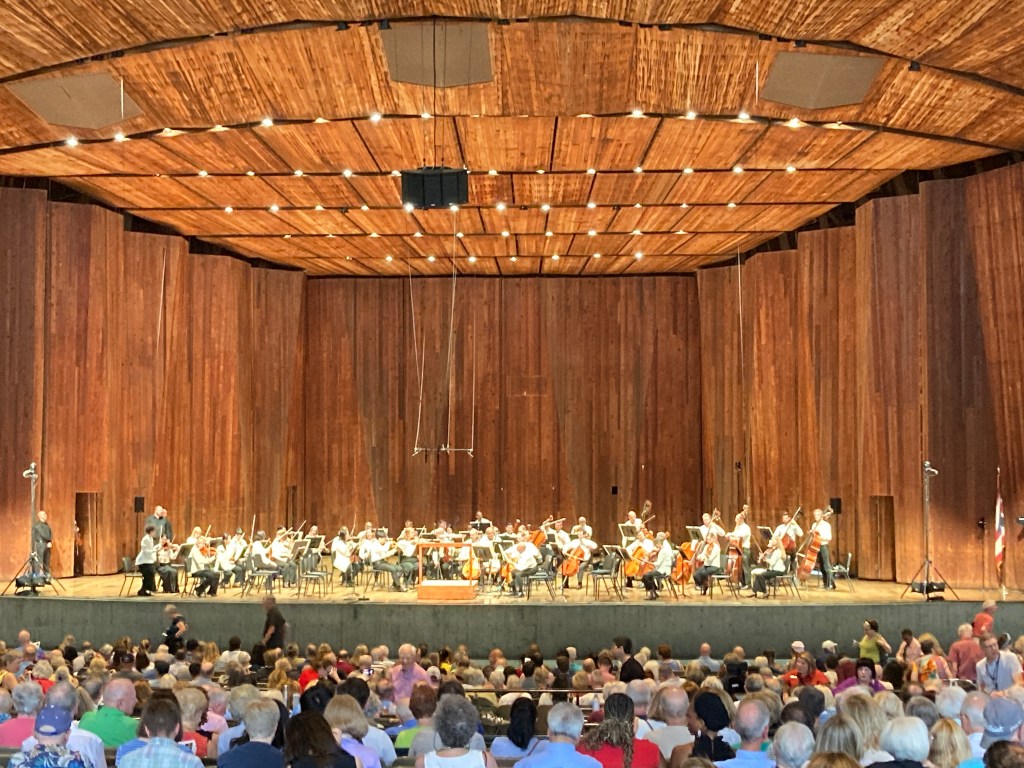
It had been more than 15 years since I had heard the Chicago Symphony Orchestra live – and nearly 25 since I had heard them on their home ground, Orchestra Hall in Symphony Center. So last year, when the CSO announced that young conducting phenomenon Klaus Mäkelä (referenced in my highlights of 2024 post) had accepted the post of Music Director Designate, I decided that a renewed acquaintance with one of the USA’s top orchestras was long overdue.

Orchestra Hall, dating all the way back to 1904, is a unique venue in and of itself: its wide but thin stage and steeply raked balconies make for a intimate (if not always comfortable) concert experience. Renovations in the 1990s added gallery seats above and behind the stage, as well as a suspended shell to soften and deepen a challenging acoustic. So it wasn’t hard to imagine the musicians feeling like they were in a fishbowl as they clambered atop multilevel risers in front of a full house.

But beyond the typical pre-concert buzz, there was a question in the air. By and large, Mäkelä has made his reputation in post-Romantic and 20th-century music — well-regarded recordings of Sibelius and Stravinsky, Chicago guest shots focused on big pieces by Shostakovich and Mahler. Would his take on the core classical repertoire — works the CSO has performed since its start in the 1890s, conducted by everyone from founding conductor Theodore Thomas to previous Music Director Riccardo Muti — measure up?

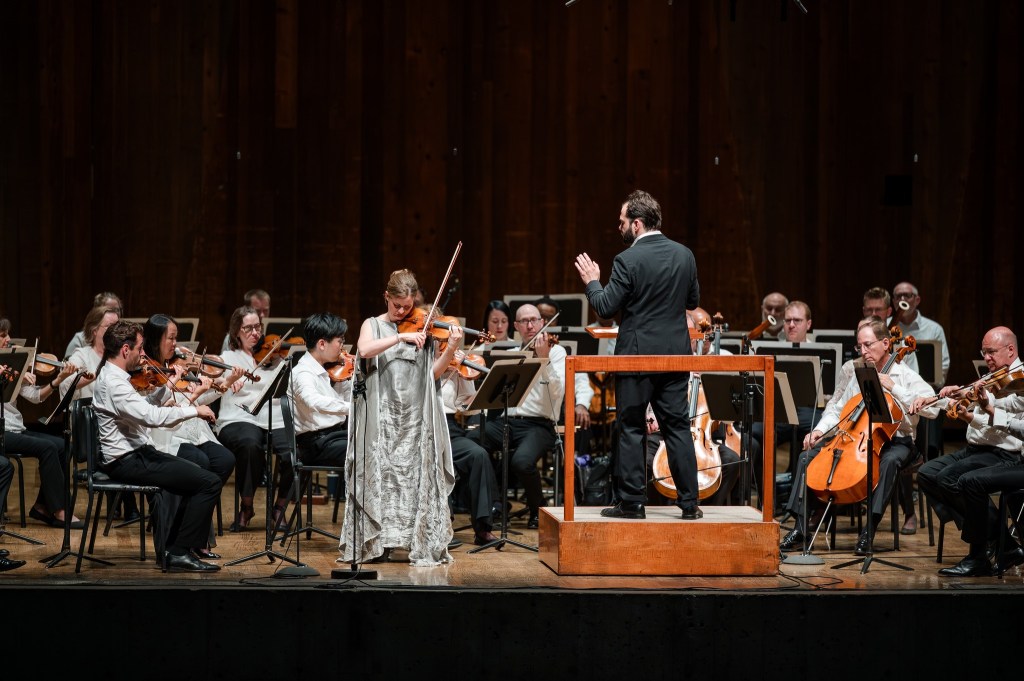
That question was answered in a flash, as Mäkelä and CSO Artist in Residence Daniil Trifonov whipped up a fresh, appealing reading of Johannes Brahms’ Piano Concerto No. 2. None of the overbearing, ponderous sludge that unimaginative historians accuse Brahms of here! Trifonov’s playing was always flowing, supple and strong, with no hints of pounding or cloudy tone; CSO principals Mark Almond (horn) and John Sharp (cello) made the most of their lyrical solo moments with warm tone and deep expressiveness; and the orchestra sounded lithe and limber in the extended opening, energetically playful in Brahms’ scherzo, chastely gorgeous in a delectable Andante, and delightfully bouncy in the closing Allegretto. All the while, Mäkelä was sculpting the overall sound, focusing balances, dynamics and timing for maximum emotional impact. The scattered spontaneous applause after every movement (the grinning conductor and pianist had to restrain themselves before pouncing on the finale) was proof that the music hit home, even before the final ovation and the outsized reaction to Trifonov’s encore (a Chopin prelude lasting less than a minute).

After intermission came a centennial tribute to the CSO’s late Principal Guest Conductor Pierre Boulez (who conducted the orchestra the last time I’d heard them — a dark, lush program of Ravel and Bartok in Ann Arbor, back in 2010). Well executed by brass septet and precisely conducted by Mäkelä, Boulez’s Initiale lived up to its billing — a tart, postmodern appetizer announcing itself pointedly, quickly tying itself into contrapuntal knots, then breaking loose for a final flourish. Complete with a tuba mute (which always makes me smile)!

But it was the last work on the program, Antonin Dvořák’s Symphony No. 7, that really showed what Mäkelä and the CSO can accomplish together. The orchestra’s tone was at its richest, its dynamic range wider and its rhythmic flow freer than in the Brahms. Mäkelä threw himself into the piece with greater animation and more sweeping body language — but also with a greater willingness to let the players take the reins, dropping his beat to focus on accents and phrasing for surprisingly long stretches. The powerful resonance of Dvořák’s opening themes and their punchy development, the breadth of feeling in his Andante, the infectious swing of the Scherzo’s cross-rhythms, and the hard-won, dramatic climax — they were all there in vibrant technicolor, fully formed, overflowing with life and vigor. You could tell that Mäkelä dug leading the CSO, and they obviously dug playing with him. And the audience absolutely loved it, leaping to its feet as Makela acknowledged the symphony’s featured musicians, brought the orchestra up for their bow — and modestly pointed to Dvořák’s score as the applause continued.

When he becomes the CSO’s Music Director in the fall of 2027 (while at the same time taking over Amsterdam’s Concertgebouw Orchestra), Klaus Mäkelä will be 31. Based on last Friday night’s concert, he’s got an amazing head start — both on a lifetime of personal musical growth, and building a potentially astounding rapport with one of the top orchestras in the world. Believe me, I’ll be back to Chicago much sooner next time!

— Rick Krueger

Glass Hammer’s Rogue: Joy in the Midst of Regret

Glass Hammer has returned with a new album, Rogue – due out April 11, 2025. Not surprisingly, given the history of this group, it is a stark departure from their previous several albums. Where the Skallagrim Trilogy rocked very hard, and their most recent work, Arise, was an exercise in space rock jamming, Rogue is jumps out of the gate with a burst of pure melodic bliss.

After listening to Rogue nonstop for four days, I am put in mind of some of Glass Hammer’s most enjoyable musical moments, such as Life By Light (Culture of Ascent), Having Caught a Glimpse (The Inconsolable Secret), and The Curse We Weave (Three Cheers for the Broken Hearted), among many, many others. I am tempted to say Rogue represents a return to form, except Glass Hammer has never fallen out of form – each release of theirs is a self-contained gem of excellence. Instead, let’s just say Rogue is a joyful celebration of beautiful melody.

What If, the first track, sets the stage as the protagonist decides to leave his cold and gray home in the north and head south to find a long-lost love – he is hoping to reignite an old romance that he ended years ago. It is a bouncy song that conveys the hopefulness of our hero as he sets out.

Summer! He’s weary of sleet and snow
Summer! Come now and do not go
He’s heading south to the land of his dreams

The Road South is where reality begins to set in. Has he made a mistake leaving his home? Is that a storm ahead? Musically, this song is reminiscent of classic Alan Parsons Project to me. Oliver Day’s lap steel guitar is outstanding – graceful and fluid without sounding shrill.

Tomorrow  is one of the most beautiful songs on the album. As our hero wrestles with the memories of all the wrongs he has committed in the past, a voice reassures him,

All will be fine
God is watching over all you do
His eye is on the sparrow and on you

The accompanying melody is appropriately soothing and calming.

Pretty Ghost and Sunshine feature the gorgeous vocals of Olivia Tharpe,  along with another pair of winning melodies. On Sunshine, Fred Schendel gives an outstanding performance on lap steel guitar.

Next up is my favorite track on the album, I Will Follow. This is a driving, upbeat, infectious song with an unshakeable earworm for a melody. It’s one of the best songs in the entire Glass Hammer catalog, featuring layered harmonies that should be listened to on headphones to be fully appreciated.

The Wonder Of It All has a synth-driven opening that I find very appealing. One thing I’ve enjoyed over the past few albums has been Glass Hammer’s incorporation of Tangerine Dream-like interludes that feature very cool rhythmic elements. Lyrically, this song seems to be a turning point for our hero:

Oh, I’m weary, yet I’m blessed
For all you’ve given me
The wonder of it all, I’d have to say
That I was here at all
I’ve done so little to deserve
This life you gave me

One Last Sunrise is a terrific instrumental, and Babb really shines on bass and Taurus pedals. I’ve said it before, and I’ll say it again: Steve Babb is one of the most inventive bassists working in music today.

Terminal Lucidity, at 10:19, is the longest track, and it is primarily instrumental. Synths, electric piano, and electric guitar weave a seductive web of melody that draw the listener in before an energetic jam gets going. Eventually, it becomes clear that our hero is on his deathbed: “Ashes to ashes, dust to dust/I can hear them calling me”. It was a stark and chilling moment when I first realized the true journey being taken!

Rogue closes with the triumphant and joyful All Good Things. Another uplifting melody (underpinned by Babb’s terrific bass work) brings the story to an emotionally satisfying ending:

This life you gave me
I’ll bring it home, you know
Sunshine in the morning sky
Descending from on high

It seems that, for all intents and purposes, Glass Hammer is now primarily a Steve Babb project. He handles some lead and backing vocals, bass, keyboards, Taurus pedals, guitars, and percussion. Longtime musical partner Fred Schendel plays guitar on Tomorrow and lap steel guitar on Sunshine. Babb has collected a stellar cast of supporting musicians: Thomas Jakob and Olivia Tharpe on vocals, Reese Boyd, David Walliman, and Atillio Calabrese all take a turn on lead guitar, and Oliver Day does a phenomenal job on guitar and lap steel throughout. Ariel Perchuk contributes some excellent synth solos, while Randall Williams and Evgeni Obruchkov provide drum work.

Rogue is one of the most ambitious albums Glass Hammer has attempted, and they pull it off with ease – it is an unalloyed triumph in all respects: conceptually, lyrically, and musically. Taken as a whole, this set of songs is the most satisfying Glass Hammer has provided in many years. I can’t stop listening to it! Meanwhile, the concept of a man wrestling with the demons of his past as he faces death would be daunting for anyone to tackle, but Glass Hammer does it with grace and hope. I can’t recommend Rogue enough to listeners who appreciate and are looking for melodic rock that has depth. It’s my favorite album of 2025, and I don’t see that changing any time soon.

The Fantastical Prog of Terra Incognita (Uncharted Shores)

Hello, Spirit of Cecilia readers! Kevin J. Anderson has a Kickstarter campaign up and running for a gorgeous reissue of his Terra Incognita trilogy of fantasy novels and accompanying music that includes a new album from Roswell Six – Terra Incognita: Uncharted Shores.  Brad Birzer, Rick Krueger, and Tad Wert share their thoughts on it.

Tad: Brad and Rick, I understand this is the third Terra Incognita album, but they haven’t been on my radar. What’s the story behind this group, and how are they connected to author Kevin Anderson?

Rick: Tad and Brad, it’s great to join you two for a roundtable at long last!  I’m sure Brad knows a lot more about this project than I do.  But I first came across Kevin Anderson when he and Neil Peart wrote a novel based on the Rush album Clockwork Angels.  That one led to two more novels in the CA universe over the years, Clockwork Lives and Clockwork Destiny; all three of them were delightfully true to Peart’s concepts, with lots of clever Easter eggs from the Rush canon and enjoyable plot twists.  The only other novel of Anderson’s I previously read is The Dark Between the Stars, the first part of a science fiction trilogy that was nominated for a Hugo award back in 2015 – solid, sprawling space opera fun.   I’ve just downloaded his latest, Nether Station and am racing through it; he’s got that ever so slightly pulpy, lickety-split writing style down.  it’s about a deep space expedition that, little by little, gets kinda eldritch . . .

But that really just scratches the surface of what Anderson has done.  He’s most famous for continuing Frank Herbert’s Dune saga with Herbert’s son Brian; he’s also produced tie-in novels in the Star Wars, X-Files and DC universes; he’s an extremely prolific writer overall, whether it’s sci-fi, fantasy, horror or any combination of those genres – by his count, about 180 novels to date.  On top of all that, he and his wife Rebecca Moeste run their own publishing company, WordFire Press.

Through Brad’s connections with Anderson, I’m on WordFire’s mailing list, so I’ve noticed that he’s run a few Kickstarter campaigns over the years.  His latest campaign is a reissue of Terra Incognita, a fantasy trilogy originally published in 2009-2011. The thing that’s different about these books, though, is that the first two had soundtracks; apparently, Anderson has had a lot of contact with the music world over the years.  And maybe that’s where I should let Brad take over.

Brad: My dear friends, Tad and Rick, so great to do this with you guys!  And, to talk about one of my all-time favorite human beings, Kevin J. Anderson.  I’ve been reading Kevin’s works for years, but I only got to know him for the first time about 11 years ago.  I had a one-year position at the University of Colorado-Boulder (2014-2015 academic year), and that position came with some funding to bring speakers in.  As soon as I arrived in Longmont (where we lived for the year), I contacted Kevin (whom I had never met) and Dan Simmons.  I never heard back from Simmons, but Kevin immediately agreed to come speak for me.  He and his lovely (and equally talented) wife, Rebecca, came to Boulder, and Kevin gave an excellent speech on the art of writing fiction.  He called it his “pop-corn theory,” explaining that ideas happen all over the place.  I loved the speech.

And, I also loved Kevin and Rebecca.  We hit it off at dinner at an Indian restaurant right before Kevin’s talk.  He then invited us to his famous New Year’s Eve party for 2015.  Dedra and I happily drove to Monument to see Kevin’s impressive and rather Arthurian house!  Crazily enough, my car slid down his steep driveway and almost crushed the natural gas vein!  Thank the good Lord that disaster was averted and New Year’s Eve was a different kind of blast.  One of the great things about Kevin is he knows how to form communities.  He’s a natural leader.

We also really bonded over his friendship with Neil Peart.  In fact, it was Kevin who suggested I write the book about Peart’s lyrics, Cultural Repercussions, for his WordFire Press.  I was deeply honored to do so not just because of my love of Rush, but also because of my respect for Kevin.

And, Kevin has deep roots in the prog rock community.  Indeed, I can’t imagine a current writer who has greater or more legitimate ties to prog than does Kevin.  Rush’s Grace Under Pressure inspired Kevin’s first novel, Resurrection, Inc., and Kevin’s never been shy about his inspirations: Rush, Kansas, Styx . . . .

Rick, you brought up Clockwork Angels and its surrounding universe.  Admittedly, I love the Clockwork trilogy–the novels, the audiobooks, the graphic novels–and I think that Kevin really offered new insights into Rush and, frankly, into music.  To me, Clockwork Angels is Chestertonian, and I don’t understand why it’s not been made a Netflix series!

When I first encountered Kevin’s music project, Roswell Six, I was understandably impressed by the scope as well as the execution of the vast project.  Kevin has a great entrepreneurial spirit, but always with the artistic soul.  Roswell Six perfectly blends Kevin’s many loves and expertises.  I’ve been proudly listening to the first two CDs since they were first released, and I happily include them among my all-time favorite albums.  I’m especially taken with the first CD, 2009’s Beyond the Horizon.

When Kevin first announced this Kickstarter project–hardback editions of Terra Incognita as well as a re-release of the first two Roswell Six CDs, AND a brand-new third CD, I was absolutely thrilled.  I pledged during the second hour of the campaign.  And, that campaign has done exceedingly well.  Initially hoping to hit the $10,000 mark, the Kickstarter project, as of this writing, is at the $51,000 mark with 399 backers!  Incredible.  And, so well deserved.

So, what do you guys think of the music?

Tad: Okay, both of you have much more experience with Anderson’s work than I. When I saw that there was a companion novel to Rush’s Clockwork Angels, I immediately read it and enjoyed it very much. The Roswell Six albums slipped under my radar, though.

That said, I really like this third album, Terra Incognita (Uncharted Shores). To my ears, it’s pretty much straightforward, classic progrock. Fans of Kansas, Styx, Spock’s Beard, Threshold, Arena, et al. will love it. The fact that there are so many different vocalists brings to mind an Arjen Lucassen project – especially when the beautiful voice of Anneke van Geirsbergen appears in track 3, “A Sense of Wonder”. 

I like the acoustic, Celtic sounding “Haunted and Hunted” a lot. “Lighthouse” is another highlight for me, with its chugging rock riffing and excellent guitar soloing. “The Ballet of the Storm” is an instrumental that has a very nice intro played on violin that transforms into a warm piano/electric guitar duet underpinned by some excellent bass. 

“The Key to Creation” features the return of Anneke, and it has a fun 80s vibe to it – it’s got a relentless beat with a wall of synthesized sound. As a matter of fact, I think this is my favorite track on the album. It has a nice hook in the chorus that sticks in my ear. 

“Unexpected” keeps the musical quality high with, I believe, Dan Reed handling the vocals. I feel like these songs will take on more meaning when I have the chance to read the accompanying novels. They obviously follow a storyline. In many of the tracks, I can hear sounds of the sea, which makes sense, given the Uncharted Shores title!

Rick: Brad, what you said about Anderson’s connections in the music world helped me get my bearings for listening to Uncharted Shores; it definitely has that American heartland prog vibe with some nifty touches of funk (but also touches of European theatricality, as Tad pointed out).  KJA gave an interview this week with Michael Citro of Michael’s Record Collection where they go into the background behind the music; the basic tracks are written and performed by Bob Madsen (bass), Billy Connolly (guitar), Jerry Merrill (keys) and Gregg Bissonette (drums) – all artists working under the umbrella of The Highlander Company Records.  (Madsen’s band The Grafenberg Disciples announced themselves to the world a few years back with a tribute to Peart, “No Words”, that caught Anderson’s attention.)  And all that excellent violin work is by Jonathan Dinklage – he led the Clockwork Angels string section on those 2012 & 2013 tours.  Rush connections aplenty!

The guest vocalists take the whole thing up a notch as well.  Michael Sadler from Saga sings on the title song. “Hunted and Haunted” and “Lighthouse”; he’s played one of the “lead roles” for all three albums. Like you said, Tad, Ted Leonard and Anneke give it their all on their feature tracks.  But the big surprise for me was Dan Reed, who takes the villain role on “Mortal Enemies” and “Unexpected”; for a minute, I thought Steve Walsh had emerged from retirement!  Reed has this grizzled timbre, but a real purity of tone and expression underneath, and he absolutely sells the part.  And The Grafenberg Disciples vocalist Hans Eberbach brings it all home on “Not In My Name” –  gutsy and soulful by turns, and consistently dramatic (with Tull’s Doane Perry contributing a spoken-word cameo as a capper)!  I think that’s the track that’s my favorite so far.

But there isn’t a duff song on the new album, and it definitely grew on me the second time through.  I agree with you, Tad, that knowing the Terra Incognita storyline better will probably help, but the core emotions and throughline of the story come across loud and clear.  According to the Anderson/Citro interview, all the albums are being released through Sony (on InsideOut?) in the fall, but I decided not to wait; I’ve pledged for the ebooks and the digital albums, so my summer reading and listening are already lined up.  And when the CDs go to broad release – who knows?  It’d be far from the first time I’ve bought music twice!

Brad: Tad and Rick, so well stated!  And, yes, I pledged to buy all three albums as well, even though I already own the first two.  If you’ve not listened yet, I especially recommend the first track on Beyond the Horizon: Ishalem.  Incredible prog metal.  Very much in line with Ayreon or Dream Theater.

For those out there not totally familiar with Kevin, he has, as noted above, written extensively in the Star Wars, Dune, and X-Files franchises.  My favorite of his own books (that is, those not set in another mega genre/universe) are Nether Station (a sequel to H.P. Lovecraft’s Mountains of Madness) and Stake (a completely original novel questioning the existence of the supernatural).

Again, all praise to Kevin for bringing together so many beloved things: fantasy, science fiction, and prog rock!

Tad: Kevin Anderson’s Kickstarter link is here, for those interested!

SciFi/Fantasy Meets Prog (and the result is glorious)

Acclaimed author Kevin J. Anderson, is beginning a Kickstarter campaign tomorrow (March 11, 2025) to reissue his three-volume Terra Incognita project. The books have been previously published in paperback, but have been out of print. Anderson plans to rerelease them as a deluxe set of hardcovers in a slipcase.

Accompanying the books is a trio of albums featuring the cream of progressive rock. Just check out the lineup for the soon-to-be released third album, Uncharted Shores:

• Michael Sadler (SAGA)
• Dan Reed (Dan Reed Network)
• Doane Perry (Jethro Tull)
• Ed Toth (Doobie Brothers, Vertical Horizon)
• Jonathan Dinklage (Rush Clockwork Angels, Lady Gaga, Barbra Streisand)
• Greg Bissonette (David Lee Roth, Ringo Starr All Stars)
• Anneke van Giersbergen (European vocalist)
• Ted Leonard (Spock’s Beard, Pattern-Seeking Animals)

Be on the lookout for an in-depth review of this album soon. Meanwhile, check out the Kickstarter campaign – it will be the only means of acquiring this historic literary/musical project, and it only runs from March 11 through April 4!

[This post was updated to reflect the fact that all three novels have been published in paperback, and the personnel for the third Terra Incognita album was incorrect. The post now has the correct lineup.]

New Album In the Works from Glass Hammer

GLASS HAMMER GOES ROGUE WITH April 11th RELEASE

Glass Hammer’s “Rogue” spins the tale of one man’s fateful, final journey. “He leaves everything he knows behind,” explains composer Steve Babb. “And thinks he’s returning to a place where he once knew happiness, but in reality, his odyssey will sweep him away to somewhere completely unexpected.”

Babb explains that the ten-song album explores themes of regret, heartache, and the mortal salience that comes with age. “Life is fleeting,” he continues. “It’s a heavy topic for an album, but the music isn’t as heavy as our last few releases. Rogue is much more like the Glass Hammer albums our fans refer to as “classic.”

And who’s in the lineup? “It’s no secret that Glass Hammer reinvents itself every few albums,” says Babb. “It’s happened again! This time with a lot of new faces.”

Rogue features performances by Fred Schendel, Reese Boyd, and David Wallimann (GH guitarist 2006-2010). Vocalists Thomas Jakob (Netherlands) and Olivia Tharpe (USA) are new to the band. They’re joined by guitarist Oliver Day (UK), keyboardist Ariel Perchuck (Argentina), drummer Evgeni Obruchkov (Poland), and others. “It’s an international cast of characters,” Babb points out. “A super-talented group that our fans are sure to love.”

The hour-long Rogue is Glass Hammer’s twenty-second studio album. Fans can pre-order autographed copies, t-shirts and downloads on the band’s website. www.glasshammer.com

Steve Babb photo credit: Julie Babb

Track list:

  1. What If
  2. The Road South
  3. Tomorrow
  4. Pretty Ghost
  5. Sunshine
  6. I Will Follow
  7. The Wonder Of It All
  8. One Last Sunrise
  9. Terminal Lucidity
  10. All Good Things

Here’s the teaser video:

A 2024 Coda: kruekutt’s Highlights in Classical & Jazz

To complement Brad, Tad & Carl’s fine “Best of” selections, herewith a sampler of favorites and notable releases from the year in both classical music and jazz. As often as I drift away from both genres, I return to them on a regular basis — and it happened again to fine effect in 2024! Listening links are included in the album titles.

Highlights in Classical Music

If you followed my series To the True North this past summer, you learned how impressed I was by Canada’s Elora Singers and their annual Festival. The Singers’ latest album In Beauty May I Walk was released in time for this year’s closing festival weekend; a collection of contemporary works drawing inspiration from the theme of revelation, it offers an absorbing balance of breathtaking precision and deeply felt emotion. Eriks Esenvalds “In Paradisum” and “Only in Sleep”, Jonathan Dove’s title piece and Stephanie Martin’s “A Frost Sequence” are highlights, but every composition (whether musing on nature, the search for God or time’s inevitable passage) draws in the listener and cuts to the heart. Never indulging in sentimentality, conductor Mark Vuorinen and the Singers nonetheless lay bare the human condition and affirm life’s inherent value; this is choral singing at its finest, and an official 2024 Favorite. (The Singers’ recent Christmas album Radiant Dawn is well worth hearing this time of year, too.)

This year was the centennial of John Culshaw, who pioneered stereo recordings of opera and classical music as a producer for Decca Records in the decades following World War II. Unbeknownst to me, Decca had already completed new high-definition transfers of two Culshaw classics: the first complete set of Richard Wagner’s marathon operatic cycle The Ring of the Nibelungs (with the Vienna Philharmonic plus a bevy of postwar vocal talent, conducted by a young Georg Solti; consistently considered one of the recording industry’s greatest achievements); and the recorded premiere of Benjamin Britten’s War Requiem (the composer’s shattering anti-war masterwork, this album changed my life) — longtime Favorites which I snapped up new versions of straightaway. Now the actual centenary sees the release of John Culshaw, The Art of the Producer – The Early Years, 1948-1955. The first impression of this 12-disc set, recorded entirely in mono, is how fresh and vivid everything sounds; whether working live or in controlled conditions, Culshaw’s keen ear and finely honed production skills place you in the room with the performers. Wagner operas staged live at Bayreuth, Britten performing at his own Aldeburgh Festival and Samuel Barber conducting his music in the studio stand out, but even an underprepared Brahms German Requiem (with Solti squeezing the best he can out of overmatched forces) has its charms. Beyond sheer documentary value, this set demonstrates how essential Culshaw’s sonic discernment, organizational skills and empathetic rapport with artists was in developing the lifelike recorded sound we take for granted today.

Even as it’s been swallowed up by one multinational conglomerate after another over the decades, Decca has maintained its commitment to both vivid, dynamic sound and talented artists in development. The latest case in point: the youthful Finnish conductor Klaus Mäkelä, who’s quickly made waves in the orchestral world with fully grounded yet remarkably fresh readings of 20th-century classics, from Jean Sibelius’ organically evolving symphonies to Igor Stravinsky’s kaleidoscopic early ballets. At the helm of the Oslo Philharmonic for Symphonies 4, 5 & 6 by quintessential Russian modernist Dmitri Shostakovich, Mäkelä reaches new heights: the 4th’s macabre, Mahlerian grotesquerie (suppressed for a quarter-century due to Soviet disapproval) and the 6th’s journey from ethereal beauty to dry, exhausted humor unfold relentlessly, while a less- pressurized-than-usual 5th revels in cool control that builds to an appropriately tumultuous climax, all captured for maximum impact. Recently headhunted to lead both Amsterdam’s Concertgebouw Orchestra and the Chicago Symphony (where I’ll be seeing him conduct next spring), Mäkelä is a classical superstar in the making, and this double set (definitely on the Favorites list) shows both his already prodigious skills and his rich potential.

Finally, toward year’s end I stumbled across a wonderfully eclectic oratorio, Benedict Sheehan’s Akathist. Setting a lengthly Russian Orthodox prayer that literally thanks God for everything, Sheehan’s musical approach is anything but predictable: chant from both Western and Easter traditions rubs elbows with Baroque polyphony, Romantic impressionism, Gospel and jazz. And yet, the broad, inevitable arch of the piece readily encompasses the multiplicity of text and texture, gathering up protest against the wounds of the world, cameraderie as comfort amidst pain, and overwhelming gratitude for blessings great and small into a moving, integrated whole. The assembled forces of The Choir of Trinity Wall Street, Artefact Ensemble and Novus NY pull off this music with style and panache to spare. Not just a Favorite; if there’s an essential classical recording for 2024, I’d argue this is it.

(Highlights in jazz follow the jump . . .)

Continue reading A 2024 Coda: kruekutt’s Highlights in Classical & Jazz