Category Archives: Philosophy

A Passion Like No Other

On Good Friday 2020, the Leipzig Bachfest presented a unique version of Bach’s St. John Passion in Bach’s home church, the Thomaskirche.  It was a performance uncannily suited to these extraordinary times.

To quote the announcement of the performance (quickly re-scheduled for Good Friday following the cancellation of the 2020 Bachfest):

The actual Passion story will be performed by just three musicians. In this production, the Icelandic tenor Benedikt Kristjánsson tells the story of Jesus’ Passion on the basis of Bach’s Passion, taking on the role of the Evangelist and all the other characters – and also conducting the virtual choir. Harpsichordist Elina Albach and percussionist Philipp Lamprecht take the role of the orchestra. (Photo: Nino Halm).

All the viewers at home are invited to sing the chorales besides five singers in St. Thomas’ Church led by Thomaskantor Gotthold Schwarz, and the artists. Bach choirs who were invited to the 2020 Bachfest will be participating by video link.

At first, I found the idea of a chamber St. John Passion a bit disconcerting — like an unrealized idea of Emerson, Lake and Palmer, perhaps?  But the Thomaskirche (with video inserts from the absent choirs) proved the perfect setting for the sparse instrumentation. And as the 90-minute work unwound, it became more and more moving; the musicianship, focus and dedication Kristjánsson, Albach and Lamprecht conjured up was inescapable — especially during a riveting version of the Passion’s finale.  It brings me to tears every time I hear it, and this time was no exception:

Lord, let at last Thine angels come,
To Abram’s bosom bear me home,
That I may die unfearing;
And in its narrow chamber keep
My body safe in peaceful sleep
Until Thy reappearing.
And then from death awaken me,
That these mine eyes with joy may see,
O Son of God, Thy glorious face,
My Savior and my fount of grace.
Lord Jesus Christ, my prayer attend, my prayer attend,
And I will praise Thee without end.

My suggestion: set aside an hour and a half today or tomorrow, hook up your computer or miscellaneous online device to a big screen and a good sound system, and let this powerful version of one of Bach’s greatest masterpieces rip.  The stream is here; program (with the chorales printed out for singing) is here.

— Rick Krueger

Moving Toward Dread Conformity ~ The Imaginative Conservative

1953 was a banner year for the conservative soul and intellect. Russell Kirk’s seminal The Conservative Mind came out that year. As did Leo Strauss’s pathbreaking Natural Right and History. Daniel Boorstin published his close study of Americana, The Genius of American Politics. Eliot penned his critical play, The Confidential Clerk, and Ray Bradbury offered the world Fahrenheit 451.

The zeitgeist had yet to exhaust her resources, however, and Robert Nisbet produced his magisterial The Quest for Community, a work that mightily complemented the other works of that year, almost, but not quite, forming a whole with Kirk’s The Conservative Mind. Oxford University Press released Quest on February 12, 1953, exactly a month before Regnery published Kirk’s book.
— Read on theimaginativeconservative.org/2020/04/moving-toward-dread-conformity-bradley-birzer.html

A deed of mercy:The quality of mercy is not strained. It droppeth as the gentle rain from heaven

Richard K. Munro's avatarSpirit of Cecilia

Richard Berkey and to the right my kinsman, whom I knew very well as a boy and young man NORMAN ELIASSON (10th Armored Division) Bronze Star V for Valor (Bastogne, Dec 1944)

The quality of mercy is not strained.
It droppeth as the gentle rain from heaven
Upon the place beneath. It is twice blest:
It blesseth him that gives and him that takes.
‘Tis mightiest in the mightiest; it becomes
The thronèd monarch better than his crown.
His scepter shows the force of temporal power,
The attribute to awe and majesty
Wherein doth sit the dread and fear of kings;
But mercy is above this sceptered sway.
It is enthronèd in the hearts of kings;
It is an attribute to God Himself;
And earthly power doth then show likest God’s
When mercy seasons justice. Therefore, Jew,
Though justice be thy plea, consider this:
That in the course of justice…

View original post 724 more words

happy international talk talk day

As some of you might very well know, today is International Talk Talk Day.  Sometime in 1987 or 1988—the memory fades—Kevin McCormick and I vowed that every April 5th, we would listen to the entirety of Talk Talk’s mid-period masterpiece, The Colour of Spring, as a reminder of three things.

First, that no matter how dark the world might become, beauty endures and promises—through the seasons—eternal renewal.

Second, that no matter where we are in the world, our friendship endures.

Third, that Mark Hollis (RIP) was a genius.

Since the late 1980s, Tad Wert has joined in the pledge.  Please join us in celebrating that miracle that was Talk Talk.

Here she comes
Silent in her sound
Here she comes
Fresh upon the ground
Come gentle spring
Come at winter’s end
Gone is the pallor from a promise that’s nature’s gift
Waiting for the color of spring
Let me breathe
Let me breathe the color of spring
Here she comes
Laughter in her kiss
Here she comes
Shame upon her lips
Come wanton spring
Come for birth you live
Youth takes it’s bow before the summer the seasons bring
Waiting for the color of spring

–Mark David Hollis, 1986

To get a copy of The Colour of Spring, go here: https://burningshed.com/talk-talk_the-colour-of-spring_cd?filter_name=talk%20talk&filter_sub_category=true
Painting by James Marsh, ©1986.

Keep the Faith: Marillion’s “Afraid of Sunlight” at 25 ~ The Imaginative Conservative

Each of these four tracks builds in soulful intensity and bardic purpose until Mr. Hogarth is begging us to answer, “how do we now come to be afraid of sunlight”? It is a plea for a recognition of the human condition, in all of its majesty and tragedy.
— Read on theimaginativeconservative.org/2020/04/keep-faith-marillion-bradley-birzer.html

The Founders’ Moral Mind Was Revolutionary, and Free | The American Conservative

Thompson sees his own work as a fulfillment and filling out of the work of his beloved mentors, Bailyn and Wood. As such, Thompson’s book is, properly and justly, filled with attempts to understand free will. Where Bailyn and Wood gave too much credence to the power of ideas (again, as somewhat determinisms and deterministic), Thompson wrestles with the much more difficult problem of individual free will. After all, imagine a world in which every single person—past, present, and future—is a moral agent. The world gets very, very complicated, very, very quickly
— Read on www.theamericanconservative.com/articles/bradley-thompson-birzer-america-revolutionary-mind-founders/

John Marshall: A Primer ~ The Imaginative Conservative

Perhaps more than any other figure in the early history of the American Republic, Marshall shaped the Supreme Court as well as attitudes toward and understandings of the U.S. Constitution. While many of the cases over which Marshall presided are important to a constitutional understanding of America, five in particular stand out. The first, Marbury v. Madison, 1803, established the power of the Supreme Court to Judicial Review, which served as a defense of the judiciary against the other two branches of government. In the twentieth century, the Supreme Court reinterpreted Marshall’s advocacy of Judicial Review to mean judicial supremacy, but such an interpretation was never Marshall’s intent. Marshall only desired for the third branch of the federal government to be equal to the first two.
— Read on theimaginativeconservative.org/2020/03/john-marshall-primer-bradley-birzer.html

I-Postcard

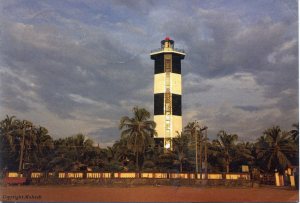
Over a decade ago I had shot this glistening sun bathed view of a Lighthouse. It sort of happened during one of those long motorcycle rides, and in an obscure part of the globe. Few years ago someone actually contacted me, and requested permission to create a post card from that exact photo. Of course, I obliged! Recently, just out of curiosity, I Googled for postcards based on that Lighthouse, and ran into this interesting WordPress link – Remembering Letters and Postcards. There are visible paper wrinkles and postal stamp watermarks on that photo, and also a copyright Mahesh printed at the bottom left corner!

Just another one of those motorcycle rides, and just another one of those photos. But it caught the attention of a Lighthouse Thematic Philatelist, and it turned into a postcard. Someone actually bought that postcard, and mailed it to a lady residing in a distant part of the world. Who then scanned and uploaded it to her website. And now I Googled to find my own photo! But, now my memories of clicking that photo are also perceived in a totally different context. Basically, that simple act now feels quite gilded and romantic. To quote a related earlier post – “with every single step we are progressively shaping our own trajectory, and at the same time influencing lives of others.” In this case, that mere instinctive act of capturing a Lighthouse in its tropical sunset splendor, ended up traveling across the world!

The lady who got the postcard, or the person who sent it to her, will never know the backstory of that motorcyclist who captured it. They simply derived some value from the unknown motivations of a photographer. Just like how I derived value from the unknowns who engineered that Royal Enfield motorcycle and that Nokia camera. And also just like how I now derive value from the actions of these unknown actors sending postcards to each other. They all created an elaborate feedback loop to my rather innocuous photo. To generalize all this — our ability to derive and add value to the unknowns, significantly more than to the known, tends to create unique value chains. It’s probably the most romantic side to this market based civilization.

This photograph incident just illustrates a general fact. If for the most part our actions help the unknown, than the known. It automatically implies that we also get most of our help from the anonymous. Grocery we buy, coffee we brew, roads we travel, clothes we wear, this sever hosting wordpress.com, everything! Leonard Reed has this famous essay, I-Pencil, explains how difficult it would be create a simple pencil with only known help. In short, we are always acting as part of different collectives. Just that it’s an anonymous group, and often transient and constantly forming and acting based on needs of the many. Quite like an organism which keeps adapting to emerging survival pressures.

O death, where is thy sting? O grave, where is thy victory?

Richard K. Munro's avatarSpirit of Cecilia

Brad Birzer wrote:
“love one another. Be good to one another. Love your neighbor as you love yourself. It’s not enough to say “I love you.” Show it, mean it, live it. Does your neighbor need a friendly ear? Does the homeless man (for whatever reason he’s homeless) need a crust of bread? Does that stray cat need to be loved? After all, even that skanky cat is a creature made by God for a purpose beyond mere existence. Every time one of my cats jumps in my lap and distracts me from writing, I am reminded that EVERY living creature has a purpose. “

Brad Birzer wrote “we’re all going to die. Yes, gentle reader, I mean YOU. You will die. Maybe not today, and maybe not tomorrow, but someday. When Edmund Burke passed away, he gave a rousing speech.

Never succumb to the enemy; it is a struggle…

View original post 2,422 more words