Auld Pop (Thomas Munro, Sr.) said we should always look to God’s providence with great humility. In all our affairs and business of a family and nation we had to depend upon His blessing.
Both my father and Auld Pop believed that the family was the basis of our culture and civilization and If God were not acknowledged there we would have no reason to expect his blessing. Auld Pop often said the “best laid plans o’ mice an’ men aft gang agley.” For enriching a family or nation some are so grasping and avaricious and Midas-like that they forget what really matters which is love and the happiness of one’s race and line.
Yes, that was an expression I often heard that we should have pride in our race and line (as Munros and as Gaels) and that we should “Dread God” (Biodh T-eagal Dhe Oirre; we should reverence unto God: this is the ancient Munro motto of course).
Money was important, of course, because one needed bread “but man did not live on bread alone” and also “what does it profit a man if he gains the whole world and loses his soul?”
I think it was very clear to me that my father and grandfather were unfailing opponents of the passion for wealth, advancement in society or the preoccupation with material things. Neither man played golf or spent more time than necessary with business associates preferring to spend their holidays and weekends entirely with their wives and children. My father and grandfather taught me to read and write before I went to school and gave me the rudiments of Spanish, Latin, French and Gaelic at home. They considered children to be God’s gifts, a heritage, a blessing and special a reward : a thousand treasures in one.
They often spoke of “our splendid ancient heritage” which I suppose was our entire civilization of music, poetry, literature, art, language, song and our faith and free institutions. The both loved art and music. They saw great artists in person like John McCormack, Laurence Tibbett , Rachmaninov and enjoyed concerts and recordings.
My father and Auld Pop also lived through the Great Depression and had memories of the Highland Clearances and the Great Hunger of the 1840’s. They had seen war, experienced hunger, exile and immigration and knew that there was no absolute security to be found in material wealth anywhere at any time. At best money could be a cushion but over and over I was told the “man was the gold and that a man could not be measured by the colour of his skin, or by his speech, or by his clothes and jewels, but only by the heart” (from Mika Waltari)
Real wealth was richness of experience, joy in friends and family and delight in conviviality, one’s garden, sport, music, verse, art and literature.
The author RICHARD K. MUNRO after a hike in Sedona, Arizona
Nothing Big Big Train does is unimportant in the world of music or in the larger world of art. As such, its most recent release, Summer’s Lease, is an important cultural marker, a signal act of beauty in a terribly—at least at the moment—ugly world. It’s as though Spawton, Longdon, and Co. are stating: hold on just a bit longer. . . we’ll all make it.
The album begins with the enchanting and pastoral instrumental, “Expecting Snow,” followed by a majestic—and reworked—version of “Kingmaker,” one of the oldest songs in the BBT canon, but a song that never tires and never grows old or out of style. The song is approaching, quickly, its thirtieth anniversary. Again, though, it only gets more interesting with age.
From here, BBT jumps forward two years, to 1995, and offers us a glorious reworking of the very first track to appear on CD, “Wind Distorted Pioneers.” Danny’s delicate-turned-jazz piano work and Rachel’s lush strings (as opposed to heavy guitar) make this a track to behold and celebrate. Truly, this track is a thing of wonder.
The band then gives us an in-studio live version of Swan Hunter’s rather sensuous and pondering “Summer’s Lease” and a subtly reworked version of track two of The Underfall Yard, “Master James of St. George.”
To conclude disk one, BBT offers a slightly shorter version of “London Song.” What was once barely over 34 minutes is now, with a bit of pruning and reworking, just barely under 34 minutes. Each version though—whether the original download or this CD version—is simply outstanding, a manifest demonstration of BBT’s compositional skills and dedication to excellence.
Disk two is, for the most part, much more straight forward with few surprises: “Victorian Brickwork”; “Judas Unrepentant”; “East Coast Racer”; “Curator of Butterflies”; “Swan Hunter”; “Transit of Venus Across the Sun”; Nick’s latest song; and “Brave Captain”.
On disk two, the only real surprise is the just-mentioned Nick D’Virgilio’s latest song, the undeniably mesmerizing “Don’t Forget the Telescope,” a track of seemingly endless possibilities, a tangle of love intertwined in a spirit of exploration. The song feels live, and it feels as though we’re listening to it an Irish baptism or wake (you know, the kind wake that celebrates life) being held on the south side of Chicago in the 1920s. Glorious.
Finally, I must write something about the packaging. BBT understands well that its fan base likes tangible things, and this package does not disappoint. Each of the two CDs come in nice cloth sleeves, the booklet is long (though, in Japanese!), and Sarah Ewing’s artwork is. . . well, just perfect and fantastic. Indeed, this is now my favorite BBT album cover. I would love to own a print of it.
No matter how bleak the world looks at the moment, Big Big Train wields the light, encouraging us to keep going, no matter the cost and no matter the doubt.
Every now and then you read a book that really impacts you. A book that simply sticks with you, one that, for days after you finish, you can’t get it out of your head – and don’t want to. It can be a novel, or maybe a non-fiction book, maybe something about history that makes you look at the world in a different way, or stretches you mind into a previously unknown shape. It may also become something about which you feel absolutely compelled to tell others. For me, the book that currently occupies that space is the incredible story of a defector from the prison-state of North Korea.
Originally published in 2015, Hyeonseo Lee’s The Girl with Seven Names is not merely a harrowing tale, it is a collection of them. These are stories that are all too real for the millions born in North Korea and for the intrepid few who dare to seek freedom by attempting escape from its bondage.
Ms. Lee’s book is subdivided into three parts. The first part chronicles her life from birth until her eventual escape. It includes multiple moves until her family finally settles in the town of Hyesan, on the North Korean border with China and within sight of the city of Changbai – the brighter lights of which eventually became a lure to the author. Some of what is revealed is unsurprising – the forced indoctrination, the public executions, the atomization of society, the forced reverence for the pathetically insecure “Dear Leader”. Other aspects were more surprising – such as a border with China that was frequently crossed in both directions, the amount of smuggling that occurs, and so on. In retrospect, one should not be surprised that a system as oppressive as that in North Korea produces so much bribery, black market commerce, and general corruption that filters all the way down to the lowest levels of society.
And speaking of the levels of society, the author educates the reader on the North Korean system of songbun, in which people are ranked within society in one of fifty-one gradations spanning over three broad categories – loyal, wavering or hostile. Ms. Lee rightfully notes that the system of songbun had created a society more stratified than that of a feudal society, and one in which upward movement is nearly impossible. Like all communist animal farms, that of North Korea is one in which all animals are equal, but some are most definitely more equal than others.
As Part One nears its conclusion, the author’s disillusionment with her home country grows, particularly during the famine of the mid-90’s which left about a million dead. Nearing the end of her high school years, facing college and adulthood, and the aforementioned allure of the lights of Changbai, the Ms. Lee decides to take a short trip across the river to get just a small taste of freedom before returning home to begin the next phase of life. As this first part ends with a walk across the frozen Yalu River, in what eventually became a one way journey.
Part Two chronicles Ms. Lee’s life as an illegal in China. In short order, the author finds out that while she is technically free from the bonds of North Korea, she is still not truly free. In addition to a myriad of other human rights abuses, the Chinese government’s miserable record on human rights includes the repatriation of North Korean defectors, sending most of them to a back to their prison-state and leaving them to a fate of hard labor, execution, or both. Thus, the author’s existence during her decade in China was a precarious one, forcing her to adopt new identities with the frequency of a spy in a John LeCarre novel (hence the seven names to which the title refers). In numerous instances she is nearly caught, escaping arrest with a combination of guile and luck. To complicate matters further, she managed to stay in communication with her mother and brother back in North Korea, bearing the weight of guilt regarding loved ones left behind. More than once her mother implored her to come home, assuring her the right people could be bribed to make her return a safe one.
I’ve mentioned elsewhere that my own mother is a defector from East Germany, crossing into West Berlin with her family when she was age 10. While the train ride she and her family took in 1953 was not without risks, their freedom was assured once they had crossed into West Berlin. Such was not the case for Ms. Lee, as crossing the border into China was only the beginning of a very long journey, one that was fraught with danger every step of the way. The fact that she did not go home despite the continuous hazard of being an illegal in China is a testament to her courage – and the incredible difficulty of escaping North Korea.
The third part of the book finds the author finally making it to Seoul, South Korea, and her eventual convincing of her mother and brother to defect. She returns to China and the border near her hometown and escorts them over 2000 miles into Laos. Along the way, the hazards of being caught are as ever present as they were in her previous decade as a Chinese illegal, only with higher stakes by having her mother and brother in tow. In Laos, her mother and brother are arrested and held in jail for months, although thankfully, not repatriated (apparently even the government of Laos is more humane than that of China – a low bar to hurdle). After exhausting all her options and running out of money to bribe the Laotion authorities, serendipity intervenes in the form of an Australian man who decides to help for no other reason than it was the right thing to do. Even a hardened misanthrope would have to reconsider his outlook after reading about this incident. With Ms. Lee receiving the funds she needs, she is able to spring her family from jail and finally get them into Seoul. Free at last.
Today, Ms. Lee spends a lot of her time as an activist for North Korean defectors and human rights in general. She wants the world to know the true fate of North Koreans, both those that remain and those that defect – both successfully and unsuccessfully. She has done multiple TED talks, one of which is embedded below. While North Korea still suffers under the boot of a third generation “leader” in Kim Jong-Un (or, as I refer to him, Pudgy Bucket of Baby Fat with the Worst Haircut Ever), Lee and others like her seek to shine the light of the international community on the horrible conditions imposed on North Koreans, the savage human rights abuses, and above all, a form of government for which no decent, civilized human being should give any quarter. Her goal is to see the Korean peninsula re-united, with the people of the North living under the banner of freedom. We should all say a prayer for the North Korean people, and root for Ms. Lee to one day to witness the realization of her dream.
On Good Friday 2020, the Leipzig Bachfest presented a unique version of Bach’s St. John Passion in Bach’s home church, the Thomaskirche. It was a performance uncannily suited to these extraordinary times.
The actual Passion story will be performed by just three musicians. In this production, the Icelandic tenor Benedikt Kristjánsson tells the story of Jesus’ Passion on the basis of Bach’s Passion, taking on the role of the Evangelist and all the other characters – and also conducting the virtual choir. Harpsichordist Elina Albach and percussionist Philipp Lamprecht take the role of the orchestra. (Photo: Nino Halm).
All the viewers at home are invited to sing the chorales besides five singers in St. Thomas’ Church led by Thomaskantor Gotthold Schwarz, and the artists. Bach choirs who were invited to the 2020 Bachfest will be participating by video link.
At first, I found the idea of a chamber St. John Passion a bit disconcerting — like an unrealized idea of Emerson, Lake and Palmer, perhaps? But the Thomaskirche (with video inserts from the absent choirs) proved the perfect setting for the sparse instrumentation. And as the 90-minute work unwound, it became more and more moving; the musicianship, focus and dedication Kristjánsson, Albach and Lamprecht conjured up was inescapable — especially during a riveting version of the Passion’s finale. It brings me to tears every time I hear it, and this time was no exception:
Lord, let at last Thine angels come, To Abram’s bosom bear me home, That I may die unfearing; And in its narrow chamber keep My body safe in peaceful sleep Until Thy reappearing. And then from death awaken me, That these mine eyes with joy may see, O Son of God, Thy glorious face, My Savior and my fount of grace. Lord Jesus Christ, my prayer attend, my prayer attend, And I will praise Thee without end.
My suggestion: set aside an hour and a half today or tomorrow, hook up your computer or miscellaneous online device to a big screen and a good sound system, and let this powerful version of one of Bach’s greatest masterpieces rip. The stream is here; program (with the chorales printed out for singing) is here.
1953 was a banner year for the conservative soul and intellect. Russell Kirk’s seminal The Conservative Mind came out that year. As did Leo Strauss’s pathbreaking Natural Right and History. Daniel Boorstin published his close study of Americana, The Genius of American Politics. Eliot penned his critical play, The Confidential Clerk, and Ray Bradbury offered the world Fahrenheit 451.
The zeitgeist had yet to exhaust her resources, however, and Robert Nisbet produced his magisterial The Quest for Community, a work that mightily complemented the other works of that year, almost, but not quite, forming a whole with Kirk’s The Conservative Mind. Oxford University Press released Quest on February 12, 1953, exactly a month before Regnery published Kirk’s book.
— Read on theimaginativeconservative.org/2020/04/moving-toward-dread-conformity-bradley-birzer.html
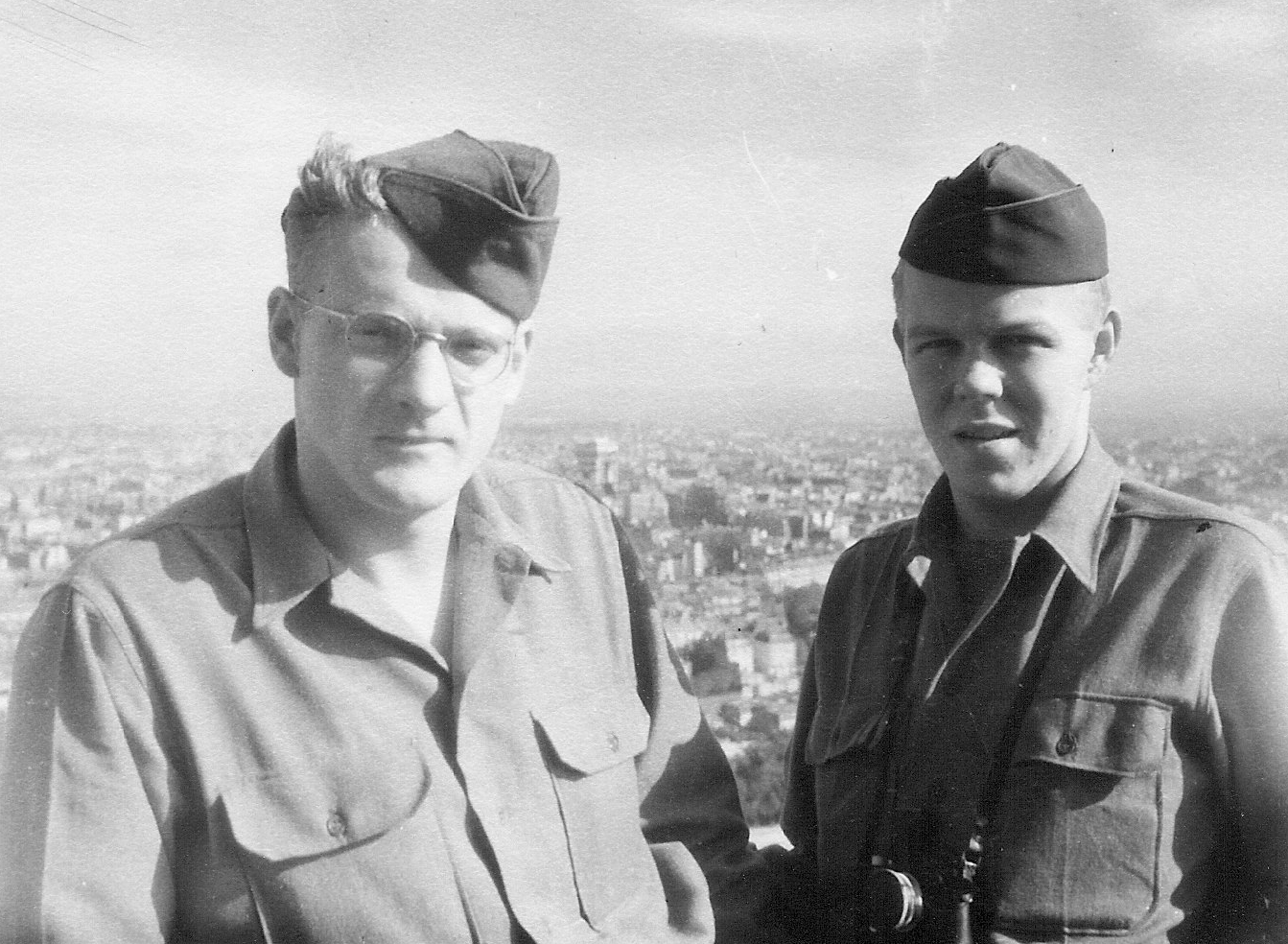
Richard Berkey and to the right my kinsman, whom I knew very well as a boy and young man NORMAN ELIASSON (10th Armored Division) Bronze Star V for Valor (Bastogne, Dec 1944)
The quality of mercy is not strained. It droppeth as the gentle rain from heaven Upon the place beneath. It is twice blest: It blesseth him that gives and him that takes. ‘Tis mightiest in the mightiest; it becomes The thronèd monarch better than his crown. His scepter shows the force of temporal power, The attribute to awe and majesty Wherein doth sit the dread and fear of kings; But mercy is above this sceptered sway. It is enthronèd in the hearts of kings; It is an attribute to God Himself; And earthly power doth then show likest God’s When mercy seasons justice. Therefore, Jew, Though justice be thy plea, consider this: That in the course of justice…
As some of you might very well know, today is International Talk Talk Day. Sometime in 1987 or 1988—the memory fades—Kevin McCormick and I vowed that every April 5th, we would listen to the entirety of Talk Talk’s mid-period masterpiece, The Colour of Spring, as a reminder of three things.
First, that no matter how dark the world might become, beauty endures and promises—through the seasons—eternal renewal.
Second, that no matter where we are in the world, our friendship endures.
Third, that Mark Hollis (RIP) was a genius.
Since the late 1980s, Tad Wert has joined in the pledge. Please join us in celebrating that miracle that was Talk Talk.
Here she comes Silent in her sound Here she comes Fresh upon the ground Come gentle spring Come at winter’s end Gone is the pallor from a promise that’s nature’s gift Waiting for the color of spring Let me breathe Let me breathe the color of spring Here she comes Laughter in her kiss Here she comes Shame upon her lips Come wanton spring Come for birth you live Youth takes it’s bow before the summer the seasons bring Waiting for the color of spring
Each of these four tracks builds in soulful intensity and bardic purpose until Mr. Hogarth is begging us to answer, “how do we now come to be afraid of sunlight”? It is a plea for a recognition of the human condition, in all of its majesty and tragedy.
— Read on theimaginativeconservative.org/2020/04/keep-faith-marillion-bradley-birzer.html




 want to. It can be a novel, or maybe a non-fiction book, maybe something about history that makes you look at the world in a different way, or stretches you mind into a previously unknown shape. It may also become something about which you feel absolutely compelled to tell others. For me, the book that currently occupies that space is the incredible story of a defector from the prison-state of North Korea.


 Spirit of Cecilia
You must be logged in to post a comment.