I am 69 and in reasonable health but recently I hurt my back and leg and for the first time in my life I have difficulty in walking. (I can walk with a cane but some days are better than others). So I went to the doctor and he recommended Physical Therapy which I have started. I have six more weeks of Physical Therapy (thank God for Anthem Blue Cross insurance. The prognosis is good but I am a little anxious. I don’t want to be in a wheelchair or use a walker quite yet! I want to get back to long walks an swimming in the pool this summer! So the biggest challenge is getting back on my feet!
Daily writing prompt
What is the biggest challenge you will face in the next six months?
No matter how old you are now. You are never too young or too old for success or going after what you want. Here’s a short list of people who accomplished great things at different ages
1) Cervantes was 58 when he wrote Part I of Don Quixote
2) Helen Keller, at the age of 19 months, became deaf and blind. But that didn’t stop her. She was the first deaf and blind person to earn a Bachelor of Arts degree. 3) Mozart was already competent on keyboard and violin; he composed from the age of 5. 4) Anne Frank was 12 when she wrote the diary of Anne Frank. One of the poignant things about her diary is the promise she showed at so young an age. She symbolizes many thousands who lost their lives prematurely and so their contributions to humanity were wiped out. 5) Michelangelo created two of the greatest sculptures “David” and “Pieta” by age 28 18) Alexander the Great, by age 29, had created one of the largest empires of the ancient world 19) J.K. Rowling was 30 years old when she finished the first manuscript of Harry Potter 20) Amelia Earhart was 31 years old when she became the first woman to fly solo across the Atlantic Ocean 23) Martin Luther King Jr. was 34 when he wrote the speech “I Have a Dream.” 24) Marie Curie was 35 years old when she was nominated for a Nobel Prize in Physics 25) The Wright brothers, Orville (32) and Wilbur (36) invented and built the world’s first successful airplane and making the first controlled, powered and sustained heavier-than-air human flight 26) Vincent Van Gogh was 37 when he died virtually unknown, yet his paintings today are worth millions. 27) Neil Armstrong was 38 when he became the first man to set foot on the moon. 28) Mark Twain was 40 when he wrote “The Adventures of Tom Sawyer”, and 49 years old when he wrote “Adventures of Huckleberry Finn” 29) Christopher Columbus was 41 when he discovered the Americas
Who is MUCH more likely to die on the job? A woman? Or a man?
FACT: 93% of workplace deaths are to men. Why?
Because men take the dirtiest and most dangerous jobs and work the longest hours to make as much money as they can while they can. I know because it was what I did. I could have been in those workplace death certificates. I did some dirty and dangerous jobs.
They say your 20s are the best time of your life but for me, there were years of frustration and suffering and separation from loved ones. But I just stoically carried on. Getting your first full-time job is sometimes very difficult. People are surprised but I would say in my early life I was turned down for every job I applied for. I was too qualified or not qualified enough. It was humiliating and a chastening experience. So I left home and went West. I told my mother I would keep going until I got a full-time job and if I had to go to Alaska or Australia, I would do that. I ended up in Washington State and later California. But by following the economic magnet and moving where there were SOME job openings I got work and for over forty years I always worked. It was hard to leave home (essentially never returned) but working felt a lot better.
After I left the service I had very little money (a few thousand dollars) and an old Chrysler (free and clear). I worked in construction for five years. I started by unloading rail cars $6 an hour I recall (then stacking over 1000 bags of Owens-Corning fiberglass insulation); then I dug trenches under a place called Yesler Terrace with an e-tool.
The first day my partner and I got ZERO PAY. That’s right ZERO pay.
We were paid by the square foot of insulation installed.
But we worked Friday, Saturday and Sunday and finished the job (a job no one else wanted). Monday morning at 5AM we got another job.
And we gained the respect of the foreman (a tough ex-Marine) because we did not complain. We knew the job had to be done and we knew the terms of the contract.
We also knew it was no good to complain; to get more work you had to finish the job you were on satisfactorily. Even the guy I was with was surprised but I told him hauling loads and digging in the dirt was nothing new to me. In fact, the quiet of the Yesler Terrace underfloor was almost soothing compared to the noise and explosions of Marine Corps maneuvers.
We crawled into a little entrance with a long series of extension cords and a light. The kid I was with said to me, “what if there is an earthquake?”
And I told him, “Kid, if there is an earthquake we are dead and they will never find our bodies. But you can’t live forever. Let’s dig and get out of here as soon as possible. We can do this job if we work 10 hours a day.”
We finished Sunday evening about 6PM. We spent most of three days in the semi-darkness digging and then stocking (with tubes of insulation -Certainteed was the only thing we could fit in the trench) then installing the batts. It was a huge job. I think we made about $2 an hour. Piece work in construction or farm labor is the low end of the job market.
Above us were lounging welfare families. The kid asked me what I thought of them and I said,
“I feel sorry for them; they don’t know the pride and dignity of work. Anyone can run away. Anyone can be AWOL but its the man who stays and does the job who can be proud. If you work you get ahead; if you sweat you get; things at rest remain at rest. If you stay here with them you will be miserable and ashamed your whole life. Kid, get a job do a job. Be reliable and on time. Get what education you can and finish whatever level you start. High school, Certificate programs. Don’t have any kids until you are married and when you are married stay married. You may not get rich but you will never be poor if you are lucky enough to stay healthy. Quien joven no trabaja viejo duerme sobre paja……work when you are young so you are not homeless when you are old.”
I never got rich but I have a roof over my head, money in the bank and money coming in.
And it all started because I wasn’t afraid of dirty and dangerous jobs. I had a family to support and it was what I had to do. I still have the scars from those years. But later on, I really appreciated paid vacations, benefits and a regular hourly wage.
“To believe that there must be a Creator is merely a lack of imagination, but to go so far as to think that he cares about humans at any level strikes me as supremely arrogant.” A non-believer.
Ah, of course, but it is a fond hope of many. However, it is a matter of faith, not science. And yes there is much pride and arrogance in religion -this is a grievous fault. I have no final answers …there is great mystery in life and death and creation. RICHARD K MUNRO
NON-BELIEVER: “I agree about mystery — it seems to me that confronting life, the universe, and everything head-on with reason is more powerful and more honest and more challenging than relying on faith to explain away certain mysterious aspects of nature.”
·
Richard K. Munro:
“That is the enlightenment view. But as a survivor who has seen death and killings and has beaten cancer and unemployment and near homelessness, I am glad to say that man’s final weapon -prayer is a powerful instrument. “Except for the Lord the watchman waketh in vain.” (Ps 127)
(Friend )MurphyWong:
Richard, if God did not exist, he would have to be invented for people like you and me, for we have become “fine-tuned” for God.
San Joaquin Valley, California, USA February16, 2015 and 2025
As I have written before there aren’t many atheists in foxholes.
Hard experiences in life -brushes with death- tend to bring out the religious and philosophic view of life. We accept many things on faith. God’s voice is not audible to all. Someone hard of hearing in his soul will not hear God speaking. Jesus said, “Let him who has ears hear” (Matt 11:15) The Manichees, like Tom Paine, were proud of their emancipation from tradition and boasted they had no need to defend their teachings by appealing to tradition, authority, or any sacred scriptures. For them reason alone was sufficient.
But as I have said we all rely on faith, for example for historical knowledge. There is no way to prove that Caesar was murdered by the Senators or Cicero was executed by Mark Anthony. We know seven times seven is 49. But any event that happens in the long past of human history is always dependent on sources which are someone else’s word. The distinctive feature of historical knowledge is that it is based on testimony or sources that are “worthy of trust.” The rest usually works itself out. That’s true for the historical examples, but frequently NOT true in science. Often there are direct remains from past events (e.g., fossils, geological formations), which can be examined firsthand, not having to take someone else’s word for it. And in astronomy, we see the past directly, due to the time it has taken for light from distant objects and events to reach us.
I recall Augustine spoke of AUTHORITY in his discussion on faith. We owe our beliefs to a large extent on AUTHORITY. I am for example an authority on Spanish grammar and accentuation (I’=am an AP Reader for ETS in essays). But all my life I have relied on Spanish grammars and dictionaries. In everyday life, we all have to accept the authority or special opinion or knowledge of someone else. Without faith, that is without confidence in the truthfulness of others, the “sacred bond of the human race” would be broken. Nothing is stable if we are stubbornly determined to believe NOTHING can be believed with absolute certainty. As a teacher my student has to believe me that I know English grammar that I know Spanish grammar and that I know things about history.
I wanted to clean my DE pool filter. At first I wanted to rely only on my reason. But upon examining it I determined I needed the advice of someone with experience in cleaning DE filters. I did research on the Internet and found a “how to do it with photographs.” And with the help of my wife I did it. But I also learned that by doing what I did I risked permanently damaging the filter and making it useless.
I determined that it wasn’t worth it to spend almost seven hours cleaning and reassembling the filter. So I pay a certain amount of money to a workman who is an expert in this. Now I watch him to see what I can learn but I know what I can do successfully and without economic risk and what is not worth the economic risk.
In other words, I have learned that reason alone is not the way to fix my roof or maintain my car. Because not all can be known. But I was glad for the experience. I have learned a lot about pool maintenance and do most of it myself. However, I seek the experience of experts and specialists to resurface the pool or repair the pump and vacuum. Those things I can clean and maintain and troubleshoot but I know the limits of my skill and knowledge.
Authority in religion at its best and wisest does not impose or coerce.
Similarly, I cannot command someone to learn Spanish or English. I can only invite them to enjoy the wonderful adventure it is to learn and study and use languages. I delight in my grandchildren writing me notes in Spanish and the best I can do is praise them and encourage them!
A good teacher does not strong arm students and say like Hitler OBEY ME because I AM THE TEACHER. A good teacher is patient and earns the confidence of his students by experience ,by reputation, my knowledge, by insight and of course by the truth. And a student cannot merely memorize (or cheat); he has to understand and understand how to learn. I think there can be no knowledge of God without faith for faith is the only way we can know God. Faith in this life is always incomplete. As Paul said, “Now we believe in part.” “Happy is the people whose God is the Lord.” PS 144·
FAITH vs REASON. I remember as a young man tending towards the enlightenment/skeptical/Tom Paine point of view.
But I was never entirely atheistic. I tended towards agnosticism-perhaps I still do.
But life experience plus Thomas Merton plus C.S. Lewis plus Chesterton built upon what tendency I had towards Christianity. I also experienced directly and indirectly sectarian hatred of evangelical Protestants versus Catholics and hatred towards Jews. (as a young man I had little or no contact with Mormons, Muslims or Buddhists) This hatred and prejudice almost turned me against religion entirely.
But then I gradually realized that the sectarian feeling of Irish Catholics against Scottish Protestants for example was more political and nationalistic than theological. And similarly, hatred of the Jews was pathological and based on jealousy. I have always felt Christians ought to be very grateful to the Jews for giving us the philosophic and literary and religious basis of our faith. So falling into a prideful hatred of others is an unfortunate tendency found in many but one we should reject.
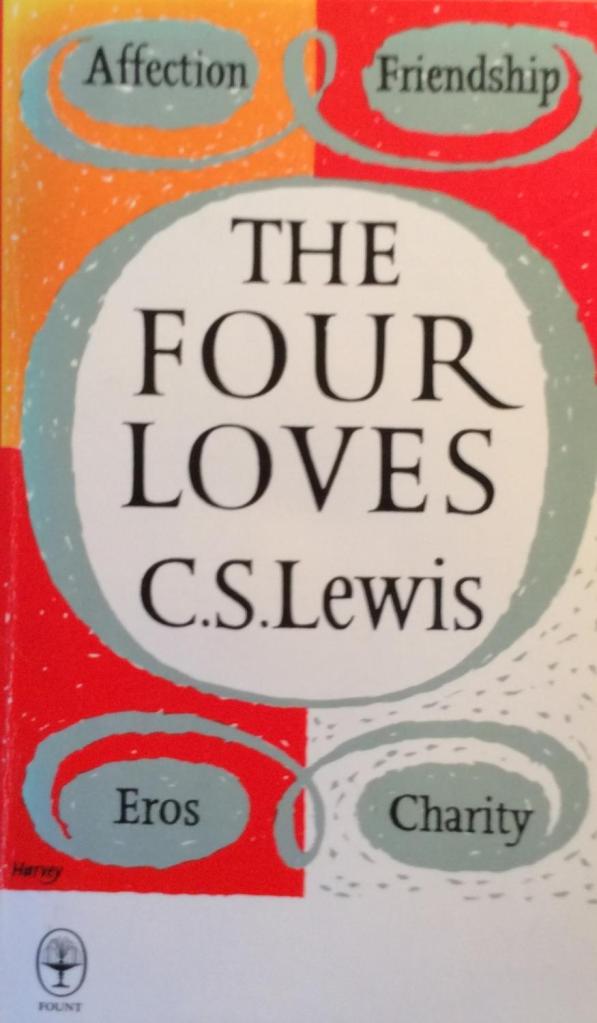
But the true message of Christianity is love. I did not really understand love as a boy or young man. When Eros awoke in me in my teens I sensed that kind of love was the most powerful love.
However I became aware of the fact that there were many kinds of love -I am sure you know them -storge for affection, agape (caritas) for altruistic love or care for others, philia or the love of comrades or friendship and of course eros or erotic physical love. Philia love I learned both in the service and as a faculty member at my schools and as a coach. Storgic love and agape love I learned from my mother; eros became a fixation in late adolescence as I became physically infatuated with women aged 16 to 30 plus. I suppose I always like mature women more than silly girls so even as a young man voluptuous 30-something women were very attractive to me. But I quickly learned that erotic attraction was as much a thing of imagination and passing fancy as anything else.
And I found, in my experience, most very beautiful women were not necessarily kind or good. But I was lucky in a way. I did not travel in rich circles and nor did I have much money of my own or glorious career aspirations. So the most physically beautiful women just passed me by and did me a favor.
And of course looks don’t last. Some women have a high lifetime batting average -they are attractive from age 17 to 60 and some are flashes in the pan who lose their looks and figures early . There are women who are stunningly beautiful from late adolescence until their early20’s and then completely let themselves go. I could tell you stories of my near escapes.
But I think it true that I was basically a kind man who did not take advantage of women or mistreat them. If anything women used their sexuality to take advantage of me (at least briefly). But I was wise enough not to get caught up in that honey trap. It is a card women play if they really want something. But of course unless they aren’t sincere it isn’t worth much.
If a man wants a spouse for life -he should choose character and someone with a prospects of a good lifetime batting average for attractiveness.
Money per se was not important to me. I think to marry for money is even more stupid than to marry for sex. One should avoid people who have MONEY PROBLEMS (huge debts; spending problems). But one should ignore financial gain when one marries. It is better to marry for love ,in my opinion.
My father said to me, “#1 never date a woman who would not be a good mate -you won’t get dragged down or distracted that way.
#2 Look at the mother and aunts. That probably is that the daughter will look like in her 30’s 40’s and 50’s. Say to yourself if you would be satisfied with a woman like that.” I think this was wise advice. I also think the family of a woman (or man) says a lot about that person. My wife, for example, was the favorite niece of her uncles, and much beloved by her grandfather.
She was very kind to her younger cousins; she was involved in teaching young people in a religious youth program. She was religiously devout much more so than I was. But gradually I changed my views and realized I was comfortable with her worldview and I wanted to share her faith totally. I had seen a lot of divorce a lot of bitter breakups in New York and I did not want that to be part of my life. We talked about marriage and she considered it a sacrament something holy and something for life.
Of course, that was exactly how my non-Latin but Catholic parents and grandparents felt and I realized that my views on marriage were strongly influenced by my parent’s experience even though I did not, at the time, think those values were especially “Catholic” merely “traditional.”
Of course, in my life it was a balance between character and intellectual interests and sexual attraction. I knew women who were attractive to me but I was not attractive to them “no chemistry”they said.
And similarly I liked women who were nice, had nice families and were good cooks and pleasant companions but I didn’t think we could ever have children. In this case there was little chemistry on myside. One need not burn with erotic passion like a wild rutting beast all of one’s life but I think it is good to have shared young passionate love with a spouse. The memory of that passion and that oneness is the basis for a sense of permanent connection and gratitude, particularly when that passion is not merely what my grandfather called “dud in the mud sex” that is contracepted sex that produces no children.
I suppose for me the chief qualification for a woman is that I wanted her physically to be the mother of my children and spiritually and intellectually the mother of my children.
I crossed out any ZPGer’s or Radical Feminists and it is true that in time when on I only dated women from my faith tradition. I tried to date women from other backgrounds but our philosophies of life were too different. In variably we would argue. I was called “medieval” (and worse).
I found personally, that I liked Latin women better than the American women I met chiefly because they had more traditional values and I realized as a son of an immigrant I had more traditional values than the average New Yorker, certainly.
Interestingly enough my son also married a Latin and our daughter also married a Latin. It is a cognate fact that no one in my family for a thousand years has married a native-English speaking woman. Of course, my people came from the fringe of the English-speaking (and Protestant) world. Prior to 1890-1920 most of my family were non-native speakers of English. Because of this we have always tended to be “amphibious” and cosmopolitan. Working in Latin America we learned Spanish; living in Canada we learned French. Serving in the 27th Division (1914-1919) my grandfather learned spoken Hindi and Punjabi. Serving in the Philippines, my father who already spoke French learned Spanish and Tagalog. Even as we lost to old language we retained an openness and interest in other languages and a love of music, song and poetry. So I can never remember a time when I lived in a monolingual English-only household. There is no question as a Gael (by ancestry) I feel a connectedness to the ancient bonds of Christendom and to Rome. We never looked exclusively to London or Paris or New York or Washington.
And I suppose if one grows up with stories of saints and missionaries one never loses that connectedness entirely. And like a loadstone, the wandering heart drifts back to true north.
And faith and love. My grandfather came to America with very little except a strong faith and a strong desire to work and thus remain free. Though we no longer share his nationality nor his native language with our children I think he would be very satisfied that we were ‘bydan free’ (saorsa gu brath/ forever free) and that we were stable in our faith traditions. I believe his faith inheritance was more important to him than his race or nationalist considerations. This is expressed in the fact that he did not marry a woman of his national origin (nor did I). There was never a question that we would marry people only from his region of Scotland or his language –in our faith life there were people from every race and every corner of the globe. And in the 21st century I fully expect to have grandchildren who bear the races and lines of many peoples and three or four continents. But as my grandfather, Auld Pop, used to say, “the important thing about grandchildren is HAVING THEM; the next important thing is that they are HEALTHY; the last important thing is that they are LOVED and CARED FOR.”
The rest usually works itself out. That seems REASONABLE TO ME by experience
But It all began with FAITH that all will yet be well and knowledge that one of the most powerful wisdoms is REVERENCE FOR LIFE and REVERENCE FOR GOD. The earliest Bible quote I knew was this: “DREAD GOD and OBEY his commandments for that is the whole duty of man. “
“How much better to get wisdom than gold, to get insight rather than silver!” Proverbs 16:16
I think Feminism has done young women a very great disservice but putting them at loggerheads with men and their own natures. The fact is , young women’s best years for fertility and attractiveness are between 16 and 27. Nothing can change that. After age 27 the fertility of women drops over incrementally year by year until by age 40 or 42 or so conception is difficult or impossible.
Therefore, women who sacrifice their family life for professional careers are often opting for a life of loneliness and childlessness.
There must be great many women 40 and above who now regret they never had children though I doubt, if I may be so bold, there are many American woman above 40 who lack sexual experience.
But most of their experience is of the dud-in-the mud hook up kind and so really is mostly wasted time. Neither the person nor society will have anything to show for it fifty years in the future. RUTH MUNRO my mother. She lost many childbearing years to WW2 1941-1946. But still had three children including ME at age 39. Thanks, Mom
I have been slowly reading John Wyndham’s works, and I finally hit paydirt! His earlier efforts, Foul Play Suspected, and Planet Plane, were not very good. However, his fourth novel, The Day of the Triffids, is a classic dystopian tale. It’s been made into a movie and TV miniseries, and even though it was published in 1951, it hasn’t aged one bit.
It is told through the eyes of biologist Bill Masen, who has made a career out of studying some strange plants called triffids. They grow to be 8 to 10 feet tall, they produce very useful and nutritious oil, and they are able to move about on their three main roots. Unfortunately, they are also carnivorous and have lethal stingers they can whip out and lash their victim with. It’s possible to “dock” a triffid – i.e. cut off it’s stinging lash – but that reduces the quality of its oil, as well as the yield of its seeds.
No one knows for sure where they came from, but they suddenly appeared all over the world at pretty much the same time. Masen believes they are the result of Soviet genetic engineering. Their benefits outweigh their risks, and Masen works for the main developer of triffid products. One day on the job, he is glancingly stung in the face and temporarily blinded. This accident turns out to be a Godsend, because while he is the hospital bandaged up and recovering, an extraordinary, bright green meteor shower occurs one evening. Everyone on earth is awestruck by its beauty, and Masen has to listen to his nurse describe it in great detail.
However, the next day, when he is scheduled to have his eye bandages removed, no one comes by his room. He calls for breakfast, and there is no reply. He takes the bandages off himself, and he soon realizes that everyone who watched the cosmic pyrotechnics is blind. What follows is a clear-eyed account of what would happen if 99% of humanity suddenly went blind, and there is a strange species of ambulatory plants that seem to be sentient and can kill.
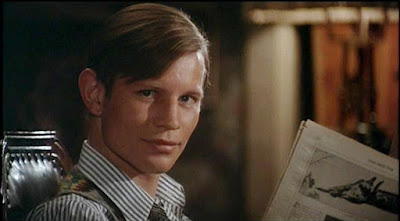
I remember my meeting with Michael York in Spain in 1973 vividly.
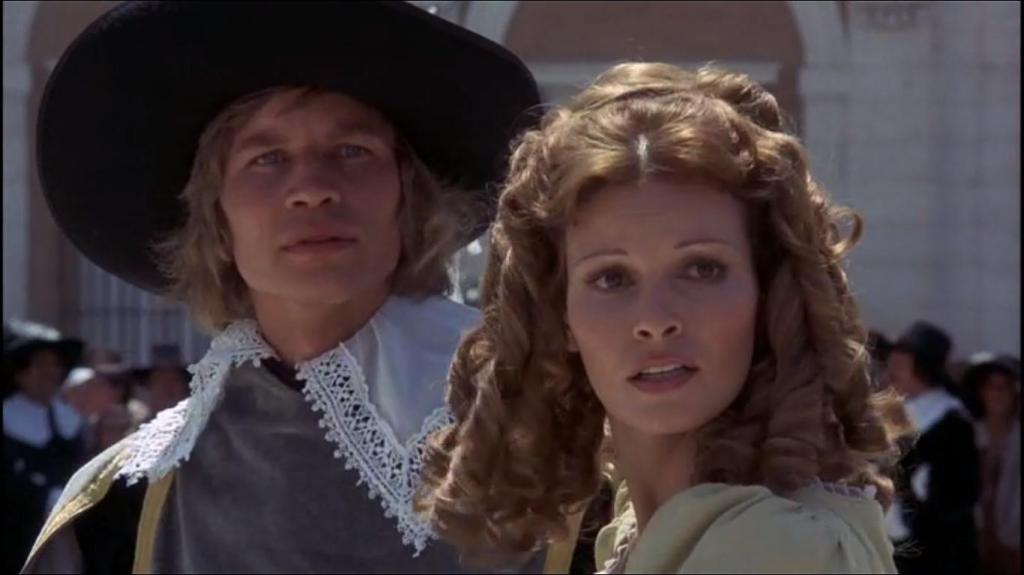
He was in Soria to film exterior scenes of THE THREE MUSKETEERS.
In fact, I had just recently seen CABARET at the Rex Theater in Soria just a few days before I met him. A very significant picture for me because I went with a Spanish friend and later that Spanish friend became my wife (we have been married almost 43 years!) We found we had a similar passion for musicals and classic films.
I was studying at the time with a Spanish program with the University of Northern Iowa at the time (sadly the program which flourished for over 30 years is now defunct).
Soria was a great place (especially then) to study Spanish because
1) there was almost no English-speaking tourism so there was almost total immersion
2) Most Sorians were reasonably well-educated and spoke a beautiful and rich Castilian dialect.
But it meant monolingual English speakers might experience loneliness. I enjoyed living in Europe immensely. In those days Spain was inexpensive for Americans (not true today!). Soria itself had a beautiful natural setting and many historic castles and ruins dating from Celitc, Roman, Moorish and Medieval times. El Cid was at Berlanga de Duero and attended Mass there and in churches in Soria. There is a statue to the anonymous JUGLAR DEL CID (author of the Poem of the Cid) in Soria.
I could be mistaken as to the date but I think the date I met York was July 4 1973 because we had the whole day off from classes for the 4th of July which was the custom of the program for a group activity and we took the bus to Berlanga del Duero where they were doing the exterior shots of the Three Musketeers.
I was lucky enough to observe the epic “battle scenes” as the soldiers “assaulted” the castles in their colorful uniforms and swords and lances. If it was not a cast of thousands there were at least hundreds of uniformed extras. I got to see and talk to the extras (all Spaniards) in the town. After watching this assault of the Castle I went hiking around the ruins on the base and approached the castle.
It was a very hot day and I took refuge from the late afternoon sun for in the shade of a ruined castle wall.
And who should I find there, alone, resting in the shade none other than Michael York?
Of course, I recognized him immediately (he was not that famous then) because I had just seen him in Cabaret. Michael invited me to sit down next to him and we shared our picnic lunches (he had chorizo, Manchego cheese and I had Tortilla de Patatas sandwich. I had a big bottle of water (agua sin gas) and we shared that. I seem to remember he had a bota of red wine and he offered me some as well.
A cast member passing by took a picture of us together. York seemed happy to have the company of an English-speaking person. We had a few laughs together. I was a totally unexpected visitor.
Michael was very friendly and we talked about Britain and America (briefly), Spanish history and of course the movie the THREE MUSKETEERS and CABARET.
I explained I was a big classical movie buff and loved British films (my family emigrated from Britian to the USA 1923-1948). He asked me if I was just visiting Spain for tourism and I said no I was there to study the language and culture with a view to get an MA in Spanish literature. My father encouraged me to study Spanish as it was a “real expertise”; there is no question Soria and Spanish culture changed my entire life and career.
Michael talked about his experience on the stage in England and I mentioned my father always believed British actors had better training because of their stage experience than a lot of “California Kids” who showed much less range that the great British actors (Maurice Evans, Laurence Olivier, Alex Guinness, Jack Hawkins, Leslie Howard, Wendy Hiller, Paul Scofield, John Mills) and of course himself whom I put as a talent in the same category. York was a little surprised that I could rattle off the names of British actors like that.
York laughed and modestly said, “I take my craft seriously and try to give my best performance. “
I was eager to see or meet RAQUEL WELCH who was in the movie. The late Miss Welch was one of the great sex symbols of the 60s and 70s.
Michael laughed and explained that if I went down to the town I would only find her stunt double because all of Miss Welch’s scenes were shot in the studio in London. I don’t remember if they had already filmed them or were going to film them a little later.
I told Michael that I really enjoyed his performance in Cabaret and thought the picture itself was original and powerful and would be remembered as one of the great musicals. He was impressed by my critique and said, “That’s every actors dream to do something important and memorable.”
We talked about movies filmed in Spain especially DR ZHIVAGO some of whose scenes were filmed in SORIA. I also mentioned that the trains with Russian slogans were preserved in a train museum in Madrid. He said he was going to make an effort to see that.
Michael specifically mentioned other exterior shots that they were going to film in Canon Del Rio Lobos ( a very picturesque place.) A friend asked me about other shots such as a night swordfight on the frozen lake.
Since it was Soria in summertime an about 90 degrees or more I don’t think that shot was filmed in Soria. It is much more likely to have been shot in the studio in London like Miss Raquel’s scenes. But that is just speculation on my part because Michael and I only talked about Berlanga del Duero and Canon Del Rio Lobos.
Of course, lunch break doesn’t last forever so Michael shook my hand and excused himself to go back to work.
I wished him best of luck in this film. I stopped one moment more to ask him to tell Raquel Welch that a fan was very disappointed that he didn’t have a chance to meet her in person and he said he would make sure to tell Miss Welch when they were in London together.
So that is my Michael York story. Like ships passing in the night, we met and made our final farewells. He probably would not remember me but I would always remember him.
For years I would show people among my Spanish photos MY FRIEND MICHAEL YORK.
It interesting to meet authors or celebrities in person
My grandfather heard GEORGE BERNARD SHAW speak in person in Glasgow and met THOMAS EDISON in the 1920’s . My father met GENERAL MACARTHUR in 1945 in Manila and my uncle knew PRESIDENT EISENHOWER while he was at Columbia University and later met JOHN F. KENNEDY. My uncle worked in the Faculty dining room and served Eisenhower and his friends many times. Ike, in fact, called him NORM! I met Pamela Harriman (daughter-in-law to Winston Churchill) when she was then Mrs. Harriman. Harriman didn’t mean much to me at the time, but I was aware that Pamela Harriman was at one time Mrs. Randolph Churchill. I remembered seeing her interviewed for the series THE WORLD AT WAR.
One Broadway star we knew well was BILL TABBERT then original Lt Cabel of South Pacific. He was our next door neighbor and my sister and I were friends with his kids. He sang at my mother’s Hamiliton Piano many times (I still have the piano). He was a very nice man but as my father said he was devasted when he was turned down for the Hollywood role. He came close. Ezio Pinza was to be in it and said he wouldn’t do it without Bill but then Pinza died unexpectedly and that was it. Hollywood and the theater is a tough business. He was in three Broadway hits and had one bestselling record (Soundtrack of South Pacific). His signature song was YOUNGER THAN SPRINGTIME. At the end of his life, he hawked LPs in dinner clubs around New York and acted in soap operas. He had one LP of his greatest hits recorded in Italy. He died fairly young. My father liked him a lot and they had lunch together in New York many times a favorite haunts such as the the now vanished 1407 Club or Luchow’s. Sic transit gloria mundi.
My parents saw many famous actors and actresses live on the stage from 1933-1990 chiefly in New York or London.
I had a great experience at the revival of GIGI in 1976 when I sat next to E. G. Marshall (he was alone and like me wearing a MOYNIHAN FOR SENATE PIN so I think it was about October 1976). Many would know Marshall for his TV shows and TV appearances, but I was especially interested in his classic films such as TWELVE ANGRY MEN, It is one thing to see a person perform LIVE but another to have a chance to interact and get to know that person a little in real life. Marshall was a very cultivated and polite man who had a vast knowledge of classical music, opera, and musicals. He was somewhat surprised that I only in my early 20s had almost the same musical tastes as he! In his case, I got his autographs. No selfies in those days!
In my later life I enjoy reading, studying languages, listening to classical music as well as the traditional and national music of Scotland, blogging on the internet and corresponding with authors such as Johnathan Leaf (the playwright) Arthur Herman and Andrew Roberts.
I had the pleasure and honor of working with Lord Roberts on his great WALKING WITH DESTINY biography of Churchill as well as his book on GEORGE III. Roberts is a fine fellow. If you ever read his biography on Churchill you will notice many references to films and actors -many of these were researched by me.
I am older than Lord Roberts so I have memories of the late 1950s and early 1960s and have seen many classic films. His uncle was in the great film THE LAST VALLEY and he was very surprised to know the film was a financial disaster in America because of the controversial subject matter (30 Years War and Christianity). My father and I went to see it in a movie palace in NYC and we were the only customers.
My daughter has an annotated (autographed ) copy with all the refences and footnotes I contributed. LORD ROBERTS was very thankful and we had a wonderful collaboration that lasted very a year. I helped edit the book and read all the galleys before publication. I have edited or reviewed other books for other authors (Diane Ravitch, Rosalie Pedalino Porter ) but WALKING WITH DESTINY was the greatest experience and best book I have ever worked on.
Meeting Michael York was a very memorable and happy interlude from my Spanish days. I never saw him again but of course. Yet it remains a very pleasant memory. Show business is a tough business and I have known many singers and players who just never made it big though they had some success. Michael York kept working and as far as I know, he is still (as of 2025) working in his 80s! Very glad to have met him and glad to know he has known some happiness and success!
All Hallows Eve is Charles Williams’ seventh novel, and one of his best. In 2024, I began working my way through all of the novels of this member of The Inklings, the famous literary group of friends that included J. R. R. Tolkien and C.S. Lewis. Williams’ fiction is definitely darker and more philosophical than the writings of either of the his more well known colleagues.
All Hallows Eve begins with a startling scene: a young woman, Lester Furnival, is standing on a street in nighttime London, and there are none of the usual sounds and traffic around her. She soon realizes that she is dead. She and a friend, Evelyn Mercer, were supposed to meet each other for a get-together, but they were killed by a plane crashing into the area. It appears that Lester and Evelyn are in some sort of purgatory – they can interact with each other, but they do not perceive any other beings. The only way they know it’s night is when the lights come on in the houses around them. There is no sun or moon, just a diffuse, gray light.
Back in the land of the living, Lester’s grieving husband, Richard, visits his artist friend, Jonathan Drayton. Drayton is a talented painter who shows Richard his latest work: a painting of a charismatic religious leader who goes by the moniker Simon the Clerk, or Simon Leclerc. It has been commissioned by Lady Wallingford, a devoted disciple of Simon. Jonathan Drayton is in love with her daughter Betty, but she will not allow them to get engaged.
Lady Wallingford drops by to view the painting, and she is extremely disappointed. In her eyes, Simon looks malevolent, and the people in the congregation look like insects. Later, Simon himself visits Drayton to view the painting, and he proclaims it a masterpiece that captures him perfectly.
What follows is a very dark tale of necromancy and all-consuming greed for power. Simon was conceived and born during the French revolution, and he has plans for world domination that involve breaking through to the spiritual plane where Lester and Evelyn are. Lady Wallingford’s daughter, Betty, is the hinge through which this will happen. Things get very creepy as the story unfolds – I was put in mind of Rosemary’s Baby as the pieces fell into place.
As a favor to Jonathan, Richard Furnival agrees to attend a meeting of Simon’s followers, and see if he is legitimate. Simon uses some sort of spell to put everyone under his will. At the end of the meeting, Simon speaks to Richard, and Richard recounts their disturbing conversation to Jonathan:
“He [Simon] said: ‘I won’t keep you, Mr. Furnival. Come back presently. When you want me, I shall be ready. If you want your wife, I can bring her to you; if you don’t want her, I can keep her away from you. Tell your friend I shall send for him soon. Good-bye.” So then I walked out.
He lifted his eyes and looked at Jonathan, who couldn’t think of anything to say. Presently Richard went on, still more quietly: “And suppose he can?”
“Can what?” asked Jonathan gloomily.
“Can,” said Richard carefully and explicitly, “do something to Lester. Leave off thinking of Betty for a moment; Betty’s alive. Lester’s dead, and suppose this man can do something to dead people?
CHARLES WILLIAMS. All Hallows’ Eve (Kindle Locations 1850-1855). Delphi Classics. Kindle Edition.
As the story unfolds, there is a contrast between the characters who grow and mature, and the ones who degenerate. Betty, who is initially a slave to Simon’s will, gradually comes into her own and is able to resist him. Lester also matures spiritually as she learns to navigate the purgatory she is in. Both she and Richard remember their brief marriage, regret the mistakes they made, and come to a much deeper love than they had when she was alive. Even Jonathan’s art takes on a life of its own, becoming more transcendent.
On the other side, Lady Wallingford becomes less and less of an individual with actual agency, Evelyn undergoes a horrific degeneration into petty hatred, and Simon Leclerc reaps the rewards of his dark magic.
All Hallows Eve is one of Williams’ most accessible reads, as well. In a few of his earlier novels, particularly Descent Into Hell, his prose was very dense and unwieldy, and his dialog hard to follow. Every conversation in All Hallows Eve is terse and to the point. I thoroughly enjoyed this novel, even though it creeped me out at times. I wonder if the creators of Netflix’s Stranger Things are familiar with it, since there are definite similarities in the basic premise of both tales. Anyway, for fans of fantasy with a very dark edge (but a happy ending), I highly recommend All Hallow Eve.
Glass Hammer’s “Rogue” spins the tale of one man’s fateful, final journey. “He leaves everything he knows behind,” explains composer Steve Babb. “And thinks he’s returning to a place where he once knew happiness, but in reality, his odyssey will sweep him away to somewhere completely unexpected.”
Babb explains that the ten-song album explores themes of regret, heartache, and the mortal salience that comes with age. “Life is fleeting,” he continues. “It’s a heavy topic for an album, but the music isn’t as heavy as our last few releases. Rogue is much more like the Glass Hammer albums our fans refer to as “classic.”
And who’s in the lineup? “It’s no secret that Glass Hammer reinvents itself every few albums,” says Babb. “It’s happened again! This time with a lot of new faces.”
Rogue features performances by Fred Schendel, Reese Boyd, and David Wallimann (GH guitarist 2006-2010). Vocalists Thomas Jakob (Netherlands) and Olivia Tharpe (USA) are new to the band. They’re joined by guitarist Oliver Day (UK), keyboardist Ariel Perchuck (Argentina), drummer Evgeni Obruchkov (Poland), and others. “It’s an international cast of characters,” Babb points out. “A super-talented group that our fans are sure to love.”
The hour-long Rogue is Glass Hammer’s twenty-second studio album. Fans can pre-order autographed copies, t-shirts and downloads on the band’s website. www.glasshammer.com
ON FIRE: LIVE FROM THE BLUE MOROCCO, A HEATED UNISSUED 1967 PERFORMANCE BY FREDDIE HUBBARD, DUE FROM RESONANCE AS LIMITED THREE-LP SET ON RECORD STORE DAY APRIL 12
Legendary Trumpeter is Heard at His Ferocious Peak at Sylvia Robinson’s Bronx Club with an All-Star Combo Featuring Bennie Maupin, Kenny Barron, Herbie Lewis, and Freddie Waits
Deluxe Package, Also Available on CD on April 18, Includes New Interviews with Maupin and Barron, Notes by Jazz Authority John Koenig, Appreciations and Interviews with Charles Tolliver, Eddie Henderson, Steven Bernstein, Jeremy Pelt and More Trumpet master Freddie Hubbard is heard at the apex of his early brilliance in the newly unearthed collection On Fire: Live from the Blue Morocco, which arrives on April 12 as an exclusive, limited three-LP Record Store Day release from Resonance Records.
Remastered from the original tapes by Matthew Lutthans, with the LPs mastered by Bernie Grundman and pressed at Le Vinylist, the previously unreleased set was captured by recording engineer Bernard Drayton in 1967 at the Blue Morocco, a jazz spot located in the New York borough of the Bronx and operated by Sylvia Robinson, later a co-founder of Sugar Hill Records. The collection was produced with the full endorsement of the trumpeter’s son and estate representative Duane Hubbard.
Hubbard’s work with Art Blakey & the Jazz Messengers, his appearances on historic recordings by John Coltrane and Ornette Coleman, and his own brilliant recordings as a leader for Blue Note and Impulse! Records led contemporary observers to hail him as the masterful successor to the late Clifford Brown. He is heard on the new release playing a storming set of his own compositions and a pair of smartly arranged standards. Hubbard is backed by his working group of the day, a skilled unit that included saxophonist Bennie Maupin, pianist Kenny Barron, bassist Herbie Lewis, and drummer Freddie Waits.
The package — which will also be issued as a two-CD set on April 18 — is co-produced by Bernard Drayton, his celebrated son and drummer Charley Drayton, and Zev Feldman, the award-winning “Jazz Detective” and co-president of Resonance Records. It includes an introductory essay by jazz scholar John Koenig; new interviews by Feldman with Maupin and Barron; and interviews and appreciations by trumpeters Charles Tolliver, Eddie Henderson, Steven Bernstein, and Jeremy Pelt; and more.
Feldman says, “This album captures Freddie Hubbard at an important point in his career. He had come fully into his own and was forging for himself an honored place in the pantheon of the world’s greatest jazz trumpet players. These live recordings represent Freddie at the height of his powers. The band on these recordings was Freddie’s working group at the time, and they certainly rose to his level.”
“We were excited about Freddie Hubbard coming to the Blue Morocco,” says Drayton, who also captured the previously unreleased recording of Kenny Dorham at the club that is being released for RSD by Resonance. “By 1967, when this album was recorded, Freddie was laying his claim, as Dizzy Gillespie put it, as the greatest trumpet player in the world. Freddie was a dynamo, full of energy and full of pepper. As you can hear, he was on fire. I’m proud to have documented this page in the annals of Freddie’s career.”
Duane Hubbard adds, “My dad, to me and millions of fans, was one of the greatest trumpet players in history. He came to New York from Indianapolis with the drive to be great. In New York, he worked with the top musicians of the time. He took every gig, and he practiced so much and worked so hard that with his natural gifts he rose to be one of the greatest jazz musicians of his, or any, generation.”
“As the performances on this album show,” Koenig writes, “it’s easy to see the qualities that allowed Freddie to make his way into the rarefied milieu of the jazz elite as an instrumentalist. But with this recording, we also have a view of Freddie coming fully into his own as a bandleader. These tracks have never before been heard publicly. They show Freddie in action in a live setting with what was his first regular working band.”
Hubbard’s gifted sidemen of the day testify that playing alongside Hubbard at the top of his game was a thrilling experience.
“Playing with Freddie was very, very intense,” Maupin says. “It was really exciting for me to be able to be a part of the group and be doing these things with him. It was a lot of fun, just great musical fun. For me, playing with someone who had been working with people like Art Blakey, who had that kind of incredible experience, I realized what I needed to do just to keep up with him: I had to really practice a lot. It inspired me to really up my game.”
Hubbard’s formidable legacy as a trumpeter has served as an example for his successors on the instrument.
“Hub was one of my trumpet heroes in my youth,” Tolliver says. “Initially coming out of Brownie, by slightly modifying an already great embouchure, he was able physically to fashion and create the style he was aiming for — to execute and muscle the trumpet in a saxophone-like pianistic manner resulting in incredible improvisational feats and solos never heard before, while at the same time delivering a big, sassy, warm, brass sound without ever sacrificing those crucial inherent elements of our art form — swing, the blues, and pure sophistication.”
Henderson recalls, “Freddie dominated the trumpet scene in the ‘60s, ‘70s and ‘80s. He was without a doubt the top of the hill — his trumpet expertise and prowess, his execution and facility, his range. And his compositions were so challenging, over and above what was coming out of the bebop era. They were very difficult harmonically to maneuver through.”
In an enthusiastic outburst, Bernstein says, “This recording is insane! It’s one of the most exciting live documents I’ve ever heard in my life. It’s f!cking mind-blowing. Freddie’s on fire. It’s just so damn good.”
Resonance Records is a multi-GRAMMY® Award-winning label (most recently for John Coltrane’s Offering: Live at Temple University for “Best Album Notes”) that prides itself in creating beautifully designed, informative packaging to accompany previously unreleased recordings by the jazz icons who grace Resonance’s catalog. Headquartered in Beverly Hills, CA, Resonance Records is a division of Rising Jazz Stars, Inc. a California 501(c) (3) non-profit corporation created to discover the next jazz stars and advance the cause of jazz. Current Resonance Artists include Tawanda, Eddie Daniels, Tamir Hendelman, Christian Howes and Donald Vega. www.ResonanceRecords.org










You must be logged in to post a comment.