Hannah Pryor, Fred Schendel, Steve Babb, and Aaron Raulston
“Wow”, just “Wow”. Check out the video for The Years Roll By, the new song from Glass Hammer’s upcoming album, At The Gate. If you need a lift, this song will do it! It hearkens back to GH’s classic, more “symphonic” sound, while incorporating the heavier edge they’ve had lately. IMHO, it’s one of the best songs they’ve recorded in their long career:
Here’s the official press release with more info:
The Years Roll By is the opening track on Glass Hammer’s At The Gate concept album —set for release on October 7th, 2022.
Bandleader Steve Babb said the following about the new album: “At The Gate completes our sword and sorcery inspired trilogy that began with 2020s Dreaming City. We followed that up with last year’s Skallagrim—Into The Breach.”
For the uninitiated, he went on to explain. “It’s the story of a scarred and battered thief, Skallagrim, who’s had his memory stolen along with the love of his life. He’s got to fight unimaginable horrors and slay hideous creatures and sorcerous villains if he’s ever to reclaim either. Finally, at the end of the last album, his memory is returned, but he finds himself cursed to wait one thousand years for a chance to find his lost love! At The Gate picks up at the end of his tale as he prepares to face the ultimate challenge of his life—to finally rescue his girl and defeat the evil being who has imprisoned her.
“Of course, as with any Glass Hammer concept album, there is more to it than a simple plot. On the surface, it appears to be about magic swords and heroes, but it’s actually a story about confronting evil, how to survive it, and how to face despair and heartache.
And most importantly, it’s about why the pursuit of profound and lasting joy in an often joyless world is worthwhile, even when all available evidence suggests it cannot be found.”
Babb says he chose to open the album with a ballad. “…something ethereal, something reminiscent of what our fans call classic Glass Hammer. The Years Roll By fits the bill, I think. Of course, there’ll be plenty of metal and prog on the new album. The next music video I plan to release hits really hard!”
Autographed copies of At The Gate are available for pre-order on the Glass Hammer Store website. www.glasshammer.com
There can be no question that commerce and political union tend to favor the Big Languages and marginalize other “little” languages such as Scottish Gaelic, Irish Gaelic, Navajo , Quechua, etc. I think mankind has a tendency towards monolingualism. Certainly nationalists, almost invariably, favor one official national language. So I do not believe a little Babel is built into the human soul.
Quite the contrary. One has to invest in and work at maintaining a bilingual household or to encourage polyglotism. I know this from personal experience. There are varying levels of bilingualism or multilingualism in our family. I think it highly likely that all our grandchildren will be bilingual at the very least.
However, a healthy bilingualism is possible over a long term: Switzerland is a good example. Canada (English and French) is another. The United States seems to be permanently bilingual Spanish/English in some regions. Another example would be Israel (Hebrew and English).
But I would say that Israel did not have to reach into the past to revive Hebrew. Hebrew has always been a language that has been studied and spoken aloud. In modern times it merely replaced Yiddish or Ladino. But we recall Yiddish and Ladino were often written with Hebrew characters.
Some say “Official bilingualism”, as it is called in Anglophone Canada, detracts from multiculturalism because it unfairly prioritizes French over other minority languages. Scottish Gaelic is still spoken in Nova Scotia but has diminished greatly since 1900 and has had little government support. The same is true for Canada’s indigenous languages.
But French like English is a Big Language or culture language not unlike Latin or Greek in their time.
St. Patrick could (probably )speak at least two Celtic dialects -Old Irish and British) but he wrote almost exclusively in Latin.
Why?
Because Latin was a “Big Language” or culture language in a way Irish Gaelic was not. Latin, Greek and Hebrew were Big Languages because they were languages of the Bible, a vast literature, laws etc.
So historically Big Languages (languages that are commercially or culturally important) are more likely to be a Koine or lingua franca) and so therefore much more likely to survive over a long period of time.
Italian is a lesser Big Language and so is German BUT both these languages are such powerful cultural languages (with a vast literature and musical culture) that their songs will be sung for centuries all over the world. Arabic, Chinese, Portuguese all seem to have a guaranteed future for religious, political and demographic reasons.
I have been a student of languages all of my life and now in retirement I am studying Modern Greek and Ancient Greek as well as reading Latin every day.
Most of the languages I study have strong associations with literature, poetry, and song. I have read most international literature in translation, of course, but when I have read poetry or songs in their original, I know that translations are not sufficient, so I try whenever possible to study bilingual texts and the original versions.
Each language is indeed God’s work of art whether they be Big Languages or not. Official bilingualism may not be possible everywhere, but language studies are very important for educational, cultural and national security reasons. The greatest way we can appreciate and respect another culture and people is by learning that culture’s language. that we should respect the cultures and languages of others. Personally, my own life and education have been greatly enriched by the study of languages. My understanding of English grammar and vocabulary has been heightened by my studies of Latin, Greek, Gaelic, German, Spanish and Portuguese. I have a hobby for the all of the days that remain to me and I think my language studies help keep my brain sharp.
“And one morning before dawn on a hot day in July, without informing a single person of his intentions, and without anyone seeing him, he armored himself with all his armor and mounted Rocinante, wearing his poorly constructed helmet, and he grasped his shield and took up his lance and through the side door of a corral he rode out into the countryside with great joy and delight at seeing how easily he had given a beginning to his virtuous desire.” CERVANTES
I think it was C.S. Lewis who said that one should read at least one old book for every one or two new books. Now, I love old books and the classics and when it comes to literature (drama, novels, poetry) i favor the classics. I enjoy the Beatles but if one reads their songs as poems and literature, they are quite minor when compared to the greatest songwriter ever produced by the British Isles, namely, Robert Burns. The Beatles are like nice picture postcards or cotton candy, but they are not deeply wise and as moving as, for example, as Shakerspeare, Cervantes or Tirso de Molina or Calderon de la Barca or even El Duque de Rivas.
But I always come back to Don Quixote. Instead of going back to watch “video thrillers” like The Sopranos or Stranger Things (both enteraining in their own ways) consider doing something else like reading or re-reading a classic poem or book (something over 100 years old). We have Netflix series today and movies but during the Renaissance people were engaged by the Arthurian Romance like Amadis de Gaula circa 1535 and numerous sequels. These stories all followed a similar pattern: the beautiful and virtuous damsel, incredibly handsome and brave and noble chivalrous knights, evil and treacherous villains, impossible quests. As literacy developed with the printing press the romance was what the reading public adored.
It is not insignificant that some of the Spanish Conquistadors of the 16th century named places they discovered from names that directly came from chivalric romances, for example: California. Cervantes turned this world on its head. Instead of fantasy he seemed to say I will show you the real world the real Spain, real places and real people the Spanish people and their culture. And he did. Don Quixote is a serious and tragic book but it is also one of the funniest books every written! Cervantes gave us unforgettable stories and characters and much more to laugh about and to think about.
Another thing Cervantes did was move away from stories merely focused on the court and aristocratic life to daily life of the ordinary people of Spain. We remember Don Quixote as the first novel but it was one of the first and still the greatest on the road narratives. Whomever Don Quixote finds on his travels, a nobleman, a common innkeeper, a barber, a bandit, a soldier, prisoner, a moor, or a prostitute Cervantes showed dignity and humanity in everyone.
Don Quixote proclaimed: “It is not the responsibility of knights errant to discover whether the afflicted, the enchained and the oppressed whom they encounter on the road are reduced to these circumstances and suffer this distress for their vices, or for their virtues: the knight’s sole responsibility is to succour them as people in need, having eyes only for their sufferings, not for their misdeeds.”
And of course, Don Quixote has the delightful travelling companion the everyman of the people, Sancho Panza. It is interesting to note that Shakespeare, who was a contemporary of Cervantes, mostly wrote of the higher echelons of society, the captains and the kings, the queens, the nobility, MacBeth, Brutus, Caesar Cleopatra or Mark Anthony. The commoners are to be found in Shakespeare, of course, I recall the Gravedigger in Hamlet, Bottom, Feste the Jester, Malvolio but the nobles and elites predominate.
Here, Cervantes is more modern than Shakespeare who was so grounded in the aristocratic classics like Plutarch’s Lives. Shakespeare seemed to know, instinctively, that the “groundlings” loved to vicariously enjoy the life of lords and ladies. “
In English-speaking America the delightful Lazarillo de Tormes is not as well-known as Don Quixote but I have always considered it an important precursor and I believe inspiration to Don Quixote. In one episode the Hidalgo of Toledo, reminds us of a younger Don Quixote. And like Don Quixote, Lazarillo de Tormes is a road story. The primary difference is that it is rather more episodic than Don Quixote and the remarkably interesting sympathetic and tragic character of the Hidalgo only appears in one episode. So this picaresque novel is really more a series of interrelated stories than a complete novel. But like Don Quixote Lazarillo is ironic and intensely funny.
But in addition, like Don Quixote, Lazarillo de Tormes is very realistic and continually makes reference to the dress, food, customs of 16th century Spain. In many ways, Lazarillo de Tormes is one of the first psychological works. In its humor and satire on Spanish society. I recommend to anyone who reads Don Quixote to spend a few evenings to read Lazarillo de Tormes. “ni oro ni plata te puedo dar, pero sí muchas enseñanzas para vivir.” “No hay tal cosa en el mundo para vivir mucho que comer poco.” These are quotations of the penniless Hidalgo. “Neither gold nor silver can I give you but many lessons for life” and “There is nothing is the world to live well as to eat little.” This is what the Hidalgo says when his poverty causes Lazarillo and him to fast.
Cervante’s characters are full of wise commentaries on life:
“All I know is that while I’m asleep, I’m never afraid, and I have no hopes, no struggles, no glories — and bless the man who invented sleep, a cloak over all human thought, food that drives away hunger, water that banishes thirst, fire that heats up cold, chill that moderates passion, and, finally, universal currency with which all things can be bought, weight and balance that brings the shepherd and the king, the fool and the wise, to the same level. There’s only one bad thing about sleep, as far as I’ve ever heard, and that is that it resembles death, since there’s very little difference between a sleeping man and a corpse.”
Don “Quixote says: “Destiny guides our fortunes more favorably than we could have expected. Look there, Sancho Panza, my friend, and see those thirty or so wild giants, with whom I intend to do battle and kill each and all of them, so with their stolen booty we can begin to enrich ourselves. This is noble, righteous warfare, for it is wonderfully useful to God to have such an evil race wiped from the face of the earth.” “What giants?” Asked Sancho Panza. “The ones you can see over there,” answered his master, “with the huge arms, some of which are very nearly two leagues long.” “Now look, your grace,” said Sancho, “what you see over there aren’t giants, but windmills, and what seems to be arms are just their sails, that go around in the wind and turn the millstone.” “Obviously,” replied Don Quijote, “you don’t know much about adventures.”
Sancho doesn’t know the fictional world of chivalric knights like someone today who does not know the world of Star Wars or The Lord of the Rings.
There is a wonderful old Highland saying “is i ‘n ailleantachd maise nam ban” (the truest beauty of womankind is in their modesty). Immodesty is like drunkenness is unattractive. Character is perhaps the most important element of beauty. Cervantes wrote:
“Remember that there are two kinds of beauty: one of the soul and the other of the body. That of the soul displays its radiance in intelligence, in chastity, in good conduct, in generosity, and in good breeding, and all these qualities may exist in an ugly man. And when we focus our attention upon that beauty, not upon the physical, love generally arises with great violence and intensity. I am well aware that I am not handsome, but I also know that I am not deformed, and it is enough for a man of worth not to be a monster for him to be dearly loved, provided he has those spiritual endowments I have spoken of.”
“It is a science,” said Don Quixote, “that comprehends in itself all or most of the sciences in the world, for he who professes it must be a jurist, and must know the rules of justice, distributive and equitable, so as to give to each one what belongs to him and is due to him. He must be a theologian, so as to be able to give a clear and distinctive reason for the Christian faith he professes, wherever it may be asked of him. He must be a physician, and above all a herbalist, so as in wastes and solitudes to know the herbs that have the property of healing wounds, for a knight-errant must not go looking for someone to cure him at every step. He must be an astronomer, so as to know by the stars how many hours of the night have passed, and what clime and quarter of the world he is in. He must know mathematics, for at every turn some occasion for them will present itself to him; and, putting it aside that he must be adorned with all the virtues, cardinal and theological, to come down to minor particulars, he must, I say, be able to swim as well as Nicholas or Nicolao the Fish could, as the story goes; he must know how to shoe a horse, and repair his saddle and bridle; and, to return to higher matters, he must be faithful to God and to his lady; he must be pure in thought, decorous in words, generous in works, valiant in deeds, patient in suffering, compassionate towards the needy, and, lastly, an upholder of the truth though its defence should cost him his life. Of all these qualities, great and small, is a true knight-errant made up;”
The greatest and noblest of the virtues Cervantes teaches us comes from love and friendship:
“I will buy a flock of sheep, and everything that is fit for the pastoral life; and so calling myself the shepherd Quixotis, and then the shepherd Pansino, we will range the woods, the hills and the meadows, singing and versifying….Love will inspire us with a theme and wit, and Apollo with harmonious lays. So shall we become famous, not only while we live, but to make our loves as eternal as our songs. ”
The idea of romantic love has an attractive and rich history in classical literature.
Robert Burns and Walter Scott come to mind immediately
Highland lad my love was born (Burns)
A Highland lad my love was born,
The Lalland laws he held in scorn,
But he still was faithfu' to his clan,
My gallant, braw John Highlandman.
Chorus:
  Sing hey my braw John Highlandman!
  Sing ho my braw John Highlandman!
  There's not a lad in a' the lan'
  Was match for my John Highlandman.

With his philibeg an' tartan plaid,
An' guid claymore down by his side,
The ladies' hearts he did trepan,
My gallant, braw John Highlandman.

We ranged a' from Tweed to Spey,
An' liv'd like lords an' ladies gay,
For a Lalland face he feared none,
My gallant, braw John Highlandman.

They banish'd him beyond the sea
But ere the bud was on the tree,
Adown my cheeks the pearls ran,
Embracing my John Highlandman.

But, och! they catch'd him at the last,
And bound him in a dungeon fast.
My curse upon them every one,
They've hang'd my braw John Highlandman!

And now a widow, I must mourn
[The pleasures that will] ne'er return ;
No comfort but a hearty can,
When I think on John Highlandman.

Here it is performed by the famous and talented Highland composer and bardess Mairi MacInnes.  Her modern Gaelic songs and compositions are very admired.
BURNS. “My Love is Like a Red Red Rose” . This is a famous song. My father and grandfather knew this poem by heart and both recited it the day of their wedding. I sang it at my wedding in Spain and translated it to Spanish.
Walter Scott: JOCK O’ Hazeldean is an old favorite I sang with my mother at our Hamiliton upright piano countless times or in long rides back from Shea Stadium after a baseball game in the 1960s.
Why weep ye by the tide, ladie,
  Why weep ye by the tide?
I'll wed ye tae my youngest son,
  And ye'll shall be his bride;
And ye'll shall be his bride, ladie,
  Sae comely tae be seen;"
But aye she loot the tears down fa'
  For Jock o' Hazeldean.
Then we have also Victor Hugo’s The Toilers of the Sea, Shakespeare’s Romeo and Juliet, Wagner’s Tristan and Isolde, Verdi’s magnificent La forza del destinoThe Force of Destiny)
The libretto was based on a Spanish romantic drama, Don Álvaro o la fuerza del sino (1835), by Ángel de Saavedra, El Duke of Rivas. It is very interesting to note that La Fuerza del Sino deals with the theme on racism and class prejudice as well as interracial love.
Unforgettable in the story of romantic love we have Heine’s love poems and the Schubert and Hugo Wolf music settings for them. My mother used to sing Heine’s famous song. She said it almost made on forget German beastliness entirely and remember a better world and the best part of German culture.
And there are an infinite number of parodies and burlesques of romantic stories including Tom Jones as well as Don Quixote. A Funny Thing Happened on the Way to the Forum comes to mind (Stephen Sondheim) as well as Learner and Loewe’s Brigadoon, My Fair Lady, Gigi and Camelot.
“If the spark doesn’t come, that’s a pity; but we do not read the classics out of duty or respect, but only out of love.” said Italo Calvino. “All that can be done is for each of us to invent our own ideal library of our classics; and I would say that one half of it would consist of books we have read and that have meant something for us and the other half of books which we intend to read and which we suppose might mean something to us. We should also leave a section of empty spaces for surprises and chance discoveries.”
Italo Calvino also wrote:
“The classics are those books which constitute a treasured experience for those who have read and loved them; but they remain just as rich an experience for those who reserve the chance to read them for when they are in the best condition to enjoy them. For the fact is that the reading we do when young can often be of little value because we are impatient, cannot concentrate, lack expertise in how to read, or because we lack experience of life. This youthful reading can be (perhaps at the same time) literally formative in that it gives a form or shape to our future experiences, providing them with models, ways of dealing with them, terms of comparison, schemes for categorizing them, scales of value, paradigms of beauty: all things which continue to operate in us even when we remember little or nothing about the book we read when young. When we reread the book in our maturity, we then rediscover these constants which by now form part of our inner mechanisms though we have forgotten where they came from. There is a particular potency in the work which can be forgotten in itself but which leaves its seed behind in us. “
So let us return to the classics and often.
A classic to me is something of surpassing literary beauty that touches upon themes of universal human importance such as timeless truths. There are many books on family relationships; one of the greatest of course is the Old Testament another is the Odyssey. Both books illustrate that the traditional family is the essential foundation of any civilization and culture. My father and I often talked about marriage and choosing a mate and the importance of chilldren. My father often said “marriage did not mean sex or money or advancement but openness to children and deep frienship.” He was married for 59 1/2 years separated only by war and, finally, death. When spoke of marriage he referred to the classics such as Pride and Prejudice, A Tale of Two Cities Little Dorrit and the Four Loves by C.S. Lewis. My father emphasized that one should not marry or have a relationship based on sexual attraction alone. One should marry someone at the right time for the right reasons. I loved a girl once but did not ask her to marry me because I had no job and very little to offer her. I did offer her my friendship and worked hard to be worthy of her love. In the end, we married and lived happily ever after. But I only asked her to marry me at the right time and in the right place.
“The classics are a treasury of the world’s accumulated wisdom that counteract trendy ideas and modern ideologies Just as there is great art, great music, and great architecture that evokes wonder and enlarges the mind,” wrote Mitchell Kalpaka. He said also that. “the classics too possess the power to reach the depths of the mind, heart, and soul in a way that films and media can never penetrate.”
Movies ARE wonderful because they are an easy shared experience. I love classic movies and grew up watching them with my parents and grandparents at places like the Little Carnegie in New York City, on Saturday Night on the Movies or the CBS LATE Show and later on VHS tapes. I will never forget seeing the 1935 David Copperfield one dark and rainy evening almost 60 years ago with my entire family including my mother’s mother. At one poignant point when David finally reaches his aunt after much suffering and travail the entire family broke down in tears including all the children. I can never re-read Dickens without remembering movie and TV versions of his works. But the books are greater and deeper than the films. The films are like canned soup and toast compared to a homemade Thanksgiving or Christmas dinner.
Ford’s The Grapes of Wrath is a powerful unforgettable film about how poverty almost destroyed family bonds beneath the wheel but Steinbeck’s book is far deeper. Richard Brook’s Elmer Gantry is a wonderful introduction to the 1927 novel by Sinclair Lewis but it is less than half the story (read the entire book!). All Quiet on the Western Front is a 1930 American film based on the 1929 by German novelist Erich Maria Remarque and was Directed by Lewis Milestone. It was the first Oscar Winner for Best Picture winner based on a novel and to its credit it comes very close to the spirt of the novel. My grandfather, who was a World War I combat veteran said the book and the movie came closest to the experience of the combat soldier as any he knew. For Whom the Bell Tolls (see the uncut version) is a 1943 American film produced and directed by Sam Wood and starring Gary Cooper, Ingrid Bergman, unforgettably Akim Tamiroff as Pabloi and , Katina Paxinou as Pilar. The film is a noble attempt but the main character Robert Jordan (an American teacher of Spanish) is only partially characterized in the film, but the film does summarize the main action. El Sordo’s Last Stand is powerfully recreated for example. However, the education of Robert Jordan during the Spanish Civil War his experience with fanatical Communists as well as Spanish Nationalists and his love for Spain and the Spanish people are only partially illustrated. Once again, the film is a good introduction to the book but the book is far deeper. The late Hugh Thomas, an expert on the Spanish Civil war felt the two best books and essential books on the Spanish Civil War were For Whom the Bell Tolls by Hemingway and Homage to Catalonia by Orwell. Anna Karenina by Leo Tolstoy has been filmed several times (I remember the Garbo/March version and the 2012 Keira Knightley, version.) I read Anna Karenina as a young man and was moved by its modernity with its honest themes of adultery, passionate erotic love, humanity, and life in Russia plus I think elements of mental illness.
But nothing beats a great book—not even great movies or operas based on books.
Sed in primis ad fontes ipsos properandum, id est graecos et antiquos. (“Above all, one must go to the sources themselves, that is, to the Greeks and the Ancient authors” ERASMUS)
So we must return to CERVANTES, DANTE, HOMER, VERGIL and SHAKERSPEARE and other greats and near greats. I would never say Rumer Godden’s 1945 A Fugue in Time, made into the film Enchantment in 1948 starring David Niven and Teresa Wright is the greatest book every written but I will say this for the book. It is very accessible and I am fond of it. There is a lot of room for lesser classics and sentimental favorites. And it had a very important influence on me personally. I saw the film first and read the book. Because of the book I realized as Conan Doyle did there were decisive moments in our life. “Now is the dramatic moment of fate, Watson, when you hear a step upon the stair which is walking into your life, and you know not whether for good or ill.” Sometimes you have to take a chance. Sometimes you have only a narrow opportunity to get to know someone and to express your true feelings to that person. Loves and friendships can wash away and be lost forever. We all have regrets and have all made mistakes but if one can say one is happy at the end of one’s life and if one has had much love and contentment in one’s personal life one can count oneself blessed. This lesson the Bible and the great classics teach us.
The thought will not down that an unfortunate choice was made when King Richard III was selected as the spearhead stage offering. It is definitely the most unwholesome of all Shakespeare’s tragedies, and its only character of any real dramatic interest is that of Richard himself — a physically repulsive hypocrite, liar & murderer without one redeeming feature.
— The Stratford Beacon-Herald, June 30, 1953
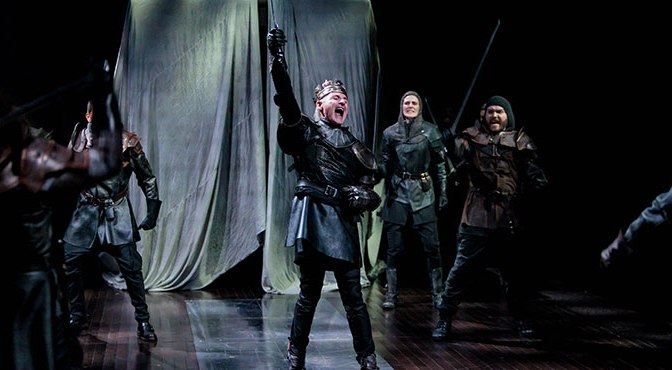
Defying the Beacon-Herald’s strictures, the Stratford Festival nonetheless opened its inaugural season with Richard III — with no less a personage than Alec Guinness (“the old Obi-Wan”, as I overheard a Festival-going mom telling her son a few years back) in the title role, and the results were raved about throughout the Anglophone world. Since then, the Festival has mounted the tragedy at least seven more times, with both widely-known actors such as Alan Bates (1967) and Brian Bedford (1977) and talented company members like Stephen Ouimette (1997) and Tom McCamus (2002’s 50th season) flocking to fill the part.
Having paid his dues at Stratford before launching into a well-rounded career that spans Canadian biopics of Pierre Trudeau & Glenn Gould and comic book movies (Thor: The Dark World and The Amazing Spider Man 2), it’s intriguing to see Colm Feore become a repeat Richard, 35 years after he first essayed the role at the 1988 Festival. His deeply physical take on the Duke of Gloucester, complete with a gait that evokes the scoliosis evident in the monarch’s recently-discovered skeleton, is visually riveting. His way with the text is equally arresting; doing without the scene-chewing excess of an Olivier, he’s nonetheless “determined to prove a villain” from the opening soliloquy, unabashedly eager to walk the Tom Patterson Theatre audience through his machinations as he claws his way toward the throne. And like Feore’s other role this season as Molière’s The Miser, his Richard becomes the focal point around which Shakespeare’s cast revolves, constantly manipulated and mesmerized by him whether they realize it or not.
Sooner or later, however, most of the other characters do discover what Richard really wants. Freed from their self-deception and ambition, it’s their reactions that give the tragedy both its recurring sparks of conflict and its building momentum. Michael Blake’s Duke of Clarence, with his dreamed intimations of his brother’s betrayal; Jessica B. Hill’s Lady Anne, whose loathing of Richard is palpable even as he perversely woos her (and wins her!); Ben Carlson’s clueless Hastings and Andre Sills’ scheming Buckingham, whose death row regrets soar to commanding heights — all these keep any empathy the audience may be developing for the would-be usurper at arm’s length.
Towering over all these are Seana McKenna (who played Richard in 2011!) as the mad, prophetic dowager Queen Margaret, calling down curses on all and sundry; Lucy Peacock, whose Queen Elizabeth soars to dizzy heights of spite and bereavement following Richard’s slaughter of her children; and Diana LeBlanc, whose Duchess of York is shocked into cursing her upstart son just as he gains the throne. This is titanic stuff — the loosely historical narrative may drive the action of the play, but the clash of deep — and deeply flawed — characters is what keeps us from joining Team Richard, despite the combined allure of Shakespeare’s words and Feore’s strange appeal. In fact, no sooner does Richard become king than we (and possibly he) realize that his downfall is inevitable — and that we need to see it, to make some sense of these tumultyous events.
Even in the intimate TPT (with one-third the capacity of the Festival Theatre), there’s spectacle aplenty to be mined by director Antoni Cimolino and the populous, well-drilled cast as Richard approaches his necessary end. Royal processions, civil unrest, a coronation, ghostly visitations and the final battle between the forces of the usurper and Jamie Mac’s enigmatic, recessive Henry Tudor stir the blood, even as they bring Richard’s lurid dreams to both their culmination and their dissolution. And while this generally traditional production is a feast for the eyes and ears that I can’t recommend highly enough, Cimolino leaves us with more food for thought as well. His prologue and epilogue are set in the present day, with the discovery of Richard’s skeleton and his reburial in Leicester Cathedral bookending the tragedy — as if to remind us that, no matter how high Shakespeare’s characters may fly, as the Bard wrote later in his career,
Golden lads and girls all must, Like chimney sweepers come to dust.
In last year’s cut-down Stratford Festival lineup, actor/musician/playwright Beau Dixon’s Freedom Cabaret (part of the Festival’s Forum of other performing arts and speakers) garnered some of the strongest reviews. Walking out of yesterday’s performance of Freedom Cabaret 2.0, I completely understood why.
Subtitled “How Black Music Shaped the Dream of America”, this year’s cabaret is loosely structured around the life of work and Martin Luther King, Jr. Dixon’s command of the black musical tradition is formidable and thrillingly eclectic; grasping the connections between decades and genres with a firm hand, his new set comfortably mingles jazz, soul, folk, gospel and even a touch of hip-hop in an arc that illuminates both King’s journey and the idealism he set loose during the era of the Civil Rights Movement.
And the ensemble that Dixon has reconstituted for this year — serving as the lynchpin on piano and vocals for a trio of singers with rhythm section — grasps those connections at the same level, vividly painting a compelling portrait of King’s context, life, death and legacy. Shakura Dickson’s floating soprano and Alana Bridgewater’s earthy alto scale the gospel heights of “Oh, Happy Day” and “Move On Up A Little Higher”, then pull back for an eerie, hovering “Strange Fruit” and Nina Simone’s wrenching “Four Women”; Aadin Church runs the emotional and vocal gamut from soaring tenor to down-home baritone on showcases like Louis Armstrong’s “(What Did I Do to Be So) Black and Blue”. Rohan Staton on guitar, Roger Williams on bass and Joe Bowden on drums lay down one irresistible groove after another, slipping serenely from a Jeff Beck quote in “People Get Ready” to the abstracted jazz of “Freedom Day”. And Dixon ties it all together with his supple piano, his power-packed voice and his understated yet emotional narration.
Most fascinating to me were the artists Dixon chose to anchor King’s story. Stevie Wonder’s “Love’s in Need of Love Today” and “Living for the City” bookended the narrative, melding harmonic sophistication with unaffected idealism; the Staples Singers “Why? (Am I Treated So Bad)”, “Freedom Highway” and “Respect Yourself” embodied both the lament of the oppressed and the spiritual grit to stand up against that oppression. But the searing quartet of pieces by chanteuse Nina Simone provided the real key to unlock the heart of King’s message. From unflinching confrontation with racism’s deepest horrors in “Mississippi Goddamn” (operatic in structure, visceral in its impact) through the heartbroken elegy for the fallen leader “Why? (The King of Love Is Dead)” pivoting to the visionary hope of “To Be Young, Gifted and Black”, Simone’s music is brutally honest and unsparing — but it also incarnates how King’s dream of hatred conquered by love was set loose in the 1960s and how its ramifications have been rippling out ever since.
The dream and its spread — even after the horrors of black history in the United States, even in the face of what obstacles remain following the progress of the Civil Rights era — are why Dixon and his ensemble can finish Freedom Cabaret with a hearty invitation for the Festival audience to join the “Love Train” that King set in motion. If you can, I highly recommend you catch it.
Setlist:
Oh, Freedom
Love’s in Need of Love Today (Stevie Wonder)
Why? (Am I Treated So Bad) (The Staples Singers)
Oh, Happy Day (The Edwin Hawkins Singers)
Move On Up A Little Higher (Mahalia Jackson)
Strange Fruit (Billie Holliday)
Mississippi Goddam (Nina Simone)
Freedom Highway (The Staples Singers)
People Get Ready (The Impressions)
We Shall Not Be Moved
John Henry (Harry Belafonte)
Black Man in a White World (Michael Kiwanuka)
(What Did I Do to Be So) Black and Blue? (Louis Armstrong)
Respect Yourself (The Staples Singers)/Respect (Aretha Franklin)
Freedom Day (Max Roach & Abbey Lincoln)
Phenomenal Woman (Maya Angelou)/Four Women (Nina Simone)
So Much Trouble in the World (Bob Marley and the Wailers)
Why? (The King of Love Is Dead) (Nina Simone)
Harlem (Langston Hughes)/To Be Young, Gifted and Black (Nina Simone)
Living for the City (conclusion) (Stevie Wonder)
Ain’t No Stoppin’ Us Now (McFadden & Whitehead)
Move On Up (Curtis Mayfield)
Love Train (The O’Jays)
Personnel:
Joe Bowden, drums
Alana Bridgewater, singer
Aadin Church, singer
Shakura Dickson, singer
Beau Dixon, piano, singer, musical director
Rohan Staton, guitars
Roger Williams, basses
Freedom Cabaret 2.0: How Black Music Shaped the Dream of America runs through August 28th at the Tom Patterson Theatre’s Lazaridis Hall in Stratford, Ontario. Tickets are available at stratfordfestival.ca.
Harpagon, the title character of Molière’s The Miser, is a flat-out fool. Money — getting it, keeping it, hoarding it — is his obsession; in the presence of his stash, he kneels in abject devotion. But he also projects that obsession onto everyone else in his life. He berates his adult son and daughter for their “spendthrift” ways; he lends cash only at exorbitant rates (with outrageous stipulations in the small print); his fear of both having his treasure with him and letting it out of his sight easily slides into wholesale paranoia that everyone is out to part him from it.
The thing is, Harpagon isn’t completely wrong; his single-mindedness warps how everyone in his life approaches him. Both his children hesitate to reveal their new loves to him, for fear he’ll deny access to their trust funds. His household servants (including his son’s shady buddy and his daughter’s lover) suck up to him and diss their colleagues to his face, bitching behind his back and battling for dominance all the while. The local matchmaker (who Harpagon has tasked with finding him a new, young wife) and moneylender butter him up outrageously, hoping against hope to profit from their flattery. Even the ingenue both Harpagon and his son are after wants the miser’s money — to provide for her ill mother’s medical care, but still! The farcical complications of the play flow naturally and wittily from this set-up; in the company of a master fool who has what they desire, everyone’s foolishness will out.
Where the Stratford Festival’s new production of The Miser is faithful to that core revelation of Molière’s wry fable, it sparkles with a sneaky glee — even through two layers of adaptation (Ranjit Bolt’s Anglicized translation of 2001, further updated to contemporary Canada by director Antoni Cimolino). Guarding not only his briefcase full of Canadian $100s, but every absurd knick-knack in his Victorian horror of a house, Colm Feore’s Harper is the blazing star of this show; his alternating mania about Mammon and cluelessness about everything else send everyone around him into their own eccentric orbits. The household servants — ne’er do well Fletcher (a phlegmatic, sly Emilio Vieira), butler/secret lover Victor (Jamie Mac, confident and bewildered in turn), and chef/chauffeur Jack (Ron Kennell in full clowning mode) — alternately brazen their way through Harper’s whims and unleash their frustrations on each other; matchmaker Fay (Festival stalwart Lucy Peacock, in what amounts to a well-deserved star cameo) puts on a show of managerial competence for everyone else while gingerly fumbling with Harper like he’s about to explode; love interest Marianne (an empathetic, determined Beck Lloyd) stands up for herself and her mother appealingly, even as Harper and his son Charlie scrap over her like kids on a playground.
The characterizations of Charlie and Harper’s daughter Eleanor were what struck me as the weakest part of this production. While Qasim Khan and Alexandra Lainfiesta hit the right notes of frustration and futility (aided by the campy thrift-store chic of their costuming), their amped-up desperation comes across as shrill and brittle. The struggle between a serenely ignorant father and his deprived yet somehow spoiled children — the heart of the play’s satire — is where Cimilono least trusts Molière to connect. Instead, he crams gratituous Boomer vs. Millenial references into both the program notes and the script, saddling Charlie with a petty consumerist materialism and Eleanor with a string of cliche “woke yet broke” slogans. It has to be said that Khan and Lainfiesta sell this material with all their considerable ability; but for me, the insistence on painfully present-tense content is what keeps a funny production from crossing over into the hysteria that Molière generates when played with trust. There are plenty of simmering chuckles and outright hoots here, but not as many unstoppable guffaws as I had hoped for.
That said, this production of The Miser (complete with an over-the-top fairy-tale ending that does retain its hilarious impact through the layers of updating, as David Collins’ wonderfully deadpan Sir Arthur Edgerton sticks the landing) had the Festival Theatre audience in stitches, attested by the generous, heartfelt ovation for Feore and his supporting cast. If you can peer through the alternately opaque and overripe references to “the next Bezos” and “the land of Tim’s” (oh, and Harper’s distrust of safes — they attract the FBI as well as burglars!), you may well find yourself reflected in Molière’s unflattering yet strangely revealing mirror.
The Miser is currently in previews at the Stratford Festival Theatre. It officially opens on August 26th, playing through October 29th. Tickets are available at stratfordfestival.ca.
This is an exciting time for the Stratford Festival. In 2022, we reopen our theatres, honour the excellence of the past and embark on a new leg of our journey together. A fresh start: an opportunity to reassess ourselves in the world today, reaffirm what we value and take the best path to an extraordinary future.
This will also be a year to celebrate milestones: our 70th season, the 20th anniversary of the Studio Theatre, the 10th season of The Meighen Forum, and the grand opening of our glorious new Tom Patterson Theatre.
It’s fitting, then, that our season theme for 2022 is New Beginnings. Our playbill explores the difficult moral and ethical decisions a new journey entails: What is the best way to start again? How can we avoid the traps of the past? In an imperfect world, what is good?
From Shakespeare’s most iconic play, Hamlet, to the American family classic Little Women; from the great Nigerian Nobel Prize winner Wole Soyinka’s Death and the King’s Horseman to such captivating new plays as 1939 and Hamlet-911, we offer you stories about navigating a new start in life.
Since 2004, my wife and I have been regular visitors to the Stratford Festival in southwestern Ontario. We’ve fallen in love with the Festival’s unbroken ethos across 70 seasons — dynamic, top-level performances by a dedicated repertory company of classics by William Shakespeare, Molière, Anton Chekhov, Berthold Brecht and others, as well as substantive, appealing musicals and fresh, often experimental works by today’s playwrights. We’ve also fallen in love with the city of Stratford; set in the heart of Ontario farm country, it combines picturesque architecture, unique shops and eateries, and a stunningly beautiful park system along the Avon River and Lake Victoria. And the thought of everyone who’s trod a stage at the Festival’s multiple theatres, played a rock show at the hockey rink or busked for change on the streets (ranging from Alec Guinness and William Shatner to Richard Manuel of The Band and native son Justin Bieber) makes the place a performing arts lover’s dream.
Which is why it hit hard when, in the wake of the worldwide pandemic, the Festival’s 2020 season was cancelled and the 2021 season only went on under severe limitations and restrictions. It’s true that the summer of 2020 brought welcome YouTube screenings of the Festival’s ongoing project to film every play by Shakespeare (along with other archival videos), culminating in the online Stratfest At Home subscription service. But, a few days back at a local B&B, with a full season of 10 productions energizing the town around us, has served to remind me that there’s nothing like the real thing. And that experience is what I plan to share here with you.
Over the next few days, we’ll be attending Molière’s The Miser (currently in previews at the Festival Theatre), Shakespeare’s Richard III (at the new Tom Patterson Theatre), and Freedom Cabaret 2.0: How Black Music Shaped the Dream of America (at the TPT’s Lazaridis Hall). Look for reviews posted here ASAP after each performance. Whether you’re able to visit the Stratford Festival this season or in the future (or take in what it offers online), my hope is to capture at least a bit of the serious fun, the sheer emotional and intellectual sweep, the thrills, spills, heartbreak and heart’s ease — in short, the immersive, cathartic experience live theatre at its best can provide, and that the two of us have come to love and crave.
I’m excited you’ll be reissuing the first Storm Corrosion album this year. I know you get asked this a lot, but…have you and Opeth’s Mikael Åkerfeldt talked recently about making another album?
It is the 10th anniversary, so we’re doing a new version, and we’re gonna get together and do some press to promote it. We even talked about recording a new track for the new edition, but we said, “If we’re gonna do that, why don’t we just do a new record?” So the subject certainly has come up. I think we would love to do something else together. I don’t think we’d do a follow-up to that record. I think we want to do something quite different again. I don’t know what that would be, but I know that’s the way he is and what I am. That record is so perfect and definitive in what it tries to do and what it achieves. It’s a little diamond, I think. And I think a lot of people missed out on it because it’s not what they expected us to do. But I know that for some people that it’s their favorite thing that either of us have done. I’ve heard that more and more. There’s a little cult growing up around that record.
— Read on www.spin.com/2022/06/steven-wilson-porcupine-tree-reunion-interview/
An extraordinary man by any measure, Owen Barfield (1898-1997), one of the least known of the Inklings, published his first book, History in English Words, in 1926, at the very young age of 27 or 28. One of the finest books I’ve ever read, History in English Words is an in-depth examination of the history of Western civilization as seen through the eyes of English speakers, measuring a significant number of words through their individual journeys and evolutions.
— Read on theimaginativeconservative.org/2022/08/owen-barfield-history-in-english-words-bradley-birzer.html
Granted, I love the American West. I love open skies, I love mountains, and I love cool, dry air. Even given all these personal loves, I still think Yellowstone is something truly special. Everywhere you look—in addition to seeing families—you see an abundance of nature, God’s creation at its most glorious. Mountain ranges, vast meadows, deep canyons, pine tree forests, dynamic rivers and waterfalls, boiling and steaming geysers, petrified trees. The landscapes in Yellowstone are as varied as they are vast. As my younger children noted, many of the landscapes in Yellowstone rivaled anything in a fantasy novel (specifically Narnia) or a painting.
— Read on theimaginativeconservative.org/2022/08/yellowstone-150-bradley-birzer.html




 Spirit of Cecilia
You must be logged in to post a comment.