It’s 5/4: Dave Brubeck Day!
It’s 5/4–Dave Brubeck Day!

https://bradleyjbirzer.substack.com/p/54-happy-dave-brubeck-day
The Unessential Brubeck
A review of Philip Clark, Dave Brubeck: A Life in Time (New York: DaCapo Press, 2020). Xvii + 403 pp of text + discography, bibliography, and index.
I do not remember a time in my life when Dave Brubeck’s music did not provide the soundtrack. Indeed, his music is inextricably tied up to and with my own life. Some of my earliest memories come from staring at Brubeck’s album covers—Time Out and Time Further Out by S. Neil Fujita and Joan Miro, respectively—and trying to make sense of the abstractions. And, as family lore goes, even as a kid I loved dancing to music such as “Take Five,” even waking up the entire household in the middle of the night by blaring the stereo system at full volume. As was the case with probably many of us of my generation, Time Out was one of my father’s favorite albums and Brubeck one of his favorite musicians, rivaled only by Herb Alpert. To this day, I have stacks and stacks of Brubeck CDs and boxsets, and his music plays throughout the house and the office. Maybe not daily, but certainly weekly. When my older brother, Todd, and I get together, we still talk Brubeck. Even now, as I pour through various prog and jazz albums, I’m always on the lookout for Brubeck’s influences.
As a case in point, Pat Metheny’s latest, From This Place—arguably this jazz master’s best—reflects widely and deeply the compositional structure of Brubeck’s best album, 1964’s Time Changes. The resemblance is simply too obvious to ignore. Even the theme is critical. Brubeck’s album was inspired by a short story involving two cellmates and a crust of bread. The religious essence of the album is blatant, with Brubeck trying to find that which ties all humans together, regardless of ethnicity or race. It is, for all intents and purposes, a meditation on human decency and divine agency. Metheny’s latest calls us to be the best we can expect of ourselves as Americans.
In 2012, when Brubeck died around Christmas time of that year, I vowed that I would one day write a biography of him. Despite preliminary research and reading, I’ve really not dived into this project, but Brubeck remains a profound part of my life, nonetheless.
Two stories from Brubeck’s own life mean everything to me.
First, at Ronald Reagan’s last summit with Soviet leader Mikhail Gorbachev, held in Moscow in 1988, the Reagan administration insisted that Dave Brubeck represent America as her greatest cultural achievement. Brubeck’s producer, Russell Gloyd, recognized this grand achievement for what it was. “You have to put this in perspective,” he argued. “There was Perestroika, the whole awakening of the Soviet Union, the whole concept of what was taking place at that time in world history. This was the first time there was hope of a real chance for an understanding between the East and the West,” he continued. “For Dave to be the representative artist meant everything to everyone who was close to us.”
The atmosphere was tense. Reagan was exhausted from his trip, Gorbachev’s security was worried about assassination plots, and it was a ridiculously hot and humid day in Moscow. “I walked in thinking that this was the hardest room Dave had ever had to work in his life,” claims Gloyd. After a number of lackluster diplomatic niceties in the stuffy room, Brubeck walked up to the piano, sat down, and started playing “Take the ‘A’ Train.” “It brought down the house,” Gloyd reports. “People were up and cheering. I’ll never forget Bob Dole—he looked like a little kid. He had his one good hand raised above his head like he was at a football game. He’d turn around, and there was a Soviet general, loaded with medals, doing the same thing! They looked at each other like, ‘You like Brubeck? I like Brubeck! We like Brubeck.” It was, Gloyd notes, “the greatest single twenty-minute set in his life.” The Cold War became much less frigid that day.
Second, though he came from a Presbyterian family, Brubeck converted to Roman Catholicism as an adult. “I never had belonged to any church. I was never baptized before,” Brubeck remembered. “I was the only son in the family who wasn’t baptized a Presbyterian. It was just an oversight.” To be certain, religious music—from the African-American community as well as from the white/European community—had always intrigued and influenced him. He wrote liturgical-jazz pieces about Easter, Christmas, and Martin Luther King.
Though he had written a number of specifically religious themed albums and pieces, however, his greatest expression of his Christianity came when Our Sunday Visitor (headquartered in Huntington, Indiana) commissioned Brubeck to write a Mass. He, in very Brubeck fashion, entitled it, To Hope! A Celebration, and performed it—with Gloyd conducting—at Washington National Cathedral. The premier music review website, Allmusic, writes of it: This stunning work incorporates jazz interludes into the hypnotic Responsorial “The Peace of Jerusalem” and “Alleluia,” a particularly challenging section for the choir. The vocal soloists are impressive; tenor Mark Bleeke’s feature “While He Was At Supper” is especially moving. The overall effect of this beautiful work is absolutely stunning; it resists being labeled in any one category, it is simply great music.” Fundamentally optimistic about the human experience, Brubeck had said in a commencement address in 1982: “What is really important in the community, in the worst of times, is often music. It’s the cement for the community that holds it together, and the thing that gives it hope.”
Sadly, neither of these stories can be found in Philip Clark’s just published “biography,” Dave Brubeck: A Life in Time (New York: DaCapo Press, 2020). Though the cover proclaims this to be “the definitive investigative biography of jazz legend Dave Brubeck,” there is not a single mention of Brubeck’s 1988 trip to Moscow or his conversion to Catholicism. Just how definitive is this biography by Clark? Bizarrely, Brubeck is not even born until page 302.
When I first learned of the existence of this book—on February 19—I purchased it at a Books-a-Million within a few hours of the news. Rather than wait for the cheaper Amazon.com version, I had to have the book immediately. I was thrilled it existed, and I dove right into it. Alas, rarely have I been so disappointed by a book.
When it comes to writing—on a sentence by sentence basis—Clark is outstanding. According to the dust jacket, he has written for a vast number of music periodicals as well as for the London Guardian and the London Times. There’s no doubting his grammar or style. But when it comes to composing a book of this length, he is. . . to be polite. . . lacking. It turns out that Clark knew Brubeck relatively well and had interviewed him a number of times in the last twenty years of his life. Though we learn nothing of Brubeck’s Catholicism or his trip to Moscow—both so essential to his life—we do get editorial comments such as
“As the bus breaks for the London border, with the motorway to Brighton stretching ahead, [bassist] Moore falls into earnest conversation with Iola Brubeck. Heads nod remorsefully, then Moore’s grotesque caricature of President George W. Bush’s nervy Texas drawl hits a manic crescendo reminiscent of an operatic made scene.”
Or, this tidbit:
“As I wrote all these years later, that Brubeck’s accounts of his country’s gravest shame should have such damning relevance to Trump’s America felt unbearably poignant and tragic—time overlaps, but it is also cyclic.”
I am certainly no fan—in any way, shape, or form—of Presidents Bush or Trump, but I very much fail to understand why these things matter in a biography of Dave Brubeck, who was so much better and worthy of so much more than what Clark presents in this book.
Clark is at his best in the book when not writing the biographical parts. Indeed, Clark excels at explaining Brubeck’s techniques, his influences, and his influence. During parts of the book—especially Clark’s section on Brubeck’s influence on rock and progressive rock—I was riveted. Clark is also good when it comes to Brubeck’s defying the horrific racialist laws, habits, and customs of much of 1950s and 60s America. Brubeck was not only an optimist in his view of humanity, he was deeply humane in his understanding of the dignity of the human person. He never backed down from what he believed correct, and his actions on race relations are nothing short of heroic in his own lifetime.
If you’re looking for a fan-boy appreciation of Brubeck’s talents and his understandings of race relations, Dave Brubeck: A Life in Time, is a fine outing. If, however, you’re looking for the “definitive, investigative biography of jazz legend Dave Brubeck” run as far away from this book as possible. One of the greatest talents to come out of 20th-century America, Brubeck deserves so much better.
Until someone actually does the critically hard work of looking closely at Brubeck’s life through his music as well as through his letters and papers and getting into the very bright and endlessly creative soul of Brubeck, no definitive biography yet exists. The best book on Brubeck remains Fred M. Hall, It’s About Time: The Dave Brubeck Story (Fayetteville: University of Arkansas Press, 1996). It’s an excellent book, and the stories above come from Hall’s work.
Or, just listen to Brubeck’s music. He poured himself into his art—into every note.
In Concert: A Great Orchestra, A Hot Conductor, A Thrilling Night
The Chicago Symphony Orchestra, Friday, May 2, 2025.
It had been more than 15 years since I had heard the Chicago Symphony Orchestra live – and nearly 25 since I had heard them on their home ground, Orchestra Hall in Symphony Center. So last year, when the CSO announced that young conducting phenomenon Klaus Mäkelä (referenced in my highlights of 2024 post) had accepted the post of Music Director Designate, I decided that a renewed acquaintance with one of the USA’s top orchestras was long overdue.
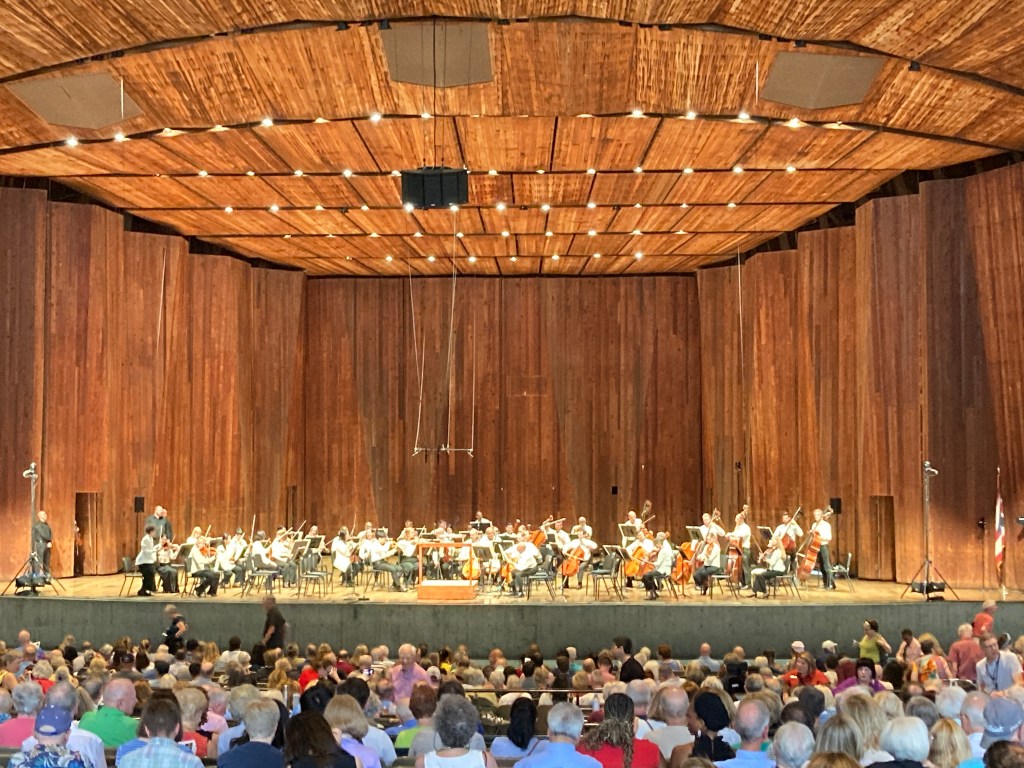
Orchestra Hall, dating all the way back to 1904, is a unique venue in and of itself: its wide but thin stage and steeply raked balconies make for a intimate (if not always comfortable) concert experience. Renovations in the 1990s added gallery seats above and behind the stage, as well as a suspended shell to soften and deepen a challenging acoustic. So it wasn’t hard to imagine the musicians feeling like they were in a fishbowl as they clambered atop multilevel risers in front of a full house.

But beyond the typical pre-concert buzz, there was a question in the air. By and large, Mäkelä has made his reputation in post-Romantic and 20th-century music — well-regarded recordings of Sibelius and Stravinsky, Chicago guest shots focused on big pieces by Shostakovich and Mahler. Would his take on the core classical repertoire — works the CSO has performed since its start in the 1890s, conducted by everyone from founding conductor Theodore Thomas to previous Music Director Riccardo Muti — measure up?
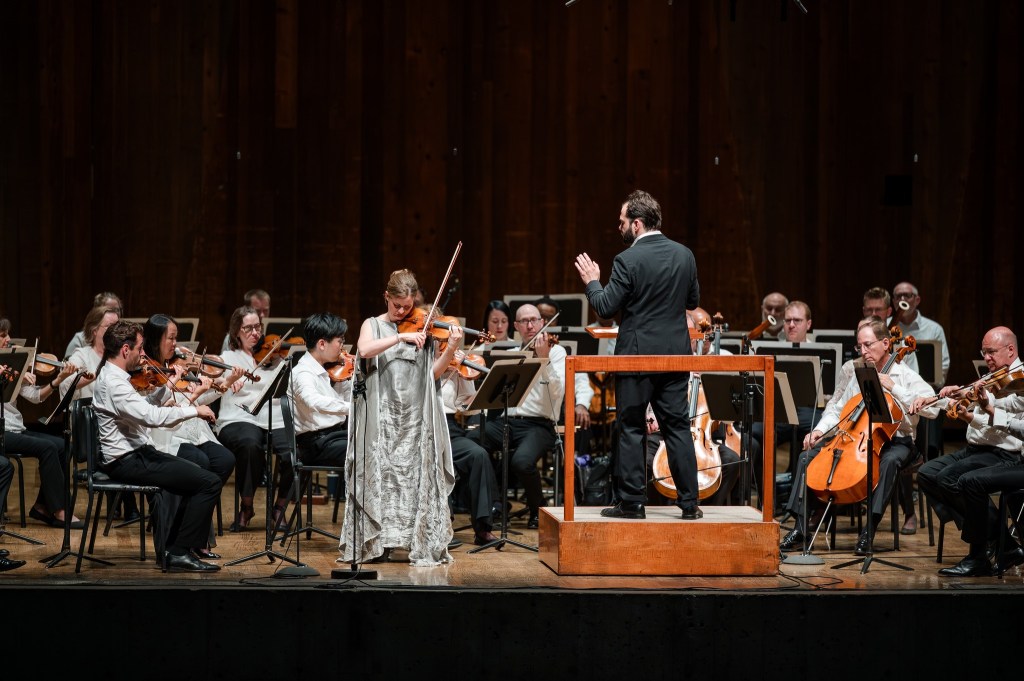
That question was answered in a flash, as Mäkelä and CSO Artist in Residence Daniil Trifonov whipped up a fresh, appealing reading of Johannes Brahms’ Piano Concerto No. 2. None of the overbearing, ponderous sludge that unimaginative historians accuse Brahms of here! Trifonov’s playing was always flowing, supple and strong, with no hints of pounding or cloudy tone; CSO principals Mark Almond (horn) and John Sharp (cello) made the most of their lyrical solo moments with warm tone and deep expressiveness; and the orchestra sounded lithe and limber in the extended opening, energetically playful in Brahms’ scherzo, chastely gorgeous in a delectable Andante, and delightfully bouncy in the closing Allegretto. All the while, Mäkelä was sculpting the overall sound, focusing balances, dynamics and timing for maximum emotional impact. The scattered spontaneous applause after every movement (the grinning conductor and pianist had to restrain themselves before pouncing on the finale) was proof that the music hit home, even before the final ovation and the outsized reaction to Trifonov’s encore (a Chopin prelude lasting less than a minute).
After intermission came a centennial tribute to the CSO’s late Principal Guest Conductor Pierre Boulez (who conducted the orchestra the last time I’d heard them — a dark, lush program of Ravel and Bartok in Ann Arbor, back in 2010). Well executed by brass septet and precisely conducted by Mäkelä, Boulez’s Initiale lived up to its billing — a tart, postmodern appetizer announcing itself pointedly, quickly tying itself into contrapuntal knots, then breaking loose for a final flourish. Complete with a tuba mute (which always makes me smile)!
But it was the last work on the program, Antonin Dvořák’s Symphony No. 7, that really showed what Mäkelä and the CSO can accomplish together. The orchestra’s tone was at its richest, its dynamic range wider and its rhythmic flow freer than in the Brahms. Mäkelä threw himself into the piece with greater animation and more sweeping body language — but also with a greater willingness to let the players take the reins, dropping his beat to focus on accents and phrasing for surprisingly long stretches. The powerful resonance of Dvořák’s opening themes and their punchy development, the breadth of feeling in his Andante, the infectious swing of the Scherzo’s cross-rhythms, and the hard-won, dramatic climax — they were all there in vibrant technicolor, fully formed, overflowing with life and vigor. You could tell that Mäkelä dug leading the CSO, and they obviously dug playing with him. And the audience absolutely loved it, leaping to its feet as Makela acknowledged the symphony’s featured musicians, brought the orchestra up for their bow — and modestly pointed to Dvořák’s score as the applause continued.
When he becomes the CSO’s Music Director in the fall of 2027 (while at the same time taking over Amsterdam’s Concertgebouw Orchestra), Klaus Mäkelä will be 31. Based on last Friday night’s concert, he’s got an amazing head start — both on a lifetime of personal musical growth, and building a potentially astounding rapport with one of the top orchestras in the world. Believe me, I’ll be back to Chicago much sooner next time!
- Klaus Mäkelä conducts the Chicago Symphony Orchestra in works by Berlioz, Beethoven, Schumann, Sibelius, Richard Strauss, Milhaud, Gershwin and Stravinsky during the 2025-26 season.
- The CSO can be heard weekly on Sundays at 8 pm Central time on WFMT.
- Numerous recordings by the CSO and related artists are available on CD from The Symphony Store.
— Rick Krueger
Paul Johnson’s Creators – Praise for Artists of All Kinds
Paul Johnson is my favorite historian (my dear friend, Brad Birzer, is my favorite living historian!). Johnson takes complicated subjects, makes them understandable, and he does it in an entertaining way. He’s British, but he has written a fantastic history of the United States, A History of the American People. Other excellent books of his are The Birth of the Modern: World History 1815 – 1830, and Modern Times: The World from the Twenties to the Nineties.
Creators was written after his book, Intellectuals, received some criticism for focusing too heavily on the hypocrisy of some of history’s most famous and influential intellectuals. As he explained, “I defined an intellectual as someone who thinks ideas are more important than people.” I, personally, appreciated learning about the moral failings of Rousseau, Marx, Ibsen, Sartre, and other thinkers who have been lionized by our intelligentsia. It’s the eternal story: “Do as I say, not as I do.”
Anyway, Creators is, on balance, a more positive and inspiring collection of portraits. In it, Johnson gives us brief descriptions of Chaucer, Durer, Shakespeare, J. S. Bach, Turner and Hokusai, Jane Austen, A.W.N. Pugin and Viollet-le-Duc, Victor Hugo, Mark Twain, Tiffany, T.S. Eliot, Balenciaga and Dior, and Picasso and Walt Disney. Throughout these portraits his admiration for these artists’ work shines clearly.
Johnson is the master of providing the interesting anecdote that humanizes and makes real his subject. For example, he writes that the composer Wagner
required a beautiful landscape outside his windows, but when he wrote music, the silence had to be absolute and all outside sounds, and sunlight, had to be excluded by heavy curtains of the finest and costliest materials. They had to draw with “a satisfying swish.” The carpets had to be ankle-deep; the sofas enormous; the curtains vast, of silk and satin. The air had to be perfumed with a special scent. The polish must be “radiant.” The heat must have been oppressive, but Wagner required it. Johnson, Paul. Creators: From Chaucer and Durer to Picasso and Disney (p. 9). HarperCollins. Kindle Edition.Johnson praises Chaucer for creating the very idea of English literature. Before him, all politics and creative arts were conducted in French and Latin. He was the first to proudly use English in his poetry, and his portrayals of various classes of people are unparalleled. In my opinion, Creators is worth reading for his chapter on Shakespeare alone. Johnson does a wonderful job explaining how a man with humble beginnings could attain such incredible heights of literary excellence. Interestingly, he makes the case for Shakespeare not being an intellectual. In other words, for Shakespeare, people were more important than ideas.
He [Shakespeare] rarely allows his opinions open expression, preferring to hint and nudge, to imply and suggest, rather than to state. His gospel, however, is moderation in all things; his taste is for toleration. Like Chaucer, he takes human beings as he finds them, imperfect, insecure, weak and fallible or headstrong and foolish—often desperate—and yet always interesting, often lovable or touching. He has something to say on behalf of all his characters, even the obvious villains, and he speaks from inside them, allowing them to put forward their point of view and give their reasons. Johnson, Paul. Creators: From Chaucer and Durer to Picasso and Disney (p. 54). HarperCollins. Kindle Edition.I also learned that no one has created as many words and phrases that have entered common use as Shakespeare. Some estimate he coined as many as 6700 new words! Like Harold Bloom, Johnson has nothing but praise for the two Henry IV plays and Hamlet. Johnson’s explication of the psychological and moral dilemmas explored in Hamlet is fantastic.
It is characteristic of this stupendous drama that the long passages of heroic reflection, which never bore but stimulate, are punctuated by episodes of furious action, the whole thing ending in a swift-moving climax of slaughter. No one can sit through Hamlet and absorb its messages—on human faith and wickedness; on cupidity, malice, vanity, lust; on regeneration and repentance; on love and hate, procrastination, hurry, honesty, and deceit; on loyalty and betrayal, courage, cowardice, indecision, and flaming passion—without being moved, shaken, and deeply disturbed. The play, if read carefully, is likely to induce deep depression—it always does with me—but if well produced and acted, as Shakespeare intended, it is purgative and reassuring, for Hamlet, the confused but essentially benevolent young genius, is immortal, speeding heavenward as “flight of angels sing thee to thy rest.” It is, in its own mysterious and transcendental way, a healthy and restorative work of art, adding to the net sum of human happiness as surely as it adds to our wisdom and understanding of humanity. Johnson, Paul. Creators: From Chaucer and Durer to Picasso and Disney (p. 75). HarperCollins. Kindle Edition.Johnson’s next subject, Johann Sebastian Bach, was a solidly middle class man who was confident in his extraordinary ability to compose music, even if he wasn’t recognized for it during his lifetime.
Bach was by far the most hardworking of the great musicians, taking huge pains with everything he did and working out the most ephemeral scores in their logical and musical totality, everything written down in his fine, firm hand as though his life depended on it—as, in a sense, was true, for if Bach had scamped a musical duty, or performed it with anything less than the perfection he demanded, he clearly could not have lived with himself. It is impossible to find, in any of his scores, time-serving repetitions, shortcuts, carelessness, or even the smallest hint of vulgarity. He served up the highest quality, in performance and composition, day after day, year after year, despite the fact that his employers, as often as not, could not tell the good from the bad or even from the mediocre. Johnson, Paul. Creators: From Chaucer and Durer to Picasso and Disney (pp. 82-83). HarperCollins. Kindle Edition.It’s almost a miracle that we have as many works of his today to perform, as they were scattered amongst his descendants after he died. If not for the efforts of Mendelssohn to restage Bach’s St. Matthew Passion in 1827, we might not have had the revival of his music that we enjoy so much today. Johnson uses this event to share another fun anecdote:
Afterward, at Zelter’s house, there was a grand dinner of the Berlin intellectual elite. Frau Derrient whispered to Mendelssohn: “Who is the stupid fellow sitting next to me?” Mendelssohn (behind his napkin): “The stupid fellow next to you is the great philosopher Friedrich Hegel!” Johnson, Paul. Creators: From Chaucer and Durer to Picasso and Disney (p. 93). HarperCollins. Kindle Edition.The chapter on the artists William Turner and Hokusai is very interesting. Both began drawing from the age of three. Turner was somewhat controversial because of his new and unusual way of painting light, but he ended up one of the most popular and wealthy artists in history. Unfortunately, time and bungling “restorers” have kept us from appreciating his radical use of color. Even his contemporaries could see how his paintings faded not long after he finished them. Hokusai never profited much from his prodigious output, always begging benefactors for money. According to Johnson, he pretty much invented landscape art in Japan. He was quite a character:
There was a restless rootlessness to him, reflected in the fact that he changed his name, or rather the signature on his works, more than fifty times, more often than any other Japanese artist; and in the fact that during his life he lived at ninety- three different addresses. The names he used included Fusenko, meaning “he who does only one thing without being influenced by others”; “The Crazy Old Man of Katsushika”; and “Manji, the Old Man Mad about Drawing.” After he fell into a ditch, as a result of a loud clap of thunder, he signed himself “Thunder” for a time. Johnson, Paul. Creators: From Chaucer and Durer to Picasso and Disney (p. 108). HarperCollins. Kindle Edition.Johnson’s chapter on Jane Austen is the slightest one, not because of any fault of Johnson, but because we know so little of Austen. Her family suppressed most of her personal correspondence, and they tried to make her into a Victorian woman, rather than the Regency one she was. However, according to Johnson, we can glean some personality traits from the letters and reminiscences that do exist and conclude that she was fun-loving young woman, which was the source of her genius:
Laughter was the invariable precursor, in Austen’s life, of creative action—the titter, the laugh, the giggle, or the guffaw was swiftly followed by the inventive thought. Once Austen began to laugh, not with the melodramatic novels she read, but against them, she began to look into herself and say, “I can do better than that.” Johnson, Paul. Creators: From Chaucer and Durer to Picasso and Disney (pp. 130-131). HarperCollins. Kindle Edition.Pugin and Violett-le-Duc were both architects, the former responsible for the Gothic revival in England. We have Pugin to thank for the beautiful Houses of Parliament in London. The chapter on Victor Hugo is a very interesting one. In it, Johnson poses the question,
That Hugo was phenomenally creative is unarguable: in sheer quantity and often in quality too, he is in the highest class of artists. But he forces one to ask the question: is it possible for someone of high creative gifts to be possessed of mediocre, banal, even low intelligence? Johnson, Paul. Creators: From Chaucer and Durer to Picasso and Disney (p. 156). HarperCollins. Kindle Edition.Johnson does not have a lot of admiration for Hugo, pointing out how contradictory his political opinions were, depending on what party was in power. He also kept many mistresses, well into his eighties! Mark Twain comes in for more respectful treatment. Johnson posits that his genius was as a storyteller – to truly appreciate his work, we need to hear it “performed”. He also had a knack for making great literature out of almost nothing:
His creativity was often crude and nearly always shameless. But it was huge and genuine, overpowering indeed, a kind of vulgar magic, making something out of nothing, then transforming that mere something into entire books, which in turn hardened into traditions and cultural certitudes. Johnson, Paul. Creators: From Chaucer and Durer to Picasso and Disney (p. 171). HarperCollins. Kindle Edition.T. S. Eliot was a paradox – very conservative in his personal life, yet revolutionary in his poetry:
Eliot was never once (except on holiday) photographed without a tie, wore three-piece suits on all occasions, kept his hair trimmed, and was the last intellectual on either side of the Atlantic to wear spats. Yet there can be absolutely no doubt that he deliberately marshaled his immense creative powers to shatter the existing mold of poetical form and context, and to create a new orthodoxy born of chaos, incoherence, and dissonance. Johnson, Paul. Creators: From Chaucer and Durer to Picasso and Disney (p. 204). HarperCollins. Kindle Edition.The turning point in Eliot’s career came when he met Ezra Pound, who introduced him to lots of European literary stars and convinced him to emigrate to England. He married Vivian Haighwood, but it doesn’t sound like the relationship was much fun:
From the early days of their marriage they engaged in competitive hypochondria. Both became valetudinarians and were always dosing themselves, complaining of drafts, and comparing symptoms. Johnson, Paul. Creators: From Chaucer and Durer to Picasso and Disney (p. 213). HarperCollins. Kindle Edition.However, this dismal marriage, coupled with his job at Lloyd’s bank in London, spurred Eliot to create his masterpieces, The Waste Land and Four Quartets. As Johnson puts it, The Waste Land‘s strength is its elusiveness:
The greatest strength and appeal of the poem is that it asks to be interpreted not so much as the poet insists but as the reader wishes. It makes the reader a cocreator. Johnson, Paul. Creators: From Chaucer and Durer to Picasso and Disney (p. 219). HarperCollins. Kindle Edition.Four Quartets solidified Eliot’s position as the leading poet of the twentieth century, even though, in Johnson’s words, “they are not about anything”. What they are is evocative of a nihilistic mood that dominated mid-twentieth century western culture. The appalling meaninglessness and slaughter of WWI that led into WWII left a cultural elite with almost no hope Eliot was their spokesman. I wish I could have been present at the gathering Johnson describes below!
The Four Quartets were much discussed when I was a freshman at Oxford in 1946, and they, too, were still fresh from the presses. I recall a puzzled and inconclusive discussion, after dinner on a foggy November evening, in which C. S. Lewis played the exegete on “Little Gidding,” with a mumbled descant from Professor Tolkien and expostulations from Hugo Dyson, a third don from the English faculty, who repeated at intervals, “It means anything or nothing, probably the latter.” Johnson, Paul. Creators: From Chaucer and Durer to Picasso and Disney (p. 223). HarperCollins. Kindle Edition.In his chapter on Picasso and Disney, Johnson praises Picasso for his incredible creativity and canny judgment:
… Picasso became the champion player, and held the title till his death, because he was extraordinarily judicious in getting the proportions of skill and fashion exactly right at any one time. He also had brilliant timing in guessing when the moment had arrived for pushing on to a new fashion. Although his own appetite for novelty was insatiable, he was uncannily adept at deciding exactly how much the vanguard of the art world would take. Johnson, Paul. Creators: From Chaucer and Durer to Picasso and Disney (p. 253). HarperCollins. Kindle Edition.But he also exposes a very dark side of Picasso; how he abused women and men, stabbed friends in the back, and seemed to have no moral sense.
He would create situations in which one mistress angrily confronted another in his presence, and then both rolled on the floor, biting and scratching. On one occasion Dora Maar and Marie-Thérèse Walter pounded each other with their fists while Picasso, having set up the fight, calmly went on painting. The canvas he was working on was Guernica. Johnson, Paul. Creators: From Chaucer and Durer to Picasso and Disney (p. 256). HarperCollins. Kindle Edition.Walt Disney, on the other hand, comes in for quite a bit of praise. I really enjoyed Johnson’s detailed explanation of just how revolutionary Disney was when it came to combining sound and animation in a film. Practically all animated content we enjoy today owes a debt to Disney. What was his strength as a creator? According to Johnson,
Whereas Picasso tended to dehumanize the women he drew or painted. Disney anthropomorphized his animal subjects; that was the essential source of his power and humor. Johnson, Paul. Creators: From Chaucer and Durer to Picasso and Disney (p. 258). HarperCollins. Kindle Edition.The final chapter, Metaphors in a Laboratory, addresses the idea of scientific creativity. Johnson argues that through the use of metaphors, scientists are able to communicate their ideas and spur others to innovate. A lot of this chapter rehashes persons and topics he covers in The Birth of the Modern – how Wordsworth and the scientist and inventor Humphrey Gray were great friends and shared ideas with each other, how the engineer Telford transformed the British landscape with canals, roads, and bridges of simplicity and beauty. Creators is a wonderful celebration of one of the greatest human characteristics: the ability to create. Even though some of the creators were not the nicest people who lived (such as Picasso), their works survive to inspire others.
Tad Takes on Raymond Chandler
John Wyndham’s The Kraken Wakes: Deep Sea Dystopia
The Kraken Wakes (1953) is John Wyndham’s sixth novel and the first to follow his masterpiece, The Day of the Triffids. Like its predecessor, The Kraken Wakes is the story of an apocalyptic event that threatens the survival of humanity. In this case, it isn’t mass blindness and carnivorous, mobile plants, but rather an unseen yet enormously powerful alien presence that makes its home in the deepest sections of our oceans.
Wyndham begins his tale with the two main characters, Mike and Phyllis Watson, watching icebergs in the English Channel slowly drift past them. Wait, what? Icebergs in the English Channel? Yes, and it isn’t until nearly the end of the book that we learn why that’s the case.
The story is told through the eyes of Mike Watson, a scriptwriter and journalist for the EBC (English Broadcasting Corporation). He divides his account into three large sections, Phase One, Phase Two, and Phase Three.
Continued here.
Wind-Blown Notes: Rush’s Grace Under Pressure
My favorite Rush album has been, at least going back to April 1984, Grace Under Pressure. I realize that among Rush fans and among prog fans, this might serve as a contentious choice. My praise of GUP is not in any way meant to denigrate any other Rush albums. Frankly, I love them all. Rush has offered us an outrageous wealth of blessings, and I won’t even pretend objectivity.
I love Rush. I love Grace Under Pressure.
I still remember opening Grace Under Pressure for the first time. Gently knifing the cellophane so as not to crease the cardboard, slowly pulling out the vinyl wrapped in a paper sleeve, the hues of gray, pink, blue, and granite and that egg caught in a vicegrip, the distinctive smell of a brand new album. . . . the crackle as the needle hit . . . .
I was sixteen.
From the opening wind-blown notes, sound effects, and men, I was hooked, completely. I had loved Moving Pictures and Signals–each giving me great comfort personally, perhaps even saving my life during some pretty horrific junior high and early high school moments.
But this Grace Under Pressure. This was something else.
If Moving Pictures and Signals taught me to be myself and pursue excellence, Grace Under Pressure taught me that once I knew myself, I had the high duty to go into the world and fight for what’s good and right, no matter the cost. At sixteen, I desperately needed to believe that, and I thank God that Peart provided that lesson. There are so many other lessons a young energetic boy could have picked up from the rather fragile culture of the time and the incredibly dysfunctional home in which I was raised. With Grace Under Pressure, though, I was certainly ready to follow Peart into Hell and back for the right cause. Peart certainly became one of the most foundational influences on my life, along with other authors I was reading at the time, such as Orwell and Bradbury.
Though I’m sure that Peart did not intend for the album to have any kind of overriding story such as the first sides of 2112 or Hemispheres had told, GUP holds together as a concept album brilliantly.
The opening calls to us: beware! Wake up! Shake off your slumbers! The world is near its doom.
Or so it seems.
Geddy’s voice, strong with anxiety, begins: “An ill wind comes arising. . .” In the pressures of chaos, Pearts suggests, we so easily see the world fall apart, ourselves not only caught in the maelstrom, but possibly aggravating it. “Red Alert” ends with possibly the most desperate cry of the Old Testament: “Absalom, Absalom!” Certainly, there is no hope merely in the self. Again, so it seems.
The second song, gut wrenching to the extreme, deals with the loss of a person, his imprint is all that remains after bodily removed from this existence. Yet, despite the topic, there is more hope in this song than in the first. Despite loss, memory allows life to continue, to “feel the way you would.” I had recently lost my maternal grandfather–the finest man I ever knew–before first hearing this album. His image will always be my “Afterimage.”
It seems, though, that more than one have died. The third song takes us to the inside of a prison camp. Whether a Holocaust camp or a Gulag, it’s unclear. Frankly, it’s probably not important if the owners of the camp are Communists or Fascists. Either way, those inside are most likely doomed. Not only had I been reading lots of dystopian literature in 1984 (appropriate, I suppose, given the date), but I was reading everything I could find by and about Solzhenitzyn. This made the Gulag even more real and more terrifying.
Just when the brooding might become unbearable, the three men of Rush seem to offer a Gothic, not quite hellish, smile as the fourth song, “The Enemy Within” begins. Part One of “Fear,” the fourth track offers a psychological insight into the paranoia of a person. Perhaps we should first look at our own problems before we place them whole cloth upon the world.
Pick needle up, turn album over, clean with dust sponge, and drop needle. . . .
Funk. Sci-fi funk emerges after the needle has crackled and founds its groove. A robot has escaped, perhaps yearning for or even having attained sentience. I could never count how many hours of conversation these lyrics prompted, as Kevin McCormick and I discussed the nature of free will. It’s the stuff of Philip K. Dick, the liberal arts, and the best of theology.
More bass funk for track six and a return to psychological introspection, “Kid Gloves.” But, we move out quickly into the larger world again with the seventh track, “Red Lenses,” taking the listener back to the themes of paranoia. When the man emerges for action, will he do so in reaction to the personal pain he has experienced, or will he do so with an objective truth set to enliven the common good?
In the end, this is the choice for those who do not lose themselves to the cathode rays. Is man fighting for what should be or he is reacting merely to what has happened, “to live between a rock and a hardplace.”
Unlike the previous albums which end with narrative certainty, Grace Under Pressure leaves the listener with more questions than it does answers, though tellingly it harkens to Hemingway and to T.S. Eliot.
Given the album as a whole, one might take this as Stoic resignation–merely accepting the flaws of the world. “Can you spare another war? Another waste land?”
Wheels can take you around
Wheels can cut you down. . . .
We’ve all got to try and fill the void.
But, this doesn’t fit Peart. We all know whatever blows life dealt Peart, he stood back up, practiced twenty times harder, and read 20 more books. That man did not go down for long. And, neither should we.
In the spring of 1987, much to my surprise, one of my humanities professors allowed me to write on the ideas of Peart. I can no longer find that essay (swallowed up and now painfully lonely on some primitive MacPlus harddrive or 3.5 floppy disk most likely rotting in a landfill in central Kansas), but it was the kind of writing and thinking that opened up whole new worlds to me. My only quotes were from “Grace Under Pressure,” drawing a distinction between nature of the liberal arts and the loss of humanity through the mechanizing of the human person. It dealt, understandably, with environmental and cultural degradation, the dangers of conformist thinking, and the brutal inhumanity of ideologies. It was probably the smartest thing I’d written up to that point in my life, and even my professor liked it.
Of course, the ideas were all Peart’s, and I once again fondly imagined him as that really great older brother–the one who knows what an annoying pain I am, but who sees promise in me anyway, giving me just enough space to find my own way.
I’m fifty seven, and I still want Neil to have been my older brother.
And, if you want more on Rush, here’s my book on Neil Peart at amazon.com.
Trollope’s Can You Forgive Her? Another Victorian Classic
Ever since I read Charles Dickens’ first novel, The Pickwick Papers, I have been a fan of Victorian literature. Anthony Trollope was a contemporary of Dickens, and an incredibly prolific writer. Can You Forgive Her? is the first novel in his Palliser series. It begins with the dilemma facing Alice Vavasor: “What should a woman do with her life?” For an upper-class woman in Victorian England, the options were limited to marrying or living with relatives the rest of your life.
Alice is engaged to a man everyone (including her) acknowledges is a perfect catch. John Grey has a substantial estate in Cambridgeshire, he is definitely in love with her, he is intelligent, handsome, and doting. Yet, Alice looks upon a future with him with apprehension – she only sees herself trapped in a boring country estate with no intellectual or social stimulation. As she explains to her aunt McLeod,
People always do seem to think it so terrible that a girl should have her own way in anything. She mustn’t like any one at first; and then, when she does like some one, she must marry him directly she’s bidden. I haven’t much of my own way at present; but you see, when I’m married I shan’t have it at all.
ANTHONY TROLLOPE. Can You Forgive Her? (Kindle Locations 564-566). Delphi Classics. Kindle Edition.
It doesn’t help that she previously was in love with her cousin, George Vavasor, who cheated on her. He fancies himself a bohemian who is above such mundane institutions as marriage, and he and his sister, Kate, waste no time convincing Alice to break off her engagement with Grey.
Alice convinces herself she is unworthy of being John Grey’s wife, but to her consternation, he refuses to accept her rejection of him and insists she is still betrothed to him. He isn’t ugly or forceful in any way, he is simply confident that, given time, she will come to her senses and return to him.
Kate Vavasor is also unmarried, and she has an extended visit with her aunt, Arabella Greenow. Mrs. Greenow has recently lost her fabulously wealthy older husband, and Trollope’s account of how she flirts with two men – the boring but well-off farmer Mr. Cheesacre and the dashing but penniless Mr. Bellfield – while observing the proper mourning rituals is hilarious.
Yet another cousin of Alice, Lady Glencora Palliser, invites Alice up to her estate to spend a few weeks. Lady Glencora is very rich, very young, and recently married to Plantagenet Palliser, a very dull man who greatest ambition is to be Chancellor of the Exchequer. She once loved a dissolute young man, Burgo Fitzgerald, but her family intervened and made her marry the much more suitable Palliser. He doesn’t give her much attention, and she is fairly miserable.
Burgo is friends with George Vavasor, and he hopes to elope with Glencora to Italy. George doesn’t encourage him to do this, but he doesn’t discourage him, either. George is basically amoral, and he pursues whatever path will give him the most pleasure. He breaks up Alice and John Grey’s engagement, because he gets a kick out of it, not because he is in love with Alice. So the stage is set for all kinds of social intrigue and shenanigans; in other words, a perfect setting for a Victorian novel!
This is the first novel by Trollope I’ve read, and I’m impressed. He is very different from Dickens, though. Where it was always clear from his works that Dickens had a heart for the poor and downtrodden in Victorian England, Trollope obviously moved in a higher social setting. He chronicles the issues and conflicts facing the British governing class in the mid-nineteenth century.
Can You Forgive Her? is primarily concerned with the limited options available to upper class women of that time. Alice is principled (to a fault) and wants to make a difference in English society. Her only option, since she can’t vote – let alone run for Parliament – is to ally herself to someone who can run for office. That is a major reason why she breaks off her engagement to John Grey; he is quite happy to live a quiet and prosperous life in Cambridgeshire, taking no interest at all in politics.
Lady Glencora is forced into a marriage with the up and coming Plantagenet Palliser, and even though it is her fortune that makes possible his political career, she has no interest. She is the most interesting character in the novel. She yearns to be free of stuffy Victorian conventions, and she delights in tweaking her poor husband’s sensibilities. She’s never in danger of getting into any scandal, but she is very funny whenever she decides to do what she wants.
More serious is George Vavasor. Initially, he is a somewhat sympathetic character, in that he wants his former love, Alice, to renew their relationship. He is very clever in the ways he manipulates her and his sister, Kate, to get what he wants. As the novel progresses, he becomes more and more trapped in a downward spiral of greed, deceit, and fury. By the end of the book, he is truly evil.
Plantagenet undergoes character growth in a positive way, learning how to be a good husband to Lady Glencora restoring proper perspective to his life. He and Cora will return in later Palliser novels, and I look forward to seeing their marriage mature.
Aunt Greenow also develops into a worthy character. At first, she is comical in her flirtations with Mr. Cheesacre and Captain Bellfield, but when her niece Kate needs her, she is there with excellent advice and moral support.
The main negative of the novel is the indecision of Alice when it comes to accepting John Grey’s standing offer to resume their engagement. She drags her feet for increasingly poor reasons, and it gets tiresome to read of her inner struggles when there really isn’t much reason for them. However, as a portrait of upper class Victorian England, Can You Forgive Her? is a detailed and fascinating glimpse into a long gone era. I will definitely read the next novel in the series, Phineas Finn.
Glass Hammer’s Rogue: Joy in the Midst of Regret

Glass Hammer has returned with a new album, Rogue – due out April 11, 2025. Not surprisingly, given the history of this group, it is a stark departure from their previous several albums. Where the Skallagrim Trilogy rocked very hard, and their most recent work, Arise, was an exercise in space rock jamming, Rogue is jumps out of the gate with a burst of pure melodic bliss.
After listening to Rogue nonstop for four days, I am put in mind of some of Glass Hammer’s most enjoyable musical moments, such as Life By Light (Culture of Ascent), Having Caught a Glimpse (The Inconsolable Secret), and The Curse We Weave (Three Cheers for the Broken Hearted), among many, many others. I am tempted to say Rogue represents a return to form, except Glass Hammer has never fallen out of form – each release of theirs is a self-contained gem of excellence. Instead, let’s just say Rogue is a joyful celebration of beautiful melody.
What If, the first track, sets the stage as the protagonist decides to leave his cold and gray home in the north and head south to find a long-lost love – he is hoping to reignite an old romance that he ended years ago. It is a bouncy song that conveys the hopefulness of our hero as he sets out.
Summer! He’s weary of sleet and snow
Summer! Come now and do not go
He’s heading south to the land of his dreams
The Road South is where reality begins to set in. Has he made a mistake leaving his home? Is that a storm ahead? Musically, this song is reminiscent of classic Alan Parsons Project to me. Oliver Day’s lap steel guitar is outstanding – graceful and fluid without sounding shrill.
Tomorrow is one of the most beautiful songs on the album. As our hero wrestles with the memories of all the wrongs he has committed in the past, a voice reassures him,
All will be fine
God is watching over all you do
His eye is on the sparrow and on you
The accompanying melody is appropriately soothing and calming.
Pretty Ghost and Sunshine feature the gorgeous vocals of Olivia Tharpe, along with another pair of winning melodies. On Sunshine, Fred Schendel gives an outstanding performance on lap steel guitar.
Next up is my favorite track on the album, I Will Follow. This is a driving, upbeat, infectious song with an unshakeable earworm for a melody. It’s one of the best songs in the entire Glass Hammer catalog, featuring layered harmonies that should be listened to on headphones to be fully appreciated.
The Wonder Of It All has a synth-driven opening that I find very appealing. One thing I’ve enjoyed over the past few albums has been Glass Hammer’s incorporation of Tangerine Dream-like interludes that feature very cool rhythmic elements. Lyrically, this song seems to be a turning point for our hero:
Oh, I’m weary, yet I’m blessed
For all you’ve given me
The wonder of it all, I’d have to say
That I was here at all
I’ve done so little to deserve
This life you gave me
One Last Sunrise is a terrific instrumental, and Babb really shines on bass and Taurus pedals. I’ve said it before, and I’ll say it again: Steve Babb is one of the most inventive bassists working in music today.
Terminal Lucidity, at 10:19, is the longest track, and it is primarily instrumental. Synths, electric piano, and electric guitar weave a seductive web of melody that draw the listener in before an energetic jam gets going. Eventually, it becomes clear that our hero is on his deathbed: “Ashes to ashes, dust to dust/I can hear them calling me”. It was a stark and chilling moment when I first realized the true journey being taken!
Rogue closes with the triumphant and joyful All Good Things. Another uplifting melody (underpinned by Babb’s terrific bass work) brings the story to an emotionally satisfying ending:
This life you gave me
I’ll bring it home, you know
Sunshine in the morning sky
Descending from on high
It seems that, for all intents and purposes, Glass Hammer is now primarily a Steve Babb project. He handles some lead and backing vocals, bass, keyboards, Taurus pedals, guitars, and percussion. Longtime musical partner Fred Schendel plays guitar on Tomorrow and lap steel guitar on Sunshine. Babb has collected a stellar cast of supporting musicians: Thomas Jakob and Olivia Tharpe on vocals, Reese Boyd, David Walliman, and Atillio Calabrese all take a turn on lead guitar, and Oliver Day does a phenomenal job on guitar and lap steel throughout. Ariel Perchuk contributes some excellent synth solos, while Randall Williams and Evgeni Obruchkov provide drum work.
Rogue is one of the most ambitious albums Glass Hammer has attempted, and they pull it off with ease – it is an unalloyed triumph in all respects: conceptually, lyrically, and musically. Taken as a whole, this set of songs is the most satisfying Glass Hammer has provided in many years. I can’t stop listening to it! Meanwhile, the concept of a man wrestling with the demons of his past as he faces death would be daunting for anyone to tackle, but Glass Hammer does it with grace and hope. I can’t recommend Rogue enough to listeners who appreciate and are looking for melodic rock that has depth. It’s my favorite album of 2025, and I don’t see that changing any time soon.
The Citadel of Fear – Classic Dark Fantasy
Francis Stevens is the pen name of Gertrude Barrows Bennett. The Citadel of Fear was her first and most famous novel, published in 1918. It features a “lost city” in Central America, along the lines of Conan Doyle’s The Lost World. However, where the main threats in Doyle’s adventure were dinosaurs, Stevens’ tale features a lost civilization – the ancient city of Tlapallan – which is inhabited by peoples who still practice human sacrifice and worship the ancient Aztec gods.
You can read the rest of my review here.


You must be logged in to post a comment.