I always knew I’d do book reviews here someday. What I didn’t anticipate is that the very first one would be a book authored by Nikki Sixx, whose claim to fame is as the bassist of the now-retired heavy metal band Mötley Crüe. Spirit of Cecilia is not the place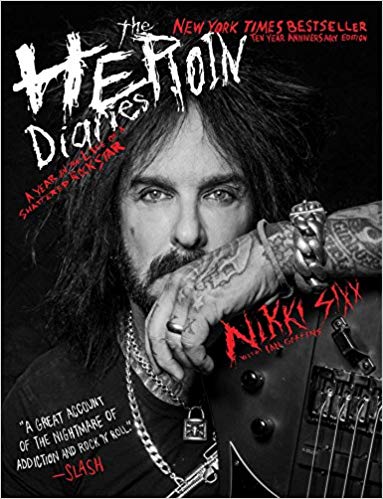 you would expect to find a review of a book authored by a heavy metal musician, particularly one from a band with a reputation as notorious as the one which is his claim to fame. Yet, for reasons I will discuss below, this powerful book is more relevant today than upon its original publication in 2007, and maybe even relative to the 10th Anniversary Edition (the one I read) released in 2017.
As the title suggests, the bulk of The Heroin Diaries is just that – entries in a diary. In particular, these are diary entries recorded by Sixx between Christmas 1986 and Christmas 1987, while he was in the midst of a vicious heroin addiction. It was an addiction that nearly cost him his life – and in fact did, for two minutes on December 23, 1987, before a determined paramedic revived him with two adrenaline shots to the heart. Interspersed the book’s diary entries are contemporaneous thoughts and accounts from people around Sixx, including bandmates, managers, and his mother (with whom his relationship was strained, to put it mildly), among others.
The opening entry finds Sixx alone in his mansion on Christmas Day 1986, shooting up, or as he describes it, “watching [his] holiday spirit coagulating in a spoon.” It’s not hyperbole to call it a depressing beginning. The events of the year that follows include the recording of an album, a tour, numerous misadventures, and an absolutely insane amount of drug consumption. This drug consumption went well beyond just the heroin which had him in its grip. It was the rock star lifestyle on steroids.
The diary entries range from lucid and clear-headed at one extreme to the mad ramblings of a mind spiraling out of control at the other. The more lucid entries show Sixx as someone keenly aware of being captive to something from which he desperately wants to be free. There is a point in the year in which he was able to get away from heroin in particular and drugs in general for ten days or so, but eventually the addiction sucks him back into its vortex. With regard to the more rambling entries, we find Sixx often times consumed by paranoia, hiding in his closet or flushing his stash (and effectively, hundreds of dollars) down the toilet for fear of being watched through his windows by the police, only to realize later that nothing of the sort actually occurred. This is followed in some instances by calling his dealer to obtain more drugs, becoming paranoid again after getting high, flushing the drugs again … you know the drill. Lather, rinse, repeat.
As a quick aside, one of the criticisms I have seen from a few reviewers of this book is that it somehow glorifies or glamorizes addiction. That opinion is, for the lack of a better term, bat-shinola crazy. Many of the various diary entries and associated anecdotes in the book range from repulsive, disgusting, to horrifying, to heartbreaking, and other emotions that are far removed from anything resembling glamour. Nobody with a modicum of sanity would find glamour in drug addiction after reading this book.
Among the cast of characters surrounding Sixx in his race into hell are numerous enablers that will enrage the reader. Chief among them are the record company types and assorted managers and others who were only too happy to indulge Sixx in his addiction as long as the band (for which he was the main creative force) was making them money. Then there are the dealers who made their living by preying on Sixx’s weakness. I’ll except his bandmates from this dishonorable mention, since all of them were dealing with their own demons at the time. This applies most keenly to the band’s guitarist (Mick Mars) who has long suffered from a particularly debilitating form of arthritis known as ankylosing spondylitis.
On the flip side, a hero of note in the book is a man named Allen Kovac, Sixx’s personal manager. Subsequent to the events of the diaries themselves, Sixx had one brief relapse with heroin in which Kovac issued an ultimatum – you can work with me or you can have your heroin. But not both. In one of the kindest things anyone has ever done for Sixx, Kovac’s tough love served as the catalyst for his final break from this nasty drug, and was instrumental in leading to full sobriety.
While the diary portion is extremely tough reading, Sixx’s chronicling of his life subsequent to the events of 1987 serves as a happy and uplifting ending. As he states in the book, the beauty is in the recovery. In the 10th Anniversary edition, the “posthumous” adventures, as he calls them, come in two parts, the first leading up to the book’s original 2007 publication, and the second covering the remaining time up to 2017.
Reading through the author’s description of his post-addiction life, it is at times hard to reconcile that it’s written by the same person who scribbled the diary entries describing the insanity of Christmas 1986 to Christmas 1987. While some of difference can be attributed to wisdom and maturity gained over the years, it is also apparent that the clarity of a completely sober mind is a significant (if not the dominant) factor. At the end of the story we find Sixx enjoying marriage and fatherhood far more than he ever enjoyed any rock star excess, and we find a man indulging in creative passions including his love of photography instead of sinking into a debilitating drug addiction. The contrast between the Nikki Sixx of today and the one from 1987 could not be more striking.
Ultimately, The Heroin Diaries is a story of redemption.
One might wonder why Sixx would chose to bare his soul as he did in The Heroin Diaries; why he would want to show himself at his absolute worst. Some of this undoubtedly is spurred by the opioid crisis currently ravaging parts of the country. Understandably, as a recovering addict, he wants to help others through prevention and recovery. On the prevention side, a reading of the entries in his diary would be more than enough to dissuade almost anybody from trying heroin, cocaine, or other hard drugs. On the recovery side, the reader will know that if Sixx can climb out of the hole he was in then there is hope for anyone that truly wants to break the chains of addiction. The opioid crisis will be solved one person at a time, by preventing people from starting down the road Sixx traveled and by demonstrating to present addicts and those around them that their situation, no matter how bad it seems, is not hopeless. With lives being ruined and families being torn apart by the scourge of opioid addiction, this message is needed now more than ever.
Thank you for sharing, Nikki.






You must be logged in to post a comment.