Tag Archives: Friedrich Hayek

I-Postcard

Over a decade ago I had shot this glistening sun bathed view of a Lighthouse. It sort of happened during one of those long motorcycle rides, and in an obscure part of the globe. Few years ago someone actually contacted me, and requested permission to create a post card from that exact photo. Of course, I obliged! Recently, just out of curiosity, I Googled for postcards based on that Lighthouse, and ran into this interesting WordPress link – Remembering Letters and Postcards. There are visible paper wrinkles and postal stamp watermarks on that photo, and also a copyright Mahesh printed at the bottom left corner!

Just another one of those motorcycle rides, and just another one of those photos. But it caught the attention of a Lighthouse Thematic Philatelist, and it turned into a postcard. Someone actually bought that postcard, and mailed it to a lady residing in a distant part of the world. Who then scanned and uploaded it to her website. And now I Googled to find my own photo! But, now my memories of clicking that photo are also perceived in a totally different context. Basically, that simple act now feels quite gilded and romantic. To quote a related earlier post – “with every single step we are progressively shaping our own trajectory, and at the same time influencing lives of others.” In this case, that mere instinctive act of capturing a Lighthouse in its tropical sunset splendor, ended up traveling across the world!

The lady who got the postcard, or the person who sent it to her, will never know the backstory of that motorcyclist who captured it. They simply derived some value from the unknown motivations of a photographer. Just like how I derived value from the unknowns who engineered that Royal Enfield motorcycle and that Nokia camera. And also just like how I now derive value from the actions of these unknown actors sending postcards to each other. They all created an elaborate feedback loop to my rather innocuous photo. To generalize all this — our ability to derive and add value to the unknowns, significantly more than to the known, tends to create unique value chains. It’s probably the most romantic side to this market based civilization.

This photograph incident just illustrates a general fact. If for the most part our actions help the unknown, than the known. It automatically implies that we also get most of our help from the anonymous. Grocery we buy, coffee we brew, roads we travel, clothes we wear, this sever hosting wordpress.com, everything! Leonard Reed has this famous essay, I-Pencil, explains how difficult it would be create a simple pencil with only known help. In short, we are always acting as part of different collectives. Just that it’s an anonymous group, and often transient and constantly forming and acting based on needs of the many. Quite like an organism which keeps adapting to emerging survival pressures.

Beyond Creation

Stunning autumn hues aside, motorcycling in Pacific Northwest is a lot about winding roads. It’s about navigating those curves at an optimal trajectory and speed, creating those lively moments when your foot pegs brush the tarmac. It’s about discovering that thin line, the line which separates recklessness from precarious optimism, that optimism of everything beyond your control going right! Discovering that trajectory requires a clear view, and an understanding of the full turn ahead. That along with instincts and skills tends to shape the plan on how to approach the turn, how to maneuver, at what speed etc.

High level plan aside, how you actually cover every inch on this trajectory also matters, because this determines how you approach the remaining part of the curve. In fact, at every point on that curve, along with basic physics, our own limitations and constraints of our machines determine our immediate next steps. So you are essentially shaping the specifics of the path as you go along. This simple principle actually applies to even the most mundane activities in life.

To quote the above Canadian death metal band — “Every decision we take. Every step we make. Every word we use. And every rule we choose.” – In short, even in our everyday life, with every single step we are progressively shaping our own trajectory, and at the same time influencing lives of others. So, if you had a fortunate or an unfortunate accident, it might not be that immediately preceding step. It could be any action leading up to the accident, which actually set in motion that accident prone trajectory.

The actual question is what are those steps which maximized the probability of that incident. It could be that disturbing conversation you had with the neighbor or that reckless driver on the freeway, or both. It could also be that this accident was just inevitable. With exhaustive variables at each step, identifying and modelling that action or sequence of actions is non-trivial. It sort of requires omniscience and infinite computing power. But a functioning society requires individual to take responsibility, with the fair assumption that our free will defines the path. In short, we shape our good and bad “accidents”, by acting or not acting to compensate for external pressures.

Life at the Margins

The early morning buzz of an engine, or that moment when we ride off the garage onto the pavement, or that instant when we tear into a freeway ramp – these are all glimpses of riding at the margins, at the margins of transitions. From stillness to the rumbling promise of 1200cc engine, from being boxed in a garage to bustling downtown alleys, from constrains of 25mph to 70mph open landscapes. All marked transitions. Life actually resides at these margins, because these are the moments when we feel most alive.

Taking a 40 mph curve at 60mph is riding at the margins, but only until we conquer the very same curve at 80mph. If we want that exact same feeling, then we need to simply raise the bar. Doing the exact same thing twice does not help, because we have already moved the boundaries. Margins are now further away. We automatically strive to raise that benchmark because it’s that feeling at the margins which matter, rest is just a means to that end. This is true whether it’s at the margins of riding, or general pleasure seeking, or for that matter any human pursuit! We all seek that feeling — which a first sip of whisky provides at the end of a long day, or that first serving of frozen custard on a summer afternoon, or that satisfaction of solving a new problem at work. Second time around none of these feel the same.

The constant pursuit of being at the margins is visible across all the human spheres. We were probably happy with library until we had ebooks and Wikipedia, now we are only happy with augmented reality! We found happiness with no internet, but now we are unhappy with the internet speeds! We were also contented with Magna Carta or bill of rights, until we had a chance with modern republic with democracy. But, as expected, now we are not merely contented with these unprecedented freedoms. We are not contented with mere liberties which enable us to freely pursue our material goals. But instead we want to be at the margins again, where education, healthcare, transportation etc are universal. Undoubtedly, even if we manage to achieve them, we would simply raise the bar. It’s easy to realize, what makes us tick is this never ending journey to the margins. In short, the next time I clock 120mph, it just might not look as fast.

Hume and that cat

Once this motorcyclist asked me – “What do you call her?” – pointing at the motorcycle. I responded — “nothing!”, and casually explained how it’s just a machine. She was shocked, and retorted in a rather jovial way — “You called her a machine, now she will breakdown!” Sort of reminded me of this David Hume quote “There is a very remarkable inclination in human nature, to bestow on external objects the same emotions, which it observes in itself; and to find everywhere those ideas, which are most present to it.” Hume goes on to attribute these inclinations to mostly children, poets and ancient philosophers. May be the lady was a poet? My own instincts tend to go the other way, I rather bestow on humans the characteristics of inanimate objects. We are also machines, just really complex ones. Guess I am no child, a poet or that ancient philosopher.

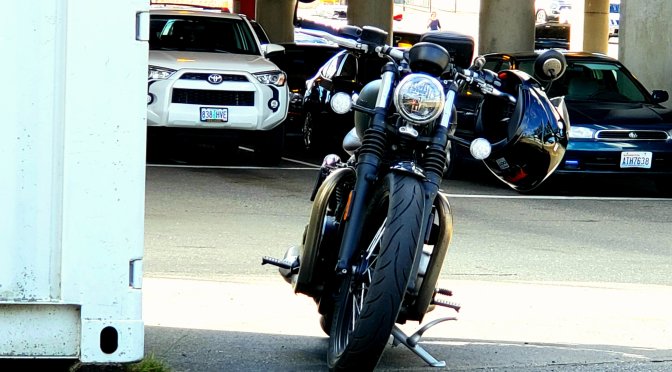
Hume’s insight is probably more prevalent, and often a cause for serious mischief. Recently I went riding to Orcas islands, but had an overnight stay at Anacortes to catch that early morning Ferry. Overnight motorcycle parking in a motel lot is always risky, so to minimize the attention I draped it with a dull two-wheeler cover. Next morning I noticed this feral cat sitting and staring at the motorcycle. In a parking lot filled with cars, this draped bike might have invoked his curiosity? We can actually never know. If I say the cat was curious, all that means is — if I was a cat, then I’d be curious. For all you know, that cat might have been a fan of Triumph motorcycles, and it was simply gazing in admiration. Or maybe it was just day dreaming. Possibilities are endless. Unless we place sensors in his brain, we can never truly understand that intend behind his action.

Not just in animals, we have this propensity to assume intend based on the actions of our fellow humans too. Sometimes it’s related to the curious actions of our spouse, or parents or maybe relatives. Our subject of scrutiny can also be the distant actions of some movie star or politicians, as seen through YouTube or TV. Lengthy contentious discussion on the behavior of such a celebrity is not that uncommon. But, whenever we assume intend based on actions, it only tells us more about our own mind, our own assumptions, which may or may not be relevant to the actual object, animal or the person being scrutinized. Not surprising that Hayek once said “We are studying mental and not physical events, and much that we believe to know about the external world is, in fact, knowledge about ourselves

Causal Chain

Recently went riding at the margins of Olympic, was actually planning to do a loop through couple of forest roads, but eventually ended up running into a road gated shut. So, had to turn back half way, and ride across the same bridge seen on my way up. And not just the same bridge, I crossed paths with the same hiker who was now walking back from the other end. Clearly, even he was amused at this bizarre coincidence. How often do the path of a motorcyclist, and a hiker in the wilderness converge on a bridge — twice!

In a way, coincidences or accidents are just separate causal chains coinciding at some point. For instance — ferry time, riding pattern, not up-to-date maps on the GPS etc were all immediate preceding links on my causal chain. If we go further back, then there are other causal sequences explaining why ferry times are the way they are, or how I ended up riding in some quirky way etc. But, we can only speculate about the causal events related to the mysterious hiker.


In that sense, every moment is the consequence of a set of connected or disconnected and known or unknown preceding causal events. Actually, even in my case, we can only speculate whether it was the incorrect map or did someone just decided to shut that road the previous day? Or maybe my riding pattern was immaterial. That means if all the other factors remained same, all types of riders would have faced the mysterious hiker, twice! If only we could replay life, and control it for various factors.

Some coincidences are rare, but others tend to be recurring and contentious. For instance, rising college tuition, health care costs or govt deficit spending tend to be recurring and divisive. But there are also recurring less contentious coincidences – like plummeting smart phone or fast food prices! Rarely do we see political rallies about unaffordable fries. Recurring events tend to have some dominant agency – it can be some specific group of people, natural forces, or some incentive structure etc. But general discourse is rarely about correcting these complex causal factors, which led to the present contentious pattern. But it’s usually more about introducing new factors into the mix — like price/licensing controls, or a new tax, or may be a new war? So, instead of fixing the root cause we keep introducing workarounds. Sounds like another recurring pattern.

Group Code

Spring poses interesting opportunities, especially if you can manage to ride up to the mountains. Not every day you motorcycle through icy roads on a bright day, at near zero temperatures, and with a backdrop of snow covered mountains! Not to mention the occasional water stream, gently crossing the freeway, and a highway shoulder precariously stacked with freshly removed snow – guess this is why they call motorcycling as sensory overload? As usual, the fuel tank was also sort of running low; the two gallon tank has been a bit difficult to handle, especially when you go exploring. But, like every other time, when it was close to being empty, providence manifested in the form of a Shell gas station.

Group riding on this motorcycle is going to be a tad annoying, for others! You definitely don’t want to ride with someone who is constantly on the lookout for a gas station. In that sense, groups do pose different trade-offs. We all prefer different riding patterns, different frequency for stops, speeds, routes etc. But group cohesion mandates uniformity; unless you really enjoy the company this requirement of uniformity can be a tad stifling.

Not just in group riding, even in general life situations, we all have different and often contradicting preferences and views. So, unless there is a commonly enforced code, large groups of people will not easily get along. And unless this conformity code is overall in sync with our own preferences, we are simply not going to join and remain being part of such a group. We can actually see that conflict of code manifest in all social spheres. Whether it’s family gatherings or workplace or recreational, large groups of people tend to not get along without clearly enforced hierarchy or code. The probability of this conflict of code increases with time. Not surprising it’s hard even for ~50% of couples to stay together for a life time.

Along with that duration of time, another factor which increases possibility of conflict is intellectual refinement. More you think, more your mind diverges from the median. Any serious thought and reflection adds layers of cognition to your mind. These layers increases  the possibility of our thought being different from others. When processing any complex situation, we’d simply see more or different aspects to the same problem, which makes our solutions also different. So, more we think, more the intellectual compromises we need to make to just fit in. If you have strong convictions, such compromises will be daunting. Hayek famously said “largest group of people whose values are very similar are the people with low standards”. In that sense, joining Hells Angels or some political party is not so different. Both signify low standards, the end of serious thought and reflection, but may be in slightly different ways.

“I was alive”

Walter White from Breaking Bad famously said – “I was alive”. What essentially drove him to create that Drug Empire was entrepreneurship, that excitement of feeling alive. It was not about providing for family, or for the progeny etc. Being alive seems to be a lot about being in touch with reality, sort of being plugged in. That constant awareness to gauge the situation and to adapt plans accordingly. In a way, being alive is also a lot about being human. What separates us from animals, at least most of us, is that ability to not just instinctively react, but instead use real cognition.

Being alive is also quintessential Americana; no other civilization has encoded this into their Constitution. That framework to avoid being shaped by the collective, but instead through individual volition, essential English liberties seamlessly upgraded to American Federalism! Being part of a collective is comforting. Whether its politics, sports or music, we tend to seek out that tribal identity. It’s probably our hunter gatherer instincts, constantly pushing us to belong. In that sense, American institutions are sort of intended to push back against those primitive instincts.

James Madison quite presciently stated in defense of  Federalism — ” the society itself will be broken into so many parts, interests, and classes of citizens, that the rights of individuals, or of the minority, will be in little danger from interested combinations of the majority”. While most of the world enforced compliance through govt machinery, American framers attempted to avoid that very fate. While most of the societies built governance for conformity, American framers attempted to avoid that very fate. While Americans allowed that civil society to emerge, a society where there is scope to feel alive, most of the world pandered to conformance. I think it’s Hayek who once said — ‘man got civilized in spite of his best efforts’? From that perspective, in spite of our best efforts, American Federalism incentivized emergence of civil society. Society where an individual will have that opportunity to feel alive.

Even though at a more basic level, riding motorcycle is also a lot about being alive, and probably more about staying alive too. For starters you are always in touch with the realities of the environment. You’re expected to be responsible for your own safety. You’re not protected by the collective, their seat belts or air bags. You have to be aware of the guy in his truck and the mom in her van, busy sifting through their critical Facebook posts. You need to simply adapt your path to steer clear of them, or any other potential threats, social media driven or otherwise. But the flip side is, when you are riding, all the other travails melt away. So plugged in to that sublime present, there are no cognitive resources to think about that uncertain future, or that disappointing past. In that sense, you feel alive, but in a totally different manner I guess.

The Road to Serfdom at 75 Years Young

Peter Boettke writes

“Key to his argument is that in a democratic liberal society, there’s no overarching single scale of values. Society cannot achieve a single hierarchy of ends we all agree on. In fact, the great strength of democratic liberal societies is a multiplicity of values that are respected among diverse and often divergent, even distant, individuals”

I used to have this bumper sticker on my Jeep — ‘If we are on a road to serfdom, hope it’s bumpy and bureaucrats are driving lowriders’


The Hayek Auction

You will find them here, for instance Hayek’s copy of Wealth of Nations went for almost 200k, it was estimated in the 4k to 6k range.

“Desktop ephemera and personal effects” were estimated at 200-300 British pounds, went for 87,500 British pounds.  Crazy!  Many of the items went for 10x or 20x their original estimates.

From Marginal Revolution

Friedrich_Hayek_portrait

The original uploader was DickClarkMises at English Wikipedia. [CC BY-SA 3.0], via Wikimedia Commons

Libertarian Transformers

For some reason people gasp when I mention the dominant Libertarian themes in Transformers 4 : Age of Extinction. Buried beneath inane comedy and not so sleek Budweiser advertisements are some stunning Hayekian/Misesian ideas. Contrasting to the first three Transformers movies, Age of Extrinction refuses to glamorize military. Instead of Marines fighting evil aliens in Middle-East, we have CIA black ops oppressing an innovative Texan inventor. From Cade Yeager (played by Mark Wahlberg) emphasizing to the black cloaked agents to get off his property, to ignorant bureaucrat Harold Attinger (played by Kelsey Grammer) destabilizing planet with his foreign policy, Michael Bay’s U-Turn on politics cannot be more evident.

Govt propping up bad guys in an alien war, or private firms profiting from war, or having an elected US President become subservient to career bureaucrats – this movie cuts close to reality in numerous subtle and different ways. How a private weapons manufacturer, Joshua Joyce (played by Stanley Tucci), changes his mind when confronted with reality. But, a bureaucrat constantly refusing to confront his own folly is worth noting. In this case Hollywood illustrating how private sector can get corrupted by govt incentives — quite uncommon! Not to mention, Kelsey Grammer comforting the US President by claiming the all-powerful alien bounty hunter as his “asset”, a genuine black comedy moment!

Essentially the whole movie is about an individualistic inventor trying to stabilize the world, while govt busy-bodies propping up chaos. Sounds like it appeals to all our civilized human instincts. Café intellectuals might disagree, but Hollywood is among the best Western institutions. They’re  more effective than any military in spreading liberal ideas across the globe. Niall Fergurson’s ‘The West and the Rest’ quite aptly sums up this sentiment through a quote from the French philosopher Régis Debray — “more power in blue jeans and rock and roll than the entire Red Army”.

Bjoern Kommerell [CC BY-SA 4.0], via Wikimedia Commons