Tag Archives: History

The Betrothed: A 200 Year Old Tale of Suffering and Redemption

Alessandro Manzoni published his magnum opus, The Betrothed, in 1824. At the time, Italy was composed of many different states with different dialects. Through the popularity of his novel, Manzoni forged a uniform version of the modern Italian language. As such, The Betrothed is one of the most important literary works in Italian culture. It’s also a delightful and wonderful novel.

It is set in northern Italy in the early seventeenth century – 1628 to 1630, to be exact. Technically, the Spanish empire is in charge of the region, but the towns are ruled by local lords – some benevolent and fair, some cruel and despotic. In a small town in Lombardy near Lake Como, young and honest Lorenzo “Renzo” Tramaglino, and the pretty and pious peasant girl, Lucia Mondella, are planning to get married. Unfortunately, the local ruler, Don Rodrigo, has noticed the beauty of Lucia, and he has a bet with his decadent cousin, Count Attilio, that he will seduce Lucia. He sends two of his “bravi” (basically thugs) to threaten Don Abbondio, the priest who is supposed to perform the wedding. Don Abbondio is a self-centered coward who takes the bravi’s warnings to heart and tells Renzo that the wedding must be postponed.

On this basic event, a massive, sprawling chronicle unfolds that takes in a famine, a plague, and political upheaval. Renzo and Lucia, with the help of her mother, Agnese, first try to trick Don Abbondio into marrying them by a subterfuge, but he sees through them, and his frantic cries for help awaken the entire village. At the same time, Don Rodrigo’s head henchman, Griso, is leading a group of bravi to kidnap Lucia. Lucia, Agnese, and Renzo barely escape, after being warned by a good friar, Fra Cristoforo. He arranges for Lucia and Agnese to take shelter at a convent, while Renzo heads to Milan seeking work.

While in Milan, the innocent and naive Renzo gets caught up in some bread riots, because prices have risen due to flour shortages resulting from the famine. Manzoni has some fun here at the expense of clueless political leaders who try to curry popularity by defying the laws of economics:

Ferrer [the Grand Chancellor of Milan] saw – and who would not? – that a fair price for bread is a very desirable thing. He thought – and this was his mistake – that all it would require was an order from him. He set the bread meta (as they called the tariff of foodstuffs) at a price that would have been fair if the average price for grain had been thirty-three liras a bushel, when in reality it sold for as much as eighty. He acted like an aging woman who thinks she can be young again by simply altering her birth certificate.

As a result of Ferrer’s folly, the bread shortages worsen, and the chapters describing the horrors of a city in the throes of a deep famine are incredibly moving. Thousands of people die from starvation, and the scenes Manzoni describes are heartrending.

As soon as there is some relief from the famine, the Thirty Years War intrudes in the form of German mercenaries who ravage and pillage the countryside. They also bring another wave of the bubonic plague, and when it strikes the densely populated city of Milan it practically wipes out everyone. Renzo manages to get out and head to the town of Bergamo, where a friend is able to employ him as a silk weaver. 

Meanwhile, Don Rodrigo has not given up his obsession with Lucia. He calls on the most powerful gangster in the area to kidnap her from the convent and bring her to him. This gangster is so feared, he is only referred to as “The Nameless One”. He pulls the strings of every prominent person in northern Italy, and he is incredibly powerful. He succeeds in kidnapping Lucia, and when he first confronts her, her helpless purity and piety somehow warm his cold heart and begins a long process of repentance.

I’ll stop there, because I don’t want to spoil the tale any more. Manzoni does a masterful job of portraying the horror and suffering of those struck by the plague. Nevertheless, this is, at heart, a comic novel, so there are some truly humorous characters and scenes. The aforementioned Don Abbondio is hilarious in his efforts to avoid responsibility and save his skin. He’s a scoundrel, but a lovable one. The Archbishop of Milan, Federigo Borromeo, is a heroic an inspiring man who does everything in his power to alleviate the suffering of those around him. The underlying message throughout the book is that the meek and powerless, through the mercy of God, can eventually triumph.

Many of Manzoni’s characters are based on actual historical figures, and he has a lot of fun making comments on their actions and behavior. The premise of the novel is that he has discovered a lost manuscript, and he is retelling the story related in it to a nineteenth century audience. There are many clever asides to the reader that make the book very enjoyable.

Finally, I must praise the translator of the latest version of The Betrothed, Michael F. Moore. He has made a 200-year-old novel sound as new and up to date as any contemporary writer without losing any of Manzoni’s power and morality. Even though it is 650 pages, I zipped through it in a few days. My all-time favorite author is Charles Dickens, and The Betrothed is on a par with Dickens’ best. It’s a wonderful and moving novel that should be as widely known as any well-loved and revered English language classic.

Paul Johnson’s Creators – Praise for Artists of All Kinds

Paul Johnson is my favorite historian (my dear friend, Brad Birzer, is my favorite living historian!). Johnson takes complicated subjects, makes them understandable, and he does it in an entertaining way. He’s British, but he has written a fantastic history of the United States, A History of the American People. Other excellent books of his are The Birth of the Modern: World History 1815 – 1830, and Modern Times: The World from the Twenties to the Nineties. Creators was written after his book, Intellectuals, received some criticism for focusing too heavily on the hypocrisy of some of history’s most famous and influential intellectuals. As he explained, “I defined an intellectual as someone who thinks ideas are more important than people.” I, personally, appreciated learning about the moral failings of Rousseau, Marx, Ibsen, Sartre, and other thinkers who have been lionized by our intelligentsia. It’s the eternal story: “Do as I say, not as I do.” Anyway, Creators is, on balance, a more positive and inspiring collection of portraits. In it, Johnson gives us brief descriptions of Chaucer, Durer, Shakespeare, J. S. Bach, Turner and Hokusai, Jane Austen, A.W.N. Pugin and Viollet-le-Duc, Victor Hugo, Mark Twain, Tiffany, T.S. Eliot, Balenciaga and Dior, and Picasso and Walt Disney. Throughout these portraits his admiration for these artists’ work shines clearly. Johnson is the master of providing the interesting anecdote that humanizes and makes real his subject. For example, he writes that the composer Wagner
required a beautiful landscape outside his windows, but when he wrote music, the silence had to be absolute and all outside sounds, and sunlight, had to be excluded by heavy curtains of the finest and costliest materials. They had to draw with “a satisfying swish.” The carpets had to be ankle-deep; the sofas enormous; the curtains vast, of silk and satin. The air had to be perfumed with a special scent. The polish must be “radiant.” The heat must have been oppressive, but Wagner required it. Johnson, Paul. Creators: From Chaucer and Durer to Picasso and Disney (p. 9). HarperCollins. Kindle Edition.
Johnson praises Chaucer for creating the very idea of English literature. Before him, all politics and creative arts were conducted in French and Latin. He was the first to proudly use English in his poetry, and his portrayals of various classes of people are unparalleled. In my opinion, Creators is worth reading for his chapter on Shakespeare alone. Johnson does a wonderful job explaining how a man with humble beginnings could attain such incredible heights of literary excellence. Interestingly, he makes the case for Shakespeare not being an intellectual. In other words, for Shakespeare, people  were more important than ideas.
He [Shakespeare] rarely allows his opinions open expression, preferring to hint and nudge, to imply and suggest, rather than to state. His gospel, however, is moderation in all things; his taste is for toleration. Like Chaucer, he takes human beings as he finds them, imperfect, insecure, weak and fallible or headstrong and foolish—often desperate—and yet always interesting, often lovable or touching. He has something to say on behalf of all his characters, even the obvious villains, and he speaks from inside them, allowing them to put forward their point of view and give their reasons. Johnson, Paul. Creators: From Chaucer and Durer to Picasso and Disney (p. 54). HarperCollins. Kindle Edition.
I also learned that no one has created as many words and phrases that have entered common use as Shakespeare. Some estimate he coined as many as 6700 new words! Like Harold Bloom, Johnson has nothing but praise for the two Henry IV plays and Hamlet. Johnson’s explication of the psychological and moral dilemmas explored in Hamlet  is fantastic.
It is characteristic of this stupendous drama that the long passages of heroic reflection, which never bore but stimulate, are punctuated by episodes of furious action, the whole thing ending in a swift-moving climax of slaughter. No one can sit through Hamlet and absorb its messages—on human faith and wickedness; on cupidity, malice, vanity, lust; on regeneration and repentance; on love and hate, procrastination, hurry, honesty, and deceit; on loyalty and betrayal, courage, cowardice, indecision, and flaming passion—without being moved, shaken, and deeply disturbed. The play, if read carefully, is likely to induce deep depression—it always does with me—but if well produced and acted, as Shakespeare intended, it is purgative and reassuring, for Hamlet, the confused but essentially benevolent young genius, is immortal, speeding heavenward as “flight of angels sing thee to thy rest.” It is, in its own mysterious and transcendental way, a healthy and restorative work of art, adding to the net sum of human happiness as surely as it adds to our wisdom and understanding of humanity. Johnson, Paul. Creators: From Chaucer and Durer to Picasso and Disney (p. 75). HarperCollins. Kindle Edition.
Johnson’s next subject, Johann Sebastian Bach, was a solidly middle class man who was confident in his extraordinary ability to compose music, even if he wasn’t recognized for it during his lifetime.
Bach was by far the most hardworking of the great musicians, taking huge pains with everything he did and working out the most ephemeral scores in their logical and musical totality, everything written down in his fine, firm hand as though his life depended on it—as, in a sense, was true, for if Bach had scamped a musical duty, or performed it with anything less than the perfection he demanded, he clearly could not have lived with himself. It is impossible to find, in any of his scores, time-serving repetitions, shortcuts, carelessness, or even the smallest hint of vulgarity. He served up the highest quality, in performance and composition, day after day, year after year, despite the fact that his employers, as often as not, could not tell the good from the bad or even from the mediocre. Johnson, Paul. Creators: From Chaucer and Durer to Picasso and Disney (pp. 82-83). HarperCollins. Kindle Edition.
It’s almost a miracle that we have as many works of his today to perform, as they were scattered amongst his descendants after he died. If not for the efforts of Mendelssohn to restage Bach’s St. Matthew Passion in 1827, we might not have had the revival of his music that we enjoy so much today. Johnson uses this event to share another fun anecdote:
Afterward, at Zelter’s house, there was a grand dinner of the Berlin intellectual elite. Frau Derrient whispered to Mendelssohn: “Who is the stupid fellow sitting next to me?” Mendelssohn (behind his napkin): “The stupid fellow next to you is the great philosopher Friedrich Hegel!” Johnson, Paul. Creators: From Chaucer and Durer to Picasso and Disney (p. 93). HarperCollins. Kindle Edition.
The chapter on the artists William Turner and Hokusai is very interesting. Both began drawing from the age of three. Turner was somewhat controversial because of his new and unusual way of painting light, but he ended up one of the most popular and wealthy artists in history. Unfortunately, time and bungling “restorers” have kept us from appreciating his radical use of color. Even his contemporaries could see how his paintings faded not long after he finished them. Hokusai never profited much from his prodigious output, always begging benefactors for money. According to Johnson, he pretty much invented landscape art in Japan. He was quite a character:
There was a restless rootlessness to him, reflected in the fact that he changed his name, or rather the signature on his works, more than fifty times, more often than any other Japanese artist; and in the fact that during his life he lived at ninety- three different addresses. The names he used included Fusenko, meaning “he who does only one thing without being influenced by others”; “The Crazy Old Man of Katsushika”; and “Manji, the Old Man Mad about Drawing.” After he fell into a ditch, as a result of a loud clap of thunder, he signed himself “Thunder” for a time. Johnson, Paul. Creators: From Chaucer and Durer to Picasso and Disney (p. 108). HarperCollins. Kindle Edition.
Johnson’s chapter on Jane Austen is the slightest one, not because of any fault of Johnson, but because we know so little of Austen. Her family suppressed most of her personal correspondence, and they tried to make her into a Victorian woman, rather than the Regency one she was. However, according to Johnson, we can glean some personality traits from the letters and reminiscences that do exist and conclude that she was fun-loving young woman, which was the source of her genius:
Laughter was the invariable precursor, in Austen’s life, of creative action—the titter, the laugh, the giggle, or the guffaw was swiftly followed by the inventive thought. Once Austen began to laugh, not with the melodramatic novels she read, but against them, she began to look into herself and say, “I can do better than that.” Johnson, Paul. Creators: From Chaucer and Durer to Picasso and Disney (pp. 130-131). HarperCollins. Kindle Edition.
Pugin and Violett-le-Duc were both architects, the former responsible for the Gothic revival in England. We have Pugin to thank for the beautiful Houses of Parliament in London. The chapter on Victor Hugo is a very interesting one. In it, Johnson poses the question,
That Hugo was phenomenally creative is unarguable: in sheer quantity and often in quality too, he is in the highest class of artists. But he forces one to ask the question: is it possible for someone of high creative gifts to be possessed of mediocre, banal, even low intelligence? Johnson, Paul. Creators: From Chaucer and Durer to Picasso and Disney (p. 156). HarperCollins. Kindle Edition.
Johnson does not have a lot of admiration for Hugo, pointing out how contradictory his political opinions were, depending on what party was in power. He also kept many mistresses, well into his eighties! Mark Twain comes in for more respectful treatment. Johnson posits that his genius was as a storyteller – to truly appreciate his work, we need to hear it “performed”. He also had a knack for making great literature out of almost nothing:
His creativity was often crude and nearly always shameless. But it was huge and genuine, overpowering indeed, a kind of vulgar magic, making something out of nothing, then transforming that mere something into entire books, which in turn hardened into traditions and cultural certitudes. Johnson, Paul. Creators: From Chaucer and Durer to Picasso and Disney (p. 171). HarperCollins. Kindle Edition.
T. S. Eliot was a paradox – very conservative in his personal life, yet revolutionary in his poetry:
Eliot was never once (except on holiday) photographed without a tie, wore three-piece suits on all occasions, kept his hair trimmed, and was the last intellectual on either side of the Atlantic to wear spats. Yet there can be absolutely no doubt that he deliberately marshaled his immense creative powers to shatter the existing mold of poetical form and context, and to create a new orthodoxy born of chaos, incoherence, and dissonance. Johnson, Paul. Creators: From Chaucer and Durer to Picasso and Disney (p. 204). HarperCollins. Kindle Edition.
The turning point in Eliot’s career came when he met Ezra Pound, who introduced him to lots of European literary stars and convinced him to emigrate to England. He married Vivian Haighwood, but it doesn’t sound like the relationship was much fun:
From the early days of their marriage they engaged in competitive hypochondria. Both became valetudinarians and were always dosing themselves, complaining of drafts, and comparing symptoms. Johnson, Paul. Creators: From Chaucer and Durer to Picasso and Disney (p. 213). HarperCollins. Kindle Edition.
However, this dismal marriage, coupled with his job at Lloyd’s bank in London, spurred Eliot to create his masterpieces, The Waste Land and Four Quartets. As Johnson puts it, The Waste Land‘s strength is its elusiveness:
The greatest strength and appeal of the poem is that it asks to be interpreted not so much as the poet insists but as the reader wishes. It makes the reader a cocreator. Johnson, Paul. Creators: From Chaucer and Durer to Picasso and Disney (p. 219). HarperCollins. Kindle Edition.
Four Quartets solidified Eliot’s position as the leading poet of the twentieth century, even though, in Johnson’s words, “they are not about anything”. What they are is evocative of a nihilistic mood that dominated mid-twentieth century western culture. The appalling meaninglessness and slaughter of WWI that led into WWII left a cultural elite with almost no hope Eliot was their spokesman. I wish I could have been present at the gathering Johnson describes below!
The Four Quartets were much discussed when I was a freshman at Oxford in 1946, and they, too, were still fresh from the presses. I recall a puzzled and inconclusive discussion, after dinner on a foggy November evening, in which C. S. Lewis played the exegete on “Little Gidding,” with a mumbled descant from Professor Tolkien and expostulations from Hugo Dyson, a third don from the English faculty, who repeated at intervals, “It means anything or nothing, probably the latter.” Johnson, Paul. Creators: From Chaucer and Durer to Picasso and Disney (p. 223). HarperCollins. Kindle Edition.
In his chapter on Picasso and Disney, Johnson praises Picasso for his incredible creativity and canny judgment:
… Picasso became the champion player, and held the title till his death, because he was extraordinarily judicious in getting the proportions of skill and fashion exactly right at any one time. He also had brilliant timing in guessing when the moment had arrived for pushing on to a new fashion. Although his own appetite for novelty was insatiable, he was uncannily adept at deciding exactly how much the vanguard of the art world would take. Johnson, Paul. Creators: From Chaucer and Durer to Picasso and Disney (p. 253). HarperCollins. Kindle Edition.
But he also exposes a very dark side of Picasso; how he abused women and men, stabbed friends in the back, and seemed to have no moral sense.
He would create situations in which one mistress angrily confronted another in his presence, and then both rolled on the floor, biting and scratching. On one occasion Dora Maar and Marie-Thérèse Walter pounded each other with their fists while Picasso, having set up the fight, calmly went on painting. The canvas he was working on was Guernica. Johnson, Paul. Creators: From Chaucer and Durer to Picasso and Disney (p. 256). HarperCollins. Kindle Edition.
Walt Disney, on the other hand, comes in for quite a bit of praise. I really enjoyed Johnson’s detailed explanation of just how revolutionary Disney was when it came to combining sound and animation in a film. Practically all animated content we enjoy today owes a debt to Disney. What was his strength as a creator? According to Johnson,
Whereas Picasso tended to dehumanize the women he drew or painted. Disney anthropomorphized his animal subjects; that was the essential source of his power and humor. Johnson, Paul. Creators: From Chaucer and Durer to Picasso and Disney (p. 258). HarperCollins. Kindle Edition.
The final chapter, Metaphors in a Laboratory, addresses the idea of scientific creativity. Johnson argues that through the use of metaphors, scientists are able to communicate their ideas and spur others to innovate. A lot of this chapter rehashes persons and topics he covers in The Birth of the Modern – how Wordsworth and the scientist and inventor Humphrey Gray were great friends and shared ideas with each other, how the engineer Telford transformed the British landscape with canals, roads, and bridges of simplicity and beauty. Creators is a wonderful celebration of one of the greatest human characteristics: the ability to create. Even though some of the creators were not the nicest people who lived (such as Picasso), their works survive to inspire others.

Don’t QUIT ! THE IMPORTANCE OF EFFORT

By Richard K Munro

No matter how old you are now. You are never too young or too old for success or going after what you want. Here’s a short list of people who accomplished great things at different ages

1) Cervantes was 58 when he wrote Part I of Don Quixote

2) Helen Keller, at the age of 19 months, became deaf and blind. But that didn’t stop her. She was the first deaf and blind person to earn a Bachelor of Arts degree.
3) Mozart was already competent on keyboard and violin; he composed from the age of 5.
4) Anne Frank was 12 when she wrote the diary of Anne Frank. One of the poignant things about her diary is the promise she showed at so young an age. She symbolizes many thousands who lost their lives prematurely and so their contributions to humanity were wiped out.
5) Michelangelo created two of the greatest sculptures “David” and “Pieta” by age 28
18) Alexander the Great, by age 29, had created one of the largest empires of the ancient world
19) J.K. Rowling was 30 years old when she finished the first manuscript of Harry Potter
20) Amelia Earhart was 31 years old when she became the first woman to fly solo across the Atlantic Ocean
23) Martin Luther King Jr. was 34 when he wrote the speech “I Have a Dream.”
24) Marie Curie was 35 years old when she was nominated for a Nobel Prize in Physics
25) The Wright brothers, Orville (32) and Wilbur (36) invented and built the world’s first successful airplane and making the first controlled, powered and sustained heavier-than-air human flight
26) Vincent Van Gogh was 37 when he died virtually unknown, yet his paintings today are worth millions.
27) Neil Armstrong was 38 when he became the first man to set foot on the moon.
28) Mark Twain was 40 when he wrote “The Adventures of Tom Sawyer”, and 49 years old when he wrote “Adventures of Huckleberry Finn”
29) Christopher Columbus was 41 when he discovered the Americas

Rush: Between the Wheels

To live between a rock and a hard place
In between time
Cruising in primetime
Soaking up the cathode rays
To live between the wars in our time
Living in real time
Holding the good time
Holding on to yesterdays

You know how that rabbit feels
Going under your speeding wheels
Bright images flashing by
Like windshields towards a fly
Frozen in the fatal climb
But the wheels of time
Just pass you by

Wheels can take you around
Wheels can cut you down
We can go from boom to bust
From dreams to a bowl of dust
We can fall from rockets’ red glare
Down to “Brother, can you spare…”
Another war, another wasteland
And another lost generation

It slips between your hands like water
This living in real time
A dizzying lifetime
Reeling by on celluloid
Struck between the eyes by the big-time world
Walking uneasy street
Hiding beneath the sheets, got to try and fill the void

You know how that rabbit feels
Going under your speeding wheels
Bright images flashing by
Like windshields towards a fly
Frozen in that fatal climb
But the wheels of time
Just pass you by

We can go from boom to bust
From dreams to a bowl of dust
We can fall from rockets’ red glare
Down to “Brother, can you spare…”
Another war, another wasteland
And another lost generation

Wheels can take you around
Wheels can cut you down
Fall from rockets’ red glare
Down to “Brother, can you spare…”
Another war, another wasteland
Another lost generation

Source: Musixmatch

Songwriters: Geddy Lee / Alex Lifeson / Neil Peart

Between the Wheels lyrics © Ole Core Music Publishing, Anthem Core Music Publishing

Is Trump a Potential Hitler?

By Richard K. Munro

Does Trump have things in common with Hitler or Mussolini or Franco?

The historian recognizes common elements.

1) nationalist

There is no question Trump appeals to patriotic and nationalist feelings. However, his nationalism is not of the Blood and Soil variety in this he is more like Franco who was not a virulent antisemite people say Trump is anti-immigrant but many Immigrants support him and he welcomes immigrants to America as long as the process is orderly and legal and does not endanger America’s domestic tranquility.

What is Trump’s religion? That I do not know it often seems he does not have one. But unlike Hitler or Stalin Trump is not virulently atheistic and anti Religion. Many Evangelical Protestants, Amish, Mormons, Catholics even Jews, and some Muslims support Trump as a defender of First Amendment rights and traditional family mores. Also unlike Hitler Trump has many children and grandchildren (some of whom are Jewish) In addition his running mate has mixed-race children. So Trump’s movement is not virulently anti-Semitic nor narrowly White Supremacist.

2) Populism.

Like Hitler Trump is in a way a mass media creation. Hitler we forget was a celebrity who received as much fan mail as a Hollywood star. I grew up in New York and it is remarkable that i have known about Trump for over 50 or 60 years. So he had movie cameos, and was on talk shows and on TV. He was a TV star. I am not a Trump cultist but he has his fanatically loyal followers who seem to dismiss any behavior or rhetoric or transgressions. This populist cult of personality strain he seems to have in common with strong men and yes authoritarian dictators. So I do not dismiss concerns that Trump could become an authoritarian dictator.

3) Personality.

However, Trump is an American not a German or Russian. He is proud and vain. He wants to be famous and successful as an American president. He wants to have a legacy. I do not know Trump. All I know is what I read in the newspapers and interviews with people i have met. The impression I have is of a mercurial and cunning deal maker who is somewhat shallow and not deeply read. But people say in person he is funny, humane, and friendly so he is not a psychopath like Hitler or Stalin. Trump is imperfect but he is not an Orange Himmler or an Orange Hitler. That seems like wild hyperbole. Let’s not forget Trump ALREADY was president for four years and did not lock Hillary up or establish concentration camps. He did not persecute Jews. In fact, one could argue that Trump has been the most pro-Israel president in history.

But history will be the final judge.

I hope for America’s sake Trump will be like Noah a good man in his time.

I think Trump will try his best to be a good, wise, and humane president. I wish him luck and success for the sake of America, Israel, and the world.

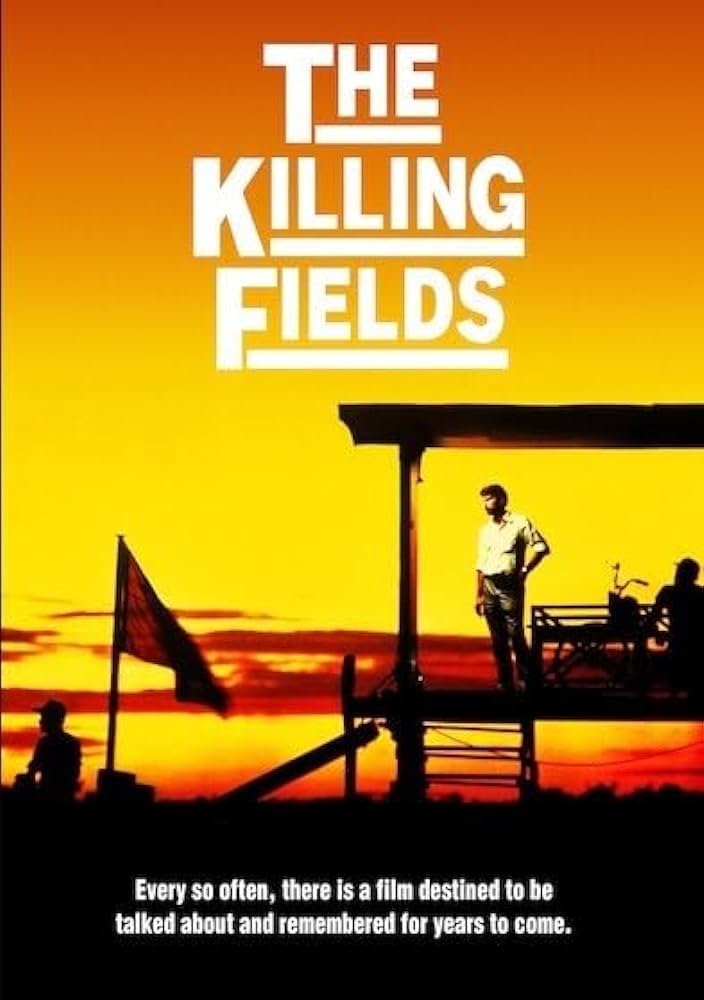
Further Thoughts on The Killing Fields

Over at Law and Liberty, I had the great privilege of offering a 40th anniversary retrospective of the 1984 movie, The Killing Fields: https://lawliberty.org/the-tragedy-and-triumph-of-the-killing-fields/

A reader responded to me over at my other website, Stormfields. Here’s the note he left–

Dear Dr. Birzer,

Your piece on “The Killing Fields” was timely in an Internet sense, in that the film has been prominently on Netflix of late and a lot of folks may be rewatching or encountering it for the first time (me). Your essay made me want to contact you directly. I’m fine with doing so here. I completely agree with perhaps 90% of your take on the film; the other 10% I vehemently disagree with, because it is Reaganite revisionism.

The issue you DO touch on– the culpability of the U.S. in regimes like KR coming to power– is where we disagree. The Cambodian genocide never happens if the U.S. doesn’t decide to fight (and lose) a catastrophic proxy war in Vietnam. Wars destabilize nearby countries. This was OUR fault. The movie, in fact, makes this very clear, putting it in lines spoken by Sam Waterston’s Sydney Schanberg. The intensification of conflicts and wars makes groups like KR MORE paranoid and ruthless in their aims. 

You also have quite a lot of nerve to call the KR “racist” because they were slaughtering ethnic minorities (although, curiously, they idolized the Chinese Mao). What was the U.S., then, who are estimated to have killed some 3 million people in Vietnam? I always return to the General Westmoreland’s response in “Hearts and Minds”: “Life is cheap in the Orient.” What could be a more racist justification for wanton slaughter of soldiers and civilians alike? 

I have to admit my disbelief that you are trying to use this film as a rationale for your larger project of Christian nationalism. At the same time, it intrigues me that you would do so, and that you are actually interested in memory– unlike most of the Right in the U.S. right now. So I hope you’ll engage me in a dialogue.

My response.

Dear Roberto, thanks so much for your note. I appreciate your taking me and my arguments seriously.

Honestly, I don’t think we disagree on much. Maybe my wording was a little off. Here’s what I wrote in the unedited version of the piece regarding U.S. involvement:

The U.S. Role

In 1970, a military coup, possibly with the backing of the CIA, displaced the Cambodian king, and he and the Khmer Rouge became unlikely allies.  The U.S., then fighting a war against North Vietnam, expanded into Cambodia in the early 1970s, through air power and infantry (U.S. infantry had gone into the country at least as early as 1969, a full year before the coup).  

Disturbingly, the United States—unconstitutionally, illegally, and secretly (at least to the American public)—dropped nearly 540,000 tons of explosives on the beleaguered country, itself already fighting a civil war.  

This tonnage was more than all the tonnage dropped on Japan during World War II.  To state that the United States destabilized an already destabilized area of the world is the understatement of understatements.  While one could never logically blame the atrocities of the Khmer Rouge on U.S. intervention in the region, it would be equally a mistake to dismiss what the U.S. did to the region in the years leading up to the Watergate crisis.  A country wrecked by internal division became radicalized against the West, driving many would-be neutral Cambodians into the ranks of the Khmer Rouge.The United States ended its mass bombings in 1973 and abandoned its Cambodian embassy on April 12, 1975.  

So, I’m most certainly not opposed to blaming the U.S. Clearly, our bombing was tragically immoral and unconstitutional. I do believe that the atrocities committed by the Khmer Rouge were made out of the free will of those involved. I hate indiscriminate bombing, but our bombing of Japan and Germany (again, sometimes deeply immoral such as the dropping of the atomic bomb on Nagasaki or the firebombing of Dresden) didn’t lead to radicalization but to pacification. So, there can’t be a direct correlation between U.S. bombing and population radicalization. Undoubtedly, though, our bombing served to move many more Cambodians into the ranks of the Khmer Rouge.

Please note, however, that I never criticize the movie for it blaming the U.S. I honestly don’t know what the causation was.

As to the racism of the U.S. in Cambodia and Vietnam, you’re quite possibly right. It’s not something I’ve given enough thought to, but I should. Given that we gave amnesty to huge numbers of Southeast Asians in the 1970s, though, our racism (if it existed) couldn’t be a blanket racism.

As to the change of being a Reaganite, I plead guilty, and I don’t think I’ve ever not said as much. I loved the man and still revere his memory as our last great president. I have his picture hanging proudly in my office (along with a portrait of John Paul II).

As to being a Christian nationalist–this one intrigues me. I’ve never been accused of being any such thing. You’re the first! I’m a practicing Roman Catholic (and, thus, a papist), so I can’t really be a nationalist. Further, my politics are extremely libertarian and, therefore, decentralized. I’ve published numerous articles–especially at The Imaginative Conservatism–attacking any form of nationalism.

Anyway, thank you again for comments. I hope my answer helps.

Yours, Brad

My Quiet Book Nook is the perfect place to read, write and study

by Richard K Munro

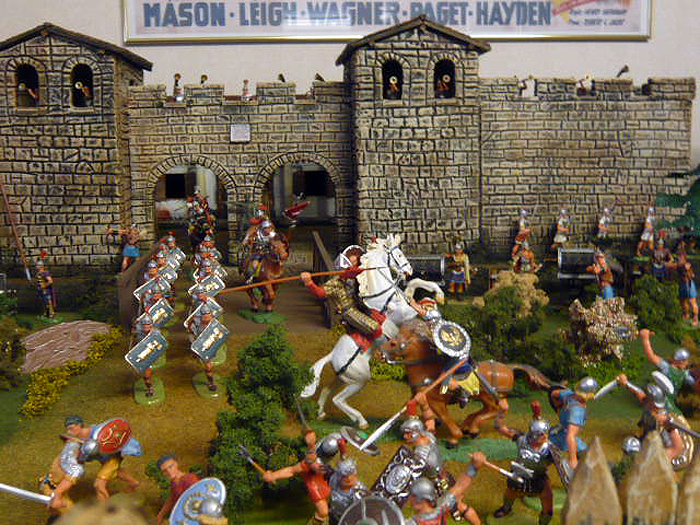
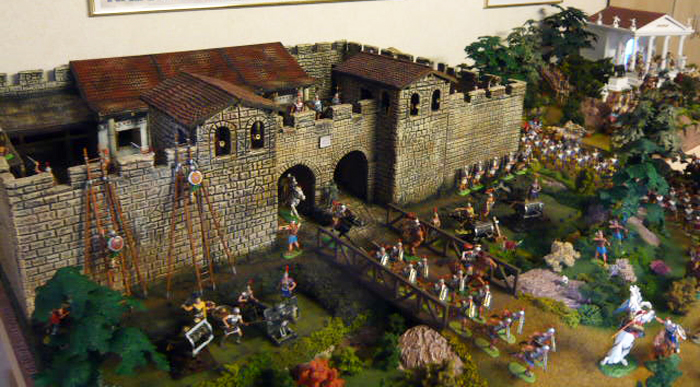
Elastolin diorama
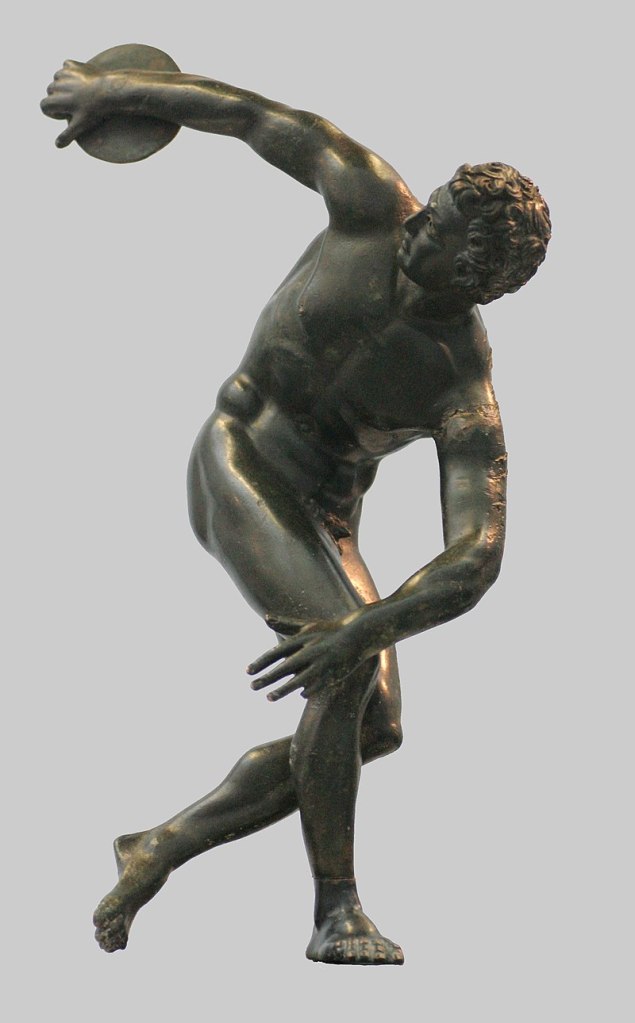
The Discus Thrower
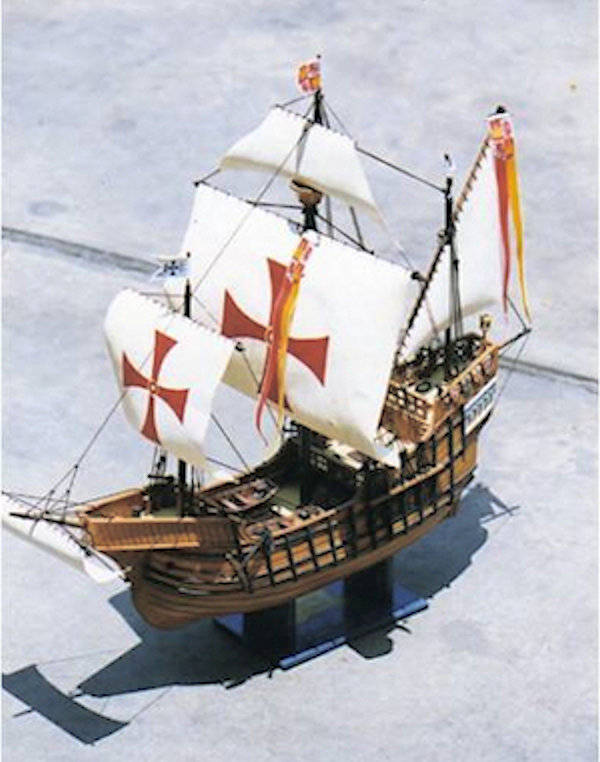
Santa Maria model circa 1992 made by RUTH, IAN and RICHARD MUNRO at CHRISTMAS

The perfect Book Nook or private library has at least one plush leather chair preferably with a rocker and nice padded as I have in the corner. It is an old friend I have owned it for over 30 years and my father enjoyed using it. I always let my father have my best chair and I would sit in my mother’s chair, my second-best chair. It is a carpeted room. My chair has its own special lamp. I have a ceiling fan for the summer plus some built-in lights. My room has a table for study plus two desks and many bookshelves, some decorated with fossils, busts, baseball memorabilia, and toy soldiers. I have an electric pencil sharpener I use almost daily. I have over 60 composition notebooks filled with language notes and about 20 blank ones for future use.  I have windows that look out towards the garden and in the summer, I see many birds and squirrels dancing about. We live in a very quiet neighborhood next to a nice park with trees, a pond, and paths to walk.  To the left of my desk, I have a French door that opens to the covered patio which has chairs and a table on which I study on find days in the spring, fall, and early winter. It has a screen door from which I can hear music in my rooms. I have no TV in my book nook but I have a radio on my BOSE CD player and many CD’s chiefly classical. And of course, I sometimes watch YouTube videos on my laptop (but not often).  My music is chiefly from SPOTIFY, but also via my phone and BOSE Microlink (Itunes) . In the Spring summer and Fall, I often listen to baseball games on the porch or in the library while reading or doing language studies. I used to listen to the radio a lot but now mostly listen to Audible books or podcasts.

There is plenty of storage for paper. I have a printer connected to the laptop.  In my library I have about ten reems on the shelves and two in a drawer under the printer. I have a larger supply in reserve in the garage. I have three chairs besides the leather chair. Next to the leather chair, I have a side table that belonged to my father with a drawer. Another chair belonged to my mother and is about 65 years old. I have boxes for index cards and coffee mugs filled with #2 pencils, colored pencils Bausch and Lomb magnifying glasses. In a wooden box, I have a chrome Cross Pen that belonged to my father. The box has a spare cartridge I use the pen to sign personal letters or important documents. I have a phone next to my laptop and a brass hand winding, Tiffany clock, hydrometer, barometer, and thermometer. It is my backup case of a blackout, and it serves as a paperweight. I have two staplers on my desk It was a retirement gift to my father in 1976. Next to the phone is a reproduction of Myron’s Discobolus or “discus thrower”, Greek: Δισκοβόλος, Diskobólos). I picked this up at the Vatican circa 1972; they have a wonderful full-sized marble Roman copy found, I believe, at Hadrian’s Villa.  The Greek original in bronze is lost but we know the work from numerous Roman copies.  Munich there is a fine Roman bronze reproduction of Myron’s Discobolus, 2nd century AD.  I have several busts of famous historical figures some American but mostly Greek, Roman, classical composers or literary figures.

I have a tall glass display case filled with a model of the SANTA MARIA, that my mother, my son and I put together one Christmas before her death (1992 I believe). My mother did the rigging. There are also “ruins” and dioramas of charging Elastolin Roman soldiers on food and horses, Huns, Goths, and Normans (the “Barbarians”. They date back to 1963-1971. There are a few I/R figures and French Starluxe mixed in. There are two chariots and some Roman siege weapons. On the mantle of my fireplace, I have cards, models, and toy soldiers. I have a Lewis and Clark Diorama I bought at a museum in Iowa in 2004 (it includes Sacagawea and York).  I have followed almost the entire trail of Lewis and Clark starting in 1982 and finishing in 2004. On the walls I have art reproductions and historical photographs I have collected over the past 60 years such as Churchill holding a tommy gun I have for example a full-size museum replica of ATHENA MOURNING.  At my main desk, I have books of quotations, reference books, and dictionaries. I use the Internet and electronic dictionaries but find book versions easier to study and for annotations.  I have a variety of English dictionaries. The one I use the most is the 4edtion American Heritage. One of my favorites is the Oxford Companion to English Literature – a nice leather-bound edition. It is the 5th edition edited by Margaret Drabble which is the last edition to have complete commentaries on Walter Scott and other classic authors. I have an extensive library of English language books chiefly classics, biographies, and histories but also baseball books and large-sized art reproduction books. I also have a modest library of Latin books (many bilingual), Greek books including the Bible (I am studying Greek presently, Gaelic books (chiefly song books and poetry but some history and nonfiction), many (hundreds) of Spanish books, some Portuguese books, some French books, some German books. I have a German-Spanish dictionary for example and a Latin-Spanish dictionary. One of my favorite reference books is MAMMALS of the WORLD (1964) which is very useful for ascertaining the indigenous names of mammals in many languages and of course which has curious animal facts and thousands of black-and-white photographs.

I can’t say I have been EXTREMELY productive as a writer in my life but I have read and studied much and been able to teach many. Review reading via rote rehearsal is effective but it is always better to note take and create study cards from notes and use colors and pictures whenever possible. ’

I know Spanish very well, for example, and often speak it but I read and review Spanish at least 20-30 minutes a day (I don’t usually take any notes). For new languages such as Italian or Greek, I take notes sentences dialogues, and translations and write new vocabulary, I draw colored pictures and copy words that give me difficulty three times over and highlight them with yellow. I probably practice 5-7 languages a day. I read Portuguese very well but found I speak it less well since I have not used it daily for more than 40 years. But I practice listening and speaking via Duolingo and so have regained most of my former fluency. I never lost my ability to read but found my writing had declined due to lack of practice and when speaking I tended to fall into Spanish. My book nook is my quiet refuge from the world.

“Here comes the fieldmarshall!”

By Richard K. Munro

 My uncle (Norman Eliasson) served with the 10th Armored Division and used his German to pass through the German lines in December 16, 1944 thus avoiding capture and possible execution.  His plan was simple he said,  “Achtung!Deutsche Soldaten der 1. SS-Panzer-Division Leibstandarte-SS Adolf Hitler Hierkommt der Feldmarschall!  (“Men of the…  here comes the Field Marshall!”)  The Germans all stood to attention –obeying orders as my uncle had hoped- so my uncle and his fellow American soldiers drove right through the front lines in their jeep without a single shot being fired until they were long gone !

My uncle did get in trouble getting through the American lines because the American soldiers of the101st Airborne quizzed  him about baseball and my uncle who had not grown up in America knew very little about the game.  He had been to Ebbets field however and managed to name some Dodger players. But what really convinced them was his knowledge of Jewish delicatessens in New York, the subways and the streets.   My uncle had been a delivery boy during high school! And of course, he could speak a little Yiddish as well (very similar to German).

https://www.thestate.com/news/local/military/article14388251.html

Measuring the Influence of Russell Kirk and Other Conservative Authors ~ The Imaginative Conservative

As noted on the slide itself, this slide compares and considers, arguably, the seven most influential male conservatives of the 20th century: Irving Babbitt; Friedrich Hayek; Christopher Dawson; Eric Voegelin; Leo Strauss; Russell Kirk; and Harry Jaffa. [As a sidenote, had I included Paul Elmer More, his reputation would have paralleled, almost exactly, Irving Babbitt’s, so I left it off for sake of clarity.] This chart makes several things clear. First, and most significantly, the most important conservative thinker of the century came at its beginning, not its end: Irving Babbitt. At his height, Babbitt soared above all others, and he experienced three peaks. Second, the most important conservative as of 2008, without compare, is Leo Strauss. Yet, interestingly, his reputation declined rather shockingly during the Clinton years, and only rebounded with the election of George W. Bush. Third, Christopher Dawson and, to a lesser extent, Eric Voegelin each enjoyed considerable and sustained popularity over decades.
— Read on theimaginativeconservative.org/2019/05/russell-kirk-influence-conservative-authors-bradley-birzer.html