
Its own kind of debating society, the TCBS considered almost any question as long as it avoided relationships with girls. “Oh, we [TCBS] discussed everything under the sun except girls I should say. Oh, yes. That was what bound us together. Somehow you felt ‘this chap and I can talk about anything.’” Wiseman later remembered, “And we also shared the philosophy that, number one is at the top. And I don’t know why those things impressed me so that now you’re sitting there and they sort of come out again. But there it is, and I feel sure that I’ve got it right. . . . But as I say, we formed the TCBS because it—when we had a gap in these exam programs we pushed off to Barrow’s stores in order to have some tea.”[9] And, yet, it wasn’t just girls. Though current events were not prohibited, Tolkien avoided them. “I mean to say that Tolkien was a very constructive person, in a narrow line,” Wiseman explained. “You ask him about Norse poetry, he’s bound to get it right. You asked him about Calvin Coolidge, he might quite easily get it wrong.”[10] Still, if Wiseman remembered correctly, Tolkien dominated the discussions, not just because of his personality, but because of his penetrating intelligence and knowledge. “Well, you couldn’t [feel comradeship] with John Ronald. He wasn’t the comrade of anybody except himself. . . . Oh yes, and he deserved it, too.”[11] Several other students at King Edward’s joined the TCBS as well, but Tolkien, Wiseman, Gilson, and Smith remained the core four of the group.[12]
— Read on theimaginativeconservative.org/2019/05/immortal-four-tolkien-barrovian-society-bradley-birzer.html
All posts by bradbirzer
These US Catholic Bishops Promise to ‘Disrupt’ Trump | The Stream
This program was laid out at the First U.S. Regional Meeting of Popular Movements, which happened last week, and summed up in a manifesto called “Message from Modesto.” That “Meeting” included not just the cardinal and the bishops, but staff from the Vatican department for the Promotion of Integral Human Development and the Catholic Campaign for Human Development [CCHD].
The CCHD is the organization that radical Saul Alinsky personally helped left-wing Catholics to design, as the exposé A Wolf in Sheep’s Clothing documents. The Chicago branch of the CCHD, with the approval of then Cardinal Joseph Bernardin, cut the check that sent the young Barack Obama to his first Saul Alinsky “community organizing” school.
— Read on stream.org/these-us-catholic-bishops-promise-disrupt-trump/
Real Memorials: Patriotism not Jingoism ~ The Imaginative Conservative
Though I consider myself rather patriotic—especially to the West of Socrates and Augustine and to the America of Washington and Jefferson—I have often found public liturgies, such as Memorial Day, distasteful. There’s too much contrivance in them, and they always feel too “new and improved” and yet sterile even in their flashiness.
At an aesthetic level, who wouldn’t choose to wear black and pour a bottle of tequila on a grave on All Soul’s Day under a grim November sky rather than be mesmerized by the gaudy reds and blues displayed around blossoming spring flowers and under a glittering May sun?
Mea culpa, but death in this world is not a pretty thing, though many die well. Death should be somber, contemplative, and prayerful, not jingoistically and superficially triumphant. Our victory in death comes from He who died on a Hill of Skulls, not from the soldier of a nation-state.
— Read on theimaginativeconservative.org/2019/05/real-memorials-patriotism-jingoism-bradley-birzer-timeless.html
Cicero’s Republic: Three in One ~ The Imaginative Conservative
Yet, in this greatest of strengths also resides the deepest of weaknesses. When the people enjoy true liberty, they often fail to identify its source, admiring its effects rather than its causes. In particular, they misunderstand the necessity of virtue to the health of a society, misbelieving it the possession of the haughty and elite. “For when, on account of this mistaken notion of the common people, the State begins to be ruled by the riches, instead of the virtue, of a few men, these rulers tenaciously retain the title, though they do not possess the character of the best,” he laments. “For riches, names, and power, when they lack wisdom and the knowledge of how to live and to rule over others, are full of dishonour and insolent pride, nor is there any more depraved type of State than that in which the richest are accounted best.”
— Read on theimaginativeconservative.org/2019/05/cicero-republic-three-in-one-bradley-birzer.html
Think Progress Publishes Fake News | Abbeville Institute
As a lawyer, I could be reprimanded, maybe even disbarred, for the kind of professional misconduct that Mr. Michel has demonstrated in his intemperate reporting about the Abbeville Institute’s conference. Shouldn’t journalists be held equally accountable? Arguably, at least in certain circumstances, their capacity to harm society is greater than lawyers’, given that their writings are immediately available worldwide whereas the actions of most lawyers most of the time are confined to their jurisdiction and the parties to a case. If I could be removed from my profession or disciplined for actions similar to those of Mr. Michel in this instance, why shouldn’t he be removed from his? Will media companies, including those that employ him, care about the flaws in his reporting? Will they continue to feature his writings or air his opinions on television? Will his other work be scrutinized to ensure that it has truthfully conveyed verifiable facts to the general public? And what will happen to him if concerned readers discover a pattern of professional misconduct in his work, or that he has misled the public?
— Read on www.abbevilleinstitute.org/blog/think-progress-publishes-fake-news/
Fundraiser by Eleanor Rabaioli : Help Catherine Kuiper Heal
Eleanor Rabaioli needs your help today! Help Catherine Kuiper Heal – Friends, A little over one year ago, our dear Catherine (Sims) Kuiper was diagnosed with a rare autoimmune disease called dermatomyositis. She had defended her dissertation the previous summer (while pregnant with her second son, Daniel) and was set to graduate with her Ph.D. from Notre Dame in…
— Read on www.gofundme.com/help-catherine-kuiper-heal
Cicero’s Republic: Implanted in the Nature of Man ~ The Imaginative Conservative
In two of his last dialogues—On the Republic and On the Laws (most likely meant to be part of one larger work)—Cicero offered some of his most Stoically-influenced thoughts on the nature of man, the community, and the divine. Yet, as the names of each dialogue reveals, Cicero also took Plato as his exemplar, though his Roman republican conclusions differ considerably from Plato’s. The text of the former, fascinatingly enough, faded from western history from sometime in the seventh century until 1819! An early medieval monk erased a copy of it, recording St. Augustine’s commentary on the psalms atop of it. Thankfully, Angelo Mai recognized this two hundred years ago and recreated what he could of the palimpsest. During the missing eleven centuries, On the Republic only existed as a variety of quotes and commentary as written by St. Augustine in The City of God, and as a memory in the minds of a few other scholars who had had access to the manuscript before it got erased.
— Read on theimaginativeconservative.org/2019/05/ciceros-republic-implanted-nature-man-bradley-birzer.html
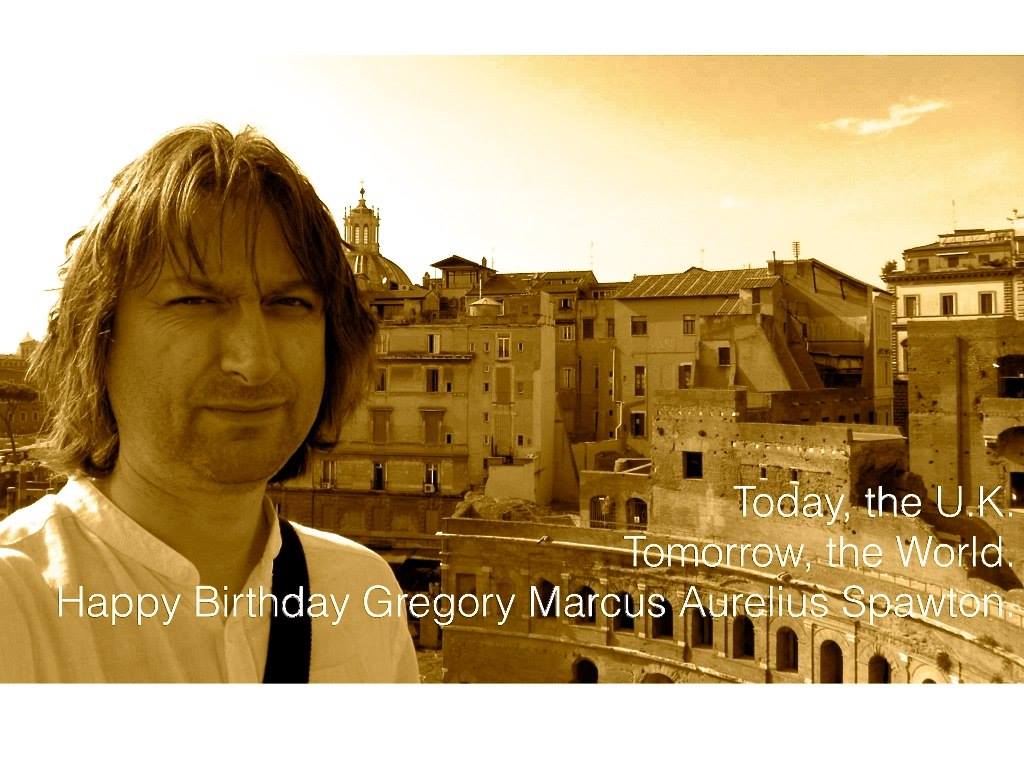
Greg Spawton ages
Happy birthday, Greg, master of the TrainYard!
Measuring the Influence of Russell Kirk and Other Conservative Authors ~ The Imaginative Conservative
As noted on the slide itself, this slide compares and considers, arguably, the seven most influential male conservatives of the 20th century: Irving Babbitt; Friedrich Hayek; Christopher Dawson; Eric Voegelin; Leo Strauss; Russell Kirk; and Harry Jaffa. [As a sidenote, had I included Paul Elmer More, his reputation would have paralleled, almost exactly, Irving Babbitt’s, so I left it off for sake of clarity.] This chart makes several things clear. First, and most significantly, the most important conservative thinker of the century came at its beginning, not its end: Irving Babbitt. At his height, Babbitt soared above all others, and he experienced three peaks. Second, the most important conservative as of 2008, without compare, is Leo Strauss. Yet, interestingly, his reputation declined rather shockingly during the Clinton years, and only rebounded with the election of George W. Bush. Third, Christopher Dawson and, to a lesser extent, Eric Voegelin each enjoyed considerable and sustained popularity over decades.
— Read on theimaginativeconservative.org/2019/05/russell-kirk-influence-conservative-authors-bradley-birzer.html
Best of Yes, Post 1983
For most music fans, and especially prog rockers, Yes existed between 1969 and 1983.
Some would even end Yes around 1979.
Amazingly enough, though, Yes still exists. And, while the band has never produced a perfect album since 1983’s 90125, it has produced a number of tracks equal to the best of the “classic Yes” period.
The two best albums of this later period were Magnification (2001) and Fly from Here-Return Trip (2018).
For those interested (and with ears to hear), here are my favorites from 1987-present.
- Birthright (Anderson Bruford Wakeman Howe, 1989)
- Dreamtime (Magnification, 2001)
- Endless Dream (Talk, 1994)
- Evensong (Union, 1991)
- Fly From Here (Fly From Here-Return Trip, 2018)
- Homeworld (The Ladder, 1999)
- I’m Running (Big Generator, 1987)
- In the Presence Of (Magnification, 2001)
- Into the Storm (Fly From Here-Return Trip, 2018)
- Life on a Film Set (Fly From Here-Return Trip, 2018)
- Magnification (Magnification, 2001)
- Minddrive (Keys to Ascension 2, 1997)
- New Language (The Ladder, 1999)
- Order of the Universe (Anderson Bruford Wakeman Howe, 1989)
- Shoot High Aim Low (Big Generator, 1987)
- Silent Talking (Union, 1991)
- Spirit of Survival (Magnification, 2001)
- Subway Walls (Heaven and Earth, 2014)
- Themes (Anderson Bruford Wakeman Howe, 1989)


You must be logged in to post a comment.