All posts by Thaddeus Wert

High school math teacher and fan of all kinds of music, but most of all prog.

Celebrating A Classic: Spock’s Beard’s V

V

In this crazy post, Tad and Brad think hard and deep about Spock’s Beard’s fifth album, appropriately named V.  Tad and Brad (my gosh, we rhyme) think the world of this album.  As Tad will note, it’s what brought him back to the genre of progressive rock, and Brad will affirm that he loves all things, Spock’s Beard, never having actually left prog rock.  Indeed, if truth be told, Birzer thinks that he first encountered Spock’s Beard, THE LIGHT, sometime in 1994, even though the official literature claims a 1995 release date. . .

Brad.  My gosh, it was 2000, that year of mystery and chaos that saw the release of the fifth Spock’s Beard album, V.  The album, even subconsciously, seems to think that prog needs a new release, a new introduction to the world.  Even the opening track wants to invite all new adherents to all things proggy.

At the end of the day, you’ll be fine!!!!!!!!!!!!!!!!!!!!!!!!!

And, to be sure, prog was coming into its third phase.  Spock’s Beard, The Flower Kings, and Porcupine Tree had all ushered the genre into its newest phase.

Tad: Brad, it’s hard to believe that V is more than 20 years old! Yes, this one album reintroduced me to the world of prog. I still remember exactly how I discovered it: at the time I read Mojo Magazine regularly, and they had an issue with a Genesis cover story. There was an inset article about “current prog artists to check out”. One of them was Spock’s Beard, so I went to Tower Records (remember when there were record stores?) and, low and behold, there was a copy of V. I popped it into my car’s CD player, and I couldn’t believe the incredible music that poured out!

Up to that point, I was listening to practically every style of music except prog. In high school, I enjoyed Yes, Genesis, ELP, Jethro Tull, Pink Floyd, etc., but once the 80s hit, I quit following that genre. I was flabbergasted to hear a band like Spock’s Beard unapologetically playing progressive rock, but with an updated, contemporary sounding style. 

I think what impressed me the most was Neal Morse’s gift for melody. He obviously loved the Beatles, but he didn’t imitate them. Rather, he incorporated their sense of harmony and melody into massive epics that never seemed overlong. I remember in March of 2021 we went down to Florida for Spring Break, and all I listened to for a week was Spock’s Beard! And from there an entire new world of music opened up for me.

Brad:  Wow, Tad, what a wonderful memory.  Florida and Spock’s Beard!  Very nice.  

In the early 1990s, I remember wondering what had happened to progressive rock and encountering–through Tracks Records in Bloomington, Indiana–a revival of the genre through Spock’s Beard, The Light.  

As I noted above, it seems–at least in memory–to be sometime in 1994.  I was a graduate student at Indiana University, then, and I was quite the customer for Track’s.  I remember the manager telling me about The Light, but I remember it in the fall of 1994.  

For whatever reason, SB remembers the albums as coming out in 1995.  Somewhere–and I don’t know where–there’s a discrepancy.  At the time, I was thrilled with The Light, and I wanted more.   From that point forward, I followed the band.  Except for the embrace of the f-word, I absolutely loved The Light.  

It’s funny, but since the band was so abrupt in its language, Neal Morse has since sent out a warning about the music.  Honestly, though it was his attack on Catholicism–especially through his album Sola Scriptura, that warned me more than his embrace as had the f-word.  I don’t mind my kids hearing the f-word, but it was his attack on Roman Catholicism that really chilled me.

As it was, the band, Spock’s Beard, produced some great prog rock and some real straight-forward rock after 1995.  It was V, however, that really reminded us all that progressive rock was not only alive but thriving.  It was, by far, the most progressive album the band had released since its second release, Beware of Darkness.  Yet, to be sure, V is nothing compared to its successor, Snow, which really embraced not only progressive rock, but the Catholic Church (its priests, in particular) as well.

When V came out, I was blown away,.  Album number 5 from the band was simply brilliant, and I was so glad to have the progressive rock genre come back in full force.  Indeed, when you bring into account the early Flower Kings, it and Spock’s Beard really introduced us to the third wave of progressive rock.  Both, somehow, brought us all into the fold of a whole new take on the classic genre.

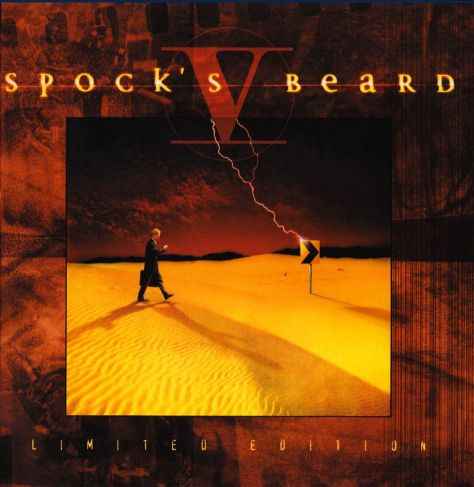
Tad: Before we get into discussing the music, I want to give a shoutout to the artwork. At first glance, it looks like a businessman walking in a desert past a traffic sign (a sideways V) telling him to go forward while a forked lightning bolt (making a V) pierces the sky behind him. But on closer inspection, you realize he has two shadows (making a V), he must be on an alien planet! The whole scene is worthy of Hugh Symes’ best work for Rush. I love it!

Brad: Agreed.  The art is excellent and reminiscent of Hugh Symes.  A wonderful comparison.

What surprises me most, however, Tad, is how much of a solo album for Neal Morse this fifth album from Spock’s Beard actually is.  If we take the liner notes seriously–and I have no reason not to–Morse wrote every lyric and every song with the exception of the excellent. THOUGHTS (Part II), the most Morse-like of all the tracks!  Indeed, the original “Thoughts” appeared on the second Spock’s Beard album, Beware of Darkness, and is credited to. . . no surprise. . . Neal Morse!  Indeed, looking over the first six Spock’s Beard’s albums, what is shocking is that all seem to have been written by Neal Morse and Neal Morse almost (not always) solo!

This means, of course, that V really is a Neal Morse album with Spock’s Beard as a mere backing band.  I will admit, I’m rather shocked to realize this.  I had always thought the band contributed much more to Spock’s than this.

As such, Testimony is a Neal Morse album without Spock’s as a backing band!

That said, and attributed, Spock’s Beard V is an astounding album, whether a Morse album or not.  Everything just works perfectly on V.  The art, the lyrics, the music, the sequence of songs.  All of it, just perfect.

And, though Morse wrote all of this, I’m quite happy with the band.  Nick D’Virgilio is especially great at drumming so appropriately for this album.

Tad: Yes, the first six Beard albums were almost entirely Neal Morse projects. I have a DVD, The Making of V, that chronicles his production of V, and it’s very illuminating. It’s clear he has a very specific vision of how he wants every song to sound. He meets with each member of the group to go over their parts. They make minor suggestions, but by and large he is calling all the shots. Even that little woo-wah guitar sound that Alan Morse makes 12 minutes into “At The End of the Day” is due to Neal’s urging.

Speaking of “At the End of the Day”, let’s dive into the songs on this album. “At the End of the Day” is one of my favorite opening tracks, ever. It has it all – driving rock, acoustic passage with soft vocals, and time changes all over the place! At 16:28 in length, it’s not a quick listen, but the time flies – I never get fatigued whenever I listen to it. As with every Morse composition, the catchy melodies fall over themselves as they spill out of my speakers – they are endlessly engaging and captivating. I love this song!

You mentioned “Thoughts (Part II)”, and this song led me to explore the music of classic Gentle Giant, because somewhere I read that the a cappella sections were inspired by that group (I think by “Knots”, off of their Octopus album). I also hear a lot of Kansas in this song. It is another highlight. 

Actually, there isn’t a bad track on V. I skipped over “Revelation”, but it deserves some praise – at first listen, you think it’s a relaxed, soft rock ditty, but then it morphs into some of the heaviest rock Spock’s Beard ever produced. 

Even though V was only released on CD, I’ve always thought of “All On A Sunday” as kicking off “side 2”. This is such a happy, welcoming song for me. Once again, Morse’s gift for a catchy melody really shines here. “Goodbye To Yesterday” is more sombre, but still beautiful. This song is a showcase for the Beard’s knack for gorgeous vocal harmonies. You can hear how good a singer Nick D’Virgilio is here.

I’ve rambled enough – you’re our resident lyrics expert; what do you think of Morse’s words on V?

Brad: Tad, thanks for such good thoughts.  I think your analysis is simply awesome.  Fantastic.  The DVD “The Making of “V”” sounds excellent.  I’ll have to check it out.

I must admit, Tad, when it comes to Neal Morse lyrics, I’m always a bit conflicted.  I love his music–composition, tone, flow, etc.–but I find his lyrics less persuasive as it were.  Some of this is simply poor bias on my part.  I loved the music of The Light, but I was less than taken with the lyrics.  As mentioned above, I just think the “f-word” is totally avoidable in songs.  To me, its employment is always and everywhere a sign of a lack of imagination.  Since then, I’ve been skeptical about his lyrics.  I especially disliked the lyrics of Sola Scriptura.

Specifically, as to V, however, I generally like the lyrics, though I find them–again–unpersuasive.  When I listen to Big Big Train, for example, I always assume my prevailing attitudes and ideas will be challenged.  As I hear V, though, the lyrics are just random words that sound good with the music.  In no way have I been challenged in basic assumptions or ideas.  I’m more moved by the insertion of a dirty organ than I am by the words.

Here’s section III of the “Great Nothing.”

Come up breathing
Up from the water
Man, he was so submerged
Where’s the feeling?

It must be way under
Far from the spoken word

No, no – no corporate ladder
No hometown parade
The fat cats just keep getting fatter
What does it matter
The thing must be played…

One note timeless…

Don’t let the buzz get you down
Don’t lose your memory or you’ll sink fast and drown
But you can’t seem to sleep for the thoughts in your mind
Since you can’t stand to think you have one hell of a time
Hanging with submergers you drink yourself blind
You think it’s fine

You’ve got time…

What is this all about?  I have no idea, and, worse, I’m not that interested in knowing or figuring it out.

Again, Tad, don’t get me wrong.  I really like Morse’s music, I just feel less taken with his lyrics.  An exception to this is his lyrics for Testimony and Testimony 2.  I loved and devoured these lyrics–as they told a story.

Tad: Brad, your points are well taken. As far as the lyrics to “The Great Nothing” go, I believe Morse wrote them as a tribute to his friend and fellow musician, Kevin Gilbert. He was enormously talented, but the music industry never knew how to promote him. He died not too long before V was recorded.

As I’ve mentioned before, I have a hard time paying attention to lyrics , except as they add to the overall sound of a song. It’s a failing of mine – I’m too lazy to get into them! Like you, though, I don’t have a lot of patience for gratuitous profanity when it occurs.

As far as “The Great Nothing” goes, I think, musically, it is one of the greatest songs Spock’s Beard ever recorded. It is one I never tire of listening to, with its various sections of melody. Dave Meros’ bass is outstanding on it, as is Nick D’Virgilio’s drums.

There is one section (the “You missed your calling” one) that sounds like something Paul McCartney could write – it’s that catchy. When I first heard this epic, I had to stop what I was doing and hit “Rewind” on my CD player several times!

They say that hindsight is 20/20, but I get the sense that Morse intended for V to close a chapter in Spock’s Beard’s career. I couldn’t wait for the next album, Snow, but I was very disappointed with it. It sounded so different from anything else they had recorded, and the story kind of creeped me out. Like you, I thought Testimony was a tremendous album – one of Morse’s all-time best. But that’s a topic for another post!

Brad: Thanks so much, Tad.  You have excellent responses, of course, and I had no idea that Morse was referring to the work of Kevin Gilbert.  Next time I listen to V, I’ll keep that in mind.

Tad: It’s always a blast to bounce thoughts and reactions with you, Brad! I hope our readers take some time to listen to V. It is not available on Spotify (apparently Morse doesn’t like their payment structure), but it is on Apple Music. Here is “The Great Nothing”, via YouTube:


Ultravox’s Rage In Eden, Revisited

Rage In Eden

In this post, Tad and Brad are joined by Kevin, as we assess the brilliance of Ultravox’s 1981 masterpiece, Rage in Eden.  By the way, Tad usually does these intros, so forgive me (Brad!) for making a mess of it.

Brad: Tad and Kevin, so very glad to be doing this review with you.  I have a feeling this will be a long one.  It was, I must admit, Kevin who really introduced me to Ultravox in the fall of 1986, our freshmen year at Notre Dame. I had, of course, heard of “Vienna” as a single, but I knew very little about the band.  

After telling him how much I loved progressive rock (especially Genesis, Kansas, and Yes), Kevin introduced me to Vienna (the album), Rage in Eden, Quartet, and Lament.  I must reveal–I feel deeply in love with all of them, but especially with Rage in Eden and Lament.  

At the time, Kevin mentioned to me that he loved the lyrics so much he hoped, one day, to write an entire book about “The Thin Wall.”  This notion, of course, caught my attention.

But, I must also admit that my love of Ultravox has been deeply personal, too.  I was a huge fan of Quartet, and I was listening to it when my wife and I drove to the hospital to deliver our fifth child way back in 2007.  She (our baby) died in childbirth, and I still can’t listen to that album.  I tried again, recently, and it only brought up terrible memories.  In a weird way, I say this as a compliment to Ultravox, as the music means everything to me.

Relatively recently, though, Steven Wilson has remixed and remastered Midge Ure-era Ultravox: Vienna; Rage in Eden; and Quartet.

Tad and Kevin, what do you guys think of Rage in Eden? 

Tad: Brad, I am looking forward to discussing this classic album with you and Kevin! I had just begun my junior year in college when it was released, and I still remember my jaw dropping when I first heard the urgent synth beat to “The Voice” fading in to full volume. 

By fall of 1981, I was totally immersed in British new wave music, and I loved artists like Thomas Dolby, Gary Numan, The Human League, Depeche Mode, ABC, Howard Jones… well, I could go on forever! Anyway, to my ears there was something that immediately set Ultravox apart, and Rage In Eden became an album that transcended its moment in pop history. I think what struck me the most was the warmth of their music, which arose from three elements: Midge Ure’s powerful baritone vocals, Warren Cann’s excellent drums, and Billy Currie’s violin. 

Other synthpop artists, like Gary Numan or Orchestral Manoeuvres In The Dark, could come up with killer hooks, but they also sounded cold and brittle. Ultravox had awesome synth lines that cracked and boomed, but underneath them was a human presence that lent their music accessibility.

Okay, I’ll stop for now and give Kevin a chance to jump in!

Kevin: Thanks Tad.  So glad to be a part of this discussion. I came a bit later to this Ultravox album.  I was intrigued by the Ultravox when I first caught the video for “Vienna” probably around 1982 or so. Not long after seeing it I found a copy of the album at Hogwild Records in San Antonio.  I was completely taken with the sound.  And shortly after that a musician friend suggested Rage in Eden.  Upon hearing Rage In Eden again today I had the same uncanny sense about it that I was so drawn to so many years ago. 

On the one hand, they are unmistakably a part of the early 1980’s oeuvre.  The synth sounds by themselves place them among the artists you mention, Tad. And I would agree that unlike Numan and OMD, Ultravox had a warmth and a power that was much more appealing. And Midge Ure’s theatrical way of writing really sets their music apart. The textures and the lyrics are very much about establishing a sense of place and story. It’s as if you’ve stepped into the pages of a novel and UV is providing the soundtrack. And his stories and vocal delivery are so compelling that even after so many years the music is remarkably fresh and engaging.

Another thing that struck me when listening to Rage in Eden again, was the guitar work.  The synths are clearly present throughout the mix, but it’s Ure’s guitar that really sets them apart from the schtick of the typical keyboard band. It’s the great blending of his angular phrasing and the sharp tone that shape the overall sonic impression. No doubt he and Edge (U2) were listening to each other, but Alex Lifeson and Geddy Lee of Rush were too. Ultravox was breaking new ground.

Brad: I’m in full agreement with you both.  I love the music on Rage in Eden and I also think it’s angular, but I must admit, it’s the lyrics that do the most for me.  Take the lyrics to the title track:

We sit and watch these lifeless forms
Stark and petrified
The high suspense of an empty stage drawing in clutching to its breast
With murmured words we sigh and focus on the main facade

Beyond the hard reluctant windows
News from magazines
We wrote their names on books we’d borrowed as if to bring us closer still
And threw it all away to focus on the main facade
Rage in Eden jigsaw sequence
But no-one could see the end

And they were the new gods
And they shone on high
Their heavy perfume on the night sucked them down in red tide
All is through the looking glass focus on the main facade
Rage in Eden jigsaw sequence
But no-one could see the end

Disciples of the new way
Portraits in the new sand
See when they run their longest mile holding caps in wet hands
Eyes upon them try to focus on the main facade
Rage in Eden jigsaw sequence
But no-one could see the end

These lyrics are simply astounding.  As many times as I’ve listened to this album since 1986, they continue to grab me, wrestle with me, and turn me into something pathetically receptive.

Or, even better, the lyrics for “The Thin Wall,” here with Bovine Grace!

The sound is on the visions move
The image dance starts once again
They shuffle with a bovine grace and glide in syncopation
Just living lines from books we’ve read
With atmospheres of days gone by
With paper smiles
The screenplay calls a message for the nation

And those who sneer will fade and die
And those who laugh will surely fall
And those who know will always feel their backs against the thin wall
The thin wall
Thin wall

Grey men who speak of victory
Shed light upon their stolen life
They drive by night and act as if they’re moved by unheard music
To step in time and play the part
With velvet voices smooth and cold
Their power games a game no more
And long the chance to use it

And those who dance will spin and turn
And those who wait will wait no more
And those talk will hear the word
And those who sneer will fade and die
And those who laugh will surely fall
And those who know will always feel their backs against the thin wall
The thin wall
Thin wall
The thin wall 

And those who dance
The thin wall
And those who talk
The thin wall
And those who sneer
The thin wall
And those who laugh
The thin wall
And those who know
The thin wall
And those who dance
The thin wall
And those who wait
The thin wall
And those who talk

Again, simply astounding.  Words that actually mean something.  Or, again, “Accent on Youth”:

What is this phase that I am going through
O these precious years
Please take my hand and let me breathe again
Young depressive tears

We stumble blindly chasing something new and something sinful
You take my time you live my life for me
What have I done to rate this penalty
You suck me dry
My body cries
We stumble blindly chasing instant thrills and lasting memories

Accent on youth
Attention 
Ascends on you

I scream with frustration and lost control
Open for the blows
My hands fall limp and hang down by my side
Take my soul and go
We stumble blindly chasing dancing lights and others’ wishes

Just let me close my eyes and slip away
Dream a dream alone
You give me just enough rope for the task
Let this man alone
We stumble blindly chasing silhouettes and vacant faces
So well rehearsed our moves once so graceful turn against us

We stalk dark passages, we’re looking for that sweet surrender
Just let me close my eyes and slip away
Dream a dream alone
You give me just enough rope for the task

Let this man alone
We stumble blindly chasing silhouettes and vacant faces
So well rehearsed our moves once so graceful turn against us
We stalk dark passages, we’re looking for that sweet surrender

After thirty-plus years of listening to these words, they still mean everything to me.  If I had to find a comparison, I would say that, at the time, only The Fixx were writing lyrics as beautifully wrought and perfectly written for the angular music they were producing.

Tad: Kevin, now that you point it out, of course Ure must have been influenced by The Edge in his guitar style! His choppy, rhythmic lines are very similar to The Edge’s, yet still original. And his solos are so good – flowing and ascending inexorably to a satisfying conclusion. His solo on “Death in the Afternoon” is breathtaking.

Brad, thank you for sharing the lyrics to these songs. As many times as I’ve listened to this album, I’ve never delved into them very far. To me, they always conjured an overall atmosphere of drive and energy, while sounding somewhat claustrophobic (and I mean that in a good way).

I love the way Rage In Eden is sequenced – for example, after the slow dirge of the title track, “Death in the Afternoon” bursts out with incredible energy. The music of that track is paradoxically life-affirming, given its title. And how about the transition from the album’s longest song, “The Stranger Within” to “Accent on Youth”? The former song is one long, relentless groove with subtle synth accents in the background that hypnotically lulls the listener into a relaxed state, until the rapid beat of “Accent on Youth” ups the energy again with a beautiful melody sung with pure joy by Ure. That transition might be my favorite moment of the album. 

However, I can’t pick a favorite song, because each one hinges on the next to create an organic whole. I think Conny Plank deserves a lot of credit for the frankly beautiful sound of this album. There is a depth to the soundstage that reveals new and delightful details in the mix. At times it is a massive wall of sound (“The Voice”), and at other times it is a wide-open space, (“Your Name Has Slipped My Mind Again”).

One last point I’d like to make – the album art is some of my all-time favorite. Peter Saville, who also worked with New Order and Factory records, came up with a gorgeous art deco style for Rage In Eden that complements the music perfectly. (See above) It looks sleek, modern, ancient, and classical all at the same time. Due to legal issues, his artwork that graced the 1981 vinyl version wasn’t used on a couple of reissues, but Chrysalis has recently reissued a 5 CD/DVD version that has the original art. 

Brad: Tad, you’re most welcome!  Good lyrics mean everything to me.  So glad to know there are good writers out there.  Ultravox is definitely among the best when it comes to words and lyrics.  If, as Kevin said, the guitar is angular, so are the words and images the band presents.

And,Tad,  I agree with you regarding the organic whole.  Every song relies on every other song.  A definite completeness to Rage in Eden.

Kevin, I hadn’t thought about The Edge getting his sound, in part, from Ultravox.  But, as you pointed out, we do know that Rush was influenced by Ultravox.  You can really hear it on “Vital Signs” on Moving Pictures and really all of Signals.

Kevin: I don’t doubt their influence on other bands and songwriters of the time. Ure didn’t invent the chopped chord technique—reggae and ska were everywhere in the English scene—but he brought into it his own colors within the context of the atmospheric keyboard parts.  That blend IS the UV sound.  And he was also working more with minor chords and almost jazzy voicings.  That along with the mostly dry engineering, creates a sort of cubist tapestry.

Which is what makes the final track so striking.  “Your Name Has Slipped My Mind Again” is drenched in reverb, echo, and sustain.  It’s like a freeze frame at the end of an intense film but the credits don’t flow.  Instead, it continues for four-and-a-half  minutes frozen in time. None of the parts are synced until the refrain is sung. And then all you can recall of the lyric is the title line and the passionate “oh ohs.”  

Which brings me back to the dramatic nature of the writing. He places you in a narrative that leaves you wondering, yet there is a clarity to the storyline.  It’s not all smoke and mirrors—or Duran Duran-y drama for drama’s sake.  As it concludes you have the distinct feeling that you’ve arrived somewhere with the narrator: somewhere quite mysterious, yet beautiful.

And this cinematic sensibility (which begins with the arrival of Midge Ure on Vienna (1980)) has Ultravox creating great art and continuing the development of progressive rock.  They pick up where Yes’s Drama (1980) leaves off and take the genre somewhere utterly new.  Though at the time of the release of Rage in Eden Chris Squire and the boys were working on their own new band, Cinema, (which eventually drew in Jon Anderson and morphed into Yes’s 90125) theirs was more of radio-friendly rock. Concurrently Genesis was heading into similar territory with Abacab and Genesis (1983). Ultravox, along with a handful of other like-minded groups, were much more the avant garde creativists and the real inheritors of the progressive rock aesthetic. Less than five years after the release of Ultravox’s Lament, Talk Talk would release their post-rock masterpiece Spirit of Eden.

Which reminds me—I’m glad that you focused in on the lyrics, Brad.  Because there is something so compelling about Ure’s writing and the way he brings his sensibilities to each subject. There is a unique sense of place for each individual track on Rage in Eden. If you examine the tracks carefully in sequence you’ll notice that each one has either a slightly or sometimes greatly differing cadence.  Which leads to another striking element on the album—the variety in the groove.  Even though three of the tracks share a close tempo it’s never in sequence and the other six tunes are quite varied.  

It’s interesting, Tad, that you mentioned the transition between “The Stranger Within” and “Accent on Youth.” Rage in Eden really shines in those transitions—like scene changes. 

And remarkably, despite it being a classic New Wave album, it’s clear that at least the final track was recorded without a click track. The tempo imperceptibly varies a great deal—as much as 7bpm faster and slower and in that ethereal space. Yet Ure’s vocal, the drum, and the keyboard are pretty tightly in sync after the intro. Which makes it likely that at least these main parts were recorded live in the studio and not overdubbed. Coming on the heels of the incredible ascending key modulations at the end of “Accent on Youth” (one of my favorite musical moments on the whole album), into the great violin solo called “The Ascent”, then the cascading piano and the revved-up glissando at its culmination and suddenly…it cuts off into an echoing gunshot.  The variability in the final track’s tempo along with the removal of the rhythmic pulse casts the listener into space—adrift—off a cliff and in descent.  It’s one of the most powerfully visual moments on the whole record. A riveting  conclusion to the whole album.

Tad: Beautiful insights, Kevin! Midge Ure himself would agree with you; he is quoted as saying, “I think ‘Rage in Eden’ was always one of my favourite albums. There’s a starkness about it, an austere, mystical distance, a coldness to it but a coldness that kind of works.”

I think with that, we can bring our celebration of Rage In Eden to a close. Even though it didn’t chart above 144 in the US, it had a huge influence on the New Wave music scene internationally. I hope our conversation has given Spirit of Cecilia readers some incentives to check out this classic work from the early 80s! 

Here is the official video for “The Thin Wall”:

Look At The Flower Kings Now!

Flower Kings look

Welcome back, Spirit of Cecilia readers! In this post, Brad Birzer and Tad Wert discuss the new album from the Flower Kings, Look At You Now.

Tad: Brad, I know the Flower Kings are one of your favorite artists in music. They certainly are prolific – when they release an album, it’s usually a double-length one. Look At You Now clocks in at a relatively modest (for them) 67 minutes.

I’m not as big a fan of them as you are, but I certainly respect their talent. That said, I have to say that this album is really attractive to me. It seems more focused and energetic than previous releases. Right off the bat, “Beginner’s Eyes” is a song I bet Yes wishes they could produce these days. It’s majestic and inviting at the same time.

Brad: Dear Tad, you wrote this over a week ago, and I’m just now getting to it.  I’m so sorry, my friend.  It’s been crazily busy here, but not busy enough to warrant such neglect.  

Anyway, I’m so glad you’ve introduced us to the new Flower Kings album, Look at You Now.  I first came to the Flower Kings back in the year 2000.  A student (now a beloved colleague in the philosophy department)  leant me his copy of Flower Power, and I was utterly gobsmacked.  I couldn’t believe how nuanced the album was on disk one (the Flower Kings rarely do anything short), and I loved the “b-sides” of disk two.  From there, I worked backward and found my way through the band’s entire catalog.  

For twenty-three years now, I’ve been fully immersed in everything Roine Stolt (the founder of the band) has done–from the Flower Kings to Kaipa to Transatlantic to The Sea Within to Agents of Mercy.  The guy is astoundingly relentless and talented.  I’ve even tracked down and purchased–for my personal collection–Flower Kings rarities, all of them beautiful.

The latest album, Look at You Now, is much more laid back than I would’ve expected from the band.  If you look at something like Space Revolver (my favorite album from the band), the band is nearly unrestrainable.  But for this new album, the band is confident in its mellow state.  Even its mellowness, though, has a nice intensity to it.

Tad: Brad, I find it interesting that you characterize Look At You Now as laid back – my first impression was that it had more fire than usual! However, I haven’t heard Space Revolver, so I don’t have the same history to compare Look At You Now to that you do. As I mentioned in the intro to this post, I think “Beginner’s Eyes” is a great song that outdoes anything Yes has recorded in years. Stolt’s guitar really stings in his solo. Another song I found immediately appealing is “Scars”, with its gritty, bluesy intro and infectious groove it lays down. Once again, Stolt’s guitar work is outstanding (assuming he’s the lead guitarist here); the entire song reminds me of something Eric Clapton might have produced at his peak. 

I also appreciate the fact that almost all the tracks on this album are relatively short – more than half are under five minutes. Maybe it’s my age, but I’ve lost patience with songs that meander without resolution for more than six or seven minutes. I have a friend who went to a Phish show a couple of nights ago, and he said he had to leave after the first three songs took 45 minutes! Neal Morse is one of the few artists who can hold my interest over a long period of time; most others, not so much. Okay, rant over – as I said, I think the Flower Kings have done a great job paring every song on this album down to its essentials, and I think that makes for a really strong album overall.

Brad: Tad, thanks so much for a great response.  I love the rant.  I must admit, though, I’m a guy who likes meandering in my music.  Phish playing only three songs over forty-five minutes sounds wonderful to me.  I’m guessing I would’ve been immersed in the experience.

As to The Flower Kings, this new album is definitely a surprise, especially given the shortness of the songs.  But, I very much appreciate and like what the band is doing.  I think you’re absolutely right, any band–Yes or The Flower Kings–should be proud of a song like the album opener, “Beginner’s Eyes.”  What a delight it is.

As much as I love the dual vocals with the Flower Kings, I also especially like the instrumental passages, and one of my favorite tracks is “Dr. Ribedeaux.”  Despite the absence of lyrics, I think this song has the most classical Flower Kings feel to it.

I also love that The Flower Kings are willing to wear their influences so openly.  Obviously, “Mother Earth”’s introduction sounds like something Brian May of Queen might have done, and much of the album has a Yes fan–as you were implying above.

And, Tad, before we close this review, I must encourage you to listen to Space Revolver.  It’s most certainly a top 15 prog album for me.  It’s wacky and gorgeous, all at the same time.

Regardless, I’m so glad to have The Flower Kings in the world.  Roine Stolt is my favorite viking hippie!

Tad: Brad, I love “Sr. Ribedeaux” as well! A great instrumental workout. In sum, I think Look At You Now is a worthy addition to the extensive Flower Kings catalog. In my opinion, one of their best, and well worth checking out if someone isn’t familiar with their work. And I promise to give Space Revolver a listen – you have yet to steer me wrong with your music recommendations!

Steven Wilson’s The Harmony Codex

Harmony Codex

The always intriguing Steven Wilson has a new album coming out September 29: The Harmony Codex. Brad Birzer and Tad Wert share their thoughts on this new work by one of modern music’s most gifted artists.

Tad: Brad, I think you’ll agree with me that one thing we can expect from Steven Wilson is the unexpected. When he was in No-Man with Tim Bowness, he created an interesting amalgam of ambient/techno/pop that was unique. As the leader of Porcupine Tree, he spearheaded the resurgence of progressive rock in the 2000s that wasn’t afraid to pay homage to the “dinosaurs” of the ‘70s like Pink Floyd, Genesis, Emerson Lake and Palmer, and Yes. His solo career has been a rollercoaster ride – which I have enjoyed – where he has produced music in practically every style. I think he has deliberately worked to escape being pigeonholed as a “Progressive Rock” artist, and he asks his fans to simply appreciate him for his music, whichever mode it happens to be.

Which is my long-winded way of introducing our thoughts on his latest work, The Harmony Codex. The first time I listened to it, I wasn’t particularly struck by any song, as I immediately was with his earlier album, To The Bone. But then I listened again, this time with headphones, and holy cow! This is an amazing album. It really came alive when I heard the songs in the soundstage Wilson has crafted.

Brad: Tad, thanks so much for staring us off on this conversation.  As always, my friend, it’s an honor to talk music with you.  

I have not yet listened to The Harmony Codex with headphones.  What an excellent idea.  Maybe tonight I will do that.

In the meantime, I have listened to the album (so graciously provided by Steven Wilson’s PR firm) numerous times since we received the review copy the other day.  In some weird way, it’s become a part of me this week.

I agree with you that it didn’t do much for me on the first listen.  In fact, I thought it way too overproduced.  Our own Carl Olson has likened it to Kate Bush, but it struck me as far more Tears for Fears, Elemental-period.  I’m not sure I would say this now after so many listens, but I also wouldn’t say at this point that it’s overproduced.  The album has truly grown on me to the point that I absolutely love it.  Again, I couldn’t imagine the past week without it.  I am jealous of those who were able to hear the album in an Atmos-equipped room.  That must’ve been quite the experience.

I guess this takes me back, personally, to my own musical “relationship” with Steven Wilson.  I first heard “Trains” on an album rock radio station while doing some shopping in northern Indiana over two decades ago.  I immediately went to a very good store in Fort Wayne and purchased In Absentia as well as Up the Downstair Case and Signify.  Yes, it was a very good CD shop!  A kind student, finding out my new found-love love, then gifted me with Stars Die: The Delerium Years.  

I fell in love with Wilson and then proceeded to buy everything I could from him–everything from his contribution to OSI, to his No-Man work with Tim Bowness, to his later Blackfield albums.  When his first solo album, Insurgentes, came out I was thrilled.  

I now, twenty-one years later, have a huge Steven Wilson collection.  Everything he has written directly as well as probably 95% of what he’s remixed for other bands.  And, of course, I happily own the deluxe edition of his autobiography, etc.

All of this is a very long way of admitting, I wasn’t sure what to expect from Wilson on this new album.  To me, the absolute height of his profound musical ability can be found in Hand.Cannot.Erase, what I think is my second favorite album of all time.  His lowest point, though, was The Future Bites.  At least to me, though I know there are good things on that album.  Yet, the whole project came off as cynical.

Still, I very much worried that The Harmony Codex would be The Future Bites, Part II.  I am so very thankful that Wilson took his music in a different direction.  While I think The Harmony Codex shares some production values with The Future Bites, it is an album that stands on its own, far closer to, say, Grace for Drowning than to The Future Bites.

Anyway, I eagerly await the deluxe edition of The Harmony Codex I ordered from Burning Shed.

Tad: Brad, my love affair with Wilson’s music followed almost exactly the same path as you – I bought Fear of a Blank Planet, because Alex Lifeson of Rush played on it. I was hooked, and I quickly picked up every album I could find that Wilson was connected to. It didn’t hurt that Snapper/KScope was reissuing all of No-Man and Porcupine Tree at the time. Like you, I was exposed to OSI through Wilson’s vocals on their debut!

As far as The Harmony Codex goes, I wouldn’t say it’s his best, but it is very satisfying to listen to. I would like to know who and what influenced him while he was composing the music for this album. I hear Middle Eastern motifs in the first track, Inclination, classical minimalism in the intro to Impossible Tightrope, which then morphs into a jazz/rock fusion workout that sounds like something Herbie Hancock might do in the early ‘70s. The title track sounds almost baroque in its melody. For me, the weakest song is the single, Rock Bottom, but the other songs have set a very high bar. I think my favorite is the closing track, Staircase: nine and a half minutes of beautiful music that held me riveted from beginning to end. The break that features the bass bursting out of the mix is incredible!

You’ll notice that I haven’t spoken much about the lyrics – as I mentioned in an earlier dialogue of ours, a song’s melody has to attract me before I’ll invest any time in pondering the words. Wilson’s lyrics can be problematic for me, particularly from earlier in his career, because they dwell on some very dark subjects. In Absentia, for all its pleasant melodies, is about a serial rapist/killer. And I agree Hand.Cannot.Erase is an outstanding work of art. However, its subject matter – a young woman who dies alone in her apartment and isn’t missed for months –  is so heartbreaking that I have a hard time listening to it! You’re the lyrics man, so what are your thoughts on Wilson’s words in The Harmony Codex?

Brad: Yeah, Wilson can be really, really creepy when it comes to his lyrics, and he’s previously been obsessed with truly dark subject matter.  On not just one album, but several, he follows killers, drug addicts, and other miscreants.  

Hand.Cannot.Erase works so well for me, because he does have some hope at the end of the album, and I think he nails grief perfectly on that album.

As such, I think the weakest song on the new album is “Actual Brutal Facts.”  I can’t quite make out all the lyrics, but the muffled distorted  voice weirds me out quite a bit.  I like the music to the song, but the lyrics seem chilling.  Maybe I’m wrong on this, as I’ll need to wait until I see the lyric sheet.  As it is, the song tires me out.

And, Tad, I must admit, I’ve not been able to understand all the lyrics on the new album, so I can’t really pass judgment on them.  I will have to wait for the physical album to pass any real judgments.

Wilson employs that same creepy voice on the final track, “Staircase,” but it doesn’t seem as oppressive on this one.  In fact, I agree with you, Tad, this is an excellent track.

Maybe my ultimate answer to you about the lyrics, Tad, is this.  My favorite track on the album is the instrumental, “Impossible Tightrope.”  In an interview, Wilson mentioned that he followed Mark Hollis’s lead (from Spirit of Eden and Laughing Stock) in recording far more than needed and then edited the various pieces and contributions together.  He said the “Impossible Tightrope” on the bonus cd of the deluxe edition will sound very different from the one released on the main album.

Tad: That’s very interesting that Wilson openly talks about late-era Talk Talk being a big influence – I hope he does a surround sound remix of Spirit of Eden. That would be a dream come true for me!

I’ve been listening to The Harmony Codex a lot the past 24 hours, and I have a new favorite track: “What Life Brings”. It’s the shortest one on the album, and it has the prettiest melody Wilson has composed in years. Just when you think it’s going to be a predictable, fairly pedestrian song, he introduces a slight modulation in the key that raises it up to a thing of beauty. Wilson is the master of that.

I agree with you about “Actual Brutal Facts” – it leaves me cold. It sounds like he’s trying his hand at hip hop, and it doesn’t work for me. That said, on the whole I think The Harmony Codex is one of Wilson’s better albums. It has a nice flow overall, while covering quite a few different styles of music. It’s definitely “proggier” than his previous two albums. Personally, I enjoy his explorations into various styles – he’s such a gifted musician, anything he does sounds good!

Brad, as always, it’s a blast to do a dialogue with you – your enthusiasm and brilliant writing raises the bar for me!

Frost*: A Million Reasons to Love Milliontown

Milliontown

Greetings, Spirit of Cecilia readers! In this post, Brad Birzer and Tad Wert discuss a classic prog rock album that is a mutual favorite of theirs: Frost*’s debut, Milliontown.

Tad: Brad, I have you to thank for making me aware of this wonderful album. I think you mentioned it in some social media post years ago, and I replied, “What’s Frost*?”. You immediately sent me a link to a video of Jem Godfrey and Dec Burke playing an informal duet performance of Hyperventilate, and I was hooked. Fortunately, I was able to snag a copy of Milliontown before it became unavailable. 

So, Brad, to paraphrase John J. Miller, host of The Great Books podcast, “What makes Frost*’s Milliontown a great album?”

Brad: it’s always good to start with John J. Miller, bookmonger extraordinaire and a man possessing excellent taste in music!  He’s also great to have a beer with.  Someday, Tad, we have to get you up to Hillsdale so you can meet your true brothers!

As to what makes Milliontown such a great album–there are, throughout the album, a million things going on at once, and it all could’ve readily have devolved into pure chaos.  But Frost* always holds all things together.  Indeed, it’s the genius of the band.  And, by the time we’re immersed in the opening track, “Hyperventilate,” we’ve been happily flooded with a wall of sound as well as outrageous digressions.  Again, though, it all comes together as a beautiful whole.

I’m really glad I sent you that video of Godfrey and Burke.  To me, that clip captures the essence of Frost*.  Playful yet professional. 


Back to Milliontown as an album.  Strangely, the first time we hear a human voice on the album, it’s a distorted recording that opens track two, “No Me No You,” and then the singer sings with absolute urgency.

Things slow down considerably with “Snowman,” track number three.  This song has almost a ballad feel, something that could’ve been from Genesis’s And Then There Were Three.

Things revive, rather seriously, with track four, “Black Light Machine.”  Yet, the lyrics are dark–about a psychopath.  The lyrics here really get into Steven Wilson territory.  Still, this is probably the poppiest song on the album, even though it’s a little over 10 minutes in length.  Again, a paradox of Frost*–combining the poppiest tunes with the darkest lyrics.

The hyperness of Frost* continues with the penultimate track of the album, “The Other Me,” a funky prog song, sounding a bit like Thomas Dolby and a bit like mid-period Tears for Fears. [the order of these songs, by the way, is different on different releases of the album.  My review, here, reflects the song order as on 13 Winters]

And, of course, this brings us to the greatest track of the album, the magisterial 26-minute, “Milliontown,” Frost*’s equivalent of “Supper’s Ready” by Genesis.

So, Tad, what makes you think this is a great album?  And, what are your thoughts about the individual songs?

Tad: Brad, for me the test of whether an album is great or not is simple: do I listen to it again after my initial experience of it? When I get a new album, I typically enjoy it for a week or so, giving it half a dozen spins. After that, it gets filed away and I’m unlikely to pull it out again. Some albums, though, stand the test of time, and I never tire of them. Genesis’ Abacab, Yes’ Going For The One, Big Big Train’s The Underfall Yard (among other BBT masterpieces), Glass Hammer’s Ode To Echo, Spock’s Beard’s V, Gazpacho’s Night, Steven Wilson’s The Raven That Refused To Sing are all albums that I return to again and again, and I always find something new to delight in. Milliontown also falls into that group.

I think it’s the perfect balance of pop appeal with the – as you so aptly put it – barely controlled chaos that makes this album so compulsively listenable. “The Other Me” is a great example of this – it features a chorus that begs to be sung along to, while underneath all kinds of weird noises are percolating and bursting out at odd times. Atonal, screaming guitars compete with beautiful piano lines, while the vocals veer from a whisper to a scream. It is a raucous, glorious roar of music, and I love it.

“Snowman” is another favorite. As you mentioned, it slows things down, with its very simple, almost childlike melody, but I’m a sucker for a pretty tune, and this is one pretty tune! Jem Godfrey’s production is perfect, keeping things relatively spare and open, which allows the vocals to feel more intimate.

I agree with you that “Black Light Machine” is very poppy, and I love that. It’s just an aural rush of exhilaration, which, of course, belies its dark subject matter. No matter, I enjoy every second of its 10+ minute length. Dec Burke’s guitar solo is outstanding here, as well.

And then there is the epic title track. Wow! Burke’s vocals at the beginning are simply haunting, while Godfrey’s keyboards carry the gorgeous melody. I am in awe of how so many perfect melodies spill out in the course of this one song. Godfrey was definitely plugged into his muse when he composed this song. The time flies by every time I listen to it –  there’s a frantic, swirling climax of everyone hurtling to a final whoosh!, and when you think it’s over, Jem closes things out with a very sweet coda on solo piano.

In his notes to the reissue set of Frost*’s first three albums, he says that he wasn’t happy with the original mix of Milliontown, so he rerecorded some parts and remixed it. I have to agree that as good as the original version was, the new version that was released in 2020 is better. 

Like Glass Hammer, Frost* has featured a rotating cast of members, but the one constant, Jem Godfrey, has meant that there has always been a recognizable Frost* sound. I think the current guitarist/vocalist John Mitchell is a terrific partner for Godfrey, but Burke’s work on Milliontown is superb.

Brad: Wow, Tad, this is an awesome response.  You really nail the genius of Frost*. Thanks for your comments about the individual songs, especially.

And, you’re right, of course, the band really centers around Jem Godfrey and his rotating cast of brilliant musicians.  

Have you had a chance to listen to Island Live yet?  “Milliontown” sounds just as wonderful live as it does in the studio, though the vocals are a bit muted on the recording.

I’m also in complete agreement with you about what makes a great album.  I’m with you–most albums get a few weeks of time on my playlist, then get filed away.  I have shelves as well as boxes of CDs–my favorites displayed in a glass cabinet.  

Certain albums, though–and your list is very close to mine–find themselves in constant rotation, and I come back to them frequently.  I would also put Milliontown in that constant rotation category, though, frankly, every Frost* album fits in this category.  I probably come back to Falling Satellites and Day and Age as often as Milliontown, especially when I’m on not infrequent long car drives.

A few months ago, I posted my top 200 albums–all ones I consider more than mere moments of time.  Frost* featured prominently.

I’m eager to know what the band is doing next.

Tad: Brad, I just finished listening to Island Live, and you are right – it sounds wonderful. The 2-cd/Blu-ray is already sold out, and it just came out in June of this year!

I also listen to Falling Satellites and Day and Age as often as Milliontown – the former is more pop, albeit a far more elegant strain than what passes for “pop” today – while the latter was my favorite album of 2021. Mitchell’s love of classic Police really comes through on that album.

Well, Brad, I think we’ve done Milliontown justice – I hope readers who are unfamiliar with it are moved to check it out!

Glass Hammer Takes Off For The Cosmos

Arise

Having just finished posting a discussion of three classic Glass Hammer albums, comes news of the upcoming release of a new album! Arise is the title, and it is a completely new direction – thematically – from the Skallagrim Trilogy that took up their previous three albums.

If there is one constant in the career of Glass Hammer, it is change. I am not aware of any musical group that is always pursuing new directions, both lyrically and musically as Glass Hammer. The miracle of them is the consistent excellence of their output, regardless of the path they take.

Arise is a sci-fi epic, and I mean a true epic. It follows the voyage of an android sent to explore some deep space anomalies. The mission is called Android Research Initiative for Space Exploration. As we travel with our android ARISE, we encounter exoplanets: some beautiful (Arion), and some seemingly malevolent (Proxima Centauri B). There is also a “curious anomaly detected at WASP-12” – a rift in space where mysterious entities bent on destruction are entering our universe.

Communications from ARISE eventually cease, but strangely enough, “inexplicable sightings of the presumed-destroyed spacecraft Deadalus have emerged.” I don’t know if this indicates that the saga of ARISE will continue or not, but it looks like there could be more to come.

Musically, the album is not as heavy as the Skallagrim Trilogy, but it definitely rocks. Wolf 359 features Hannah Pryor on lead vocals again and she sings beautifully over a relentless beat. Arion (18 Delphini b) is a bright, upbeat song featuring Babb and Pryor trading lead vocals. Mare Sirenum is a brief instrumental in the spacey “Tangerine Dream” mode that GH has become so good at producing. Lost begins as a bluesy jam and then transforms into a very ear-friendly tune sung by Pryor. Rift at WASP-12 is my current favorite track – it’s a blistering rocker with a great hook. Proxima Centauri B is slow-burning heavy rocker that has Babb’s terrific bassline mixed up front, and it sounds great. Arise clocks in at 11:44, and it is quite a good epic. It features Pryor’s best vocals on the album. The song slowly builds in intensity and when she sings, “So little time left to say this/So little time is left for anything/There is a light up in heaven/There is a light shining down upon man/See Him, know Him, love Him/See, feel/And know eternal truth” it is a truly cathartic moment. The album closes with a long instrumental jam that holds the listener’s interest from the opening note to the last.

Besides Hannah Pryor, Reese Boyd is back on lead guitar. Randall Williams handles drums, and overseeing the entire project is Glass Hammer’s cofounder, Steve Babb. He outdoes himself here, tackling keyboards, rhythm and lead guitars, bass guitar. percussion, and vocals. Cofounder Fred Schendel plays drums and guitars on WASP-12.

Musically, ARISE is a winner, offering moments of serene beauty as well as ferocious rock. Hannah Pryor really shines on vocals throughout, and Steve Babb is still the most inventive bassist in rock. The concept of the album fascinates me, as well. The hero of the saga, ARISE, is an android – by definition an artificial human. Yet, in every song, he (she/it?) seems capable of perceiving a spiritual reality. In Wolf 359, ARISE sings, “They say that God is watching over me/I’m not sure what He wants or what He hopes to see.” And in Arion (18 Delphini b), “Thank God I found it/Thank God you’re standing here with me.” At the end, even though communication from ARISE seems to have ceased, it appears that he is returning to Earth – perhaps in a resurrected form? Hopefully, this is not the last we hear from this tale. As with every Glass Hammer album, the lyrics provide much food for thought. 

Some Glass Hammer, Revisited

Hammer

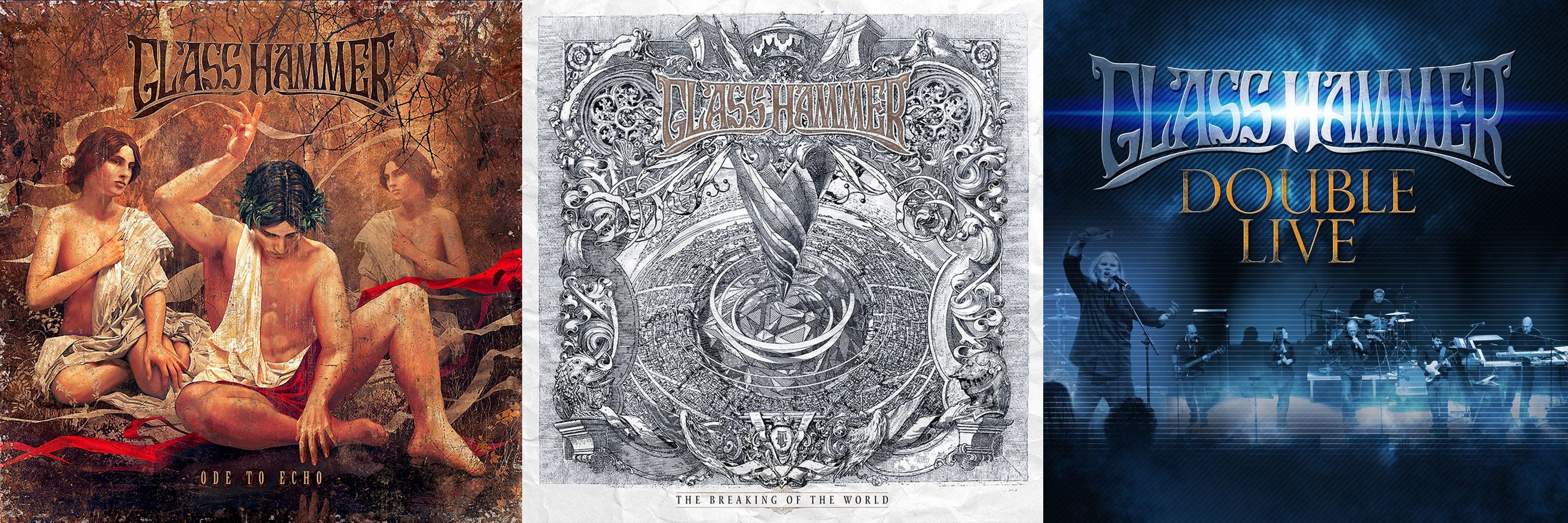
In this post, Brad Birzer and Tad Wert have a conversation about a trio of classic Glass Hammer albums, Ode To Echo, The Breaking Of The World, and Double Live. Glass Hammer is a progressive rock group whose long career has encompassed many personnel and stylistic changes. The one constant has been the core duo of the group: bassist/keyboardist/vocalist Steve Babb and keyboardist/guitarist/vocalist Fred Schendel. It’s no secret they are among Birzer’s and Wert’s all-time favorite musical artists.

Tad: Okay, Brad, I’m responsible for this topic of conversation. Over the past few days, I have been revisiting some earlier Glass Hammer albums, in particular the ones that feature Carl Groves and Susie Bogdanowicz on lead vocals. In my opinion, these three are a high point in the long career of GH – a career that has many high points! 

I know that many fans love the albums with Jon Davison, and they are excellent, but for some reason, the blend of Groves’ and Bogdanowicz’s voices are very appealing to me. I also appreciate Kamran Alan Shikoh’s outstanding lead guitar on these songs. This was, relatively speaking, a fairly stable configuration, with Aaron Raulston on board with drums. He’s still with them today, and I think his work has lifted them into the premier ranks of prog rock.

Brad:  Tad, I’m so glad you initiated this conversation.  You’re right, I’m a huge fan, and I have been ever since Amy Sturgis (an academic friend) introduced me to Lex Rex while we were at a conference in Princeton many, many years ago.  Crazily, it was also the same moment that I got Radiohead’s Hail to the Thief.  What a bizarre mix!

At the time, she told me about Steve and Fred and said I might like what they were doing.  And, here I thought I was the king of prog rock knowledge, and I didn’t–at the time–know about this seminal American band!  How mistaken I was!

Since then, I’ve happily taken the deep dive into all things Glass Hammer.  I even had the chance to have dinner with Steve Babb several years ago–one of the finest nights of my adult life.  He’s an amazingly nice and creative person!  I’m proud to count him as a friend and ally in this crazy world.  The guy is not just a wizard at bass and composition, but he’s an accomplished novelist, father, husband, and band leader.

For what it’s worth, I even take some considerable time to thank Steve (and Big Big Train as well) as huge inspirations for my book project on Tolkien and the Inklings.  Truly, Glass Hammer and Big Big Train were the essential soundtrack to that book.

Given the long history of Glass Hammer–dating back to 1992!–the albums (all wonderful) you selected are what, I guess, we would call mid-period Glass Hammer.

I’m a huge fan of all three, and I think that Double Live especially showcases everything wonderful and mighty about the band.  Groves and Bogdanowicz are in rarest fine form, and I’ve rather publicly and happily proclaimed Bogdanowicz to have the single finest voice in prog rock next to the late David Longdon’s.  I still think this.  It doesn’t hurt that Susie is also a knock-out.

I know that lots of folks like Jon Davison, but, frankly, he’s just a little too effeminate and fey for my tastes.  I tried recently to listen to the new Yes album, and I couldn’t get past the first song.  Give me Groves and Bogdanowicz any day!

Tad: Brad, I agree with you about Double Live. Most concert DVDs I have I’ll watch once or twice, but rarely more. I have watched Double Live at least half a dozen times, and here’s the interesting thing – there are no flashy special effects, lasers, or smoke machines. It’s just six very gifted musicians at the top of their form, presenting a terrific set of songs. They exude relaxed confidence, and they obviously love playing with and off each other. I wish this lineup had lasted longer!

Okay, here’s another reason I picked these three albums to revisit: I think they contain some of the best lyrics GH has come up with. Let’s face it, even with just Babb and Schendel, they have an embarrassment of riches – both are extremely literate and thoughtful lyricists, who assume their audience has the intellectual capacity to appreciate their work. That said, I think Groves sets a pretty high bar on the songs he co writes, and spurs Babb and Schendel to even greater heights on their lyrics. For example, here’s some of Groves’ lyrics to Garden of Hedon (off of Ode To Echo):

The Garden welcomes you, ma’am

Please sit down and find twice as much as you’ll eat

Cornucopia of desires

Lying there at your feet

The Garden welcomes you, sir

Please relax and find everything you want

Very little of what you need

No bread, no water, no God

Or these from Bandwagon (off of The Breaking of the World):

“We care!” Isn’t that what you said from your ocean-front home?

I know it’s got to make you feel so much nicer

“Go and be warmed.” Oh such warm charity

And these words still with no action will soothe you

Soothe you

If that isn’t a prescient condemnation of our current plague of empty virtue-signaling, I don’t know what is!

Brad: Yeah, Glass Hammer is prog for the intelligent listener, and given that prog is already rock for the intelligent listener, GH is really, really special.  More on that in a moment.  

My only complaint about Double Live is that it’s only available on DVD.  I would love a blu-ray edition, especially given the fact that Steve and Fred are two of our greatest audiophiles.  Can you imagine what the blu-ray sound quality would be like?  Simply excellent.

One of my deepest dreams is to have Glass Hammer play at Hillsdale, especially given how outstanding our music program is.  The band could use our existing choral students.  Oh, this gives me goosebumps even thinking about it.

Back to lyrics.  I’m in absolute agreement with you, Tad.  These albums just exude a powerful confidence.  Babb has such a fictional and mythic quality to his lyrics.  Here, for example, is Babb on “Ozymandias”:

The sculptor ‘neath his gaze

‘Twould be a monument of praise

Thus he enshrined the royal sneer

Of him, this Tyrant-King of Fear

I kneel to wipe away the dust of years

With trembling fingers trace the words

Found etched upon its base

They said, “I am King of Kings

See my works and know despair!”

Yet broken now he lies forgotten!

Let’s turn and leave him there

Nothing remains but this colossal wreck of stone

Round it boundless, bare stretch wide the desert sand

Forgotten, he lies

Here, his legacy dies

On “Mythopoeia,” Babb readily captures the essence of J.R.R. Tolkien’s poem of the same name and the speech given by the grand professor at the University of St. Andrew’s in the late 1930s, “On Fairy Stories.”

Maker of myth with your rhyme you weave

A tapestry of tales untold in recorded time

And though the shadows draw near

He writes as if he sees the world bathed all in sunlight

Can he keep the fеar at bay

In hope of day eternal

Hе’s dreamt of a paradise

Ruled by a thing infernal

Sub-create!

A mortal yet strives in his fallen state

He fills his world with monsters

They hide round each corner

Plotting wickedness, wreck and ruin

He fills his world with monsters

For monsters filled his world

One last thing–at least for now–about Ode to Echo and Breaking of the World.  The art for each is simply gorgeous.  For whatever reason, I didn’t buy the t-shirt for Breaking of the World, but I proudly wear my Ode To Echo t-shirt.  Indeed, over the last couple of years, I noticed I was the only one wearing a Glass Hammer t-shirt at Devil’s Tower in Wyoming and at Yellowstone.

Tad: Brad I’m glad you shared Babb’s lyrics to Ozymandias, which is the perfect ending to Ode to Echo. And yes, the art for both of these albums is some of the best in their career. One last thing I’d like to mention – in Ode to Echo, they include a marvelous cover of Goffin/King’s Porpoise Song, from The Monkees’ Head soundtrack. What a great song from the psychedelic ‘60s, and they improve on the original. In their earlier album, Three Cheers for the Brokenhearted, they covered the Zombies’ classic, A Rose For Emily; it would be great if Babb and Schendel recorded an entire album of their psychedelic favorites!

Well, my friend, hopefully our paean of praise for this brief period of Glass Hammer’s career will spur our readers to investigate these albums. It’s been a blast revisiting them with you!

Rhys Marsh Finds Solace In “Towards the West”

Rhys-Marsh--Towards-The-West

Greetings, loyal Spirit of Cecilia readers! Brad Birzer and Tad Wert engage in another music-related discussion, this time focusing on Rhys Marsh’s latest album, Towards The West.

Tad: Brad, thank you for suggesting we do a dialogue on this album. As I listened to it, I was almost overwhelmed with its spare, emotional vulnerability. I visited Marsh’s website, and he explains there that he recorded this music not long after his father passed away. 

Brad: Thanks so much, Tad.  I’ve been a fan of Marsh’s for a while now, ever since I first heard his Karisma release, October After All.  And, I really like his work with Mandala.  

But, I’m in complete agreement with you.  Even the length of Towards the West is intimate–at only 38 minutes long.  The album feels like it could’ve been the funeral service for Marsh’s father.  It has an intimate aspect, but it also has a holy aspect to it.  

You’re absolutely right, I think, to call out its “spare, emotional vulnerability.”  The music strikes me very much as a mix between Mark Hollis’s solo album from 1998 and Kevin McCormick’s acoustic music.  It’s holy, haunting, and ethereal.

I really like the lyrics as well, and I’m glad Marsh decided to let the song lengths be whatever they needed to be.  So, on this album, we have 2 minute tracks and 10 minute tracks.  Every song is exactly what it needs to be.

What do you think of the lyrics, Tad?  I find Marsh one of the best lyricists out there.  Everything he writes is meaningful, and given that this is a tribute to his father, the lyrics are especially meaningful.  Certainly, I’d be honored if one of my kids wrote about me at this level!

Tad: Brad, I’m glad you mentioned the 38 minute length of Towards The West. One of the banes of the compact disc era, in my opinion, was the temptation to fill its 75-minute capacity with music. That’s great for classical music, but for rock – even prog with its epics – 75 minutes listening can be exhausting! So, yes, the relatively short length of Towards The West just adds to its heft. Okay, rant over.

As far as the lyrics go, I agree that Marsh has a true gift. You and I differ in this respect: I am drawn to melody first, then lyrics, whereas I believe you’re the converse of that. Marsh’s vocals here are extremely prominent in the mix, which means the lyrics are front and center. I listened to the album through headphones, and it was almost as if he were whispering in my ear. 

There are many gems to be treasured here. I particularly like “Your words will never fade/Our love will always stay”, from It’s Like You Always Said. That song also includes a cassette recording of Marsh’s father speaking. Another lyric is “We think of you and all the years we spent together/The things you’d say, and how we’d laugh…You picked me up when I was down and you helped me to see/The things that matter and those that don’t”, from We’ll See You Again. It sounds mundane, but it’s really profoundly touching when Marsh sings it. My own father loved nothing better than to crack a joke and make those around him laugh, so I could immediately connect with Marsh there.

Brad: Despite being a father to seven kids, I never knew my dad.  I was only two months old when he died.  My older brothers were age 8 and 5 when he passed away.  So, I love stories of dads!  I love hearing that your dad always wanted folks to laugh.  And, I really appreciate Marsh’s tribute to his father.  The album truly is moving, and the more I listen to it, the more taken I am with it.  It really does grab the listener from the opening notes and carries him/her through to the very end.  

I think my favorite part is toward the middle and end of “Cauterise” as the music builds up so perfectly, so beautifully.  By this point in the album, Marsh has earned the right to give us a wall of sound.  Especially after how spare the earlier parts of the album are.  It really is an amazing buildup.

And, again, this takes me back to an earlier point (made above).  This is truly an album.  Not just a collection of songs, but a coherent and cohesive concept album, a work of art from beginning to end.

I also really love the spiritual quality of “We’ll See You Again.”

Anyway, Tad, Towards the West  is truly one of my favorite releases of the year.  I’m not exactly sure what Marsh means by the title of the album, but it has a Tolkienian feel to me–Frodo, Bilbo, and Gandalf departing for the Blessed Realm.

Tad: Yes! Towards the West is an album, not a random collection of songs. Before we close, I’d like to single out Marsh’s choice of instrumentation for some appreciation. It’s primarily acoustic, with a lot of piano. Most of the time, things are relatively hushed and intimate; which, given the subject matter, makes sense. When Marsh introduces electric guitar and bass, it’s always in service to the overall sound already established. I love the rawness of the music in this album. These could be demos, in a way – very well-produced ones, at least.

Okay, Brad, I think we’ve done Mr. Marsh’s new opus justice. Those interested in purchasing a hard copy can do so at Burning Shed, linked here.

Surf’s Up for the Lords Of Atlantis

Lords of Atlantis

Hello, Spirit of Cecilia music fans! In this post, Brad Birzer and Tad Wert discuss the recently released eponymously titled album by Lords of Atlantis.

Tad: Okay, Brad, you were the one who suggested we tackle this album, and I confess I was unfamiliar with it. When I first cranked it up, I thought it was a soundtrack to an Hawaii 5-O episode! It’s an interesting mix of surf music and prog, all instrumental. According to the House of Tabu website, it is a supergroup of sorts from the surf genre, bringing together guitarist Ivan Pongracic and drummer Dane Carter of The Madeira, guitarist Jeremy DeHart of The Manakooras and Aqualads, and bassist Jonpaul Balak of Surfer Joe and the Tikiyaki multiverse.

Tell me why you are so enthusiastic about these guys!

Brad: Dear Tad, I love doing these with you.  Thank you, my friend.  I’m sorry to be a bit late in responding.  We started college classes on Wednesday, I had a wedding on Friday afternoon, and, my oldest son, Nathaniel, returned for a year in Jerusalem today.  So, lots and lots of chaos in the Birzer household!

Tad, I will freely admit, I’m not in the least objective when it comes to the Lords of Atlantis.  I’ve had the privilege of meeting (briefly) Dane Carter, the drummer, and he’s a great guy.  But, my real bias is with Ivan Pongracic.  He’s not only one of my favorite colleagues at Hillsdale (he teaches economics), but he’s also one of my closest friends.  So, when I hear Ivan’s guitar’s beautiful Hawaii 5-0 style guitar, I think gentleman, friend, economist, friend, colleague, friend, fellow beer drinker, friend, and fellow cat lover!

I’m a huge fan of The Madeira (I even own a t-shirt!), and I’m an even bigger fan of Lords of Atlantis.  Ivan has been shaped by The Shadows, by The Beatles, by Pink Floyd, etc.  The guy is not only brilliant, he’s also the epitome of an artist when it comes to surf and prog.  He reeks of integrity.

I told him recently that I have a hard time reviewing his music, only because it’s instrumental.  When you and I review, I focus so heavily on lyrics, Tad.  As Ivan told me (and I believe him), instrumental just means “imagist.”  That is, each song is a color, each song is a chapter, and each song is a story.  I love that.

Tad: Brad, that is fascinating, and it explains why you are an evangelist for the Lords. Now that I understand that context, let me say that the first time I listened to their album, it was the guitar work that most impressed me. I can definitely hear shades of David Gilmour, especially on the song, Seaglass. As a matter of fact, I think that is my favorite track of the album. It’s a beautiful song with a wonderful melody. Barbary Corsairs is another winner, reminiscent of early Merseybeat music. Atlas is a roaring rocker that I like a lot as well. Throughout the entire album, Pongracic is a master of the lean and economical guitar phrase (sorry, I couldn’t resist!).

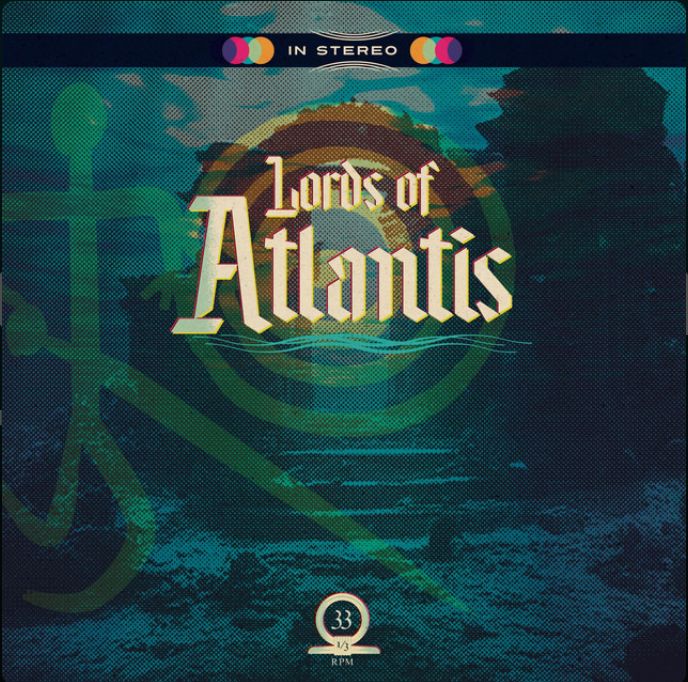
Also, let me mention how much I like the cover art. It has a fun retro feel to it, with its “In Stereo” flag at the top, and the 33 1/3 rpm at the bottom. Very cool!

Brad: Thanks, Tad, for indulging my passions and my friendships!  I agree with you completely about the Lords of Atlantis and the David Gilmour feel.  But, then, of course, there’s a HUGE Dick Dale feel and influence as well.  So. . . Gilmour, Dale, Pongracic.  Amazing trio!  Two things I’d like to add to this conversation.  First, like Pongracic himself, his guitar playing (and the playing of the entire band) is simply tasteful.  Taste just exudes from this music.  

Second, each song really is a kind of tone poem, awaiting our own visual interpretations.  When, for example, I hear “Barbary Corsairs,” I can’t help but imagine the corsairs floating illegally and unlawfully through the Mediterranean, wreaking havoc upon the civilized world.  Yet, again, there’s something so tasteful about the song, that I also can’t help but imagine Thomas Jefferson defending American sovereignty in the area and sending in the Marines to attack North African slave fortresses!  Or, when I hear “Libertas!” I can’t help but imagine the American patriots defending common law and Natural Rights against the oppressions of King George.  And again, when I hear “Chariots of the Gods,” I can’t help but imagine the various pantheons of the ancient world, all mixed and warring with one another.  Zeus, Venus, Jupiter, Aphrodite!  Which pantheon wins?

Tad: Brad, I agree that the music evokes wonderful visuals – “Eye of the Sahara” made me think of a camel caravan traveling across a dune in the desert.

Well, I think we can agree that this album is a real treat for fans of upbeat instrumental rock. They supply the tunes, the listener supplies the pictures!

North Atlantic Oscillation’s United Wire

United Wire

A favorite music artist of ours is North Atlantic Oscillation. This Scottish duo have created an utterly unique and beautiful sound that manages to combine Beach Boys harmonies, Radiohead melodicism, and shoegazer walls of sound. They recently released their fifth album, United Wire, and it is a triumph. With songs varying from hushed, angelic voices to dissonant-yet-attractive noise, it is another reason why NAO are unparalleled in their ability to meld disparate musical elements into a stunning and immensely satisfying listening experience.

Once again, Brad Birzer and Tad Wert take some time to share thoughts on a much-loved group:

Tad: Okay, Brad, I have been smitten with North Atlantic Oscillation since their debut album, Grappling Hooks. As a matter of fact, it was my favorite album of 2010! And rather than succumbing to the dreaded “sophomore slump”, I thought their second album, Fog Electric, was even better. The Third Day maintained the high quality of their music. I should probably mention Sam Healy’s excellent solo 2013 record, Sand, which, for all intents and purposes, sounds like an NAO album to me. 

They left KScope Music and released Grind Show in 2018, which was a bit of a disappointment. Their consistently excellent releases up to that point, and the tremendous growth they exhibited must have spoiled me! Grind Show, while good, didn’t blow me away like every other album of theirs. So it was with some trepidation that I bought United Wire. I needn’t have worried; this is a tremendous return to form, in my opinion. What are your thoughts on it?

Brad: Dear Tad (how’s that for a traditional introduction?), I love doing these with you, my friend.  If anything, I worry that I’ll bug you too much about such dialogues!  I could definitely do one or more a week over the next year.

That said, you bring out the best of me.  

And, for all you readers out there, Tad may have formally introduced himself under the “Tad:” bit, but he actually wrote the intro (above) to this piece as well, and I can’t think of a better way of introducing the true beauty and excellence of NAO than what he typed: “utterly unique and beautiful sound that manages to combine Beach Boys harmonies, Radiohead melodicism, and shoegazer walls of sound.”  In a million years, or armed with 1,000 monkeys and their typewriters, I could not have captured the band so perfectly.

I will also admit this as well, I love Sam Healy, and it’s incredibly hard for me to be objective about him.  Granted, I don’t know him well personally, but he and I have corresponded a bit, and I think he’s just freaking brilliant.  

And, generous.  An example: I tried like mad to purchase a copy of the latest release, United Wire, through the internet, and the site continuously rejected my credit card (for those of you who don’t know me, I’ve been employed by the same place since 1999, and my wife also has an income–we’re not un-well off!) repeatedly.  I mentioned this to Sam on Facebook, and a few weeks later, I found a copy of United Wire waiting for me in my Michigan mailbox. Gratis!

And, what happened?  On the first play, I fell in love with the album.  Several weeks later, it’s still in constant rotation, and I think the world of it.  Whether it’s NAO or SAND, Healy knows music.  He lives it, and he breathes it.

Tad, I must admit–we, for once, disagree on something–I really liked Grind Show.  I didn’t think it was as good as the first three NAO albums, but I definitely liked it.  For me, though, at least prior to United Wire, the true masterpiece, a PROG MUST OWN, was Fog Electric.  To me, one can’t consider him or herself a fan of progressive rock at all without actually loving Fog Electric.  Grappling Hooks was brilliant pop (in the Tears for Fears vein), but Fog Electric was pure prog.

When Fog Electric first came out, admittedly at first, I didn’t get it.  Then, Kscope re-released it, and I was utterly blown away by it.  I would consider it, for me, a top fifteen ever rock album.  That is, going all the way back to Bill Haley and the Comets, NAO’s Fog Electric is one of the top fifteen albums of all time.

So, Tad, what do you think of NAO album no. five, United Wire?

Tad: Brad, I love United Wire. My credit card worked (ha!), and I bought the CD through MusicGlue, which also included a digital download. One of the options is a “merged” version, which has all of the tracks merged into one long one. I think that is the way NAO intended for the album to be listened to, and I really like it.

Matryoshka is my favorite track. It begins with a distorted and processed voice over a mechanized beat, and then it transforms into a beautiful piano-based coda that I wish would last forever. Then the distortion tries to take over again, but the piano wins in the end.

Brad: Tad, I’m not sure I have a favorite track.  I love the whole damned (sorry for the expletive) thing!!!!  I would agree with you that Sam intentionally made the bandcamp release (which I bought)  one long track.  The album really, really works.  As in, really, really, works!

Tad: Oh, I agree. As I mentioned earlier, I think the way we’re supposed to listen to it is as one continuous suite of songs. Sam Healy is a musical genius when it comes to composing melodies and arranging instrumental accompaniment. At first listen, you think there is something wrong with the tape speed, then you realize it’s been deliberately slowed down and sped up. And it works! Drum and percussion bang out frenetic beats while angelic vocals float serenely above the chaos. Underpinning everything are electronic ambiences that sometimes come to the fore, but usually remain in the background. There are layers and layers of sound that keep the music endlessly fascinating.

Well, I think we’ve made clear our love for this band in general and this album in particular. You can purchase your own copy of it at MusicGlue or BandCamp.