
Those of us who seek to preserve the Good, the True, and the Beautiful are aware, as the old saying goes, that “there be dragons” in the world who seek to destroy the invaluable inheritance that is Western Civilization.
Perhaps this has never been truer than it is today in our hyper-polarized world, where conservatives are now often branded “haters” and even “traitors” and “insurrectionists” by those who want to throw overboard the Permanent Things and build a progressive utopia.
— Read on theimaginativeconservative.org/2021/04/there-be-dragons-support-the-imaginative-conservative.html
Evership To Release Third Album

It’s been a long wait, but we can now rejoice: Evership (Shane Atkinson & Beau West) is set to release a new album, The Uncrowned King, Act I. If you haven’t heard their previous work, every self-respecting fan of melodic, intellectually stimulating prog rock owes it to him or herself to give them a listen.
From their latest newsletter is this teaser:
Album 3 is the first half of a Rock Opera adaptation of the 1910 book by Harold Bell Wright called The Uncrowned King. This story is an allegory in the style of The Pilgrim’s Progress but with a story arch of Twain’s Prince and the Pauper meets Dicken’s Christmas Carol.
A pilgrim on a search for Truth arrives at the Temple of Truth with questions about the journey. In answer, the Keeper of the Temple retires him to The Quiet Room, overlooking The Beautiful Sea, where he is visited by the The Four Voices of Life. Each Voice tells him a piece of a story entitled “The Uncrowned King”, to give answer to his questions.
Rich with imagery, Shane has adapted the story faithfully to a progressive rock format we believe our fans will enjoy. Broken into two releases, the story is an allegory on the nature of truth. It is a statement that real truth cannot be derived solely by the senses, but it is more transcendent and one must be courageous in its pursuit and consequence.
Sounds like a fascinating premise for a concept, and I can’t wait to hear it. You can preorder The Uncrowned King, Act I here.
Meanwhile, while you’re waiting, enjoy listening to “Ultima Thule” from their debut album:
Arjen Lucassen and Pete Pardo Interview
I’m rather proudly a huge fan of Arjen Lucassen (and have been for years and years and years), and Pete Pardo does an excellent job of interviewing him here. Lucassen is so earnest and so enthusiastic. A great combination for a musician. This interview is well worth watching.
GREAT ROMANTIC MOMENT

“Now from his breast into the eyes the ache
of longing mounted, and he wept at last,
his dear wife, clear and faithful, in his arms,
longed for as the sunwarmed earth is longed for by a swimmer
spent in rough water where his ship went down
under Poseidon’s blows, gale winds and tons of sea.
Few men can keep alive through a big serf
to crawl, clotted with brine, on kindly beaches
in joy, in joy, knowing the abyss behind:
and so she too rejoiced, her gaze upon her husband
,her white arms round him pressed as though forever.”
― Homer, The Odyssey

Rhiannon Giddens with Francesco Turrisi, “They’re Calling Me Home”
Rhiannon Giddens & Francesco Turrisi’s There Is No Other was one of my favorite albums of 2019. Reviewing it, I described it as
A sweep of traditions and times woven together . . . one of those albums that Duke Ellington might termed ‘beyond category,’ resonating with the core of our shared humanity.
Giddens and Turrisi’s breathtaking new effort They’re Calling Me Home does it again. Recorded in Ireland under lockdown conditions with limited guests, the duo spin shimmering sonic webs with viola, banjo, guitar, accordion and hand percussion, enlivening a brilliantly eclectic gamut of spirituals, folk songs, hymns, Baroque arias and striking originals.
And as always, Giddens’ incomparable voice compels your attention, tracing the commonalities of these variegated songs across the centuries — caressing Monteverdi’s “Si dolce e’l Tormento” and the Anglo-Appalachian “When I Was in My Prime,” testifying to a hope beyond reason on “I Shall Not Be Moved,” staring down mortality itself on a vehement, haunted version of “O Death:”
Separated from their extended families in North Carolina and Italy by the pandemic, Giddens and Turrisi have made, essentially, an album of laments; They’re Calling Me Home faces up to the spectres of separation (temporary and permanent) that continue to stalk our world. But strengthened by the confrontation, they — and we — come out the other side refreshed, able to rejoice in the life and love still there for us to find and cherish.
Buy They’re Calling Me Home at Nonesuch Records; listen to it below:
— Rick Krueger
10 Books Every Imaginative Conservative Should Read ~ The Imaginative Conservative
Dedicated to the British people in the midst of war, Christopher Dawson’s 1942 The Judgment of the Nations is everything a history book should be but rarely is. With lively prose and ceaselessly innovative ideas, Dawson considers the role of Providence in history and produces a twentieth-century version of St. Augustine’s City of God. Modern evils and totalitarianisms, he notes, are the results of the shallowness of liberalism and the wickedness of progressivism, each conspiring to make men nothing but cogs in a grinding machine.
— Read on theimaginativeconservative.org/2021/04/10-books-every-imaginative-conservative-should-read-bradley-birzer.html
Frost* Heats Up

Frost*’s upcoming album, Day and Age, showed up in the DropBox this past weekend, and considering their last one, Falling Satellites, was one of my top 5 of 2016, I immediately plugged it into the USB port of my home stereo. After eight consecutive listens and picking my jaw up off the floor, I have to state up front that Day and Age is Jem Godfrey, John Mitchell, and Nathan King’s finest achievement. Ever.
The album opens with the title track, and it is a galloping monster straight out of the gate. A young boy tells the listener to “enjoy yourselves, you scum!”, a relentless beat is established, and one of the most addictive keyboard/guitar riffs ever recorded takes charge. I think Frost* must have been listening to a lot of Synchronicity-era Police before writing this song, because it reminds me of that massive, tense, steamroller of a song, “Synchronicity II”. It is a masterpiece of controlled chaos that builds inexorably for nearly 12 minutes. There’s even a little ska-like section at the 5:33 mark that makes the Police invocation explicit. However, in a battle of the bands, Frost* would beat the pants off Messrs. Sumner, Copeland, and Summers. This is an incredible track, and after I heard it for the first time, I wondered if the rest of the album could possibly hit the high bar it set.
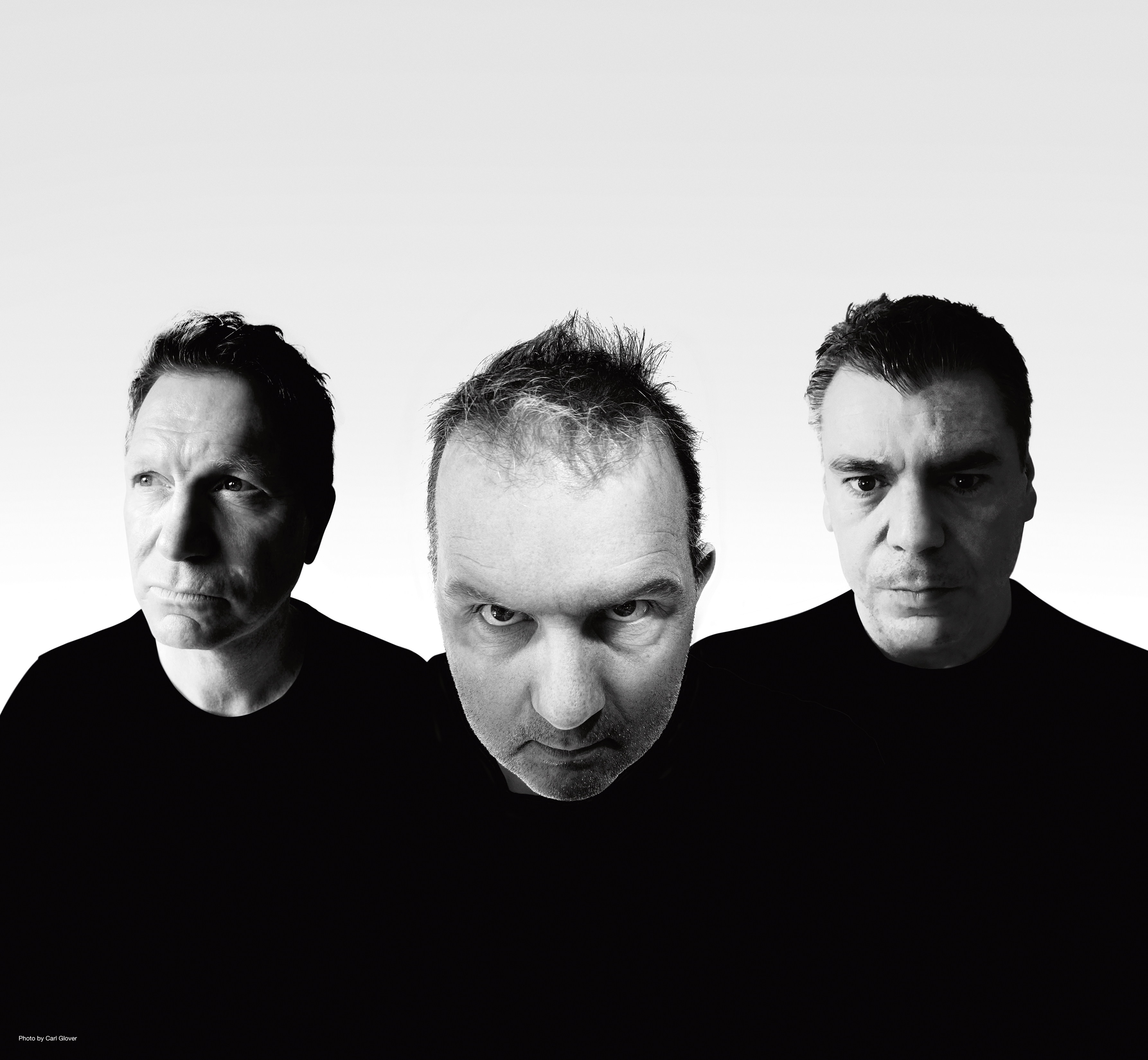
I need not have worried, as every song on Day and Age is equally strong. There is not a single clunker on the album. I don’t what lit a fire under John Mitchell, but his vocals have never sounded more impassioned (and he’s sung quite a few songs with a lot of passion!). The core of the group is Jem Godfrey (keyboards, vocals), John Mitchell (guitars, bass, vocals), and Nathan King (bass, keyboards, vocals). They have enlisted the talents of three different drummers – Pat Mastelotto, Darby Todd, and Kaz Rodriguez – and each one provides perfect support depending on the needs of the song.
“Terrestrial” is the first single, and it is a great choice – melodic, energetic, and leaving the listener wanting more:
“Waiting for the Lie” is a keyboard-based ballad that provides a nice respite from the fast-paced previous tracks. It features a beautiful melody that is allowed to shine through a no-frills production. “The Boy Who Stood Still” is a spoken-word allegory about a boy who, you guessed it, stood still. So still, that he disappeared. The narrator tells the tale over an infectious bed of ’80s – era synths and skittering drums. It sounds weird, but it is oddly attractive.
“Island Life” begins with some waves on the beach as washes of synths and some arpeggiated guitar (there’s that classic Police vibe again!) as Mitchell sings of escaping a dreary life and “living in this island life”. “Skywards” is my second-favorite song (after the title track), with some especially beautiful chord progressions in the melody. You think you know where it’s going, and it takes an unexpected turn and ends up even better than you anticipated.
Wait, did I say “Skywards” was my second-favorite song? I actually meant “Killing the Orchestra”! An electric piano and delicate vocals introduce this one, and it gradually builds into a mini-symphony that includes Mitchell’s best guitar solo of the album. It is nine and half minutes of musical bliss that segues immediately into the closing track, “Repeat to Fade”, that reprises some of the themes from the title track. This is a terrifically dense and claustrophobic track that features Mitchell hollering, “Enjoy yourselves, you scum!” Sounds oppressive, I know, except that the melody is very uplifting and makes the dark atmosphere bearable.
Nathan King recalls the writing and recording of “Repeat to Fade”: “We were 30 feet by the sea, next to a nuclear power station and a lighthouse, in midwinter! …in my head you can absolutely hear the bleak isolated oppression having an effect on us.”
The recording conditions may not have been ideal, but Jem, Nathan, and John have managed to produce a pop/prog masterpiece of an album from them. I’ve listened to it a dozen times now, and I find new delights every time.
Day and Age will be released on May 14, 2021 on InsideOut Music. You can preorder it here: https://frost-band.lnk.to/DayAndAge
The Bandwagon USA

Thanks to Big Big Train’s most recent newsletter, we now have news of a new online record store in the U.S., serving North America. The Bandwagon USA. Thrilled to have this news, and, for us Americans, let’s please support The Bandwagon USA as much as we can.

Floating Points, Pharoah Sanders & the London Symphony Orchestra, “Promises”
WARNING: SPOILERS AHEAD!!
Imagine if you will . . .
From silence, a seven note riff on piano, celeste and harpsichord, cycling over two repeated bass notes. Recorded so intimately you hear the piano’s damper pedals lift, as much a part of the cycle’s rhythm as the melodic tones.
About a minute and a half in, the cry of a saxophone. First responding to the keyboard cycles, then skirling continuously over them. Electric piano creeps in to fill the empty sonic crevices while the London Symphony’s strings pass above, dividing from a unison note into clustered washes. The blues are unmistakably evident from Pharaoh Sanders’ first note — and somehow the emotion he conveys is echoed in the ethereal, dissonant orchestral blanket.
The riff cycles, the sax and strings ebb; Sam Shepherd (aka Floating Points) steps forward with hesitant, mellow yet insistent synthesizers. Then, unexpectedly, Sanders vocalises — running scales, lip trilling, removing his horn from the equation and trusting us with his unadorned humanity, to gripping, gorgeous effect.
As he picks up the sax again, the mood and the eternal motif shift to match. Darker, thicker keys in a minor mode support grittier, more active improvisation and a stark synthesized squall by Shepherd, before subsiding to quiet counterpoint behind the unending riff.
Sanders leaps in once more — only to give way to a sustained, yearning solo cello solo that awakens the orchestra. The meditation that ensues is another moment of sheer beauty — gigantic, suspended unison lines that become a breathtaking mash-up of spiritual jazz and the English pastoral tradition, John Coltrane and Ralph Vaughan Williams locked in brotherly embrace.
The string chords pile up, mounting through consonance to dissonance — then collapse! In the ensuing silence, a quiet violin, answered by electric piano. Then, Sanders — this time so hushed, yet so gritty and breathy, over a fragile web of keyboard accents strung across the unstopping riff. A distant synth joins the dialog; Sanders cajoles it closer, helps it take more definite shape, then backs away, as Shepherd fires up free floating sequences across the stereo field and weaves a solo around them.
For the final time, Sanders breaks loose above the echoing, fading field of electronic sound, both conjuring up both the heady free jazz of his youth and the measured maturity of his long career into a memorable melodic volley. Shepherd returns to his subdued accents on synth, organ, electric piano; the riff patiently continues to cycle. Silence resumes its initial place in the piece, now dominant but not triumphant.
Until the riff stops! In its place, thick, ponderous organ chords that trail off into vibrato and echo. Total quiet; a slow-growing cloud of treated strings that burst into glittering fireworks, then subside into the final silence.
Fortunately, you don’t have to imagine this. Floating Points’ remarkable collaboration with Pharoah Sanders and the LSO is real. And moving. And my favorite album of the year to date. Listen to it below, then get it for yourself via Bandcamp.
— Rick Krueger
What Remains of Conservatism? ~ The Imaginative Conservative
To my mind, these voices have never been more needed and more relevant. A humanist but certainly no conservative, George Orwell once famously remarked, “we have now sunk to a depth at which the re-statement of the obvious is the first duty of intelligent men.”
In this fine Orwellian tradition, it is worth remembering three things, each of which reminds us what it means to conserve our most cherished traditions—that is, to be a traditional conservative—even in a time of chaos.
First and foremost, we must remember that every single person is an unrepeatable center of dignity and freedom, each a moral and ethical agent, endowed with free will, and born in a certain time and certain place, never to be repeated. Life matters, and it is a precious gift every single time it appears. That is, each person is a unique reflection of the Infinite, a bearer of the Imago Dei, and a Temple of the Holy Spirit. No matter how much corruption a person puts on during this lifetime, he or she remains precious, at least at the heart of things. For even the most corrupt human being has within him the spark of divine grace, no matter how close to being smothered that spark is. “In Him, we move and live and have our being,” the Stoics and St. Paul assured us
— Read on theimaginativeconservative.org/2021/04/what-remains-conservatism-bradley-birzer.html


You must be logged in to post a comment.