Tag Archives: Friedrich Hayek

I-Postcard

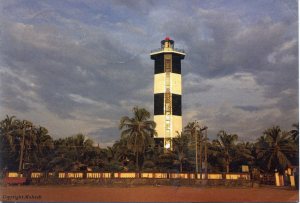
ver a decade ago, I shot this glistening sun-bathed view of a lighthouse. It happened during one of those long motorcycle rides, and in an obscure part of the globe. A few years ago, someone contacted me to request permission to create a postcard from that exact photo, and I agreed. Recently, just out of curiosity, I Googled for postcards based on that lighthouse and ran into an interesting WordPress link – Remembering Letters and Postcards. The card had visible paper wrinkles, a postal stamp watermark, and © Mahesh printed at the bottom!

Just another one of those motorcycle rides, and another one of those photos. But it caught the attention of a Lighthouse Thematic Philatelist who turned it into a postcard. Someone actually bought that card and mailed it to a distant part of the world. Whoever received the card scanned and uploaded it, and now I Googled to find my own photo! But now my memories of taking it are also perceived in a totally different context. Basically, that simple act now feels quite gilded and romantic. One of my favorite bands wrote this lyric — “with every single step we are progressively shaping our own trajectory, and at the same time influencing lives of others.” In this case, my act of framing a lighthouse, in its tropical sunset splendor, ended up traveling the world!

The lady who got the postcard, or the person who sent it to her, will never know the backstory of that motorcyclist who captured it. They simply derived some value from the unknown motivations of a photographer. Just like how I derived value from those who engineered the Royal Enfield motorcycle and the Nokia camera. And how I derive value from the actions of the unknown actors sending postcards to each other. Several independent actions accidentally formed a virtuous loop surrounding an innocuous photo — something common yet rarely appreciated. To generalize all this, our ability to add distributed value without explicit top-down coordination creates unique value chains. It’s probably the most romantic side of a market-based civilization.
The photograph incident just illustrates a general fact – as much as we add value to unknowns, we also get most of our help from them. This includes our groceries, the coffee we brew, the roads we travel, the clothes we wear – almost everything in our lives we owe to unknown actors. Leonard Reed’s famous essay I-Pencil explained how impossible it is to create a simple pencil without the help of the unknowns. In short, we are always acting as part of collectives that are rarely visible, often transient, and constantly forming as a response to the unknown needs of the many. Quite like a complex organism — adapting to emerging selection pressures.

Republished at ridersmodel.com

Beyond Creation

Stunning autumn hues aside, motorcycling in the Pacific Northwest is a lot about winding roads. It’s about navigating curves at an optimal trajectory and speed, creating those lively moments when your foot pegs brush the tarmac. It’s about discovering the thin line, the line which separates recklessness from precarious optimism, the belief that everything beyond your control is going just right! Discovering that trajectory requires a clear view and an understanding of the full turn ahead. That, along with instincts and skills, shapes the plan on how to approach the turn, how to maneuver, at what speed, etc.

High-level plan aside, how you cover every inch of this trajectory also matters because this determines the viable options ahead. In fact, at every point on that curve, along with basic physics, our own limitations and constraints of our machines determine possible trajectories. Beyond motorcycling — it’s like working towards a long-term vision, while shaping the specifics of the execution as we go along. Reaching the long-term goal requires constant adaptation to what the road presents, not what was anticipated.

Quoting the Canadian death metal band Beyond Creation — “Every decision we take. Every step we make. Every word we use. And every rule we choose.” – With every single step, we are shaping the details of our own trajectory, and at the same time influencing the lives of others connected to us. So, if you had a fortunate or an unfortunate accident, it might not be the immediately preceding step. It could be any action leading up to the accident, which actually set in motion that unfortunate trajectory

 The question is – what were those steps that maximized the probability of that incident? It could be that disturbing conversation with the neighbor or that reckless driver on the freeway. With an exhaustive set of variables, identifying and modeling those sequences is non-trivial. It requires omniscience and intractable computing power. Complex realities are nuanced but expensive too, so a civil society demands a practical approach – that of individual responsibility. A fair assumption is the existence of free will. In short, we shape our good and bad accidents by acting or not acting to compensate for external pressures.

To go back to the analogy of motorcycling PNW winding roads — there are always unforeseen factors affecting the specifics of the execution. Low probability but high impact variables like twigs on the road, those strategically placed potholes, or a deer gently crossing the path — all these and more impact a motorcyclist’s vision of navigating curves with finesse. But that uncertainty is not a cost; it is the reason to feel alive, which is vital to motorcycling. It’s also critical to know that, even with determinism provided by the law, uncertainty is an artifact of a highly interconnected system.

Republished at ridersmodel.com

Life at the Margins

The early morning buzz of an engine, or that moment when riding from the garage onto the pavement, or that instant when tearing into a freeway ramp. From stillness to the rumbling promise of a 1200cc engine, from a boxed garage onto bustling downtown alleys, and from the constraints of 25-mph to 70-mph open landscapes. These are all glimpses of riding at the margins, at the margins of state transitions.

Taking a 40-mph curve at 60-mph is riding at the margins, but only until conquering the very same curve at 80-mph. We automatically strive to raise that benchmark because it’s that feeling at the margins that matters – being at the limits of skill and adrenaline. What we seek is evolution — to that new state. An innate biological instinct – constantly forcing us to adapt.

The pursuit itself is universal — whether it’s at the margins of riding or simple pleasure seeking. We seek that feeling – the one which a first sip of whisky provides at the end of a long day, or that first serving of frozen custard on a summer afternoon, or that satisfaction of solving a new problem at work. In this case, at the margins of relative novelty. The feeling that a new state of satisfaction has been unlocked.

The constant pursuit of being at the margins is visible across all human endeavors. We were probably happy with the library until we had ebooks and Wikipedia; now we are only happy with augmented reality. We found happiness with no internet, but now we are unhappy with the internet speeds. All these actions and pursuits will eventually manifest at a higher level – shaping political, organizational, and familial institutions.

Once we were content with Magna Carta and then the Bill of Rights, until we had a chance with the modern democratic republic. But, as expected, we are no longer satisfied with these unprecedented institutional freedoms. We are not satisfied with mere liberties enabling us to freely pursue our material goals. But instead, we want to be at the margins where education, healthcare, transportation, etc are universal. Even if we managed to achieve it, we would continue to raise the bar. Not because we aren’t inherently grateful, but just because that’s an instinctive direction. This evolution applies to higher-level social institutions too, including private organizations. Once, just having a paycheck was the norm, but now there are added perks like company shares and healthcare. Familial roles used to be well-defined, but they have evolved to be more fluid, enabling better alignment with shifting social and economic changes. At every level — from mind to social institutions — adaptive mutations happen right at the margins — driver of the growth because that’s where we feel the most alive.

Republished at ridersmodel.com

Hume and that cat

Once, a fellow motorcyclist asked, pointing at my ride, “What do you call her?” I responded — “nothing!”. Casually explained how it’s just a machine. She wasn’t impressed but remained jovial — “You called her a machine, now she’ll breakdown!” This reminded me of a David Hume’s quote from ‘A Treatise of Human Nature’ – “There is a very remarkable inclination in human nature, to bestow on external objects the same emotions, which it observes in itself; and to find everywhere those ideas, which are most present to it.” Hume goes on to attribute these inclinations to mostly children, poets, and ancient philosophers. Maybe the lady was a poet. My own instincts tend to go the other way; I’d rather bestow on humans the characteristics of inanimate objects. We are also machines – but with immensely complex circuits. Guess this would mean I am no child, a poet, or that ancient philosopher.

Hume’s insight is probably more prevalent and often a cause of serious mischief. Recently, on a ride to Orcas Island, I stayed overnight at Anacortes to catch that early morning ferry. Motorcycle parking in a motel lot is always risky, so to minimize attention, the bike was draped in a dull two-wheeler cover. The next morning, I noticed this feral cat sitting and staring at it. In a parking lot filled with cars, this draped bike might have piqued his curiosity. We can actually never know. If I say the cat was curious, it just means that if I were a cat, then I’d be curious. For all you know, that cat might have been a fan of Triumph motorcycles, and it was simply gazing in admiration. Or maybe it was just daydreaming. Possibilities are endless. Unless we place sensors in his brain, we can’t truly understand the meaning behind his actions.

Not just in animals, we have this propensity to assume intent based on the actions of our fellow humans, too. Sometimes it’s related to the curious actions of our spouse, parents, or relatives. Our subject of scrutiny can also be the distant actions of some movie star or politician, as seen through YouTube or TV. A lengthy, contentious discussion about the behavior of such a celebrity is not uncommon. But whenever we assume intent from actions, it only tells us more about our own mind and assumptions, which may or may not be relevant to the actual object, animal, or person being scrutinized. Not surprising that Hayek once said, “We are studying mental and not physical events, and much that we believe to know about the external world is, in fact, knowledge about ourselves.”

Extending this beyond cats and motorcycles, we can state that perception is inherently contextual. This applies to the conversations we have, the emails we send, the photos we capture, or, for that matter, any creation. It does not imply that perception needs to always align with the “true” context of the object. For instance, movies need not be perceived based on the director’s intent; it only needs to make sense to the observer’s mind. Hence, a work of art with mass appeal will typically be layered. So, even if the director intended horror, it could get an award for comedy. But the application of scientific theories is rarely subjective – imagine using chemotherapy for the common cold! In that sense, we can afford to live in a subjective reality until we cannot. Our creations do add value, but it may not be for the reasons we perceive. Life is a bit about realizing all this and calibrating for that divergence. It’s also about understanding the larger implications of the mind’s contextual nature on individual identities and social fragmentation.

Republished at ridersmodel.com

Causal Chain

Recently, I went riding at the margins of the Olympic National Park. The plan was to loop through a couple of scenic forest roads, but eventually, I ran into a closed gate. So, had to turn around and ride back through the same bridge I had crossed earlier. And not just the same bridge; I crossed paths with the same hiker who was now walking back from the other end. Clearly, even he was amused at the coincidence. How often do paths of a motorcyclist and a hiker in the wilderness converge on a bridge — twice!

In a way, coincidences or accidents are just separate causal chains intersecting at some point. For instance, ferry times, riding patterns, and outdated GPS maps are all preceding links in my causal chain. If we go further back, there are other causal sequences that explain why ferry times are the way they are, or how I ended up riding in a specific way. But we can only speculate about the causal events related to the mysterious hiker.

All we can say is – every event has a causal chain with known and unknown preceding events. Even in my case, we can only speculate whether the map was incorrect and led to a private road or if someone just shut that gate on that particular day. Maybe my riding pattern was immaterial. That means if all the other factors remained the same, all types of riders would have faced the mysterious hiker twice! To estimate causal weight, we’d need to replay events and control for variables – practically impossible. That implausibility hints at the layered, multidimensional nature of the system.

 Causal chains operate at multiple levels as well. For instance, the riding pattern could be attributed to upstream causes of motorcycle gear ratios. The engineering of gearboxes has its own causal chains. But a motorcycle spare part is an abstract, reusable node involved in multiple chains – linking several motorcycles, models, and riders. Such a part’s functions are abstracted enough to serve multiple similar purposes. Eventually, the world itself can be interpreted as an interconnected network of abstract sub-systems, each with its own contextual functions. Larger sub-systems are composed of smaller systems and nodes with similar abstract qualities. Imagine building blocks with clear, logical, and physical boundaries, but operating without explicitly articulating their internal structure.

All kinds of systems — biological, chemical, or even social frameworks can be modeled through such a view. In the case of societies, components involved are individuals, families, organizations, and their workflows. For instance, the same individuals when at work serve a different contextual purpose than at home — becoming time-shared abstract nodes within different domain-specific workflows. The structural parallels between larger social institutions and a lonely motorcyclist in the wilderness illustrate the concept of organized complexity. They both function with a level of efficiency that hides the chaos of their own causal chains.

Within any such order — recurring patterns typically indicate underlying drivers. With complex systems, there is a difficulty in isolating them. There are even more challenges with designing optimal solutions for obvious problems. For instance, rising college tuition, health care costs, or government deficit spending are recurring and contentious phenomena. But there are also recurring beneficial patterns – like plummeting smartphones or fast-food prices! Rarely do we see political rallies about unaffordable fries.

The dominant agency causing these patterns can be a specific group of people, natural forces, or an incentive structure. But general discourse is rarely about correcting complex causal factors that led to a contentious pattern. This happens because it’s expensive to dive deep, isolate causality, then arrive at a hypothesis that fits multiple contexts, and then propose and test a generic solution. The general tendency is to introduce new factors into the mix as workarounds — like price/licensing controls, a new tax, maybe a trade war, or even an actual war. There is also a strong political incentive not to do root cause analysis of social problems — often, they ruffle too many feathers. The benefit of a complex interconnected system is overall productivity, and there is even a romantic side to all this.

Republished at ridersmodel.com

Group Code

poses interesting opportunities, especially if you can manage to ride up to the mountains. It’s not every day you ride through icy roads on a bright day, at near-zero temperatures, and with a backdrop of snow-covered mountains! Not to mention occasional water streams gently crossing the freeway, and a highway shoulder precariously stacked with freshly removed snow, one of the many reasons why motorcycling is called sensory overload. As usual, the fuel tank was running low; the two-gallon tank has been a bit difficult to handle, especially when you go exploring. But, like every other time, when it was close to being empty, providence manifested in the form of a Shell gas station.

Group riding on this motorcycle is going to be a tad annoying for others. You don’t want to ride with someone who is constantly on the lookout for a gas station — it introduces unnecessary friction, especially if someone is ahead with a five-gallon tank. In that sense, groups do pose different trade-offs. We all prefer different riding patterns, stop frequencies, speeds, routes, etc. Essentially, a 2-gallon cafe racer will find it hard to get along with a bagger.

Not just in group riding, even general social order demands a certain degree of shared, compatible rule-following. Without the commonly agreed code, large groups of people will not get along. For example, top-down hierarchical code is mandatory in the military. While role-based layering is common in private organizations. Government bureaucracies depend on documented processes and structure, where adherence to processes often becomes a primary objective. Achieving such goals at scale requires a rule-based coordination. These properties are often decomposed and applied at different layers of the system.

As evident above, the nature of this shared code also depends on the social sphere. The military has a specific purpose and, hence, a strictly enforced structure. Here, there is little room for malleability. While private organizations tend to have more abstract goals – selling products and services, and are therefore more open-ended, evolving based on contingent profitable circumstances. A family tends not to have any specific goals, except to treat each other well or maintain general cohesion. Hence, the rules are informal. Societies also have shared laws and norms, but in general, they are even more abstract and geared toward coexistence. For example, we don’t need to be nice to our neighbors if we don’t infringe on their rights.

The pattern is clear – group goals are mapped to some shared code, and effective compliance determines the outcomes. The goals of a free civil society differ from those of the military; hence, they have different codes. While peacetime goals target prosperous coexistence, military code demands predictable, disciplined behavior. While creativity and exercise of individual volition are peacetime virtues, a volatile wartime environment prioritizes disciplined execution under pressure. A soldier is forced to apply predefined rules of conduct to moral choices, while a free individual can exercise subjective ethical judgments. Soldier code has its purpose, just that it’s unaligned with peacetime goals.

To go back to the original bagger vs cafe racer problem – their riding incompatibility is because their motorcycling goals and internal inclinations are different, and that same difference reflects in their machines and riding rules. Eventually, whether it’s riding or life, we’re always part of various groups – and what we seek is elusive harmony of goals, codes, and resulting outcomes through actions. Satisfaction in life relies on a fabric of alignment across time, constantly evolving to satisfy the changing needs. Such an outcome on a larger scale demands the use of a powerful multi-purpose instrument — the law.

Republished at ridersmodel.com

“I was alive”

Walter White, from the popular series Breaking Bad, said, “I was alive.” What essentially drove him to build a Drug Empire was entrepreneurship, that excitement of feeling alive. It was not about providing for the family. Being alive is about being in direct contact with reality — absorbing and processing external signals. It demands constant awareness – processing stimuli, gauging situations, and adapting accordingly. In that sense, being alive is also a lot about being human. What separates us from animals, at least most of us, is the ability to not just instinctively react, but instead employ higher levels of cognition. Having that widespread opportunity to develop higher levels of thinking through individual ownership and responsibility deserves some acknowledgment. For most of human history, this was a privilege reserved for the few.

Being alive is quintessential Americana; few civilizations have managed to formally encode this at scale into a political Constitution and broader social fabric. Devising a layered framework to limit the collective while defending individual volition at this scale is unique because arguments for such a framework run counter to intuition.

Channeling essential English liberties and the Scottish Enlightenment, American Framers executed something different in terms of impact and scale. They made a well-reasoned argument for Federalism and achieved a democratic consensus. A sufficiently intricate argument was framed, communicated to the broader population, and executed as an institutional change. Selling an idea this sophisticated is not easy – usually complex ideas find agreement among a limited minority, and then the results motivate slow widespread adoption. But the American framers abstracted the underlying principles of the existing society to a higher level – to that of a union of states and drove mass consensus from there. Being able to execute something like this without corrupting those core ideas through demagoguery or personal agendas is uncommon. In fact, popular support of ideas that refuse to pander to baser instincts is an unusually rare phenomenon.

There is an interesting scientific aspect to this. Being part of a collective is comforting. Whether it’s politics, sports or music, we tend to seek out that tribal identity. It’s probably our hunter-gatherer instincts, constantly pushing us to belong. In that sense, American institutions elevated the overall social order by channeling tribalism as a check. To paraphrase F.A. Hayek — ‘man got civilized despite his best efforts’.

James Madison quite presciently stated in defense of Federalism — “the society itself will be broken into so many parts, interests, and classes of citizens, that the rights of individuals, or of the minority, will be in little danger from interested combinations of the majority”. Instead of enforcing compliance through centralized mechanisms, American framers accepted reality as it exists and attempted to work within those constraints. It simply grounded republicanism in a more realistic understanding of human nature.

While many societies enforced conformity through top-down control and directed purpose, American framers showed unusual practical prudence. They allowed civil society, order, and purposes to emerge through peaceful coexistence. From that perspective, American Federalism created a framework of incentives favorable to the formation of civil society. A society where individual volition can survive, where coexistence was the path of least resistance, and, more importantly, where an individual could feel alive.

Even though, at a more basic level, riding a motorcycle is also a lot about being alive, and probably more about staying alive too. For starters, you are always in touch with the realities of the environment. You’re expected to be responsible for your own safety. You’re not protected by the collective, their seat belts, or air bags. You must be aware of the lifted truck with no visibility or minivan with a driver busily sifting through critical social media reels. You simply need to adapt your path to steer clear of them, or any other potential threats, social media-driven or otherwise. But the flip side is, when you are riding, all the other travails blend into the background. So plugged in to that sublime present, there are no cognitive resources to think about an uncertain future or that disappointing past. In that sense, you feel alive, but in a different mode of engagement with reality. But, there’s a prerequisite for encouraging that feel-alive-individualism – equality before the law.

Republished at ridersmodel.com

The Road to Serfdom at 75 Years Young

Peter Boettke writes

“Key to his argument is that in a democratic liberal society, there’s no overarching single scale of values. Society cannot achieve a single hierarchy of ends we all agree on. In fact, the great strength of democratic liberal societies is a multiplicity of values that are respected among diverse and often divergent, even distant, individuals”

I used to have this bumper sticker on my Jeep — ‘If we are on a road to serfdom, hope it’s bumpy and bureaucrats are driving lowriders’


The Hayek Auction

You will find them here, for instance Hayek’s copy of Wealth of Nations went for almost 200k, it was estimated in the 4k to 6k range.

“Desktop ephemera and personal effects” were estimated at 200-300 British pounds, went for 87,500 British pounds.  Crazy!  Many of the items went for 10x or 20x their original estimates.

From Marginal Revolution

Friedrich_Hayek_portrait

The original uploader was DickClarkMises at English Wikipedia. [CC BY-SA 3.0], via Wikimedia Commons

Libertarian Transformers

For some reason people gasp when I mention the dominant Libertarian themes in Transformers 4 : Age of Extinction. Buried beneath inane comedy and not so sleek Budweiser advertisements are some stunning Hayekian/Misesian ideas. Contrasting to the first three Transformers movies, Age of Extrinction refuses to glamorize military. Instead of Marines fighting evil aliens in Middle-East, we have CIA black ops oppressing an innovative Texan inventor. From Cade Yeager (played by Mark Wahlberg) emphasizing to the black cloaked agents to get off his property, to ignorant bureaucrat Harold Attinger (played by Kelsey Grammer) destabilizing planet with his foreign policy, Michael Bay’s U-Turn on politics cannot be more evident.

Govt propping up bad guys in an alien war, or private firms profiting from war, or having an elected US President become subservient to career bureaucrats – this movie cuts close to reality in numerous subtle and different ways. How a private weapons manufacturer, Joshua Joyce (played by Stanley Tucci), changes his mind when confronted with reality. But, a bureaucrat constantly refusing to confront his own folly is worth noting. In this case Hollywood illustrating how private sector can get corrupted by govt incentives — quite uncommon! Not to mention, Kelsey Grammer comforting the US President by claiming the all-powerful alien bounty hunter as his “asset”, a genuine black comedy moment!

Essentially the whole movie is about an individualistic inventor trying to stabilize the world, while govt busy-bodies propping up chaos. Sounds like it appeals to all our civilized human instincts. Café intellectuals might disagree, but Hollywood is among the best Western institutions. They’re  more effective than any military in spreading liberal ideas across the globe. Niall Fergurson’s ‘The West and the Rest’ quite aptly sums up this sentiment through a quote from the French philosopher Régis Debray — “more power in blue jeans and rock and roll than the entire Red Army”.

Bjoern Kommerell [CC BY-SA 4.0], via Wikimedia Commons