
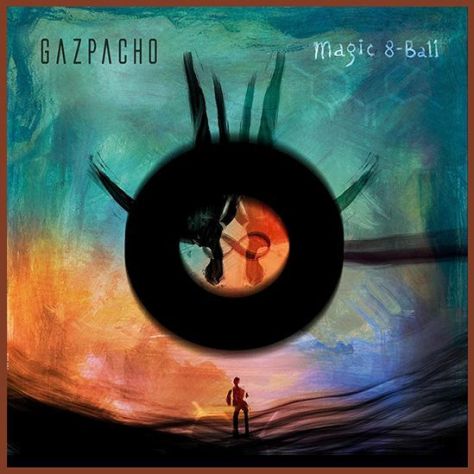
Greetings, Spirit of Cecilia readers! In this post, we share our thoughts on the latest album from a group we have long admired – Norway’s Gazpacho.
Tad: Brad, the first Gazpacho album I picked up was Missa Atropos (2010), and I have to admit, I couldn’t get into it. Jan-Henrik Ohme’s vocals seemed kind of weird, and none of the songs had memorable melodies, to my ears. However, on your recommendation, I bought their fourth album, Night (2007), and I fell in love with it. Their use of repetitive riffs throughout the entire album had a hypnotic effect on me, and it remains a favorite of mine.
They’ve just released their twelfth album (not counting a few live sets), Magic 8 Ball, and I think it is one of their best. It sounds like they have decided to embrace their talent for writing excellent “pop”-style songs, and this album includes eight thoroughly enjoyable tracks. After the deep and philosophical musings of 2020’s Fireworker, Magic 8 Ball strikes me as a more lighthearted and accessible offering. I love it!
Brad: Tad! Always a pleasure, my awesome friend. And, to imagine that we get time to talk and write about things we absolutely love. Life doesn’t get much better than this.
Yeah, I’m just a few years short of two decades of loving Gazpacho. Sometime in the early 2000s, I really fell in love with Kscope and started purchasing everything the label was putting out. To this day, I have a pretty strong Kscope collection.
At the time, if you remember, the label was also putting out samplers. On one of those samplers, in 2007, I was exposed to Gazpacho’s Night, and I purchased it immediately. To say that I was taken with it would be an understatement. Though I have loved everything Gazpacho has released, Night and Tick Tock remain my absolute favorites–standards by which I not only judge Gazpacho but all bands and all prog. Once I encountered Night, I went back and purchased Bravo, When Earth Lets Go, and Firebird. Those first three are much more art pop and art rock than their later stuff. Beginning with Night, the only real way to describe their music is prog or post-prog.
To be sure, I’ve never missed an album. Each new release is a treat, to be sure. Crazily enough, I even bought Introducing Gazpacho–a best of collection–simply because I wanted to support the band. I even have a specific shelf in my home office in which I display my most prized music. Gazpacho sits beautifully next to my Talk Talk, Big Big Train, Marillion, The Flower Kings, and Glass Hammer collections.
Somewhat infamously (at least in my household and with my wife), I was so taken with Fireworker at St. Croix, the previous Gazpacho album, that after purchasing the stand-alone CD, I purchased the blu-ray of the album. Then, I was so taken with the blu-ray, I purchased the deluxe book/boxset of the album. So, I have all three different versions of that glorious album! So, yes, I’m a bit of a Gazpacho nut.
Now we have Magic-Eight Ball and it fits into its own category. Indeed, this new album strikes me as a cross between their prog and post-prog albums post Night and their art pop albums, pre Night. The first five tracks really fit well within the prog and post-prog realm, but the last three tracks–especially “Magic Eight Ball” and “Immerwahr”–really feel like the first few albums. That is, they’re more art pop or art rock than prog or post-prog.
That said, I really love this new album, though on my first few listens, I was a bit taken aback by “Magic Eight Ball” and “Immerwahr.” I’m just no longer used to Gazpacho being pop!
Tad: Brad, I think you’ve hit on something – Magic 8 Ball really is a summation of what Gazpacho has done, going back to the beginning. Let’s talk about the songs themselves. The album opens with the stately “Starling”, which pulls me in with Ohme’s warm and intimate vocals. The instrumentation is primarily piano with some gorgeous violin work from Mikael Krømer. There is a sense of longing to the melody as it slowly builds in intensity. By the end of its 9-minute length, the guitars are roaring, but it’s never overwhelming. I love the gentle closing lyrics: Oh, let us be reborn. It’s one of my favorite opening tracks in the entire Gazpacho discography.
The second track, “We Are Strangers”, is one of my favorites of the album, and it’s a great choice for a single. Don’t laugh, but when I first heard it, I kept thinking it reminded me of something, and then it hit me: the chord changes and Ohme’s vocals are very much in the vein of classic Duran Duran! I mean that as a compliment; I think Duran Duran made some of the best pop music of the ‘80s.
The third track, “Sky King” is another relatively hushed and intimate track. Once again, Gazpacho has come up with an incredibly beautiful melody that is sung with delicacy by Ohme. Even when Jon-Arne Vilbo’s guitars come crashing in, it sounds like Ohme is whispering in my ear. The mix of this album is masterful – every instrument is clearly delineated, even during moments of glorious guitar-heavy noise.
So, three tracks in, and I’m already hopelessly in love with this album!
Brad: Thanks, Tad. An excellent analysis. I love how track four, “Ceres,” begins with a haunted-sounding piano, and it continues throughout the song. The rhythm of the song is extraordinary, especially the percussive elements mixed with the vocals. The whole thing sounds simply driving, but in a properly gentle way.
Track five, the bizarrely titled “Gingerbread Men,” in contrast to the previous track, begins hesitatingly, playfully hinting at a loss of direction, before the guitar comes confidently in and persuasively centers the song. There’s some really unusual sounds–maybe someone playing piano strings as percussion? I like the lyrics, though I’m not sure what they’re supposed to mean:
Through the haze
Swallows flying high
While we sleep
In a world of steel
There’s no peace
It is my belief
That my life has been discreet
Door slammed shut
The big bad wolf of night
Fragments of hope in this endless climb
Lit up by traffic lights
Broken dreams
Parading gingermen
Aftermath
Turn away
From them
And:
And now the cars go by
Silver ghosts
Of all the gingermen
Washing out
Washed away
With the rain
You bettеr pack a suitcase
Escape beyond thе city limits
Or watch your old self disappear
Before the end is writ in dough
It can only be delayed
Track six, “Eight Ball” is shocking and discordant, only because it’s so poppy, contrasting with not only most of Gazpacho’s post-Night music but with the first half of this album in particular. Indeed, “Eight Ball”’s actually downright whimsical, something that would not be out of place in an 1890’s carnival or early twentieth-century musical. I’m getting Ray Bradbury vibes, mixed with some animated classic Disney! Despite being poppy, “Eight Ball”’s really good, and it makes me realize that I should never box Gazpacho into any particular category.
The poppy feel continues with the seventh track, “Immerwahr,” though not the whimsy. This sounds a lot like a Marillion song–especially with the guitar on it. I especially like the lyrics:
Leaving Chekhov in the drawer
Throw the bankers at the window
Where the panic and the fear
Palest moonlight ever
Silver everywhere
Was the greater meaning
Hiding in the past
Did we send it all to bed
While the spirits of the poor
Jitterbug on judgement day
Track eight, “Unrisen,” finishes the album. While more poppy than the first five tracks of the album, it’s the least poppy of the final three songs. The strings are especially gorgeous, and I had no idea if they’re real or synthesized. There’s a definite playful quality to the keyboards, too. And, once again, I really like the lyrics, though I’m not sure what they mean.
Now you’re an astronaut lost in endless universe
Within thosе lines are older days of othеrs, I withhold the nameless why
In glass and velvet green
Mystic cryptic secret whispers
Let them be the dreamless sleep for you
See how they drift in clouds and
See how they smile
Higher, higher into the deep blue
Sail the sea of tranquility
They remind me of the lyrics from the earliest Gazpacho albums.
Tad, I’m not sure how to conclude this. I really like the new Gazpacho, and I think it’s a fine addition to their output as a whole. What really draws me to Gazpacho, though, are their concept albums. As such, while I’ll certainly and happily return to Magic-Eight Ball, I’ll probably return more often to Night, Tick Tock, Missa Antropos, etc.
Tad: Brad, thank you for sharing those lyric excerpts. I have a hard time understanding the meaning of most Gazpacho songs; I think they aim more for a mood or atmosphere than for a specific message.
I’m glad you noted the whimsical nature of the title track – when I first heard it, I also thought of a carnival ride! It’s somewhat unique in their catalog, and I like it a lot. Now that you mention it, I think the entire album is suffused with whimsy, including the title. Did you ever have one of those magic 8 ball toys? You asked a question, shook it, and an answer would float up to a little window: “Maybe”, “Definitely so”, etc.
I’d like to also give some praise for the opening bars of the closing track, “Unrisen”. With the keyboards and violin accompanying Ohme’s vocals, it sounds downright baroque to my ears – like something Vivaldi or Thomas Tallis might have composed. I swear, I can even hear a harpsichord in the background! Anyway, that’s just an example of the many musical delights I’m enjoying on this album.
While I share your love for their concept albums, I think Magic 8 Ball is one of their strongest collection of tunes. They sound really energized and confident on every track, and I am impressed with how they keep pushing the envelope after twelve albums. Here’s to hoping they record many more!





 Spirit of Cecilia
You must be logged in to post a comment.