Tag Archives: reviews

The Fantastical Prog of Terra Incognita (Uncharted Shores)

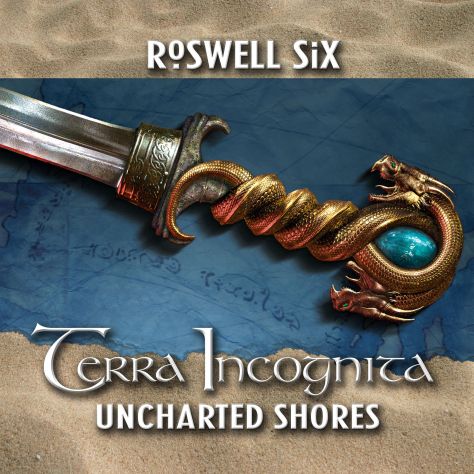
Hello, Spirit of Cecilia readers! Kevin J. Anderson has a Kickstarter campaign up and running for a gorgeous reissue of his Terra Incognita trilogy of fantasy novels and accompanying music that includes a new album from Roswell Six – Terra Incognita: Uncharted Shores.  Brad Birzer, Rick Krueger, and Tad Wert share their thoughts on it.

Tad: Brad and Rick, I understand this is the third Terra Incognita album, but they haven’t been on my radar. What’s the story behind this group, and how are they connected to author Kevin Anderson?

Rick: Tad and Brad, it’s great to join you two for a roundtable at long last!  I’m sure Brad knows a lot more about this project than I do.  But I first came across Kevin Anderson when he and Neil Peart wrote a novel based on the Rush album Clockwork Angels.  That one led to two more novels in the CA universe over the years, Clockwork Lives and Clockwork Destiny; all three of them were delightfully true to Peart’s concepts, with lots of clever Easter eggs from the Rush canon and enjoyable plot twists.  The only other novel of Anderson’s I previously read is The Dark Between the Stars, the first part of a science fiction trilogy that was nominated for a Hugo award back in 2015 – solid, sprawling space opera fun.   I’ve just downloaded his latest, Nether Station and am racing through it; he’s got that ever so slightly pulpy, lickety-split writing style down.  it’s about a deep space expedition that, little by little, gets kinda eldritch . . .

But that really just scratches the surface of what Anderson has done.  He’s most famous for continuing Frank Herbert’s Dune saga with Herbert’s son Brian; he’s also produced tie-in novels in the Star Wars, X-Files and DC universes; he’s an extremely prolific writer overall, whether it’s sci-fi, fantasy, horror or any combination of those genres – by his count, about 180 novels to date.  On top of all that, he and his wife Rebecca Moeste run their own publishing company, WordFire Press.

Through Brad’s connections with Anderson, I’m on WordFire’s mailing list, so I’ve noticed that he’s run a few Kickstarter campaigns over the years.  His latest campaign is a reissue of Terra Incognita, a fantasy trilogy originally published in 2009-2011. The thing that’s different about these books, though, is that the first two had soundtracks; apparently, Anderson has had a lot of contact with the music world over the years.  And maybe that’s where I should let Brad take over.

Brad: My dear friends, Tad and Rick, so great to do this with you guys!  And, to talk about one of my all-time favorite human beings, Kevin J. Anderson.  I’ve been reading Kevin’s works for years, but I only got to know him for the first time about 11 years ago.  I had a one-year position at the University of Colorado-Boulder (2014-2015 academic year), and that position came with some funding to bring speakers in.  As soon as I arrived in Longmont (where we lived for the year), I contacted Kevin (whom I had never met) and Dan Simmons.  I never heard back from Simmons, but Kevin immediately agreed to come speak for me.  He and his lovely (and equally talented) wife, Rebecca, came to Boulder, and Kevin gave an excellent speech on the art of writing fiction.  He called it his “pop-corn theory,” explaining that ideas happen all over the place.  I loved the speech.

And, I also loved Kevin and Rebecca.  We hit it off at dinner at an Indian restaurant right before Kevin’s talk.  He then invited us to his famous New Year’s Eve party for 2015.  Dedra and I happily drove to Monument to see Kevin’s impressive and rather Arthurian house!  Crazily enough, my car slid down his steep driveway and almost crushed the natural gas vein!  Thank the good Lord that disaster was averted and New Year’s Eve was a different kind of blast.  One of the great things about Kevin is he knows how to form communities.  He’s a natural leader.

We also really bonded over his friendship with Neil Peart.  In fact, it was Kevin who suggested I write the book about Peart’s lyrics, Cultural Repercussions, for his WordFire Press.  I was deeply honored to do so not just because of my love of Rush, but also because of my respect for Kevin.

And, Kevin has deep roots in the prog rock community.  Indeed, I can’t imagine a current writer who has greater or more legitimate ties to prog than does Kevin.  Rush’s Grace Under Pressure inspired Kevin’s first novel, Resurrection, Inc., and Kevin’s never been shy about his inspirations: Rush, Kansas, Styx . . . .

Rick, you brought up Clockwork Angels and its surrounding universe.  Admittedly, I love the Clockwork trilogy–the novels, the audiobooks, the graphic novels–and I think that Kevin really offered new insights into Rush and, frankly, into music.  To me, Clockwork Angels is Chestertonian, and I don’t understand why it’s not been made a Netflix series!

When I first encountered Kevin’s music project, Roswell Six, I was understandably impressed by the scope as well as the execution of the vast project.  Kevin has a great entrepreneurial spirit, but always with the artistic soul.  Roswell Six perfectly blends Kevin’s many loves and expertises.  I’ve been proudly listening to the first two CDs since they were first released, and I happily include them among my all-time favorite albums.  I’m especially taken with the first CD, 2009’s Beyond the Horizon.

When Kevin first announced this Kickstarter project–hardback editions of Terra Incognita as well as a re-release of the first two Roswell Six CDs, AND a brand-new third CD, I was absolutely thrilled.  I pledged during the second hour of the campaign.  And, that campaign has done exceedingly well.  Initially hoping to hit the $10,000 mark, the Kickstarter project, as of this writing, is at the $51,000 mark with 399 backers!  Incredible.  And, so well deserved.
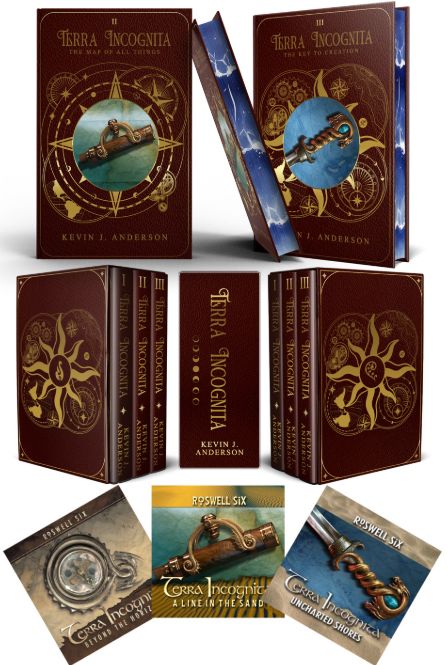
So, what do you guys think of the music?

Tad: Okay, both of you have much more experience with Anderson’s work than I. When I saw that there was a companion novel to Rush’s Clockwork Angels, I immediately read it and enjoyed it very much. The Roswell Six albums slipped under my radar, though.

That said, I really like this third album, Terra Incognita (Uncharted Shores). To my ears, it’s pretty much straightforward, classic progrock. Fans of Kansas, Styx, Spock’s Beard, Threshold, Arena, et al. will love it. The fact that there are so many different vocalists brings to mind an Arjen Lucassen project – especially when the beautiful voice of Anneke van Geirsbergen appears in track 3, “A Sense of Wonder”. 

I like the acoustic, Celtic sounding “Haunted and Hunted” a lot. “Lighthouse” is another highlight for me, with its chugging rock riffing and excellent guitar soloing. “The Ballet of the Storm” is an instrumental that has a very nice intro played on violin that transforms into a warm piano/electric guitar duet underpinned by some excellent bass. 

“The Key to Creation” features the return of Anneke, and it has a fun 80s vibe to it – it’s got a relentless beat with a wall of synthesized sound. As a matter of fact, I think this is my favorite track on the album. It has a nice hook in the chorus that sticks in my ear. 

“Unexpected” keeps the musical quality high with, I believe, Dan Reed handling the vocals. I feel like these songs will take on more meaning when I have the chance to read the accompanying novels. They obviously follow a storyline. In many of the tracks, I can hear sounds of the sea, which makes sense, given the Uncharted Shores title!

Rick: Brad, what you said about Anderson’s connections in the music world helped me get my bearings for listening to Uncharted Shores; it definitely has that American heartland prog vibe with some nifty touches of funk (but also touches of European theatricality, as Tad pointed out).  KJA gave an interview this week with Michael Citro of Michael’s Record Collection where they go into the background behind the music; the basic tracks are written and performed by Bob Madsen (bass), Billy Connolly (guitar), Jerry Merrill (keys) and Gregg Bissonette (drums) – all artists working under the umbrella of The Highlander Company Records.  (Madsen’s band The Grafenberg Disciples announced themselves to the world a few years back with a tribute to Peart, “No Words”, that caught Anderson’s attention.)  And all that excellent violin work is by Jonathan Dinklage – he led the Clockwork Angels string section on those 2012 & 2013 tours.  Rush connections aplenty!

The guest vocalists take the whole thing up a notch as well.  Michael Sadler from Saga sings on the title song. “Hunted and Haunted” and “Lighthouse”; he’s played one of the “lead roles” for all three albums. Like you said, Tad, Ted Leonard and Anneke give it their all on their feature tracks.  But the big surprise for me was Dan Reed, who takes the villain role on “Mortal Enemies” and “Unexpected”; for a minute, I thought Steve Walsh had emerged from retirement!  Reed has this grizzled timbre, but a real purity of tone and expression underneath, and he absolutely sells the part.  And The Grafenberg Disciples vocalist Hans Eberbach brings it all home on “Not In My Name” –  gutsy and soulful by turns, and consistently dramatic (with Tull’s Doane Perry contributing a spoken-word cameo as a capper)!  I think that’s the track that’s my favorite so far.

But there isn’t a duff song on the new album, and it definitely grew on me the second time through.  I agree with you, Tad, that knowing the Terra Incognita storyline better will probably help, but the core emotions and throughline of the story come across loud and clear.  According to the Anderson/Citro interview, all the albums are being released through Sony (on InsideOut?) in the fall, but I decided not to wait; I’ve pledged for the ebooks and the digital albums, so my summer reading and listening are already lined up.  And when the CDs go to broad release – who knows?  It’d be far from the first time I’ve bought music twice!

Brad: Tad and Rick, so well stated!  And, yes, I pledged to buy all three albums as well, even though I already own the first two.  If you’ve not listened yet, I especially recommend the first track on Beyond the Horizon: Ishalem.  Incredible prog metal.  Very much in line with Ayreon or Dream Theater.

For those out there not totally familiar with Kevin, he has, as noted above, written extensively in the Star Wars, Dune, and X-Files franchises.  My favorite of his own books (that is, those not set in another mega genre/universe) are Nether Station (a sequel to H.P. Lovecraft’s Mountains of Madness) and Stake (a completely original novel questioning the existence of the supernatural).

Again, all praise to Kevin for bringing together so many beloved things: fantasy, science fiction, and prog rock!

Tad: Kevin Anderson’s Kickstarter link is here, for those interested!

Meeting Michael York (and other celebrities)

By Richard K. Munro

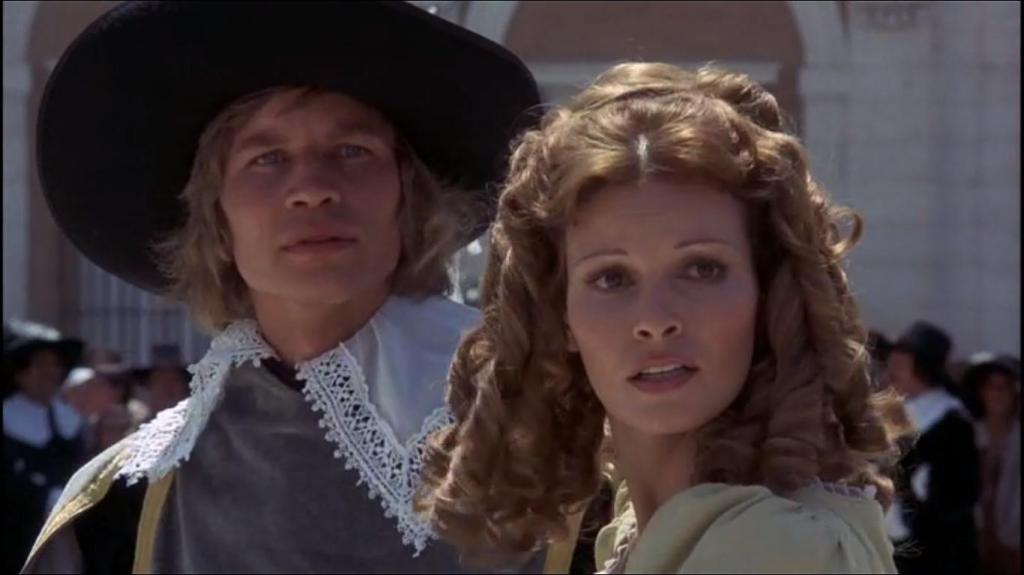
Raquel Welch (Spain August 1973)

Castillo Berlanga del Duero (Soria, Spain)

I remember my meeting with Michael York in Spain in 1973 vividly.

He was in Soria to film exterior scenes of THE THREE MUSKETEERS.    

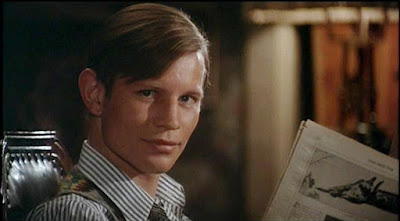
In fact, I had just recently seen CABARET at the Rex Theater in Soria just a few days before I  met him.  A very significant picture for me because I went with a Spanish friend and later that Spanish friend became my wife (we have been married almost 43 years!) We found we had a similar passion for musicals and classic films.

 I was studying at the time with a Spanish program with the University of Northern Iowa at the time (sadly the program which flourished for over 30 years is now defunct).   

Soria was a great place (especially then) to study Spanish because

1) there was almost no English-speaking tourism so there was almost total immersion

2) Most Sorians were reasonably well-educated and spoke a beautiful and rich Castilian dialect. 

But it meant monolingual English speakers might experience loneliness. I enjoyed living in Europe immensely. In those days Spain was inexpensive for Americans (not true today!).  Soria itself had a beautiful natural setting and many historic castles and ruins dating from Celitc,  Roman, Moorish and Medieval times.  El Cid was at Berlanga de Duero and attended Mass there and in churches in Soria. There is a statue to the anonymous JUGLAR DEL CID (author of the Poem of the Cid) in Soria.

I could be mistaken as to the date but I think the date I met York was July 4 1973 because we had the whole day off from classes  for the 4th of July which was the custom of the program for a group activity and we took the bus to Berlanga del Duero where they were doing the exterior shots of the Three Musketeers.  

I was lucky enough to observe the epic “battle scenes” as the soldiers “assaulted” the castles in their colorful uniforms and swords and lances.   If it was not a cast of thousands there were at least hundreds of uniformed extras.  I got to see and talk to the extras (all Spaniards) in the town.  After watching this assault of the Castle I went hiking around the ruins on the base and approached the castle.   

It was a very hot day and I took refuge from the late afternoon sun for in the shade of a ruined castle wall.   

And who should I find there, alone, resting in the shade none other than Michael York?

 Of course, I recognized him immediately (he was not that famous then) because  I had just seen him in Cabaret.   Michael invited me to sit down next to him and we shared our picnic lunches   (he had chorizo, Manchego cheese and I had  Tortilla de Patatas sandwich. I had a big bottle of water (agua sin gas) and we shared that.  I seem to remember he had a bota of red wine and he offered me some as well.

A cast member passing by took a picture of us together.    York seemed happy to have the company of an English-speaking person. We had a few laughs together.  I was a totally unexpected visitor.

Michael was very friendly and we talked about Britain and America (briefly),   Spanish history and of course the movie the THREE MUSKETEERS and CABARET.  

 I explained I was a big classical movie buff and loved British films (my family emigrated from Britian to the USA 1923-1948).  He asked me if I was just visiting Spain for tourism and I said no I was there to study the language and culture with a view to get an MA in Spanish literature.  My father encouraged me to study Spanish as it was a “real expertise”;  there is no question Soria and Spanish culture changed  my entire life and career.  

Michael talked about his experience on the stage in England and I mentioned my father always believed British actors had better training because of their stage experience than a lot of “California Kids” who showed much less range that the great British actors  (Maurice Evans, Laurence Olivier,  Alex Guinness,  Jack Hawkins,  Leslie Howard,  Wendy Hiller, Paul Scofield, John Mills) and of course himself whom I put as a talent in the same category. York was a little surprised that I could rattle off the names of British actors like that.   

York laughed and modestly said,  “I take my craft seriously and try to give my best performance. “

I was eager to see or meet RAQUEL WELCH who was in the movie.  The late Miss Welch was one of the great sex symbols of the 60s and 70s.    

Michael laughed and explained that if I went down to the town I would only find her stunt double because all of Miss Welch’s scenes were shot in the studio in London.   I don’t remember if they had already filmed them or were going to film them a little later.     

 I told Michael that I  really enjoyed his performance in Cabaret and thought the picture itself was original and powerful and would be remembered as one of the great musicals.  He was impressed by my critique and said,  “That’s every actors dream to do something important and memorable.” 

We talked about movies filmed in Spain especially DR ZHIVAGO some of whose scenes were filmed in SORIA.   I also mentioned that the trains with Russian slogans were preserved in a train museum in Madrid.    He said he was going to make an effort to see that.

Michael specifically mentioned other exterior shots that they were going to film in Canon Del Rio Lobos ( a very picturesque place.)   A friend asked me about other shots such as a night swordfight on the frozen lake.   

Since it was Soria in summertime an about 90 degrees or more I don’t think that shot was filmed in Soria.  It is much more likely to have been shot in the studio in London like Miss Raquel’s scenes.  But that is just speculation on my part because Michael and I only talked about Berlanga del Duero and Canon Del Rio Lobos.  

Of course,  lunch break doesn’t last forever so Michael shook my hand and excused himself to go back to work. 

I wished him best of luck in this film.  I stopped one moment more to ask him to tell Raquel Welch that a fan was very disappointed that he didn’t have a chance to meet her in person and he said he would make sure to tell Miss Welch when they were in London together.

So that is my Michael York story.     Like ships passing in the night, we met and made our final farewells. He probably would not remember me but I would always remember him.

For years I would show people among my Spanish photos MY FRIEND MICHAEL YORK.   

It interesting to meet authors or celebrities in person   

My grandfather heard GEORGE BERNARD SHAW speak in person in Glasgow and met THOMAS EDISON in the 1920’s .  My father met GENERAL MACARTHUR in 1945 in Manila and my uncle knew PRESIDENT EISENHOWER while he was at Columbia University and later met JOHN F. KENNEDY.  My uncle worked in the Faculty dining room and served Eisenhower and his friends many times. Ike, in fact, called him NORM!  I met Pamela Harriman (daughter-in-law to Winston Churchill) when she was then Mrs. Harriman.   Harriman didn’t mean much to me at the time, but I was aware that Pamela Harriman was at one time Mrs. Randolph Churchill. I remembered seeing her interviewed for the series THE WORLD AT WAR.

One Broadway star we knew well was BILL TABBERT then original Lt Cabel of South Pacific.  He was our next door neighbor and my sister and I were friends with his kids.  He sang at my mother’s Hamiliton Piano many times (I still have the piano).  He was a very nice man but as my father said he was devasted when he was turned down for the Hollywood role.   He came close. Ezio Pinza was to be in it and said he wouldn’t do it without Bill but then Pinza died unexpectedly and that was it.    Hollywood and the theater is a tough business.  He was in three Broadway hits and had one bestselling record (Soundtrack of South Pacific).  His signature song was YOUNGER THAN SPRINGTIME.  At the end of his life, he hawked LPs in dinner clubs around New York and acted in soap operas.  He had one LP of his greatest hits recorded in Italy.   He died fairly young. My father liked him a lot and they had lunch together in New York many times a favorite haunts such as the the now vanished 1407 Club or Luchow’s. Sic transit gloria mundi.

My parents saw many famous actors and actresses live on the stage from 1933-1990 chiefly in New York or London.   

I had a great experience at the revival of GIGI in 1976 when I sat next to E. G. Marshall (he was alone and like me wearing a MOYNIHAN FOR SENATE PIN so I think it was about October 1976).   Many would know Marshall for his TV shows and TV appearances, but I was especially interested in his classic films such as TWELVE ANGRY MEN,  It is one thing to see a person perform LIVE but another to have a chance to interact and get to know that person a little in real life.       Marshall was a very cultivated and polite man who had a vast knowledge of classical music, opera, and musicals.  He was somewhat surprised that I only in my early 20s had almost the same musical tastes as he!  In his case, I got his autographs. No selfies in those days!

In my later life I enjoy reading, studying languages, listening to classical music as well as the traditional and national music of Scotland,   blogging on the internet and corresponding with authors such as Johnathan Leaf (the playwright)  Arthur Herman and Andrew Roberts.  

I had the pleasure and honor of working with Lord Roberts on his great WALKING WITH DESTINY biography of Churchill as well as his book on GEORGE III.   Roberts is a fine fellow.  If you ever read his biography on Churchill you will notice many references to films and actors -many of these were researched by me. 

I am older than Lord Roberts so I have memories of the late 1950s and early 1960s and have seen many classic films.  His uncle was in the great film THE LAST VALLEY and he was very surprised to know the film was a financial disaster in America because of the controversial subject matter (30 Years War and Christianity).  My father and I went to see it in a movie palace in NYC and we were the only customers.  

 My daughter has an annotated (autographed ) copy with all the refences and footnotes I contributed.  LORD ROBERTS was very thankful and we had a wonderful collaboration that lasted very a year.  I helped edit the book and read all the galleys before publication.   I have edited or reviewed other books for other authors (Diane Ravitch, Rosalie Pedalino Porter ) but WALKING WITH DESTINY was the greatest experience and best book I have ever worked on. 

Meeting Michael York was a very memorable and happy interlude from my Spanish days.    I never saw him again but of course. Yet it remains a very pleasant memory. Show business is a tough business and I have known many singers and players who just never made it big though they had some success. Michael York kept working and as far as I know, he is still (as of 2025) working in his 80s! Very glad to have met him and glad to know he has known some happiness and success!

Charles Williams’ All Hallows Eve – Stranger Things Meets Rosemary’s Baby

The First Edition

All Hallows Eve is Charles Williams’ seventh novel, and one of his best. In 2024, I began working my way through all of the novels of this member of The Inklings, the famous literary group of friends that included J. R. R. Tolkien and C.S. Lewis. Williams’ fiction is definitely darker and more philosophical than the writings of either of the his more well known colleagues.

All Hallows Eve begins with a startling scene: a young woman, Lester Furnival, is standing on a street in nighttime London, and there are none of the usual sounds and traffic around her. She soon realizes that she is dead. She and a friend, Evelyn Mercer, were supposed to meet each other for a get-together, but they were killed by a plane crashing into the area. It appears that Lester and Evelyn are in some sort of purgatory – they can interact with each other, but they do not perceive any other beings. The only way they know it’s night is when the lights come on in the houses around them. There is no sun or moon, just a diffuse, gray light.

Back in the land of the living, Lester’s grieving husband, Richard, visits his artist friend, Jonathan Drayton. Drayton is a talented painter who shows Richard his latest work: a painting of a charismatic religious leader who goes by the moniker Simon the Clerk, or Simon Leclerc. It has been commissioned by Lady Wallingford, a devoted disciple of Simon. Jonathan Drayton is in love with her daughter Betty, but she will not allow them to get engaged.

Lady Wallingford drops by to view the painting, and she is extremely disappointed. In her eyes, Simon looks malevolent, and the people in the congregation look like insects. Later, Simon himself visits Drayton to view the painting, and he proclaims it a masterpiece that captures him perfectly.

What follows is a very dark tale of necromancy and all-consuming greed for power. Simon was conceived and born during the French revolution, and he has plans for world domination that involve breaking through to the spiritual plane where Lester and Evelyn are. Lady Wallingford’s daughter, Betty, is the hinge through which this will happen. Things get very creepy as the story unfolds – I was put in mind of Rosemary’s Baby as the pieces fell into place.

As a favor to Jonathan, Richard Furnival agrees to attend a meeting of Simon’s followers, and see if he is legitimate. Simon uses some sort of spell to put everyone under his will. At the end of the meeting, Simon speaks to Richard, and Richard recounts their disturbing conversation to Jonathan:

“He [Simon] said: ‘I won’t keep you, Mr. Furnival. Come back presently. When you want me, I shall be ready. If you want your wife, I can bring her to you; if you don’t want her, I can keep her away from you. Tell your friend I shall send for him soon. Good-bye.” So then I walked out.

He lifted his eyes and looked at Jonathan, who couldn’t think of anything to say. Presently Richard went on, still more quietly: “And suppose he can?”

“Can what?” asked Jonathan gloomily.

“Can,” said Richard carefully and explicitly, “do something to Lester. Leave off thinking of Betty for a moment; Betty’s alive. Lester’s dead, and suppose this man can do something to dead people?

CHARLES WILLIAMS. All Hallows’ Eve (Kindle Locations 1850-1855). Delphi Classics. Kindle Edition.

As the story unfolds, there is a contrast between the characters who grow and mature, and the ones who degenerate. Betty, who is initially a slave to Simon’s will, gradually comes into her own and is able to resist him. Lester also matures spiritually as she learns to navigate the purgatory she is in. Both she and Richard remember their brief marriage, regret the mistakes they made, and come to a much deeper love than they had when she was alive. Even Jonathan’s art takes on a life of its own, becoming more transcendent.

On the other side, Lady Wallingford becomes less and less of an individual with actual agency, Evelyn undergoes a horrific degeneration into petty hatred, and Simon Leclerc reaps the rewards of his dark magic.

All Hallows Eve is one of Williams’ most accessible reads, as well. In a few of his earlier novels, particularly Descent Into Hell, his prose was very dense and unwieldy, and his dialog hard to follow. Every conversation in All Hallows Eve is terse and to the point. I thoroughly enjoyed this novel, even though it creeped me out at times. I wonder if the creators of Netflix’s Stranger Things are familiar with it, since there are definite similarities in the basic premise of both tales. Anyway, for fans of fantasy with a very dark edge (but a happy ending), I highly recommend All Hallow Eve.

Spirit of Cecilia’s Best of 2024

Greetings, music lovers and readers of Spirit of Cecilia! 2024 is fast coming to a close, and the SoC crew would like to share their favorite albums of the year. There was a lot of great new music, terrific deluxe reissues, and releases from old favorites. Hopefully, our lists will lead to some albums you will love as well.

Brad: Tad, thanks for starting us off and inviting everyone to participate.  Always great to write with you!  I’ll just start with an alphabetical listing of my favorite releases of 2024:

  • “Dogs” by Pink Floyd, as done by Tim Bowness and Giancarlo Erra
  • Airbag, The Century of the Self
  • BBT, Flare on the Lens
  • BBT, The Likes of Us
  • Bruce Soord, Caught in the Hum
  • David Gilmour, Luck and Strange
  • Frost*, Life in the Wires
  • IZZ, Collapse the Wave
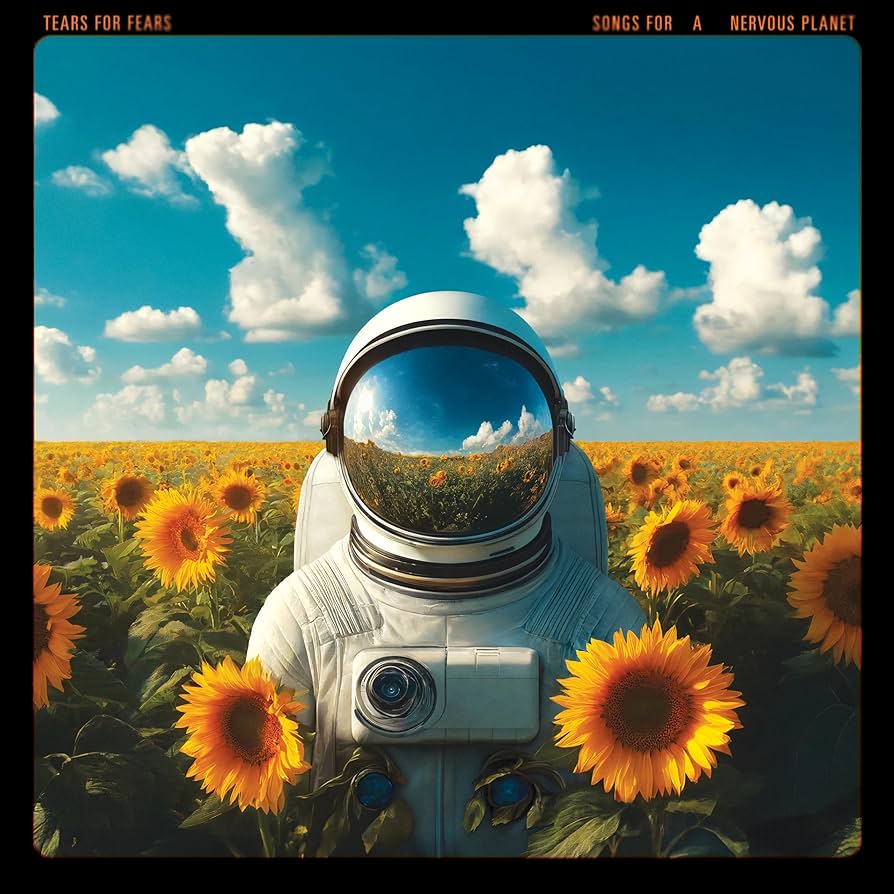
  • Tears for Fears, Songs for a Nervous Planet
  • The Bardic Depths, What We Really Like in Stories
  • The Cure, Songs of a Lost World
  • The Pineapple Thief, It Leads to This
  • The Pineapple Thief, Last to Run EP
  • The Tangent, To Follow Polaris
  • Tim Bowness, Powder Dry

And, I’m not even including vital re-releases such as the deluxe edition of Synchronicity by the Police; Fear of a Blank Planet by Porcupine Tree; Spectrum ‘97 by Phish; Lament by Ultravox; Bursting Out by Jethro Tull; or This Strange Engine by Marillion.

If I go just by my playlist numbers, I’d have to list “Dogs”, Frost*, IZZ, and, especially, The Cure.  In fact, since The Cure first arrived, I’ve listened to almost nothing else.  But, I went through such phases with Frost* and IZZ, too.  And, really, I can’t recommend the single of “Dogs” highly enough.  Bowness and Erra give it just the right beauty and creepiness that a proper Pink Floyd remake so desperately needs.

I must admit, though, I’m totally against the lyrical content of “Dogs.”  I can’t believe our entrepreneurs are so bloodthirsty as this.  Like or despise Elon Musk, for example, as you will, but he’s not bloodthirsty.  In fact, if anything, I think he’d hate to “be dragged down by the stone.”  And, he would hate to drag anyone else down by the stone.  He definitely wants to win, but he wants to win fairly, by the rules established by society (unless all of society is corrupt, but let’s hope that Pink Floyd isn’t so Marxian as this).  Maybe I’m wrong, however.  Perhaps, I’m deaf, dumb, and blind, and that I keep pretending. . .  Is this how Roger Waters saw his friendship/adversarial relationship with David Gilmour?  If so, so very sad.  For my money, give me Phish’s “Bouncing Around the Room” as the touchstone song dealing with entrepreneurship.

To be certain, though, I’m also a bit biased on the whole The Bardic Depths release.  Given that I wrote the lyrics for it, I’m quite taken with it.  Dave Bandanna did an amazing job in composing the music.  So brilliant, so beautiful, so mystical, so joyful.  Dave brings every song to life, and I’m always stunned to hear my own words given form and made manifest.

And, then, what’s not to love about the new David Gilmour?  In fact, when he sings with his daughter, Romany, I’m completely taken.  So much better than Dogs, co-written with Roger Waters..  Especially if you listen to something as glorious as “Between Two Points.”  I would give anything to have such a relationship with my daughter that I could write something so gorgeous with her.  Romany over Roger any day.

And, seriously, this brings me to all the incredible re-releases of 2024.  Oh, to be “Prince Caspian” and float upon the waves.  Oh, to be Prince Caspian.  Dang, Phish was simply brilliant when they were.

I also want to single out Airbag.  I don’t know their politics, but it strikes me that with this release, especially, they’re trying to combat conformism and cancel culture.  I could be wrong, but I’m willing to take a chance that this is a brilliant counter-cultural masterpiece.   One that shakes the conformists of the world to their very foundations.  And, who wouldn’t love that bass playing and interplay with the drums?  Genius.  Thank God for the non-conformists of the world.  Airbag sounds like Pink Floyd, in terms of legacy, but they are completely their own band.

If Airbag sounds anti-political, Robert Smith on the new Cure album, sounds confessional.  Bless me, Father, I, Robert Smith, have sinned, and something wicked this way comes.  Truly, the latest The Cure album is a masterpiece, a true sequel to Pornography and Disintegration.  My love and respect for Smith only grows with age.

If Airbag is countering the world and Smith is confessing for us all, then IZZ is proclaiming the inherent goodness of each one of us.  I’m not sure what the lyrics are all about on Collapse the Wave, but I feel that John Galgano and Laura Meade are asking us to look at our best selves.  Rather than be dour, they find wonder.  As far as I can tell, IZZ has been reading a lot of T.S. Eliot and a lot of John Paul II.

Tad: What a great list, Brad! Yours and mine overlap quite a bit, since we are often of like mind when it comes to music. Here is mine, based on how often I listened to each album:

8. Kyros – Mannequin

7. IZZ – Collapse the Wave

6. Jeff Johnson/Phil Keaggy – Spinning On a Cosmic Dime

5. Tears For Fears – Songs For a Nervous Planet

4. Airbag – The Century of the Self

3. Bardic Depths – What We Really Like In Stories

2. The Cure – Songs of a Lost World

1. Frost* – Life In the Wires

I’ve been a fan of Kyros’ music for several years now. They wed 80s sensibilities to 2020s expertise. Mannequin is another great collection of pop/prog.

Like you, I admire IZZ enormously. As far as I can tell, the lyrics to the title track are about quantum physics and faith. Who else but the Galgano brothers could pull off such an ambitious song? They definitely succeed.

Jeff Johnson and Phil Keaggy have collaborated several times before, and Spinning On a Cosmic Dime is the most lighthearted and fun of their albums. Johnson is a master of all keyboards – acoustic and electronic, while Keaggy is one of the finest guitarists alive today. When they get together, magic happens.

The Tears For Fears is primarily a live album, but the five new studio tracks are some of the best songs they’ve ever recorded.

You’ve already said everything I could want to say about the Airbag album. They continue to impress me with their social commentary, and their instrumental chops are outstanding. Their previous album, A Day At the Beach, is still my favorite, but The Century of Self is really, really satisfying.

The Bardic Depths’ new one is also a great album. Listening to it is like having a beer with C.S. Lewis, Tolkien, and the other Inklings. To my ears, it’s the most musically ambitious set of songs from TBD, and I have thoroughly enjoyed listening to it throughout 2024.

The Cure’s album came out of nowhere as far as I was concerned, and I approached it with some trepidation – there’s nothing worse than an old favorite trying to recapture the spark and failing miserably. Robert Smith et al. came up with a fantastic album that easily holds its own with their previous best. Amazing!

Frost*’s Life In the Wires is far and away the most-played album of 2024 for me. I have yet to tire of it, and every time I listen to it I find some new and delightful detail. Jem Godfrey sings all of the vocals on this one, and he is terrific. The beautiful melodies pouring out of my speakers are such a bountiful feast for my ears. The story is fascinating as well – a young man rebels against a world run by AI when he hears a pirate radio broadcast. After tracking it down to its source, it turns out to be an automated program. But then things get weird – he seems to sacrifice himself to become the new source of the radio broadcasts and spark an awakening of humanity. At least that’s how I read it. 

So that’s what I spent my time listening to this past year. I also loved the Ultravox Lament box set and the Talk box set by Yes. It’s nice to have this often overlooked album get the treatment it deserves. 

Brad: Yes, Tad, thanks for the reminder about Yes’s 30th anniversary edition of Talk.  The last of the Trevor Rabin-Yes era albums, it’s simply beautiful.  Clearly, the band was going for a progressive AOR sound at the time, but the production is so very clean.  I love the packaging as well for it.  Not overblown, but a solid release in terms of presentation.  Don’t get me wrong, I love big box sets like Lament by Ultravox, but sometimes the smaller packaging works just as well.  For me, Marillion’s and Jethro Tull’s releases–in terms of packaging–hit the sweet spot.  Basically small books that fit perfectly on a book shelf.

Thanks, too, for the story about the new Frost*.  I’ve listened to it numerous times, but I’d not figured out the lyrics.  What a great story!  Now, I’ll listen to it with different ears.

I’m so glad we agree on The Cure, on Airbag, and on Frost*.  Three essentials of the year.

As it turns out, The Cure also released their brand new album as a live release–Songs from a Live World–as well.  Gorgeous.  Seriously, what else can Robert Smith do?  He simply captures the mood of every era in which he finds himself.  And, I, for one, am so fortunate to be alive when Robert Smith is alive.

I would also note that 2024 is an important anniversary date.  Kevin McCormick’s gorgeous Squall came out in 1999, a mere 25 years ago!  Even the rather snobbish All-Music recognized the brilliance of Squall.  As far as I understand it, McCormick is working on a follow-up CD.

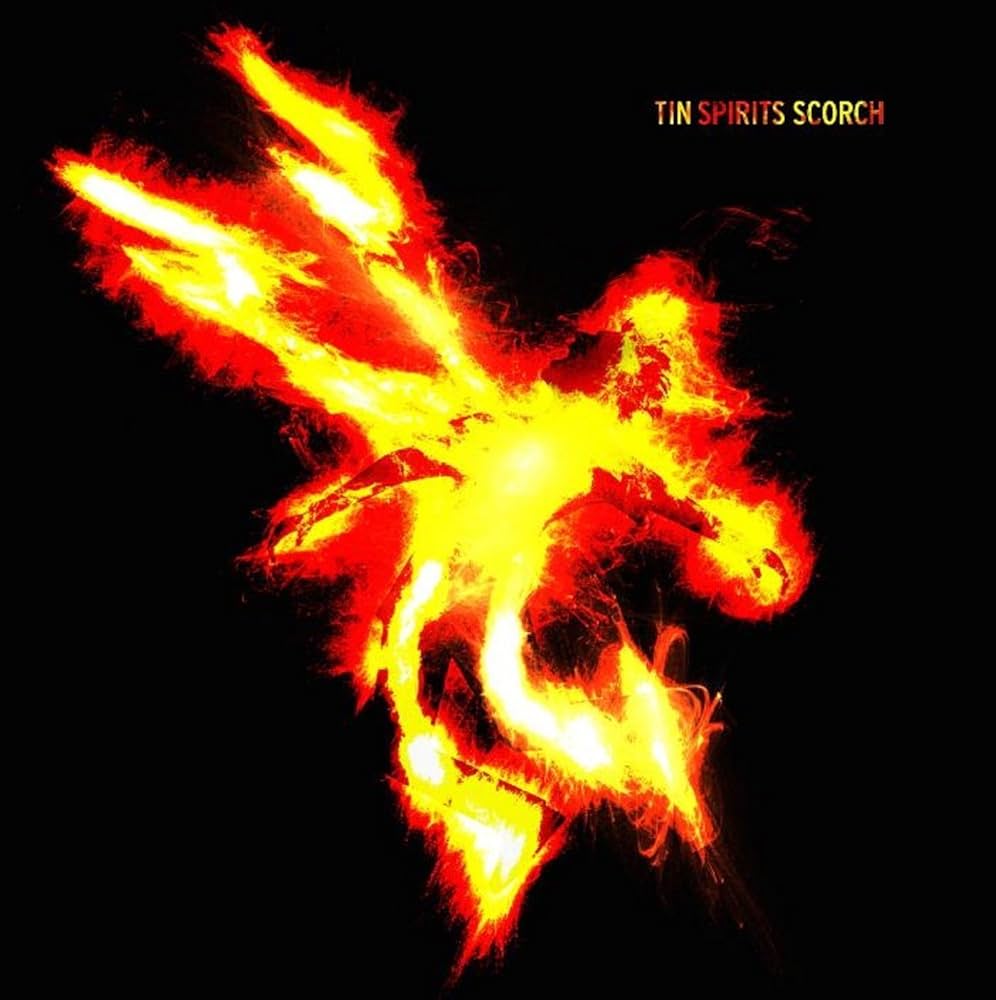
It’s also the ten-year anniversary of the genius Scorch by the Tin Spirits.  A favorite album.  Also, ten years ago, appeared the brilliant Demon by Gazpacho and Anathema’s mediocre to good Distant Satellites.  

But, Holy Moses, it’s not just about Tin Spirits.  If we go back to the twentieth anniversary of releases, 2004, we get to The Pineapple Thief, Variations on a Dream; Glass Hammer’s Shadowlands; Proto-Kaw, Before Came After; The Tangent, The World We Drive Through; Ayreon, The Human Equation; and Marillion, Marbles.  Sheesh, what else do you want?

Carl: Full and necessary confession: 2024 turned out to be year in which I listened to little new prog rock, or rock of any kind. Not for any lack of new and worthy rock music, but 2024 also turned out to be the year in which I fell quite a ways down The Vinyl Rabbit Hole. I’ll likely say more about that in a separate post on my favorite jazz of 2024, but suffice to say that I’ve been haunting various thrift and record stores. 

My most listened album of the year was released 30 years ago: Seal’s second album (1994), titled, inconveniently enough, Seal—just like his 1991 debut. A deluxe edition was released, with a remastered version of the album (fantastic), as well as alternative versions of the songs (also wonderful). I listened to this album countless times when it first came out, and I have never tired of it (or of his first or third, titled Human Being). Why has it resonated so strongly with me? I’m not entirely sure, but for me it is a perfect pop/rock album, and it sits squarely in the middle of a trio of albums that I continue to think is one of the finest three-in-a-row rock/pop album families you’ll ever hear. 

I enjoyed the new albums by Frost* and Pineapple Thief and if I listened more closely, I’m confident that I would really like them. Both bands have consistently produced accessible, intelligent prog rock of the highest order, so I plan to revisit them in the weeks to come. 

Caligula’s Horse’s Charcoal Grace is mysteriously but aptly titled, as the music has a dusky, burnt quality that also shines with many moments of delicate beauty. This Aussie band has been a longtime favorite, and this album adds to a discography rich with ridiculous chops and vocals at the service of exquisitely crafted songs. A keeper. 

Keep Me Fed by The Warning, the talented sister trio out of Mexico, is (as they say) a banger. Or a series of bangers, the sort of swaggering, catchy hard rock—with sublime harmonies—that has been sorely missed in recent years. For my money, I prefer their live versions a bit more; they are dynamic performers whose young ages (20 to 25) defy (even bely) the band’s evident maturity and exuberant zest. 

Speaking of all female bands, a somewhat guilty pleasure this year has been watching videos of the mind-melting Japanese metal band Lovebites. They have been compared to Iron Maiden and similar metal bands, which makes it all the more strange as I have never cared that particular genre. All five of these ladies are virtuosos, and Miyako Watanabe, one of the two guitarists, was a classical pianist until her late teens, when she picked up electric guitar for the first time. The live album Memorial For The Warrior Souls (2024) and the studio album Judgment Day (2023) are unrelentingly fast, in-your-face, melodic, and—yes—tremendous fun. Check them out live on YouTube and prepare to be amazed.

Myles Kennedy might just be the hardest working and (by all accounts) nicest rocker out there today, and his third solo album The Art of Letting Go is classic Kennedy—powerful, assured, dynamic, moving—with some nice little twists. His is one of the finest rock voices of the past couple of decades, but his guitar playing and song writing are just as polished, varied, and inviting. 

The Smile is like Radiohead if it didn’t have all of its members–and if it released albums more quickly. Which is what it is, with Thom Yorke (vocals, guitar, bass, keys) and Jonny Greenwood (guitar, bass, keys) joined by Tom Skinner (drums). Wall of Eyes (released in January) and Cutouts (same session, released in October) are quirky, dark, strangely fun, often weird, always melodic, and never, ever boring. Yorke’s voice is timeless and Greenwood’s playing, which is always so distinctive, is a revelation. And this album comes across to me as even more jazz influenced than their debut—but never in a direct, obvious way. Great stuff!

One of my favorite country artists, Dwight Yoakam, is back with his first new album in almost a decade. Brighter Days finds the Bakersfield legend firing on all cylinders, apparently reenergized by marriage and a young son. Dwight sounds half his age (68) and his band, no surprise, is tight and razor sharp. Every cut is worth the price, with the deceptively simple “I Spell Love” getting a nod from this fan. 

Speaking of artists aging well, Van Morrison continues his remarkable output, with three albums: Beyond Words, New Arrangements and Duets, and Live at Orangefield. The first is all instrumental and is enjoyable, with some unexpected quirks. The second is a solid collection, featuring collaborations with Kurk Elling, Joss Stone, and Willie Nelson, all to good effect. But the live album, recorded a few years ago, is a revelation, captures a mid-70s Morrison at the top of his powers, featuring (as usual) a crack band and some other-worldly backing vocals. It rewards repeated listens and is a notable testament to Morrison’s brilliance as both a singer and songwriter. 

Brad: Carl, excellent choices.  I, too, like The Smile, and I, too, (thanks to you) listened to a lot of Seal II as well!  I also bought Trevor Horn’s memoir, but I have yet to read it.

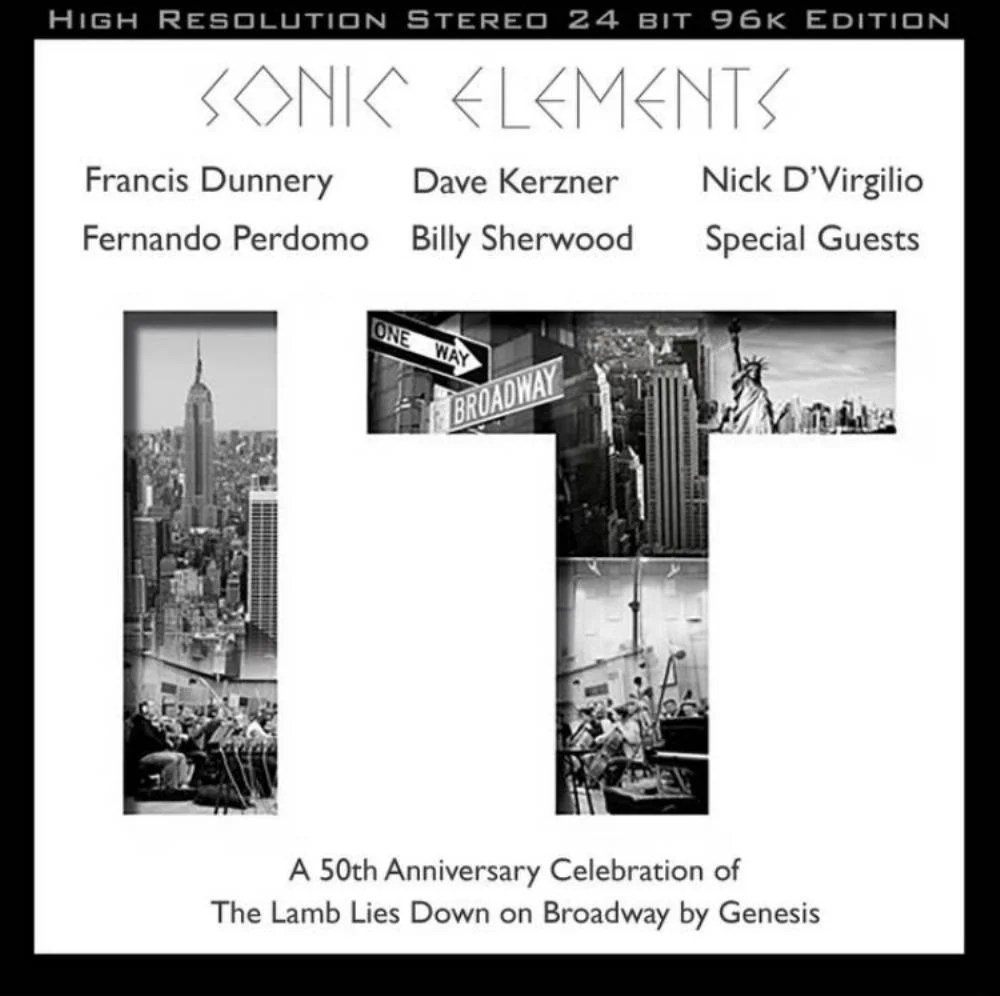
Well, folks, this pretty much wraps up 2024 for us.  We have a lot to look forward to in 2025.  It looks like The Cure will be releasing more music, there’s a new and final season of Stranger Things, and we’ll be celebrating the 50th anniversary of The Lamb Lies Down on Broadway by Genesis.  Not only is there a 50th anniversary edition of The Lamb coming out, but the brilliant Dave Kerzner has re-recorded the entire album and is offering it as a 3-cd set plus hi-res download for only $49.99, plus shipping.

Big Big Train will be touring the U.S, and IZZ will be performing some stripped down shows–maybe even in Hillsdale!

I’m sure we’ll continue to give our hard-earned money to The Burning Shed and Rita Kay Drew’s The Band Wagon USA.  I highly recommend supporting both of these truly excellent business enterprises.  Amazingly enough, each is competitive with Amazon, even with overseas shipping costs.

Tad, Carl, Kevin, Erik, and I wish you all a Merry Christmas (remember, we’re only on day three of twelve), a Happy Hanukkah (remember, we’re also only on day three!), and Happy New Year, everyone!

Speaking Humor to Power: Ghostbusters at 40

I am Egon. Well, right now I’m not, as I’ve just gotten a much-needed haircut. But, when my hair is full (it doesn’t just get long, it gets full and big), I look so much like Egon (Harold Ramis) that it became my high school nickname when Ghostbusters hit the big screen forty years ago. Even to this day, people say I look like Ramis (may he rest in peace). But even beyond this personal connection, I possess a deep admiration for the philosophical and political themes of the movie. The way it mocks the false authority of power, while never undermining the true authority of the transcendent makes the film a perfect libertarian fable. 

At the time it came out, in the summer of 1984, I was sixteen, and Ghostbusters became the highest-grossing comedy up to that point. Few had intentionally mixed the genres of comedy and horror (Young Frankenstein being a critical exception), and critics did not quite know what to make of it. “But, however good an idea it may have been to unleash Mr. Murray in an ‘Exorcist’-like setting,” The New York Timesclaimed, “this film hasn’t gotten very far past the idea stage. Its jokes, characters and story line are as wispy as the ghosts themselves, and a good deal less substantial.” The Wall Street Journal, though, was much more taken with the film. “‘Ghostbusters’ is the most sophisticated and sweetest of this group’s particular brand of schtick-em-up movies,” the paper noted, comparing it to Animal House and Caddyshack

Time, however, has been quite kind to Ghostbusters—certainly more than the film’s original critics were—and it became a beloved classic immediately after its release. One might be tempted to call it a “cult classic,” but its popularity has gone well beyond “cult.” Indeed, it dominated the screen throughout the summer of its release. Additionally, it spawned (no pun intended) two animated TV series (The Real Ghostbusters and Extreme Ghostbusters) as well as three movie sequels (Ghostbusters IIGhostbusters: Afterlife, and Ghostbusters: Frozen Empire) of varying quality. Then, of course, there were also comic books and video games based on the film. While the special effects and sets of the original movie looked great in 1984, they come across a bit cheesier forty years later, but this only adds to the overall charm of the movie. . . .

Bill Evans in Norway

ELEMENTAL MUSIC UNEARTHS BILL EVANS IN NORWAY FOR RSD BLACK FRIDAY RELEASE AS EXCLUSIVE
TWO-LP SET ON NOV. 29


Master Pianist’s Energetic 1970 Performance at the Kongsberg Jazz Festival Arrives as a Deluxe CD Version on Dec. 6
 
Comprehensively Annotated Set Includes Interviews with Evans, Bassist Eddie Gomez and Drummer Marty Morell, and Norwegian Pianist Roy Hellvin; Reflections on Evans’ Art by Keyboardists Aaron Parks and Craig Taborn; and Notes by Evans Scholar Marc Myers

Elemental Music will release Bill Evans in Norway, a brilliant 1970 trio concert captured at the Kongsberg Jazz Festival, as an exclusive RSD Black Friday two-LP set on Nov. 29.
 
The 180-gram vinyl package, mastered by Matthew Lutthans at the Mastering Lab and pressed at Memphis Pressing, will be succeeded by a deluxe CD version on Dec. 6.
 
This latest Evans archival find by the team at Elemental Music, produced for release by the award-winning “Jazz Detective” Zev Feldman, is being issued in cooperation with the Bill Evans Estate. The package includes a rare interview with Evans conducted by Norwegian critic and impresario Randi Hultin at the Kongsberg Jazz Festival; new interviews with bassist Eddie Gomez and drummer Marty Morell, members of the pianist’s longest-lived trio, who supported him at the festival; an interview with Norwegian pianist Roy Hellvin, who was in the audience at the performance; reflections on Evans’ art by pianists Aaron Parks, Craig Taborn, and Eliane Elias; and concert photographs by Arthur Sand.
 
“Between Resonance Records and Elemental Music, I’ve had the good fortune of working with Evan Evans of the Bill Evans Estate for the past 14 years, and this will be my 12th production working with the family,” producer Feldman says. “These recordings come from the archives of Norway’s Kongsberg Jazz Festival, which was founded in 1964. It’s been a major breakthrough for us to have established contact with their team in 2023 and we’re very excited about this new relationship.”


Jak Kilby/Arena PAL

The Kongsberg appearance on June 26, 1970, found the Evans trio in especially stirring form. The pianist — who had recently begun to wean himself off a longtime addiction to heroin in a supervised methadone program — was especially sensitive to his audience’s tastes, and brought a fresh energy to his repertoire.
 
Myers notes, “Evans appreciated Norwegians’ reserve, modesty and politeness. He also was aware that their moods tended to be lugubrious in the winter, when there was less sunlight each day, and more gleeful in the summer, when the sun set around 11 p.m. While preparing the Kongsberg set list, he knew Norwegian concertgoers would have a deep connection to wistful songs such as ‘What Are You Doing the Rest of Your Life?,’ ‘Turn Out the Stars,’ and ‘Quiet Now.’ But as you listen, you’ll notice that the Bill Evans Trio took many of these traditionally somber songs at a more spirited clip.”
 
Evans himself said on the day after the date, “This is an excellent audience, and it’s weird to think that a little place like Kongsberg can hire musicians from all over the world just because they like jazz here. I admire the enthusiasm of the organizers, who do all of this without earning a penny for it….These days here in Kongsberg have really meant something to me. It’s a beautiful place, and I’ve been able to relax.”

The pianist’s rhythm section, both experienced hands at European touring, took their cues from the leader’s approach. Gomez says, “When we played in Kongsberg, we had just played at the Montreux Jazz Festival in Switzerland. The recording of that event was called Montreux II. And at that time Montreux was a very high-profile festival. Having passed that hurdle, we went on to Kongsberg, and that was a relief. I felt really relaxed, like, ‘Okay, this is good. It’s not like Montreux, there’s less pressure.’ And I think the outcome is a record that’s quite good.”
 
Adds Morell, “There’s nothing like playing jazz in Europe — Norway, Scandinavia. Bill was loved, and it was always a special treat, and an honor really, to play for those people, because he was appreciated so well. But then you go to Paris and London and other countries, and it was a similar vibe. And South America, too. Bill was revered all over the world.”
 
Hellvin says, “It was a great kick for me to hear the tape of this 1970 Bill Evans concert 54 years after being there. I can still remember the atmosphere created by the trio. The summer in Norway was unusually warm that year, but inside the Kongsberg cinema there was a special mood. I don’t think I’ve ever seen another audience so quiet and concentrated, especially during Bill’s rendition of Leonard Bernstein`s ‘Some Other Time.’ It really left us spellbound! To me, Evans was playing a little harder than usual, and with more attack on his up-tempo numbers.”
 
The players touched by Evans’ influence find the essence of the keyboardist’s genius expressed in a fresh way in the unique Kongsberg performance.
 
“I’ve come to realize that on Bill’s playing there is lyricism and sensitivity,” Parks says, “but also deep intelligence, and above all a great muscularity. There’s a tactile, grippy kind of thing to the way in which he approaches harmony. There’s a real vitality, and a sense of putting skin in the game, rhythmically. All of that can be felt on this Kongsberg concert.”

Taborn says, “The group playing in Kongsberg is really interesting for me, because I think the Marty Morell years are fascinating….With Morell, Bill is really on top a lot. He has a much brighter feel. He’s really pushing stuff. Even bringing the tempos up a little bit. This group is swinging along in a brighter way, which really brings out the more rhythmic side of Bill Evans.”

Summing up the impact of Evans’ enduring music, Elias says, “Bill Evans created his own musical universe in harmony, melody and rhythm and has influenced generations of musicians with his sound and conception of interplay.  I consider him to be one of my important influences.”

Frost*: Life In The Wires Is Perfection

Frost* is set to release their fifth studio album on October 18, Life In The Wires, which follows the excellent Day and Age of 2021. Once again, Jem Godfrey is the prime mover, this time handling all of the lead vocals in addition to keyboards and songwriting. John Mitchell returns on guitars, with Nathan King on bass and Craig Blundell on drums. There are nearly ninety(!) minutes of music here, and it is all terrific. Not a single moment is filler.

As Godfrey explains,

“It’s actually a sort of continuation from Day and Age. The first track on the new album starts with the end of the last track from that album “Repeat to Fade,” where the static comes up and a voice says “Can you hear me?” I remember putting that in when we did Day and Age as a possible little hook for the future; a character somewhere out there in Day and Age land trying to be heard. What does he want to say? Can anybody hear him? Day and Age kind of sets up the world that this character lives in and Life in the Wires tells his story”.

The album chronicles the adventures of a young man, Naio, who lives in the near future, in a world dominated by AI. One night, he hears a voice coming out of the static on an old AM radio asking, “Can you hear me?” From that initial contact, Naio goes on a quest to find out who is the person behind the Livewire radio broadcasts. Meanwhile, the AI that runs the world, “The All-Seeing Eye”, is on Naio’s trail, trying to prevent him from connecting with the mysterious man on the radio:

You wanna take me down for hearing voices on my radio
But I have seen your way of life and, thank you, I don’t want to know
You feed the people food and fear to keep them all compliant
But I won’t play your game so now you’ll fight to keep me silent

Interspersed between tracks are nuggets of speech from Livewire Radio broadcaster: “Hey, this is Livewire, voice of the free. And tonight we’re taking calls. Heh! I’m just kidding… Hahahaha!”

That’s the storyline, so what about the music? I have to say, I haven’t been this blown away by an album in years. Day and Age was my favorite album of 2021, and Life In The Wires is even better. Jem Godfrey is the master of crafting attractive and heartfelt songs, and every song on Life In The Wires delivers. Every style is visited here: ballads, straightforward rock, very heavy rock, and, of course, prog. I have listened to the entire album at least two dozen times, and I keep finding new things to delight in.

The boys of Frost* are a mean biker gang in their off-hours. Frost Band photo by Will Ireland

“Evaporator” is an extended, upbeat, almost funky tune with a nice 80s vibe. “Absent Friends” is a gorgeous and delicate piano-based ballad that reminds me of classic Aqualung (the group, not the Tull album). “School (Introducing the All Seeing Eye)” is a blistering instrumental where Mitchell shows off his chops.

Everything reaches a climax with the final three tracks, “Moral and Consequence”, “Life In The Wires (Part 2)”, and “Starting Fires”. “Moral and Consequence” has one of the most irresistible hooks I’ve ever heard. At the end of its more than 8 minutes, I was still begging for more, until the opening chords of “Life In The Wires (Part 2)”. This track is almost 16 minutes of near-perfect prog perfection. It calls to mind the best of Abacab – era Genesis, but, to my ears, it is better produced than that classic album. The closer, “Starting Fires” is simply beautiful – a somber and sweet melody sung to some spare musical backing. It seems as if Naio has connected with Livewire, and they are going to start a resistance to the Eye:

We’re making waves
We’re starting fires
We can’t go back
to Paradise

We’re starting fires

2024 is coming to close, and so far, Life In The Wires is the Album of the Year for me. We’ve been blessed with some great music this year, in particular The Bardic Depths album, What We Really Like In Stories, but my gosh, Frost* has put together an album for the ages.

Here is the official video for “Moral and Consequence”:

Political Beats – Yes!!

Our founder, Brad Birzer, recently did a two-part episode of National Review’s music podcast, Political Beats. If you are not familiar, this podcast usually features a guest and a discussion of a particular band.
For this two-parter, Brad and the normal panel discuss the career of progressive rock giants Yes, album-by-album. I’ve conversed with Brad in a group chat about the episode, and he liked my comments enough to ask me to present them here. As such, here they are, unedited save for a few interjections.

First comment, after listening fully to Part 1 and a little bit of Part 2 (in italics, my additional interjections in brackets]:

Hi Brad – I just finished listening to the first Yes episode and have listened up through the discussion on GFTO in the second episode. I loved the discussion on TFTO, and I think “beautiful failure” is an apt description, although I would also add it was a necessary failure. They found their limits on that album because they tested those limits, and I think that allowed them to be more concise and focused with their next two albums. [Tales from Topographic Oceans was Yes’s most ambitious album, and to paraphrase what Jon Anderson said about it, it was the meeting of high ideals and low energy. It certainly has some brilliant music on it but also has a lot of mindless noodling. Most of the panel thought the first and last pieces of the album – The Revealing Science of God and Ritual, respectively – were the best pieces. For my money, it’s actually the second piece, The Remembering, which holds together best (although even it suffers a little from needless padding). On that note, I think the bass playing in that piece is brilliant, often subtle and understated (not often a Chris Squire trademark), and he says as much that he was proud of that in YesStories by Tim Morse]

I also liked the observation that at times on TFTO, they were fitting the art to the format instead of just letting it flow organically. That’s one reason I’m not as down on the digital formats as some are today, because it essentially removes such restraints an allows the artist to just create without having to adapt the art to the format. I think Gazpacho’s Night is a great example of that, as I just don’t think it would flow anywhere near as well if it had to be adapted to (and possibly compromised by) the LP format. [In line with the discussion above, I think a lot of the problem with TFTO was directly related to this observation. Multiple panelists stated this album could have been better with some editing, but such editing within the limitations of the LP format would have been much more difficult.]

I would have been a slightly dissenting voice in the GFTO discussion with regard to Awaken, which I think is pure, magical, utter freakin’ brilliance and even in a catalog that includes Close to the Edge, it’s my favorite Yes composition. The production, the dynamics of the piece, the playing, the shifts in mood … all of that adds up to me as just an incredible musical journey that leaves me satisfied every time I hear it, and yet wanting more of it at the same time. [This was my biggest dissent with the panel. Not that they disrespected Awaken, but they certainly didn’t see it the way I do. Progressive rock (particularly, symphonic progressive rock) was often described as the fusion of rock and classical music, and this piece more than any exemplifies that fusion in its best form to my ears. The tone and timbre of the instrumentation here (especially with the harp and the church organ) really give it a classical feel in a way that exceeds event hat of Close to the Edge. The crescendo that consumes the second half of the piece, beginning with a few quiet plucks of the harp by Anderson is brilliance, slowly, patiently building to a powerful conclusion. Give it another try. On the other hand, I loved that they all showed so much love to Parallels, my second favorite song on this album, which features incredible playing (and interplay) among Howe’s guitar, Squire’s bass, and Wakeman’s keyboards. I had a lot more to say about this album some years ago on Progarchy, that piece can be found here.]

Will let you know what I think of the rest of it when I finished. Really looking forward to the discussions of Drama and 90125.

Second Comment after listening to Part 2:

Finished the second episode now. Definitely enjoyed the discussion and agreed with a majority of the takes. After Magnification, the only Yes album that has interested me is Fly From Here: Return Trip because of the Drama connection. Drama, BTW, might be my favorite Roger Dean cover. I love the album, although I will admit that the overselling of “Yes” on Tempus Fugit wore on my after a while (but instrumentally, it’s an incredible song). [That’s about my only issue at all with Drama, which is a great album in its own right. I share the sentiments with others on the panel that wonder what might have been had that lineup continued.]

Thought the observation that some of the ideas on Tormato were good ideas poorly executed was a good one. My pick for that would by Onward, which I actually liked much better on Keys to Ascension when Howe brought in the nylon string guitar in place of the electric in the studio version. [Onward is one of many pieces by bands I love that seem to come off better live than in the studio, and Howe’s nylon string guitar on the KTA version is the reason why here. Gates of Delirium is another Yes piece l like better live than in the studio due to some production issues (although the Steven Wilson remaster seemed to fix most of those).]

As for Release Release, I’ve always preferred a cover by Shadow Gallery (from the tribute album Tales from Yesterday) to the original studio version, as it has the punch that the original was lacking. [That song just needed to rock more. While Howe was excellently versatile in many styles of guitar, he didn’t seem to have an affinity for the kind of bone-crunching power chords that song needed, or at least he saved that for Machine Messiah on the next album]

Like you and the rest of the panel, I was pretty disappointed with Big Generator, other than Shoot High Aim Low, it was pretty forgettable. Trivia note: I heard a Rabin interview where he stated that Love Will Find a Way was a song he had originally written for Stevie Nicks, but the rest of the band wanted to keep it for themselves. [Yeah, what a disappointment after 90125. On the other hand, I loved the discussion of 90125, and was happy that nobody on the panel was such a prog snob that they dismissed the album as other prog snobs are wont to do. Sure, it was a lot different from their previous work, but it was undoubtedly Yes, and it was the kind of reinvention that only a band like Yes could pull off in such a spectacular fashion.]

If you’re a Yes fan and haven’t listened to these this two-part episode, I strongly recommend you do so. You won’t be sorry!

Collapsing Waves: The Power of IZZ

Spirit of Cecilia loves the prog group IZZ! It’s always a cause for rejoicing when they release a new album, and member John Galgano was kind enough to share an advance copy with us. It’s called Collapse the Wave, and it contains some of the best music they’ve ever recorded. Brad Birzer and Kevin McCormick share their thoughts on this new set of songs.

Brad: I always love doing these with you guys.  Kevin, thanks for being my partner here.

I absolutely love IZZ.  Indeed, the band represents best what we try to do at Spirit of Cecilia.  Art for the sake of intellectual and spiritual edification, understanding the dignity of the human person, and playing like men and women possessed by the muses.  Lyrics that read like T.S. Eliot wrote them based on the theology of John Paul II and the philosophy of C.S. Lewis.  What’s not to love?

Every part of the band is incredible–from John Galgano’s excellent voice and bass to Laura Meade’s rather heavenly vocals.  Tom Galgano (I love that this is a family affair)’s majestic keyboards and vocals, to Paul Bremner’s astounding guitar work, to the two profound drummers, Brian Coralian and Greg Dimideli.  Amazing.  Astounding.  “This is the real thing.”

To be sure, IZZ and Glass Hammer are my two favorite rock bands from the U.S. If anything, I just can’t believe that IZZ isn’t HUGE!  They deserve to be adored and well loved.  Frankly, they should be as loved here in the States as Big Big Train is in the U.K. and Europe.

I also love how the band–though unique in its own sound–reflects the loves of the members of IZZ: Gentle Giant, Genesis, ELP, Yes, Jethro Tull, and others.  In other words, they readily blend tradition with innovation, no mean feat in 2024.

My own history with the band goes back over a dozen years now.  In fact, I was introduced to the band by their 2012 album, Crush of Night.  I’m not sure, now, how I came across it.  It was probably a submission to Progarchy, and I was reviewing for CatholicVote and The Imaginative Conservative, then, too.  Man did I fall in love with that album or what?  To me, it was (and remains) a perfect album.  Composition, lyrics, mood . . . everything rock deserves.  To this day, it remains one of my all-time favorite albums.  And, it was a part of a trilogy of albums, including The Darkened Room from 2009 and Everlasting Instant from 2015.  A trilogy of albums!  Aside from Riverside and Glass Hammer, what band does this anymore?  Dang, I loved it.

And, here’s just a sampling of the lyrics from Crush of Night:

I could run only half the way

Though she loved me more than I can say

How could I falter?

How could I fall?

Though I’d remember I would not call

When I was young she said, “Pick out the toys

That you want

I’ll see what I can do

Did I take care of you?

By the way

A dollar or two can go a very long way

Use it to buy anything you want.”

The droning sound of the rosary

Etched in my heart

More than a memory

In one of my more obnoxious (or daring!) moments, I wrote the band the year I was living in Colorado (2014-2015 academic year), and they responded by sending me several of their CDs!  I still remember opening the mail box in Longmont and discovering such a rich treasure trove.  It meant everything to me.  This act of kindness predisposed me toward the band, of course, and I immediately back ordered everything–going all the way back to album no 1, 1998’s Sliver of the Sun.  If these guys were going to support me, I was most certainly going to support them.

Two other things convinced me of IZZ’s greatness.  First, I bought their live DVD, simply called IZZ LIVE, and I devoured it.  [If amazon.com is to be believed, I ordered it on May 4, 2013] I couldn’t believe how cooly normal (and normally cool) these people looked.  They didn’t look like long-haired metal heads but like normal, professional people.  I would’ve been looking at a video of my history department colleagues.  Yet, what they were doing on stage was definitely beyond normal.  Cool, sure.  But, not normal.  Extraordinary passion and talent manifests itself in that DVD.  It’s still one of my favorite live concerts, and I would’ve given a lot to have been there at the recording of it.  Thank the Good Lord, they preserved the show.

Second, in 2012, I had also listened to and reviewed John Galgano’s gorgeous solo album, Real Life is Meeting.  I thought Galgano was as great alone as he was in his band.  The man simply brims with creativity and integrity. Then, we started corresponding through email and social media.  Again, Galgano stunned me as a truly genuine person.  I know almost as much about Galgano’s love of the Mets as I do about his love of prog!

But, Kevin, I’ll shut up for a minute and let you jump in.

Kevin: Well this is my first exposure to IZZ. What strikes me immediately is the variety of music on this new release, Collapse the Wave. The opening, “We Are 3rd,” is an expansive track that covers a lot of prog ground in its eight and a half minutes running. The keys and drums harken to mid-era Genesis with the guitars and melody lines more-styled on Yes’s similar mid-era work.  The bass lines offer an excellent grounding to the dense textures and carry wonderful counter-melodies. And then about two-thirds of the way into it the tune opens up to expose a piano ostinato and glockenspiel in tandem and highlights the lyric: 

Coming to the brink of change

The past is shifting out of range

The wind is at our back

 It’s a beautiful moment and definitely one my favorite sections on the record.

Musically there is a great deal of variety on the record. “We Are 3rd” and “Brace for Impact” have a relatively heavy guitar leads, but with many contrasting sections.  “Brace for Impact” in particular has moments reminiscent of King Crimson’s angularities, which almost reprises in the final track “And We Will Go.” Elsewhere we hear solo piano accompanying voice in both “So Many Voices” and “Deep Inside.”  The latter piece shifts into a folk-like arrangement with acoustic guitar and bass.

The title track, “Collapse the Wave” shows hints of jazz meeting Kansas at their most jam-bandish, eventually settling into an almost reggae back beat, the drums holding a tight groove. There are moments that even feel like latter-day XTC—a sound heard again later on the album in “Soak Up the Sunlight.”

I really like the acoustic passages used by IZZ on this record. The aforementioned piano echoes later in the guitar intro to “Sometimes Sublime.” They definitely know how to shift between contrasting styles and thus melding them into their own sound.

Brad: You’ve covered the music brilliantly, Kevin.  Thank you!  I love your analysis.  I will admit, I’d not thought of Kansas and being a jam band.  But, relistening to “Collapse the Wave,” I totally agree.  This could be something (updated, of course) off of Leftoverature.  

And, speaking of jam bands, maybe there’s a bit of Phish in here!  Oh, those East Coasters. . .

I already noted this above, but when it comes to IZZ, I especially appreciate the vocals and the lyrics.  That the band has three vocalists gives us a Yes “Leave It” or Yes, “All Good People” vibe.  As much as I love the Galgano voices, I’m especially taken with Laura Meade.  Her solo album from last year, The Most Dangerous Woman in America, remains a favorite, even though it’s a bit poppier than IZZ.  It’s hard not to fall in love with her–arguably one of the greatest vocalists in rock music today.

Well, there is so much more we could say about IZZ and Collapse the Wave.  But, probably the best thing we can do is recommend it.  And, we HIGHLY recommend it.  Yes, I’m shouting at you.  It comes out in a just a few days, and you can pre-order it here: https://izzmusic.bandcamp.com/album/collapse-the-wave

What are you waiting for???  Pre order it!

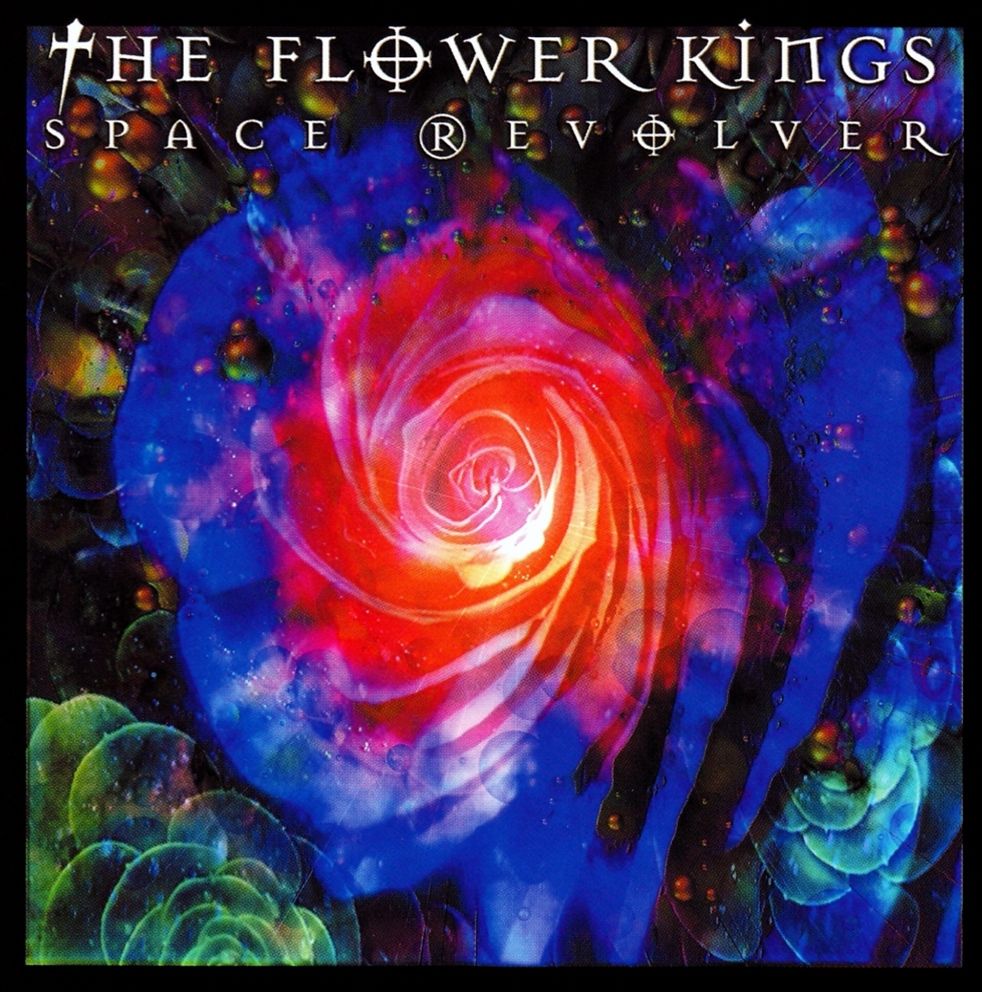
The Flower Kings: Space Revolver and More!

Space Revolver

One of Brad Birzer’s favorite musical artists is The Flower Kings, and one of his favorite albums of theirs is Space Revolver. In this dialog, he and Tad Wert discuss that album and its place in their discography.

Tad: Brad, it’s good to be interacting with you again on Spirit of Cecilia! I chose this classic album, because I know it’s a favorite of yours.

My first exposure to The Flower Kings was their album, Stardust We Are, which I bought because of a Mojo Magazine article on “the new wave of progressive rock”. I have to admit that I tried repeatedly to listen to the whole album, and it never held my interest enough for me to do so. I know that you love Roine Stolt and his Flower Kings, so every time a new album was released, I gave it a try, but there were always other artists’ music that took my attention.

Then, last week, I found an inexpensive copy of Space Revolver, and I don’t know exactly why, but I picked it up. Once I heard the opening chords of I Am The Sun Pt. 1, I was immediately taken with this album! I think Stolt (in my humble opinion), had hit upon a very good balance between power and grace in his music. As I continued to listen to the rest of the album, I was gratified to hear that that high quality of songwriting continued throughout.

Brad: Dear Tad, it’s been too long, my friend.  What have I been doing?  Too much teaching of the American founding period and too much grading!  Ha.  No, of course, I love my teaching and my students, but they are distractions from my love of reviewing albums with you and my love of progressive rock!  So glad to be done with the semester (and, frankly, it was a great one!!!) and back to reviewing with you.  Ahh. . . the good life.

Yes, I’ve been a fan of The Flower Kings for a long time, now, and I’ve been an evangelist of the band just as long.  Way back in the year 2000, a former student (now the head of our philosophy department) leant me a copy of Flower Power.  I was immediately taken with it, and I bought everything available at the time by the band.  I fell in love with everything.  Absolutely everything, including Roine Stolt’s solo album, The Flower King (which, I assume is just a hippy-ish name for Jesus).  

Crazily enough, the band released Space Revolver on July 4th of that year.  Coincidence?  I have no idea, but it struck me as a perfect Fourth of July album.  Especially with those queer lines in the first track–”I left my heart in San Francisco.  I left my mind in San Francisco Bay.”  Wow, did I laugh hard or what!!!  24 years later, the line still cracks me up.

I’ve had the chance to correspond a bit with Stolt, and I even sent him some books on economics (by Wilhelm Roepke) before a longish tour he took.  As far as I know, he took the books with him!  How great is that?  Frankly, I’d be happy to be his book supplier.  At the time I sent him the Roepke books, he was really interested in an anti-Marxist form of economics, that is, the creation of more private property (small family farms) rather than less.  Again, how great is that?  “Ride this bitch, that is power!”  

Anyway, Tad, this is a long way of saying, I love the music, and I love the band.  I think the world of both.

Tad: Okay, Brad, your off-hand remark about the Flower King being Jesus is something that I’ve wondered about for a while: is Roine a Christian? The 1994 album, Roine Stolt’s The Flower King, is steeped in religious imagery, specifically Christian, and, of course, he has collaborated with Neal Morse in Transatlantic. Anyway, if true, it helps make sense of a lot of his music!

Also, here’s something else that came to me while listening to Space Revolver – to my ears, it is a huge leap forward in songwriting from Stardust We Are, and I was wondering what might have caused it. Then it hit me: Space Revolver was written and recorded a few months after Stolt was involved in the first Transatlantic album SMPTE! I think Neal Morse must have had an influence on Stolt; that opening piano riff in I Am The Sun Pt. 1 is very Morsian (to coin a word!). Chicken Farmer Song, Underdog, A Slave To Money, and A King’s Prayer all feature outstanding melodies – they’re downright power poppish in their catchiness. Even the jam that closes out A King’s Prayer is focused and tight, with nary a wasted note.

The tootling mellotron that opens I Am The Sun Pt. 2 is one of my favorite moments of the entire album. I hear it, and I can’t help but smile and bob my head. Actually, the whole atmosphere of this album is one of joy. Stolt seems to be having the time of his life, and he wants the world to know it.

I also want to single out Ulf Wallander’s soprano saxophone work for praise. I love that instrument, but in the wrong hands it can be very annoying. Wallander does a great job zipping off very pleasant  improvisations that add a lot to the overall feel.

The only misstep on this album, in my opinion, is Hans Froberg’s You Don’t Know What You’ve Got, which sticks out like a sore thumb. It just doesn’t fit in with the rest of the album. That said, it’s not a bad song, it just doesn’t work for me in the context of the other tracks.

Okay, I’ve raved enough; your turn!

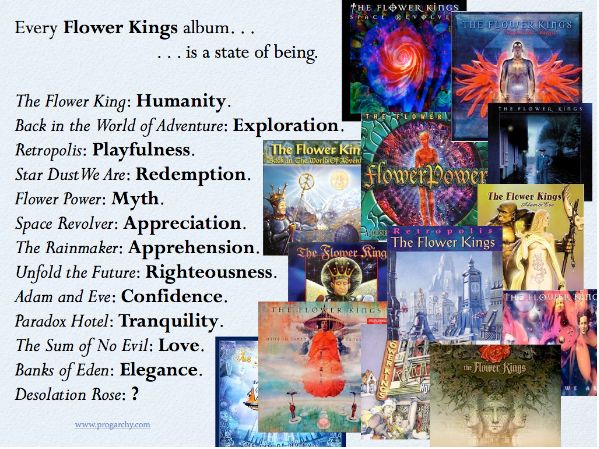
Brad: Tad, what a fun writeup.  Thank you–I think you clearly identify the joy and playfulness that is so prevalent in Space Revolver.  Stolt was clearly having the time of his life.  I love all the other albums – in fact, I made a meme a years ago expressing what I loved about each album (see below) – and I’m especially taken with Flower Power (the first of theirs I heard) and Paradox Hotel.  I really like Stardust We Are, too–but each of these other albums lacks the extreme playfulness of Space Revolver.

Flower Kings meme

[I made the above meme back when Desolation Rose came out.  I was rather blown away by the album when it was released, but mostly because it was so intense and lacked the characteristic mischievousness of the previous albums.  Indeed, when we were really active at Progarchy, I even planned out a book on the Flower Kings (never realized, except for some snippets, here or there), following the meme’s albums’s themes.  I was planning on arguing that The Flower Kings were to Europe what Big Big Train was to England and what Glass Hammer was to America.

The book would’ve come out before my Neil Peart biography and even before what you and I, Tad, wrote on Big Big Train.  I was, at the time, emailing with Stolt, and I was rather taken with him (still am) as an artist and as a human being.  He was extremely active on Facebook at the time, as was his wife, and they were always interesting.  We disagreed radically on the meaning and legacy of President Obama, but, again, he was always a total and intelligent gentleman.  

It’s about the time I sent him the Roepke book.  

I did try to interview Stolt about Rush, but he very kindly responded that he didn’t know enough about the band to offer anything substantive.  He was genuine, kind, and humane in his response.

One of many grand schemes never realized. . .]

Birzer Flower Kings
Brad’s Flower Kings Collection

[Above photo, my fantasizing.  In the middle of my then-Flower Kings collection, I’ve placed three of my own books, my biographies of (right to left) Christopher Dawson, J.R.R. Tolkien, and Charles Carroll of Carrollton.  Yes, I desperately wanted my work to be tied to Roine Stolt and the Flower Kings.  I thought–and still do–that if any of my biographies could reach the majesty of Stolt’s artistry, I would truly have made a mark on the world.]

A few responses to you directly, Tad.  It’s funny, I had always assumed that Neal Morse was influenced by Roine Stolt, rather than the other way around.  And, Stolt, to me, seems deeply influenced by King Crimson, Yes, and Genesis.  This seems especially clear on his solo, The Flower King, and Retropolis, both of which came before Transatlantic.  But, I assume this is like a chicken or the egg question.  At this point (2024), the two must’ve influenced each other so completely that one can’t any longer disentangle which idea or person came first.  Together, Stolt and Morse are the heart of rambunctious third-wave prog.

As to Stolt being Christian, I have no idea.  In our brief correspondence, I obnoxiously asked him directly about his faith, and he never responded or hinted, one way or the other.  Being Swedish, he was almost certainly raised nominally Lutheran, even if the Swedes only attend services on Easter and Christmas.  

Regardless, Stolt employs Christian symbolism frequently, especially in the early The Flower King’s albums.  Again, I think that “The Flower King” is a sort of hippie Cosmic Christ.  Here are the lyrics from the first album:

Falling out of the sky, falling into a dream
All I need is the heart where it all can begin
It’s just a matter of time, it’s just a matter of trust
It’s just a matter of faith when we all sleep in the dust

Don’t deny, just verify the genius of it all
It’s the cycle of all living thing, hear the children
Hear the children call !

“We believe in the light, we believe in love every precious little thing
We believe you can still surrender you can serve the Flower King”

Going out into the grey, into purple and red
See, all the beautiful shapes flowing out of my head
It’s just a matter of time, it’s just a matter of trust
It’s just a matter of faith when we all sleep in the dust

Don’t deny, just verify the genius of it all
It’s the cycle of all living, hear the children
Hear the children call !

“We believe in the light, we believe in love every precious little thing
We believe you can still surrender you can serve the Flower King”


“We believe in the heart, we believe in healing in a house where angels sing
We’ll unite the divided and the fallen one will serve the Flower King”

“We believe in the heart, we believe in healing in a house where angels sing
We’ll unite the divided and fallen one will serve the Flower King”

Again, I don’t quite think this is the orthodox Jesus Christ of Christian faith, but a rather humanistic but still supernatural Flower King.  When the band becomes “The Flower Kings,” they’re not divinizing themselves but rather becoming disciples.  

What strikes me most, though, is that Stolt’s use of mythological symbols is not Lutheran, but deeply Roman Catholic.

On track four of Space Revolver, “Monster Within,” Stolt sings “Mother Mary, she’s left the building crying/silent tears rolling down her cheek.”  Granted, this could just be a Beatles’ reference, but Mary, here, seems more supernatural than Paul McCartney’s mother.  After all, Mary is the opposite of some kind of demagogue trying to seduce our children and who feeds on power and who controls the bats.

One of my favorite The Flower King’s albums, Unfold the Future, posits a war between the devil and Mary.  On the final track:

Clueless

Living in a business cluster, predator to suit your needs
Raven sitting on your shoulder, lurking the suburban weeds
Think I saw you in the bank, think I saw you in a talkshow
Swear I saw your mindless grin, justify the final blow

Swallowing the endless laughter, cultivate the deadly sins
Getting even altogether, hiding from the Holy Mother
This is how you raise the Cain, this is what you teach our children
Back on duty dog eat dog, they’re clueless in the Devil’s playground

Then, of course, on Space Revolver, on track 6, “Underdog,” there’s that really weird line/sound byte: “John Paul’s pizza, the biggest pizza you’ve ever seen.”  When this album came out, in the year 2000, the only John Paul that mattered was John Paul II.

So, is Stolt Christian?  I have no idea, but he’s an awesome ally, a man of integrity, and a grand myth maker.  Taken together, this is so much what I love about Stolt and the band.  Never once I have listened to them without my imagination being stimulated, expanded, and made manifest!

Tad: Wow, Brad! I knew you were a fan of Stolt, but I wasn’t aware of all the thought you’ve put into his music. I now have a much greater appreciation for his overall oeuvre than before. I think you’re probably correct about who influenced whom – Morse had to be aware of Stolt while he was in Spock’s Beard, and Stolt had to be aware of Morse. They likely influenced and appreciated each other, which led to the formation of another outstanding prog group, Transatlantic. 

I kind of like it that Stolt is mum about his faith; it allows different interpretations of his music. What’s important to me is that he seems to be a light-bearer, as opposed to a dark nihilist like so many Scandinavian death metal artists. Stolt is always positive and optimistic, even when he is singing about something he’s unhappy about. In that regard, Desolation Rose seems to be his “darkest” work, and it is still uplifting to my ears.

So here’s my takeaway on Space Revolver: it is the perfect introduction to The Flower Kings for someone who is new to them. In it, the group hits the perfect combination of melodicism, progginess, and improv jamming. Once you’ve absorbed this album, all the others make sense. They’ve had an amazingly productive run the past 30(!) years, and I hope they go for 30 more!