Tag Archives: rock

It’s 5/4: Dave Brubeck Day!

It’s 5/4–Dave Brubeck Day!
https://bradleyjbirzer.substack.com/p/54-happy-dave-brubeck-day

The Unessential Brubeck

A review of Philip Clark, Dave Brubeck: A Life in Time (New York: DaCapo Press, 2020). Xvii + 403 pp of text + discography, bibliography, and index.

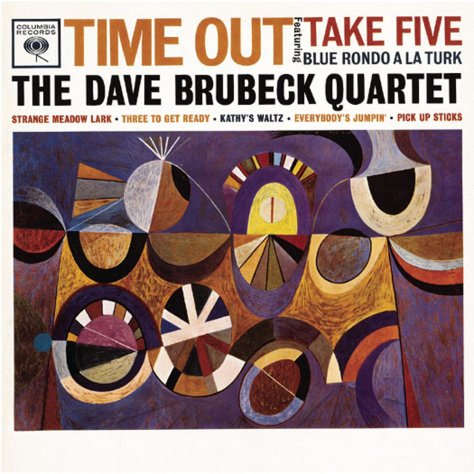
I do not remember a time in my life when Dave Brubeck’s music did not provide the soundtrack. Indeed, his music is inextricably tied up to and with my own life. Some of my earliest memories come from staring at Brubeck’s album covers—Time Out and Time Further Out by S. Neil Fujita and Joan Miro, respectively—and trying to make sense of the abstractions. And, as family lore goes, even as a kid I loved dancing to music such as “Take Five,” even waking up the entire household in the middle of the night by blaring the stereo system at full volume. As was the case with probably many of us of my generation, Time Out was one of my father’s favorite albums and Brubeck one of his favorite musicians, rivaled only by Herb Alpert. To this day, I have stacks and stacks of Brubeck CDs and boxsets, and his music plays throughout the house and the office. Maybe not daily, but certainly weekly. When my older brother, Todd, and I get together, we still talk Brubeck. Even now, as I pour through various prog and jazz albums, I’m always on the lookout for Brubeck’s influences.  

As a case in point, Pat Metheny’s latest, From This Place—arguably this jazz master’s best—reflects widely and deeply the compositional structure of Brubeck’s best album, 1964’s Time Changes. The resemblance is simply too obvious to ignore. Even the theme is critical. Brubeck’s album was inspired by a short story involving two cellmates and a crust of bread. The religious essence of the album is blatant, with Brubeck trying to find that which ties all humans together, regardless of ethnicity or race. It is, for all intents and purposes, a meditation on human decency and divine agency. Metheny’s latest calls us to be the best we can expect of ourselves as Americans.

In 2012, when Brubeck died around Christmas time of that year, I vowed that I would one day write a biography of him.  Despite preliminary research and reading, I’ve really not dived into this project, but Brubeck remains a profound part of my life, nonetheless. 

Two stories from Brubeck’s own life mean everything to me.

First, at Ronald Reagan’s last summit with Soviet leader Mikhail Gorbachev, held in Moscow in 1988, the Reagan administration insisted that Dave Brubeck represent America as her greatest cultural achievement. Brubeck’s producer, Russell Gloyd, recognized this grand achievement for what it was. “You have to put this in perspective,” he argued. “There was Perestroika, the whole awakening of the Soviet Union, the whole concept of what was taking place at that time in world history. This was the first time there was hope of a real chance for an understanding between the East and the West,” he continued. “For Dave to be the representative artist meant everything to everyone who was close to us.”

The atmosphere was tense.  Reagan was exhausted from his trip, Gorbachev’s security was worried about assassination plots, and it was a ridiculously hot and humid day in Moscow. “I walked in thinking that this was the hardest room Dave had ever had to work in his life,” claims Gloyd. After a number of lackluster diplomatic niceties in the stuffy room, Brubeck walked up to the piano, sat down, and started playing “Take the ‘A’ Train.” “It brought down the house,” Gloyd reports. “People were up and cheering. I’ll never forget Bob Dole—he looked like a little kid. He had his one good hand raised above his head like he was at a football game. He’d turn around, and there was a Soviet general, loaded with medals, doing the same thing! They looked at each other like, ‘You like Brubeck? I like Brubeck! We like Brubeck.” It was, Gloyd notes, “the greatest single twenty-minute set in his life.” The Cold War became much less frigid that day.

Second, though he came from a Presbyterian family, Brubeck converted to Roman Catholicism as an adult. “I never had belonged to any church. I was never baptized before,” Brubeck remembered. “I was the only son in the family who wasn’t baptized a Presbyterian. It was just an oversight.” To be certain, religious music—from the African-American community as well as from the white/European community—had always intrigued and influenced him. He wrote liturgical-jazz pieces about Easter, Christmas, and Martin Luther King. 

Though he had written a number of specifically religious themed albums and pieces, however, his greatest expression of his Christianity came when Our Sunday Visitor (headquartered in Huntington, Indiana) commissioned Brubeck to write a Mass.  He, in very Brubeck fashion, entitled it, To Hope! A Celebration, and performed it—with Gloyd conducting—at Washington National Cathedral. The premier music review website, Allmusic, writes of it: This stunning work incorporates jazz interludes into the hypnotic Responsorial “The Peace of Jerusalem” and “Alleluia,” a particularly challenging section for the choir. The vocal soloists are impressive; tenor Mark Bleeke’s feature “While He Was At Supper” is especially moving. The overall effect of this beautiful work is absolutely stunning; it resists being labeled in any one category, it is simply great music.” Fundamentally optimistic about the human experience, Brubeck had said in a commencement address in 1982: “What is really important in the community, in the worst of times, is often music. It’s the cement for the community that holds it together, and the thing that gives it hope.”

Sadly, neither of these stories can be found in Philip Clark’s just published “biography,” Dave Brubeck: A Life in Time (New York: DaCapo Press, 2020).  Though the cover proclaims this to be “the definitive investigative biography of jazz legend Dave Brubeck,” there is not a single mention of Brubeck’s 1988 trip to Moscow or his conversion to Catholicism. Just how definitive is this biography by Clark? Bizarrely, Brubeck is not even born until page 302.

When I first learned of the existence of this book—on February 19—I purchased it at a Books-a-Million within a few hours of the news. Rather than wait for the cheaper Amazon.com version, I had to have the book immediately. I was thrilled it existed, and I dove right into it. Alas, rarely have I been so disappointed by a book.

When it comes to writing—on a sentence by sentence basis—Clark is outstanding.  According to the dust jacket, he has written for a vast number of music periodicals as well as for the London Guardian and the London Times. There’s no doubting his grammar or style. But when it comes to composing a book of this length, he is. . . to be polite. . . lacking.  It turns out that Clark knew Brubeck relatively well and had interviewed him a number of times in the last twenty years of his life. Though we learn nothing of Brubeck’s Catholicism or his trip to Moscow—both so essential to his life—we do get editorial comments such as

“As the bus breaks for the London border, with the motorway to Brighton stretching ahead, [bassist] Moore falls into earnest conversation with Iola Brubeck. Heads nod remorsefully, then Moore’s grotesque caricature of President George W. Bush’s nervy Texas drawl hits a manic crescendo reminiscent of an operatic made scene.”

Or, this tidbit: 

“As I wrote all these years later, that Brubeck’s accounts of his country’s gravest shame should have such damning relevance to Trump’s America felt unbearably poignant and tragic—time overlaps, but it is also cyclic.”

I am certainly no fan—in any way, shape, or form—of Presidents Bush or Trump, but I very much fail to understand why these things matter in a biography of Dave Brubeck, who was so much better and worthy of so much more than what Clark presents in this book.

Clark is at his best in the book when not writing the biographical parts.  Indeed, Clark excels at explaining Brubeck’s techniques, his influences, and his influence. During parts of the book—especially Clark’s section on Brubeck’s influence on rock and progressive rock—I was riveted.  Clark is also good when it comes to Brubeck’s defying the horrific racialist laws, habits, and customs of much of 1950s and 60s America. Brubeck was not only an optimist in his view of humanity, he was deeply humane in his understanding of the dignity of the human person. He never backed down from what he believed correct, and his actions on race relations are nothing short of heroic in his own lifetime.

If you’re looking for a fan-boy appreciation of Brubeck’s talents and his understandings of race relations, Dave Brubeck: A Life in Time, is a fine outing.  If, however, you’re looking for the “definitive, investigative biography of jazz legend Dave Brubeck” run as far away from this book as possible. One of the greatest talents to come out of 20th-century America, Brubeck deserves so much better.

Until someone actually does the critically hard work of looking closely at Brubeck’s life through his music as well as through his letters and papers and getting into the very bright and endlessly creative soul of Brubeck, no definitive biography yet exists.  The best book on Brubeck remains Fred M. Hall, It’s About Time: The Dave Brubeck Story (Fayetteville: University of Arkansas Press, 1996). It’s an excellent book, and the stories above come from Hall’s work.

Or, just listen to Brubeck’s music. He poured himself into his art—into every note.

Wind-Blown Notes: Rush’s Grace Under Pressure

My favorite Rush album has been, at least going back to April 1984, Grace Under Pressure.  I realize that among Rush fans and among prog fans, this might serve as a contentious choice.  My praise of GUP is not in any way meant to denigrate any other Rush albums.  Frankly, I love them all.  Rush has offered us an outrageous wealth of blessings, and I won’t even pretend objectivity.

I love Rush.  I love Grace Under Pressure.

extrait_rush-grace-under-pressure-tour-1984_0

I still remember opening Grace Under Pressure for the first time.  Gently knifing the cellophane so as not to crease the cardboard, slowly pulling out the vinyl wrapped in a paper sleeve, the hues of gray, pink, blue, and granite and that egg caught in a vicegrip, the distinctive smell of a brand new album. . . . the crackle as the needle hit . . . .

I was sixteen.

From the opening wind-blown notes, sound effects, and men, I was hooked, completely.  I had loved Moving Pictures and Signals–each giving me great comfort personally, perhaps even saving my life during some pretty horrific junior high and early high school moments.

But this Grace Under Pressure.  This was something else.

If Moving Pictures and Signals taught me to be myself and pursue excellence, Grace Under Pressure taught me that once I knew myself, I had the high duty to go into the world and fight for what’s good and right, no matter the cost.  At sixteen, I desperately needed to believe that, and I thank God that Peart provided that lesson.  There are so many other lessons a young energetic boy could have picked up from the rather fragile culture of the time and the incredibly dysfunctional home in which I was raised.  With Grace Under Pressure, though, I was certainly ready to follow Peart into Hell and back for the right cause.  Peart certainly became one of the most foundational influences on my life, along with other authors I was reading at the time, such as Orwell and Bradbury.

Though I’m sure that Peart did not intend for the album to have any kind of overriding story such as the first sides of  2112 or Hemispheres had told, GUP holds together as a concept album brilliantly.

The opening calls to us: beware!  Wake up!  Shake off your slumbers!  The world is near its doom.

Or so it seems.

Geddy’s voice, strong with anxiety, begins: “An ill wind comes arising. . .”  In the pressures of chaos, Pearts suggests, we so easily see the world fall apart, ourselves not only caught in the maelstrom, but possibly aggravating it.  “Red Alert” ends with possibly the most desperate cry of the Old Testament: “Absalom, Absalom!”  Certainly, there is no hope merely in the self.  Again, so it seems.

The second song, gut wrenching to the extreme, deals with the loss of a person, his imprint is all that remains after bodily removed from this existence.  Yet, despite the topic, there is more hope in this song than in the first.  Despite loss, memory allows life to continue, to “feel the way you would.”  I had recently lost my maternal grandfather–the finest man  I ever knew–before first hearing this album.  His image will always be my “Afterimage.”

It seems, though, that more than one have died.  The third song takes us to the inside of a prison camp.  Whether a Holocaust camp or a Gulag, it’s unclear.  Frankly, it’s probably not important if the owners of the camp are Communists or Fascists.  Either way, those inside are most likely doomed.  Not only had I been reading lots of dystopian literature in 1984 (appropriate, I suppose, given the date), but I was reading everything I could find by and about Solzhenitzyn.  This made the Gulag even more real and more terrifying.

Just when the brooding might become unbearable, the three men of Rush seem to offer a Gothic, not quite hellish, smile as the fourth song, “The Enemy Within” begins.  Part One of “Fear,” the fourth track offers a psychological insight into the paranoia of a person.  Perhaps we should first look at our own problems before we place them whole cloth upon the world.

Pick needle up, turn album over, clean with dust sponge, and drop needle. . . .

Funk.  Sci-fi funk emerges after the needle has crackled and founds its groove.  A robot has escaped, perhaps yearning for or even having attained sentience.  I could never count how many hours of conversation these lyrics prompted, as Kevin McCormick and I discussed the nature of free will.  It’s the stuff of Philip K. Dick, the liberal arts, and the best of theology.

More bass funk for track six and a return to psychological introspection, “Kid Gloves.”  But, we move out quickly into the larger world again with the seventh track, “Red Lenses,” taking the listener back to the themes of paranoia.  When the man emerges for action, will he do so in reaction to the personal pain he has experienced, or will he do so with an objective truth set to enliven the common good?

grace_under_pressure_0

In the end, this is the choice for those who do not lose themselves to the cathode rays.  Is man fighting for what should be or he is reacting merely to what has happened, “to live between a rock and a hardplace.”

Unlike the previous albums which end with narrative certainty, Grace Under Pressure leaves the listener with more questions than it does answers, though tellingly it harkens to Hemingway and to T.S. Eliot.

Given the album as a whole, one might take this as Stoic resignation–merely accepting the flaws of the world.  “Can you spare another war?  Another waste land?”

Wheels can take you around

Wheels can cut you down. . . .

We’ve all got to try and fill the void.

But, this doesn’t fit Peart.  We all know whatever blows life dealt Peart, he stood back up, practiced twenty times harder, and read 20 more books.  That man did not go down for long.  And, neither should we.

In the spring of 1987, much to my surprise, one of my humanities professors allowed me to write on the ideas of Peart.  I can no longer find that essay (swallowed up and now painfully lonely on some primitive MacPlus harddrive or 3.5 floppy disk most likely rotting in a landfill in central Kansas), but it was the kind of writing and thinking that opened up whole new worlds to me.  My only quotes were from “Grace Under Pressure,” drawing a distinction between nature of the liberal arts and the loss of humanity through the mechanizing of the human person.  It dealt, understandably, with environmental and cultural degradation, the dangers of conformist thinking, and the brutal inhumanity of ideologies.  It was probably the smartest thing I’d written up to that point in my life, and even my professor liked it.

Of course, the ideas were all Peart’s, and I once again fondly imagined him as that really great older brother–the one who knows what an annoying pain I am, but who sees promise in me anyway, giving me just enough space to find my own way.

I’m fifty seven, and I still want Neil to have been my older brother.

And, if you want more on Rush, here’s my book on Neil Peart at amazon.com.

Glass Hammer’s Rogue: Joy in the Midst of Regret

Glass Hammer has returned with a new album, Rogue – due out April 11, 2025. Not surprisingly, given the history of this group, it is a stark departure from their previous several albums. Where the Skallagrim Trilogy rocked very hard, and their most recent work, Arise, was an exercise in space rock jamming, Rogue is jumps out of the gate with a burst of pure melodic bliss.

After listening to Rogue nonstop for four days, I am put in mind of some of Glass Hammer’s most enjoyable musical moments, such as Life By Light (Culture of Ascent), Having Caught a Glimpse (The Inconsolable Secret), and The Curse We Weave (Three Cheers for the Broken Hearted), among many, many others. I am tempted to say Rogue represents a return to form, except Glass Hammer has never fallen out of form – each release of theirs is a self-contained gem of excellence. Instead, let’s just say Rogue is a joyful celebration of beautiful melody.

What If, the first track, sets the stage as the protagonist decides to leave his cold and gray home in the north and head south to find a long-lost love – he is hoping to reignite an old romance that he ended years ago. It is a bouncy song that conveys the hopefulness of our hero as he sets out.

Summer! He’s weary of sleet and snow
Summer! Come now and do not go
He’s heading south to the land of his dreams

The Road South is where reality begins to set in. Has he made a mistake leaving his home? Is that a storm ahead? Musically, this song is reminiscent of classic Alan Parsons Project to me. Oliver Day’s lap steel guitar is outstanding – graceful and fluid without sounding shrill.

Tomorrow  is one of the most beautiful songs on the album. As our hero wrestles with the memories of all the wrongs he has committed in the past, a voice reassures him,

All will be fine
God is watching over all you do
His eye is on the sparrow and on you

The accompanying melody is appropriately soothing and calming.

Pretty Ghost and Sunshine feature the gorgeous vocals of Olivia Tharpe,  along with another pair of winning melodies. On Sunshine, Fred Schendel gives an outstanding performance on lap steel guitar.

Next up is my favorite track on the album, I Will Follow. This is a driving, upbeat, infectious song with an unshakeable earworm for a melody. It’s one of the best songs in the entire Glass Hammer catalog, featuring layered harmonies that should be listened to on headphones to be fully appreciated.

The Wonder Of It All has a synth-driven opening that I find very appealing. One thing I’ve enjoyed over the past few albums has been Glass Hammer’s incorporation of Tangerine Dream-like interludes that feature very cool rhythmic elements. Lyrically, this song seems to be a turning point for our hero:

Oh, I’m weary, yet I’m blessed
For all you’ve given me
The wonder of it all, I’d have to say
That I was here at all
I’ve done so little to deserve
This life you gave me

One Last Sunrise is a terrific instrumental, and Babb really shines on bass and Taurus pedals. I’ve said it before, and I’ll say it again: Steve Babb is one of the most inventive bassists working in music today.

Terminal Lucidity, at 10:19, is the longest track, and it is primarily instrumental. Synths, electric piano, and electric guitar weave a seductive web of melody that draw the listener in before an energetic jam gets going. Eventually, it becomes clear that our hero is on his deathbed: “Ashes to ashes, dust to dust/I can hear them calling me”. It was a stark and chilling moment when I first realized the true journey being taken!

Rogue closes with the triumphant and joyful All Good Things. Another uplifting melody (underpinned by Babb’s terrific bass work) brings the story to an emotionally satisfying ending:

This life you gave me
I’ll bring it home, you know
Sunshine in the morning sky
Descending from on high

It seems that, for all intents and purposes, Glass Hammer is now primarily a Steve Babb project. He handles some lead and backing vocals, bass, keyboards, Taurus pedals, guitars, and percussion. Longtime musical partner Fred Schendel plays guitar on Tomorrow and lap steel guitar on Sunshine. Babb has collected a stellar cast of supporting musicians: Thomas Jakob and Olivia Tharpe on vocals, Reese Boyd, David Walliman, and Atillio Calabrese all take a turn on lead guitar, and Oliver Day does a phenomenal job on guitar and lap steel throughout. Ariel Perchuk contributes some excellent synth solos, while Randall Williams and Evgeni Obruchkov provide drum work.

Rogue is one of the most ambitious albums Glass Hammer has attempted, and they pull it off with ease – it is an unalloyed triumph in all respects: conceptually, lyrically, and musically. Taken as a whole, this set of songs is the most satisfying Glass Hammer has provided in many years. I can’t stop listening to it! Meanwhile, the concept of a man wrestling with the demons of his past as he faces death would be daunting for anyone to tackle, but Glass Hammer does it with grace and hope. I can’t recommend Rogue enough to listeners who appreciate and are looking for melodic rock that has depth. It’s my favorite album of 2025, and I don’t see that changing any time soon.

Dave Kerzner’s New Lamb/IT

I’ve been into music—mostly progressive rock and jazz—for as long as I can remember.  As I’ve mentioned before, my first love was YESSONGS—owned by two older brothers.  I loved everything about it—the music, the lyrics, the art.  It also just seemed like a super science-fiction project to my very young mind.  I would’ve been six when YESSONGS came out.

After Yes, my second loves were Kansas and then Genesis.  I encountered Kansas in 1975, sometime around age 8.  In fact, living in Kansas, there was no escaping Kansas.  Americans don’t often realize it, but Kansans are as proud of being Kansans and their fellow Kansans as Texans are about being Texan; they’re just not loud about it.  So, yes, we lived and breathed LEFTOVERTURE and POINT OF NO RETURN.

Genesis, though, didn’t come to me until about 1978, me aged 10, when I fell in love with “Follow You, Follow Me” and purchased AND THEN THERE WERE THREE.  That was one of the first albums I ever bought.  Followed by DUKE, by ABACAB, by GENESIS.  From there, worked backward to TRICK OF THE TALE and WIND AND WUTHERING and, especially, SECONDS OUT.  I loved SECONDS OUT.  I even had video recorded—through the USA Network—a concert from the SECONDS OUT period with Bill Bruford on drums.

I also really liked Peter Gabriel—especially SECURITY—but for some reason I was reluctant to take a deep dive into Gabriel-era Genesis.  Honestly, I have no idea why, except that I so admired the Phil Collins period—especially TRICK and WIND.  

I love the Peter Gabrel era of Genesis so much now, however, that I can barely remember a time when I didn’t love them.  

So, right before I went to college (fall of 1986), I bought LAMB LIES DOWN ON BROADWAY.  To state that my mind was boggled, would be an understatement.  I knew “Carpet Crawlers” of course, but to listen to it in context truly floored me.  At the time (remember, I was 18), I thought Lamb was either the greatest statement of prog ever written or a statement of chaos and madness.  Either way, I wasn’t surprised that Gabriel chose to leave after making the album.  Clearly, the album means something profound and deep in the history of prog.

It’s a strange album lyrically, as a young Puerto Rican male wants to escape from the corporate conformity imposed at every level of his life.  Ah, you “progressive hypocrites.”

When Kevin McCormick—one of my all-time closest friends, a professional classical guitarist, a key contributor to this website—and I first talked Genesis (this would’ve been the fall of 1986), I expressed my love of Lamb, and he thought I was crazy.  Only a true Genesis weirdo would like LAMB, just as only a true Yes weirdo would like TALES FROM TOPOGRAPHIC OCEANS.  It was a funny conversation.  Kevin, it should be noted, was the first friend I had who could talk music as much as I could.  A high school friend, Joel, came close, but Joel was mostly into college rock and alternative music, not rock or prog.  So, his opinion (or, given LAMB, his anti-opinion) really meant a great deal to me.  Still, I continued to love LAMB as an act of mad genius.

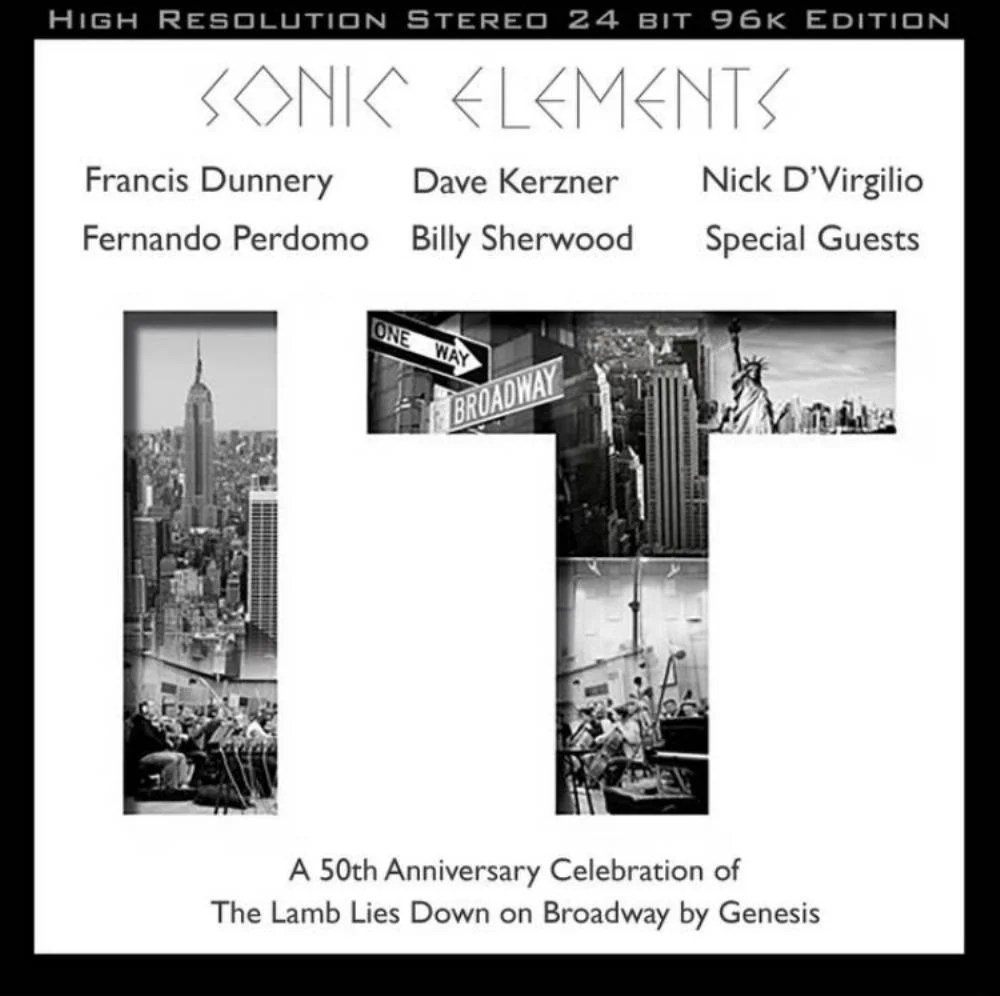
Jump forward fifty years. . . and the mighty and awesome Dave Kerzner has recreated and recorded a brand new version of LAMB simply called IT.  If you don’t know the work of Kerzner, you really should.  He’s the great touchstone or fountainhead of our era’s (third wave or beyond) progressive rock.  From Sound of Contact, through his solo work (NEW WORLD DELUXE and STATIC), through his work with In Continuum, Kerzner is a genius.  He knows how to write the best lyrics, and he also knows how to write the best hooks.  But, there’s one thing about Kerzner that often doesn’t get recognized.  He’s a perfectionist, an audiophile at the level of Steven Wilson.  Don’t get me wrong, Steven Wilson has one of the best ears out there.  But, Kerzner’s is equally good.  

He just gets sound.

As far as I knew there’s nothing that Kerzner has released that I don’t proudly own.  So, when I heard he was remaking LAMB, I was absolutely thrilled.  And, there’s nothing about Kerzner’s version that doesn’t satisfy me.  From his production to its use of real strings, it’s a glorious masterpiece, so very worthy of its now-fifty-year old original.  Kerzner is exactly a year younger than me, and while I don’t know him, I wouldn’t be shocked if he and I encountered the album in much the same way.

In every way, Kerzner has done justice to LAMB.  For 1975, it was immaculately produced, but that simply can’t compare to the immaculate production of 2025.  IT—Kerzner’s version—replicates the entire album, again always advancing the production, especially with live orchestration.  Additionally, Kerzner offers a third disc with alternative versions of the classic tracks.

Even the band of IT is an all-star cast of current prog royalty: Kerzner, Francis Dunnery, Nick D’Virgilio, Fernando Perdomo, Billy Sherwood, and special guests.

Spirit of Cecilia readers, it just doesn’t get better than this.  Whether it’s genius or madness, who can say?  Except to note, there’s always a bit of madness in all genius, and a bit of genius in all madness.  LAMB/IT is smack-dab in the center.  Since Kerzner first sent me the tracks via Bandcamp, I’ve been listening obsessively.  That obsession—part madness and part genius—will continue for sometime, especially as we approach the end of the semester and with finals starting to loom larger. . . .

To order IT, please click here.

Spirit of Cecilia’s Best of 2024

Greetings, music lovers and readers of Spirit of Cecilia! 2024 is fast coming to a close, and the SoC crew would like to share their favorite albums of the year. There was a lot of great new music, terrific deluxe reissues, and releases from old favorites. Hopefully, our lists will lead to some albums you will love as well.

Brad: Tad, thanks for starting us off and inviting everyone to participate.  Always great to write with you!  I’ll just start with an alphabetical listing of my favorite releases of 2024:

  • “Dogs” by Pink Floyd, as done by Tim Bowness and Giancarlo Erra
  • Airbag, The Century of the Self
  • BBT, Flare on the Lens
  • BBT, The Likes of Us
  • Bruce Soord, Caught in the Hum
  • David Gilmour, Luck and Strange
  • Frost*, Life in the Wires
  • IZZ, Collapse the Wave
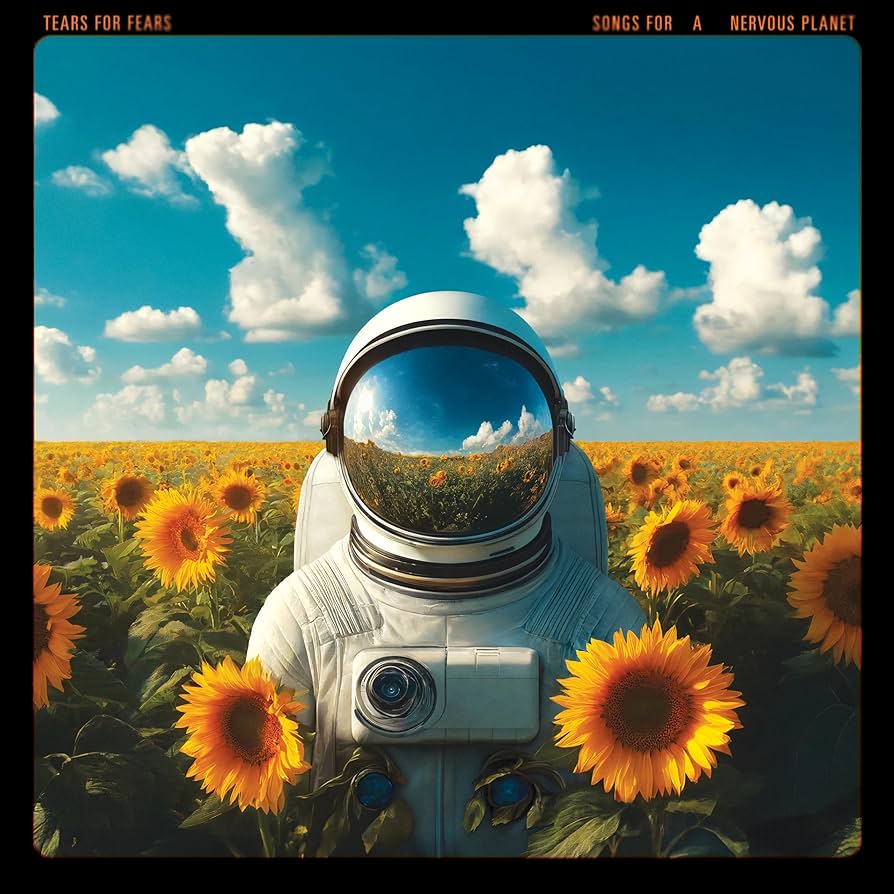
  • Tears for Fears, Songs for a Nervous Planet
  • The Bardic Depths, What We Really Like in Stories
  • The Cure, Songs of a Lost World
  • The Pineapple Thief, It Leads to This
  • The Pineapple Thief, Last to Run EP
  • The Tangent, To Follow Polaris
  • Tim Bowness, Powder Dry

And, I’m not even including vital re-releases such as the deluxe edition of Synchronicity by the Police; Fear of a Blank Planet by Porcupine Tree; Spectrum ‘97 by Phish; Lament by Ultravox; Bursting Out by Jethro Tull; or This Strange Engine by Marillion.

If I go just by my playlist numbers, I’d have to list “Dogs”, Frost*, IZZ, and, especially, The Cure.  In fact, since The Cure first arrived, I’ve listened to almost nothing else.  But, I went through such phases with Frost* and IZZ, too.  And, really, I can’t recommend the single of “Dogs” highly enough.  Bowness and Erra give it just the right beauty and creepiness that a proper Pink Floyd remake so desperately needs.

I must admit, though, I’m totally against the lyrical content of “Dogs.”  I can’t believe our entrepreneurs are so bloodthirsty as this.  Like or despise Elon Musk, for example, as you will, but he’s not bloodthirsty.  In fact, if anything, I think he’d hate to “be dragged down by the stone.”  And, he would hate to drag anyone else down by the stone.  He definitely wants to win, but he wants to win fairly, by the rules established by society (unless all of society is corrupt, but let’s hope that Pink Floyd isn’t so Marxian as this).  Maybe I’m wrong, however.  Perhaps, I’m deaf, dumb, and blind, and that I keep pretending. . .  Is this how Roger Waters saw his friendship/adversarial relationship with David Gilmour?  If so, so very sad.  For my money, give me Phish’s “Bouncing Around the Room” as the touchstone song dealing with entrepreneurship.

To be certain, though, I’m also a bit biased on the whole The Bardic Depths release.  Given that I wrote the lyrics for it, I’m quite taken with it.  Dave Bandanna did an amazing job in composing the music.  So brilliant, so beautiful, so mystical, so joyful.  Dave brings every song to life, and I’m always stunned to hear my own words given form and made manifest.

And, then, what’s not to love about the new David Gilmour?  In fact, when he sings with his daughter, Romany, I’m completely taken.  So much better than Dogs, co-written with Roger Waters..  Especially if you listen to something as glorious as “Between Two Points.”  I would give anything to have such a relationship with my daughter that I could write something so gorgeous with her.  Romany over Roger any day.

And, seriously, this brings me to all the incredible re-releases of 2024.  Oh, to be “Prince Caspian” and float upon the waves.  Oh, to be Prince Caspian.  Dang, Phish was simply brilliant when they were.

I also want to single out Airbag.  I don’t know their politics, but it strikes me that with this release, especially, they’re trying to combat conformism and cancel culture.  I could be wrong, but I’m willing to take a chance that this is a brilliant counter-cultural masterpiece.   One that shakes the conformists of the world to their very foundations.  And, who wouldn’t love that bass playing and interplay with the drums?  Genius.  Thank God for the non-conformists of the world.  Airbag sounds like Pink Floyd, in terms of legacy, but they are completely their own band.

If Airbag sounds anti-political, Robert Smith on the new Cure album, sounds confessional.  Bless me, Father, I, Robert Smith, have sinned, and something wicked this way comes.  Truly, the latest The Cure album is a masterpiece, a true sequel to Pornography and Disintegration.  My love and respect for Smith only grows with age.

If Airbag is countering the world and Smith is confessing for us all, then IZZ is proclaiming the inherent goodness of each one of us.  I’m not sure what the lyrics are all about on Collapse the Wave, but I feel that John Galgano and Laura Meade are asking us to look at our best selves.  Rather than be dour, they find wonder.  As far as I can tell, IZZ has been reading a lot of T.S. Eliot and a lot of John Paul II.

Tad: What a great list, Brad! Yours and mine overlap quite a bit, since we are often of like mind when it comes to music. Here is mine, based on how often I listened to each album:

8. Kyros – Mannequin

7. IZZ – Collapse the Wave

6. Jeff Johnson/Phil Keaggy – Spinning On a Cosmic Dime

5. Tears For Fears – Songs For a Nervous Planet

4. Airbag – The Century of the Self

3. Bardic Depths – What We Really Like In Stories

2. The Cure – Songs of a Lost World

1. Frost* – Life In the Wires

I’ve been a fan of Kyros’ music for several years now. They wed 80s sensibilities to 2020s expertise. Mannequin is another great collection of pop/prog.

Like you, I admire IZZ enormously. As far as I can tell, the lyrics to the title track are about quantum physics and faith. Who else but the Galgano brothers could pull off such an ambitious song? They definitely succeed.

Jeff Johnson and Phil Keaggy have collaborated several times before, and Spinning On a Cosmic Dime is the most lighthearted and fun of their albums. Johnson is a master of all keyboards – acoustic and electronic, while Keaggy is one of the finest guitarists alive today. When they get together, magic happens.

The Tears For Fears is primarily a live album, but the five new studio tracks are some of the best songs they’ve ever recorded.

You’ve already said everything I could want to say about the Airbag album. They continue to impress me with their social commentary, and their instrumental chops are outstanding. Their previous album, A Day At the Beach, is still my favorite, but The Century of Self is really, really satisfying.

The Bardic Depths’ new one is also a great album. Listening to it is like having a beer with C.S. Lewis, Tolkien, and the other Inklings. To my ears, it’s the most musically ambitious set of songs from TBD, and I have thoroughly enjoyed listening to it throughout 2024.

The Cure’s album came out of nowhere as far as I was concerned, and I approached it with some trepidation – there’s nothing worse than an old favorite trying to recapture the spark and failing miserably. Robert Smith et al. came up with a fantastic album that easily holds its own with their previous best. Amazing!

Frost*’s Life In the Wires is far and away the most-played album of 2024 for me. I have yet to tire of it, and every time I listen to it I find some new and delightful detail. Jem Godfrey sings all of the vocals on this one, and he is terrific. The beautiful melodies pouring out of my speakers are such a bountiful feast for my ears. The story is fascinating as well – a young man rebels against a world run by AI when he hears a pirate radio broadcast. After tracking it down to its source, it turns out to be an automated program. But then things get weird – he seems to sacrifice himself to become the new source of the radio broadcasts and spark an awakening of humanity. At least that’s how I read it. 

So that’s what I spent my time listening to this past year. I also loved the Ultravox Lament box set and the Talk box set by Yes. It’s nice to have this often overlooked album get the treatment it deserves. 

Brad: Yes, Tad, thanks for the reminder about Yes’s 30th anniversary edition of Talk.  The last of the Trevor Rabin-Yes era albums, it’s simply beautiful.  Clearly, the band was going for a progressive AOR sound at the time, but the production is so very clean.  I love the packaging as well for it.  Not overblown, but a solid release in terms of presentation.  Don’t get me wrong, I love big box sets like Lament by Ultravox, but sometimes the smaller packaging works just as well.  For me, Marillion’s and Jethro Tull’s releases–in terms of packaging–hit the sweet spot.  Basically small books that fit perfectly on a book shelf.

Thanks, too, for the story about the new Frost*.  I’ve listened to it numerous times, but I’d not figured out the lyrics.  What a great story!  Now, I’ll listen to it with different ears.

I’m so glad we agree on The Cure, on Airbag, and on Frost*.  Three essentials of the year.

As it turns out, The Cure also released their brand new album as a live release–Songs from a Live World–as well.  Gorgeous.  Seriously, what else can Robert Smith do?  He simply captures the mood of every era in which he finds himself.  And, I, for one, am so fortunate to be alive when Robert Smith is alive.

I would also note that 2024 is an important anniversary date.  Kevin McCormick’s gorgeous Squall came out in 1999, a mere 25 years ago!  Even the rather snobbish All-Music recognized the brilliance of Squall.  As far as I understand it, McCormick is working on a follow-up CD.

It’s also the ten-year anniversary of the genius Scorch by the Tin Spirits.  A favorite album.  Also, ten years ago, appeared the brilliant Demon by Gazpacho and Anathema’s mediocre to good Distant Satellites.  

But, Holy Moses, it’s not just about Tin Spirits.  If we go back to the twentieth anniversary of releases, 2004, we get to The Pineapple Thief, Variations on a Dream; Glass Hammer’s Shadowlands; Proto-Kaw, Before Came After; The Tangent, The World We Drive Through; Ayreon, The Human Equation; and Marillion, Marbles.  Sheesh, what else do you want?

Carl: Full and necessary confession: 2024 turned out to be year in which I listened to little new prog rock, or rock of any kind. Not for any lack of new and worthy rock music, but 2024 also turned out to be the year in which I fell quite a ways down The Vinyl Rabbit Hole. I’ll likely say more about that in a separate post on my favorite jazz of 2024, but suffice to say that I’ve been haunting various thrift and record stores. 

My most listened album of the year was released 30 years ago: Seal’s second album (1994), titled, inconveniently enough, Seal—just like his 1991 debut. A deluxe edition was released, with a remastered version of the album (fantastic), as well as alternative versions of the songs (also wonderful). I listened to this album countless times when it first came out, and I have never tired of it (or of his first or third, titled Human Being). Why has it resonated so strongly with me? I’m not entirely sure, but for me it is a perfect pop/rock album, and it sits squarely in the middle of a trio of albums that I continue to think is one of the finest three-in-a-row rock/pop album families you’ll ever hear. 

I enjoyed the new albums by Frost* and Pineapple Thief and if I listened more closely, I’m confident that I would really like them. Both bands have consistently produced accessible, intelligent prog rock of the highest order, so I plan to revisit them in the weeks to come. 

Caligula’s Horse’s Charcoal Grace is mysteriously but aptly titled, as the music has a dusky, burnt quality that also shines with many moments of delicate beauty. This Aussie band has been a longtime favorite, and this album adds to a discography rich with ridiculous chops and vocals at the service of exquisitely crafted songs. A keeper. 

Keep Me Fed by The Warning, the talented sister trio out of Mexico, is (as they say) a banger. Or a series of bangers, the sort of swaggering, catchy hard rock—with sublime harmonies—that has been sorely missed in recent years. For my money, I prefer their live versions a bit more; they are dynamic performers whose young ages (20 to 25) defy (even bely) the band’s evident maturity and exuberant zest. 

Speaking of all female bands, a somewhat guilty pleasure this year has been watching videos of the mind-melting Japanese metal band Lovebites. They have been compared to Iron Maiden and similar metal bands, which makes it all the more strange as I have never cared that particular genre. All five of these ladies are virtuosos, and Miyako Watanabe, one of the two guitarists, was a classical pianist until her late teens, when she picked up electric guitar for the first time. The live album Memorial For The Warrior Souls (2024) and the studio album Judgment Day (2023) are unrelentingly fast, in-your-face, melodic, and—yes—tremendous fun. Check them out live on YouTube and prepare to be amazed.

Myles Kennedy might just be the hardest working and (by all accounts) nicest rocker out there today, and his third solo album The Art of Letting Go is classic Kennedy—powerful, assured, dynamic, moving—with some nice little twists. His is one of the finest rock voices of the past couple of decades, but his guitar playing and song writing are just as polished, varied, and inviting. 

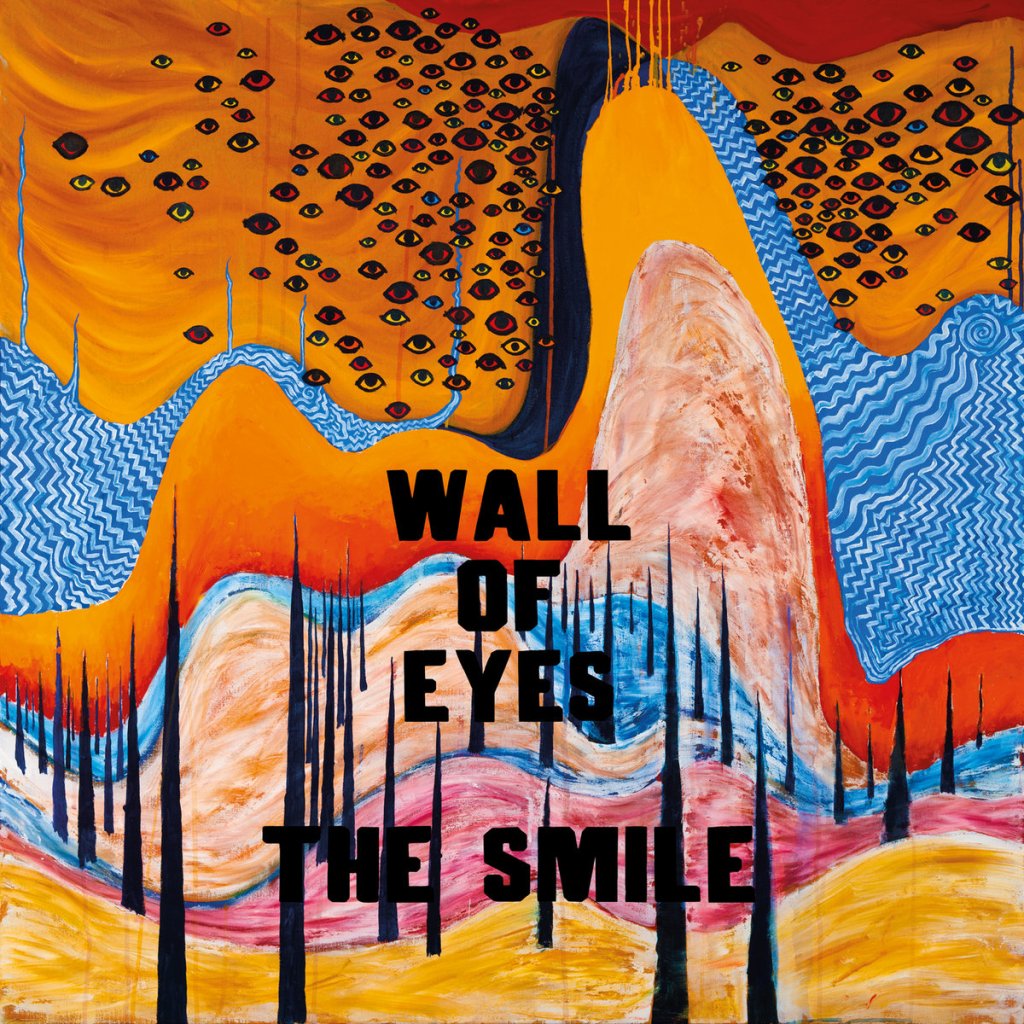
The Smile is like Radiohead if it didn’t have all of its members–and if it released albums more quickly. Which is what it is, with Thom Yorke (vocals, guitar, bass, keys) and Jonny Greenwood (guitar, bass, keys) joined by Tom Skinner (drums). Wall of Eyes (released in January) and Cutouts (same session, released in October) are quirky, dark, strangely fun, often weird, always melodic, and never, ever boring. Yorke’s voice is timeless and Greenwood’s playing, which is always so distinctive, is a revelation. And this album comes across to me as even more jazz influenced than their debut—but never in a direct, obvious way. Great stuff!

One of my favorite country artists, Dwight Yoakam, is back with his first new album in almost a decade. Brighter Days finds the Bakersfield legend firing on all cylinders, apparently reenergized by marriage and a young son. Dwight sounds half his age (68) and his band, no surprise, is tight and razor sharp. Every cut is worth the price, with the deceptively simple “I Spell Love” getting a nod from this fan. 

Speaking of artists aging well, Van Morrison continues his remarkable output, with three albums: Beyond Words, New Arrangements and Duets, and Live at Orangefield. The first is all instrumental and is enjoyable, with some unexpected quirks. The second is a solid collection, featuring collaborations with Kurk Elling, Joss Stone, and Willie Nelson, all to good effect. But the live album, recorded a few years ago, is a revelation, captures a mid-70s Morrison at the top of his powers, featuring (as usual) a crack band and some other-worldly backing vocals. It rewards repeated listens and is a notable testament to Morrison’s brilliance as both a singer and songwriter. 

Brad: Carl, excellent choices.  I, too, like The Smile, and I, too, (thanks to you) listened to a lot of Seal II as well!  I also bought Trevor Horn’s memoir, but I have yet to read it.

Well, folks, this pretty much wraps up 2024 for us.  We have a lot to look forward to in 2025.  It looks like The Cure will be releasing more music, there’s a new and final season of Stranger Things, and we’ll be celebrating the 50th anniversary of The Lamb Lies Down on Broadway by Genesis.  Not only is there a 50th anniversary edition of The Lamb coming out, but the brilliant Dave Kerzner has re-recorded the entire album and is offering it as a 3-cd set plus hi-res download for only $49.99, plus shipping.

Big Big Train will be touring the U.S, and IZZ will be performing some stripped down shows–maybe even in Hillsdale!

I’m sure we’ll continue to give our hard-earned money to The Burning Shed and Rita Kay Drew’s The Band Wagon USA.  I highly recommend supporting both of these truly excellent business enterprises.  Amazingly enough, each is competitive with Amazon, even with overseas shipping costs.

Tad, Carl, Kevin, Erik, and I wish you all a Merry Christmas (remember, we’re only on day three of twelve), a Happy Hanukkah (remember, we’re also only on day three!), and Happy New Year, everyone!

New Wave Prog: The Missing Sub-genre?

Admittedly, I might have given this way too much thought, but I wonder if there’s a historical sub-genre of music that we all mislabeled at the time.  The historical orthodoxy is that we went from prog to punk to new wave and post-punk and, then, by the mid 1990s, into third-wave prog. 

Could there have existed a third way, though, a melding of prog and new wave and post-punk?  As such, I think of albums by traditional prog groups such as Yes (Drama and, to a lesser extent, 90125), Genesis (Abacab), or Rush (Moving PicturesSignalsGrace Under Pressure, and, especially, Power Windows) that all benefitted greatly from new wave and post-punk.  

But, I can also think of a number of new wave bands that employed very serious prog elements such as Modern English (After the Snow), Tears for Fears (The HurtingSongs from the Big Chair), The Fixx (Reach the BeachPhantoms, and Walkabout), Ultravox (ViennaRage in Eden, and Lament), Thomas Dolby (The Flat Earth), New Order (Low-Life), XTC (Skylarking), Echo and the Bunnymen (Over the WallOcean Rain), Simple Minds (Sons and Fascination, Sister Feelings Call, and New Gold Dream), and Talk Talk (Colour of Spring).  One might also think of a band like B-Movie.

Maybe, just maybe, Yes and Thomas Dolby have far more in common than we thought.

And, if there was such a sub-genre of New Wave Prog, it would help us understand shoegaze (Cocteau Twins, My Bloody Valentine, Lush) in the late 1980s and early 1990s as well as bands such as Catherine Wheel and even early No-man and Porcupine Tree.

Just my two cents. . .

Political Beats – Yes!!

Our founder, Brad Birzer, recently did a two-part episode of National Review’s music podcast, Political Beats. If you are not familiar, this podcast usually features a guest and a discussion of a particular band.
For this two-parter, Brad and the normal panel discuss the career of progressive rock giants Yes, album-by-album. I’ve conversed with Brad in a group chat about the episode, and he liked my comments enough to ask me to present them here. As such, here they are, unedited save for a few interjections.

First comment, after listening fully to Part 1 and a little bit of Part 2 (in italics, my additional interjections in brackets]:

Hi Brad – I just finished listening to the first Yes episode and have listened up through the discussion on GFTO in the second episode. I loved the discussion on TFTO, and I think “beautiful failure” is an apt description, although I would also add it was a necessary failure. They found their limits on that album because they tested those limits, and I think that allowed them to be more concise and focused with their next two albums. [Tales from Topographic Oceans was Yes’s most ambitious album, and to paraphrase what Jon Anderson said about it, it was the meeting of high ideals and low energy. It certainly has some brilliant music on it but also has a lot of mindless noodling. Most of the panel thought the first and last pieces of the album – The Revealing Science of God and Ritual, respectively – were the best pieces. For my money, it’s actually the second piece, The Remembering, which holds together best (although even it suffers a little from needless padding). On that note, I think the bass playing in that piece is brilliant, often subtle and understated (not often a Chris Squire trademark), and he says as much that he was proud of that in YesStories by Tim Morse]

I also liked the observation that at times on TFTO, they were fitting the art to the format instead of just letting it flow organically. That’s one reason I’m not as down on the digital formats as some are today, because it essentially removes such restraints an allows the artist to just create without having to adapt the art to the format. I think Gazpacho’s Night is a great example of that, as I just don’t think it would flow anywhere near as well if it had to be adapted to (and possibly compromised by) the LP format. [In line with the discussion above, I think a lot of the problem with TFTO was directly related to this observation. Multiple panelists stated this album could have been better with some editing, but such editing within the limitations of the LP format would have been much more difficult.]

I would have been a slightly dissenting voice in the GFTO discussion with regard to Awaken, which I think is pure, magical, utter freakin’ brilliance and even in a catalog that includes Close to the Edge, it’s my favorite Yes composition. The production, the dynamics of the piece, the playing, the shifts in mood … all of that adds up to me as just an incredible musical journey that leaves me satisfied every time I hear it, and yet wanting more of it at the same time. [This was my biggest dissent with the panel. Not that they disrespected Awaken, but they certainly didn’t see it the way I do. Progressive rock (particularly, symphonic progressive rock) was often described as the fusion of rock and classical music, and this piece more than any exemplifies that fusion in its best form to my ears. The tone and timbre of the instrumentation here (especially with the harp and the church organ) really give it a classical feel in a way that exceeds event hat of Close to the Edge. The crescendo that consumes the second half of the piece, beginning with a few quiet plucks of the harp by Anderson is brilliance, slowly, patiently building to a powerful conclusion. Give it another try. On the other hand, I loved that they all showed so much love to Parallels, my second favorite song on this album, which features incredible playing (and interplay) among Howe’s guitar, Squire’s bass, and Wakeman’s keyboards. I had a lot more to say about this album some years ago on Progarchy, that piece can be found here.]

Will let you know what I think of the rest of it when I finished. Really looking forward to the discussions of Drama and 90125.

Second Comment after listening to Part 2:

Finished the second episode now. Definitely enjoyed the discussion and agreed with a majority of the takes. After Magnification, the only Yes album that has interested me is Fly From Here: Return Trip because of the Drama connection. Drama, BTW, might be my favorite Roger Dean cover. I love the album, although I will admit that the overselling of “Yes” on Tempus Fugit wore on my after a while (but instrumentally, it’s an incredible song). [That’s about my only issue at all with Drama, which is a great album in its own right. I share the sentiments with others on the panel that wonder what might have been had that lineup continued.]

Thought the observation that some of the ideas on Tormato were good ideas poorly executed was a good one. My pick for that would by Onward, which I actually liked much better on Keys to Ascension when Howe brought in the nylon string guitar in place of the electric in the studio version. [Onward is one of many pieces by bands I love that seem to come off better live than in the studio, and Howe’s nylon string guitar on the KTA version is the reason why here. Gates of Delirium is another Yes piece l like better live than in the studio due to some production issues (although the Steven Wilson remaster seemed to fix most of those).]

As for Release Release, I’ve always preferred a cover by Shadow Gallery (from the tribute album Tales from Yesterday) to the original studio version, as it has the punch that the original was lacking. [That song just needed to rock more. While Howe was excellently versatile in many styles of guitar, he didn’t seem to have an affinity for the kind of bone-crunching power chords that song needed, or at least he saved that for Machine Messiah on the next album]

Like you and the rest of the panel, I was pretty disappointed with Big Generator, other than Shoot High Aim Low, it was pretty forgettable. Trivia note: I heard a Rabin interview where he stated that Love Will Find a Way was a song he had originally written for Stevie Nicks, but the rest of the band wanted to keep it for themselves. [Yeah, what a disappointment after 90125. On the other hand, I loved the discussion of 90125, and was happy that nobody on the panel was such a prog snob that they dismissed the album as other prog snobs are wont to do. Sure, it was a lot different from their previous work, but it was undoubtedly Yes, and it was the kind of reinvention that only a band like Yes could pull off in such a spectacular fashion.]

If you’re a Yes fan and haven’t listened to these this two-part episode, I strongly recommend you do so. You won’t be sorry!

Collapsing Waves: The Power of IZZ

Spirit of Cecilia loves the prog group IZZ! It’s always a cause for rejoicing when they release a new album, and member John Galgano was kind enough to share an advance copy with us. It’s called Collapse the Wave, and it contains some of the best music they’ve ever recorded. Brad Birzer and Kevin McCormick share their thoughts on this new set of songs.

Brad: I always love doing these with you guys.  Kevin, thanks for being my partner here.

I absolutely love IZZ.  Indeed, the band represents best what we try to do at Spirit of Cecilia.  Art for the sake of intellectual and spiritual edification, understanding the dignity of the human person, and playing like men and women possessed by the muses.  Lyrics that read like T.S. Eliot wrote them based on the theology of John Paul II and the philosophy of C.S. Lewis.  What’s not to love?

Every part of the band is incredible–from John Galgano’s excellent voice and bass to Laura Meade’s rather heavenly vocals.  Tom Galgano (I love that this is a family affair)’s majestic keyboards and vocals, to Paul Bremner’s astounding guitar work, to the two profound drummers, Brian Coralian and Greg Dimideli.  Amazing.  Astounding.  “This is the real thing.”

To be sure, IZZ and Glass Hammer are my two favorite rock bands from the U.S. If anything, I just can’t believe that IZZ isn’t HUGE!  They deserve to be adored and well loved.  Frankly, they should be as loved here in the States as Big Big Train is in the U.K. and Europe.

I also love how the band–though unique in its own sound–reflects the loves of the members of IZZ: Gentle Giant, Genesis, ELP, Yes, Jethro Tull, and others.  In other words, they readily blend tradition with innovation, no mean feat in 2024.

My own history with the band goes back over a dozen years now.  In fact, I was introduced to the band by their 2012 album, Crush of Night.  I’m not sure, now, how I came across it.  It was probably a submission to Progarchy, and I was reviewing for CatholicVote and The Imaginative Conservative, then, too.  Man did I fall in love with that album or what?  To me, it was (and remains) a perfect album.  Composition, lyrics, mood . . . everything rock deserves.  To this day, it remains one of my all-time favorite albums.  And, it was a part of a trilogy of albums, including The Darkened Room from 2009 and Everlasting Instant from 2015.  A trilogy of albums!  Aside from Riverside and Glass Hammer, what band does this anymore?  Dang, I loved it.

And, here’s just a sampling of the lyrics from Crush of Night:

I could run only half the way

Though she loved me more than I can say

How could I falter?

How could I fall?

Though I’d remember I would not call

When I was young she said, “Pick out the toys

That you want

I’ll see what I can do

Did I take care of you?

By the way

A dollar or two can go a very long way

Use it to buy anything you want.”

The droning sound of the rosary

Etched in my heart

More than a memory

In one of my more obnoxious (or daring!) moments, I wrote the band the year I was living in Colorado (2014-2015 academic year), and they responded by sending me several of their CDs!  I still remember opening the mail box in Longmont and discovering such a rich treasure trove.  It meant everything to me.  This act of kindness predisposed me toward the band, of course, and I immediately back ordered everything–going all the way back to album no 1, 1998’s Sliver of the Sun.  If these guys were going to support me, I was most certainly going to support them.

Two other things convinced me of IZZ’s greatness.  First, I bought their live DVD, simply called IZZ LIVE, and I devoured it.  [If amazon.com is to be believed, I ordered it on May 4, 2013] I couldn’t believe how cooly normal (and normally cool) these people looked.  They didn’t look like long-haired metal heads but like normal, professional people.  I would’ve been looking at a video of my history department colleagues.  Yet, what they were doing on stage was definitely beyond normal.  Cool, sure.  But, not normal.  Extraordinary passion and talent manifests itself in that DVD.  It’s still one of my favorite live concerts, and I would’ve given a lot to have been there at the recording of it.  Thank the Good Lord, they preserved the show.

Second, in 2012, I had also listened to and reviewed John Galgano’s gorgeous solo album, Real Life is Meeting.  I thought Galgano was as great alone as he was in his band.  The man simply brims with creativity and integrity. Then, we started corresponding through email and social media.  Again, Galgano stunned me as a truly genuine person.  I know almost as much about Galgano’s love of the Mets as I do about his love of prog!

But, Kevin, I’ll shut up for a minute and let you jump in.

Kevin: Well this is my first exposure to IZZ. What strikes me immediately is the variety of music on this new release, Collapse the Wave. The opening, “We Are 3rd,” is an expansive track that covers a lot of prog ground in its eight and a half minutes running. The keys and drums harken to mid-era Genesis with the guitars and melody lines more-styled on Yes’s similar mid-era work.  The bass lines offer an excellent grounding to the dense textures and carry wonderful counter-melodies. And then about two-thirds of the way into it the tune opens up to expose a piano ostinato and glockenspiel in tandem and highlights the lyric: 

Coming to the brink of change

The past is shifting out of range

The wind is at our back

 It’s a beautiful moment and definitely one my favorite sections on the record.

Musically there is a great deal of variety on the record. “We Are 3rd” and “Brace for Impact” have a relatively heavy guitar leads, but with many contrasting sections.  “Brace for Impact” in particular has moments reminiscent of King Crimson’s angularities, which almost reprises in the final track “And We Will Go.” Elsewhere we hear solo piano accompanying voice in both “So Many Voices” and “Deep Inside.”  The latter piece shifts into a folk-like arrangement with acoustic guitar and bass.

The title track, “Collapse the Wave” shows hints of jazz meeting Kansas at their most jam-bandish, eventually settling into an almost reggae back beat, the drums holding a tight groove. There are moments that even feel like latter-day XTC—a sound heard again later on the album in “Soak Up the Sunlight.”

I really like the acoustic passages used by IZZ on this record. The aforementioned piano echoes later in the guitar intro to “Sometimes Sublime.” They definitely know how to shift between contrasting styles and thus melding them into their own sound.

Brad: You’ve covered the music brilliantly, Kevin.  Thank you!  I love your analysis.  I will admit, I’d not thought of Kansas and being a jam band.  But, relistening to “Collapse the Wave,” I totally agree.  This could be something (updated, of course) off of Leftoverature.  

And, speaking of jam bands, maybe there’s a bit of Phish in here!  Oh, those East Coasters. . .

I already noted this above, but when it comes to IZZ, I especially appreciate the vocals and the lyrics.  That the band has three vocalists gives us a Yes “Leave It” or Yes, “All Good People” vibe.  As much as I love the Galgano voices, I’m especially taken with Laura Meade.  Her solo album from last year, The Most Dangerous Woman in America, remains a favorite, even though it’s a bit poppier than IZZ.  It’s hard not to fall in love with her–arguably one of the greatest vocalists in rock music today.

Well, there is so much more we could say about IZZ and Collapse the Wave.  But, probably the best thing we can do is recommend it.  And, we HIGHLY recommend it.  Yes, I’m shouting at you.  It comes out in a just a few days, and you can pre-order it here: https://izzmusic.bandcamp.com/album/collapse-the-wave

What are you waiting for???  Pre order it!

The Flower Kings: Space Revolver and More!

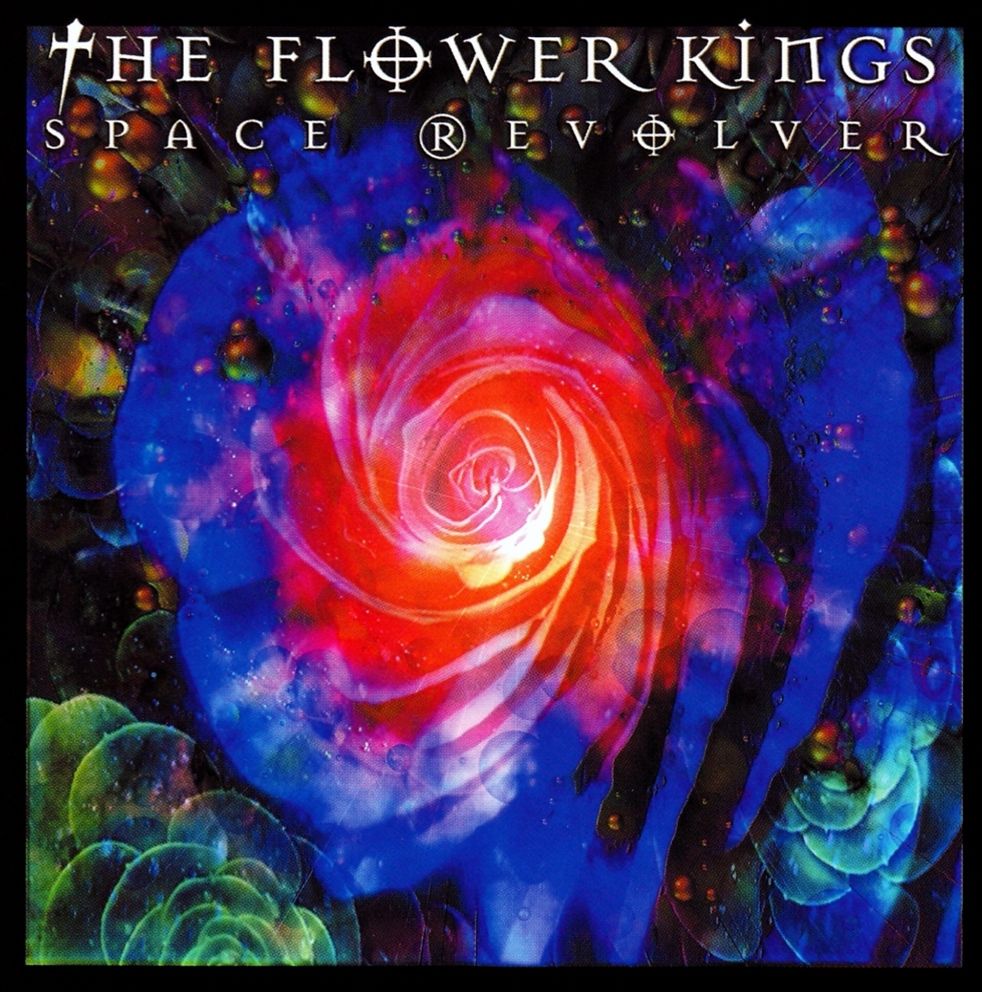
Space Revolver

One of Brad Birzer’s favorite musical artists is The Flower Kings, and one of his favorite albums of theirs is Space Revolver. In this dialog, he and Tad Wert discuss that album and its place in their discography.

Tad: Brad, it’s good to be interacting with you again on Spirit of Cecilia! I chose this classic album, because I know it’s a favorite of yours.

My first exposure to The Flower Kings was their album, Stardust We Are, which I bought because of a Mojo Magazine article on “the new wave of progressive rock”. I have to admit that I tried repeatedly to listen to the whole album, and it never held my interest enough for me to do so. I know that you love Roine Stolt and his Flower Kings, so every time a new album was released, I gave it a try, but there were always other artists’ music that took my attention.

Then, last week, I found an inexpensive copy of Space Revolver, and I don’t know exactly why, but I picked it up. Once I heard the opening chords of I Am The Sun Pt. 1, I was immediately taken with this album! I think Stolt (in my humble opinion), had hit upon a very good balance between power and grace in his music. As I continued to listen to the rest of the album, I was gratified to hear that that high quality of songwriting continued throughout.

Brad: Dear Tad, it’s been too long, my friend.  What have I been doing?  Too much teaching of the American founding period and too much grading!  Ha.  No, of course, I love my teaching and my students, but they are distractions from my love of reviewing albums with you and my love of progressive rock!  So glad to be done with the semester (and, frankly, it was a great one!!!) and back to reviewing with you.  Ahh. . . the good life.

Yes, I’ve been a fan of The Flower Kings for a long time, now, and I’ve been an evangelist of the band just as long.  Way back in the year 2000, a former student (now the head of our philosophy department) leant me a copy of Flower Power.  I was immediately taken with it, and I bought everything available at the time by the band.  I fell in love with everything.  Absolutely everything, including Roine Stolt’s solo album, The Flower King (which, I assume is just a hippy-ish name for Jesus).  

Crazily enough, the band released Space Revolver on July 4th of that year.  Coincidence?  I have no idea, but it struck me as a perfect Fourth of July album.  Especially with those queer lines in the first track–”I left my heart in San Francisco.  I left my mind in San Francisco Bay.”  Wow, did I laugh hard or what!!!  24 years later, the line still cracks me up.

I’ve had the chance to correspond a bit with Stolt, and I even sent him some books on economics (by Wilhelm Roepke) before a longish tour he took.  As far as I know, he took the books with him!  How great is that?  Frankly, I’d be happy to be his book supplier.  At the time I sent him the Roepke books, he was really interested in an anti-Marxist form of economics, that is, the creation of more private property (small family farms) rather than less.  Again, how great is that?  “Ride this bitch, that is power!”  

Anyway, Tad, this is a long way of saying, I love the music, and I love the band.  I think the world of both.

Tad: Okay, Brad, your off-hand remark about the Flower King being Jesus is something that I’ve wondered about for a while: is Roine a Christian? The 1994 album, Roine Stolt’s The Flower King, is steeped in religious imagery, specifically Christian, and, of course, he has collaborated with Neal Morse in Transatlantic. Anyway, if true, it helps make sense of a lot of his music!

Also, here’s something else that came to me while listening to Space Revolver – to my ears, it is a huge leap forward in songwriting from Stardust We Are, and I was wondering what might have caused it. Then it hit me: Space Revolver was written and recorded a few months after Stolt was involved in the first Transatlantic album SMPTE! I think Neal Morse must have had an influence on Stolt; that opening piano riff in I Am The Sun Pt. 1 is very Morsian (to coin a word!). Chicken Farmer Song, Underdog, A Slave To Money, and A King’s Prayer all feature outstanding melodies – they’re downright power poppish in their catchiness. Even the jam that closes out A King’s Prayer is focused and tight, with nary a wasted note.

The tootling mellotron that opens I Am The Sun Pt. 2 is one of my favorite moments of the entire album. I hear it, and I can’t help but smile and bob my head. Actually, the whole atmosphere of this album is one of joy. Stolt seems to be having the time of his life, and he wants the world to know it.

I also want to single out Ulf Wallander’s soprano saxophone work for praise. I love that instrument, but in the wrong hands it can be very annoying. Wallander does a great job zipping off very pleasant  improvisations that add a lot to the overall feel.

The only misstep on this album, in my opinion, is Hans Froberg’s You Don’t Know What You’ve Got, which sticks out like a sore thumb. It just doesn’t fit in with the rest of the album. That said, it’s not a bad song, it just doesn’t work for me in the context of the other tracks.

Okay, I’ve raved enough; your turn!

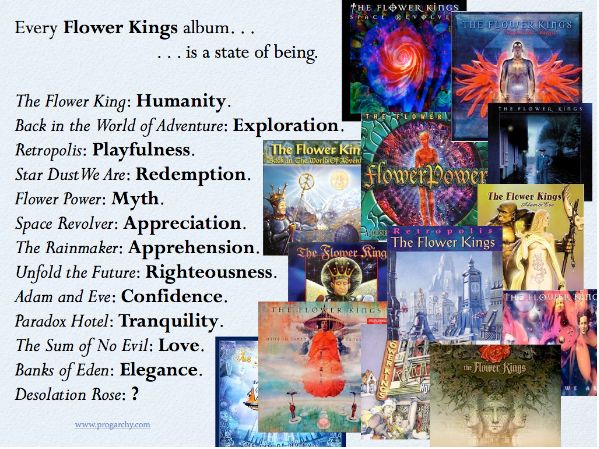
Brad: Tad, what a fun writeup.  Thank you–I think you clearly identify the joy and playfulness that is so prevalent in Space Revolver.  Stolt was clearly having the time of his life.  I love all the other albums – in fact, I made a meme a years ago expressing what I loved about each album (see below) – and I’m especially taken with Flower Power (the first of theirs I heard) and Paradox Hotel.  I really like Stardust We Are, too–but each of these other albums lacks the extreme playfulness of Space Revolver.

Flower Kings meme

[I made the above meme back when Desolation Rose came out.  I was rather blown away by the album when it was released, but mostly because it was so intense and lacked the characteristic mischievousness of the previous albums.  Indeed, when we were really active at Progarchy, I even planned out a book on the Flower Kings (never realized, except for some snippets, here or there), following the meme’s albums’s themes.  I was planning on arguing that The Flower Kings were to Europe what Big Big Train was to England and what Glass Hammer was to America.

The book would’ve come out before my Neil Peart biography and even before what you and I, Tad, wrote on Big Big Train.  I was, at the time, emailing with Stolt, and I was rather taken with him (still am) as an artist and as a human being.  He was extremely active on Facebook at the time, as was his wife, and they were always interesting.  We disagreed radically on the meaning and legacy of President Obama, but, again, he was always a total and intelligent gentleman.  

It’s about the time I sent him the Roepke book.  

I did try to interview Stolt about Rush, but he very kindly responded that he didn’t know enough about the band to offer anything substantive.  He was genuine, kind, and humane in his response.

One of many grand schemes never realized. . .]

Birzer Flower Kings
Brad’s Flower Kings Collection

[Above photo, my fantasizing.  In the middle of my then-Flower Kings collection, I’ve placed three of my own books, my biographies of (right to left) Christopher Dawson, J.R.R. Tolkien, and Charles Carroll of Carrollton.  Yes, I desperately wanted my work to be tied to Roine Stolt and the Flower Kings.  I thought–and still do–that if any of my biographies could reach the majesty of Stolt’s artistry, I would truly have made a mark on the world.]

A few responses to you directly, Tad.  It’s funny, I had always assumed that Neal Morse was influenced by Roine Stolt, rather than the other way around.  And, Stolt, to me, seems deeply influenced by King Crimson, Yes, and Genesis.  This seems especially clear on his solo, The Flower King, and Retropolis, both of which came before Transatlantic.  But, I assume this is like a chicken or the egg question.  At this point (2024), the two must’ve influenced each other so completely that one can’t any longer disentangle which idea or person came first.  Together, Stolt and Morse are the heart of rambunctious third-wave prog.

As to Stolt being Christian, I have no idea.  In our brief correspondence, I obnoxiously asked him directly about his faith, and he never responded or hinted, one way or the other.  Being Swedish, he was almost certainly raised nominally Lutheran, even if the Swedes only attend services on Easter and Christmas.  

Regardless, Stolt employs Christian symbolism frequently, especially in the early The Flower King’s albums.  Again, I think that “The Flower King” is a sort of hippie Cosmic Christ.  Here are the lyrics from the first album:

Falling out of the sky, falling into a dream
All I need is the heart where it all can begin
It’s just a matter of time, it’s just a matter of trust
It’s just a matter of faith when we all sleep in the dust

Don’t deny, just verify the genius of it all
It’s the cycle of all living thing, hear the children
Hear the children call !

“We believe in the light, we believe in love every precious little thing
We believe you can still surrender you can serve the Flower King”

Going out into the grey, into purple and red
See, all the beautiful shapes flowing out of my head
It’s just a matter of time, it’s just a matter of trust
It’s just a matter of faith when we all sleep in the dust

Don’t deny, just verify the genius of it all
It’s the cycle of all living, hear the children
Hear the children call !

“We believe in the light, we believe in love every precious little thing
We believe you can still surrender you can serve the Flower King”


“We believe in the heart, we believe in healing in a house where angels sing
We’ll unite the divided and the fallen one will serve the Flower King”

“We believe in the heart, we believe in healing in a house where angels sing
We’ll unite the divided and fallen one will serve the Flower King”

Again, I don’t quite think this is the orthodox Jesus Christ of Christian faith, but a rather humanistic but still supernatural Flower King.  When the band becomes “The Flower Kings,” they’re not divinizing themselves but rather becoming disciples.  

What strikes me most, though, is that Stolt’s use of mythological symbols is not Lutheran, but deeply Roman Catholic.

On track four of Space Revolver, “Monster Within,” Stolt sings “Mother Mary, she’s left the building crying/silent tears rolling down her cheek.”  Granted, this could just be a Beatles’ reference, but Mary, here, seems more supernatural than Paul McCartney’s mother.  After all, Mary is the opposite of some kind of demagogue trying to seduce our children and who feeds on power and who controls the bats.

One of my favorite The Flower King’s albums, Unfold the Future, posits a war between the devil and Mary.  On the final track:

Clueless

Living in a business cluster, predator to suit your needs
Raven sitting on your shoulder, lurking the suburban weeds
Think I saw you in the bank, think I saw you in a talkshow
Swear I saw your mindless grin, justify the final blow

Swallowing the endless laughter, cultivate the deadly sins
Getting even altogether, hiding from the Holy Mother
This is how you raise the Cain, this is what you teach our children
Back on duty dog eat dog, they’re clueless in the Devil’s playground

Then, of course, on Space Revolver, on track 6, “Underdog,” there’s that really weird line/sound byte: “John Paul’s pizza, the biggest pizza you’ve ever seen.”  When this album came out, in the year 2000, the only John Paul that mattered was John Paul II.

So, is Stolt Christian?  I have no idea, but he’s an awesome ally, a man of integrity, and a grand myth maker.  Taken together, this is so much what I love about Stolt and the band.  Never once I have listened to them without my imagination being stimulated, expanded, and made manifest!

Tad: Wow, Brad! I knew you were a fan of Stolt, but I wasn’t aware of all the thought you’ve put into his music. I now have a much greater appreciation for his overall oeuvre than before. I think you’re probably correct about who influenced whom – Morse had to be aware of Stolt while he was in Spock’s Beard, and Stolt had to be aware of Morse. They likely influenced and appreciated each other, which led to the formation of another outstanding prog group, Transatlantic. 

I kind of like it that Stolt is mum about his faith; it allows different interpretations of his music. What’s important to me is that he seems to be a light-bearer, as opposed to a dark nihilist like so many Scandinavian death metal artists. Stolt is always positive and optimistic, even when he is singing about something he’s unhappy about. In that regard, Desolation Rose seems to be his “darkest” work, and it is still uplifting to my ears.

So here’s my takeaway on Space Revolver: it is the perfect introduction to The Flower Kings for someone who is new to them. In it, the group hits the perfect combination of melodicism, progginess, and improv jamming. Once you’ve absorbed this album, all the others make sense. They’ve had an amazingly productive run the past 30(!) years, and I hope they go for 30 more!

The Tangent’s PO90’s “The Single”


The Tangent (For One) launch “The Single,” next track taken from ‘To Follow Polaris’ The Tangent  recently announced the release of the new studio album ‘To Follow Polaris’ on May 10th, 2024. That’s not necessarily a surprise, that’s what the band are known for. But at the same time, it’s something else too. As Andy jokes, playing on the Jaws strapline, he says “well this time it’s actually no personnel”.Today, a brand new track aptly titled ‘The Single’ has been released, and you can watch the video here: https://youtu.be/mwdbLOerLH4Andy comments of the track: “’The Single’ was originally recorded by my previous band Po90 some 25 years ago now, on an album called ‘The Time Capsule’. In the spirit of that time capsule, I opened it a quarter of a century later and recorded this updated version of it with new lyrics added to the older version. The old Po90 version was the track that in a way defined what the Tangent would be and giving it the Tangent treatment was a great pleasure. It’s a song about the documenting of history and the new ways this is going to happen, both good and bad…”

Watch the previously released video for ‘The North Sky’ here: https://youtu.be/x5CAzcKZXvA

Watch Andy discuss the making of the new album here: https://youtu.be/Lbqa5QP77L4?si=b-Xji6zq8UheDJvF

In a year when members of The Tangent could be seen onstage all over the world with Steve Hackett, Soft Machine, Karnataka, David Cross, It Bites, Cyan and others, plus on recordings by those artists and The Anchoret, The Michael Dunn Project, Argos and Retreat From Moscow, it became clear that there was not going to be time to get together for anything more than one gig in April 2023.

So the band agreed that the band’s leader/main writer Andy Tillison would keep the material coming and would make an album by The Tangent entirely alone. It would still be The Tangent. Just for one.
“Besides Which” Andy says, “I’ve always wanted to do this, use what I have learned from Luke, Jonas, Steve, Theo and many other alumni and take it to final production. Now was the time!”

What transpired over the following year is in one sense an “absolutist” solo album and is entirely the work of one person in all aspects including artwork, layout, design, lyrics, composition, performance, recording, production, mixing, mastering and authoring. But in another sense it’s totally Tangent. “I could not have begun to make this record without having had the experiences of working with the band. So although the different instruments are not attempted to be played in the actual style of the normal lineup, they are inspired by the kind of things these guys do”

‘To Follow Polaris’ will be available as a Limited Deluxe Collector’s Edition CD Mediabook (including bonus track and extensive 24-page booklet, Gatefold 180g 2LP vinyl (also including bonus track), & as Digital Album. Pre-order now here: https://thetangent.lnk.to/ToFollowPolaris1.The North Sky 11:36
2.A ‘Like’ In The Darkness 08:19
3.The Fine Line 08:04
4.The Anachronism 21:01
5.The Single (From A Re-Opened Time Capsule) 05:51
6.The North Sky (Radio Edit) 03:42
7.Tea At Bettys (Bonus Track) 17:32Produced between January and November 2023, the album features Andy using his multiple keyboards system as normal, but adds to the mix his first ever released performance on Bass Guitar and his second on stick driven (electronic) drums. Add electric and acoustic guitars and electronic wind controller and this is a full band recording in every sense of the word. A recording which shows Andy’s lifelong influence by artists such as Yes, Van Der Graaf Generator, Porcupine Tree, Groove Armada, Earth Wind & Fire, Roger Waters and his bands, Return To Forever, Deep Purple, Gentle Giant, Steely Dan and any band featuring the keyboard player Dave Stewart.Conceptually Andy claims the album is, ahem, “highly optimistic” but regular listeners to his work will anticipate correctly that this optimism will not be ill founded or over-easy and will be highly critical of obstacles to that optimism and the album will look as much into the dark as it does into the light.The album is intended to be thought of as a regular Tangent album – but not as the future of the band. It’s everyone’s intention to make the FOURTEENTH album as The Tangent. For Five.The Tangent online:
www.thetangent.org
https://www.facebook.com/groups/alltangentmembers/INSIDEOUT MUSIC online:
www.insideoutmusic.com
www.youtube.com/InsideOutMusicTV
www.facebook.com/InsideOutMusic
www.twitter.com/InsideOutUSA
www.insideoutmusicshop.comINSIDEOUTMUSIC Spotify Playlist: 
http://spotify.com/progrockessentials