
Hello Spirit of Cecilia Readers! I hope you’ve been following us recently. We’ve been quiet in the reviewing department but we’ve been very active with our Cecilia in Proghalla Progcasts. Here’s hoping we can get Robin Armstrong to join us soon! And, writing of Robin Armstrong, here below we review Cosmograf’s mid period, The Man Left in Space (2013), Capacitor (2014), The Unreasonable Silence (2016), and Hay Man Dreams (2017). Here’s hoping you enjoy the albums as much as we do.
Brad: Tad, as always, it’s wonderful to be reviewing with you, my awesome friend and fellow progling. It’s been too long since we last reviewed. “Father, bless me, for I have sinned. . . it’s been too long since my last review.”
I’m so glad we’re reviewing the amazing Robin Armstrong and his rather stunning prog project, Cosmograf, which began around 2009, deep into third-wave prog.
One thing we can state with certainty about Armstrong–he has an amazing ear, and he’s one of the greatest living audiophiles. I would put him in the august company of Steven Wilson, Rob Aubrey, and Bruce Soord. Everything he touches, he adds levels of perfection. I would guess some of his mixing is tedious work, but he always does the work, regardless. That level of perfection, of course, is something western civilization has been striving for since Aristotle challenged his son to pursue beauty no matter the cost! Yet, over the course of history, so few human beings have risen to the challenge. Armstrong has.
The first album I heard from Armstrong was The Man Left in Space, and, after falling in love with it, I went back and bought his first two albums. Since then, I’ve been a completist. At the time of The Man Left in Space, Armstrong was incredibly active on Facebook and social media in general (he’s much, much less active now), and I got to know him through mutual prog interests. When he put out a call for an American-voice for narration of NASA for the album, I responded within minutes with some recordings and Armstrong immediately accepted them. That was the first time my voice had ever appeared on an album, and, of course, I was absolutely thrilled. And, it created a life-long loyal fan.
One of the many things I love about Man Left in Space is its homage–but never sycophantic–to Pink Floyd. Of course, there are a lot of folks influenced by Pink Floyd, not just Armstrong, but Airbag, Steven Wilson, and Dave Kerzner. I love them all. One of the best things about all Pink Floyd-esque bands, they always take their time with their music. They linger when they need to linger, building emotion and tension. I attribute this mostly to David Gilmour’s classy and classic guitar playing.
Tad: Brad, it’s great to be in dialogue with you again, and I’m so glad we’re tackling Cosmograf! Like you, The Man Left In Space was my first exposure to Robin Armstrong’s magic, and I was immediately hooked. I love everything about his work: the impeccable production, the memorable melodies, the top-notch instrumental work, and his unassuming vocals. As a matter of fact, I think his vocals are my favorite aspect of his music: kind of everyman in quality, but conveying inner strength, if that makes sense. I even like the care he puts into the artwork for each album. Every album cover is unique, but of the highest quality.
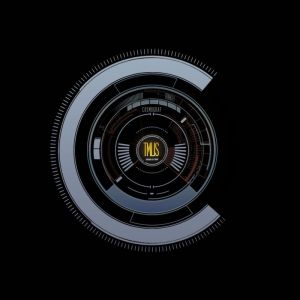
I was not as familiar with the following albums Capacitor, Unreasonable Silence, and Hay-Man Dreams, but I have really enjoyed immersing myself in them the past couple of weeks.
Let’s start with The Man Left In Space. It’s a fairly straightforward story of an astronaut who awakens in a space capsule, and he gradually realizes he has no hope of returning home to earth. There are lots of cool spoken word passages with sound effects (including a Birzeresque voice with a Kansas accent!), before a beautiful acoustic guitar begins playing an addictive riff for the second track, “Aspire, Achieve”. I hear the Pink Floyd influence you refer to, while the background vocals and crunching electric guitar that comes crashing in remind me of classic Porcupine Tree. This is a wonderful track that I still think is one of Armstrong’s finest in his long career.
Brad: That Kansas accent! Seems ubiquitous. Ha. Thanks, Tad–my first brush with prog fame.
I love “Aspire, Achieve” as well–such a stunning piece. And, you’re right, there’s a lot of Porcupine Tree in the music, but not in the vocals. Armstrong has an excellent voice, and his vocals are all his own. For me, though, the standout track is “The vacuum that I fly through.” That track gets me every time. The guitar work, especially, is so very tasteful, as is the bass.
Tad: Tasteful, indeed, Brad! Ok, as far as Capacitor goes, it seems to be a kind of steampunk tale of a man who has figured out how to transfer his consciousness into inanimate objects? At least, that’s what it seems to be, to me. In the introductory track, “The Spirit Capture”, there is quite a bit of spoken word where someone asks, “What happens to the energy in our bodies when we die?” and there is dialog between people claiming that the energy is what ghosts are. “The weight of a man’s soul is 21 grams!” “Our spirits are captured for all mankind!” Very strange. I was reminded of Christopher Nolan’s movie, The Prestige, about a magician who works with Nikola Tesla to teleport himself. The only catch is that the magician’s original body dies every time.
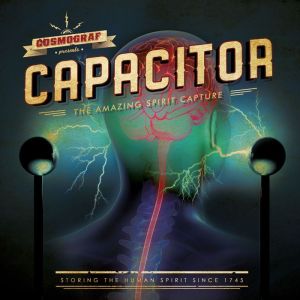
Anyway, Capacitor is very satisfying for me, musically speaking. It rocks a little harder than The Man Left In Space, and there is some tongue-in-cheek humor; in “The Reaper’s Song”, there is an announcement on a PA: “Thank you for boarding the Reaper Train’s 8 am service to Oblivion, calling at Greed, Stupidity, and Laziness.” Ha!
By the way, I think “The Reaper’s Song” is a fantastic track – a very good melodic hook in the main riff, and Armstrong’s vocals are excellent. Instrumentally, it builds nicely, until we are presented with a beautiful guitar solo, while there is an oblique reference, vocally and musically, to The Beatles’ “I Am The Walrus”. Very clever!
I also like the next song, “The Drover”, a lot. Nice, gentle, acoustic guitar and piano intro, while Armstrong sings,
In a road close to me
The sight of the drover
An old man with a pipe
Looking over your shoulder
Swinging from a tree
Wonder what made him do it?
Wow! That was quite jarring when I first heard those lyrics! The beautiful melody makes me love this song, despite its very dark subject matter. In fact, it seems to me that death permeates all of the songs on this album. I don’t have the lyrics in front of me, but there is a very foreboding atmosphere throughout the entire album. “White Car” begins with a woman conducting a seance. The final track, “The Ghost Gets Made” is definitely spooky as well. Come to think of it, I’m listening to this album a few days before Hallowe’en, and it’s a very appropriate soundtrack for this time of year!
Brad: Tad, such great thoughts. Thank you. I will admit, Capacitor is my favorite album from Cosmograf. From the opening moment to the conclusion, I find the album just riveting. Truly, Armstrong at his best and most creative. I love the subject matter, I love the lyrics, I love the flow of the album–in terms of instruments, I’m especially taken with the bass. But, the keyboards are just outstanding–they remind me of later Traffic. The flow, especially, is strong, as Armstrong moves so readily and easily between soft and hard passages, between lingering and intense. It’s really a perfect prog album. It reminds me a bit of Pink Floyd, a bit of Steven Wilson, and, though not cheesy, a bit of Alan Parsons.
You’ll laugh at me for this–but the album also reminds me of one of my favorite video games, Bioshock Infinite. For what it’s worth, I’m not really a video game guy. As I’ve gotten older, the first-person camera makes my stomach turn and I get motion sickness pretty easily. Too bad–as there are days I’d love to just come home from work and blow some stuff up! Ha. Such a guy thing. Anyway, Capacitor reminds me very much of Bioshock Infinite.
That said, Tad, I also really love The Hay-Man Dreams. If Capacitor is his retro science-fiction story, The Hay-Man Dreams is his Bradbury-esque folk tale. What are your thoughts?
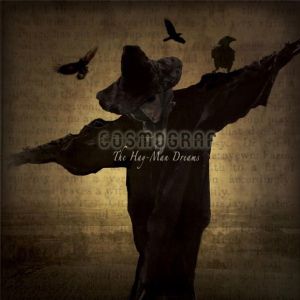
Tad: Okay, Brad, here is where I owe you a huge “Thank you”: I think The Hay-Man Dreams is Armstrong’s finest work, and I wouldn’t have heard it if not for your recommendation. From start to finish, there isn’t a misplaced note. Every musical moment is perfect, from the appropriately pastoral melodies and instrumentation to the elegant lyrics. Now, as far as the lyrics go, I’m not too sure what the concept underlying them is, but it seems that a man identifies with a scarecrow he sees in a field. He is alone and unable to feel, so he considers himself a “hay-man”. At least, that’s the impression I get.
Also, there’s a sense of unease and menace throughout:
The walkers tread the corn
They’re damaging the harvest
The gun has killed the fawn
There’s trouble in the forest
As I listen to The Hay-Man Dreams, I am reminded of one of my favorite television series: Midsomer Murders. Every episode is set in an idyllic English village where the most bizarre crimes occur. The Hay-Man Dreams would make a fitting soundtrack to it!
The third track, “The Motorway” is the best song in Cosmograf’s entire catalog, in my opinion. The acoustic guitar opening is simply delightful, and Armstrong’s vocals are full of yearning as he sings, “I want to feel a human touch/I want it really very much.” As the song progresses, it gets heavier and rocks harder. This song is a “Stairway to Heaven” for the 2010s!
Other highlights include the Beatlesque “Melancholy Death of a Gamekeeper” and the epic closing track, “Hay-Man”. Both are such stately and beautiful songs that I never tire of listening to. The former has some terrific guitar solos, and the latter features wonderful vocals by Rachel Hawnt. It also has this little spoken word interlude that I think is fantastic:
All winter through I bow my head
Beneath the driving rain
The north wind powders me with snow
And blows me black again
At midnight ‘neath a maze of stars
I flame with glittering rime
And stand above the stubble
Stiff as mail at morning-prime
But when that child called spring
And all his host of children come
Scattering their buds and dew upon
These acres of my home…
I did a little research, and they are from Walter de la Mare’s poem, The Scarecrow. How cool is that!
I can’t say enough good things about The Hay-Man Dreams – it’s an extraordinary album. Now I am very interested in your take on it. Ray Bradbury?
Brad: Well, when I hear The Hay-Man Dreams, I think of October and harvest, and I think of Ray Bradbury’s The October Country. There’s a kind of folk horror–even in its praise of country life–in and on the album. Or, at least, that’s what I hear. A kind of Scarecrow (think Batman’s Scarecrow) or something out of the X-Files. Whether it’s meant to or not, it sort of anticipates Steven Wilson’s latest, Requiem for a Village, at least in tone.
Have you had a chance to listen to The Unreasonable Silence? Again, there’s that really creepy element to it–a kind of folk horror is the best way I can put it–in the same way that Capacitor and Hay-Man are creepy.
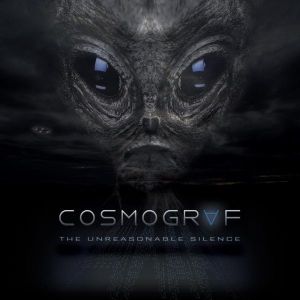
In each of these albums, Armstrong proves not only brilliant in composition but brilliant as an audiophile. Again, when it comes to production, I would happily place him up there with Soord, Aubrey, and Wilson.
The Unreasonable Silence also combines the mystery and lingering of The Man Left Out in Space with the unrelenting drive of Capacitor. I love it.
Really is there any aspect of Cosmograf in this middle period that isn’t just perfect?
Tad: Totally agree, Brad. I have listened to The Unreasonable Silence, and while I think it is very good, it doesn’t measure up to the other three, in my opinion. Maybe it’s because I find the subject matter disturbing: a man cuts himself off from his girlfriend, his job, everything, because he has had an encounter with aliens. At least, that’s what I think the album is about. With Cosmograf, nothing is clearcut.
One theme all four of these albums have in common is alienation: the man left in space is literally cut off from humanity, the steampunk inventor in Capacitor attempts to transfer his soul into a tree, the guy in The Unreasonable Silence disengages from all human contact due to a traumatic experience, and in Hay-Man a farmer, gamekeeper, motorway driver (are they all the same person?) identifies himself with an unfeeling scarecrow. I hope Robin Armstrong has at least one healthy relationship with someone in real life!
Again, Brad, thanks for suggesting we discuss this tetrad of albums; they are an amazing run for Cosmograf, and I am so glad we took a deep dive into them!


You must be logged in to post a comment.