Category Archives: History

Paul Johnson’s Creators – Praise for Artists of All Kinds

Paul Johnson is my favorite historian (my dear friend, Brad Birzer, is my favorite living historian!). Johnson takes complicated subjects, makes them understandable, and he does it in an entertaining way. He’s British, but he has written a fantastic history of the United States, A History of the American People. Other excellent books of his are The Birth of the Modern: World History 1815 – 1830, and Modern Times: The World from the Twenties to the Nineties. Creators was written after his book, Intellectuals, received some criticism for focusing too heavily on the hypocrisy of some of history’s most famous and influential intellectuals. As he explained, “I defined an intellectual as someone who thinks ideas are more important than people.” I, personally, appreciated learning about the moral failings of Rousseau, Marx, Ibsen, Sartre, and other thinkers who have been lionized by our intelligentsia. It’s the eternal story: “Do as I say, not as I do.” Anyway, Creators is, on balance, a more positive and inspiring collection of portraits. In it, Johnson gives us brief descriptions of Chaucer, Durer, Shakespeare, J. S. Bach, Turner and Hokusai, Jane Austen, A.W.N. Pugin and Viollet-le-Duc, Victor Hugo, Mark Twain, Tiffany, T.S. Eliot, Balenciaga and Dior, and Picasso and Walt Disney. Throughout these portraits his admiration for these artists’ work shines clearly. Johnson is the master of providing the interesting anecdote that humanizes and makes real his subject. For example, he writes that the composer Wagner
required a beautiful landscape outside his windows, but when he wrote music, the silence had to be absolute and all outside sounds, and sunlight, had to be excluded by heavy curtains of the finest and costliest materials. They had to draw with “a satisfying swish.” The carpets had to be ankle-deep; the sofas enormous; the curtains vast, of silk and satin. The air had to be perfumed with a special scent. The polish must be “radiant.” The heat must have been oppressive, but Wagner required it. Johnson, Paul. Creators: From Chaucer and Durer to Picasso and Disney (p. 9). HarperCollins. Kindle Edition.
Johnson praises Chaucer for creating the very idea of English literature. Before him, all politics and creative arts were conducted in French and Latin. He was the first to proudly use English in his poetry, and his portrayals of various classes of people are unparalleled. In my opinion, Creators is worth reading for his chapter on Shakespeare alone. Johnson does a wonderful job explaining how a man with humble beginnings could attain such incredible heights of literary excellence. Interestingly, he makes the case for Shakespeare not being an intellectual. In other words, for Shakespeare, people  were more important than ideas.
He [Shakespeare] rarely allows his opinions open expression, preferring to hint and nudge, to imply and suggest, rather than to state. His gospel, however, is moderation in all things; his taste is for toleration. Like Chaucer, he takes human beings as he finds them, imperfect, insecure, weak and fallible or headstrong and foolish—often desperate—and yet always interesting, often lovable or touching. He has something to say on behalf of all his characters, even the obvious villains, and he speaks from inside them, allowing them to put forward their point of view and give their reasons. Johnson, Paul. Creators: From Chaucer and Durer to Picasso and Disney (p. 54). HarperCollins. Kindle Edition.
I also learned that no one has created as many words and phrases that have entered common use as Shakespeare. Some estimate he coined as many as 6700 new words! Like Harold Bloom, Johnson has nothing but praise for the two Henry IV plays and Hamlet. Johnson’s explication of the psychological and moral dilemmas explored in Hamlet  is fantastic.
It is characteristic of this stupendous drama that the long passages of heroic reflection, which never bore but stimulate, are punctuated by episodes of furious action, the whole thing ending in a swift-moving climax of slaughter. No one can sit through Hamlet and absorb its messages—on human faith and wickedness; on cupidity, malice, vanity, lust; on regeneration and repentance; on love and hate, procrastination, hurry, honesty, and deceit; on loyalty and betrayal, courage, cowardice, indecision, and flaming passion—without being moved, shaken, and deeply disturbed. The play, if read carefully, is likely to induce deep depression—it always does with me—but if well produced and acted, as Shakespeare intended, it is purgative and reassuring, for Hamlet, the confused but essentially benevolent young genius, is immortal, speeding heavenward as “flight of angels sing thee to thy rest.” It is, in its own mysterious and transcendental way, a healthy and restorative work of art, adding to the net sum of human happiness as surely as it adds to our wisdom and understanding of humanity. Johnson, Paul. Creators: From Chaucer and Durer to Picasso and Disney (p. 75). HarperCollins. Kindle Edition.
Johnson’s next subject, Johann Sebastian Bach, was a solidly middle class man who was confident in his extraordinary ability to compose music, even if he wasn’t recognized for it during his lifetime.
Bach was by far the most hardworking of the great musicians, taking huge pains with everything he did and working out the most ephemeral scores in their logical and musical totality, everything written down in his fine, firm hand as though his life depended on it—as, in a sense, was true, for if Bach had scamped a musical duty, or performed it with anything less than the perfection he demanded, he clearly could not have lived with himself. It is impossible to find, in any of his scores, time-serving repetitions, shortcuts, carelessness, or even the smallest hint of vulgarity. He served up the highest quality, in performance and composition, day after day, year after year, despite the fact that his employers, as often as not, could not tell the good from the bad or even from the mediocre. Johnson, Paul. Creators: From Chaucer and Durer to Picasso and Disney (pp. 82-83). HarperCollins. Kindle Edition.
It’s almost a miracle that we have as many works of his today to perform, as they were scattered amongst his descendants after he died. If not for the efforts of Mendelssohn to restage Bach’s St. Matthew Passion in 1827, we might not have had the revival of his music that we enjoy so much today. Johnson uses this event to share another fun anecdote:
Afterward, at Zelter’s house, there was a grand dinner of the Berlin intellectual elite. Frau Derrient whispered to Mendelssohn: “Who is the stupid fellow sitting next to me?” Mendelssohn (behind his napkin): “The stupid fellow next to you is the great philosopher Friedrich Hegel!” Johnson, Paul. Creators: From Chaucer and Durer to Picasso and Disney (p. 93). HarperCollins. Kindle Edition.
The chapter on the artists William Turner and Hokusai is very interesting. Both began drawing from the age of three. Turner was somewhat controversial because of his new and unusual way of painting light, but he ended up one of the most popular and wealthy artists in history. Unfortunately, time and bungling “restorers” have kept us from appreciating his radical use of color. Even his contemporaries could see how his paintings faded not long after he finished them. Hokusai never profited much from his prodigious output, always begging benefactors for money. According to Johnson, he pretty much invented landscape art in Japan. He was quite a character:
There was a restless rootlessness to him, reflected in the fact that he changed his name, or rather the signature on his works, more than fifty times, more often than any other Japanese artist; and in the fact that during his life he lived at ninety- three different addresses. The names he used included Fusenko, meaning “he who does only one thing without being influenced by others”; “The Crazy Old Man of Katsushika”; and “Manji, the Old Man Mad about Drawing.” After he fell into a ditch, as a result of a loud clap of thunder, he signed himself “Thunder” for a time. Johnson, Paul. Creators: From Chaucer and Durer to Picasso and Disney (p. 108). HarperCollins. Kindle Edition.
Johnson’s chapter on Jane Austen is the slightest one, not because of any fault of Johnson, but because we know so little of Austen. Her family suppressed most of her personal correspondence, and they tried to make her into a Victorian woman, rather than the Regency one she was. However, according to Johnson, we can glean some personality traits from the letters and reminiscences that do exist and conclude that she was fun-loving young woman, which was the source of her genius:
Laughter was the invariable precursor, in Austen’s life, of creative action—the titter, the laugh, the giggle, or the guffaw was swiftly followed by the inventive thought. Once Austen began to laugh, not with the melodramatic novels she read, but against them, she began to look into herself and say, “I can do better than that.” Johnson, Paul. Creators: From Chaucer and Durer to Picasso and Disney (pp. 130-131). HarperCollins. Kindle Edition.
Pugin and Violett-le-Duc were both architects, the former responsible for the Gothic revival in England. We have Pugin to thank for the beautiful Houses of Parliament in London. The chapter on Victor Hugo is a very interesting one. In it, Johnson poses the question,
That Hugo was phenomenally creative is unarguable: in sheer quantity and often in quality too, he is in the highest class of artists. But he forces one to ask the question: is it possible for someone of high creative gifts to be possessed of mediocre, banal, even low intelligence? Johnson, Paul. Creators: From Chaucer and Durer to Picasso and Disney (p. 156). HarperCollins. Kindle Edition.
Johnson does not have a lot of admiration for Hugo, pointing out how contradictory his political opinions were, depending on what party was in power. He also kept many mistresses, well into his eighties! Mark Twain comes in for more respectful treatment. Johnson posits that his genius was as a storyteller – to truly appreciate his work, we need to hear it “performed”. He also had a knack for making great literature out of almost nothing:
His creativity was often crude and nearly always shameless. But it was huge and genuine, overpowering indeed, a kind of vulgar magic, making something out of nothing, then transforming that mere something into entire books, which in turn hardened into traditions and cultural certitudes. Johnson, Paul. Creators: From Chaucer and Durer to Picasso and Disney (p. 171). HarperCollins. Kindle Edition.
T. S. Eliot was a paradox – very conservative in his personal life, yet revolutionary in his poetry:
Eliot was never once (except on holiday) photographed without a tie, wore three-piece suits on all occasions, kept his hair trimmed, and was the last intellectual on either side of the Atlantic to wear spats. Yet there can be absolutely no doubt that he deliberately marshaled his immense creative powers to shatter the existing mold of poetical form and context, and to create a new orthodoxy born of chaos, incoherence, and dissonance. Johnson, Paul. Creators: From Chaucer and Durer to Picasso and Disney (p. 204). HarperCollins. Kindle Edition.
The turning point in Eliot’s career came when he met Ezra Pound, who introduced him to lots of European literary stars and convinced him to emigrate to England. He married Vivian Haighwood, but it doesn’t sound like the relationship was much fun:
From the early days of their marriage they engaged in competitive hypochondria. Both became valetudinarians and were always dosing themselves, complaining of drafts, and comparing symptoms. Johnson, Paul. Creators: From Chaucer and Durer to Picasso and Disney (p. 213). HarperCollins. Kindle Edition.
However, this dismal marriage, coupled with his job at Lloyd’s bank in London, spurred Eliot to create his masterpieces, The Waste Land and Four Quartets. As Johnson puts it, The Waste Land‘s strength is its elusiveness:
The greatest strength and appeal of the poem is that it asks to be interpreted not so much as the poet insists but as the reader wishes. It makes the reader a cocreator. Johnson, Paul. Creators: From Chaucer and Durer to Picasso and Disney (p. 219). HarperCollins. Kindle Edition.
Four Quartets solidified Eliot’s position as the leading poet of the twentieth century, even though, in Johnson’s words, “they are not about anything”. What they are is evocative of a nihilistic mood that dominated mid-twentieth century western culture. The appalling meaninglessness and slaughter of WWI that led into WWII left a cultural elite with almost no hope Eliot was their spokesman. I wish I could have been present at the gathering Johnson describes below!
The Four Quartets were much discussed when I was a freshman at Oxford in 1946, and they, too, were still fresh from the presses. I recall a puzzled and inconclusive discussion, after dinner on a foggy November evening, in which C. S. Lewis played the exegete on “Little Gidding,” with a mumbled descant from Professor Tolkien and expostulations from Hugo Dyson, a third don from the English faculty, who repeated at intervals, “It means anything or nothing, probably the latter.” Johnson, Paul. Creators: From Chaucer and Durer to Picasso and Disney (p. 223). HarperCollins. Kindle Edition.
In his chapter on Picasso and Disney, Johnson praises Picasso for his incredible creativity and canny judgment:
… Picasso became the champion player, and held the title till his death, because he was extraordinarily judicious in getting the proportions of skill and fashion exactly right at any one time. He also had brilliant timing in guessing when the moment had arrived for pushing on to a new fashion. Although his own appetite for novelty was insatiable, he was uncannily adept at deciding exactly how much the vanguard of the art world would take. Johnson, Paul. Creators: From Chaucer and Durer to Picasso and Disney (p. 253). HarperCollins. Kindle Edition.
But he also exposes a very dark side of Picasso; how he abused women and men, stabbed friends in the back, and seemed to have no moral sense.
He would create situations in which one mistress angrily confronted another in his presence, and then both rolled on the floor, biting and scratching. On one occasion Dora Maar and Marie-Thérèse Walter pounded each other with their fists while Picasso, having set up the fight, calmly went on painting. The canvas he was working on was Guernica. Johnson, Paul. Creators: From Chaucer and Durer to Picasso and Disney (p. 256). HarperCollins. Kindle Edition.
Walt Disney, on the other hand, comes in for quite a bit of praise. I really enjoyed Johnson’s detailed explanation of just how revolutionary Disney was when it came to combining sound and animation in a film. Practically all animated content we enjoy today owes a debt to Disney. What was his strength as a creator? According to Johnson,
Whereas Picasso tended to dehumanize the women he drew or painted. Disney anthropomorphized his animal subjects; that was the essential source of his power and humor. Johnson, Paul. Creators: From Chaucer and Durer to Picasso and Disney (p. 258). HarperCollins. Kindle Edition.
The final chapter, Metaphors in a Laboratory, addresses the idea of scientific creativity. Johnson argues that through the use of metaphors, scientists are able to communicate their ideas and spur others to innovate. A lot of this chapter rehashes persons and topics he covers in The Birth of the Modern – how Wordsworth and the scientist and inventor Humphrey Gray were great friends and shared ideas with each other, how the engineer Telford transformed the British landscape with canals, roads, and bridges of simplicity and beauty. Creators is a wonderful celebration of one of the greatest human characteristics: the ability to create. Even though some of the creators were not the nicest people who lived (such as Picasso), their works survive to inspire others.

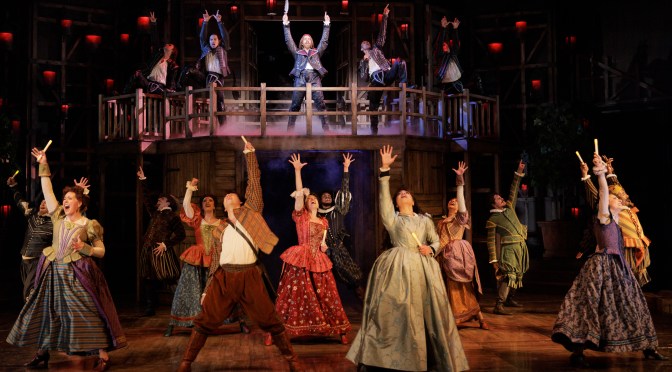
At the Stratford Festival: Something Rotten! (To the True North, Part 6)

I thought there were three genuinely great things about the Tony Award-winning musical Something Rotten, as currently playing at the Stratford Festival:

1. Mark Uhre’s frenetic take on struggling Elizabethean playwright Nick Bottom. Between his oversized desire for fame, his strained interactions with enterprising wife Bea (a confident Starr Dominque) and poetic little brother Nigel (Henry Firmston in the boy-next-door role), and his obsessive drive to take down William Shakespeare and win the Renaissance fame game, Nick is desperation personified, thoroughly uncomfortable in his own skin and all the funnier for it. Uhre plays him as a live-action version of Daffy Duck, spluttering with unbounded rage at his situation, and thus completely susceptible to any bizarre idea that crosses his path – like inventing the musical – and thus totally willing, no matter how insane the consequences that follow, to “commit to the bit”.

2. The thing is, in this universe, Nick’s right! Framing Shakespeare as a vain, manipulative rock star (continuing the parallel, think Bugs Bunny without redeeming qualities) is Something Rotten’s masterstroke. Trailed by his own theme song and a crew of dancing Bard Boys, basking in the adulation of a solo stadium gig (with hilariously low-tech special effects), scheming against Nick to the point of donning a fatsuit disguise and a Northern accent, stealing Nigel’s best lines and passing them off as his own, Jeff Lillico is a utter hoot, England’s greatest dramatist as an egotistical, over-the-top pantomime villain. Even when he lets his guard down in his big solo “Hard to Be the Bard”(“I know writing made me famous, but being famous is just so much more fun”) , this is a Shakespeare you can love to hate.

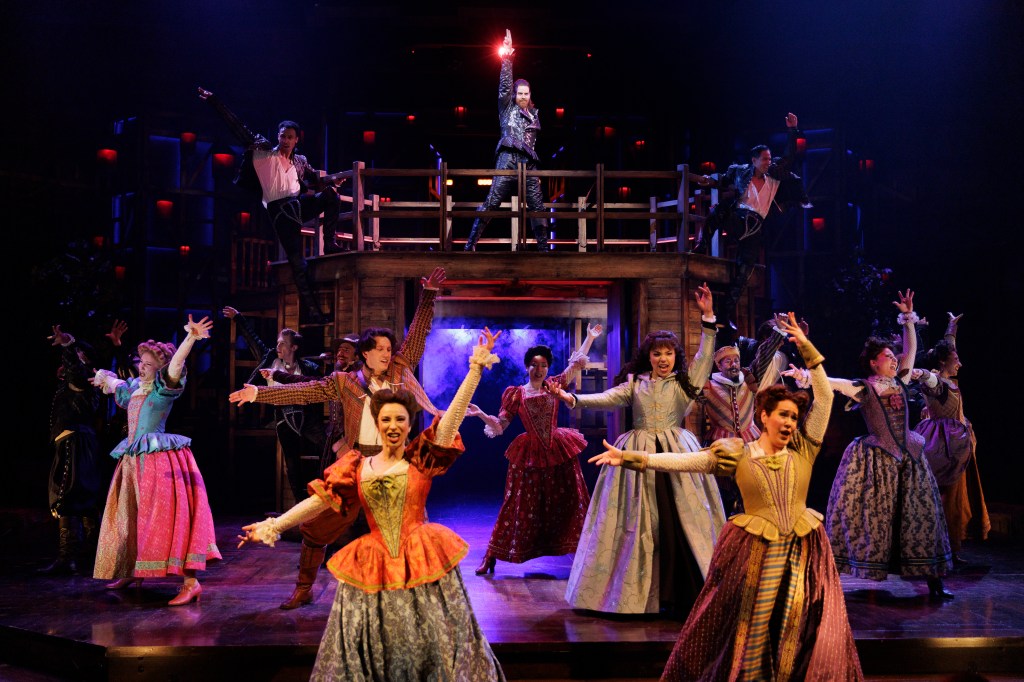
3. Speaking of over-the-top, director Donna Feore and her creative team absolutely chose the right path by leaning into the Broadway musical’s inherent absurdities, as foreseen by cut-rate soothsayer Nostradamus (Festival veteran Dan Chameroy in a giddy, disheveled supporting turn):

You could go see a musical
A musical
A puppy piece, releasing all your blues-ical
Where crude is cool
A catchy tune
And limber-legged ladies thrill you ’til you swoon
Oohs, ahhs, big applause, and a standing ovation
The future is bright
If you could just write a musical

Dan Chameroy as Nostradamus with members of the company in Something Rotten!. Stratford Festival 2024. Photo: David Hou.

Every possible cliché you can think of is there onstage for those six minutes: Sung recitatives (with self-mocking asides)! Bawdy double-entendres and suggestive choreography! Costume changes (including nonsensical hats and wigs)! Jazz hands! Synchronized high-kicking (with callbacks goofing on Feore’s 2016 Festival production of A Chorus Line)! It all worked to perfection at this matinee, the capacity audience (including your scribe) yelling and applauding for more (which the company obligingly provided) as if Pavlov had just rung his biggest, shiniest bell. And the places Nick and Nostradamus find themselves going in the second act’s big number scale even zanier heights. Complete the sentence yourself: “When life gives you eggs . . .” Then imagine the costumes!

Where Something Rotten falls short? Compared to the sublime ridiculousness of the main story, the supporting characters’ arcs bog down in vapid sentimentality and already-stale contemporary memes. Bea’s occasional empowerment shoutouts pale in comparison to what she actually does out of love for her husband and his brother, subtly undercutting her role as the true hero of the piece. Nigel’s emergence from Nick’s shadow is a bit of a damp squib; his main solo turn “To Thine Own Self Be True” proves an shallow, unearned manifesto of self-actualization instead of a rite of passage. And the meet-cute romance between Nigel and Portia (Olivia Sinclair-Brisbane, winningly portraying a budding poetry fangirl under the thumb of Juan Chioran, a Puritan father given to pre-Freudian slips) sputters, toggling between aren’t-we-transgressive smuttiness and, in “We See the Light”, a Big Message about tolerance, tediously staged as a clumsy cross between Sister Act and Rent — Feore’s only directorial misfire.

But that said, Something Rotten’s full-on commitment to farce and totally bonkers energy (with Feore, Uhre, Lillico and Chameroy setting the pace for a young, frisky cast) carries the day. Productions about Shakespeare at the Stratford Festival are typically on or about at the same level as their productions of Shakespeare, and this delightfully nutty escape into a toe-tapping alternate version of the Renaissance is no exception.

Members of the company in Something Rotten!. Stratford Festival 2024. Photo: David Hou.

— Rick Krueger

Something Rotten continues at Stratford Festival’s Theatre, with its run now extended through November 17th. Click here for ticket availability.

Music Crossing Continents: Constantinople & A Filetta at the Elora Festival (To the True North, Part 3)

Park your car in the biggest paved lot you can find in Elora, Ontario — the one adjoining the horse racing track & casino just southwest of downtown. Then, cross the road to the municipal Gambrel Barn — transformed into an unlikely concert hall for three weekends in July.

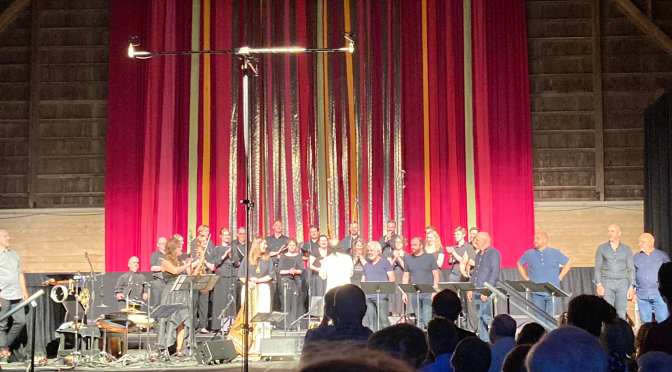
Filing onstage: Constantinople, an instrumental quartet from Montreal that plays medieval, Renaissance and Baroque instruments from Persia, Turkey, Japan, Europe and Ireland; A Filetta, a male vocal sextet from Corsica, an island ruled by France (Napoleon came from there) where the native language developed from Italian and Greek roots; and The Elora Singers, a impeccably polished, 21-voice Canadian choir. How, you might think, is this all gonna come together?

As it turns out, the answer last night was: in an exceptionally intense, immersive way. Introducing the program Clair-obscur, Constantinople’s music director Kiya Tabassin noted its title and content came into being just before 2020’s worldwide pandemic. After its first performances, in Tabassin’s words, its purpose became “to bring light (clair) to darkness (obscur)“. And over the next 90 minutes, the assembled forces proceeded to do just that, crossing a continent to meld the sounds of disparate times and places into a satisfying whole.

The music, mainly assembled by Tabassin and A Filetta’s leader Jean-Claude Acquaviva, proved thoroughly cosmopolitan and eclectic. The sextet’s singing was the obvious heart of the evening; their sturdy blend of dominant bass drones, fleet interweaving lines stacking up into glancing consonances and luxuriant melodic melismas were consistently riveting, whether voices were raised in a show of strength or hushed in breathtaking tenderness. Tabassin’s 3-stringed setar and Didem Basar’s kanun (a 78-stringed Turkish zither) danced lithely around and about the rugged vocal base, with forthright support from Tanya LaPerriere’s Baroque violin & viola and supple grounding in Patrick Graham’s ten-fingered, two-footed percussion; each player had their evocative solo moment and earned delighted applause from the crowd.

Atop this entrancing musical scaffold, the sung texts unfurled a dizzying collage of Senecan drama, Renaissance epic, Near Eastern poetry from Rumi and Hafez, traditional ponderings on the passion of Christ and Primo Levi’s meditation on the memory of the Holocaust. Here was history stripped of its timeline, collapsed into its component catastrophes and passions — pride, devotion, horror, absurdity, yearning for calm and deliverance – compounded into the moment’s expression and emotions. And when Tabassin raised his reedy voice to cavort over A Filletta’s firm foundations or the Elora Singers enriched the soundscape with supportive reinforcement and embellishments, the chamber effect broadened out to opulent symphonic proportions.

Clair-obscur (the nearest English equivalent would be chiaroscuro, the play of light and shadow in the art of painting) proved a unique mix of folk music and high art, calmly unhurried vocal prowess and upbeat improvisation, a journey through the heart of human life to a resting place of connection, catharsis and celebration. You can check out a sample of this program for yourself below (the complete concert, without The Elora Singers, can be found here):

— Rick Krueger

Americana, the Reich and Motorcycle parts

Recently I had to replace motorcycle tire, it was simply well past its tread wear. These off road Duro tires are made in Taiwan, in fact they are commonly seen in that lesser known Russian Ural motorcycles. These tires are known to be puncture resistant, and more importantly they look pretty good on a Triumph. My side-mirrors are from CRG, handle bars from British Customs, and engine/crash guard from SW-MOTECH. This is not an advertisement, but just an illustration of my ability to make choices.

Making choices for customizing motorcycles is not so different from general life choices. We pick vendors, and parts which are most suitable to our purposes and palette. Just like how we pick our grocery stores, or movie place or restaurants or investment plans. We build life and systems around us based on our choices, those who make better choices build better systems. That freedom to make choices deserves a bit of an appreciation.

Last week I was watching this TV series called “The Man in the High Castle”. It details an alternate reality where Axis powers won the war. And the US is split in half between the Reich and Imperial Japan. The series also brings in the concept of multiverse, where there are parallel realities with different outcomes. In a certain universes Axis powers rule, in others it’s the Allied forces. So, in the story Nazis realized this and decided to build this machine to travel to alternate realities, obviously to conquer them! More than scary it sounded foolish.

Even if by some random stroke of luck Hitler wins the war, they can’t hold a candle to the Allied forces in the parallel universe. So, most likely outcome would be they lose their current reality to Americans from those alternate universes. Interestingly, even here successful outcome comes down to that simple ability to make productive choices.

German Reich is forced to make choices based on meaningless criteria, while Americans make choices to build efficient systems. While Reich has to pander, Americans make choices which can deliver results. Nazis artificially limit their resource pool, while Americans allow winners to emerge from anywhere. Americans simply produce exceptional results because of their ability to make rational choices while learning from their mistakes. Over a period of time it allows best of the ideas to emerge and artificial discriminatory practices to be discarded, this eventually benefits everyone. So, one criterion to measure a legislation would be its impact on broadening choices, seems like that’ll tell whether it’s taking us closer to the Reich or to Americana.

Stratford Festival Review: Richard III by William Shakespeare

The thought will not down that an unfortunate choice was made when King Richard III was selected as the spearhead stage offering. It is definitely the most unwholesome of all Shakespeare’s tragedies, and its only character of any real dramatic interest is that of Richard himself — a physically repulsive hypocrite, liar & murderer without one redeeming feature.

— The Stratford Beacon-Herald, June 30, 1953

Defying the Beacon-Herald’s strictures, the Stratford Festival nonetheless opened its inaugural season with Richard III — with no less a personage than Alec Guinness (“the old Obi-Wan”, as I overheard a Festival-going mom telling her son a few years back) in the title role, and the results were raved about throughout the Anglophone world. Since then, the Festival has mounted the tragedy at least seven more times, with both widely-known actors such as Alan Bates (1967) and Brian Bedford (1977) and talented company members like Stephen Ouimette (1997) and Tom McCamus (2002’s 50th season) flocking to fill the part.

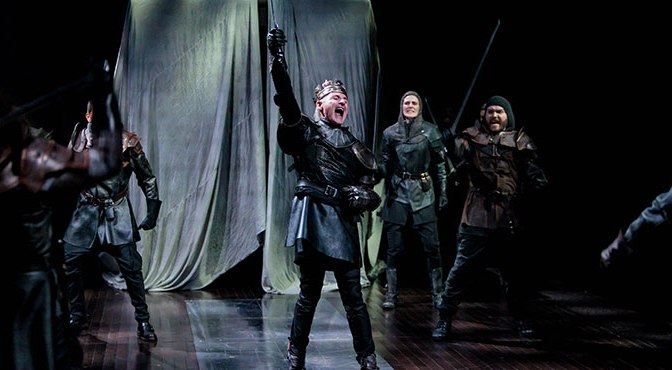
Having paid his dues at Stratford before launching into a well-rounded career that spans Canadian biopics of Pierre Trudeau & Glenn Gould and comic book movies (Thor: The Dark World and The Amazing Spider Man 2), it’s intriguing to see Colm Feore become a repeat Richard, 35 years after he first essayed the role at the 1988 Festival. His deeply physical take on the Duke of Gloucester, complete with a gait that evokes the scoliosis evident in the monarch’s recently-discovered skeleton, is visually riveting. His way with the text is equally arresting; doing without the scene-chewing excess of an Olivier, he’s nonetheless “determined to prove a villain” from the opening soliloquy, unabashedly eager to walk the Tom Patterson Theatre audience through his machinations as he claws his way toward the throne. And like Feore’s other role this season as Molière’s The Miser, his Richard becomes the focal point around which Shakespeare’s cast revolves, constantly manipulated and mesmerized by him whether they realize it or not.

Sooner or later, however, most of the other characters do discover what Richard really wants. Freed from their self-deception and ambition, it’s their reactions that give the tragedy both its recurring sparks of conflict and its building momentum. Michael Blake’s Duke of Clarence, with his dreamed intimations of his brother’s betrayal; Jessica B. Hill’s Lady Anne, whose loathing of Richard is palpable even as he perversely woos her (and wins her!); Ben Carlson’s clueless Hastings and Andre Sills’ scheming Buckingham, whose death row regrets soar to commanding heights — all these keep any empathy the audience may be developing for the would-be usurper at arm’s length.

Towering over all these are Seana McKenna (who played Richard in 2011!) as the mad, prophetic dowager Queen Margaret, calling down curses on all and sundry; Lucy Peacock, whose Queen Elizabeth soars to dizzy heights of spite and bereavement following Richard’s slaughter of her children; and Diana LeBlanc, whose Duchess of York is shocked into cursing her upstart son just as he gains the throne. This is titanic stuff — the loosely historical narrative may drive the action of the play, but the clash of deep — and deeply flawed — characters is what keeps us from joining Team Richard, despite the combined allure of Shakespeare’s words and Feore’s strange appeal. In fact, no sooner does Richard become king than we (and possibly he) realize that his downfall is inevitable — and that we need to see it, to make some sense of these tumultyous events.

Even in the intimate TPT (with one-third the capacity of the Festival Theatre), there’s spectacle aplenty to be mined by director Antoni Cimolino and the populous, well-drilled cast as Richard approaches his necessary end. Royal processions, civil unrest, a coronation, ghostly visitations and the final battle between the forces of the usurper and Jamie Mac’s enigmatic, recessive Henry Tudor stir the blood, even as they bring Richard’s lurid dreams to both their culmination and their dissolution. And while this generally traditional production is a feast for the eyes and ears that I can’t recommend highly enough, Cimolino leaves us with more food for thought as well. His prologue and epilogue are set in the present day, with the discovery of Richard’s skeleton and his reburial in Leicester Cathedral bookending the tragedy — as if to remind us that, no matter how high Shakespeare’s characters may fly, as the Bard wrote later in his career,

Golden lads and girls all must,
Like chimney sweepers come to dust.

(Cymbeline)

Richard III runs through October 30th at the Stratford Festival’s Tom Patterson Theatre. Tickets available at stratfordfestival.ca.

— Rick Krueger

Stratford Festival Review: Freedom Cabaret 2.0

In last year’s cut-down Stratford Festival lineup, actor/musician/playwright Beau Dixon’s Freedom Cabaret (part of the Festival’s Forum of other performing arts and speakers) garnered some of the strongest reviews. Walking out of yesterday’s performance of Freedom Cabaret 2.0, I completely understood why.

Subtitled “How Black Music Shaped the Dream of America”, this year’s cabaret is loosely structured around the life of work and Martin Luther King, Jr. Dixon’s command of the black musical tradition is formidable and thrillingly eclectic; grasping the connections between decades and genres with a firm hand, his new set comfortably mingles jazz, soul, folk, gospel and even a touch of hip-hop in an arc that illuminates both King’s journey and the idealism he set loose during the era of the Civil Rights Movement.

And the ensemble that Dixon has reconstituted for this year — serving as the lynchpin on piano and vocals for a trio of singers with rhythm section — grasps those connections at the same level, vividly painting a compelling portrait of King’s context, life, death and legacy. Shakura Dickson’s floating soprano and Alana Bridgewater’s earthy alto scale the gospel heights of “Oh, Happy Day” and “Move On Up A Little Higher”, then pull back for an eerie, hovering “Strange Fruit” and Nina Simone’s wrenching “Four Women”; Aadin Church runs the emotional and vocal gamut from soaring tenor to down-home baritone on showcases like Louis Armstrong’s “(What Did I Do to Be So) Black and Blue”. Rohan Staton on guitar, Roger Williams on bass and Joe Bowden on drums lay down one irresistible groove after another, slipping serenely from a Jeff Beck quote in “People Get Ready” to the abstracted jazz of “Freedom Day”. And Dixon ties it all together with his supple piano, his power-packed voice and his understated yet emotional narration.

Most fascinating to me were the artists Dixon chose to anchor King’s story. Stevie Wonder’s “Love’s in Need of Love Today” and “Living for the City” bookended the narrative, melding harmonic sophistication with unaffected idealism; the Staples Singers “Why? (Am I Treated So Bad)”, “Freedom Highway” and “Respect Yourself” embodied both the lament of the oppressed and the spiritual grit to stand up against that oppression. But the searing quartet of pieces by chanteuse Nina Simone provided the real key to unlock the heart of King’s message. From unflinching confrontation with racism’s deepest horrors in “Mississippi Goddamn” (operatic in structure, visceral in its impact) through the heartbroken elegy for the fallen leader “Why? (The King of Love Is Dead)” pivoting to the visionary hope of “To Be Young, Gifted and Black”, Simone’s music is brutally honest and unsparing — but it also incarnates how King’s dream of hatred conquered by love was set loose in the 1960s and how its ramifications have been rippling out ever since.

The dream and its spread — even after the horrors of black history in the United States, even in the face of what obstacles remain following the progress of the Civil Rights era — are why Dixon and his ensemble can finish Freedom Cabaret with a hearty invitation for the Festival audience to join the “Love Train” that King set in motion. If you can, I highly recommend you catch it.

Setlist:

  • Oh, Freedom
  • Love’s in Need of Love Today (Stevie Wonder)
  • Why? (Am I Treated So Bad) (The Staples Singers)
  • Oh, Happy Day (The Edwin Hawkins Singers)
  • Move On Up A Little Higher (Mahalia Jackson)
  • Strange Fruit (Billie Holliday)
  • Mississippi Goddam (Nina Simone)
  • Freedom Highway (The Staples Singers)
  • People Get Ready (The Impressions)
  • We Shall Not Be Moved
  • John Henry (Harry Belafonte)
  • Black Man in a White World (Michael Kiwanuka)
  • (What Did I Do to Be So) Black and Blue? (Louis Armstrong)
  • Respect Yourself (The Staples Singers)/Respect (Aretha Franklin)
  • Freedom Day (Max Roach & Abbey Lincoln)
  • Phenomenal Woman (Maya Angelou)/Four Women (Nina Simone)
  • So Much Trouble in the World (Bob Marley and the Wailers)
  • Why? (The King of Love Is Dead) (Nina Simone)
  • Harlem (Langston Hughes)/To Be Young, Gifted and Black (Nina Simone)
  • Living for the City (conclusion) (Stevie Wonder)
  • Ain’t No Stoppin’ Us Now (McFadden & Whitehead)
  • Move On Up (Curtis Mayfield)
  • Love Train (The O’Jays)

Personnel:

  • Joe Bowden, drums
  • Alana Bridgewater, singer
  • Aadin Church, singer
  • Shakura Dickson, singer
  • Beau Dixon, piano, singer, musical director
  • Rohan Staton, guitars
  • Roger Williams, basses

Freedom Cabaret 2.0: How Black Music Shaped the Dream of America runs through August 28th at the Tom Patterson Theatre’s Lazaridis Hall in Stratford, Ontario. Tickets are available at stratfordfestival.ca.

— Rick Krueger

Live from the Stratford Festival

This is an exciting time for the Stratford Festival. In 2022, we reopen our theatres, honour the excellence of the past and embark on a new leg of our journey together. A fresh start: an opportunity to reassess ourselves in the world today, reaffirm what we value and take the best path to an extraordinary future.

This will also be a year to celebrate milestones: our 70th season, the 20th anniversary of the Studio Theatre, the 10th season of The Meighen Forum, and the grand opening of our glorious new Tom Patterson Theatre.

It’s fitting, then, that our season theme for 2022 is New Beginnings. Our playbill explores the difficult moral and ethical decisions a new journey entails: What is the best way to start again? How can we avoid the traps of the past? In an imperfect world, what is good?

From Shakespeare’s most iconic play, Hamlet, to the American family classic Little Women; from the great Nigerian Nobel Prize winner Wole Soyinka’s Death and the King’s Horseman to such captivating new plays as 1939 and Hamlet-911, we offer you stories about navigating a new start in life.

Antoni Cimolino, Artistic Director, Stratford Festival

Since 2004, my wife and I have been regular visitors to the Stratford Festival in southwestern Ontario. We’ve fallen in love with the Festival’s unbroken ethos across 70 seasons — dynamic, top-level performances by a dedicated repertory company of classics by William Shakespeare, Molière, Anton Chekhov, Berthold Brecht and others, as well as substantive, appealing musicals and fresh, often experimental works by today’s playwrights. We’ve also fallen in love with the city of Stratford; set in the heart of Ontario farm country, it combines picturesque architecture, unique shops and eateries, and a stunningly beautiful park system along the Avon River and Lake Victoria. And the thought of everyone who’s trod a stage at the Festival’s multiple theatres, played a rock show at the hockey rink or busked for change on the streets (ranging from Alec Guinness and William Shatner to Richard Manuel of The Band and native son Justin Bieber) makes the place a performing arts lover’s dream.

Which is why it hit hard when, in the wake of the worldwide pandemic, the Festival’s 2020 season was cancelled and the 2021 season only went on under severe limitations and restrictions. It’s true that the summer of 2020 brought welcome YouTube screenings of the Festival’s ongoing project to film every play by Shakespeare (along with other archival videos), culminating in the online Stratfest At Home subscription service. But, a few days back at a local B&B, with a full season of 10 productions energizing the town around us, has served to remind me that there’s nothing like the real thing. And that experience is what I plan to share here with you.

Over the next few days, we’ll be attending Molière’s The Miser (currently in previews at the Festival Theatre), Shakespeare’s Richard III (at the new Tom Patterson Theatre), and Freedom Cabaret 2.0: How Black Music Shaped the Dream of America (at the TPT’s Lazaridis Hall). Look for reviews posted here ASAP after each performance. Whether you’re able to visit the Stratford Festival this season or in the future (or take in what it offers online), my hope is to capture at least a bit of the serious fun, the sheer emotional and intellectual sweep, the thrills, spills, heartbreak and heart’s ease — in short, the immersive, cathartic experience live theatre at its best can provide, and that the two of us have come to love and crave.

— Rick Krueger

COSMOGRAF – ANNOUNCE NEW ALBUM – HEROIC MATERIALS


We are really pleased to announce that Cosmograf returns with their ninth new studio album, Heroic Materials to be released on 9th September 2022.
 
William ‘Billy’ May looks back on his life at the age of 99 and realises the world has completely changed since he was a young man put into an impossible scenario, defending his country from the air. He no longer recognises much of the modern world but understands that the human race must live in a different way in the future.
 
“This album is really about change, our refusal to accept it, but also recognising that it’s essential to our survival”, says Cosmograf’s Robin Armstrong. “The story centres on a WWII Spitfire pilot who laments a lost golden era, but reflects that the human race must change its ways in order to preserve our existence on the earth.” 

Robin is joined once again by drummer, Kyle Fenton, and there is a special guest appearance from ex-Big Big Train keyboard player Danny Manners, who plays piano on the 13 min title track, set in three parts.
 
The lead track from the album, British Made is released on our Bandcamp page today, and the video for the track is available to view on YouTube now. 
British Made is really a nostalgic throw back to a golden era of motoring where design and craftsmanship was more important than carbon footprints.  I think it’s incredibly sad that we are coming to the end of this present journey with the motor car, as we reject fossil fuels for electric power, even if it’s for good reasons” says Robin.

The album sees the character wrestling with his memories of the war, and harbouring nostalgia for a past era but he realises that change is essential if we are to avoid climate catastrophe.

Heroic Materials will be available in CD, Deluxe Media book edition, Vinyl and Digital formats and pre-ordering is now live on the Gravity Dream Music website.

Heroic Materials Pre-order link: https://bit.ly/2YObrzH


The new single ‘British Made’ on YouTube: https://youtu.be/Lqj40KJLrtA

Book Review: Christopher Gehrz’s Religious Biography of Charles Lindbergh

Christopher Gehrz, Charles Lindbergh: A Religious Biography of America’s Most Infamous Pilot, Grand Rapids, MI: William B. Eerdmans Publishing Company, 2021, 265 pages.

Christopher Gehrz - Charles LindberghCharles Lindbergh is simultaneously the most fascinating and the most frustrating individual I have ever encountered. Since December 2019, I have been cataloging the Missouri Historical Society’s collection of over 2000 objects that Lindbergh donated following his May 1927 New York to Paris flight. The collection ranges from artifacts carried on that flight to the hundreds of medals and awards he received, personal effects, artwork, two aircraft, jewelry, and the random gifts people and governments sent him or gave him and his wife, Anne, on their travels. In studying the material culture owned by and given to Lindbergh, I have learned a lot about him. Perhaps I have learned too much.

I imagine Christopher Gehrz, professor of history at Bethel University in Lindbergh’s home state of Minnesota, might also say he has learned too much about Lindbergh in the course of writing the latest biography on the aviator. There have been many biographies written about Lindbergh since the pilot, outspoken isolationist, and conservationist died in 1974, with A. Scott Berg’s 1998 biography widely considered to be the standard text on Lindbergh’s life.

A lot has come out of the woodwork on Lindbergh since 1998, most prominently the discovery of his multiple extramarital affairs and the children he had with three German women. Over the past twenty years, historians have also unpacked Lindbergh’s legacy in light of his views on eugenics and race, as well as his anti-Semitic remarks made during his isolationist America First speeches in the run-up to World War II.

Despite the numerous books that have been written about Lindbergh over the years, one aspect of his life has been woefully overlooked, until now. Gehrz’s biography is the first to analyze Lindbergh’s life, writings, and actions through a religious lens. Perhaps you might not think religious or spiritual when you think of Charles Lindbergh (if you even think of him at all – increasing numbers of people I run across have never even heard of him). That would be fair, since Lindbergh was not an orthodox Christian. He did not believe in Jesus Christ as Savior and Lord, yet he was fascinated by Jesus and thought deeply about his own spirituality. Lindbergh’s Pulitzer Prize-winning 1953 book The Spirit of St. Louis drips with religious imagery, as do some of his other later writings.

Gehrz’s biography investigates Lindbergh’s beliefs and writings on Jesus, religion, spirituality, the afterlife, and how Lindbergh’s beliefs influenced his actions. Through intense archival research and analysis of published works, Gehrz unpacks Lindbergh’s spiritual complexity. Since Lindbergh’s spirituality flourished in his later years (he was only 25 when he made his famous flight), the foundational part of Gehrz’s argument rests upon the period of Lindbergh’s life spanning the 1930s until his death. The book begins by looking at the religious elements in the lives of Lindbergh’s parents and grandparents, shining a light on the rather unorthodox beliefs in which he grew up.

This book is perhaps best suited for those who already know the fundamental stories of Lindbergh’s life: his 1927 flight, his marriage to Anne Morrow, the 1932 kidnapping and murder of their son, dubbed the “crime of the century,” and Lindbergh’s involvement in the isolationist America First committee from 1940-41. Gehrz touches on Lindbergh’s early life and the 1927 flight, but he does not dwell on those periods as that is not the point of the book. Instead he briefly tells those stories through a religious lens. It is quite the literary feat to pull this narrative style off. I am fascinated and impressed by Gehrz’s skills as a writer. He tells a familiar story in a brand new way.

Gehrz looks at his subject openly and honestly.  When I sat down to read this book, I honestly expected it to be a hate-fest, but it isn’t. He simply tells the story of Lindbergh’s spiritual side in a “matter-of-fact” way, which I believe is how history should be written. Gehrz also tells this story in a very readable way. The book flows very well, and it is exceptionally well written. The biography is very focused, which makes it digestible in a way a broader biography might not be. I actually found the book to be quite the page-turner.

One of my few complaints with this tale of Lindbergh’s spirituality is one omission: there is no discussion of Lindbergh’s involvement in freemasonry. Lindbergh was a 32nd degree freemason in the Scottish Rite. He attained that level in a masonic temple in St. Louis, Missouri, when he was working as an airmail pilot prior to his transatlantic flight. I have cataloged a few artifacts given to him by that masonic group as well as others across the nation. My frustration in researching those objects was how little I could find about Lindbergh’s masonic past. About all I could find were references to it in newspapers at the time. I assume Gehrz does not mention it because either he was not aware or because there is no additional information about that part of Lindbergh’s life. There appears to be little to no related primary sources, apart from the gold masonic gifts held in the Missouri Historical Society collection. (Shameless self promotion: a coworker and I wrote a blog post about objects in the collection connected to secret societies, including a few masonic pieces: https://mohistory.org/blog/secret-societies/.)

If Gehrz had come across information related to Lindbergh’s masonic involvement, he probably would have included it. It is possible that Lindbergh never had anything to do with freemasonry after he left St. Louis. Maybe we will never know.  

One of Gehrz’s best contributions to the Lindbergh story is his analysis of Lindbergh’s journal entries from the run-up to World War II. Lindbergh published these journals in an edited form in 1970, but Gehrz dug into the original journals housed at Yale. What Lindbergh omitted from their published form says a lot.

Perhaps the most offensive thing Gehrz uncovers in his book is a journal entry from November 5, 1940 where Lindbergh, in recounting a conversation he had with friends, questions the validity of universal franchise, specifically arguing that African Americans should not be allowed to vote. In the same entry, Lindbergh discussed “the Jewish problem,” hoping to solve that “problem” without resorting to the violent racism seen in Nazi Germany (page 135).

One cannot help but be disappointed and angry with Lindbergh at such statements. Many have accused Lindbergh of being a Nazi sympathizer, which I think goes a stretch too far and misses a lot of the nuance of Lindbergh’s actions in the late 1930s and early 1940s. Nevertheless, Lindbergh, at least at this point in his life, held racist views of other human beings who are created in the image of God. He never publicly repented of such beliefs.

Gehrz’s honesty with the reader is refreshing. Rather than a distant biographer, Gehrz reminds us of his presence without inserting himself needlessly. The following is my favorite paragraph of the whole book because it perfectly encapsulates how I have felt about Lindbergh over the past twenty months of studying him (page 138):

It can’t be you! If not as intensely as his youngest child, that’s still how most of us feel when we come to this chapter in the story of Charles Lindbergh. If we have any appreciation for his historic achievements, any admiration for his courage and modesty, any compassion for the tragedies he endured, or if we simply nod along with the honest questions he asked about God, science, and mortality, we don’t want to accept that he believed what he said about Jews.

Even so, it is hard not to be a little sympathetic towards Lindbergh. The man was treated as if he were the Messiah. Gehrz has a chapter entitled “The New Christ,” where he discusses the religious language used to embrace Lindbergh following his 1927 flight. An entire monograph could be written about the reasons why Americans and Europeans embraced Lindbergh with the enthusiasm they did. Gehrz argues that the media and public created a version of Lindbergh that fit what they wanted: “Lindy.” Gehrz writes,

For all the public scrutiny that would soon make Charles Lindbergh more protective of his privacy, no one was interested in uncovering the more complicated story of their hero’s upbringing, influences, and beliefs. Whether politicians or pastors, reporters or their readers, Americans wanted a type, not a person: Lindy, not Lindbergh. (page 64)  

The media pressure on Lindbergh was intense. How is any mortal man supposed to live up to the Messiah image the public created? Add to that the kidnapping and murder of his firstborn son a few years later, which he perhaps rightly blamed on press publicity. None of this excuses his racism and lack of compassion for those he deemed lesser than himself, but it is clear that America set Lindbergh up to fail. For that I cannot help but pity him, even if I find some of his beliefs to be offensive and sinful.

The saddest part of Lindbergh’s story, however, is how it ends. Based upon Gehrz’s research and narrative of Lindbergh’s final days, I see no evidence that Lindbergh ever let go of his arrogance and pride and acknowledged Jesus as Lord and Savior. Maybe he had some sort of deathbed conversion as he died of cancer at his home on Maui, but based upon the witness of those who spent those last days with him, it does not sound like it.

In that regard, let Charles Lindbergh be a warning to us all. Lindbergh knew that scientific achievement falls far short in its attempts to explain the meaning of life, but his example also shows us that unsanctified human reason also falls short. Christopher Gehrz’s biography does an excellent job of exploring that aspect of Lindbergh’s life.

Bryan Morey

https://www.eerdmans.com/Products/7621/charles-lindbergh.aspx